2010
Whole numbers
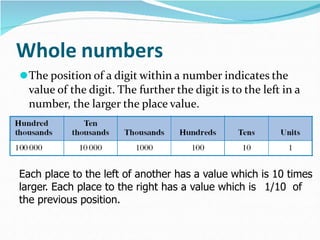
⚫The position of a digit within a number indicates the
value of the digit. The further the digit is to the left in a
number, the larger the place value.
Each place to the left of another has a value which is 10 times
larger. Each place to the right has a value which is 1/10 of
the previous position.
Decimal parts
Whole numbers have units as their smallest place value. It is
possible to keep going to smaller values than units. To show
values smaller than units, a decimal point, or dot, is placed
after the units.
We now want to extend this idea to the right of the units
place. Write a period to the right of the units place. This is
called the decimal point. Each digit to the right of that
decimal point will represent a fraction whose denominator
is a power of 10. The first place to the right of the
decimal point is the tenths place.
Decimal parts
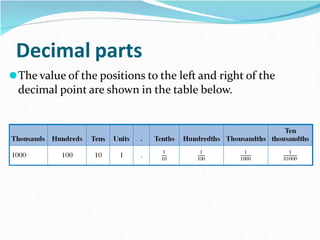
⚫The value of the positions to the left and right of the
decimal point are shown in the table below.
Definition
⚫A decimal fraction is a fraction whose
denominator is 10, 100, 1000, or some
other power of 10.
Reading or Writing Decimals in Words
⚫Step 1 Read the digits to the left of the
decimal point as a whole number.
⚫Step 2 Read the decimal point as the word
“and.”
⚫Step 3 Read the digits to the right of the
decimal point as a whole number followed
by the place value of the rightmost digit.
Representing Decimals on the Number
Line
⚫We can represent decimals on a number
line as rational numbers. We divide each
unit of the number line into tenths,
hundredths, or thousandths, and then
we find the image point of the decimal.
Comparing and Ordering Decimals
⚫1. Make the number of decimal places
the same for each number, by adding
zeros.
⚫2. Ignore the decimal point.
⚫3. The greatest number is the greatest
decimal.
ADDITION OF DECIMALS
⚫1. Arrange the decimals vertically with the decimal
points lined up.
⚫2. Add extra zeros if necessary so that each addend
has the same number of decimal places.
⚫3. Add the digits with the same place value from
right to left, like natural numbers.
⚫4. Insert the decimal point directly below the
decimal points of the addends.
SUBTRACTION OF DECIMALS
⚫1. Write the decimals vertically and line up the
decimal points.
⚫2. Add extra zeros if necessary, so that each number
has the same number of decimal places.
⚫3. Subtract the digits with the same place value from
right to left, as for natural numbers. Borrow if
necessary.
⚫4. Insert the decimal point directly below the
decimal points of the numbers.
MULTIPLICATION OF DECIMALS
⚫1. Ignore the decimal points and multiply the decimals as
whole numbers.
⚫2. Add the number of decimal places in the two decimals.
The result is the number of decimal places in the
product.
⚫3. Insert the decimal point in the product so that it has
the correct number of decimal places.
DIVISION OF DECIMALS
⚫Dividing a Whole Number by a Whole Number
⚫To divide a whole number by another whole number,
where the quotient is not a natural number, divide as in
division of whole numbers and then place the decimal
point and the required zeros to dividend.
DIVISION OF DECIMALS
⚫Dividing a Decimal by a Whole Number
⚫1. Ignore the decimal point and divide the decimal like a
whole number.
⚫2. Add zeros to the dividend as necessary.
⚫3. Insert the decimal point in the quotient so that it has
the correct number of decimal places.
DIVISION OF DECIMALS
⚫Dividing a Decimal by a Decimal Number
⚫1. Make the divisor into a whole number by moving the
decimal point to the right. Count how many places the
decimal point moves.
⚫2. Move the decimal point in the dividend the same
number of places to the right. Add zeros to the right of the
dividend if necessary, before moving the decimal point.
⚫3. Follow the steps for dividing a decimal by a whole
number.
DIVISION OF DECIMALS
⚫Dividing a Whole Number by a Decimal Number
⚫1. Make the divisor into a whole number by moving the
decimal point to the right. Count how many places the
decimal point moves.
⚫2. Perform the division. Add zeros to the right of the
dividend if necessary.
⚫3. Move the decimal point in the quotient the same
number of places to the right.
RELATIONSHIP BETWEEN FRACTIONS AND
DECIMAL NUMBERS
⚫Terminating Decimals
When we divide the numerator of a fraction by the
denominator, we obtain a decimal. If the decimal has
a finite number of decimal places, we call it a
terminating decimal.
To convert a terminating decimal to
a fraction, follow the steps.
⚫1. Ignore the decimal point and write
the number.
⚫2. Draw the fraction bar.
⚫3. Write power of 10 to the denominator.
The number of 0’s is as many as the
decimal digits.
⚫4. Simplify the fraction.
⚫Repeating Decimals
If a decimal has a fractional part whose digits repeat
endlessly, we call it a repeating decimal.
RELATIONSHIP BETWEEN FRACTIONS AND
DECIMAL NUMBERS
To convert a repeating decimal to a
fraction, follow the steps.
⚫1. Write the number without the decimal point.
⚫2. Subtract the non-repeating part from this
number.
⚫3. Write the difference as the numerator of the
fraction.
⚫4. Write the denominator as a sequence of 9’s and
zeros. The number of 9’s is as many as the number
of repeating digits of the fraction part. The
number of zeros is as many as the number of non-
repeating digits of the fraction part.
⚫5. Simplify the fraction.

decimals-110726084207-phpapp01.pptx

  • 1.
  • 2.
    Whole numbers ⚫The positionof a digit within a number indicates the value of the digit. The further the digit is to the left in a number, the larger the place value. Each place to the left of another has a value which is 10 times larger. Each place to the right has a value which is 1/10 of the previous position.
  • 3.
    Decimal parts Whole numbershave units as their smallest place value. It is possible to keep going to smaller values than units. To show values smaller than units, a decimal point, or dot, is placed after the units. We now want to extend this idea to the right of the units place. Write a period to the right of the units place. This is called the decimal point. Each digit to the right of that decimal point will represent a fraction whose denominator is a power of 10. The first place to the right of the decimal point is the tenths place.
  • 4.
    Decimal parts ⚫The valueof the positions to the left and right of the decimal point are shown in the table below.
  • 5.
    Definition ⚫A decimal fractionis a fraction whose denominator is 10, 100, 1000, or some other power of 10.
  • 6.
    Reading or WritingDecimals in Words ⚫Step 1 Read the digits to the left of the decimal point as a whole number. ⚫Step 2 Read the decimal point as the word “and.” ⚫Step 3 Read the digits to the right of the decimal point as a whole number followed by the place value of the rightmost digit.
  • 7.
    Representing Decimals onthe Number Line ⚫We can represent decimals on a number line as rational numbers. We divide each unit of the number line into tenths, hundredths, or thousandths, and then we find the image point of the decimal.
  • 8.
    Comparing and OrderingDecimals ⚫1. Make the number of decimal places the same for each number, by adding zeros. ⚫2. Ignore the decimal point. ⚫3. The greatest number is the greatest decimal.
  • 9.
    ADDITION OF DECIMALS ⚫1.Arrange the decimals vertically with the decimal points lined up. ⚫2. Add extra zeros if necessary so that each addend has the same number of decimal places. ⚫3. Add the digits with the same place value from right to left, like natural numbers. ⚫4. Insert the decimal point directly below the decimal points of the addends.
  • 10.
    SUBTRACTION OF DECIMALS ⚫1.Write the decimals vertically and line up the decimal points. ⚫2. Add extra zeros if necessary, so that each number has the same number of decimal places. ⚫3. Subtract the digits with the same place value from right to left, as for natural numbers. Borrow if necessary. ⚫4. Insert the decimal point directly below the decimal points of the numbers.
  • 11.
    MULTIPLICATION OF DECIMALS ⚫1.Ignore the decimal points and multiply the decimals as whole numbers. ⚫2. Add the number of decimal places in the two decimals. The result is the number of decimal places in the product. ⚫3. Insert the decimal point in the product so that it has the correct number of decimal places.
  • 12.
    DIVISION OF DECIMALS ⚫Dividinga Whole Number by a Whole Number ⚫To divide a whole number by another whole number, where the quotient is not a natural number, divide as in division of whole numbers and then place the decimal point and the required zeros to dividend.
  • 13.
    DIVISION OF DECIMALS ⚫Dividinga Decimal by a Whole Number ⚫1. Ignore the decimal point and divide the decimal like a whole number. ⚫2. Add zeros to the dividend as necessary. ⚫3. Insert the decimal point in the quotient so that it has the correct number of decimal places.
  • 14.
    DIVISION OF DECIMALS ⚫Dividinga Decimal by a Decimal Number ⚫1. Make the divisor into a whole number by moving the decimal point to the right. Count how many places the decimal point moves. ⚫2. Move the decimal point in the dividend the same number of places to the right. Add zeros to the right of the dividend if necessary, before moving the decimal point. ⚫3. Follow the steps for dividing a decimal by a whole number.
  • 15.
    DIVISION OF DECIMALS ⚫Dividinga Whole Number by a Decimal Number ⚫1. Make the divisor into a whole number by moving the decimal point to the right. Count how many places the decimal point moves. ⚫2. Perform the division. Add zeros to the right of the dividend if necessary. ⚫3. Move the decimal point in the quotient the same number of places to the right.
  • 16.
    RELATIONSHIP BETWEEN FRACTIONSAND DECIMAL NUMBERS ⚫Terminating Decimals When we divide the numerator of a fraction by the denominator, we obtain a decimal. If the decimal has a finite number of decimal places, we call it a terminating decimal.
  • 17.
    To convert aterminating decimal to a fraction, follow the steps. ⚫1. Ignore the decimal point and write the number. ⚫2. Draw the fraction bar. ⚫3. Write power of 10 to the denominator. The number of 0’s is as many as the decimal digits. ⚫4. Simplify the fraction.
  • 18.
    ⚫Repeating Decimals If adecimal has a fractional part whose digits repeat endlessly, we call it a repeating decimal. RELATIONSHIP BETWEEN FRACTIONS AND DECIMAL NUMBERS
  • 19.
    To convert arepeating decimal to a fraction, follow the steps. ⚫1. Write the number without the decimal point. ⚫2. Subtract the non-repeating part from this number. ⚫3. Write the difference as the numerator of the fraction. ⚫4. Write the denominator as a sequence of 9’s and zeros. The number of 9’s is as many as the number of repeating digits of the fraction part. The number of zeros is as many as the number of non- repeating digits of the fraction part. ⚫5. Simplify the fraction.