PRAYER
Dear Heavenly Father.
Aswe look forward to this beautiful day, we, sincerely express our gratitude that we have access to a
great education that will enable us to acquire and embody knowledge.
We pray that we may form meaningful camaraderie with my classmates and fellow students at City
University of Pasay.
We pray that you grant us the courage to follow righteous path all throughout our report presentation
today. Please grant us wisdom to respect our school administrators, teachers, non-teaching personnel
and fellow students; to appreciate the gift of life and most specially to practice the unparalleled
discipline.
Finally, allow us to express our gratitude to our parents, family members, guardians and teachers for
molding us to be virtuous individuals. Amen.
3.
Identify thecomponents of cytoskeleton.
Explain the role of the cytoskeleton in maintaining cell
shape and enabling movement.
Analyze the mechanisms of intracellular transport mediated
by motor proteins.
Discuss the relationship between cytoskeleton dysfunction
and diseases.
Perform experiments to observe cytoskeleton dynamics in
live cells.
OBJECTIVES
Size: 15to 25 nm.
Made of tubulin protein
Hollow tube with a wall
of 13 protofilaments
Alpha and Beta tubulin.
Function: vesicular
transport
Essential for mitotic
spindle formation
during cell division.
MICROTUBUL
ES
7.
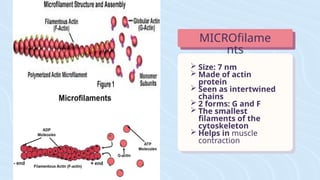
Size: 7nm
Made of actin
protein
Seen as intertwined
chains
2 forms: G and F
The smallest
filaments of the
cytoskeleton
Helps in muscle
contraction
MICROfilame
nts
8.
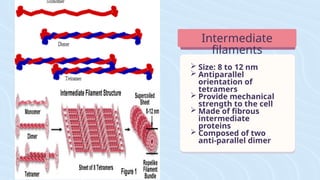
Size: 8to 12 nm
Antiparallel
orientation of
tetramers
Provide mechanical
strength to the cell
Made of fibrous
intermediate
proteins
Composed of two
anti-parallel dimer
Intermediate
filaments
9.
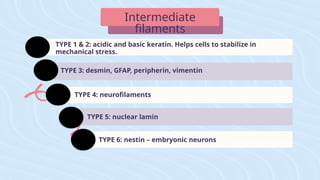
TYPE 1 &2: acidic and basic keratin. Helps cells to stabilize in
mechanical stress.
Intermediate
filaments
TYPE 3: desmin, GFAP, peripherin, vimentin
TYPE 4: neurofilaments
TYPE 5: nuclear lamin
TYPE 6: nestin – embryonic neurons
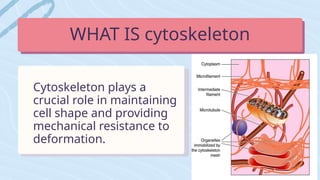
The cytoskeletonserves as the internal framework of the
cell.
The microfilaments network (often concentrated beneath
the plasma membrane as the actin cortex) provides
mechanical support and defines cell’s periphery.
Intermediate filaments contribute with tensile strength,
making the cell capable of withstanding mechanical stress.
Microtubules help in sustaining cell shape by resisting
compression and organizing the placement of organelles.
Maintaining cell shape
12.
Microfilaments andmicrotubules contribute to different
types of movement.
Examples: crawling of immune cells, contraction of muscle
cells and movement of cilia and flagella.
The cytoskeleton also plays a role in intracellular movement
of vesicles and organelles
Assists in cellular processes like endocytosis and exocytosis,
allowing cells to respond to their environment.
Plays a role in would healing and tissue regeneration by
guiding cell migration.
cell movement
Cells relyon efficient transport to move organelles, vesicles
and proteins.
The cytoskeleton acts as a transport highway with motor
proteins as carriers.
It is essential for
Cell division – Moves chromosomes and organelles.
Neuro function – Transports neurotransmitters in neurons
Immune response – Moves vesicles for signaling and
pathogen defense.
INTRACELLULAR TRANSPORT
15.
MOTOR PROTEINS
Motor proteinsfacilitate movement
within eukaryotic cells by acting on
the cytoskeleton and converting
chemical energy into mechanical
work.
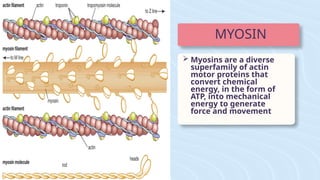
Myosins area diverse
superfamily of actin
motor proteins that
convert chemical
energy, in the form of
ATP, into mechanical
energy to generate
force and movement
MYOSIN
18.
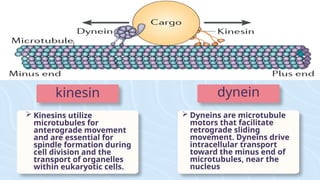
kinesin
Kinesins utilize
microtubulesfor
anterograde movement
and are essential for
spindle formation during
cell division and the
transport of organelles
within eukaryotic cells.
dynein
Dyneins are microtubule
motors that facilitate
retrograde sliding
movement. Dyneins drive
intracellular transport
toward the minus end of
microtubules, near the
nucleus
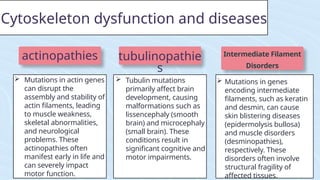
Cytoskeleton dysfunction anddiseases
Mutations in genes
encoding intermediate
filaments, such as keratin
and desmin, can cause
skin blistering diseases
(epidermolysis bullosa)
and muscle disorders
(desminopathies),
respectively. These
disorders often involve
structural fragility of
affected tissues.
actinopathies tubulinopathie
s
Intermediate Filament
Disorders
Mutations in actin genes
can disrupt the
assembly and stability of
actin filaments, leading
to muscle weakness,
skeletal abnormalities,
and neurological
problems. These
actinopathies often
manifest early in life and
can severely impact
motor function.
Tubulin mutations
primarily affect brain
development, causing
malformations such as
lissencephaly (smooth
brain) and microcephaly
(small brain). These
conditions result in
significant cognitive and
motor impairments.
21.
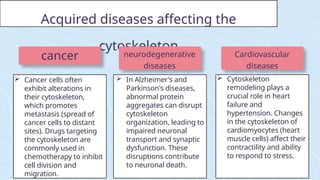
Acquired diseases affectingthe
cytoskeleton
Cancer cells often
exhibit alterations in
their cytoskeleton,
which promotes
metastasis (spread of
cancer cells to distant
sites). Drugs targeting
the cytoskeleton are
commonly used in
chemotherapy to inhibit
cell division and
migration.
In Alzheimer's and
Parkinson's diseases,
abnormal protein
aggregates can disrupt
cytoskeleton
organization, leading to
impaired neuronal
transport and synaptic
dysfunction. These
disruptions contribute
to neuronal death.
Cytoskeleton
remodeling plays a
crucial role in heart
failure and
hypertension. Changes
in the cytoskeleton of
cardiomyocytes (heart
muscle cells) affect their
contractility and ability
to respond to stress.
cancer neurodegenerative
diseases
Cardiovascular
diseases
22.
Fluorescence Microscopy
Cytoskeletalproteins (actin, tubulin) are tagged with fluorescent dyes or Green
Fluorescent Protein (GFP).
This makes microfilaments and microtubules glow under a microscope, allowing real-
time observation.
Live-Cell Imaging
Scientists take time-lapse videos of cytoskeletal changes to see how they rearrange
and move over time.Used to study cell migration, mitosis, and intracellular transport.
Drug Treatments to Observe Effects
Certain drugs are used to disrupt cytoskeleton function and analyze its role:
Nocodazole – Destroys microtubules (used to study transport and mitosis).
Cytochalasin D – Prevents actin polymerization (used to study cell movement).
How scientist study the
cytoskeleton in live cells












![3Cytoskeleton2021 [Autosaved].pdf3Cytoskeleton2021 [Autosaved].pdf3Cytoskelet...](https://cdn.slidesharecdn.com/ss_thumbnails/3cytoskeleton2021autosaved-251207180353-483508e8-thumbnail.jpg?width=640&height=640&fit=bounds)


