Math
Riddles
Question1:
What 3 positive numbers give the
same result when multiplied and
added together?
Answer: 1, 2, and 3.
Question2:
Mr. Smith has two children. If the
older child is a boy, what are the odds
that the other child is also a boy?
Answer: 50 percent.
Question3:
What number do you get when you
multiply all of the numbers on a
telephone's number pad?
Answer: 0.
Math
Trivia’s
Question#1
Is 45 a prime number?
Answer: No
Question#2
What is the degree of a triangle?
Answer: 180
Question#3
What number does "giga" stand for?
Answer: One billion.
Math
Jokes
Question#1
What do you call a number that can’t keep
still?
Answer: A roamin’ numeral.
Question#2
Why do mathematicians like parks?
Answer: Because of all the natural
logs.
Mathematician
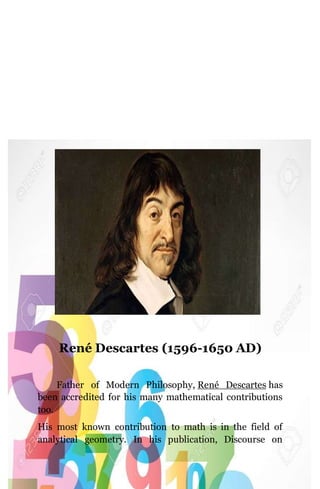
René Descartes (1596-1650 AD)
Father of Modern Philosophy, René Descartes has
been accredited for his many mathematical contributions
too.
His most known contribution to math is in the field of
analytical geometry. In his publication, Discourse on
Method (Discours de la methode), specifically its
appendices on La Geometrie achieved a milestone in
compiling the history of mathematics. Moreover, the book
also introduced standard algebraic notation, use of
lowercase a, b and c for known quantities and x, y and z for
unknown quantities.
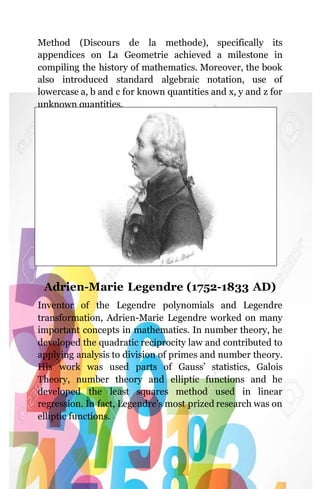
Adrien-Marie Legendre (1752-1833 AD)
Inventor of the Legendre polynomials and Legendre
transformation, Adrien-Marie Legendre worked on many
important concepts in mathematics. In number theory, he
developed the quadratic reciprocity law and contributed to
applying analysis to division of primes and number theory.
His work was used parts of Gauss’ statistics, Galois
Theory, number theory and elliptic functions and he
developed the least squares method used in linear
regression. In fact, Legendre’s most prized research was on
elliptic functions.
Legendre received an award for his mathematical
contribution by the Berlin Academy, was a Fellow of the
Royal Society and officer of Legion d’Honneur.
Answers:
Riddles
Question 1 - Answer: 1, 2, and 3
Question 2 - Answer: 50 percent
Question 3 - Answer: 0
Riddles
Math
Riddles
Question#1
How many 9′s are there between 1 and 100?
Answer: 20
9, 19, 29, 39, 49, 59, 69, 79, 89, 90, 91, 92,
93, 94, 95, 96, 97, 98, 99
Question#2
Find three positive whole numbers that
have the same answer added together or
when multiplied together.
Answer:
1,2, & 3
1 x 2 x 3 = 6 and 1 + 2 + 3 = 6
Question#3
Divide 110 into two parts so that one will be
150 percent of the other. What are the 2
numbers?
Answer:
44 and 66
Math
Trivia’s
Question#1
What word describes a number system with
a base of two?
Answer: Binary.
Question#2
What century did mathematicians first use
plus and minus signs?
Answer: The sixteenth.
Question#3
What's a flat image that can be displayed in
three dimensions?
Answer: A hologram.
Math
Jokes
Question#1
Why do they never serve beer at a math
party?
Answer: Because you can't drink and
derive...
Question#2
Why is a math book always unhappy?
Answer: Because it always has lots of
problems.
Mathematician
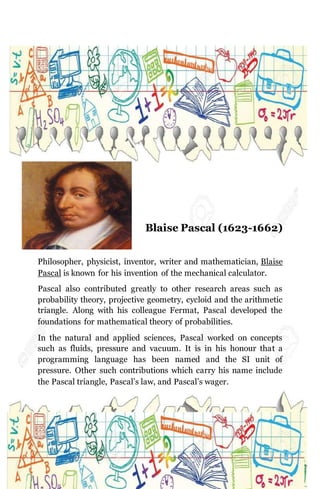
Blaise Pascal (1623-1662)
Philosopher, physicist, inventor, writer and mathematician, Blaise
Pascal is known for his invention of the mechanical calculator.
Pascal also contributed greatly to other research areas such as
probability theory, projective geometry, cycloid and the arithmetic
triangle. Along with his colleague Fermat, Pascal developed the
foundations for mathematical theory of probabilities.
In the natural and applied sciences, Pascal worked on concepts
such as fluids, pressure and vacuum. It is in his honour that a
programming language has been named and the SI unit of
pressure. Other such contributions which carry his name include
the Pascal triangle, Pascal’s law, and Pascal’s wager.
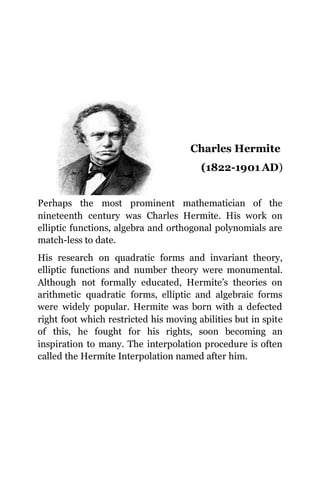
Charles Hermite
(1822-1901 AD)
Perhaps the most prominent mathematician of the
nineteenth century was Charles Hermite. His work on
elliptic functions, algebra and orthogonal polynomials are
match-less to date.
His research on quadratic forms and invariant theory,
elliptic functions and number theory were monumental.
Although not formally educated, Hermite’s theories on
arithmetic quadratic forms, elliptic and algebraic forms
were widely popular. Hermite was born with a defected
right foot which restricted his moving abilities but in spite
of this, he fought for his rights, soon becoming an
inspiration to many. The interpolation procedure is often
called the Hermite Interpolation named after him.

Math riddles

  • 1.
  • 2.
    Question1: What 3 positivenumbers give the same result when multiplied and added together? Answer: 1, 2, and 3.
  • 3.
    Question2: Mr. Smith hastwo children. If the older child is a boy, what are the odds that the other child is also a boy? Answer: 50 percent.
  • 4.
    Question3: What number doyou get when you multiply all of the numbers on a telephone's number pad? Answer: 0.
  • 5.
  • 6.
    Question#1 Is 45 aprime number? Answer: No
  • 7.
    Question#2 What is thedegree of a triangle? Answer: 180
  • 8.
    Question#3 What number does"giga" stand for? Answer: One billion.
  • 9.
  • 10.
    Question#1 What do youcall a number that can’t keep still? Answer: A roamin’ numeral.
  • 11.
    Question#2 Why do mathematicianslike parks? Answer: Because of all the natural logs.
  • 12.
  • 13.
    René Descartes (1596-1650AD) Father of Modern Philosophy, René Descartes has been accredited for his many mathematical contributions too. His most known contribution to math is in the field of analytical geometry. In his publication, Discourse on
  • 14.
    Method (Discours dela methode), specifically its appendices on La Geometrie achieved a milestone in compiling the history of mathematics. Moreover, the book also introduced standard algebraic notation, use of lowercase a, b and c for known quantities and x, y and z for unknown quantities. Adrien-Marie Legendre (1752-1833 AD) Inventor of the Legendre polynomials and Legendre transformation, Adrien-Marie Legendre worked on many important concepts in mathematics. In number theory, he developed the quadratic reciprocity law and contributed to applying analysis to division of primes and number theory. His work was used parts of Gauss’ statistics, Galois Theory, number theory and elliptic functions and he developed the least squares method used in linear regression. In fact, Legendre’s most prized research was on elliptic functions.
  • 15.
    Legendre received anaward for his mathematical contribution by the Berlin Academy, was a Fellow of the Royal Society and officer of Legion d’Honneur. Answers: Riddles Question 1 - Answer: 1, 2, and 3 Question 2 - Answer: 50 percent Question 3 - Answer: 0 Riddles
  • 16.
  • 17.
    Question#1 How many 9′sare there between 1 and 100? Answer: 20 9, 19, 29, 39, 49, 59, 69, 79, 89, 90, 91, 92, 93, 94, 95, 96, 97, 98, 99
  • 18.
    Question#2 Find three positivewhole numbers that have the same answer added together or when multiplied together. Answer:
  • 19.
    1,2, & 3 1x 2 x 3 = 6 and 1 + 2 + 3 = 6 Question#3 Divide 110 into two parts so that one will be 150 percent of the other. What are the 2 numbers? Answer: 44 and 66
  • 21.
  • 22.
    Question#1 What word describesa number system with a base of two? Answer: Binary.
  • 23.
    Question#2 What century didmathematicians first use plus and minus signs? Answer: The sixteenth.
  • 24.
    Question#3 What's a flatimage that can be displayed in three dimensions? Answer: A hologram.
  • 25.
  • 26.
    Question#1 Why do theynever serve beer at a math party? Answer: Because you can't drink and derive...
  • 27.
    Question#2 Why is amath book always unhappy? Answer: Because it always has lots of problems.
  • 28.
  • 29.
    Blaise Pascal (1623-1662) Philosopher,physicist, inventor, writer and mathematician, Blaise Pascal is known for his invention of the mechanical calculator. Pascal also contributed greatly to other research areas such as probability theory, projective geometry, cycloid and the arithmetic triangle. Along with his colleague Fermat, Pascal developed the foundations for mathematical theory of probabilities. In the natural and applied sciences, Pascal worked on concepts such as fluids, pressure and vacuum. It is in his honour that a programming language has been named and the SI unit of pressure. Other such contributions which carry his name include the Pascal triangle, Pascal’s law, and Pascal’s wager.
  • 30.
    Charles Hermite (1822-1901 AD) Perhapsthe most prominent mathematician of the nineteenth century was Charles Hermite. His work on elliptic functions, algebra and orthogonal polynomials are match-less to date. His research on quadratic forms and invariant theory, elliptic functions and number theory were monumental. Although not formally educated, Hermite’s theories on arithmetic quadratic forms, elliptic and algebraic forms were widely popular. Hermite was born with a defected right foot which restricted his moving abilities but in spite of this, he fought for his rights, soon becoming an inspiration to many. The interpolation procedure is often called the Hermite Interpolation named after him.