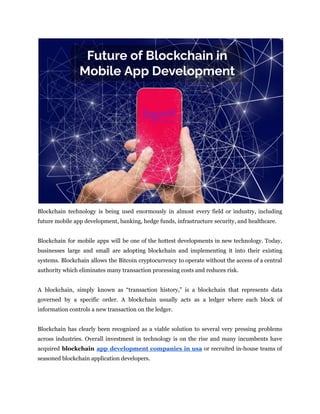
Blockchain technology is being used enormously in almost every field or industry, including
future mobile app development, banking, hedge funds, infrastructure security, and healthcare.
Blockchain for mobile apps will be one of the hottest developments in new technology. Today,
businesses large and small are adopting blockchain and implementing it into their existing
systems. Blockchain allows the Bitcoin cryptocurrency to operate without the access of a central
authority which eliminates many transaction processing costs and reduces risk.
A blockchain, simply known as “transaction history,” is a blockchain that represents data
governed by a specific order. A blockchain usually acts as a ledger where each block of
information controls a new transaction on the ledger.
Blockchain has clearly been recognized as a viable solution to several very pressing problems
across industries. Overall investment in technology is on the rise and many incumbents have
acquired blockchain app development companies in usa or recruited in-house teams of
seasoned blockchain application developers.
Blockchain technology:
A blockchain is a system that records information and makes it nearly impossible to hack,
modify, cheat or change technology.
It is replicated once and then distributed to all computers on the network. Every block consists
of several transactions. Each participant's ledger is updated with each transaction that occurs on
the blockchain. Distributed Ledger Technology or DLT is a participant-managed and distributed
database.
Blockchain is a digital ledger that allows businesses and individuals to conduct real-time
transactions over a network without intermediaries. Transactions made in Cryptocurrency are
completely secure and recorded. Powerful computer programming ensures that the validity
established in the blockchain will not change in real life.
Future of Blockchain in Mobile App Development:
1. Strict Security:
The top benefits of blockchain app development are increased security. Business databases,
especially in the financial services and insurance industries, are prone to attacks by hackers and
scammers. In a blockchain network, all transactions can be viewed by authenticated members
before being entered into the distributed ledger. Because information is stored on a chain of
computer systems rather than on a single server, data cannot be changed from a single point.
2. Unparalleled Transparency:
A blockchain is a decentralized distributed ledger where network participants have access to the
same data from all nodes, so data can only be updated or set up for further distribution after
consensus is achieved. Changing a single record on the same track requires changing all
subsequent records. It is a hallmark of an unchanging history that traditionally opaque
organizations like financial services and insurance welcome blockchain development as the next
big thing.
3. Enhanced information security:
Blockchain is famous for its impenetrable secrecy. By allowing developers to add an outermost
coating to their information and assigning private keys to consumers, it is virtually impossible
for anyone without a decrypted key to change a user's activity-specific data on and off the
network.
Also, because blockchain is a decentralized system, it maintains replicas of information across
computer systems, minimizing the risk of data leakage. Blockchain presents a fantastic
opportunity for mobile application developers to protect customer data from counterfeiting
and unauthorized activity in a world where hackers are plentiful and sensitive information is
difficult to protect.
4. Incremental Efficiency:
Blockchain avoids the need for intermediaries in the payment process, which has traditionally
been a complicated journey. Seamless payments can increase the efficiency of transactions in
regions where effective financial services are lacking. Similarly, asset management workflows
and contracts in the banking and insurance sectors can be rendered more efficiently with a
centralized system of recording ownership.
5. Digital Identification:
Insurance companies, banks, and other enterprises engage professional Android app
development company in California to create digital identity management apps. This
identity control is essential as government agencies, banks, academic institutions, and other
organizations rely on individuals' digital identities created using blockchain nodes. Now, each
transaction on a blockchain has unique characteristics and can be trusted, making it simple to
publicly or secretly register personally identifiable information on a public blockchain.
6. More secure mobile payments:
Blockchain for mobile apps offers contactless banking that is faster, safer, and much more
efficient due to its sophisticated and decentralized peer-to-peer infrastructure. Many
programmers are already leveraging the potential of peer-to-peer contactless banking in their
programs, making them safer and cheaper to create and manage.
Additionally, the possibility of access to hundreds of millions of devices or "nodes" precludes the
possibility of outages or outages, as it is unlikely that all endpoints will crash simultaneously.
Also, because blockchain is a decentralized system, it maintains replicas of information across
computer systems. Above all, with enhanced security, consumers can use the smartphone
website with greater confidence.
7. Improve product traceability:
iOS app developers in California can utilize blockchain for mobile apps to record all data
traceable by consumers in real time. The entire blockchain technology is structured so that any
flaws can be quickly identified and corrected. This helps developers verify asset validity and
prevents unnecessary fraudulent transaction formation and distortion of genuine data.
8. Organize data:
Blockchain technology provides a comprehensive data organization solution that allows data to
be stored and securely implemented on numerous chains. The custom blockchain architecture of
Android development services enhances security against possible threats.
9. Advertising model:
Users get paid in-app currency for the time they spend leveraging blockchain for mobile app
platforms that improve their advertising business. This cost-per-interest technique eliminates
the need for brokers or agents to share in sales revenue in the first place.
10. Reliability and speed:
One of the great features of distributed ledger technology is that it does not require a third-party
intermediary to conduct transactions. It simplifies and streamlines the entire process,
facilitating faster and more convenient transaction refunds. According to several sources,
blockchain-based operations are 10x faster than traditional bank exchanges.
Conclusion:
Here are some examples of how blockchain for mobile apps will impact mobile application
development. In summary, this groundbreaking innovation helps developers create highly
secure and accessible mobile apps and creates a world of tremendous possibilities for
programmers and end users alike.
Author Bio:
Hello everyone, I'm Gangadhar Chemudu. I’m a passionate content writer and SEO Executive
working in FuGenX Technologies. FuGenX is a mobile app development company in
USA, India, and the UAE. I am curious about the latest technological developments. For topics
related to mobile app development, IoT, Artificial Intelligence, machine learning, IOS, and
technology, contact me on LinkedIn.
Read also: cost to make health insurance app

Future of Blockchain in Mobile App Development.pdf

  • 1.
    Blockchain technology isbeing used enormously in almost every field or industry, including future mobile app development, banking, hedge funds, infrastructure security, and healthcare. Blockchain for mobile apps will be one of the hottest developments in new technology. Today, businesses large and small are adopting blockchain and implementing it into their existing systems. Blockchain allows the Bitcoin cryptocurrency to operate without the access of a central authority which eliminates many transaction processing costs and reduces risk. A blockchain, simply known as “transaction history,” is a blockchain that represents data governed by a specific order. A blockchain usually acts as a ledger where each block of information controls a new transaction on the ledger. Blockchain has clearly been recognized as a viable solution to several very pressing problems across industries. Overall investment in technology is on the rise and many incumbents have acquired blockchain app development companies in usa or recruited in-house teams of seasoned blockchain application developers.
  • 2.
    Blockchain technology: A blockchainis a system that records information and makes it nearly impossible to hack, modify, cheat or change technology. It is replicated once and then distributed to all computers on the network. Every block consists of several transactions. Each participant's ledger is updated with each transaction that occurs on the blockchain. Distributed Ledger Technology or DLT is a participant-managed and distributed database. Blockchain is a digital ledger that allows businesses and individuals to conduct real-time transactions over a network without intermediaries. Transactions made in Cryptocurrency are completely secure and recorded. Powerful computer programming ensures that the validity established in the blockchain will not change in real life. Future of Blockchain in Mobile App Development: 1. Strict Security: The top benefits of blockchain app development are increased security. Business databases, especially in the financial services and insurance industries, are prone to attacks by hackers and scammers. In a blockchain network, all transactions can be viewed by authenticated members before being entered into the distributed ledger. Because information is stored on a chain of computer systems rather than on a single server, data cannot be changed from a single point. 2. Unparalleled Transparency: A blockchain is a decentralized distributed ledger where network participants have access to the same data from all nodes, so data can only be updated or set up for further distribution after consensus is achieved. Changing a single record on the same track requires changing all subsequent records. It is a hallmark of an unchanging history that traditionally opaque organizations like financial services and insurance welcome blockchain development as the next big thing.
  • 3.
    3. Enhanced informationsecurity: Blockchain is famous for its impenetrable secrecy. By allowing developers to add an outermost coating to their information and assigning private keys to consumers, it is virtually impossible for anyone without a decrypted key to change a user's activity-specific data on and off the network. Also, because blockchain is a decentralized system, it maintains replicas of information across computer systems, minimizing the risk of data leakage. Blockchain presents a fantastic opportunity for mobile application developers to protect customer data from counterfeiting and unauthorized activity in a world where hackers are plentiful and sensitive information is difficult to protect. 4. Incremental Efficiency: Blockchain avoids the need for intermediaries in the payment process, which has traditionally been a complicated journey. Seamless payments can increase the efficiency of transactions in regions where effective financial services are lacking. Similarly, asset management workflows and contracts in the banking and insurance sectors can be rendered more efficiently with a centralized system of recording ownership. 5. Digital Identification: Insurance companies, banks, and other enterprises engage professional Android app development company in California to create digital identity management apps. This identity control is essential as government agencies, banks, academic institutions, and other organizations rely on individuals' digital identities created using blockchain nodes. Now, each transaction on a blockchain has unique characteristics and can be trusted, making it simple to publicly or secretly register personally identifiable information on a public blockchain. 6. More secure mobile payments: Blockchain for mobile apps offers contactless banking that is faster, safer, and much more efficient due to its sophisticated and decentralized peer-to-peer infrastructure. Many
  • 4.
    programmers are alreadyleveraging the potential of peer-to-peer contactless banking in their programs, making them safer and cheaper to create and manage. Additionally, the possibility of access to hundreds of millions of devices or "nodes" precludes the possibility of outages or outages, as it is unlikely that all endpoints will crash simultaneously. Also, because blockchain is a decentralized system, it maintains replicas of information across computer systems. Above all, with enhanced security, consumers can use the smartphone website with greater confidence. 7. Improve product traceability: iOS app developers in California can utilize blockchain for mobile apps to record all data traceable by consumers in real time. The entire blockchain technology is structured so that any flaws can be quickly identified and corrected. This helps developers verify asset validity and prevents unnecessary fraudulent transaction formation and distortion of genuine data. 8. Organize data: Blockchain technology provides a comprehensive data organization solution that allows data to be stored and securely implemented on numerous chains. The custom blockchain architecture of Android development services enhances security against possible threats. 9. Advertising model: Users get paid in-app currency for the time they spend leveraging blockchain for mobile app platforms that improve their advertising business. This cost-per-interest technique eliminates the need for brokers or agents to share in sales revenue in the first place. 10. Reliability and speed: One of the great features of distributed ledger technology is that it does not require a third-party intermediary to conduct transactions. It simplifies and streamlines the entire process, facilitating faster and more convenient transaction refunds. According to several sources, blockchain-based operations are 10x faster than traditional bank exchanges.
  • 5.
    Conclusion: Here are someexamples of how blockchain for mobile apps will impact mobile application development. In summary, this groundbreaking innovation helps developers create highly secure and accessible mobile apps and creates a world of tremendous possibilities for programmers and end users alike. Author Bio: Hello everyone, I'm Gangadhar Chemudu. I’m a passionate content writer and SEO Executive working in FuGenX Technologies. FuGenX is a mobile app development company in USA, India, and the UAE. I am curious about the latest technological developments. For topics related to mobile app development, IoT, Artificial Intelligence, machine learning, IOS, and technology, contact me on LinkedIn. Read also: cost to make health insurance app