Newsletter – December 2013

Industry Insights
Respondents to our survey in June of 2013 commented on the reasons for the significant decline in
productivity within the mining industry. Overwhelmingly they identified poor leadership as the primary
reason for declining productivity. Our most recent survey in October was designed to delve deeper into the
leadership issue.
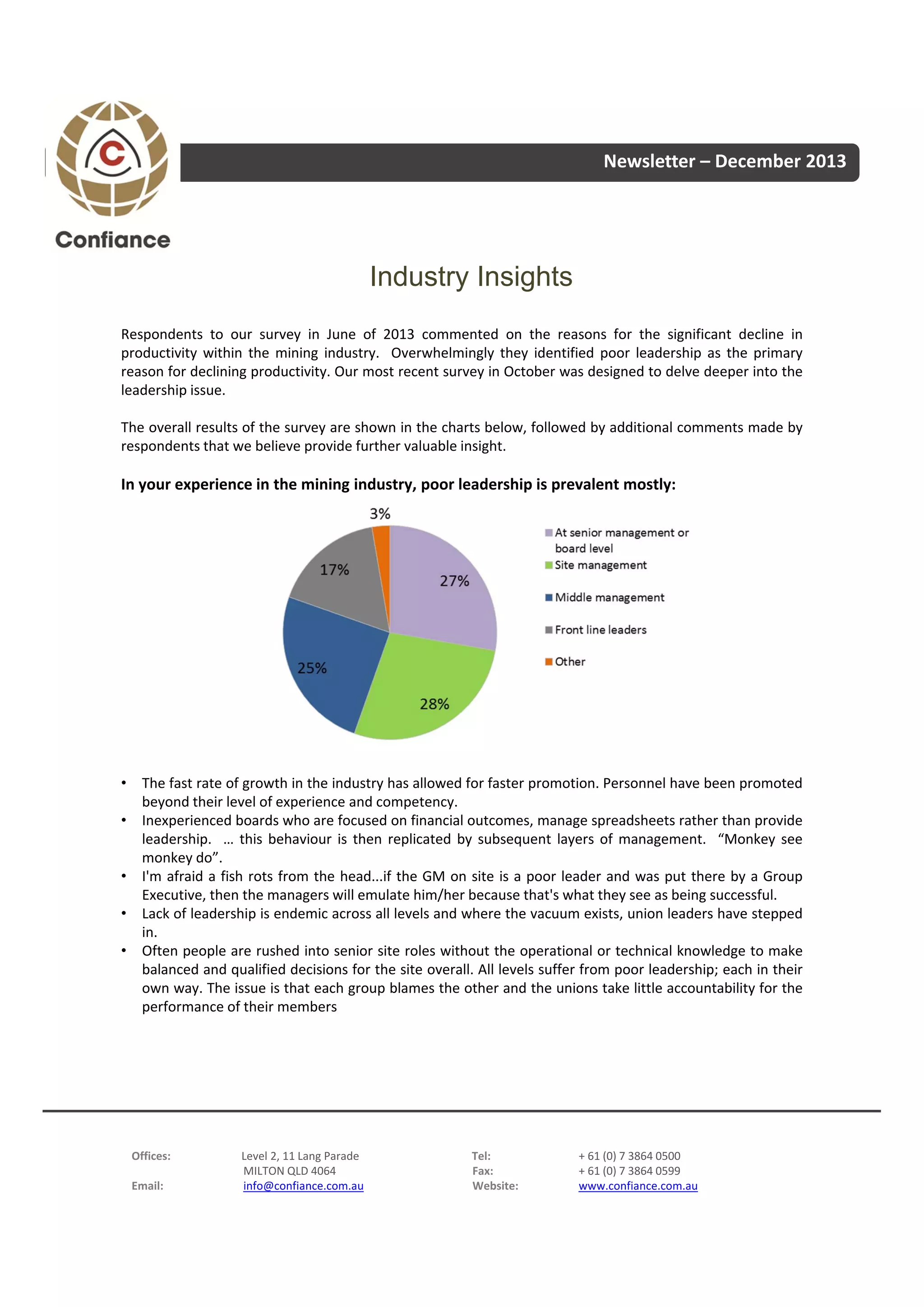
The overall results of the survey are shown in the charts below, followed by additional comments made by
respondents that we believe provide further valuable insight.

In your experience in the mining industry, poor leadership is prevalent mostly:

• The fast rate of growth in the industry has allowed for faster promotion. Personnel have been promoted
beyond their level of experience and competency.
• Inexperienced boards who are focused on financial outcomes, manage spreadsheets rather than provide
leadership. … this behaviour is then replicated by subsequent layers of management. “Monkey see
monkey do”.
• I'm afraid a fish rots from the head...if the GM on site is a poor leader and was put there by a Group
Executive, then the managers will emulate him/her because that's what they see as being successful.
• Lack of leadership is endemic across all levels and where the vacuum exists, union leaders have stepped
in.
• Often people are rushed into senior site roles without the operational or technical knowledge to make
balanced and qualified decisions for the site overall. All levels suffer from poor leadership; each in their
own way. The issue is that each group blames the other and the unions take little accountability for the
performance of their members

Offices:
Email:

Level 2, 11 Lang Parade
MILTON QLD 4064
info@confiance.com.au

Tel:
Fax:
Website:

+ 61 (0) 7 3864 0500
+ 61 (0) 7 3864 0599
www.confiance.com.au
Newsletter – December 2013

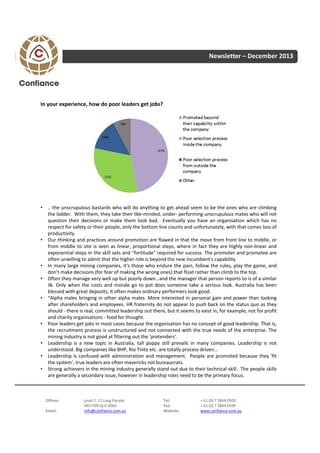
In your experience, how do poor leaders get jobs?

• .. the unscrupulous bastards who will do anything to get ahead seem to be the ones who are climbing
the ladder. With them, they take their like‐minded, under‐ performing unscrupulous mates who will not
question their decisions or make them look bad. Eventually you have an organisation which has no
respect for safety or their people, only the bottom line counts and unfortunately, with that comes loss of
productivity.
• Our thinking and practices around promotion are flawed in that the move from front line to middle, or
from middle to site is seen as linear, proportional steps, where in fact they are highly non‐linear and
exponential steps in the skill sets and "fortitude" required for success. The promoter and promotee are
often unwilling to admit that the higher role is beyond the new incumbent's capability.
• In many large mining companies, it's those who endure the pain, follow the rules, play the game, and
don't make decisions (for fear of making the wrong ones) that float rather than climb to the top.
• Often they manage very well up but poorly down...and the manager that person reports to is of a similar
ilk. Only when the costs and morale go to pot does someone take a serious look. Australia has been
blessed with great deposits, it often makes ordinary performers look good.
• “Alpha males bringing in other alpha males. More interested in personal gain and power than looking
after shareholders and employees. HR fraternity do not appear to push back on the status quo as they
should ‐ there is real, committed leadership out there, but it seems to exist in, for example, not for profit
and charity organisations ‐ food for thought.
• Poor leaders get jobs in most cases because the organisation has no concept of good leadership. That is,
the recruitment process is unstructured and not connected with the true needs of the enterprise. The
mining industry is not good at filtering out the 'pretenders'.
• Leadership is a new topic in Australia, tall poppy still prevails in many companies. Leadership is not
understood. Big companies like BHP, Rio Tinto etc. are totally process driven...
• Leadership is confused with administration and management. People are promoted because they 'fit
the system', true leaders are often mavericks not bureaucrats.
• Strong achievers in the mining industry generally stand out due to their technical skill. The people skills
are generally a secondary issue, however in leadership roles need to be the primary focus.

Offices:
Email:

Level 2, 11 Lang Parade
MILTON QLD 4064
info@confiance.com.au

Tel:
Fax:
Website:

+ 61 (0) 7 3864 0500
+ 61 (0) 7 3864 0599
www.confiance.com.au
Newsletter – December 2013

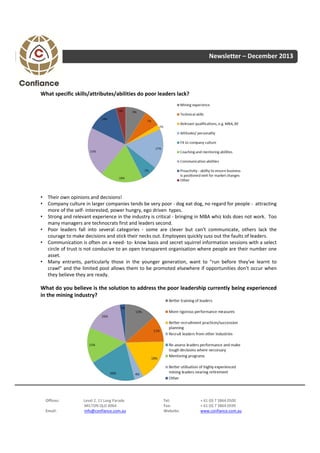
What specific skills/attributes/abilities do poor leaders lack?

• Their own opinions and decisions!
• Company culture in larger companies tends be very poor ‐ dog eat dog, no regard for people ‐ attracting
more of the self‐ interested, power hungry, ego driven types.
• Strong and relevant experience in the industry is critical ‐ bringing in MBA whiz kids does not work. Too
many managers are technocrats first and leaders second.
• Poor leaders fall into several categories ‐ some are clever but can't communicate, others lack the
courage to make decisions and stick their necks out. Employees quickly suss out the faults of leaders.
• Communication is often on a need‐ to‐ know basis and secret squirrel information sessions with a select
circle of trust is not conducive to an open transparent organisation where people are their number one
asset.
• Many entrants, particularly those in the younger generation, want to "run before they've learnt to
crawl" and the limited pool allows them to be promoted elsewhere if opportunities don't occur when
they believe they are ready.

What do you believe is the solution to address the poor leadership currently being experienced
in the mining industry?

Offices:
Email:

Level 2, 11 Lang Parade
MILTON QLD 4064
info@confiance.com.au

Tel:
Fax:
Website:

+ 61 (0) 7 3864 0500
+ 61 (0) 7 3864 0599
www.confiance.com.au
Newsletter – December 2013

• True Accountability
• My experience is that leadership has been hijacked & mystified by academics and consultants. It's not
magic, it's the work of getting things done through other people. Some are naturally good at it, some are
not (like any other human activity).
• So, identify roles which carry significant leadership accountability, define what it specifically means for
the work of people in those roles of the organisation, then develop or secure the capability to do it. This
by the way, is not HR's work.
• Four steps
1. Make the right selection for the leadership role (consciously deciding if you want somebody who is
plug & play or someone who has potential but needs development).
2. Ensure that there is support and mentoring for the leader as required ‐ particularly for a selection
where there is potential but a need to develop the person into the role.
3. Set clear expectations for performance and measure against those with regular feedback and
coaching.
4. Make the hard decision if necessary.
• The use of ‘grey hairs’ is a very significant resource that should be exploited for leadership role models
and mentors.
• Life experiences and the attitude that people are really the key to great success rather than a spread
sheet which is fudged to get the right short term outcomes.
• While we have a Life of Mine Plan for technical and operational activities, we should have a Life of Mine
for leadership and people …
• Use of highly experienced leaders outside of mining to focus on the soft skills.
• Senior Management Bonus Schemes are often not aligned to business sustainability or performance.
Hard to get right, and many KPI's are short term and easy to manipulate. This can lead to leaders
managing their Bonus KPI's rather than managing the Business. Perhaps better to decrease the relative
size of Bonus payments to base remuneration. Reward with retention and don't muck around with non‐
performers. Include employee turnover as a KPI: disillusionment walks.
• I think the rapid growth in the industry and lack of true succession planning has given the industry this
problem. There has also been an attitude/cultural shift with the younger leaders in that they expect too
much too quickly and do not want to live on remote sites.
Well, it seems our readers don’t mind getting off the fence on issues close to the bone. I don’t disagree with
any of these comments however I do think leadership roles in this industry have become increasingly more
complex and expectations on leaders have risen exponentially. And we don’t see the corresponding
increment in development and support. Nor do we see any attempt in this current downturn to preserve
the extraordinary talents and experience the industry has built over decades. Mining is parochial but
bringing in some experienced capable leadership from outside might just be the fresh air needed to shift
the paradigm.
Joanne Westh
December 2013

Offices:
Email:

Level 2, 11 Lang Parade
MILTON QLD 4064
info@confiance.com.au

Tel:
Fax:
Website:

+ 61 (0) 7 3864 0500
+ 61 (0) 7 3864 0599
www.confiance.com.au

December 2013- Industry Insights - Leadership survey

  • 1.
    Newsletter – December 2013 Industry Insights Respondentsto our survey in June of 2013 commented on the reasons for the significant decline in productivity within the mining industry. Overwhelmingly they identified poor leadership as the primary reason for declining productivity. Our most recent survey in October was designed to delve deeper into the leadership issue. The overall results of the survey are shown in the charts below, followed by additional comments made by respondents that we believe provide further valuable insight. In your experience in the mining industry, poor leadership is prevalent mostly: • The fast rate of growth in the industry has allowed for faster promotion. Personnel have been promoted beyond their level of experience and competency. • Inexperienced boards who are focused on financial outcomes, manage spreadsheets rather than provide leadership. … this behaviour is then replicated by subsequent layers of management. “Monkey see monkey do”. • I'm afraid a fish rots from the head...if the GM on site is a poor leader and was put there by a Group Executive, then the managers will emulate him/her because that's what they see as being successful. • Lack of leadership is endemic across all levels and where the vacuum exists, union leaders have stepped in. • Often people are rushed into senior site roles without the operational or technical knowledge to make balanced and qualified decisions for the site overall. All levels suffer from poor leadership; each in their own way. The issue is that each group blames the other and the unions take little accountability for the performance of their members Offices: Email: Level 2, 11 Lang Parade MILTON QLD 4064 info@confiance.com.au Tel: Fax: Website: + 61 (0) 7 3864 0500 + 61 (0) 7 3864 0599 www.confiance.com.au
  • 2.
    Newsletter – December 2013 In your experience, how do poor leaders get jobs? • ..the unscrupulous bastards who will do anything to get ahead seem to be the ones who are climbing the ladder. With them, they take their like‐minded, under‐ performing unscrupulous mates who will not question their decisions or make them look bad. Eventually you have an organisation which has no respect for safety or their people, only the bottom line counts and unfortunately, with that comes loss of productivity. • Our thinking and practices around promotion are flawed in that the move from front line to middle, or from middle to site is seen as linear, proportional steps, where in fact they are highly non‐linear and exponential steps in the skill sets and "fortitude" required for success. The promoter and promotee are often unwilling to admit that the higher role is beyond the new incumbent's capability. • In many large mining companies, it's those who endure the pain, follow the rules, play the game, and don't make decisions (for fear of making the wrong ones) that float rather than climb to the top. • Often they manage very well up but poorly down...and the manager that person reports to is of a similar ilk. Only when the costs and morale go to pot does someone take a serious look. Australia has been blessed with great deposits, it often makes ordinary performers look good. • “Alpha males bringing in other alpha males. More interested in personal gain and power than looking after shareholders and employees. HR fraternity do not appear to push back on the status quo as they should ‐ there is real, committed leadership out there, but it seems to exist in, for example, not for profit and charity organisations ‐ food for thought. • Poor leaders get jobs in most cases because the organisation has no concept of good leadership. That is, the recruitment process is unstructured and not connected with the true needs of the enterprise. The mining industry is not good at filtering out the 'pretenders'. • Leadership is a new topic in Australia, tall poppy still prevails in many companies. Leadership is not understood. Big companies like BHP, Rio Tinto etc. are totally process driven... • Leadership is confused with administration and management. People are promoted because they 'fit the system', true leaders are often mavericks not bureaucrats. • Strong achievers in the mining industry generally stand out due to their technical skill. The people skills are generally a secondary issue, however in leadership roles need to be the primary focus. Offices: Email: Level 2, 11 Lang Parade MILTON QLD 4064 info@confiance.com.au Tel: Fax: Website: + 61 (0) 7 3864 0500 + 61 (0) 7 3864 0599 www.confiance.com.au
  • 3.
    Newsletter – December 2013 What specific skills/attributes/abilities do poor leaders lack? • Theirown opinions and decisions! • Company culture in larger companies tends be very poor ‐ dog eat dog, no regard for people ‐ attracting more of the self‐ interested, power hungry, ego driven types. • Strong and relevant experience in the industry is critical ‐ bringing in MBA whiz kids does not work. Too many managers are technocrats first and leaders second. • Poor leaders fall into several categories ‐ some are clever but can't communicate, others lack the courage to make decisions and stick their necks out. Employees quickly suss out the faults of leaders. • Communication is often on a need‐ to‐ know basis and secret squirrel information sessions with a select circle of trust is not conducive to an open transparent organisation where people are their number one asset. • Many entrants, particularly those in the younger generation, want to "run before they've learnt to crawl" and the limited pool allows them to be promoted elsewhere if opportunities don't occur when they believe they are ready. What do you believe is the solution to address the poor leadership currently being experienced in the mining industry? Offices: Email: Level 2, 11 Lang Parade MILTON QLD 4064 info@confiance.com.au Tel: Fax: Website: + 61 (0) 7 3864 0500 + 61 (0) 7 3864 0599 www.confiance.com.au
  • 4.
    Newsletter – December 2013 • TrueAccountability • My experience is that leadership has been hijacked & mystified by academics and consultants. It's not magic, it's the work of getting things done through other people. Some are naturally good at it, some are not (like any other human activity). • So, identify roles which carry significant leadership accountability, define what it specifically means for the work of people in those roles of the organisation, then develop or secure the capability to do it. This by the way, is not HR's work. • Four steps 1. Make the right selection for the leadership role (consciously deciding if you want somebody who is plug & play or someone who has potential but needs development). 2. Ensure that there is support and mentoring for the leader as required ‐ particularly for a selection where there is potential but a need to develop the person into the role. 3. Set clear expectations for performance and measure against those with regular feedback and coaching. 4. Make the hard decision if necessary. • The use of ‘grey hairs’ is a very significant resource that should be exploited for leadership role models and mentors. • Life experiences and the attitude that people are really the key to great success rather than a spread sheet which is fudged to get the right short term outcomes. • While we have a Life of Mine Plan for technical and operational activities, we should have a Life of Mine for leadership and people … • Use of highly experienced leaders outside of mining to focus on the soft skills. • Senior Management Bonus Schemes are often not aligned to business sustainability or performance. Hard to get right, and many KPI's are short term and easy to manipulate. This can lead to leaders managing their Bonus KPI's rather than managing the Business. Perhaps better to decrease the relative size of Bonus payments to base remuneration. Reward with retention and don't muck around with non‐ performers. Include employee turnover as a KPI: disillusionment walks. • I think the rapid growth in the industry and lack of true succession planning has given the industry this problem. There has also been an attitude/cultural shift with the younger leaders in that they expect too much too quickly and do not want to live on remote sites. Well, it seems our readers don’t mind getting off the fence on issues close to the bone. I don’t disagree with any of these comments however I do think leadership roles in this industry have become increasingly more complex and expectations on leaders have risen exponentially. And we don’t see the corresponding increment in development and support. Nor do we see any attempt in this current downturn to preserve the extraordinary talents and experience the industry has built over decades. Mining is parochial but bringing in some experienced capable leadership from outside might just be the fresh air needed to shift the paradigm. Joanne Westh December 2013 Offices: Email: Level 2, 11 Lang Parade MILTON QLD 4064 info@confiance.com.au Tel: Fax: Website: + 61 (0) 7 3864 0500 + 61 (0) 7 3864 0599 www.confiance.com.au