Accessing Hospital Services

                 Chester Lee Corner
           “Women in Action Group”


Seemi Khan
Community Outreach Coordinator
Wednesday, April 11, 2012
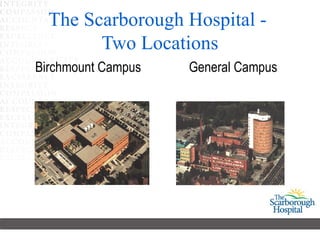
The Scarborough Hospital -
        Two Locations
Birchmount Campus   General Campus
The Scarborough Hospital’s Vision
  To be recognized as Canada’s leader in providing
  the best healthcare for a global community.

 This “global community” includes our diverse
  newcomer population in Scarborough.
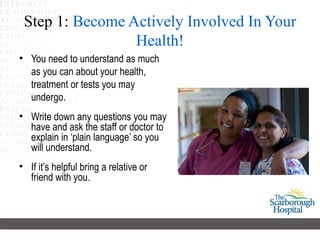
Step 1: Become Actively Involved In Your
                 Health!
• You need to understand as much
  as you can about your health,
  treatment or tests you may
  undergo.
• Write down any questions you may
  have and ask the staff or doctor to
  explain in ‘plain language’ so you
  will understand.
• If it’s helpful bring a relative or
  friend with you.
Step 2: Talking With Your Healthcare
                    Provider
•   Tell them how you feel physically, mentally and emotionally
•   Tell them your medical and family history
•   Tell them of recent illnesses, hospital and doctor visits
•   Tell them of your previous treatments or surgeries
•   Provide a list of current medications
•   Allergies to food/medication
•   Herbal Supplements/Vitamins
Step 3: Questions You Might Ask Your
             Healthcare Provider
• What is my health problem?
• What do I need to do?
• Why do I need to do this?
• What will it involve?
• What if I don’t take this
  treatment?
• Are there any side effects? If
  yes, what are they?
• Are there alternatives? If yes,
  what are the they?
Step 4: How Can The Hospital Help?
EMERGENCY DEPARTMENT – When to come?
• Difficulty breathing, shortness of breath
• Chest or upper abdominal pain or pressure
• Fainting, sudden dizziness, weakness
• Changes in vision
• Confusion or changes in mental status
• Any sudden or severe pain
• Uncontrolled bleeding
• Severe or persistent vomiting or diarrhea
• Coughing or vomiting blood
• Suicidal feelings
• Difficulty speaking
Step 4: How Can The Hospital Help?
EMERGENCY DEPARTMENT – What to expect when you come?
• You will first talk with a nurse trained to assess the severity of medical
  conditions
• Patients with life-threatening conditions to be seen first.
• Patients must tell their symptoms and medical history/medications
  taking.
• Based on information provided, might have to wait. If symptoms
  worsen then need to tell triage nurse.
• Once you see a doctor, they will determine if you need tests or if you
  need to be admitted.
• When discharged from ER you will be given written instructions on
  how to care for your illness along with any prescriptions.
• If discharged and situation worsens, come back to the ER.
Step 4: How Can The Hospital Help?
Hospital Fees:
• Ambulance fee with health card - $45
• Ambulance without a health card - $240
• Non-complicated ED visit without a health card - $260
• Rate for uninsured bed - $1800 per night
  While you are awaiting your health card you should purchase private
  insurance for these 90 days.
Step 4: How Can The Hospital Help?
Patient Relations – Complaint Process
• Patient Relations gathers information and investigates the concerns
• Review the health record, talk to staff and physicians
• Work with family/patient and staff to resolve concerns
• Resolving concerns may include;
      – Reviewing record with patient/family
      – Family meetings
      – Letters of clarification
      – Phone calls
• To get in-touch ask staff/go online/call
• We try to resolve complaints within 15 working days
Step 4: How Can The Hospital Help?
FREE Interpretation Services:
• Two full-time interpreters (9-5 / Mon-Fri.)
       One Tamil interpreter at General Location (McCowan and Lawrence)
       One Chinese speaking Cantonese/Mandarin at Birchmount Location
        (Birchmount and Finch)
• Telephone interpretation phones that are available
       24/7 in 200 languages
Step 4: How Can The Hospital Help?
Special Needs:
• Tell us if you require the following:
      Assistive walking, hearing devices, require sign language
• Let us know if you have any religious/cultural/dietary requests and
  the staff will do their best to meet your needs.
• Ask to speak to a social worker so you can access supports and
  community services.
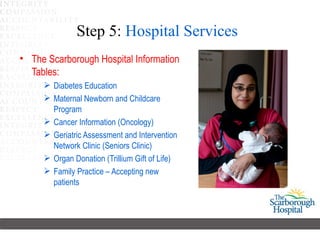
Step 5: Hospital Services
• The Scarborough Hospital Information
  Tables:
      Diabetes Education
      Maternal Newborn and Childcare
       Program
      Cancer Information (Oncology)
      Geriatric Assessment and Intervention
       Network Clinic (Seniors Clinic)
      Organ Donation (Trillium Gift of Life)
      Family Practice – Accepting new
       patients
Contact Us:
• Seemi Khan
  Community Outreach Coordinator
  skhan@tsh.to
  416-431-8200 ext.6041
• Waheeda Rahman, MA
  Director, Diversity, Equity and Stakeholder Outreach
  The Scarborough Hospital

Department Email: diversity@tsh.to

TSH Services

  • 1.
    Accessing Hospital Services Chester Lee Corner “Women in Action Group” Seemi Khan Community Outreach Coordinator Wednesday, April 11, 2012
  • 2.
    The Scarborough Hospital- Two Locations Birchmount Campus General Campus
  • 3.
    The Scarborough Hospital’sVision To be recognized as Canada’s leader in providing the best healthcare for a global community.  This “global community” includes our diverse newcomer population in Scarborough.
  • 4.
    Step 1: BecomeActively Involved In Your Health! • You need to understand as much as you can about your health, treatment or tests you may undergo. • Write down any questions you may have and ask the staff or doctor to explain in ‘plain language’ so you will understand. • If it’s helpful bring a relative or friend with you.
  • 5.
    Step 2: TalkingWith Your Healthcare Provider • Tell them how you feel physically, mentally and emotionally • Tell them your medical and family history • Tell them of recent illnesses, hospital and doctor visits • Tell them of your previous treatments or surgeries • Provide a list of current medications • Allergies to food/medication • Herbal Supplements/Vitamins
  • 6.
    Step 3: QuestionsYou Might Ask Your Healthcare Provider • What is my health problem? • What do I need to do? • Why do I need to do this? • What will it involve? • What if I don’t take this treatment? • Are there any side effects? If yes, what are they? • Are there alternatives? If yes, what are the they?
  • 7.
    Step 4: HowCan The Hospital Help? EMERGENCY DEPARTMENT – When to come? • Difficulty breathing, shortness of breath • Chest or upper abdominal pain or pressure • Fainting, sudden dizziness, weakness • Changes in vision • Confusion or changes in mental status • Any sudden or severe pain • Uncontrolled bleeding • Severe or persistent vomiting or diarrhea • Coughing or vomiting blood • Suicidal feelings • Difficulty speaking
  • 8.
    Step 4: HowCan The Hospital Help? EMERGENCY DEPARTMENT – What to expect when you come? • You will first talk with a nurse trained to assess the severity of medical conditions • Patients with life-threatening conditions to be seen first. • Patients must tell their symptoms and medical history/medications taking. • Based on information provided, might have to wait. If symptoms worsen then need to tell triage nurse. • Once you see a doctor, they will determine if you need tests or if you need to be admitted. • When discharged from ER you will be given written instructions on how to care for your illness along with any prescriptions. • If discharged and situation worsens, come back to the ER.
  • 9.
    Step 4: HowCan The Hospital Help? Hospital Fees: • Ambulance fee with health card - $45 • Ambulance without a health card - $240 • Non-complicated ED visit without a health card - $260 • Rate for uninsured bed - $1800 per night While you are awaiting your health card you should purchase private insurance for these 90 days.
  • 10.
    Step 4: HowCan The Hospital Help? Patient Relations – Complaint Process • Patient Relations gathers information and investigates the concerns • Review the health record, talk to staff and physicians • Work with family/patient and staff to resolve concerns • Resolving concerns may include; – Reviewing record with patient/family – Family meetings – Letters of clarification – Phone calls • To get in-touch ask staff/go online/call • We try to resolve complaints within 15 working days
  • 11.
    Step 4: HowCan The Hospital Help? FREE Interpretation Services: • Two full-time interpreters (9-5 / Mon-Fri.)  One Tamil interpreter at General Location (McCowan and Lawrence)  One Chinese speaking Cantonese/Mandarin at Birchmount Location (Birchmount and Finch) • Telephone interpretation phones that are available  24/7 in 200 languages
  • 12.
    Step 4: HowCan The Hospital Help? Special Needs: • Tell us if you require the following:  Assistive walking, hearing devices, require sign language • Let us know if you have any religious/cultural/dietary requests and the staff will do their best to meet your needs. • Ask to speak to a social worker so you can access supports and community services.
  • 13.
    Step 5: HospitalServices • The Scarborough Hospital Information Tables:  Diabetes Education  Maternal Newborn and Childcare Program  Cancer Information (Oncology)  Geriatric Assessment and Intervention Network Clinic (Seniors Clinic)  Organ Donation (Trillium Gift of Life)  Family Practice – Accepting new patients
  • 14.
    Contact Us: • SeemiKhan Community Outreach Coordinator skhan@tsh.to 416-431-8200 ext.6041 • Waheeda Rahman, MA Director, Diversity, Equity and Stakeholder Outreach The Scarborough Hospital Department Email: diversity@tsh.to

Editor's Notes

  • #2 My job is to help the hospital better serve our diverse Scarborough population
  • #7 Ask questions about your care and if you have any doubts or concerns. Keep asking until you feel you have all the information you need.
  • #9 No matter whether you take the ambulance or walk-in will be seen by a triage nurse. The patient will first talk with the triage nurse, who is specially trained to assess the severity of patients’ conditions and then sort them according to how serious they are. This system allows patients with life-threatening conditions to be seen first. The triage nurse will discuss your symptoms and do a brief exam, which normally includes taking your vital signs — blood pressure, heart and respiratory rate, and temperature — and checking what’s wrong, whether it’s a stomachache, sliced arm, sprained ankle, or difficulty breathing.Make sure you tell them not to minimize their symptoms. And to make sure they tell the nurse about any chronic health problems; medications they are taking (prescribed, over the counter, and herbal); any allergies; whether they are pregnant or breastfeeding; and any other key facts that relate to their health. On the basis of this information, the nurse will determine the seriousness of their complaints, which may range from life threatening (conditions that could become deadly if left untreated) to less urgent illnesses or injuries. The patient might be asked to wait while more critically ill people are treated first. Re-inforce with the group that he staff understand that waiting can be frustrating, but they’ll do their best to keep their wait time to a minimum. If your symptoms worsen, alert the triage nurse immediately. Once you see a doctor, he or she will do an exam to determine if you need additional tests. Most likely, you can be treated in the emergency department. If more extensive tests are needed or special care, such as surgery, is required, you might be admitted into the hospital.When you’re discharged from the ER, you’ll be given written instructions on how to care for your illness or injury, along with any prescriptions you will need. If you have any questions, be sure to ask your doctor or nurse before you leave. Once discharged, if your condition worsens at any time, follow the instructions you’ve been given for a worsening condition or return to the emergency department immediately.
  • #10 T he first 90 days (3 months) after arriving in Canada you are not covered under the OHIP program. Private Insurance companies are- Blue Cross, Trillium Insurance etc.
  • #11 Birchmount campus: 416-495-2701 ext. 5424 General campus: 416-495-2701 ext. 6433 or 6140
  • #13 The Scarborough Hospital is committed to a barrier-free environment for our patients and our community. Accessibility devices are available in the Locating/Communications Department at both hospital campuses. Staxi wheelchairs are available for patient transport at the General Campus in the lobby of the West Wing. Use of the chairs requires a twoonie as a deposit, similar to the grocery stores. A limited number of wheelchairs are also available in the lobbies of both campuses. Patient Religious/Cultural Dietary Needs: Patients that have special dietary such as religious or cultural requirements should notify registration and nursing staff to ensure that appropriate accommodation is provided. At the Birchmount Campus a Chinese Menu is available for patients and for Muslim patients Halal food is available at both campuses upon request.