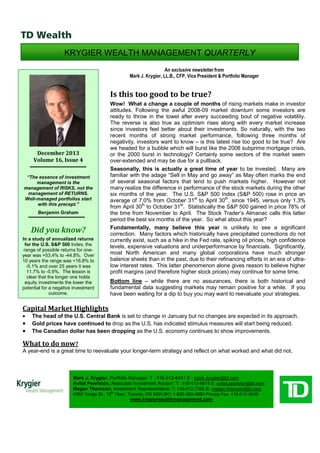
KRYGIER WEALTH MANAGEMENT QUARTERLY
An exclusive newsletter from
Mark J. Krygier, LL.B., CFP, Vice President & Portfolio Manager

Is this too good to be true?

December 2013
Volume 16, Issue 4
“The essence of investment
management is the
management of RISKS, not the
management of RETURNS.
Well-managed portfolios start
with this precept.”
Benjamin Graham

Did you know?
In a study of annualized returns
for the U.S. S&P 500 Index, the
range of possible returns for oneyear was +53.4% to -44.8%. Over
10 years the range was +16.8% to
-5.1% and over 25 years it was
11.7% to -0.9%. The lesson is
clear that the longer one holds
equity investments the lower the
potential for a negative investment
outcome.

Wow! What a change a couple of months of rising markets make in investor
attitudes. Following the awful 2008-09 market downturn some investors are
ready to throw in the towel after every succeeding bout of negative volatility.
The reverse is also true as optimism rises along with every market increase
since investors feel better about their investments. So naturally, with the two
recent months of strong market performance, following three months of
negativity, investors want to know – is this latest rise too good to be true? Are
we headed for a bubble which will burst like the 2008 subprime mortgage crisis,
or the 2000 burst in technology? Certainly some sectors of the market seem
over-extended and may be due for a pullback.
Seasonally, this is actually a great time of year to be invested. Many are
familiar with the adage “Sell in May and go away” as May often marks the end
of several seasonal factors that tend to push markets higher. However not
many realize the difference in performance of the stock markets during the other
six months of the year. The U.S. S&P 500 Index (S&P 500) rose in price an
average of 7.0% from October 31st to April 30th, since 1945, versus only 1.3%
from April 30th to October 31st. Statistically the S&P 500 gained in price 78% of
the time from November to April. The Stock Trader’s Almanac calls this latter
period the best six months of the year. So what about this year?
Fundamentally, many believe this year is unlikely to see a significant
correction. Many factors which historically have precipitated corrections do not
currently exist, such as a hike in the Fed rate, spiking oil prices, high confidence
levels, expensive valuations and underperformance by financials. Significantly,
most North American and many global corporations have much stronger
balance sheets than in the past, due to their refinancing efforts in an era of ultralow interest rates. This latter phenomenon alone gives reason to believe higher
profit margins (and therefore higher stock prices) may continue for some time.
Bottom line – while there are no assurances, there is both historical and
fundamental data suggesting markets may remain positive for a while. If you
have been waiting for a dip to buy you may want to reevaluate your strategies.

Capital Market Highlights
•

•
•

The head of the U.S. Central Bank is set to change in January but no changes are expected in its approach.
Gold prices have continued to drop as the U.S. has indicated stimulus measures will start being reduced.
The Canadian dollar has been dropping as the U.S. economy continues to show improvements.

What to do now?
A year-end is a great time to reevaluate your longer-term strategy and reflect on what worked and what did not.

Mark J. Krygier, Portfolio Manager: T : 416-512-6441 E : mark.krygier@td.com
Avital Pearlston, Associate Investment Advisor: T : 416-512-6674 E: avital.pearlston@td.com
Megan Thomson, Investment Representative: T: 416-512-7360 E: megan.thomson@td.com
4950 Yonge St., 16th Floor, Toronto, ON M2N 6K1 1-800-382-4964 Private Fax: 416-512-8248

www.krygierwealthmanagement.com
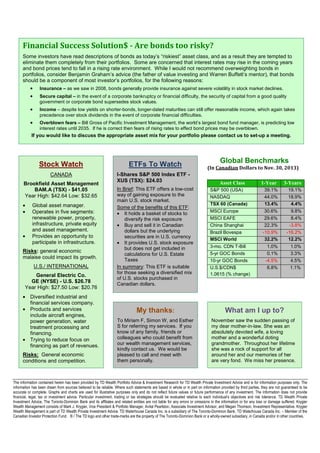
Financial Success Solution$ - Are bonds too risky?
Some investors have read descriptions of bonds as today’s “riskiest” asset class, and as a result they are tempted to
eliminate them completely from their portfolios. Some are concerned that interest rates may rise in the coming years
and bond prices tend to fall in a rising rate environment. While I would not recommend overweighting bonds in
portfolios, consider Benjamin Graham’s advice (the father of value investing and Warren Buffett’s mentor), that bonds
should be a component of most investor’s portfolios, for the following reasons:
•
•

Insurance – as we saw in 2008, bonds generally provide insurance against severe volatility in stock market declines.
Secure capital – in the event of a corporate bankruptcy or financial difficulty, the security of capital from a good quality
government or corporate bond supersedes stock values.

•

Income – despite low yields on shorter-bonds, longer-dated maturities can still offer reasonable income, which again takes
precedence over stock dividends in the event of corporate financial difficulties.

•

Overblown fears – Bill Gross of Pacific Investment Management, the world’s largest bond fund manager, is predicting low
interest rates until 2035. If he is correct then fears of rising rates to effect bond prices may be overblown.

If you would like to discuss the appropriate asset mix for your portfolio please contact us to set-up a meeting.

Stock Watch
CANADA
Brookfield Asset Management
BAM.A (TSX) - $41.05
Year High: $42.64 Low: $32.65
•
•

•

Global asset manager.
Operates in five segments:
renewable power, property,
infrastructure, private equity
and asset management.
Provides an opportunity to
participate in infrastructure.

Risks: general economic
malaise could impact its growth.
U.S./ INTERNATIONAL
General Electric Co.
GE (NYSE) - U.S. $26.78
Year High: $27.50 Low: $20.76
• Diversified industrial and
financial services company.
• Products and services
include aircraft engines,
power generation, water
treatment processing and
financing.
• Trying to reduce focus on
financing as part of revenues.
Risks: General economic
conditions and competition.

ETFs To Watch
I-Shares S&P 500 Index ETF XUS (TSX): $24.03
In Brief: This ETF offers a low-cost
way of gaining exposure to the
main U.S. stock market.
Some of the benefits of this ETF:
• It holds a basket of stocks to
diversify the risk exposure
• Buy and sell it in Canadian
dollars but the underlying
securities are in U.S. currency
• It provides U.S. stock exposure
but does not get included in
calculations for U.S. Estate
Taxes
In summary: This ETF is suitable
for those seeking a diversified mix
of U.S. stocks purchased in
Canadian dollars.

Global Benchmarks
(In Canadian Dollars to Nov. 30, 2013)
1-Year

3-Years

S&P 500 (USA)
NASDAQ
TSX 60 (Canada)

Asset Class

39.1%
44.0%
13.4%

19.1%
18.9%
4.4%

MSCI Europe

30.6%

9.8%

MSCI EAFE
China Shanghai

29.6%
22.3%

8.4%
-3.8%

Brazil Bovespa
MSCI World

-10.9%
32.2%

-16.2%
12.2%

1.0%
0.1%

1.0%
3.3%

-4.5%
6.8%

4.5%
1.1%

3-mo. CDN T-Bill
5-yr GOC Bonds
10-yr GOC Bonds
U.S.$/CDN$
1.0615 (% change)

My thanks:

What am I up to?

To Miriam F, Simon W, and Esther
S for referring my services. If you
know of any family, friends or
colleagues who could benefit from
our wealth management services,
kindly contact us. We would be
pleased to call and meet with
them personally.

November saw the sudden passing of
my dear mother-in-law. She was an
absolutely devoted wife, a loving
mother and a wonderful doting
grandmother. Throughout her lifetime
she was a rock of support for all
around her and our memories of her
are very fond. We miss her presence.

The information contained herein has been provided by TD Wealth Portfolio Advice & Investment Research for TD Wealth Private Investment Advice and is for information purposes only. The
information has been drawn from sources believed to be reliable. Where such statements are based in whole or in part on information provided by third parties, they are not guaranteed to be
accurate or complete. Graphs and charts are used for illustrative purposes only and do not reflect future values or future performance of any investment. The information does not provide
financial, legal, tax or investment advice. Particular investment, trading or tax strategies should be evaluated relative to each individual’s objectives and risk tolerance. TD Wealth Private
Investment Advice, The Toronto-Dominion Bank and its affiliates and related entities are not liable for any errors or omissions in the information or for any loss or damage suffered. Krygier
Wealth Management consists of Mark J. Krygier, Vice President & Portfolio Manager, Avital Pearlston, Associate Investment Advisor, and Megan Thomson, Investment Representative. Krygier
Wealth Management is part of TD Wealth Private Investment Advice. TD Waterhouse Canada Inc. is a subsidiary of The Toronto-Dominion Bank. TD Waterhouse Canada Inc. – Member of the
Canadian Investor Protection Fund. ® / The TD logo and other trade-marks are the property of The Toronto-Dominion Bank or a wholly-owned subsidiary, in Canada and/or in other countries.

December 13 quarterly: Is this too good to be true?

  • 1.
    KRYGIER WEALTH MANAGEMENTQUARTERLY An exclusive newsletter from Mark J. Krygier, LL.B., CFP, Vice President & Portfolio Manager Is this too good to be true? December 2013 Volume 16, Issue 4 “The essence of investment management is the management of RISKS, not the management of RETURNS. Well-managed portfolios start with this precept.” Benjamin Graham Did you know? In a study of annualized returns for the U.S. S&P 500 Index, the range of possible returns for oneyear was +53.4% to -44.8%. Over 10 years the range was +16.8% to -5.1% and over 25 years it was 11.7% to -0.9%. The lesson is clear that the longer one holds equity investments the lower the potential for a negative investment outcome. Wow! What a change a couple of months of rising markets make in investor attitudes. Following the awful 2008-09 market downturn some investors are ready to throw in the towel after every succeeding bout of negative volatility. The reverse is also true as optimism rises along with every market increase since investors feel better about their investments. So naturally, with the two recent months of strong market performance, following three months of negativity, investors want to know – is this latest rise too good to be true? Are we headed for a bubble which will burst like the 2008 subprime mortgage crisis, or the 2000 burst in technology? Certainly some sectors of the market seem over-extended and may be due for a pullback. Seasonally, this is actually a great time of year to be invested. Many are familiar with the adage “Sell in May and go away” as May often marks the end of several seasonal factors that tend to push markets higher. However not many realize the difference in performance of the stock markets during the other six months of the year. The U.S. S&P 500 Index (S&P 500) rose in price an average of 7.0% from October 31st to April 30th, since 1945, versus only 1.3% from April 30th to October 31st. Statistically the S&P 500 gained in price 78% of the time from November to April. The Stock Trader’s Almanac calls this latter period the best six months of the year. So what about this year? Fundamentally, many believe this year is unlikely to see a significant correction. Many factors which historically have precipitated corrections do not currently exist, such as a hike in the Fed rate, spiking oil prices, high confidence levels, expensive valuations and underperformance by financials. Significantly, most North American and many global corporations have much stronger balance sheets than in the past, due to their refinancing efforts in an era of ultralow interest rates. This latter phenomenon alone gives reason to believe higher profit margins (and therefore higher stock prices) may continue for some time. Bottom line – while there are no assurances, there is both historical and fundamental data suggesting markets may remain positive for a while. If you have been waiting for a dip to buy you may want to reevaluate your strategies. Capital Market Highlights • • • The head of the U.S. Central Bank is set to change in January but no changes are expected in its approach. Gold prices have continued to drop as the U.S. has indicated stimulus measures will start being reduced. The Canadian dollar has been dropping as the U.S. economy continues to show improvements. What to do now? A year-end is a great time to reevaluate your longer-term strategy and reflect on what worked and what did not. Mark J. Krygier, Portfolio Manager: T : 416-512-6441 E : mark.krygier@td.com Avital Pearlston, Associate Investment Advisor: T : 416-512-6674 E: avital.pearlston@td.com Megan Thomson, Investment Representative: T: 416-512-7360 E: megan.thomson@td.com 4950 Yonge St., 16th Floor, Toronto, ON M2N 6K1 1-800-382-4964 Private Fax: 416-512-8248 www.krygierwealthmanagement.com
  • 2.
    Financial Success Solution$- Are bonds too risky? Some investors have read descriptions of bonds as today’s “riskiest” asset class, and as a result they are tempted to eliminate them completely from their portfolios. Some are concerned that interest rates may rise in the coming years and bond prices tend to fall in a rising rate environment. While I would not recommend overweighting bonds in portfolios, consider Benjamin Graham’s advice (the father of value investing and Warren Buffett’s mentor), that bonds should be a component of most investor’s portfolios, for the following reasons: • • Insurance – as we saw in 2008, bonds generally provide insurance against severe volatility in stock market declines. Secure capital – in the event of a corporate bankruptcy or financial difficulty, the security of capital from a good quality government or corporate bond supersedes stock values. • Income – despite low yields on shorter-bonds, longer-dated maturities can still offer reasonable income, which again takes precedence over stock dividends in the event of corporate financial difficulties. • Overblown fears – Bill Gross of Pacific Investment Management, the world’s largest bond fund manager, is predicting low interest rates until 2035. If he is correct then fears of rising rates to effect bond prices may be overblown. If you would like to discuss the appropriate asset mix for your portfolio please contact us to set-up a meeting. Stock Watch CANADA Brookfield Asset Management BAM.A (TSX) - $41.05 Year High: $42.64 Low: $32.65 • • • Global asset manager. Operates in five segments: renewable power, property, infrastructure, private equity and asset management. Provides an opportunity to participate in infrastructure. Risks: general economic malaise could impact its growth. U.S./ INTERNATIONAL General Electric Co. GE (NYSE) - U.S. $26.78 Year High: $27.50 Low: $20.76 • Diversified industrial and financial services company. • Products and services include aircraft engines, power generation, water treatment processing and financing. • Trying to reduce focus on financing as part of revenues. Risks: General economic conditions and competition. ETFs To Watch I-Shares S&P 500 Index ETF XUS (TSX): $24.03 In Brief: This ETF offers a low-cost way of gaining exposure to the main U.S. stock market. Some of the benefits of this ETF: • It holds a basket of stocks to diversify the risk exposure • Buy and sell it in Canadian dollars but the underlying securities are in U.S. currency • It provides U.S. stock exposure but does not get included in calculations for U.S. Estate Taxes In summary: This ETF is suitable for those seeking a diversified mix of U.S. stocks purchased in Canadian dollars. Global Benchmarks (In Canadian Dollars to Nov. 30, 2013) 1-Year 3-Years S&P 500 (USA) NASDAQ TSX 60 (Canada) Asset Class 39.1% 44.0% 13.4% 19.1% 18.9% 4.4% MSCI Europe 30.6% 9.8% MSCI EAFE China Shanghai 29.6% 22.3% 8.4% -3.8% Brazil Bovespa MSCI World -10.9% 32.2% -16.2% 12.2% 1.0% 0.1% 1.0% 3.3% -4.5% 6.8% 4.5% 1.1% 3-mo. CDN T-Bill 5-yr GOC Bonds 10-yr GOC Bonds U.S.$/CDN$ 1.0615 (% change) My thanks: What am I up to? To Miriam F, Simon W, and Esther S for referring my services. If you know of any family, friends or colleagues who could benefit from our wealth management services, kindly contact us. We would be pleased to call and meet with them personally. November saw the sudden passing of my dear mother-in-law. She was an absolutely devoted wife, a loving mother and a wonderful doting grandmother. Throughout her lifetime she was a rock of support for all around her and our memories of her are very fond. We miss her presence. The information contained herein has been provided by TD Wealth Portfolio Advice & Investment Research for TD Wealth Private Investment Advice and is for information purposes only. The information has been drawn from sources believed to be reliable. Where such statements are based in whole or in part on information provided by third parties, they are not guaranteed to be accurate or complete. Graphs and charts are used for illustrative purposes only and do not reflect future values or future performance of any investment. The information does not provide financial, legal, tax or investment advice. Particular investment, trading or tax strategies should be evaluated relative to each individual’s objectives and risk tolerance. TD Wealth Private Investment Advice, The Toronto-Dominion Bank and its affiliates and related entities are not liable for any errors or omissions in the information or for any loss or damage suffered. Krygier Wealth Management consists of Mark J. Krygier, Vice President & Portfolio Manager, Avital Pearlston, Associate Investment Advisor, and Megan Thomson, Investment Representative. Krygier Wealth Management is part of TD Wealth Private Investment Advice. TD Waterhouse Canada Inc. is a subsidiary of The Toronto-Dominion Bank. TD Waterhouse Canada Inc. – Member of the Canadian Investor Protection Fund. ® / The TD logo and other trade-marks are the property of The Toronto-Dominion Bank or a wholly-owned subsidiary, in Canada and/or in other countries.