MARKET COMMENTARY
                                                                 An exclusive newsletter from
                                               Mark J. Krygier, LL.B., CFP, Vice President & Portfolio Manager

                              TO QE OR NOT TO QE?
                        We are sitting at a major juncture in the investment world in what continues to be extraordinary
                        times. While the Bank of Canada has been amongst the very few Central Banks globally to raise
     October 2010       short-term interest rates, in order to combat the potential for a housing market bubble, yields
  Volume 11, Issue 7    generally remain at historical lows. For instance, the yield on the Government of Canada (“GOC”)
                        10-Year Bond has dropped from 6% in early 2000 to less than 3% in recent months - a halving of the
yield in just over 10 years, while the 30-year GOC bond is at 3.3% - a record low. Even corporate bond yields, which many
of our clients have benefitted from in recent years, have dropped in recent months leading to an increasingly difficult
environment to produce income from traditional “yield-producing” investments. We expect this theme to stay intact for the
foreseeable future.
A major factor in our belief is the fiscal policy of the U.S. Central Bank – the “Fed”, which was instrumental in saving
the U.S. and perhaps the globe from financial Armageddon in 2008-09. Recently the Fed has indicated that they are
strongly considering entering a second phase of direct intervention into propping up the U.S. economy – otherwise known
as “Quantitative Easing” or “QE”. Initially their intervention was limited to dropping short-term interest rates to near zero
in order to provide liquidity to a frozen credit market – and it worked. Now that intervention will likely take the form of
aggressive U.S. government bond buying (yes, you heard right – the government will be using debt to pay off debt, kind of
like consumers using mortgages to pay off credit cards). The likely result of this second round of QE is a further
devaluation of the U.S. dollar. As a result, in Canada our own dollar ought to strengthen relative to the U.S. currency, and
the need to keep raising Canadian interest rates should disappear with the disinflationary U.S. drag.
I have seen several indications that markets will likely improve substantially by year-end and that this should continue
into 2011. While September 2010 did not turn into the dreaded down market many feared, October still has a history of
choppy markets which should be exacerbated this year by the U.S. Congressional elections. Ron Meisels, one of Canada’s
most respected technical analysts is recommending that investors look to mid-October for possible short-term lows, but
more importantly “to use all corrections as buying opportunities.” As dividend yields amongst stocks are on average
currently the same as the 10-year GOC bond yields, it behooves yield seeking investors to consider looking outside of the
conventional bond approach to both increase their after-tax yields and to potentially increase their capital at the same time.
Bottom line – whether or not the U.S. Fed moves to ease further, it will be interesting to see for how long investors will
stick to the traditional means of generating income in an ahistorical yield environment – that is the real question!

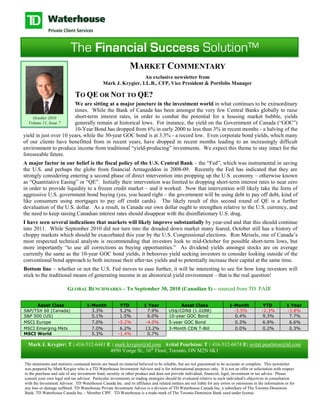
                         GLOBAL BENCHMARKS – To September 30, 2010 (Canadian $) – sourced from TD PAIR

     Asset Class                     1-Month             YTD           1 Year               Asset Class                    1-Month              YTD           1 Year
S&P/TSX 60 (Canada)                    3.3%              5.2%            7.9%          US$/CDN$ (1.0288)                     -3.5%             -2.3%          -3.8%
S&P 500 (US)                           5.1%              1.5%            6.0%          10-year GOC Bond                      0.4%              9.3%            7.7%
MSCI Europe                            7.0%             -5.2%           -4.0%          5-year GOC Bond                       0.3%              6.9%            6.6%
MSCI Emerging Mkts                     7.0%              6.2%          13.2%           3-Month CDN T-Bill                    0.0%              0.2%            0.3%
MSCI World                             5.3%             -1.4%            0.7%

  Mark J. Krygier: T : 416-512-6441 E : mark.krygier@td.com Avital Pearlston: T : 416-512-6674 E: avital.pearlston@td.com
                                     4950 Yonge St., 16th Floor, Toronto, ON M2N 6K1

The statements and statistics contained herein are based on material believed to be reliable, but are not guaranteed to be accurate or complete. This newsletter
was prepared by Mark Krygier who is a TD Waterhouse Investment Advisor and is for informational purposes only. It is not an offer or solicitation with respect
to the purchase and sale of any investment fund, security or other product and does not provide individual, financial, legal, investment or tax advice. Please
consult your own legal and tax advisor. Particular investments or trading strategies should be evaluated relative to each individual's objectives in consultation
with the Investment Advisor. TD Waterhouse Canada Inc. and its affiliates and related entities are not liable for any errors or omissions in the information or for
any loss or damage suffered. TD Waterhouse Private Investment Advice is a division of TD Waterhouse Canada Inc, a subsidiary of The Toronto-Dominion
Bank. TD Waterhouse Canada Inc. - Member CIPF. TD Waterhouse is a trade-mark of The Toronto-Dominion Bank used under license.

Fall 2010 Market Commentary

  • 1.
    MARKET COMMENTARY An exclusive newsletter from Mark J. Krygier, LL.B., CFP, Vice President & Portfolio Manager TO QE OR NOT TO QE? We are sitting at a major juncture in the investment world in what continues to be extraordinary times. While the Bank of Canada has been amongst the very few Central Banks globally to raise October 2010 short-term interest rates, in order to combat the potential for a housing market bubble, yields Volume 11, Issue 7 generally remain at historical lows. For instance, the yield on the Government of Canada (“GOC”) 10-Year Bond has dropped from 6% in early 2000 to less than 3% in recent months - a halving of the yield in just over 10 years, while the 30-year GOC bond is at 3.3% - a record low. Even corporate bond yields, which many of our clients have benefitted from in recent years, have dropped in recent months leading to an increasingly difficult environment to produce income from traditional “yield-producing” investments. We expect this theme to stay intact for the foreseeable future. A major factor in our belief is the fiscal policy of the U.S. Central Bank – the “Fed”, which was instrumental in saving the U.S. and perhaps the globe from financial Armageddon in 2008-09. Recently the Fed has indicated that they are strongly considering entering a second phase of direct intervention into propping up the U.S. economy – otherwise known as “Quantitative Easing” or “QE”. Initially their intervention was limited to dropping short-term interest rates to near zero in order to provide liquidity to a frozen credit market – and it worked. Now that intervention will likely take the form of aggressive U.S. government bond buying (yes, you heard right – the government will be using debt to pay off debt, kind of like consumers using mortgages to pay off credit cards). The likely result of this second round of QE is a further devaluation of the U.S. dollar. As a result, in Canada our own dollar ought to strengthen relative to the U.S. currency, and the need to keep raising Canadian interest rates should disappear with the disinflationary U.S. drag. I have seen several indications that markets will likely improve substantially by year-end and that this should continue into 2011. While September 2010 did not turn into the dreaded down market many feared, October still has a history of choppy markets which should be exacerbated this year by the U.S. Congressional elections. Ron Meisels, one of Canada’s most respected technical analysts is recommending that investors look to mid-October for possible short-term lows, but more importantly “to use all corrections as buying opportunities.” As dividend yields amongst stocks are on average currently the same as the 10-year GOC bond yields, it behooves yield seeking investors to consider looking outside of the conventional bond approach to both increase their after-tax yields and to potentially increase their capital at the same time. Bottom line – whether or not the U.S. Fed moves to ease further, it will be interesting to see for how long investors will stick to the traditional means of generating income in an ahistorical yield environment – that is the real question! GLOBAL BENCHMARKS – To September 30, 2010 (Canadian $) – sourced from TD PAIR Asset Class 1-Month YTD 1 Year Asset Class 1-Month YTD 1 Year S&P/TSX 60 (Canada) 3.3% 5.2% 7.9% US$/CDN$ (1.0288) -3.5% -2.3% -3.8% S&P 500 (US) 5.1% 1.5% 6.0% 10-year GOC Bond 0.4% 9.3% 7.7% MSCI Europe 7.0% -5.2% -4.0% 5-year GOC Bond 0.3% 6.9% 6.6% MSCI Emerging Mkts 7.0% 6.2% 13.2% 3-Month CDN T-Bill 0.0% 0.2% 0.3% MSCI World 5.3% -1.4% 0.7% Mark J. Krygier: T : 416-512-6441 E : mark.krygier@td.com Avital Pearlston: T : 416-512-6674 E: avital.pearlston@td.com 4950 Yonge St., 16th Floor, Toronto, ON M2N 6K1 The statements and statistics contained herein are based on material believed to be reliable, but are not guaranteed to be accurate or complete. This newsletter was prepared by Mark Krygier who is a TD Waterhouse Investment Advisor and is for informational purposes only. It is not an offer or solicitation with respect to the purchase and sale of any investment fund, security or other product and does not provide individual, financial, legal, investment or tax advice. Please consult your own legal and tax advisor. Particular investments or trading strategies should be evaluated relative to each individual's objectives in consultation with the Investment Advisor. TD Waterhouse Canada Inc. and its affiliates and related entities are not liable for any errors or omissions in the information or for any loss or damage suffered. TD Waterhouse Private Investment Advice is a division of TD Waterhouse Canada Inc, a subsidiary of The Toronto-Dominion Bank. TD Waterhouse Canada Inc. - Member CIPF. TD Waterhouse is a trade-mark of The Toronto-Dominion Bank used under license.