DECAYED,MISSING,FILLED TOOTH INDEX
INDEX - definition
• It is defined as a numerical value,
• Describing the relative status of a population
• On a graduated scale
• With definite upper and lower limits,
• Which is designed to permit and facilitate
• Comparision with other populations classified
by the same criteria and methods.
Introduction:
• The DMFT INDEX was developed by
• HENRY T KLEIN
• CARROLE E PALMER
• KNUTSON J W
• IN 1938
• To determine the prevalence of CORONAL
CARIES.
Advantages:
• Simple
• Rapid
• Versatile
• Universally accepted and applicable measurement
• This index is based on the fact that the dental hard
tissues are not self healing and established caries
leaves a scar of some sort.
• The tooth either remains decayed, or if treated, it is
extracted or filled.
• This index is therefore an IRREVERSIBLE index
measuring the lifetime caries experience.
Procedure:
• The DMFT index is applied only to permanent
teeth.
• It is composed of three components,
• D – used to describe decayed teeth
• M – used to describe missing teeth due to caries
• F – used to describe teeth that have been
previously filled due to caries.
Instruments used:
• Mouth mirror
• Explorer
Indications:
• All the 28 permanent teeth are examined,
• The teeth not included are,
1. The third molars
2. Unerupted teeth
3. Congenitally missing, Supernumerary teeth
4. Teeth removed for reasons other than dental caries such
as for orthodontic treatment or impaction.
5. Teeth restored for reasons other than dental caries such
as trauma(fracture), cosmetic purposes or for use as a
bridge abutment.
6. Primary tooth retained with the permanent successor
erupted.
The permanent tooth is evaluated since a primary tooth
is never included in this index.
Criteria for identification of dental caries:
• The lesion is clinically visible and obvious,
• The explorer tip can penetrate deep into soft
yielding material
• There is discoloration or loss of translucency
typical of undermined or demineralized enamel
• The explorer tip in a pit or fissure catches or
resists removal after moderate to firm pressure
on insertion.
Principles and rules in recording DMFT:
• No tooth must be counted more than once. it is
either decayed, missing, filled or sound.
• Decayed, missing and filled teeth should be
recorded separately, since the components of
DMF are of great interest
• When counting the number of decayed teeth,
also include those teeth, which have restorations
with recurrent decay.
• Temporary restorations are considered as filled.
• Care must be taken to list as missing only those
teeth, which have been lost due to decay. Also
included should be those teeth which are so
badly decayed that they are indicated for
extraction. the following should not be counted
as missing
a. unerupted teeth
b. missing teeth due to accident
c. congenitally missing teeth
d. teeth that have been extracted for orthodontic
reasons.
• A tooth may have several restorations but it is
counted as one tooth.
• Deciduous teeth are not included in DMF count.
• A tooth is considered to be erupted when the
occlusal surface or incisal edge is totally exposed
or can be exposed by gently reflecting the
overlying gingival tissue with the mirror or
explorer.
• A tooth is considered to be present even though
the crown has been destroyed and only the roots
are left.
Limitations
• DMFT values are not related to the number of teeth
at risk
• DMFT index can be invalid in older adults because
teeth can become lost for reasons other than caries.
• DMFT index can be misleading in children whose
teeth have been lost due to orthodontic reasons.
• DMFT index can overestimate caries experience in
teeth in which “preventive fillings” have been
placed.
• DMFT index is of little use in studies of root
caries.
• DMFT index equates a disease state with a
healthy state by assigning the same score for a
decayed tooth as well as for a filled healthy
tooth.
DECAYED, MISSING FILLED TOOTH SURFACES INDEX (DMFS)
• This index was developed by
• HENRY T KLEIN
• CARROLE E PALMER
• KNUTSON J W
• In 1938 along with the decayed, missing, filled
teeth index to assess the prevalence of coronal
caries.
Procedure:
• The DMFS index is applied only to permanent
teeth surfaces. It is composed of three
components,
• DS- USED TO DESCRIBE DECAYED TEETH
SURFCAES
• MS- USED TO DESCRIBE MISSING TEETH
SURFACES DUE TO CARIES
• FS- USED TO DESCRIBE TEETH SURFACES
THAT HAVE BEEN PREVIOUSLY FILLED DUE
TO CARIES.
ADVANTAGES:
• This index is more
• Sensitive and is usually the index of choice in a
clinical trial of caries – preventive agent.
Limitations:
• A DMFS examination takes longer
• Is more likely to produce inconsistencies in
diagnosis
• May require the use of radiographs to be fully
accurate.
The surfaces examined are;
• For anterior teeth: facial, lingual, mesial and
distal; 4 surfaces
• For posterior teeth: facial, lingual, mesial, distal
and occlusal ; 5 surfaces.
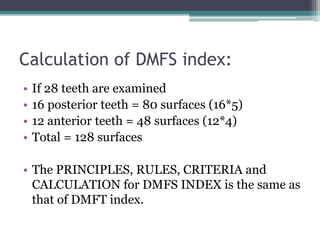
Calculation of DMFS index:
• If 28 teeth are examined
• 16 posterior teeth = 80 surfaces (16*5)
• 12 anterior teeth = 48 surfaces (12*4)
• Total = 128 surfaces
• The PRINCIPLES, RULES, CRITERIA and
CALCULATION for DMFS INDEX is the same as
that of DMFT index.

DECAYED,MISSING,FILLED TOOTH INDEX.pptx

  • 1.
  • 2.
    INDEX - definition •It is defined as a numerical value, • Describing the relative status of a population • On a graduated scale • With definite upper and lower limits, • Which is designed to permit and facilitate • Comparision with other populations classified by the same criteria and methods.
  • 3.
    Introduction: • The DMFTINDEX was developed by • HENRY T KLEIN • CARROLE E PALMER • KNUTSON J W • IN 1938 • To determine the prevalence of CORONAL CARIES.
  • 4.
    Advantages: • Simple • Rapid •Versatile • Universally accepted and applicable measurement • This index is based on the fact that the dental hard tissues are not self healing and established caries leaves a scar of some sort. • The tooth either remains decayed, or if treated, it is extracted or filled. • This index is therefore an IRREVERSIBLE index measuring the lifetime caries experience.
  • 5.
    Procedure: • The DMFTindex is applied only to permanent teeth. • It is composed of three components, • D – used to describe decayed teeth • M – used to describe missing teeth due to caries • F – used to describe teeth that have been previously filled due to caries.
  • 6.
    Instruments used: • Mouthmirror • Explorer
  • 7.
    Indications: • All the28 permanent teeth are examined, • The teeth not included are, 1. The third molars 2. Unerupted teeth 3. Congenitally missing, Supernumerary teeth 4. Teeth removed for reasons other than dental caries such as for orthodontic treatment or impaction. 5. Teeth restored for reasons other than dental caries such as trauma(fracture), cosmetic purposes or for use as a bridge abutment. 6. Primary tooth retained with the permanent successor erupted. The permanent tooth is evaluated since a primary tooth is never included in this index.
  • 8.
    Criteria for identificationof dental caries: • The lesion is clinically visible and obvious, • The explorer tip can penetrate deep into soft yielding material • There is discoloration or loss of translucency typical of undermined or demineralized enamel • The explorer tip in a pit or fissure catches or resists removal after moderate to firm pressure on insertion.
  • 9.
    Principles and rulesin recording DMFT: • No tooth must be counted more than once. it is either decayed, missing, filled or sound. • Decayed, missing and filled teeth should be recorded separately, since the components of DMF are of great interest • When counting the number of decayed teeth, also include those teeth, which have restorations with recurrent decay. • Temporary restorations are considered as filled.
  • 10.
    • Care mustbe taken to list as missing only those teeth, which have been lost due to decay. Also included should be those teeth which are so badly decayed that they are indicated for extraction. the following should not be counted as missing a. unerupted teeth b. missing teeth due to accident c. congenitally missing teeth d. teeth that have been extracted for orthodontic reasons. • A tooth may have several restorations but it is counted as one tooth.
  • 11.
    • Deciduous teethare not included in DMF count. • A tooth is considered to be erupted when the occlusal surface or incisal edge is totally exposed or can be exposed by gently reflecting the overlying gingival tissue with the mirror or explorer. • A tooth is considered to be present even though the crown has been destroyed and only the roots are left.
  • 12.
    Limitations • DMFT valuesare not related to the number of teeth at risk • DMFT index can be invalid in older adults because teeth can become lost for reasons other than caries. • DMFT index can be misleading in children whose teeth have been lost due to orthodontic reasons. • DMFT index can overestimate caries experience in teeth in which “preventive fillings” have been placed.
  • 13.
    • DMFT indexis of little use in studies of root caries. • DMFT index equates a disease state with a healthy state by assigning the same score for a decayed tooth as well as for a filled healthy tooth.
  • 14.
    DECAYED, MISSING FILLEDTOOTH SURFACES INDEX (DMFS) • This index was developed by • HENRY T KLEIN • CARROLE E PALMER • KNUTSON J W • In 1938 along with the decayed, missing, filled teeth index to assess the prevalence of coronal caries.
  • 15.
    Procedure: • The DMFSindex is applied only to permanent teeth surfaces. It is composed of three components, • DS- USED TO DESCRIBE DECAYED TEETH SURFCAES • MS- USED TO DESCRIBE MISSING TEETH SURFACES DUE TO CARIES • FS- USED TO DESCRIBE TEETH SURFACES THAT HAVE BEEN PREVIOUSLY FILLED DUE TO CARIES.
  • 16.
    ADVANTAGES: • This indexis more • Sensitive and is usually the index of choice in a clinical trial of caries – preventive agent.
  • 17.
    Limitations: • A DMFSexamination takes longer • Is more likely to produce inconsistencies in diagnosis • May require the use of radiographs to be fully accurate.
  • 18.
    The surfaces examinedare; • For anterior teeth: facial, lingual, mesial and distal; 4 surfaces • For posterior teeth: facial, lingual, mesial, distal and occlusal ; 5 surfaces.
  • 19.
    Calculation of DMFSindex: • If 28 teeth are examined • 16 posterior teeth = 80 surfaces (16*5) • 12 anterior teeth = 48 surfaces (12*4) • Total = 128 surfaces • The PRINCIPLES, RULES, CRITERIA and CALCULATION for DMFS INDEX is the same as that of DMFT index.

Editor's Notes