Illustrated and Animated
The Nervous system
By
Dean Berry, Ed. D.
The Teachers’ Choice Library
• Free PowerPoint at
• Slideshare.com
• Type PPT title or dean r berry
Which body system enables us to
experience the environment around
us, use our thinking processes to
make decisions, and take necessary
action?
Can you explain how each one of
these skills works in the human
body?
As we read, we will uncover the
answer to these questions.
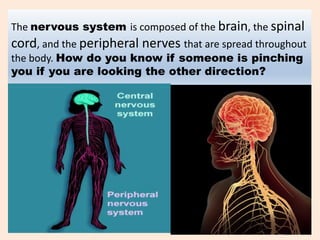
The nervous system is composed of the brain, the spinal
cord, and the peripheral nerves that are spread throughout
the body. How do you know if someone is pinching
you if you are looking the other direction?
The brain is the master organ of the nervous system. All
of the body systems and organs are under its control. Even the
slightest injury to the brain can result in mental or physical
malfunction. What is a concussion? How
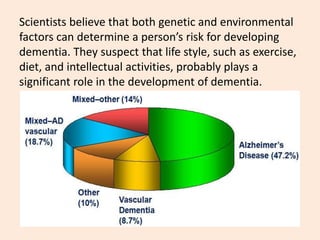
serious are some concussions?
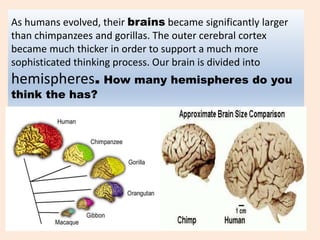
As humans evolved, their brains became significantly larger
than chimpanzees and gorillas. The outer cerebral cortex
became much thicker in order to support a much more
sophisticated thinking process. Our brain is divided into
hemispheres. How many hemispheres do you
think the has?
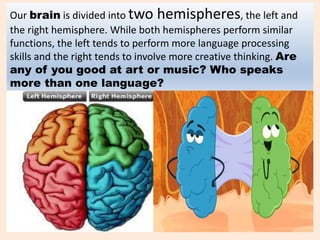
Our brain is divided into two hemispheres, the left and
the right hemisphere. While both hemispheres perform similar
functions, the left tends to perform more language processing
skills and the right tends to involve more creative thinking. Are
any of you good at art or music? Who speaks
more than one language?
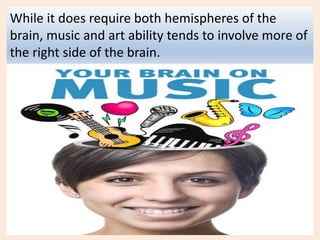
While it does require both hemispheres of the
brain, music and art ability tends to involve more of
the right side of the brain.
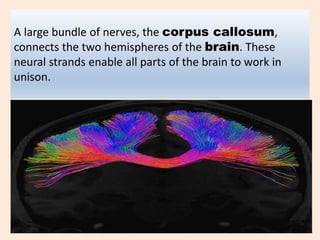
A large bundle of nerves, the corpus callosum,
connects the two hemispheres of the brain. These
neural strands enable all parts of the brain to work in
unison.
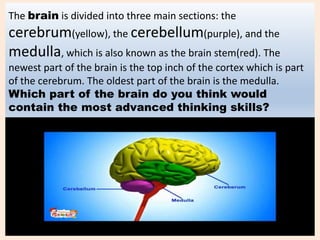
The brain is divided into three main sections: the
cerebrum(yellow), the cerebellum(purple), and the
medulla, which is also known as the brain stem(red). The
newest part of the brain is the top inch of the cortex which is part
of the cerebrum. The oldest part of the brain is the medulla.
Which part of the brain do you think would
contain the most advanced thinking skills?
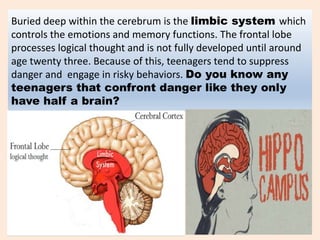
Buried deep within the cerebrum is the limbic system which
controls the emotions and memory functions. The frontal lobe
processes logical thought and is not fully developed until around
age twenty three. Because of this, teenagers tend to suppress
danger and engage in risky behaviors. Do you know any
teenagers that confront danger like they only
have half a brain?
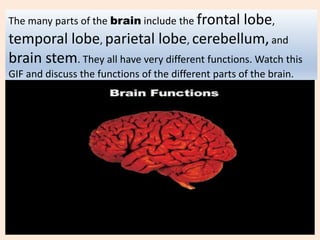
The many parts of the brain include the frontal lobe,
temporal lobe, parietal lobe, cerebellum,and
brain stem. They all have very different functions. Watch this
GIF and discuss the functions of the different parts of the brain.
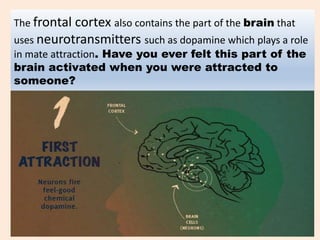
The frontal cortex also contains the part of the brain that
uses neurotransmitters such as dopamine which plays a role
in mate attraction. Have you ever felt this part of the
brain activated when you were attracted to
someone?
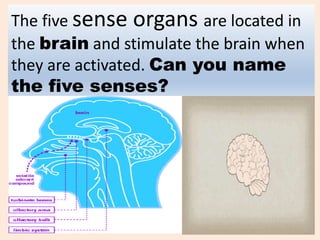
The five sense organs are located in
the brain and stimulate the brain when
they are activated. Can you name
the five senses?
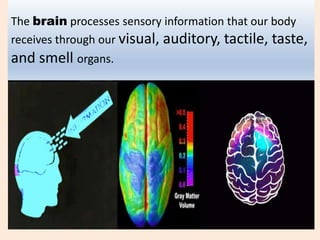
The brain processes sensory information that our body
receives through our visual, auditory, tactile, taste,
and smell organs.
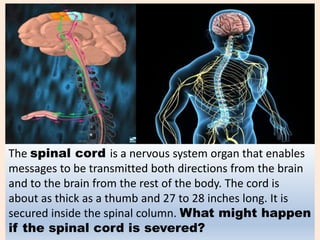
The spinal cord is a nervous system organ that enables
messages to be transmitted both directions from the brain
and to the brain from the rest of the body. The cord is
about as thick as a thumb and 27 to 28 inches long. It is
secured inside the spinal column. What might happen
if the spinal cord is severed?
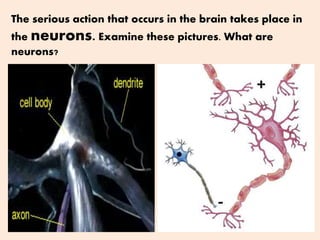
The serious action that occurs in the brain takes place in
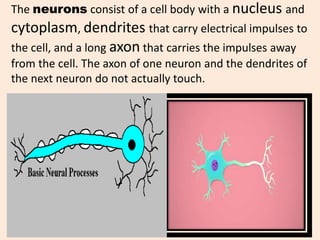
the neurons. Examine these pictures. What are
neurons?
The neurons consist of a cell body with a nucleus and
cytoplasm, dendrites that carry electrical impulses to
the cell, and a long axon that carries the impulses away
from the cell. The axon of one neuron and the dendrites of
the next neuron do not actually touch.
Generation of a nerve impulse(action potential) of a sensory
neuron occurs as a result of a stimulus such as a light, a particular
chemical, or stretching of a cell membrane by sound. Conduction
of an impulse along a neuron occurs from the dendrites to the
cell body to the axon.
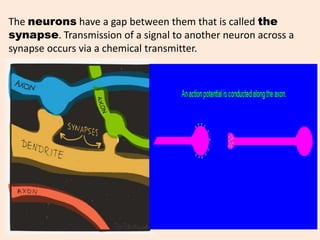
The neurons have a gap between them that is called the
synapse. Transmission of a signal to another neuron across a
synapse occurs via a chemical transmitter.
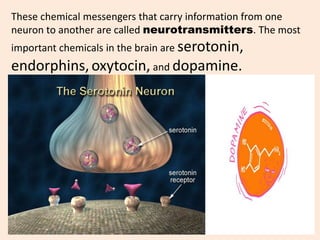
These chemical messengers that carry information from one
neuron to another are called neurotransmitters. The most
important chemicals in the brain are serotonin,
endorphins,oxytocin, and dopamine.
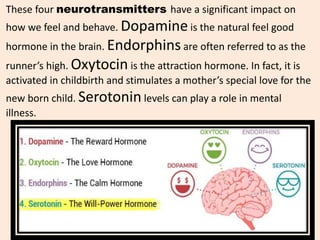
These four neurotransmitters have a significant impact on
how we feel and behave. Dopamine is the natural feel good
hormone in the brain. Endorphinsare often referred to as the
runner’s high. Oxytocin is the attraction hormone. In fact, it is
activated in childbirth and stimulates a mother’s special love for the
new born child. Serotonin levels can play a role in mental
illness.
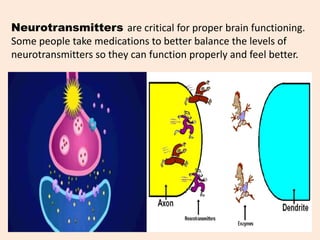
Neurotransmitters are critical for proper brain functioning.
Some people take medications to better balance the levels of
neurotransmitters so they can function properly and feel better.
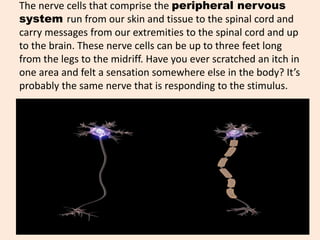
The nerve cells that comprise the peripheral nervous
system run from our skin and tissue to the spinal cord and
carry messages from our extremities to the spinal cord and up
to the brain. These nerve cells can be up to three feet long
from the legs to the midriff. Have you ever scratched an itch in
one area and felt a sensation somewhere else in the body? It’s
probably the same nerve that is responding to the stimulus.
When we take a closer look at why our brain may not function
properly, we can examine illnesses or trauma to the brain that
result in confusion, memory loss, or problems with physical
movement and coordination.
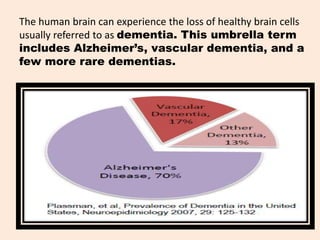
The human brain can experience the loss of healthy brain cells
usually referred to as dementia. This umbrella term
includes Alzheimer’s, vascular dementia, and a
few more rare dementias.
Scientists believe that both genetic and environmental
factors can determine a person’s risk for developing
dementia. They suspect that life style, such as exercise,
diet, and intellectual activities, probably plays a
significant role in the development of dementia.
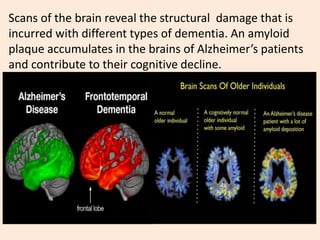
Scans of the brain reveal the structural damage that is
incurred with different types of dementia. An amyloid
plaque accumulates in the brains of Alzheimer’s patients
and contribute to their cognitive decline.
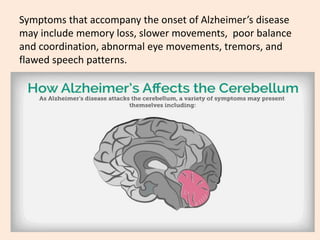
Symptoms that accompany the onset of Alzheimer’s disease
may include memory loss, slower movements, poor balance
and coordination, abnormal eye movements, tremors, and
flawed speech patterns.
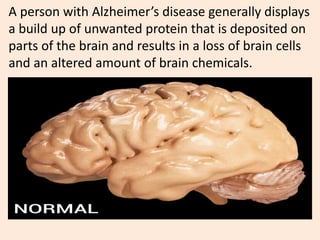
A person with Alzheimer’s disease generally displays
a build up of unwanted protein that is deposited on
parts of the brain and results in a loss of brain cells
and an altered amount of brain chemicals.
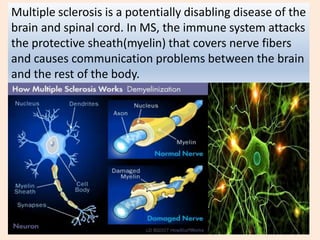
Multiple sclerosis is a potentially disabling disease of the
brain and spinal cord. In MS, the immune system attacks
the protective sheath(myelin) that covers nerve fibers
and causes communication problems between the brain
and the rest of the body.
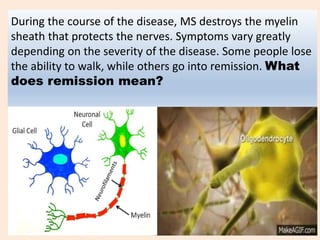
During the course of the disease, MS destroys the myelin
sheath that protects the nerves. Symptoms vary greatly
depending on the severity of the disease. Some people lose
the ability to walk, while others go into remission. What
does remission mean?
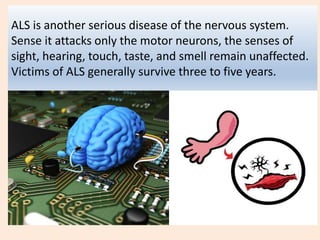
ALS is another serious disease of the nervous system.
Sense it attacks only the motor neurons, the senses of
sight, hearing, touch, taste, and smell remain unaffected.
Victims of ALS generally survive three to five years.
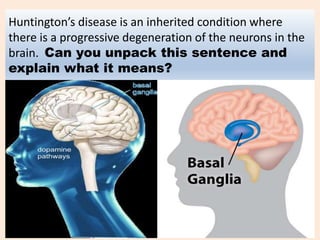
Huntington’s disease is an inherited condition where
there is a progressive degeneration of the neurons in the
brain. Can you unpack this sentence and
explain what it means?
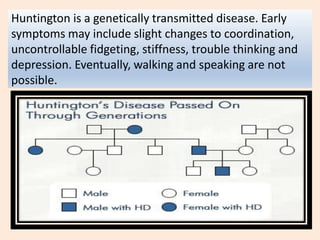
Huntington is a genetically transmitted disease. Early
symptoms may include slight changes to coordination,
uncontrollable fidgeting, stiffness, trouble thinking and
depression. Eventually, walking and speaking are not
possible.
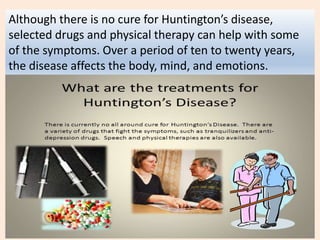
Although there is no cure for Huntington’s disease,
selected drugs and physical therapy can help with some
of the symptoms. Over a period of ten to twenty years,
the disease affects the body, mind, and emotions.
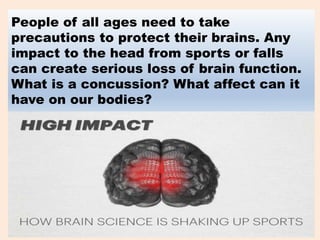
People of all ages need to take
precautions to protect their brains. Any
impact to the head from sports or falls
can create serious loss of brain function.
What is a concussion? What affect can it
have on our bodies?
Group Discussion
Meet in groups and discuss the following.
• 1. What are the major components of the
nervous system and how do they work?
• 2. Trace a stimulus from the finger to the brain.
Describe the route that neurons would take.
• 3. Describe some of the most serious diseases of
the nervous system.
Prepare to Write
Write an explanative essay
describing how the nervous system
works and how some diseases can
affect its proper functioning.
Human Brain: Structures and
Functions Excellent 5 mi9n
• https://www.youtube.com/watch?v=EeE7Fpg
061I
Parts of the Brain
6 min
• https://www.youtube.com/watch?v=jdJ5eq6i
NPA
What is a Neuron?
5 min Good
• https://www.youtube.com/watch?v=UDpydfp
Eads
How Do Nerves Work?
5 min
• https://www.youtube.com/watch?v=uU_4uA6
-zcE
Neurons and Functions
4 min
• https://www.youtube.com/watch?v=cUGuWh
2UeMk
The Human Body National Geographic
Good Overview 5 min
• https://www.youtube.com/watch?v=Ae4Mad
KPJC0
The Brain -National Geographic
Excellent 5 min
• https://www.youtube.com/watch?v=pRFXSjkp
KWA
How the Nervous System Works Rap
3 min
• https://www.youtube.com/watch?v=1uG0AEn
oLDU
How Does Your Brain Respond to Pain?
Ted Ed 6 min
• https://www.youtube.com/watch?v=I7wfDenj
6CQ

Dean r berry nervous system revised 6 6-18

  • 1.
    Illustrated and Animated TheNervous system By Dean Berry, Ed. D. The Teachers’ Choice Library
  • 2.
    • Free PowerPointat • Slideshare.com • Type PPT title or dean r berry
  • 3.
    Which body systemenables us to experience the environment around us, use our thinking processes to make decisions, and take necessary action? Can you explain how each one of these skills works in the human body? As we read, we will uncover the answer to these questions.
  • 4.
    The nervous systemis composed of the brain, the spinal cord, and the peripheral nerves that are spread throughout the body. How do you know if someone is pinching you if you are looking the other direction?
  • 5.
    The brain isthe master organ of the nervous system. All of the body systems and organs are under its control. Even the slightest injury to the brain can result in mental or physical malfunction. What is a concussion? How serious are some concussions?
  • 6.
    As humans evolved,their brains became significantly larger than chimpanzees and gorillas. The outer cerebral cortex became much thicker in order to support a much more sophisticated thinking process. Our brain is divided into hemispheres. How many hemispheres do you think the has?
  • 7.
    Our brain isdivided into two hemispheres, the left and the right hemisphere. While both hemispheres perform similar functions, the left tends to perform more language processing skills and the right tends to involve more creative thinking. Are any of you good at art or music? Who speaks more than one language?
  • 8.
    While it doesrequire both hemispheres of the brain, music and art ability tends to involve more of the right side of the brain.
  • 9.
    A large bundleof nerves, the corpus callosum, connects the two hemispheres of the brain. These neural strands enable all parts of the brain to work in unison.
  • 10.
    The brain isdivided into three main sections: the cerebrum(yellow), the cerebellum(purple), and the medulla, which is also known as the brain stem(red). The newest part of the brain is the top inch of the cortex which is part of the cerebrum. The oldest part of the brain is the medulla. Which part of the brain do you think would contain the most advanced thinking skills?
  • 11.
    Buried deep withinthe cerebrum is the limbic system which controls the emotions and memory functions. The frontal lobe processes logical thought and is not fully developed until around age twenty three. Because of this, teenagers tend to suppress danger and engage in risky behaviors. Do you know any teenagers that confront danger like they only have half a brain?
  • 12.
    The many partsof the brain include the frontal lobe, temporal lobe, parietal lobe, cerebellum,and brain stem. They all have very different functions. Watch this GIF and discuss the functions of the different parts of the brain.
  • 13.
    The frontal cortexalso contains the part of the brain that uses neurotransmitters such as dopamine which plays a role in mate attraction. Have you ever felt this part of the brain activated when you were attracted to someone?
  • 14.
    The five senseorgans are located in the brain and stimulate the brain when they are activated. Can you name the five senses?
  • 15.
    The brain processessensory information that our body receives through our visual, auditory, tactile, taste, and smell organs.
  • 16.
    The spinal cordis a nervous system organ that enables messages to be transmitted both directions from the brain and to the brain from the rest of the body. The cord is about as thick as a thumb and 27 to 28 inches long. It is secured inside the spinal column. What might happen if the spinal cord is severed?
  • 17.
    The serious actionthat occurs in the brain takes place in the neurons. Examine these pictures. What are neurons?
  • 18.
    The neurons consistof a cell body with a nucleus and cytoplasm, dendrites that carry electrical impulses to the cell, and a long axon that carries the impulses away from the cell. The axon of one neuron and the dendrites of the next neuron do not actually touch.
  • 19.
    Generation of anerve impulse(action potential) of a sensory neuron occurs as a result of a stimulus such as a light, a particular chemical, or stretching of a cell membrane by sound. Conduction of an impulse along a neuron occurs from the dendrites to the cell body to the axon.
  • 20.
    The neurons havea gap between them that is called the synapse. Transmission of a signal to another neuron across a synapse occurs via a chemical transmitter.
  • 21.
    These chemical messengersthat carry information from one neuron to another are called neurotransmitters. The most important chemicals in the brain are serotonin, endorphins,oxytocin, and dopamine.
  • 22.
    These four neurotransmittershave a significant impact on how we feel and behave. Dopamine is the natural feel good hormone in the brain. Endorphinsare often referred to as the runner’s high. Oxytocin is the attraction hormone. In fact, it is activated in childbirth and stimulates a mother’s special love for the new born child. Serotonin levels can play a role in mental illness.
  • 23.
    Neurotransmitters are criticalfor proper brain functioning. Some people take medications to better balance the levels of neurotransmitters so they can function properly and feel better.
  • 24.
    The nerve cellsthat comprise the peripheral nervous system run from our skin and tissue to the spinal cord and carry messages from our extremities to the spinal cord and up to the brain. These nerve cells can be up to three feet long from the legs to the midriff. Have you ever scratched an itch in one area and felt a sensation somewhere else in the body? It’s probably the same nerve that is responding to the stimulus.
  • 25.
    When we takea closer look at why our brain may not function properly, we can examine illnesses or trauma to the brain that result in confusion, memory loss, or problems with physical movement and coordination.
  • 26.
    The human braincan experience the loss of healthy brain cells usually referred to as dementia. This umbrella term includes Alzheimer’s, vascular dementia, and a few more rare dementias.
  • 27.
    Scientists believe thatboth genetic and environmental factors can determine a person’s risk for developing dementia. They suspect that life style, such as exercise, diet, and intellectual activities, probably plays a significant role in the development of dementia.
  • 28.
    Scans of thebrain reveal the structural damage that is incurred with different types of dementia. An amyloid plaque accumulates in the brains of Alzheimer’s patients and contribute to their cognitive decline.
  • 29.
    Symptoms that accompanythe onset of Alzheimer’s disease may include memory loss, slower movements, poor balance and coordination, abnormal eye movements, tremors, and flawed speech patterns.
  • 30.
    A person withAlzheimer’s disease generally displays a build up of unwanted protein that is deposited on parts of the brain and results in a loss of brain cells and an altered amount of brain chemicals.
  • 31.
    Multiple sclerosis isa potentially disabling disease of the brain and spinal cord. In MS, the immune system attacks the protective sheath(myelin) that covers nerve fibers and causes communication problems between the brain and the rest of the body.
  • 32.
    During the courseof the disease, MS destroys the myelin sheath that protects the nerves. Symptoms vary greatly depending on the severity of the disease. Some people lose the ability to walk, while others go into remission. What does remission mean?
  • 33.
    ALS is anotherserious disease of the nervous system. Sense it attacks only the motor neurons, the senses of sight, hearing, touch, taste, and smell remain unaffected. Victims of ALS generally survive three to five years.
  • 34.
    Huntington’s disease isan inherited condition where there is a progressive degeneration of the neurons in the brain. Can you unpack this sentence and explain what it means?
  • 35.
    Huntington is agenetically transmitted disease. Early symptoms may include slight changes to coordination, uncontrollable fidgeting, stiffness, trouble thinking and depression. Eventually, walking and speaking are not possible.
  • 36.
    Although there isno cure for Huntington’s disease, selected drugs and physical therapy can help with some of the symptoms. Over a period of ten to twenty years, the disease affects the body, mind, and emotions.
  • 37.
    People of allages need to take precautions to protect their brains. Any impact to the head from sports or falls can create serious loss of brain function. What is a concussion? What affect can it have on our bodies?
  • 38.
    Group Discussion Meet ingroups and discuss the following. • 1. What are the major components of the nervous system and how do they work? • 2. Trace a stimulus from the finger to the brain. Describe the route that neurons would take. • 3. Describe some of the most serious diseases of the nervous system.
  • 39.
    Prepare to Write Writean explanative essay describing how the nervous system works and how some diseases can affect its proper functioning.
  • 40.
    Human Brain: Structuresand Functions Excellent 5 mi9n • https://www.youtube.com/watch?v=EeE7Fpg 061I
  • 41.
    Parts of theBrain 6 min • https://www.youtube.com/watch?v=jdJ5eq6i NPA
  • 42.
    What is aNeuron? 5 min Good • https://www.youtube.com/watch?v=UDpydfp Eads
  • 43.
    How Do NervesWork? 5 min • https://www.youtube.com/watch?v=uU_4uA6 -zcE
  • 44.
    Neurons and Functions 4min • https://www.youtube.com/watch?v=cUGuWh 2UeMk
  • 45.
    The Human BodyNational Geographic Good Overview 5 min • https://www.youtube.com/watch?v=Ae4Mad KPJC0
  • 46.
    The Brain -NationalGeographic Excellent 5 min • https://www.youtube.com/watch?v=pRFXSjkp KWA
  • 47.
    How the NervousSystem Works Rap 3 min • https://www.youtube.com/watch?v=1uG0AEn oLDU
  • 48.
    How Does YourBrain Respond to Pain? Ted Ed 6 min • https://www.youtube.com/watch?v=I7wfDenj 6CQ