Dealing with the Difficult Caller
TRIAGE LOGIC TRAINING 2013
Definition
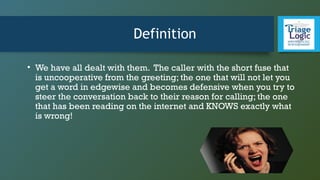
• We have all dealt with them. The caller with the short fuse that
is uncooperative from the greeting; the one that will not let you
get a word in edgewise and becomes defensive when you try to
steer the conversation back to their reason for calling; the one
that has been reading on the internet and KNOWS exactly what
is wrong!
Who are they?
• You know who they are- they are the
parent/patient that is tired, stressed out, anxious
and worried about their health or a sick child
ITS NOT PERSONAL
• These callers are not targeting you specifically, you just
happen to be in the line of fire. Being sick or having a sick
child (either acute, chronic or both) is stressful, tiring and
nerve wracking. By the time the person has called the
nurse line, many are near the end of their ropes. They may
have talked to neighbors, grandparents and read on the
internet about their symptoms- all of their efforts have not
worked and now they are callingYOU!
You have 2 choices
• A) You can fire back! “Doesn’t that caller know its been a long
day for you also?” Maybe you are tired, stressed out and in need
of a well deserved vacation. “DON’T THEY APPRECIATE
ANYTHING YOU ARE DOING FOR THEM?!?!”
OR
• B) You can cut them some slack.Take a deep breath (silently, of
course!), let them vent for a minute then ask “You sound worried,
what can I do to help you tonight”.
Identify the type of caller before
triaging
• If your caller is difficult to talk with and is calling about a sick
child, they may be angry, demanding, extremely worried,
confused or overwhelmed by other emotions
• Attempt to triage the patient with the appropriate symptom
guideline before using the Difficult Caller Guideline.
Different caller concerns use
different guidelines
• Angry or rude caller
• Caller demands to speak with physician
• Overly worried caller
What protocol would you use?
Angry or Rude Caller
• Description: Parent is angry, hostile, rude or verbally abusive.
• Verbal response: Many of these parents need 2 to 3 minutes to vent to a
sympathetic listener about whatever has upset them, after which time they
become more reasonable. Make helpful comments such as "Tell me about it”,
“That would be upsetting to anyone”, or “Was there anything else?“
• Do not criticize the parent`s comments or offer any excuses for what took
place. If appropriate, apologize.
• Disposition: Home Care for most. If the parent continues to be angry after 5
minutes of counseling, transfer the call to the physician.
Caller Demands To Speak With
Physician
• Description: A parent demands to speak with the child`s PCP even
though you could probably help them.
• Disposition:Try to help caller solve their problem; try to clarify what they
are calling about, e.g., “Do you have a specific question I could try to
help you with? We use guidelines and standard advice that has been
approved by your doctor."
• If unsuccessful, offer to page the MD on call.Tell the caller: “I will page
your physician for you, please callback if you have not heard from
him/her in 30 minutes”.
• If the caller becomes more demanding, don`t argue with him. Let the
physician inform the parent that the call easily could have been handled
by a trained triage nurse or waited until morning (ie non-urgent
requests).
Overly Worried Caller
• Description: A caller that is unduly worried or anxious
about their condition and cannot be reassured with
telephone advice.The triage nurse is certain the child is
fine. Disposition: Offer to have them seen within 24 hours
by the primary care physician. If that is not sufficient, page
the on-call physician for assistance. If the patient calls
back with additional concerns soon after the initial call has
ended, it can be assumed that they probably need to be
seen sooner.
Tips for Dealing with the Difficult Caller
Important phone etiquette to sooth
the angry caller
 Do not use slang or poor language. Never use swear words.
 If there is a problem, be concerned, empathetic, and apologetic
(even if it is not your error)
 Do not give the impression you are rushed or uninterested
 Never engage in an argument with the caller.
Source: Dialogue January/February 2011 (these tips were compiled from a hodgepodge
of websites, including Ezine, OfficeSkills and Buzzle)
Phone etiquette, cont.
• Practice good listening skills
• Always use a pleasant, congenial and friendly tone.
• Never interrupt the person while he/she is talking to you (although there
may be a few exceptions to this…)
• When hanging up the phone, make sure the caller or person who called
hangs up first
Source: Dialogue January/February 2011 (these tips were compiled from a hodgepodge of websites, including
Ezine, OfficeSkills and Buzzle)
Do not argue with them
• Do not take the anger personally. Many parents who
are angry are often frustrated, fearful and concerned.
Let the caller express their issue without
interrupting. Do not argue.
• Note all important details of the caller’s
issue/concern. Repeat the facts to the caller to verify
accuracy.
Listen
• Listen closely and acknowledge how the person is feeling, e.g.,
“I can imagine how frustrating this has been for you.”
• Identify the expectation of the caller. What do they want? In what
time frame? Do they expect a response from a specific
department or individual?
 
Offer suggestions
• Offer suggestions. Let them know what you can do and what you
need from them. Move to a positive solution. “I will notify your
physician and have him call you as soon as possible.” “I will
notify your physician that you will be calling the office in the
morning.”
Document, document, document
• Document the callers behavior using objective statements and
use direct quotes as much as possible. Avoid using labels such
as “nasty” or “angry.” You may document that their tone of voice
is stern or that they are speaking loudly, swearing, etc. Try to
describe the callers behavior accurately.
Use the Notes Section
• Documentation of the callers behavior should be done in the
notes section of the call form, not in the assessment. Remember,
the assessment is used for subjective information from the
parent concerning the child’s symptoms, not objective
observations by the nurse.

Dealing with the difficult caller

  • 1.
    Dealing with theDifficult Caller TRIAGE LOGIC TRAINING 2013
  • 2.
    Definition • We haveall dealt with them. The caller with the short fuse that is uncooperative from the greeting; the one that will not let you get a word in edgewise and becomes defensive when you try to steer the conversation back to their reason for calling; the one that has been reading on the internet and KNOWS exactly what is wrong!
  • 3.
    Who are they? •You know who they are- they are the parent/patient that is tired, stressed out, anxious and worried about their health or a sick child
  • 4.
    ITS NOT PERSONAL •These callers are not targeting you specifically, you just happen to be in the line of fire. Being sick or having a sick child (either acute, chronic or both) is stressful, tiring and nerve wracking. By the time the person has called the nurse line, many are near the end of their ropes. They may have talked to neighbors, grandparents and read on the internet about their symptoms- all of their efforts have not worked and now they are callingYOU!
  • 5.
    You have 2choices • A) You can fire back! “Doesn’t that caller know its been a long day for you also?” Maybe you are tired, stressed out and in need of a well deserved vacation. “DON’T THEY APPRECIATE ANYTHING YOU ARE DOING FOR THEM?!?!” OR • B) You can cut them some slack.Take a deep breath (silently, of course!), let them vent for a minute then ask “You sound worried, what can I do to help you tonight”.
  • 6.
    Identify the typeof caller before triaging • If your caller is difficult to talk with and is calling about a sick child, they may be angry, demanding, extremely worried, confused or overwhelmed by other emotions • Attempt to triage the patient with the appropriate symptom guideline before using the Difficult Caller Guideline.
  • 7.
    Different caller concernsuse different guidelines • Angry or rude caller • Caller demands to speak with physician • Overly worried caller What protocol would you use?
  • 8.
    Angry or RudeCaller • Description: Parent is angry, hostile, rude or verbally abusive. • Verbal response: Many of these parents need 2 to 3 minutes to vent to a sympathetic listener about whatever has upset them, after which time they become more reasonable. Make helpful comments such as "Tell me about it”, “That would be upsetting to anyone”, or “Was there anything else?“ • Do not criticize the parent`s comments or offer any excuses for what took place. If appropriate, apologize. • Disposition: Home Care for most. If the parent continues to be angry after 5 minutes of counseling, transfer the call to the physician.
  • 9.
    Caller Demands ToSpeak With Physician • Description: A parent demands to speak with the child`s PCP even though you could probably help them. • Disposition:Try to help caller solve their problem; try to clarify what they are calling about, e.g., “Do you have a specific question I could try to help you with? We use guidelines and standard advice that has been approved by your doctor." • If unsuccessful, offer to page the MD on call.Tell the caller: “I will page your physician for you, please callback if you have not heard from him/her in 30 minutes”. • If the caller becomes more demanding, don`t argue with him. Let the physician inform the parent that the call easily could have been handled by a trained triage nurse or waited until morning (ie non-urgent requests).
  • 10.
    Overly Worried Caller •Description: A caller that is unduly worried or anxious about their condition and cannot be reassured with telephone advice.The triage nurse is certain the child is fine. Disposition: Offer to have them seen within 24 hours by the primary care physician. If that is not sufficient, page the on-call physician for assistance. If the patient calls back with additional concerns soon after the initial call has ended, it can be assumed that they probably need to be seen sooner.
  • 11.
    Tips for Dealingwith the Difficult Caller
  • 12.
    Important phone etiquetteto sooth the angry caller  Do not use slang or poor language. Never use swear words.  If there is a problem, be concerned, empathetic, and apologetic (even if it is not your error)  Do not give the impression you are rushed or uninterested  Never engage in an argument with the caller. Source: Dialogue January/February 2011 (these tips were compiled from a hodgepodge of websites, including Ezine, OfficeSkills and Buzzle)
  • 13.
    Phone etiquette, cont. •Practice good listening skills • Always use a pleasant, congenial and friendly tone. • Never interrupt the person while he/she is talking to you (although there may be a few exceptions to this…) • When hanging up the phone, make sure the caller or person who called hangs up first Source: Dialogue January/February 2011 (these tips were compiled from a hodgepodge of websites, including Ezine, OfficeSkills and Buzzle)
  • 14.
    Do not arguewith them • Do not take the anger personally. Many parents who are angry are often frustrated, fearful and concerned. Let the caller express their issue without interrupting. Do not argue. • Note all important details of the caller’s issue/concern. Repeat the facts to the caller to verify accuracy.
  • 15.
    Listen • Listen closelyand acknowledge how the person is feeling, e.g., “I can imagine how frustrating this has been for you.” • Identify the expectation of the caller. What do they want? In what time frame? Do they expect a response from a specific department or individual?  
  • 16.
    Offer suggestions • Offersuggestions. Let them know what you can do and what you need from them. Move to a positive solution. “I will notify your physician and have him call you as soon as possible.” “I will notify your physician that you will be calling the office in the morning.”
  • 17.
    Document, document, document •Document the callers behavior using objective statements and use direct quotes as much as possible. Avoid using labels such as “nasty” or “angry.” You may document that their tone of voice is stern or that they are speaking loudly, swearing, etc. Try to describe the callers behavior accurately.
  • 18.
    Use the NotesSection • Documentation of the callers behavior should be done in the notes section of the call form, not in the assessment. Remember, the assessment is used for subjective information from the parent concerning the child’s symptoms, not objective observations by the nurse.