DEA Scheduling ofDEA Scheduling of
MedicationsMedications
Lori Dewey, MSN, PMHCNS-BCLori Dewey, MSN, PMHCNS-BC
October, 2014October, 2014
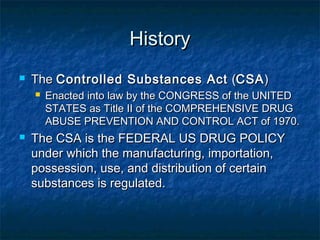
HistoryHistory
 TheThe Controlled Substances ActControlled Substances Act ((CSACSA))
 Enacted into law by the CONGRESS of the UNITEDEnacted into law by the CONGRESS of the UNITED
STATES as Title II of the COMPREHENSIVE DRUGSTATES as Title II of the COMPREHENSIVE DRUG
ABUSE PREVENTION AND CONTROL ACT of 1970.ABUSE PREVENTION AND CONTROL ACT of 1970.
 The CSA is the FEDERAL US DRUG POLICYThe CSA is the FEDERAL US DRUG POLICY
under which the manufacturing, importation,under which the manufacturing, importation,
possession, use, and distribution of certainpossession, use, and distribution of certain
substances is regulated.substances is regulated.
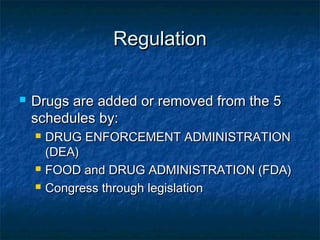
RegulationRegulation
 Drugs are added or removed from the 5Drugs are added or removed from the 5
schedules by:schedules by:
 DRUG ENFORCEMENT ADMINISTRATIONDRUG ENFORCEMENT ADMINISTRATION
(DEA)(DEA)
 FOOD and DRUG ADMINISTRATION (FDA)FOOD and DRUG ADMINISTRATION (FDA)
 Congress through legislationCongress through legislation
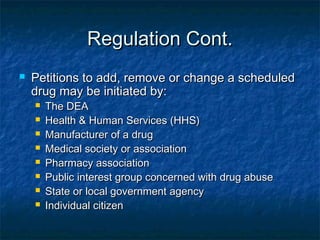
Regulation Cont.Regulation Cont.
 Petitions to add, remove or change a scheduledPetitions to add, remove or change a scheduled
drug may be initiated by:drug may be initiated by:
 The DEAThe DEA
 Health & Human Services (HHS)Health & Human Services (HHS)
 Manufacturer of a drugManufacturer of a drug
 Medical society or associationMedical society or association
 Pharmacy associationPharmacy association
 Public interest group concerned with drug abusePublic interest group concerned with drug abuse
 State or local government agencyState or local government agency
 Individual citizenIndividual citizen
Schedule ISchedule I
 The drug or other substance has a high potentialThe drug or other substance has a high potential
for abuse.for abuse.
 The drug or other substance has no currentlyThe drug or other substance has no currently
accepted medical use in treatment in the Unitedaccepted medical use in treatment in the United
States.States.
 There is a lack of accepted safety for use of theThere is a lack of accepted safety for use of the
drug or other substance under medicaldrug or other substance under medical
supervision.supervision.
 No prescriptions may be written for Schedule INo prescriptions may be written for Schedule I
substances, and such substances are subject tosubstances, and such substances are subject to
production quotas by the DEA.production quotas by the DEA.
Schedule IISchedule II
 The drug or other substance has a high potentialThe drug or other substance has a high potential
for abuse.for abuse.
 The drug or other substance has a currentlyThe drug or other substance has a currently
accepted medical use in treatment in the Unitedaccepted medical use in treatment in the United
States or a currently accepted medical use withStates or a currently accepted medical use with
severe restrictions.severe restrictions.
 Abuse of the drug or other substances may leadAbuse of the drug or other substances may lead
to severe psychological or physical dependence.to severe psychological or physical dependence.
Schedule II Cont.Schedule II Cont.
 Except when dispensed directly by a practitioner, otherExcept when dispensed directly by a practitioner, other
than a pharmacist, to an ultimate user, no controlledthan a pharmacist, to an ultimate user, no controlled
substance in schedule II may be dispensed without thesubstance in schedule II may be dispensed without the
written prescription of a practitioner, except that inwritten prescription of a practitioner, except that in
emergency situations, as prescribed by the Secretary byemergency situations, as prescribed by the Secretary by
regulation after consultation with the Attorney General.regulation after consultation with the Attorney General.
 Prescriptions shall be retained in conformity with thePrescriptions shall be retained in conformity with the
requirements of section 827 of this title.requirements of section 827 of this title.
 No prescription for a controlled substance in schedule IINo prescription for a controlled substance in schedule II
may be refilled.may be refilled.
Schedule II Cont.Schedule II Cont.
 Examples of Schedule II Drugs:Examples of Schedule II Drugs:
 Amphetamine (Adderall)Amphetamine (Adderall)
 Pure codeine & any drug containing the equivalent of more thanPure codeine & any drug containing the equivalent of more than
90 mg of codeine per dosage unit90 mg of codeine per dosage unit
 Dexmethylfenidate (Focalin)Dexmethylfenidate (Focalin)
 FentanylFentanyl
 Hydromorphone (Dilaudid)Hydromorphone (Dilaudid)
 Lisdexamfetamine (Vyvanse)Lisdexamfetamine (Vyvanse)
 Meperidine (Demerol)Meperidine (Demerol)
 MethadoneMethadone
 MorphineMorphine
 Methylphenidate (Ritalin, Concerta)Methylphenidate (Ritalin, Concerta)
 Oxycodone (Percocet)Oxycodone (Percocet)
Schedule II Cont.Schedule II Cont.
 Under new current law, Ohio’s advancedUnder new current law, Ohio’s advanced
practice nurses can prescribe Schedule IIpractice nurses can prescribe Schedule II
medications in accordance with theirmedications in accordance with their
formulary and Standard Careformulary and Standard Care
Arrangement.Arrangement.
 Thirty-two states now allow APNs to
prescribe Schedule II medications without
restrictions.
 Vicodin will become Schedule II this year.Vicodin will become Schedule II this year.
Schedule IIISchedule III
 The drug or other substance has a potential forThe drug or other substance has a potential for
abuse less than the drugs or other substances inabuse less than the drugs or other substances in
schedules I and II.schedules I and II.
 The drug or other substance has a currentlyThe drug or other substance has a currently
accepted medical use in treatment in the Unitedaccepted medical use in treatment in the United
States.States.
 Abuse of the drug or other substance may leadAbuse of the drug or other substance may lead
to moderate or low physical dependence or highto moderate or low physical dependence or high
psychological dependence.psychological dependence.
Schedule III Cont.Schedule III Cont.
 In Ohio, APNs can prescribe Schedule IIIIn Ohio, APNs can prescribe Schedule III
drugs under the provisions detailed in thedrugs under the provisions detailed in the
formularyformulary
Schedule III Cont.Schedule III Cont.
 Examples of Schedule III drugs:Examples of Schedule III drugs:
 Codeine (mixed w/ NSAID)Codeine (mixed w/ NSAID)
 Buprenorphine (Suboxone)Buprenorphine (Suboxone)
Schedule IVSchedule IV
 These drugs have been found to have aThese drugs have been found to have a
low potential for abuse relative to drugs inlow potential for abuse relative to drugs in
Schedule III; recognized medical uses;Schedule III; recognized medical uses;
and a low risk of dependence relative toand a low risk of dependence relative to
drugs in Schedule III. These are controlleddrugs in Schedule III. These are controlled
similarly to Schedule III drugs.similarly to Schedule III drugs.
 Tramadol is now Schedule IV drug.Tramadol is now Schedule IV drug.
 Previously not controlled, but was reported onPreviously not controlled, but was reported on
OAARSOAARS
Schedule IVSchedule IV
 Examples of Schedule IV drugs:Examples of Schedule IV drugs:
 XanaxXanax
 KlonopinKlonopin
 ValiumValium
 AtivanAtivan
 RestorilRestoril
 SonataSonata
 AmbienAmbien
 libriumlibrium
 TalwinTalwin
 PhenteraminePhenteramine
 MeridaMerida
Schedule VSchedule V
 These drugs have been found to have aThese drugs have been found to have a
lower potential for abuse relative to drugslower potential for abuse relative to drugs
in Schedule IV and a small incidence ofin Schedule IV and a small incidence of
physical or psychological dependence.physical or psychological dependence.
These are sometimes available without aThese are sometimes available without a
prescriptionprescription
Schedule VSchedule V
 Examples of Schedule V drugs:Examples of Schedule V drugs:
 Cough suppressants with small amounts ofCough suppressants with small amounts of
codeinecodeine
 Preparations to treat diarrheaPreparations to treat diarrhea
PREVIOUS PI/PCPREVIOUS PI/PC
STIPULATIONSSTIPULATIONS
 This year, the OBN has removed theThis year, the OBN has removed the
PI/PC requirements, and have insteadPI/PC requirements, and have instead
elected to reference SCA.elected to reference SCA.
 Major changeMajor change
 In line with advocacy for autonomy inIn line with advocacy for autonomy in
Advanced Practice NursingAdvanced Practice Nursing
Ohio Board of NursingOhio Board of Nursing
Formulary Cont.:Formulary Cont.:
**Off-Label Use: A medication may be prescribed**Off-Label Use: A medication may be prescribed
for purposes other than FDA (Food and Drugfor purposes other than FDA (Food and Drug
Administration) indications when the purpose isAdministration) indications when the purpose is
supported by current peer review literature (tosupported by current peer review literature (to
be produced by the CTP/CTP-E holder uponbe produced by the CTP/CTP-E holder upon
request which emanates from a recognized bodyrequest which emanates from a recognized body
of knowledge and as provided in the standardof knowledge and as provided in the standard
care arrangement consistent with the formulary.care arrangement consistent with the formulary.
Ohio Board of NursingOhio Board of Nursing
Formulary Cont.:Formulary Cont.:
 Combination Medication Preparations: InCombination Medication Preparations: In
order to prescribe a combination drug,order to prescribe a combination drug,
 EACH of the component drugs must beEACH of the component drugs must be
"CTP holder may prescribe" in order for"CTP holder may prescribe" in order for
the APNthe APN
 Prescriber to order the combinationPrescriber to order the combination
medication.medication.
ReferencesReferences
 Board of Nursing - www.nursing.ohio.govBoard of Nursing - www.nursing.ohio.gov
 OOAPN-OOAPN-
http://www.oaapn.org/ABCs_of_Ohio_Law.pdfhttp://www.oaapn.org/ABCs_of_Ohio_Law.pdf
 Ohio Board of Nursing Formulary -Ohio Board of Nursing Formulary -
http://www.nursing.ohio.gov/PDFS/AdvPractice/Formhttp://www.nursing.ohio.gov/PDFS/AdvPractice/Form
 U.S DEA -U.S DEA -
http://www.justice.gov/dea/pubs/scheduling.htmlhttp://www.justice.gov/dea/pubs/scheduling.html

DEA Scheduling of Medications

  • 1.
    DEA Scheduling ofDEAScheduling of MedicationsMedications Lori Dewey, MSN, PMHCNS-BCLori Dewey, MSN, PMHCNS-BC October, 2014October, 2014
  • 2.
    HistoryHistory  TheThe ControlledSubstances ActControlled Substances Act ((CSACSA))  Enacted into law by the CONGRESS of the UNITEDEnacted into law by the CONGRESS of the UNITED STATES as Title II of the COMPREHENSIVE DRUGSTATES as Title II of the COMPREHENSIVE DRUG ABUSE PREVENTION AND CONTROL ACT of 1970.ABUSE PREVENTION AND CONTROL ACT of 1970.  The CSA is the FEDERAL US DRUG POLICYThe CSA is the FEDERAL US DRUG POLICY under which the manufacturing, importation,under which the manufacturing, importation, possession, use, and distribution of certainpossession, use, and distribution of certain substances is regulated.substances is regulated.
  • 3.
    RegulationRegulation  Drugs areadded or removed from the 5Drugs are added or removed from the 5 schedules by:schedules by:  DRUG ENFORCEMENT ADMINISTRATIONDRUG ENFORCEMENT ADMINISTRATION (DEA)(DEA)  FOOD and DRUG ADMINISTRATION (FDA)FOOD and DRUG ADMINISTRATION (FDA)  Congress through legislationCongress through legislation
  • 4.
    Regulation Cont.Regulation Cont. Petitions to add, remove or change a scheduledPetitions to add, remove or change a scheduled drug may be initiated by:drug may be initiated by:  The DEAThe DEA  Health & Human Services (HHS)Health & Human Services (HHS)  Manufacturer of a drugManufacturer of a drug  Medical society or associationMedical society or association  Pharmacy associationPharmacy association  Public interest group concerned with drug abusePublic interest group concerned with drug abuse  State or local government agencyState or local government agency  Individual citizenIndividual citizen
  • 5.
    Schedule ISchedule I The drug or other substance has a high potentialThe drug or other substance has a high potential for abuse.for abuse.  The drug or other substance has no currentlyThe drug or other substance has no currently accepted medical use in treatment in the Unitedaccepted medical use in treatment in the United States.States.  There is a lack of accepted safety for use of theThere is a lack of accepted safety for use of the drug or other substance under medicaldrug or other substance under medical supervision.supervision.  No prescriptions may be written for Schedule INo prescriptions may be written for Schedule I substances, and such substances are subject tosubstances, and such substances are subject to production quotas by the DEA.production quotas by the DEA.
  • 6.
    Schedule IISchedule II The drug or other substance has a high potentialThe drug or other substance has a high potential for abuse.for abuse.  The drug or other substance has a currentlyThe drug or other substance has a currently accepted medical use in treatment in the Unitedaccepted medical use in treatment in the United States or a currently accepted medical use withStates or a currently accepted medical use with severe restrictions.severe restrictions.  Abuse of the drug or other substances may leadAbuse of the drug or other substances may lead to severe psychological or physical dependence.to severe psychological or physical dependence.
  • 7.
    Schedule II Cont.ScheduleII Cont.  Except when dispensed directly by a practitioner, otherExcept when dispensed directly by a practitioner, other than a pharmacist, to an ultimate user, no controlledthan a pharmacist, to an ultimate user, no controlled substance in schedule II may be dispensed without thesubstance in schedule II may be dispensed without the written prescription of a practitioner, except that inwritten prescription of a practitioner, except that in emergency situations, as prescribed by the Secretary byemergency situations, as prescribed by the Secretary by regulation after consultation with the Attorney General.regulation after consultation with the Attorney General.  Prescriptions shall be retained in conformity with thePrescriptions shall be retained in conformity with the requirements of section 827 of this title.requirements of section 827 of this title.  No prescription for a controlled substance in schedule IINo prescription for a controlled substance in schedule II may be refilled.may be refilled.
  • 8.
    Schedule II Cont.ScheduleII Cont.  Examples of Schedule II Drugs:Examples of Schedule II Drugs:  Amphetamine (Adderall)Amphetamine (Adderall)  Pure codeine & any drug containing the equivalent of more thanPure codeine & any drug containing the equivalent of more than 90 mg of codeine per dosage unit90 mg of codeine per dosage unit  Dexmethylfenidate (Focalin)Dexmethylfenidate (Focalin)  FentanylFentanyl  Hydromorphone (Dilaudid)Hydromorphone (Dilaudid)  Lisdexamfetamine (Vyvanse)Lisdexamfetamine (Vyvanse)  Meperidine (Demerol)Meperidine (Demerol)  MethadoneMethadone  MorphineMorphine  Methylphenidate (Ritalin, Concerta)Methylphenidate (Ritalin, Concerta)  Oxycodone (Percocet)Oxycodone (Percocet)
  • 9.
    Schedule II Cont.ScheduleII Cont.  Under new current law, Ohio’s advancedUnder new current law, Ohio’s advanced practice nurses can prescribe Schedule IIpractice nurses can prescribe Schedule II medications in accordance with theirmedications in accordance with their formulary and Standard Careformulary and Standard Care Arrangement.Arrangement.  Thirty-two states now allow APNs to prescribe Schedule II medications without restrictions.  Vicodin will become Schedule II this year.Vicodin will become Schedule II this year.
  • 10.
    Schedule IIISchedule III The drug or other substance has a potential forThe drug or other substance has a potential for abuse less than the drugs or other substances inabuse less than the drugs or other substances in schedules I and II.schedules I and II.  The drug or other substance has a currentlyThe drug or other substance has a currently accepted medical use in treatment in the Unitedaccepted medical use in treatment in the United States.States.  Abuse of the drug or other substance may leadAbuse of the drug or other substance may lead to moderate or low physical dependence or highto moderate or low physical dependence or high psychological dependence.psychological dependence.
  • 11.
    Schedule III Cont.ScheduleIII Cont.  In Ohio, APNs can prescribe Schedule IIIIn Ohio, APNs can prescribe Schedule III drugs under the provisions detailed in thedrugs under the provisions detailed in the formularyformulary
  • 12.
    Schedule III Cont.ScheduleIII Cont.  Examples of Schedule III drugs:Examples of Schedule III drugs:  Codeine (mixed w/ NSAID)Codeine (mixed w/ NSAID)  Buprenorphine (Suboxone)Buprenorphine (Suboxone)
  • 13.
    Schedule IVSchedule IV These drugs have been found to have aThese drugs have been found to have a low potential for abuse relative to drugs inlow potential for abuse relative to drugs in Schedule III; recognized medical uses;Schedule III; recognized medical uses; and a low risk of dependence relative toand a low risk of dependence relative to drugs in Schedule III. These are controlleddrugs in Schedule III. These are controlled similarly to Schedule III drugs.similarly to Schedule III drugs.  Tramadol is now Schedule IV drug.Tramadol is now Schedule IV drug.  Previously not controlled, but was reported onPreviously not controlled, but was reported on OAARSOAARS
  • 14.
    Schedule IVSchedule IV Examples of Schedule IV drugs:Examples of Schedule IV drugs:  XanaxXanax  KlonopinKlonopin  ValiumValium  AtivanAtivan  RestorilRestoril  SonataSonata  AmbienAmbien  libriumlibrium  TalwinTalwin  PhenteraminePhenteramine  MeridaMerida
  • 15.
    Schedule VSchedule V These drugs have been found to have aThese drugs have been found to have a lower potential for abuse relative to drugslower potential for abuse relative to drugs in Schedule IV and a small incidence ofin Schedule IV and a small incidence of physical or psychological dependence.physical or psychological dependence. These are sometimes available without aThese are sometimes available without a prescriptionprescription
  • 16.
    Schedule VSchedule V Examples of Schedule V drugs:Examples of Schedule V drugs:  Cough suppressants with small amounts ofCough suppressants with small amounts of codeinecodeine  Preparations to treat diarrheaPreparations to treat diarrhea
  • 17.
    PREVIOUS PI/PCPREVIOUS PI/PC STIPULATIONSSTIPULATIONS This year, the OBN has removed theThis year, the OBN has removed the PI/PC requirements, and have insteadPI/PC requirements, and have instead elected to reference SCA.elected to reference SCA.  Major changeMajor change  In line with advocacy for autonomy inIn line with advocacy for autonomy in Advanced Practice NursingAdvanced Practice Nursing
  • 18.
    Ohio Board ofNursingOhio Board of Nursing Formulary Cont.:Formulary Cont.: **Off-Label Use: A medication may be prescribed**Off-Label Use: A medication may be prescribed for purposes other than FDA (Food and Drugfor purposes other than FDA (Food and Drug Administration) indications when the purpose isAdministration) indications when the purpose is supported by current peer review literature (tosupported by current peer review literature (to be produced by the CTP/CTP-E holder uponbe produced by the CTP/CTP-E holder upon request which emanates from a recognized bodyrequest which emanates from a recognized body of knowledge and as provided in the standardof knowledge and as provided in the standard care arrangement consistent with the formulary.care arrangement consistent with the formulary.
  • 19.
    Ohio Board ofNursingOhio Board of Nursing Formulary Cont.:Formulary Cont.:  Combination Medication Preparations: InCombination Medication Preparations: In order to prescribe a combination drug,order to prescribe a combination drug,  EACH of the component drugs must beEACH of the component drugs must be "CTP holder may prescribe" in order for"CTP holder may prescribe" in order for the APNthe APN  Prescriber to order the combinationPrescriber to order the combination medication.medication.
  • 20.
    ReferencesReferences  Board ofNursing - www.nursing.ohio.govBoard of Nursing - www.nursing.ohio.gov  OOAPN-OOAPN- http://www.oaapn.org/ABCs_of_Ohio_Law.pdfhttp://www.oaapn.org/ABCs_of_Ohio_Law.pdf  Ohio Board of Nursing Formulary -Ohio Board of Nursing Formulary - http://www.nursing.ohio.gov/PDFS/AdvPractice/Formhttp://www.nursing.ohio.gov/PDFS/AdvPractice/Form  U.S DEA -U.S DEA - http://www.justice.gov/dea/pubs/scheduling.htmlhttp://www.justice.gov/dea/pubs/scheduling.html