


Clean Architecture
Iván Álvarez Frías
Erik Jhordan González Reyes
ivan.alvarez@schibsted.com.mx
@Ivanhoe
github.com/ivanhoe
erik.gonzalez@schibsted.com.mx
@ErikJhordan_Rey
github.com/erikcaffrey
“Clean code always looks like it
was written by someone who
cares”
IOS Smells
/ SCHIBSTED MEDIA GROUP
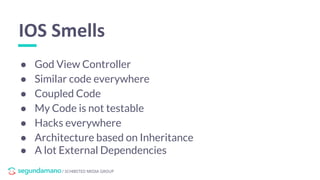
● God View Controller
● Similar code everywhere
● Coupled Code
● My Code is not testable
● Hacks everywhere
● Architecture based on Inheritance
● A lot External Dependencies
IOS Smells
STUPID
/ SCHIBSTED MEDIA GROUP
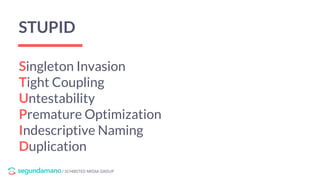
STUPID
Singleton Invasion
Tight Coupling
Untestability
Premature Optimization
Indescriptive Naming
Duplication
/ SCHIBSTED MEDIA GROUP
From STUPID to SOLID code
These are principles, not laws!
/ SCHIBSTED MEDIA GROUP
SOLID
/ SCHIBSTED MEDIA GROUP
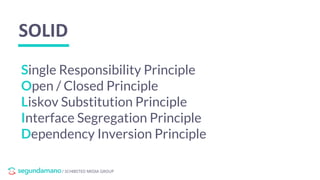
SOLID
Single Responsibility Principle
Open / Closed Principle
Liskov Substitution Principle
Interface Segregation Principle
Dependency Inversion Principle
“Depend upon abstractions. Do not
depend upon concrete classes”
Architecture
/ SCHIBSTED MEDIA GROUP
Architecture
#By Martin Fowler
“Architecture as a word we use when we want to talk about design but want to puff it up
to make it sound important.”
Clean Architecture
/ SCHIBSTED MEDIA GROUP
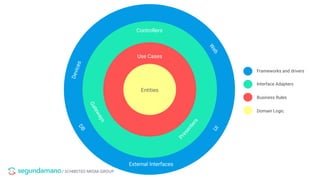
Entities
Use Cases
Controllers
Gateways
Presenters
Devices
W
ebUI
DB
External Interfaces
Frameworks and drivers
Interface Adapters
Business Rules
Domain Logic
Dependency Rule
/ SCHIBSTED MEDIA GROUP
Source code dependencies can only point inwards!
Nothing in an inner circle can know anything at all about something in an
outer circle. In particular, the name of something declared in an outer circle
must not be mentioned by the code in the an inner circle. That includes,
functions, classes. variables, or any other named software entity.
Dependency Rule
Entities
/ SCHIBSTED MEDIA GROUP
Entities encapsulate Enterprise wide business rules. An entity can be an
object with methods, or it can be a set of data structures and functions. It
doesn’t matter so long as the entities could be used by many different
applications in the enterprise.
Entities
Use Cases
/ SCHIBSTED MEDIA GROUP
The software in this layer contains application specific business rules. It
encapsulates and implements all of the use cases of the system. These use
cases orchestrate the flow of data to and from the entities, and direct those
entities to use their enterprise wide business rules to achieve the goals of
the use case.
Use Cases
Interface Adapters
/ SCHIBSTED MEDIA GROUP
The software in this layer is a set of adapters that convert data from the
format most convenient for the use cases and entities, to the format most
convenient for some external agency such as the Database or the Web.
Interface Adapters
Frameworks and Drivers
/ SCHIBSTED MEDIA GROUP
The outermost layer is generally composed of frameworks and tools such as
the Database, the Web Framework, etc. Generally you don’t write much
code in this layer other than glue code that communicates to the next circle
inwards.
This layer is where all the details go. The Web is a detail. The database is a
detail. We keep these things on the outside where they can do little harm.
Frameworks and Drivers
IOS Clean architecture
/ SCHIBSTED MEDIA GROUP
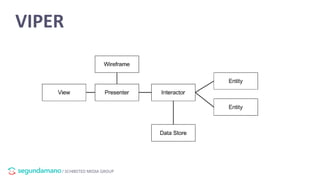
VIPER
/ SCHIBSTED MEDIA GROUP
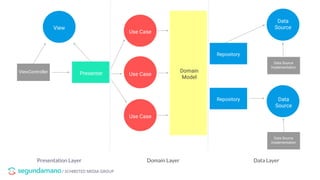
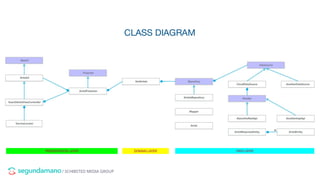
View
PresenterViewController
Use Case
Use Case
Use Case
Domain
Model
Data Source
Implementation
Repository
Repository
Data
Source
Data
Source
Data Source
Implementation
Presentation Layer Domain Layer Data Layer
Presentation Layer
/ SCHIBSTED MEDIA GROUP
● MVC
● MVP
● MVVM
UI Design Patterns
Talk Schedule
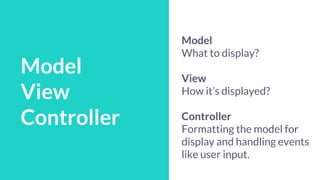
Model
View
Controller
Model
What to display?
View
How it’s displayed?
Controller
Formatting the model for
display and handling events
like user input.
Talk Schedule
Model
View
Presenter
The MVP pattern allows separate
the presentation layer from the
logic, so that everything about
how the interface works is
separated from how we
represent it on screen.
Ideally the MVP pattern would
achieve that same logic might
have completely different and
interchangeable views.
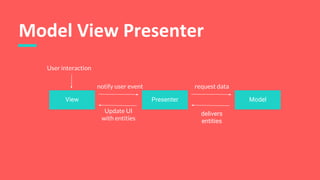
Model View Presenter
View Presenter Model
User interaction
notify user event request data
Update UI
with entities
delivers
entities
/ SCHIBSTED MEDIA GROUP
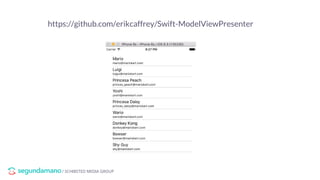
https://github.com/erikcaffrey/Swift-ModelViewPresenter
Talk Schedule
Model
View
ViewModel
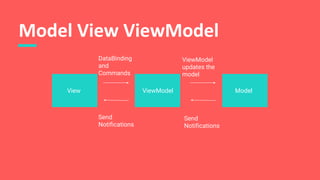
Is an architectural approach used to
abstract the state and behaviour of a
view, which allows us to separate the
development of the UI from the
business logic.
Model View ViewModel
View ViewModel Model
DataBinding
and
Commands
ViewModel
updates the
model
Send
Notifications
Send
Notifications
/ SCHIBSTED MEDIA GROUP
What Do They have in common?
Allows separate the view from the
business logic and data logic.
/ SCHIBSTED MEDIA GROUP
What pattern Should I use?
/ SCHIBSTED MEDIA GROUP
● These patterns try to solve the same problems
● Both patterns are going to improve code quality and testability.
● Think about these patterns and use the one you understand better.
UI Patterns
Domain Layer
/ SCHIBSTED MEDIA GROUP
● Contains Business Logic
● No Code specific to a framework
● Use Command Pattern (optional)
Domain
/ SCHIBSTED MEDIA GROUP
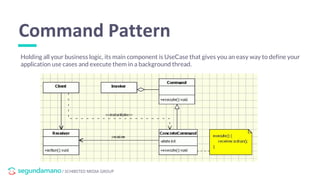
Command Pattern
Holding all your business logic, its main component is UseCase that gives you an easy way to define your
application use cases and execute them in a background thread.
Data Layer
/ SCHIBSTED MEDIA GROUP
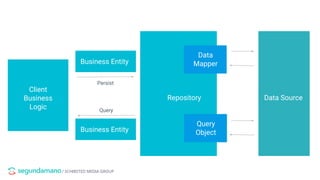
Use a repository to separate the logic that retrieves the data and maps it to
the entity model from the business logic that acts on the model. The
business logic should be agnostic to the type of data that comprises the data
source layer. For example, the data source layer can be a database, a
SharePoint list, or a Web service.
Repository Pattern
/ SCHIBSTED MEDIA GROUP
Data
Mapper
Repository
Client
Business
Logic
Business Entity
Business Entity
Persist
Query
Query
Object
Data Source
/ SCHIBSTED MEDIA GROUP
Software Design Pattern used to facilitate the usage of Dependency
Inversion.
It consists of passing dependencies (inject them) via constructor or setter in
order to extract the task of creating modules out from other modules.
Objects are instantiated somewhere else and passed as constructor
attributes when creating the current object.
Dependency Injection
/ SCHIBSTED MEDIA GROUP
● Since dependencies can be injected and configured externally we can reuse
those components.
● We can just change the implementation of any object without having to
make a lot of changes in our codebase, since that object instantiation resides
in one place isolated and decoupled.
● Dependencies can be injected into a component: it is possible to inject mock
implementations of these dependencies which makes testing easier.
Dependency Injection Advantages
/ SCHIBSTED MEDIA GROUP
● But here it comes a new problem. If we can’t create modules inside modules,
there must be a place where those modules are instantiated.
● Modules with huge constructors including lots of dependencies, code will
become dirty and hard to read.
Dependency Injection Smells
Solution ….
Dependency Injector
/ SCHIBSTED MEDIA GROUP
We can consider it as another module in our app that is in charge of providing
instances of the rest of modules and inject their dependencies.
Dependency Injector
● Service Locator
● Swinject
● Typhoon
/ SCHIBSTED MEDIA GROUP
Clean Architecture Principles
● The Dependency Rule
● Presentation is decoupled from domain
● Domain module can be a layer module.
● Data layer decouples the rest of the app
● Independent of Frameworks.
● Independent of UI
● Independent of Database
● Entities Representing Enterprise Rules
/ SCHIBSTED MEDIA GROUP
Conforming to these simple rules is not hard, and will save you a lot of
headaches going forward. By separating the software into layers, and
conforming to The Dependency Rule, you will create a system that is intrinsically
testable, with all the benefits that implies. When any of the external parts of the
system become obsolete, like the database, or the web framework, you can
replace those obsolete elements with a minimum of fuss.
Clean Architecture Conclusion
#Uncle Bob
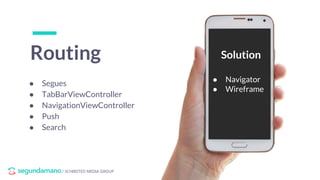
Routing
/ SCHIBSTED MEDIA GROUP
Routing
● Segues
● TabBarViewController
● NavigationViewController
● Push
● Search
Solution
● Navigator
● Wireframe
Show me code!
/ SCHIBSTED MEDIA GROUP
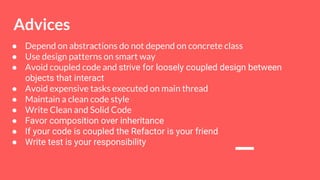
● Depend on abstractions do not depend on concrete class
● Use design patterns on smart way
● Avoid coupled code and strive for loosely coupled design between
objects that interact
● Avoid expensive tasks executed on main thread
● Maintain a clean code style
● Write Clean and Solid Code
● Favor composition over inheritance
● If your code is coupled the Refactor is your friend
● Write test is your responsibility
Advices
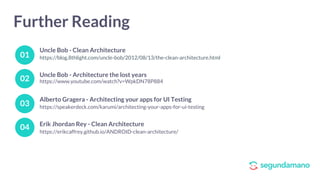
01
02
https://blog.8thlight.com/uncle-bob/2012/08/13/the-clean-architecture.html
Uncle Bob - Clean Architecture
https://www.youtube.com/watch?v=WpkDN78P884
Uncle Bob - Architecture the lost years
03
Further Reading
04
https://speakerdeck.com/karumi/architecting-your-apps-for-ui-testing
Alberto Gragera - Architecting your apps for UI Testing
https://erikcaffrey.github.io/ANDROID-clean-architecture/
Erik Jhordan Rey - Clean Architecture
Questions?
Find me
Erik Jhordan González Reyes
Mobile Engineer
github.com/erikcaffrey
erik.gonzalez@schibsted.com.mx
erikcaffrey.github.io
@ErikJhordan_Rey
+Erik Jhordan Rey
Find me
Iván Álvarez Frías
Software Engineer
github.com/ivanhoe
ivan.alvarez@schibsted.com.mx
iosdevelopers.mx
@Ivanhoe
+Ivan ??
Thank You
{NS Coder México}!

Clean Architecture

  • 1.
    Clean Architecture Iván ÁlvarezFrías Erik Jhordan González Reyes ivan.alvarez@schibsted.com.mx @Ivanhoe github.com/ivanhoe erik.gonzalez@schibsted.com.mx @ErikJhordan_Rey github.com/erikcaffrey
  • 2.
    “Clean code alwayslooks like it was written by someone who cares”
  • 3.
  • 4.
    / SCHIBSTED MEDIAGROUP ● God View Controller ● Similar code everywhere ● Coupled Code ● My Code is not testable ● Hacks everywhere ● Architecture based on Inheritance ● A lot External Dependencies IOS Smells
  • 5.
  • 6.
    / SCHIBSTED MEDIAGROUP STUPID Singleton Invasion Tight Coupling Untestability Premature Optimization Indescriptive Naming Duplication
  • 7.
    / SCHIBSTED MEDIAGROUP From STUPID to SOLID code These are principles, not laws!
  • 8.
  • 9.
  • 10.
    / SCHIBSTED MEDIAGROUP SOLID Single Responsibility Principle Open / Closed Principle Liskov Substitution Principle Interface Segregation Principle Dependency Inversion Principle
  • 11.
    “Depend upon abstractions.Do not depend upon concrete classes”
  • 12.
  • 13.
    / SCHIBSTED MEDIAGROUP Architecture #By Martin Fowler “Architecture as a word we use when we want to talk about design but want to puff it up to make it sound important.”
  • 14.
  • 15.
    / SCHIBSTED MEDIAGROUP Entities Use Cases Controllers Gateways Presenters Devices W ebUI DB External Interfaces Frameworks and drivers Interface Adapters Business Rules Domain Logic
  • 16.
  • 17.
    / SCHIBSTED MEDIAGROUP Source code dependencies can only point inwards! Nothing in an inner circle can know anything at all about something in an outer circle. In particular, the name of something declared in an outer circle must not be mentioned by the code in the an inner circle. That includes, functions, classes. variables, or any other named software entity. Dependency Rule
  • 18.
  • 19.
    / SCHIBSTED MEDIAGROUP Entities encapsulate Enterprise wide business rules. An entity can be an object with methods, or it can be a set of data structures and functions. It doesn’t matter so long as the entities could be used by many different applications in the enterprise. Entities
  • 20.
  • 21.
    / SCHIBSTED MEDIAGROUP The software in this layer contains application specific business rules. It encapsulates and implements all of the use cases of the system. These use cases orchestrate the flow of data to and from the entities, and direct those entities to use their enterprise wide business rules to achieve the goals of the use case. Use Cases
  • 22.
  • 23.
    / SCHIBSTED MEDIAGROUP The software in this layer is a set of adapters that convert data from the format most convenient for the use cases and entities, to the format most convenient for some external agency such as the Database or the Web. Interface Adapters
  • 24.
  • 25.
    / SCHIBSTED MEDIAGROUP The outermost layer is generally composed of frameworks and tools such as the Database, the Web Framework, etc. Generally you don’t write much code in this layer other than glue code that communicates to the next circle inwards. This layer is where all the details go. The Web is a detail. The database is a detail. We keep these things on the outside where they can do little harm. Frameworks and Drivers
  • 26.
  • 27.
    / SCHIBSTED MEDIAGROUP VIPER
  • 28.
    / SCHIBSTED MEDIAGROUP View PresenterViewController Use Case Use Case Use Case Domain Model Data Source Implementation Repository Repository Data Source Data Source Data Source Implementation Presentation Layer Domain Layer Data Layer
  • 29.
  • 30.
  • 31.
    / SCHIBSTED MEDIAGROUP ● MVC ● MVP ● MVVM UI Design Patterns
  • 32.
    Talk Schedule Model View Controller Model What todisplay? View How it’s displayed? Controller Formatting the model for display and handling events like user input.
  • 33.
    Talk Schedule Model View Presenter The MVPpattern allows separate the presentation layer from the logic, so that everything about how the interface works is separated from how we represent it on screen. Ideally the MVP pattern would achieve that same logic might have completely different and interchangeable views.
  • 34.
    Model View Presenter ViewPresenter Model User interaction notify user event request data Update UI with entities delivers entities
  • 35.
    / SCHIBSTED MEDIAGROUP https://github.com/erikcaffrey/Swift-ModelViewPresenter
  • 36.
    Talk Schedule Model View ViewModel Is anarchitectural approach used to abstract the state and behaviour of a view, which allows us to separate the development of the UI from the business logic.
  • 37.
    Model View ViewModel ViewViewModel Model DataBinding and Commands ViewModel updates the model Send Notifications Send Notifications
  • 38.
    / SCHIBSTED MEDIAGROUP What Do They have in common?
  • 39.
    Allows separate theview from the business logic and data logic.
  • 40.
    / SCHIBSTED MEDIAGROUP What pattern Should I use?
  • 41.
    / SCHIBSTED MEDIAGROUP ● These patterns try to solve the same problems ● Both patterns are going to improve code quality and testability. ● Think about these patterns and use the one you understand better. UI Patterns
  • 42.
  • 43.
    / SCHIBSTED MEDIAGROUP ● Contains Business Logic ● No Code specific to a framework ● Use Command Pattern (optional) Domain
  • 44.
    / SCHIBSTED MEDIAGROUP Command Pattern Holding all your business logic, its main component is UseCase that gives you an easy way to define your application use cases and execute them in a background thread.
  • 45.
  • 46.
    / SCHIBSTED MEDIAGROUP Use a repository to separate the logic that retrieves the data and maps it to the entity model from the business logic that acts on the model. The business logic should be agnostic to the type of data that comprises the data source layer. For example, the data source layer can be a database, a SharePoint list, or a Web service. Repository Pattern
  • 47.
    / SCHIBSTED MEDIAGROUP Data Mapper Repository Client Business Logic Business Entity Business Entity Persist Query Query Object Data Source
  • 48.
    / SCHIBSTED MEDIAGROUP Software Design Pattern used to facilitate the usage of Dependency Inversion. It consists of passing dependencies (inject them) via constructor or setter in order to extract the task of creating modules out from other modules. Objects are instantiated somewhere else and passed as constructor attributes when creating the current object. Dependency Injection
  • 49.
    / SCHIBSTED MEDIAGROUP ● Since dependencies can be injected and configured externally we can reuse those components. ● We can just change the implementation of any object without having to make a lot of changes in our codebase, since that object instantiation resides in one place isolated and decoupled. ● Dependencies can be injected into a component: it is possible to inject mock implementations of these dependencies which makes testing easier. Dependency Injection Advantages
  • 50.
    / SCHIBSTED MEDIAGROUP ● But here it comes a new problem. If we can’t create modules inside modules, there must be a place where those modules are instantiated. ● Modules with huge constructors including lots of dependencies, code will become dirty and hard to read. Dependency Injection Smells
  • 51.
  • 52.
  • 53.
    / SCHIBSTED MEDIAGROUP We can consider it as another module in our app that is in charge of providing instances of the rest of modules and inject their dependencies. Dependency Injector ● Service Locator ● Swinject ● Typhoon
  • 54.
    / SCHIBSTED MEDIAGROUP Clean Architecture Principles ● The Dependency Rule ● Presentation is decoupled from domain ● Domain module can be a layer module. ● Data layer decouples the rest of the app ● Independent of Frameworks. ● Independent of UI ● Independent of Database ● Entities Representing Enterprise Rules
  • 55.
    / SCHIBSTED MEDIAGROUP Conforming to these simple rules is not hard, and will save you a lot of headaches going forward. By separating the software into layers, and conforming to The Dependency Rule, you will create a system that is intrinsically testable, with all the benefits that implies. When any of the external parts of the system become obsolete, like the database, or the web framework, you can replace those obsolete elements with a minimum of fuss. Clean Architecture Conclusion #Uncle Bob
  • 56.
  • 57.
    / SCHIBSTED MEDIAGROUP Routing ● Segues ● TabBarViewController ● NavigationViewController ● Push ● Search Solution ● Navigator ● Wireframe
  • 58.
  • 59.
  • 60.
  • 61.
  • 62.
    ● Depend onabstractions do not depend on concrete class ● Use design patterns on smart way ● Avoid coupled code and strive for loosely coupled design between objects that interact ● Avoid expensive tasks executed on main thread ● Maintain a clean code style ● Write Clean and Solid Code ● Favor composition over inheritance ● If your code is coupled the Refactor is your friend ● Write test is your responsibility Advices
  • 63.
    01 02 https://blog.8thlight.com/uncle-bob/2012/08/13/the-clean-architecture.html Uncle Bob -Clean Architecture https://www.youtube.com/watch?v=WpkDN78P884 Uncle Bob - Architecture the lost years 03 Further Reading 04 https://speakerdeck.com/karumi/architecting-your-apps-for-ui-testing Alberto Gragera - Architecting your apps for UI Testing https://erikcaffrey.github.io/ANDROID-clean-architecture/ Erik Jhordan Rey - Clean Architecture
  • 64.
  • 65.
    Find me Erik JhordanGonzález Reyes Mobile Engineer github.com/erikcaffrey erik.gonzalez@schibsted.com.mx erikcaffrey.github.io @ErikJhordan_Rey +Erik Jhordan Rey Find me Iván Álvarez Frías Software Engineer github.com/ivanhoe ivan.alvarez@schibsted.com.mx iosdevelopers.mx @Ivanhoe +Ivan ??
  • 66.