Data Models and
Data Standards
Data models are blueprints for organizing and managing data
effectively. Data standards ensure consistency and accuracy,
making data more valuable.
Importance of Data Models in Data
Management
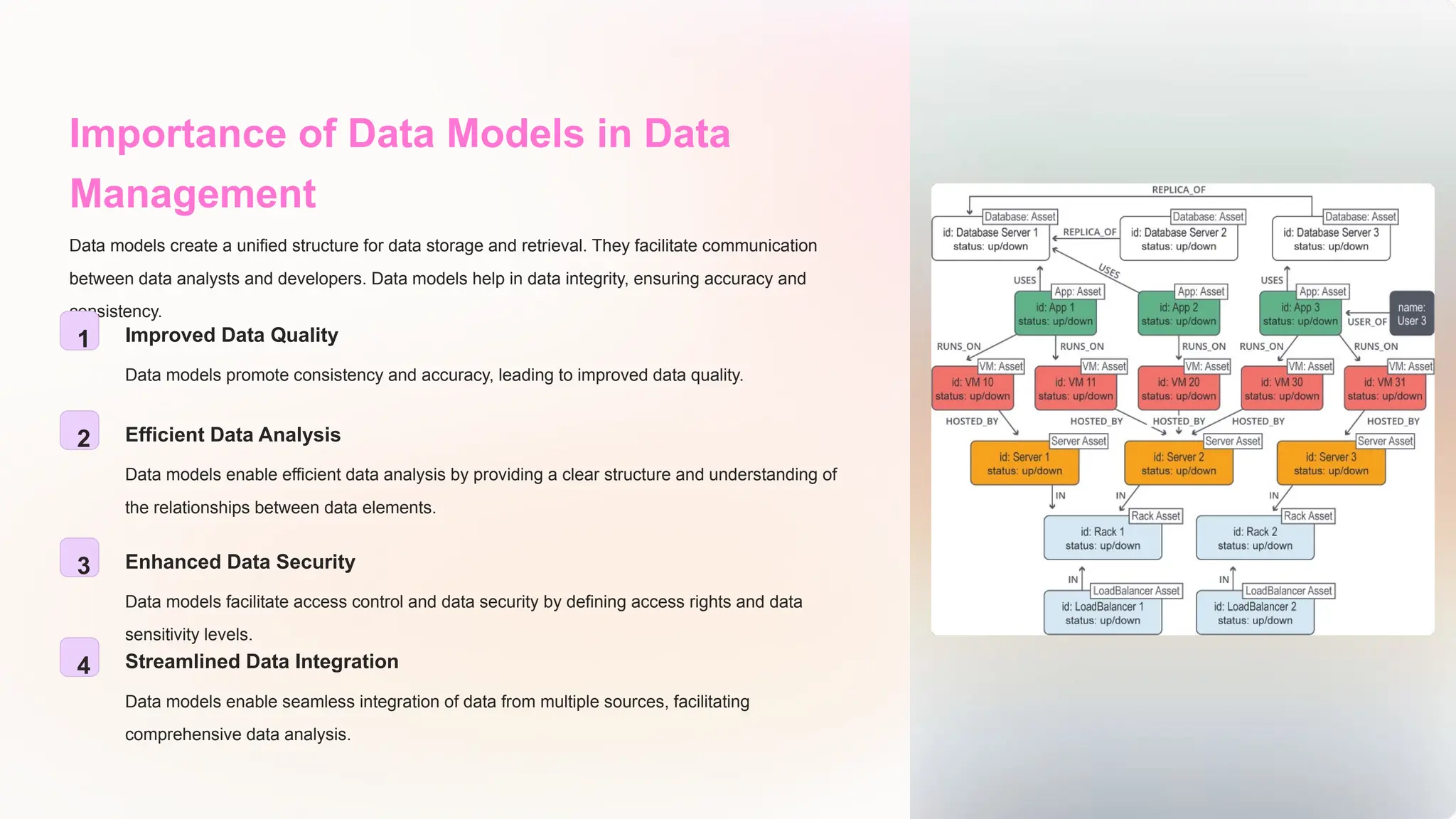
Data models create a unified structure for data storage and retrieval. They facilitate communication
between data analysts and developers. Data models help in data integrity, ensuring accuracy and
consistency.
1 Improved Data Quality
Data models promote consistency and accuracy, leading to improved data quality.
2 Efficient Data Analysis
Data models enable efficient data analysis by providing a clear structure and understanding of
the relationships between data elements.
3 Enhanced Data Security
Data models facilitate access control and data security by defining access rights and data
sensitivity levels.
4 Streamlined Data Integration
Data models enable seamless integration of data from multiple sources, facilitating
comprehensive data analysis.
Data Standards
Data standards define the rules and guidelines for data representation, formatting, and usage. They ensure
consistency and interoperability across different systems and applications.
Data Quality
Data standards promote data
integrity and accuracy, leading to
improved data quality. They
define acceptable data values
and formats.
Data
Interoperability
Data standards enable seamless
exchange of data between
different systems and
applications. They promote data
consistency across multiple
platforms.
Data Security
Data standards play a crucial
role in data security by defining
access control mechanisms and
data encryption protocols.
Types of Data
Models
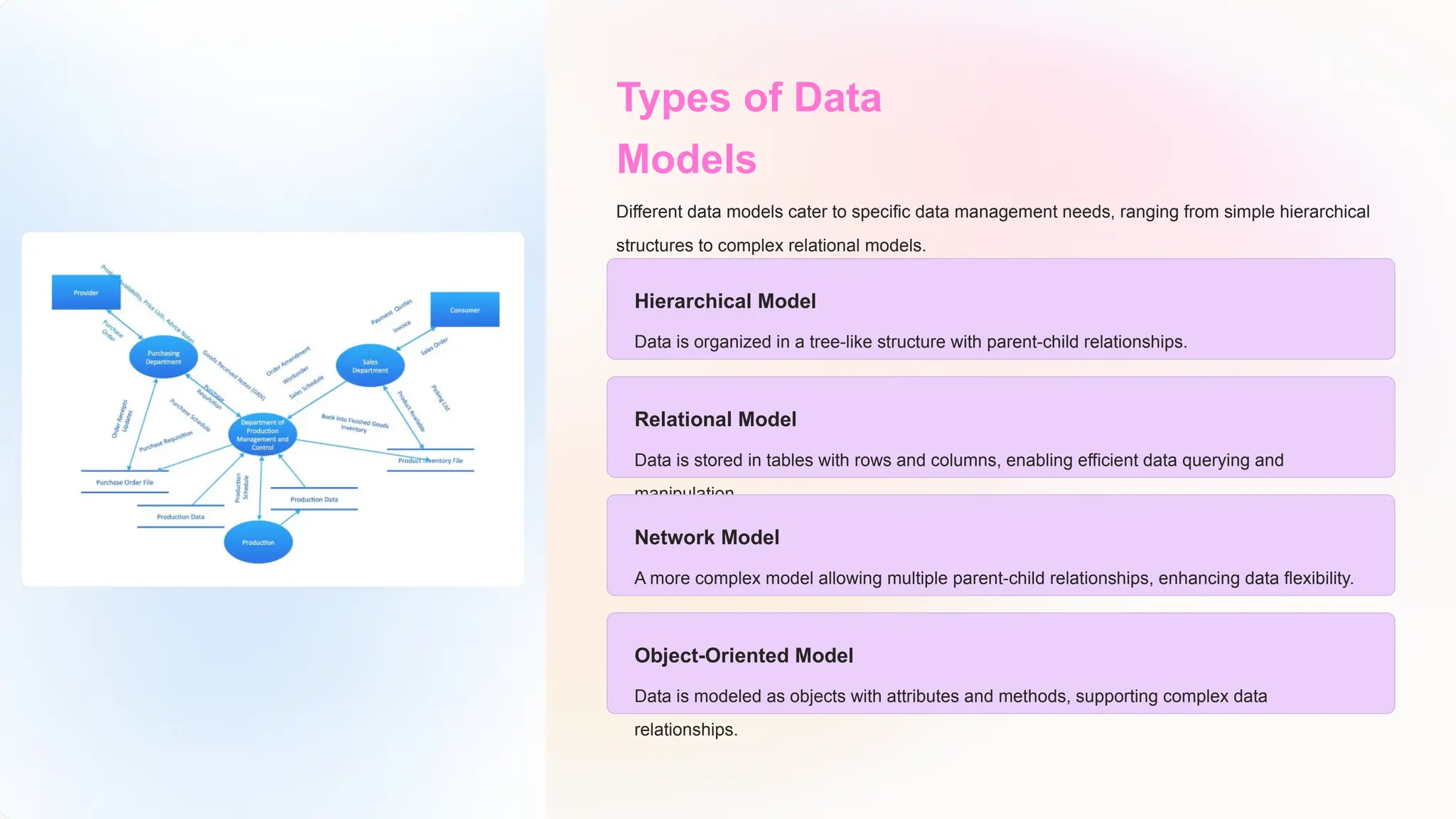
Different data models cater to specific data management needs, ranging from simple hierarchical
structures to complex relational models.
Hierarchical Model
Data is organized in a tree-like structure with parent-child relationships.
Relational Model
Data is stored in tables with rows and columns, enabling efficient data querying and
manipulation.
Network Model
A more complex model allowing multiple parent-child relationships, enhancing data flexibility.
Object-Oriented Model
Data is modeled as objects with attributes and methods, supporting complex data
relationships.
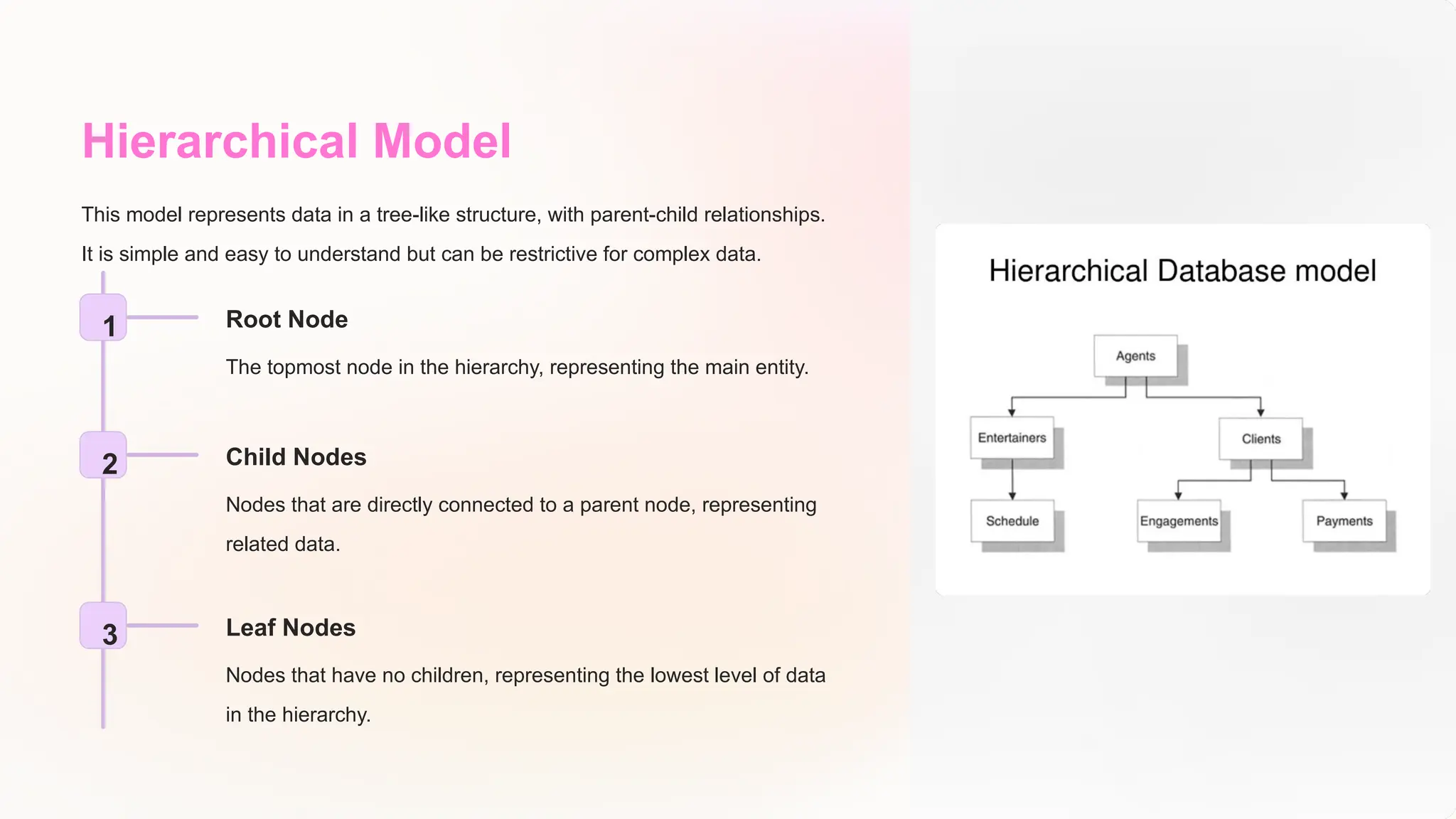
Hierarchical Model
This model represents data in a tree-like structure, with parent-child relationships.
It is simple and easy to understand but can be restrictive for complex data.
1 Root Node
The topmost node in the hierarchy, representing the main entity.
2 Child Nodes
Nodes that are directly connected to a parent node, representing
related data.
3 Leaf Nodes
Nodes that have no children, representing the lowest level of data
in the hierarchy.
Data Warehousing
Models
These models are designed for storing and analyzing large volumes of data
from multiple sources, often used in business intelligence applications.
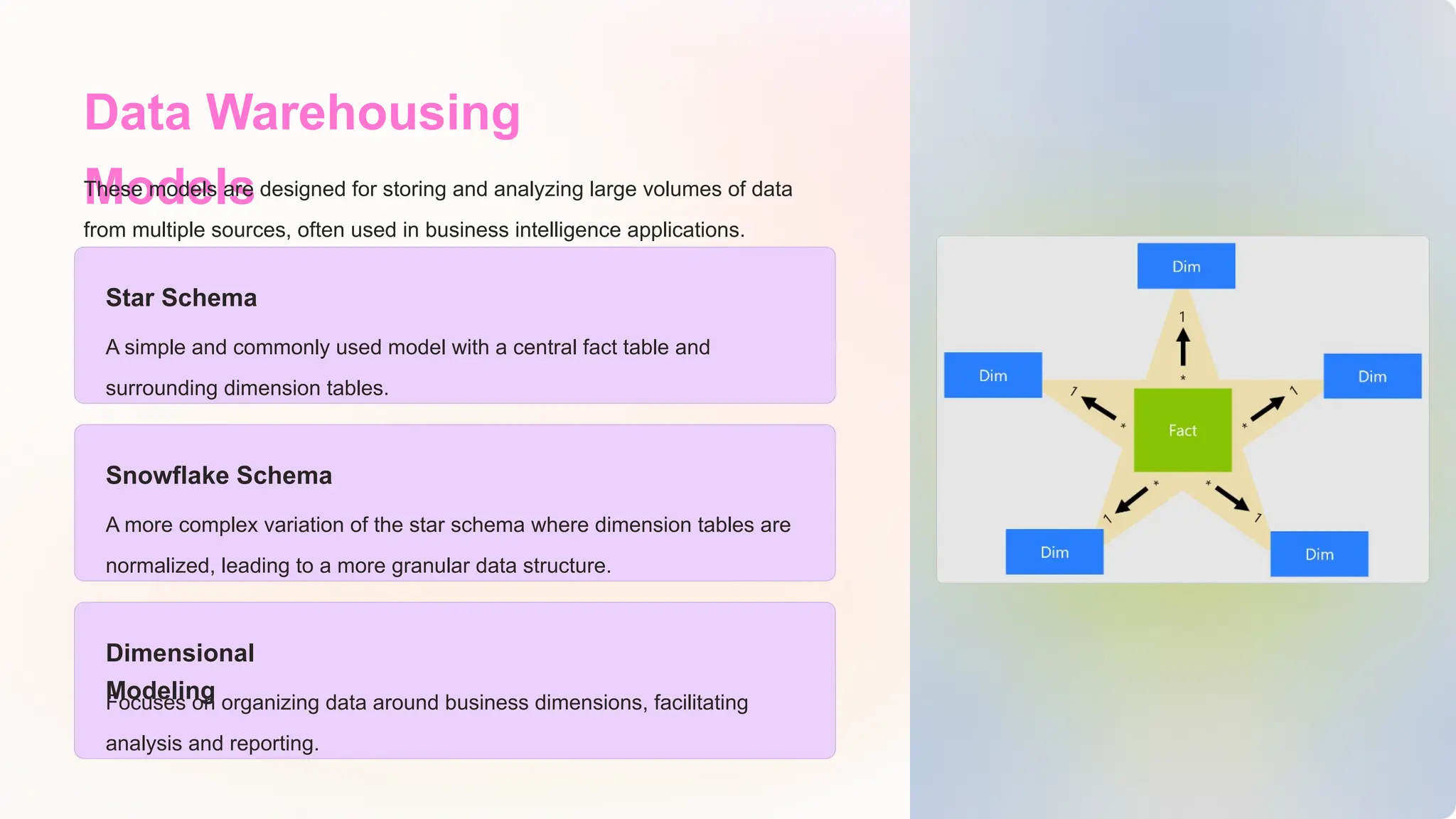
Star Schema
A simple and commonly used model with a central fact table and
surrounding dimension tables.
Snowflake Schema
A more complex variation of the star schema where dimension tables are
normalized, leading to a more granular data structure.
Dimensional
Modeling
Focuses on organizing data around business dimensions, facilitating
analysis and reporting.
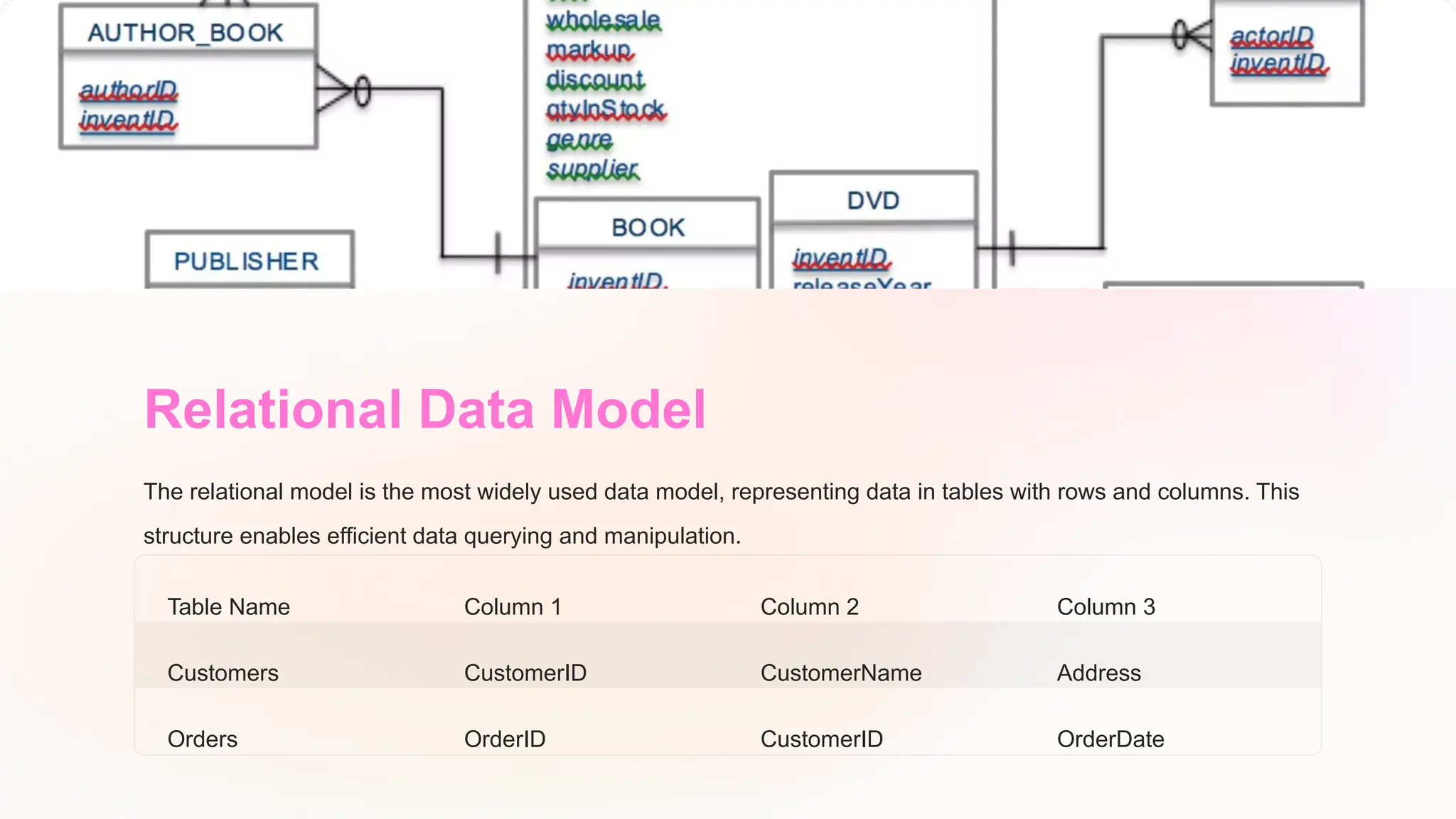
Relational Data Model
The relational model is the most widely used data model, representing data in tables with rows and columns. This
structure enables efficient data querying and manipulation.
Table Name Column 1 Column 2 Column 3
Customers CustomerID CustomerName Address
Orders OrderID CustomerID OrderDate
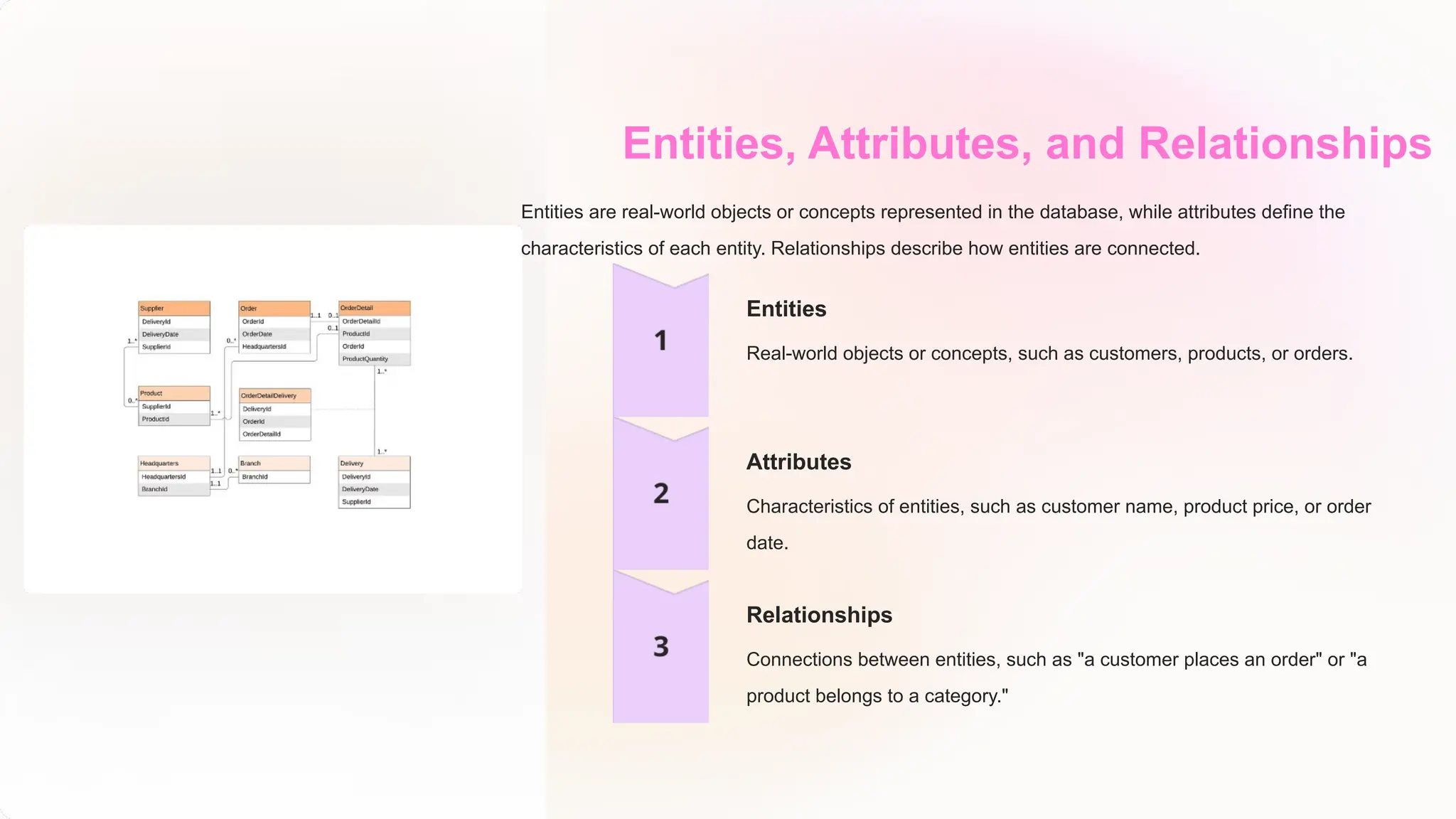
Entities, Attributes, and Relationships
Entities are real-world objects or concepts represented in the database, while attributes define the
characteristics of each entity. Relationships describe how entities are connected.
Entities
Real-world objects or concepts, such as customers, products, or orders.
Attributes
Characteristics of entities, such as customer name, product price, or order
date.
Relationships
Connections between entities, such as "a customer places an order" or "a
product belongs to a category."
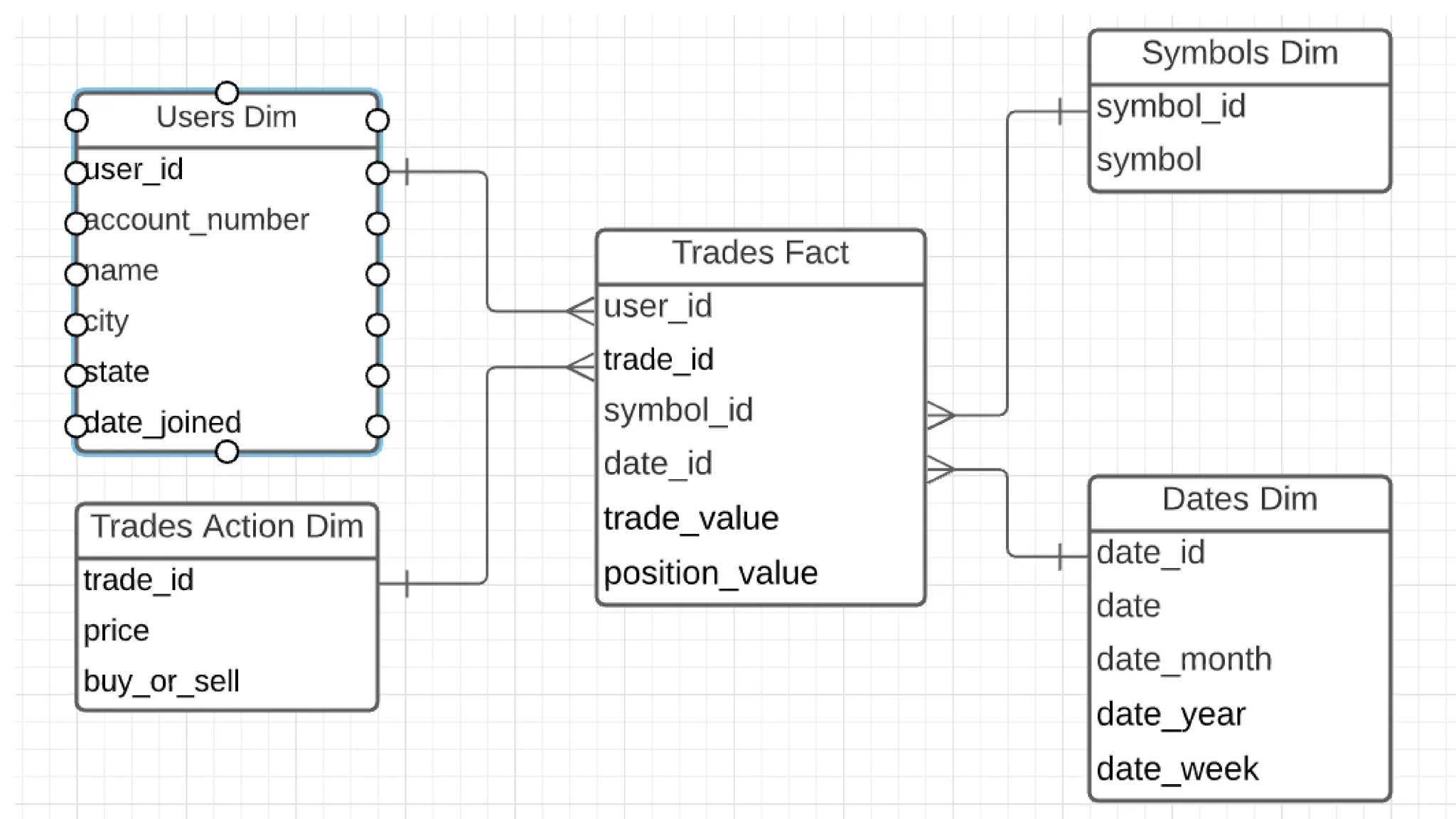
Star Schema
A simple and commonly used data warehouse model with a central fact table and surrounding dimension tables.
This model provides efficient data analysis and reporting.
Fact Table
Stores measures or numerical data, such as sales
amount or order quantity.
Dimension Tables
Provide context to the fact table by storing descriptive
attributes, such as customer information or product
details.
Normalized &
Denormalized Data
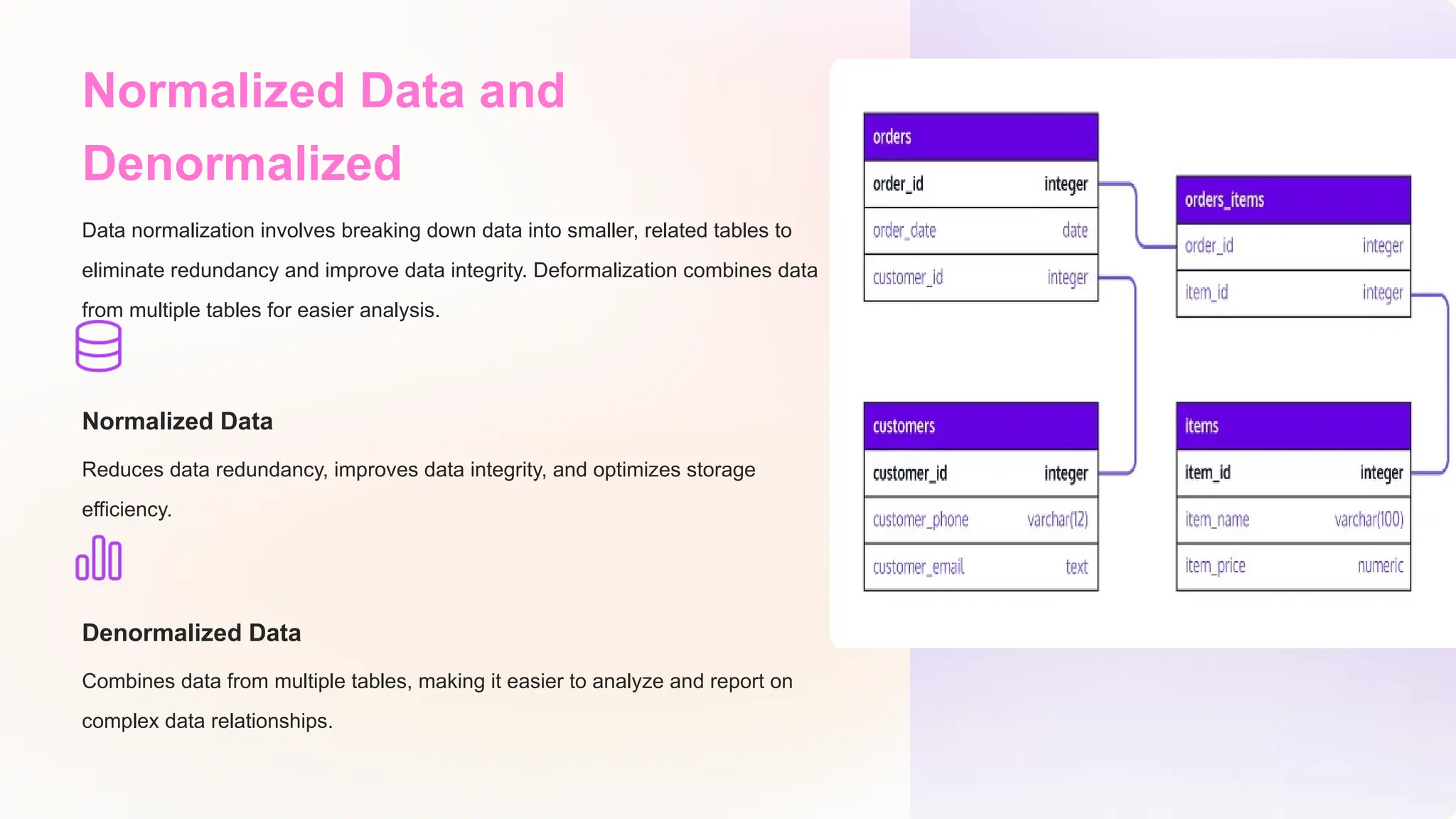
Normalized Data and
Denormalized
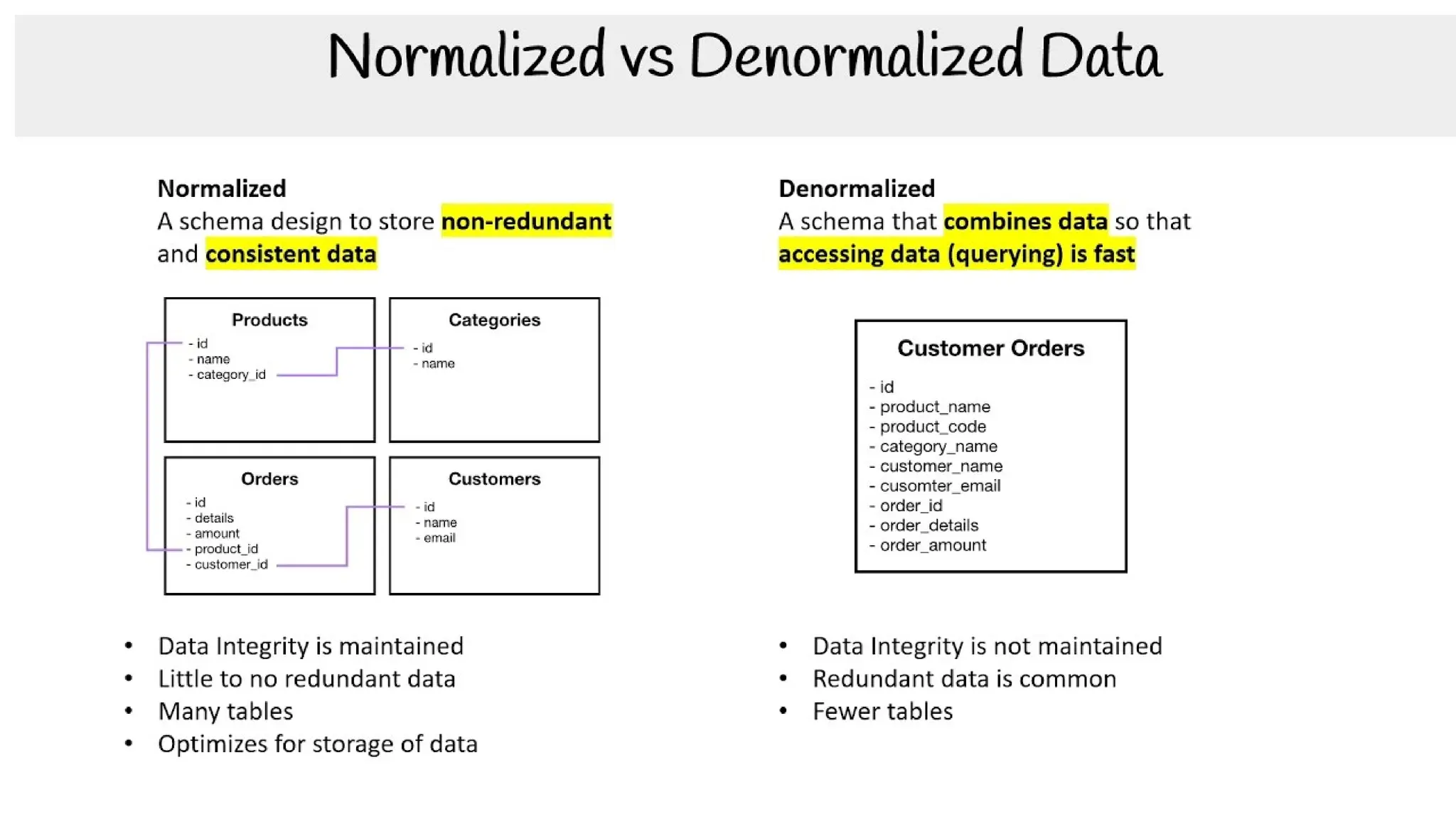
Data normalization involves breaking down data into smaller, related tables to
eliminate redundancy and improve data integrity. Deformalization combines data
from multiple tables for easier analysis.
Normalized Data
Reduces data redundancy, improves data integrity, and optimizes storage
efficiency.
Denormalized Data
Combines data from multiple tables, making it easier to analyze and report on
complex data relationships.
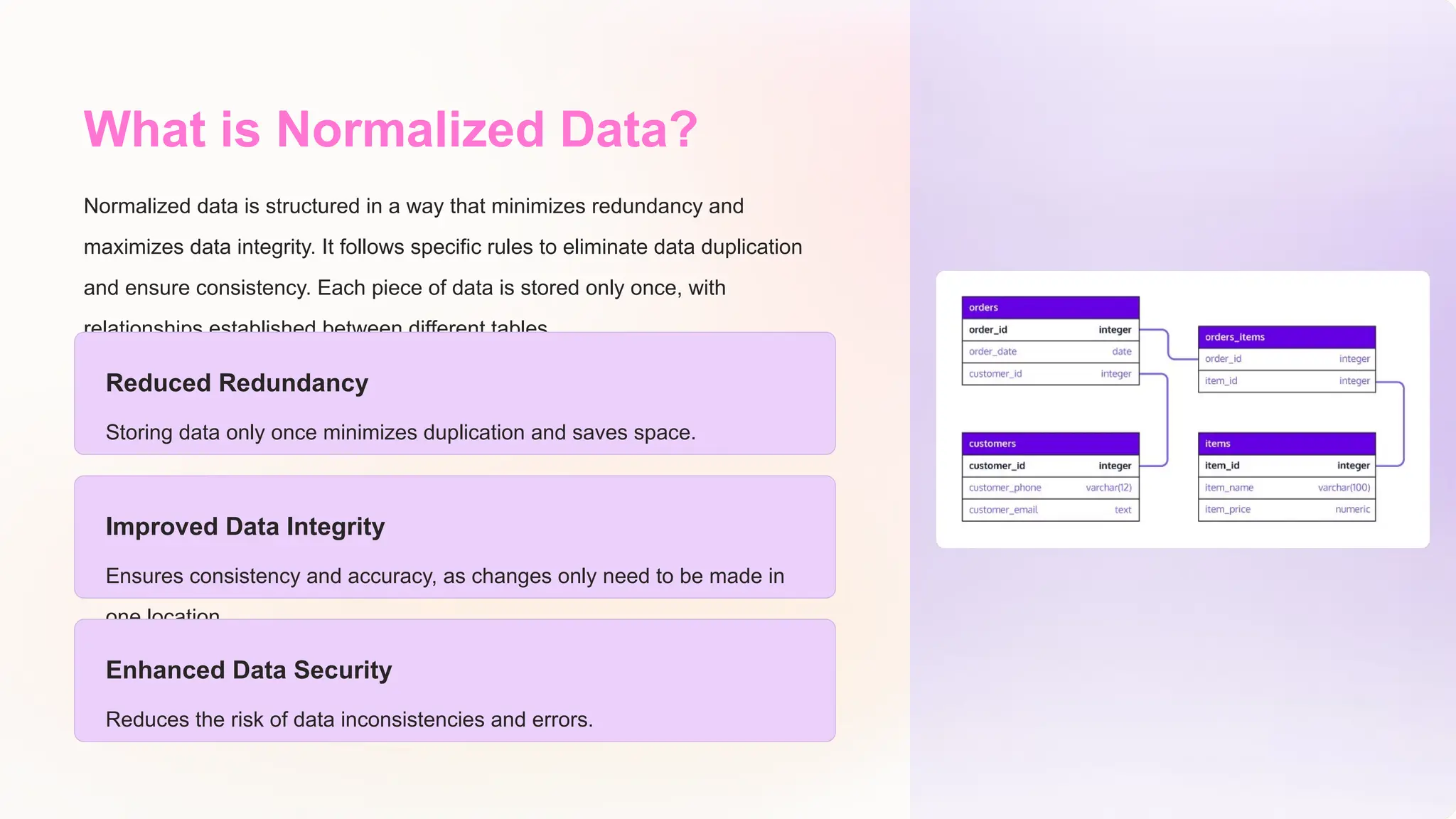
What is Normalized Data?
Normalized data is structured in a way that minimizes redundancy and
maximizes data integrity. It follows specific rules to eliminate data duplication
and ensure consistency. Each piece of data is stored only once, with
relationships established between different tables.
Reduced Redundancy
Storing data only once minimizes duplication and saves space.
Improved Data Integrity
Ensures consistency and accuracy, as changes only need to be made in
one location.
Enhanced Data Security
Reduces the risk of data inconsistencies and errors.
Benefits of Normalized
Data
Normalization offers several benefits for data management. It helps to ensure consistency, improve performance,
and enhance data security.
Efficient Data
Storage
Reduces redundancy, saving
storage space and improving
database efficiency.
Enhanced Data
Accuracy
Minimizes inconsistencies and
errors, ensuring data integrity
and reliability.
Simplified Data
Maintenance
Easier to update and manage
data, as changes need to be
made only in one location.
Challenges of Normalized
Data
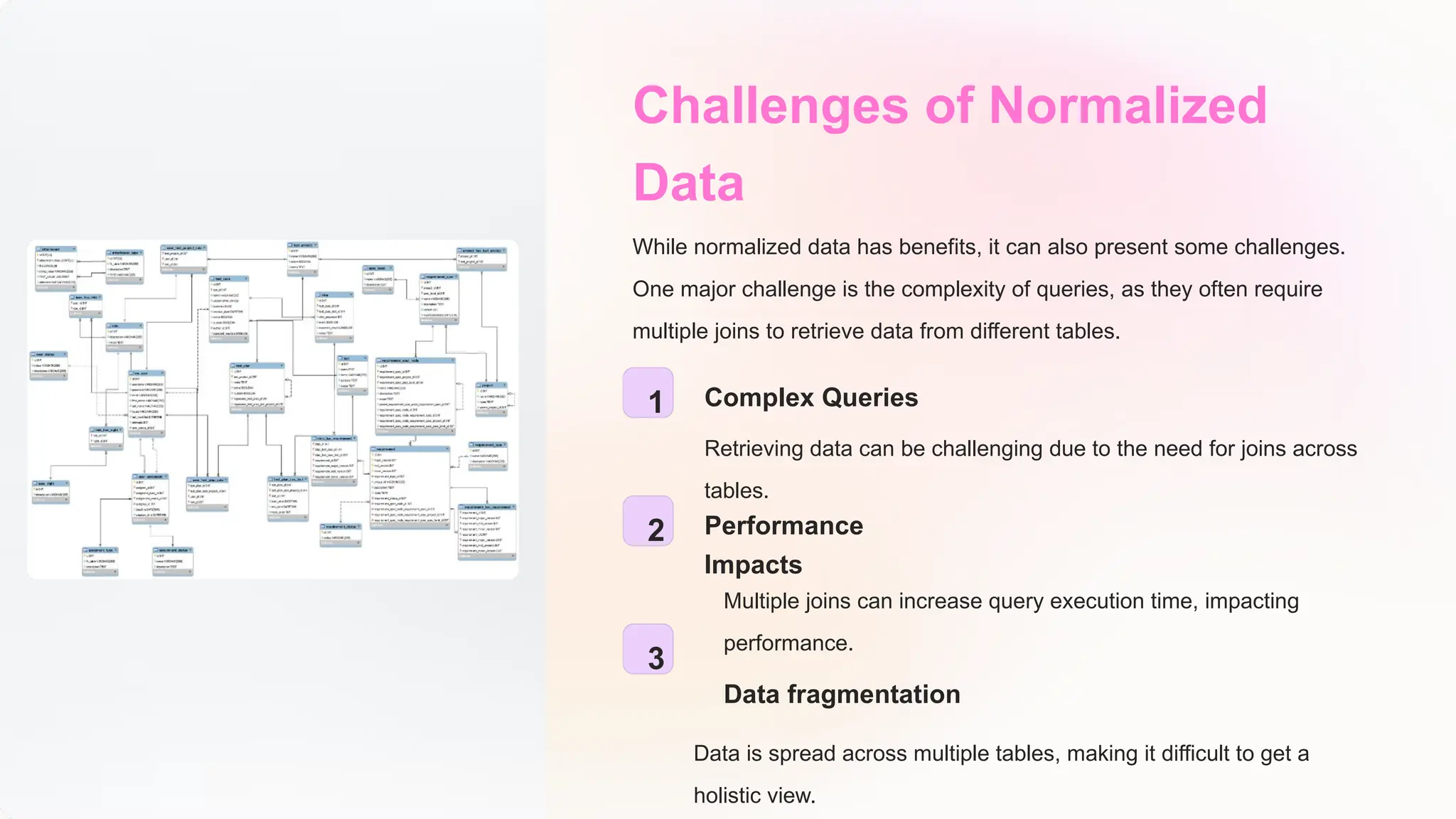
While normalized data has benefits, it can also present some challenges.
One major challenge is the complexity of queries, as they often require
multiple joins to retrieve data from different tables.
1 Complex Queries
Retrieving data can be challenging due to the need for joins across
tables.
2 Performance
Impacts
Multiple joins can increase query execution time, impacting
performance.
3
Data fragmentation
Data is spread across multiple tables, making it difficult to get a
holistic view.
What is Denormalized
Data?
Deformalized data, sometimes called denormalized data, is stored in a single table without adhering to
normalization rules. It often contains redundant data fields to make retrieval and analysis easier and faster.
Normalization Deformalization
Data is stored in multiple tables, minimizing
redundancy.
Data is stored in a single table, allowing for
redundancy.
Focus on data integrity and consistency. Prioritizes data accessibility and performance.
Advantages of
Denormalized Data
Deformalization offers advantages in scenarios where performance and ease of retrieval
are prioritized over absolute data integrity. It simplifies data access and reduces query
complexity.
Improved Performance
Faster data retrieval due to single-table storage.
Simplified Queries
Less complex queries are needed to access data.
Reduced Overhead
Less data management overhead compared to normalized data.
Disadvantages of
Denormalized Data
While deformalized data offers performance gains, it comes with potential drawbacks.
Redundancy can lead to inconsistencies and data integrity issues, making it crucial to implement
careful data management strategies.
Data Inconsistency
Redundancy can lead to inconsistencies if data is not updated correctly.
Security Risks
Increased redundancy makes it more vulnerable to data breaches.
Storage Overhead
Redundancy can consume more storage space.
When to Use Normalized vs
Denormalized Data
The choice between normalized and deformalized data depends on specific needs.
Consider factors like data integrity, performance, and data structure complexity.
1 Normalized
Ideal for data warehouses, complex databases, and applications where
integrity is crucial.
2 Denormalized
Best for reporting and analytics, data marts, and applications where
performance is paramount.
3 Hybrid Approach
Combining both techniques can be beneficial in some cases.

Dcnd data-Models-and-Data-Standards.pptx

  • 1.
    Data Models and DataStandards Data models are blueprints for organizing and managing data effectively. Data standards ensure consistency and accuracy, making data more valuable.
  • 2.
    Importance of DataModels in Data Management Data models create a unified structure for data storage and retrieval. They facilitate communication between data analysts and developers. Data models help in data integrity, ensuring accuracy and consistency. 1 Improved Data Quality Data models promote consistency and accuracy, leading to improved data quality. 2 Efficient Data Analysis Data models enable efficient data analysis by providing a clear structure and understanding of the relationships between data elements. 3 Enhanced Data Security Data models facilitate access control and data security by defining access rights and data sensitivity levels. 4 Streamlined Data Integration Data models enable seamless integration of data from multiple sources, facilitating comprehensive data analysis.
  • 3.
    Data Standards Data standardsdefine the rules and guidelines for data representation, formatting, and usage. They ensure consistency and interoperability across different systems and applications. Data Quality Data standards promote data integrity and accuracy, leading to improved data quality. They define acceptable data values and formats. Data Interoperability Data standards enable seamless exchange of data between different systems and applications. They promote data consistency across multiple platforms. Data Security Data standards play a crucial role in data security by defining access control mechanisms and data encryption protocols.
  • 4.
    Types of Data Models Differentdata models cater to specific data management needs, ranging from simple hierarchical structures to complex relational models. Hierarchical Model Data is organized in a tree-like structure with parent-child relationships. Relational Model Data is stored in tables with rows and columns, enabling efficient data querying and manipulation. Network Model A more complex model allowing multiple parent-child relationships, enhancing data flexibility. Object-Oriented Model Data is modeled as objects with attributes and methods, supporting complex data relationships.
  • 5.
    Hierarchical Model This modelrepresents data in a tree-like structure, with parent-child relationships. It is simple and easy to understand but can be restrictive for complex data. 1 Root Node The topmost node in the hierarchy, representing the main entity. 2 Child Nodes Nodes that are directly connected to a parent node, representing related data. 3 Leaf Nodes Nodes that have no children, representing the lowest level of data in the hierarchy.
  • 6.
    Data Warehousing Models These modelsare designed for storing and analyzing large volumes of data from multiple sources, often used in business intelligence applications. Star Schema A simple and commonly used model with a central fact table and surrounding dimension tables. Snowflake Schema A more complex variation of the star schema where dimension tables are normalized, leading to a more granular data structure. Dimensional Modeling Focuses on organizing data around business dimensions, facilitating analysis and reporting.
  • 7.
    Relational Data Model Therelational model is the most widely used data model, representing data in tables with rows and columns. This structure enables efficient data querying and manipulation. Table Name Column 1 Column 2 Column 3 Customers CustomerID CustomerName Address Orders OrderID CustomerID OrderDate
  • 8.
    Entities, Attributes, andRelationships Entities are real-world objects or concepts represented in the database, while attributes define the characteristics of each entity. Relationships describe how entities are connected. Entities Real-world objects or concepts, such as customers, products, or orders. Attributes Characteristics of entities, such as customer name, product price, or order date. Relationships Connections between entities, such as "a customer places an order" or "a product belongs to a category."
  • 9.
    Star Schema A simpleand commonly used data warehouse model with a central fact table and surrounding dimension tables. This model provides efficient data analysis and reporting. Fact Table Stores measures or numerical data, such as sales amount or order quantity. Dimension Tables Provide context to the fact table by storing descriptive attributes, such as customer information or product details.
  • 11.
  • 12.
    Normalized Data and Denormalized Datanormalization involves breaking down data into smaller, related tables to eliminate redundancy and improve data integrity. Deformalization combines data from multiple tables for easier analysis. Normalized Data Reduces data redundancy, improves data integrity, and optimizes storage efficiency. Denormalized Data Combines data from multiple tables, making it easier to analyze and report on complex data relationships.
  • 13.
    What is NormalizedData? Normalized data is structured in a way that minimizes redundancy and maximizes data integrity. It follows specific rules to eliminate data duplication and ensure consistency. Each piece of data is stored only once, with relationships established between different tables. Reduced Redundancy Storing data only once minimizes duplication and saves space. Improved Data Integrity Ensures consistency and accuracy, as changes only need to be made in one location. Enhanced Data Security Reduces the risk of data inconsistencies and errors.
  • 15.
    Benefits of Normalized Data Normalizationoffers several benefits for data management. It helps to ensure consistency, improve performance, and enhance data security. Efficient Data Storage Reduces redundancy, saving storage space and improving database efficiency. Enhanced Data Accuracy Minimizes inconsistencies and errors, ensuring data integrity and reliability. Simplified Data Maintenance Easier to update and manage data, as changes need to be made only in one location.
  • 16.
    Challenges of Normalized Data Whilenormalized data has benefits, it can also present some challenges. One major challenge is the complexity of queries, as they often require multiple joins to retrieve data from different tables. 1 Complex Queries Retrieving data can be challenging due to the need for joins across tables. 2 Performance Impacts Multiple joins can increase query execution time, impacting performance. 3 Data fragmentation Data is spread across multiple tables, making it difficult to get a holistic view.
  • 17.
    What is Denormalized Data? Deformalizeddata, sometimes called denormalized data, is stored in a single table without adhering to normalization rules. It often contains redundant data fields to make retrieval and analysis easier and faster. Normalization Deformalization Data is stored in multiple tables, minimizing redundancy. Data is stored in a single table, allowing for redundancy. Focus on data integrity and consistency. Prioritizes data accessibility and performance.
  • 18.
    Advantages of Denormalized Data Deformalizationoffers advantages in scenarios where performance and ease of retrieval are prioritized over absolute data integrity. It simplifies data access and reduces query complexity. Improved Performance Faster data retrieval due to single-table storage. Simplified Queries Less complex queries are needed to access data. Reduced Overhead Less data management overhead compared to normalized data.
  • 19.
    Disadvantages of Denormalized Data Whiledeformalized data offers performance gains, it comes with potential drawbacks. Redundancy can lead to inconsistencies and data integrity issues, making it crucial to implement careful data management strategies. Data Inconsistency Redundancy can lead to inconsistencies if data is not updated correctly. Security Risks Increased redundancy makes it more vulnerable to data breaches. Storage Overhead Redundancy can consume more storage space.
  • 20.
    When to UseNormalized vs Denormalized Data The choice between normalized and deformalized data depends on specific needs. Consider factors like data integrity, performance, and data structure complexity. 1 Normalized Ideal for data warehouses, complex databases, and applications where integrity is crucial. 2 Denormalized Best for reporting and analytics, data marts, and applications where performance is paramount. 3 Hybrid Approach Combining both techniques can be beneficial in some cases.