Questions On
Unit-I
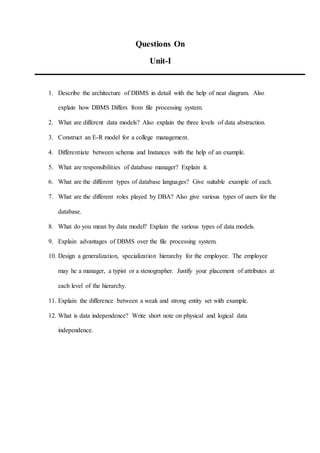
1. Describe the architecture of DBMS in detail with the help of neat diagram. Also
explain how DBMS Differs from file processing system.
2. What are different data models? Also explain the three levels of data abstraction.
3. Construct an E-R model for a college management.
4. Differentiate between schema and Instances with the help of an example.
5. What are responsibilities of database manager? Explain it.
6. What are the different types of database languages? Give suitable example of each.
7. What are the different roles played by DBA? Also give various types of users for the
database.
8. What do you mean by data model? Explain the various types of data models.
9. Explain advantages of DBMS over the file processing system.
10. Design a generalization, specialization hierarchy for the employee. The employee
may he a manager, a typist or a stenographer. Justify your placement of attributes at
each level of the hierarchy.
11. Explain the difference between a weak and strong entity set with example.
12. What is data independence? Write short note on physical and logical data
independence.
Questions On
Unit-II
1. Explain the fundamental operation in relational algebra.
2. What is an attribute?What are the various types of attributes.
3. Yet the following relation schemes he given
R=(A,B,C,)
S=(D,E,F)
Let realtion r(R) ,s(S) he given .Give an expression in SQL that is equivalent to each
of following.
i. Π A(r)
ii. σB=17(r)
iii. r×s
iv. πA,F (σC=D(r×s))
4. Write short note on
i. Trigger
ii.View
iii.Nested Subqueries
iv.Join Dependency
5. What is aggregate function? Explain aggregate functions.
6. What is integrity constraint? Discuss how the can be specified in SQL.
7. What are the various operations used in relational algebra? Explain any three with
example.
8. What is view in SQL, and how is it defined? Discuss the problem that may arise when
one attempts to update a view. How are views typically implemented.
9. Describe with suitable example the following operation in Two Relations:
i. Intersect
ii. Union
iii. Natural Join
iv. Division
10. What are SQL Predicates? Explain with suitable example.
Questions On
Unit-III
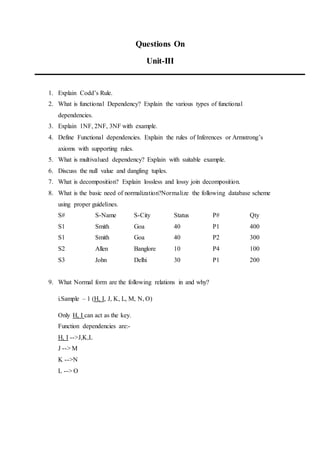
1. Explain Codd’s Rule.
2. What is functional Dependency? Explain the various types of functional
dependencies.
3. Explain 1NF, 2NF, 3NF with example.
4. Define Functional dependencies. Explain the rules of Inferences or Armstrong’s
axioms with supporting rules.
5. What is multivalued dependency? Explain with suitable example.
6. Discuss the null value and dangling tuples.
7. What is decomposition? Explain lossless and lossy join decomposition.
8. What is the basic need of normalization?Normalize the following database scheme
using proper guidelines.
S# S-Name S-City Status P# Qty
S1 Smith Goa 40 P1 400
S1 Smith Goa 40 P2 300
S2 Allen Banglore 10 P4 100
S3 John Delhi 30 P1 200
9. What Normal form are the following relations in and why?
i.Sample – 1 (H, I, J, K, L, M, N, O)
Only H, I can act as the key.
Function dependencies are:-
H, I -->J,K,L
J --> M
K -->N
L --> O
Questions On
Unit-IV
1. Explain ACID properties of database transaction with suitable example.
2. What is transaction?Explain the transaction model.
3. Explain shadow paging with an example.
4. Explain lock based protocols for concurrency control in database.
5. What is time stamp based protocols?
6. Write short note on :
i.Time stamp ordering
ii.Validation based protocol
7. Explain serializability and shadow paging with suitable example.
8. What is concurrency control ?Explain their types.
9. Explain buffer management.
10. What is recovery?Also explain Log based recovery.
11. What is two phase locking protocol ?Also explain their types.
12. Discuss the immediate update recovery technique in both single user and multiuser
environments.What are the advantages and disadvantages of immediate update?
13. Write short note on:
i.Multiple Granularity
ii.Multiversion scheme
Questions On
Unit-V
1. Explain client server Architecture.
2. Write in detail about distributed database.
3. Write note on:
i. Spatial and geographical database
ii. Multi-Media database
4. What is distributed database? Also explain their properties.
5. Draw neat sketch architecture of data warehousing and explain their components in
detail.
6. What is Data Minning? Also write the advantages and disadvantages of it.
7. Explain OLAP Architecture.
8. What is decision support system?Explain the processing model of DSS.

DBMS Question bank

  • 1.
    Questions On Unit-I 1. Describethe architecture of DBMS in detail with the help of neat diagram. Also explain how DBMS Differs from file processing system. 2. What are different data models? Also explain the three levels of data abstraction. 3. Construct an E-R model for a college management. 4. Differentiate between schema and Instances with the help of an example. 5. What are responsibilities of database manager? Explain it. 6. What are the different types of database languages? Give suitable example of each. 7. What are the different roles played by DBA? Also give various types of users for the database. 8. What do you mean by data model? Explain the various types of data models. 9. Explain advantages of DBMS over the file processing system. 10. Design a generalization, specialization hierarchy for the employee. The employee may he a manager, a typist or a stenographer. Justify your placement of attributes at each level of the hierarchy. 11. Explain the difference between a weak and strong entity set with example. 12. What is data independence? Write short note on physical and logical data independence.
  • 2.
    Questions On Unit-II 1. Explainthe fundamental operation in relational algebra. 2. What is an attribute?What are the various types of attributes. 3. Yet the following relation schemes he given R=(A,B,C,) S=(D,E,F) Let realtion r(R) ,s(S) he given .Give an expression in SQL that is equivalent to each of following. i. Π A(r) ii. σB=17(r) iii. r×s iv. πA,F (σC=D(r×s)) 4. Write short note on i. Trigger ii.View iii.Nested Subqueries iv.Join Dependency 5. What is aggregate function? Explain aggregate functions. 6. What is integrity constraint? Discuss how the can be specified in SQL. 7. What are the various operations used in relational algebra? Explain any three with example. 8. What is view in SQL, and how is it defined? Discuss the problem that may arise when one attempts to update a view. How are views typically implemented. 9. Describe with suitable example the following operation in Two Relations: i. Intersect ii. Union iii. Natural Join iv. Division 10. What are SQL Predicates? Explain with suitable example.
  • 3.
    Questions On Unit-III 1. ExplainCodd’s Rule. 2. What is functional Dependency? Explain the various types of functional dependencies. 3. Explain 1NF, 2NF, 3NF with example. 4. Define Functional dependencies. Explain the rules of Inferences or Armstrong’s axioms with supporting rules. 5. What is multivalued dependency? Explain with suitable example. 6. Discuss the null value and dangling tuples. 7. What is decomposition? Explain lossless and lossy join decomposition. 8. What is the basic need of normalization?Normalize the following database scheme using proper guidelines. S# S-Name S-City Status P# Qty S1 Smith Goa 40 P1 400 S1 Smith Goa 40 P2 300 S2 Allen Banglore 10 P4 100 S3 John Delhi 30 P1 200 9. What Normal form are the following relations in and why? i.Sample – 1 (H, I, J, K, L, M, N, O) Only H, I can act as the key. Function dependencies are:- H, I -->J,K,L J --> M K -->N L --> O
  • 4.
    Questions On Unit-IV 1. ExplainACID properties of database transaction with suitable example. 2. What is transaction?Explain the transaction model. 3. Explain shadow paging with an example. 4. Explain lock based protocols for concurrency control in database. 5. What is time stamp based protocols? 6. Write short note on : i.Time stamp ordering ii.Validation based protocol 7. Explain serializability and shadow paging with suitable example. 8. What is concurrency control ?Explain their types. 9. Explain buffer management. 10. What is recovery?Also explain Log based recovery. 11. What is two phase locking protocol ?Also explain their types. 12. Discuss the immediate update recovery technique in both single user and multiuser environments.What are the advantages and disadvantages of immediate update? 13. Write short note on: i.Multiple Granularity ii.Multiversion scheme
  • 5.
    Questions On Unit-V 1. Explainclient server Architecture. 2. Write in detail about distributed database. 3. Write note on: i. Spatial and geographical database ii. Multi-Media database 4. What is distributed database? Also explain their properties. 5. Draw neat sketch architecture of data warehousing and explain their components in detail. 6. What is Data Minning? Also write the advantages and disadvantages of it. 7. Explain OLAP Architecture. 8. What is decision support system?Explain the processing model of DSS.