DBD::SQLite
Recipes, Issues,
   and Plans
           Kenichi Ishigaki
              (@charsbar)
          YAPC::Asia 2012
             Sep 28, 2012
Thank you
for coming.
Today I‘ll show
you 10 recipes
 and 10 issues.
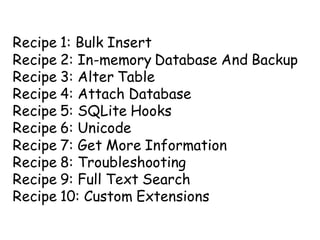
Recipe 1: Bulk Insert
Recipe 2: In-memory Database And Backup
Recipe 3: Alter Table
Recipe 4: Attach Database
Recipe 5: SQLite Hooks
Recipe 6: Unicode
Recipe 7: Get More Information
Recipe 8: Troubleshooting
Recipe 9: Full Text Search
Recipe 10: Custom Extensions
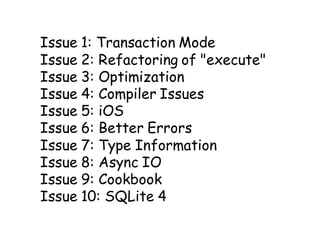
Issue 1: Transaction Mode
Issue 2: Refactoring of "execute"
Issue 3: Optimization
Issue 4: Compiler Issues
Issue 5: iOS
Issue 6: Better Errors
Issue 7: Type Information
Issue 8: Async IO
Issue 9: Cookbook
Issue 10: SQLite 4
I don’t think
everything should
be covered today.
Questions and
suggestions are
  all welcome.
Recipe 1
Bulk Insert
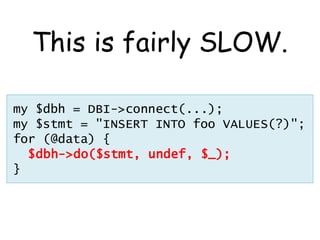
This is fairly SLOW.
my $dbh = DBI->connect(...);
my $stmt = "INSERT INTO foo VALUES(?)";
for (@data) {
  $dbh->do($stmt, undef, $_);
}
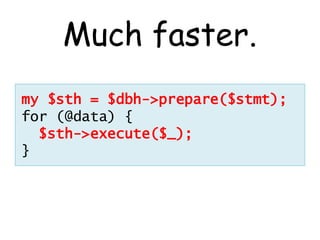
Much faster.
my $sth = $dbh->prepare($stmt);
for (@data) {
  $sth->execute($_);
}
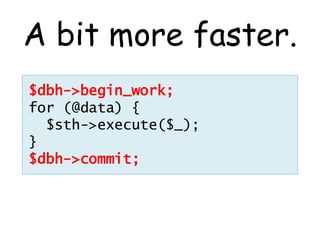
A bit more faster.
$dbh->begin_work;
for (@data) {
  $sth->execute($_);
}
$dbh->commit;
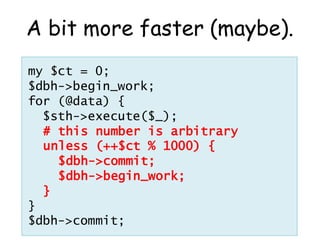
A bit more faster (maybe).
my $ct = 0;
$dbh->begin_work;
for (@data) {
  $sth->execute($_);
  # this number is arbitrary
  unless (++$ct % 1000) {
    $dbh->commit;
    $dbh->begin_work;
  }
}
$dbh->commit;
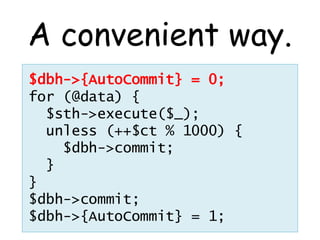
A convenient way.
$dbh->{AutoCommit} = 0;
for (@data) {
  $sth->execute($_);
  unless (++$ct % 1000) {
    $dbh->commit;
  }
}
$dbh->commit;
$dbh->{AutoCommit} = 1;
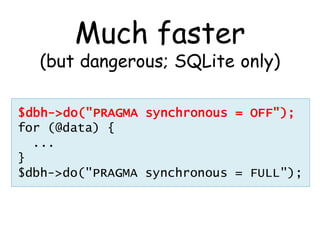
Much faster
  (but dangerous; SQLite only)

$dbh->do("PRAGMA synchronous = OFF");
for (@data) {
  ...
}
$dbh->do("PRAGMA synchronous = FULL");
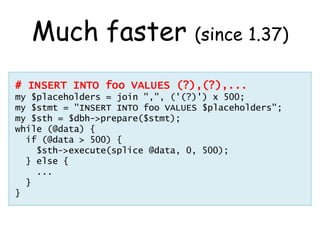
Much faster (since 1.37)
# INSERT INTO foo VALUES (?),(?),...
my $placeholders = join ",", ('(?)') x 500;
my $stmt = "INSERT INTO foo VALUES $placeholders";
my $sth = $dbh->prepare($stmt);
while (@data) {
  if (@data > 500) {
    $sth->execute(splice @data, 0, 500);
  } else {
    ...
  }
}
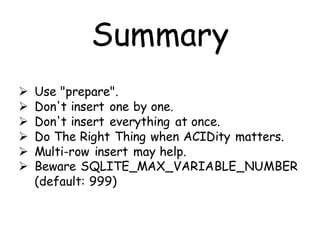
Summary
   Use "prepare".
   Don't insert one by one.
   Don't insert everything at once.
   Do The Right Thing when ACIDity matters.
   Multi-row insert may help.
   Beware SQLITE_MAX_VARIABLE_NUMBER
    (default: 999)
Recipe 2
In-memory Database
    And Backup
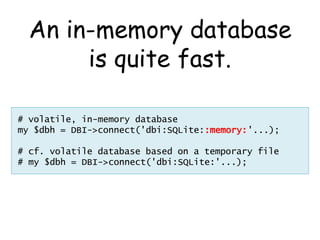
An in-memory database
       is quite fast.

# volatile, in-memory database
my $dbh = DBI->connect('dbi:SQLite::memory:'...);

# cf. volatile database based on a temporary file
# my $dbh = DBI->connect('dbi:SQLite:'...);
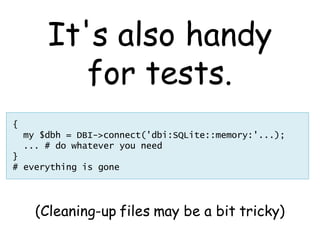
It's also handy
           for tests.
{
    my $dbh = DBI->connect('dbi:SQLite::memory:'...);
    ... # do whatever you need
}
# everything is gone


      (Cleaning-up files may be a bit tricky)
What to do
if the tests
should fail?
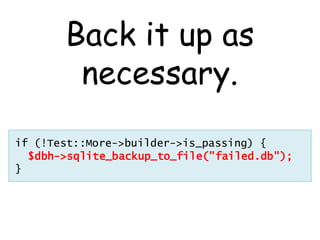
Back it up as
        necessary.
if (!Test::More->builder->is_passing) {
  $dbh->sqlite_backup_to_file("failed.db");
}
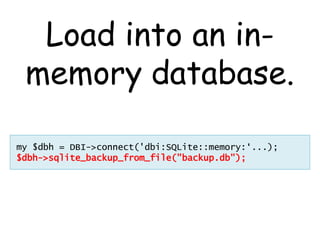
Load into an in-
 memory database.

my $dbh = DBI->connect('dbi:SQLite::memory:‘...);
$dbh->sqlite_backup_from_file("backup.db");
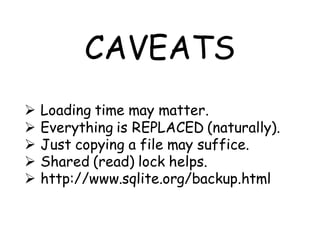
CAVEATS
   Loading time may matter.
   Everything is REPLACED (naturally).
   Just copying a file may suffice.
   Shared (read) lock helps.
   http://www.sqlite.org/backup.html
Recipe 3
Alter Table
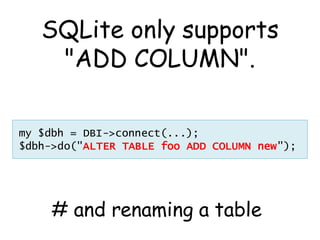
SQLite only supports
    "ADD COLUMN".

my $dbh = DBI->connect(...);
$dbh->do("ALTER TABLE foo ADD COLUMN new");


     # and renaming a table
Use a temporary
table if you want
      more.
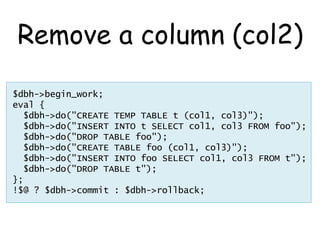
Remove a column (col2)
$dbh->begin_work;
eval {
  $dbh->do("CREATE TEMP TABLE t (col1, col3)");
  $dbh->do("INSERT INTO t SELECT col1, col3 FROM foo");
  $dbh->do("DROP TABLE foo");
  $dbh->do("CREATE TABLE foo (col1, col3)");
  $dbh->do("INSERT INTO foo SELECT col1, col3 FROM t");
  $dbh->do("DROP TABLE t");
};
!$@ ? $dbh->commit : $dbh->rollback;
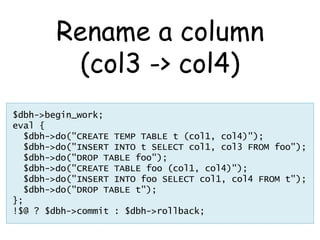
Rename a column
         (col3 -> col4)
$dbh->begin_work;
eval {
  $dbh->do("CREATE TEMP TABLE t (col1, col4)");
  $dbh->do("INSERT INTO t SELECT col1, col3 FROM foo");
  $dbh->do("DROP TABLE foo");
  $dbh->do("CREATE TABLE foo (col1, col4)");
  $dbh->do("INSERT INTO foo SELECT col1, col4 FROM t");
  $dbh->do("DROP TABLE t");
};
!$@ ? $dbh->commit : $dbh->rollback;
NOTE
   ACIDity matters here.
   A temporary table is reasonably fast.
   Want some wrapper?
   http://sqlite.org/faq.html#q11
Recipe 4
Attach Database
One big file with
    all tables
         =
Easier to copy/move.
One big file with
   all tables
        =
Easier to be locked.
Splitting a
  database into
smaller databases
    may help.
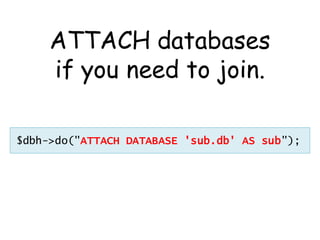
ATTACH databases
     if you need to join.

$dbh->do("ATTACH DATABASE 'sub.db' AS sub");
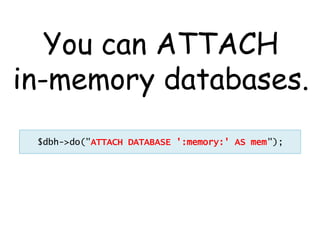
You can ATTACH
in-memory databases.
 $dbh->do("ATTACH DATABASE ':memory:' AS mem");
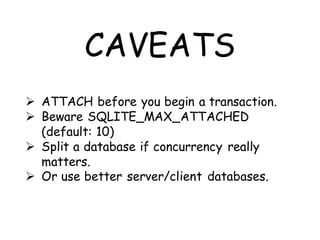
CAVEATS
 ATTACH before you begin a transaction.
 Beware SQLITE_MAX_ATTACHED
  (default: 10)
 Split a database if concurrency really
  matters.
 Or use better server/client databases.
Recipe 5
SQLite Hooks
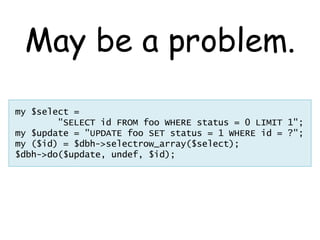
May be a problem.
my $select =
        "SELECT id FROM foo WHERE status = 0 LIMIT 1";
my $update = "UPDATE foo SET status = 1 WHERE id = ?";
my ($id) = $dbh->selectrow_array($select);
$dbh->do($update, undef, $id);
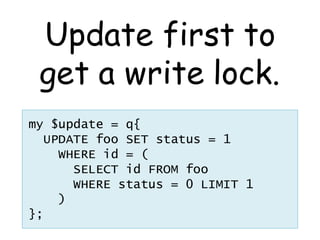
Update first to
 get a write lock.
my $update = q{
  UPDATE foo SET status = 1
    WHERE id = (
      SELECT id FROM foo
      WHERE status = 0 LIMIT 1
    )
};
What should we do
to find an updated
       row?
 # $dbh->last_insert_id doesn't work
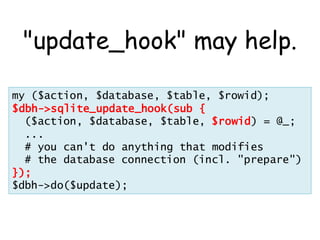
"update_hook" may help.

my ($action, $database, $table, $rowid);
$dbh->sqlite_update_hook(sub {
  ($action, $database, $table, $rowid) = @_;
  ...
  # you can't do anything that modifies
  # the database connection (incl. "prepare")
});
$dbh->do($update);
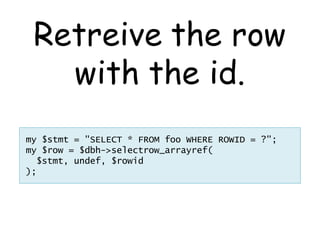
Retreive the row
   with the id.
my $stmt = "SELECT * FROM foo WHERE ROWID = ?";
my $row = $dbh->selectrow_arrayref(
  $stmt, undef, $rowid
);
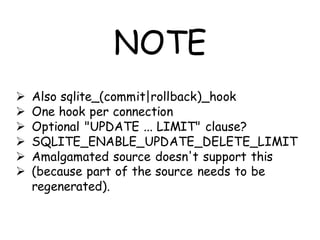
NOTE
   Also sqlite_(commit|rollback)_hook
   One hook per connection
   Optional "UPDATE ... LIMIT" clause?
   SQLITE_ENABLE_UPDATE_DELETE_LIMIT
   Amalgamated source doesn't support this
   (because part of the source needs to be
    regenerated).
Recipe 6
Unicode
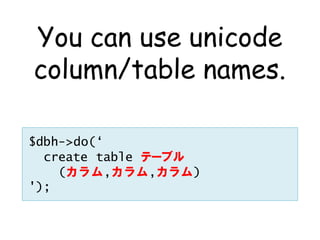
You can use unicode
column/table names.

$dbh->do(‘
  create table テーブル
    (カラム,カラム,カラム)
');
Basic rules
 decode what you get from a
  database
 encode what you put into a
  database
sqlite_unicode => 1

 what you get will be
  decoded
 what you put will be ...
Summary
 Don't need to care usually.
 Be careful when you use
  _info() methods.
 More work may be needed.
Recipe 7
Get More Information
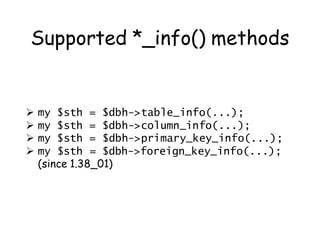
Supported *_info() methods


   my $sth = $dbh->table_info(...);
   my $sth = $dbh->column_info(...);
   my $sth = $dbh->primary_key_info(...);
   my $sth = $dbh->foreign_key_info(...);
    (since 1.38_01)
table_info()
 to get table names
  (accepts wild cards)
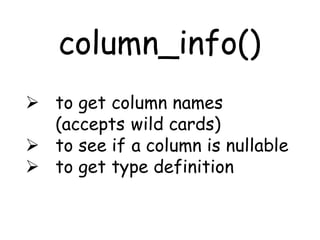
column_info()
 to get column names
  (accepts wild cards)
 to see if a column is nullable
 to get type definition
primary_key_info()

 to get primary key names
foreign_key_info()

 to get foreign key names
 or referred tables
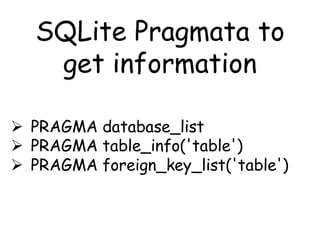
SQLite Pragmata to
    get information

 PRAGMA database_list
 PRAGMA table_info('table')
 PRAGMA foreign_key_list('table')
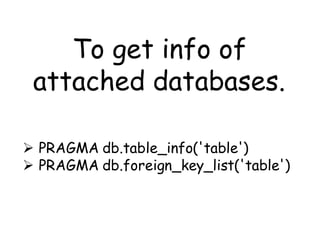
To get info of
 attached databases.

 PRAGMA db.table_info('table')
 PRAGMA db.foreign_key_list('table')
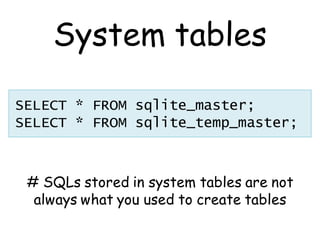
System tables

SELECT * FROM sqlite_master;
SELECT * FROM sqlite_temp_master;


 # SQLs stored in system tables are not
  always what you used to create tables
Recipe 8
Troubleshooting
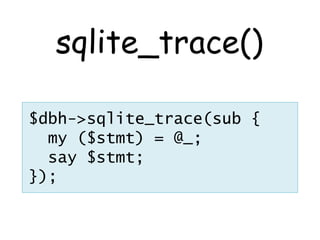
sqlite_trace()

$dbh->sqlite_trace(sub {
  my ($stmt) = @_;
  say $stmt;
});
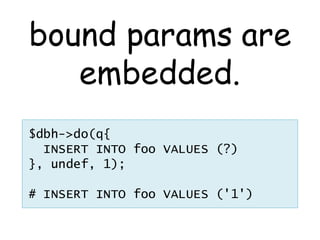
bound params are
   embedded.
$dbh->do(q{
  INSERT INTO foo VALUES (?)
}, undef, 1);

# INSERT INTO foo VALUES ('1')
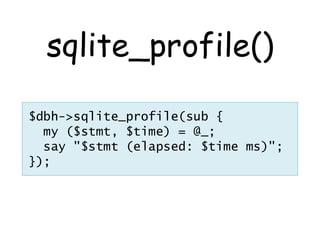
sqlite_profile()

$dbh->sqlite_profile(sub {
  my ($stmt, $time) = @_;
  say "$stmt (elapsed: $time ms)";
});
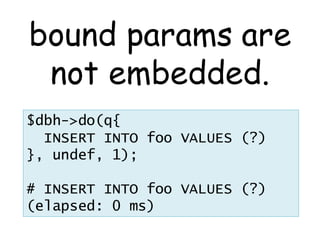
bound params are
 not embedded.
$dbh->do(q{
  INSERT INTO foo VALUES (?)
}, undef, 1);

# INSERT INTO foo VALUES (?)
(elapsed: 0 ms)
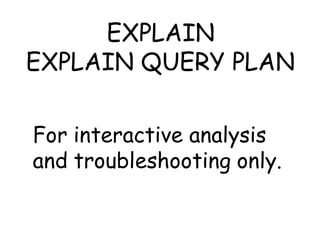
EXPLAIN
EXPLAIN QUERY PLAN

For interactive analysis
and troubleshooting only.
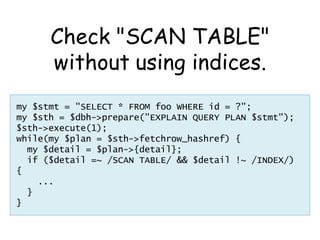
Check "SCAN TABLE"
      without using indices.
my $stmt = "SELECT * FROM foo WHERE id = ?";
my $sth = $dbh->prepare("EXPLAIN QUERY PLAN $stmt");
$sth->execute(1);
while(my $plan = $sth->fetchrow_hashref) {
  my $detail = $plan->{detail};
  if ($detail =~ /SCAN TABLE/ && $detail !~ /INDEX/)
{
    ...
  }
}
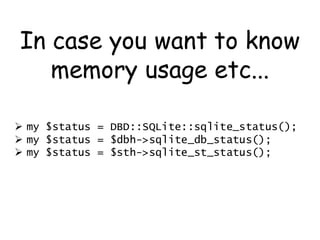
In case you want to know
   memory usage etc...

 my $status = DBD::SQLite::sqlite_status();
 my $status = $dbh->sqlite_db_status();
 my $status = $sth->sqlite_st_status();
Recipe 9
Full Text Search
SQLite supports
full text search.

 http://sqlite.org/fts3.html
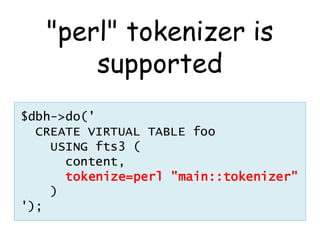
"perl" tokenizer is
       supported
$dbh->do('
  CREATE VIRTUAL TABLE foo
    USING fts3 (
      content,
      tokenize=perl "main::tokenizer"
    )
');
my $mecab = Text::MeCab->new;

sub tokenizer { return sub {
  my $node = $mecab->parse($_[0]);
  my ($index, $pos) = (0, 0);
  return sub {
    my $token = $node->surface or return;
    my $length = $node->length;
    my $start = $pos;
    my $end    = $pos += $length;
    $node = $node->next;
    return ($token, $length, $start, $end, $index++);
  };
}}


http://d.hatena.ne.jp/charsbar/20100828/1282937592
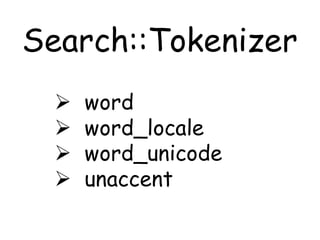
Search::Tokenizer
     word
     word_locale
     word_unicode
     unaccent
Want more?
Recipe 10
Custom Extensions
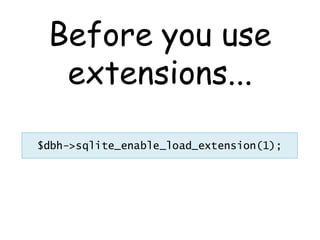
Before you use
  extensions...

$dbh->sqlite_enable_load_extension(1);
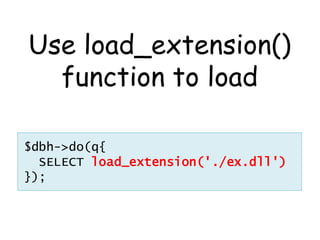
Use load_extension()
  function to load

$dbh->do(q{
  SELECT load_extension('./ex.dll')
});
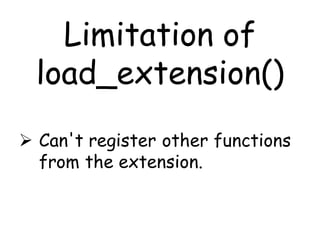
Limitation of
  load_extension()
 Can't register other functions
  from the extension.
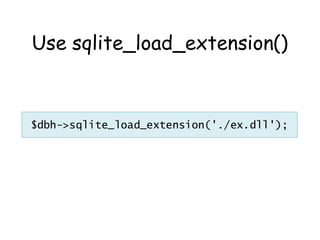
Use sqlite_load_extension()


$dbh->sqlite_load_extension('./ex.dll');
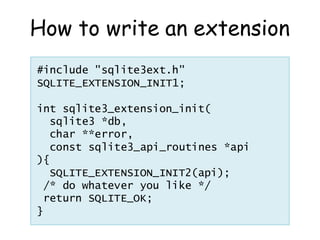
How to write an extension
#include "sqlite3ext.h"
SQLITE_EXTENSION_INIT1;

int sqlite3_extension_init(
  sqlite3 *db,
  char **error,
  const sqlite3_api_routines *api
){
  SQLITE_EXTENSION_INIT2(api);
 /* do whatever you like */
 return SQLITE_OK;
}
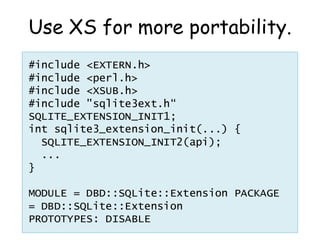
Use XS for more portability.
#include <EXTERN.h>
#include <perl.h>
#include <XSUB.h>
#include "sqlite3ext.h“
SQLITE_EXTENSION_INIT1;
int sqlite3_extension_init(...) {
  SQLITE_EXTENSION_INIT2(api);
  ...
}

MODULE = DBD::SQLite::Extension PACKAGE
= DBD::SQLite::Extension
PROTOTYPES: DISABLE
Prepare Makefile.PL
use strict;
use warnings;
use ExtUtils::MakeMaker;
# Get installed header files
get_sqlite_header("sqlite3.h") or exit;
get_sqlite_header("sqlite3ext.h") or exit;
WriteMakefile(
  NAME => 'DBD::SQLite::Extension',
  CONFIGURE_REQUIRES => {
    'File::ShareDir' => '1.0', # to get headers
    'DBD::SQLite' => '1.38_01',
  },
  FUNCLIST => ['sqlite3_extension_init'],
  DL_FUNCS => {'DBD::SQLite::Extension' => []},
);
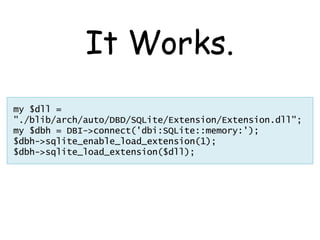
It Works.
my $dll =
"./blib/arch/auto/DBD/SQLite/Extension/Extension.dll";
my $dbh = DBI->connect('dbi:SQLite::memory:');
$dbh->sqlite_enable_load_extension(1);
$dbh->sqlite_load_extension($dll);
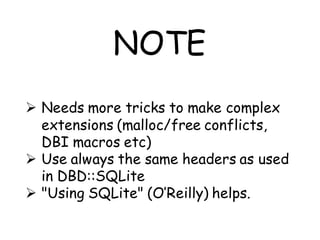
NOTE
 Needs more tricks to make complex
  extensions (malloc/free conflicts,
  DBI macros etc)
 Use always the same headers as used
  in DBD::SQLite
 "Using SQLite" (O’Reilly) helps.
Questions so far?
Issue 1
Transaction Mode
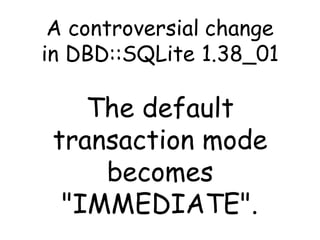
A controversial change
in DBD::SQLite 1.38_01

    The default
 transaction mode
     becomes
  "IMMEDIATE".
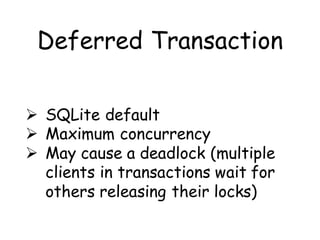
Deferred Transaction

 SQLite default
 Maximum concurrency
 May cause a deadlock (multiple
  clients in transactions wait for
  others releasing their locks)
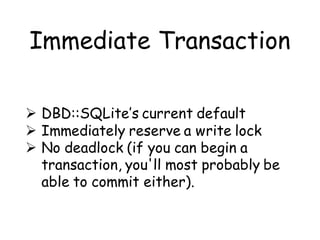
Immediate Transaction

 DBD::SQLite’s current default
 Immediately reserve a write lock
 No deadlock (if you can begin a
  transaction, you'll most probably be
  able to commit either).
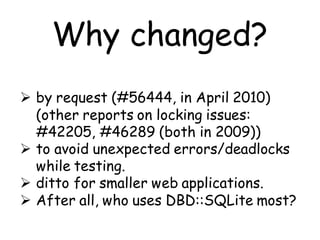
Why changed?
 by request (#56444, in April 2010)
  (other reports on locking issues:
  #42205, #46289 (both in 2009))
 to avoid unexpected errors/deadlocks
  while testing.
 ditto for smaller web applications.
 After all, who uses DBD::SQLite most?
Use "Deferred" when
you know a database
 is almost read-only.
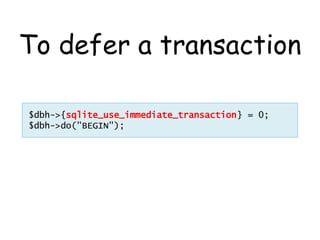
To defer a transaction

$dbh->{sqlite_use_immediate_transaction} = 0;
$dbh->do("BEGIN");
Issue 2
Refactoring of
  "execute"
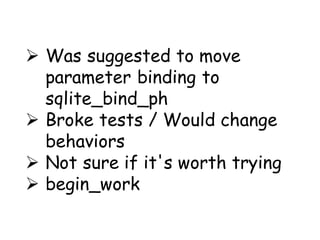
 Was suggested to move
  parameter binding to
  sqlite_bind_ph
 Broke tests / Would change
  behaviors
 Not sure if it's worth trying
 begin_work
Issue 3
Optimization
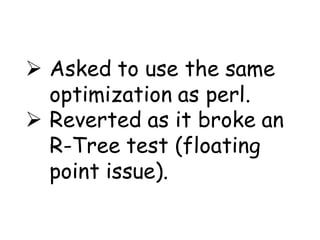
 Asked to use the same
  optimization as perl.
 Reverted as it broke an
  R-Tree test (floating
  point issue).
Issue 4
Compiler Issues
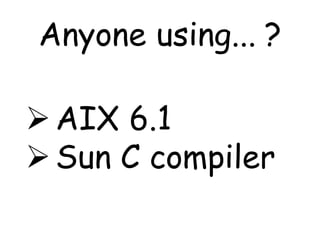
Anyone using... ?

 AIX 6.1
 Sun C compiler
Issue 5
 iOS
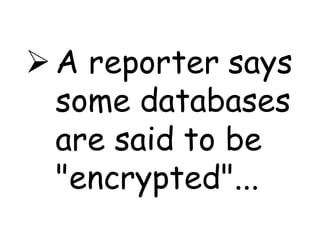
 A reporter says
  some databases
  are said to be
  "encrypted"...
Issue 6
Better Errors
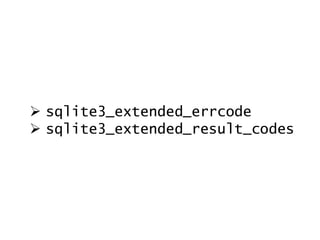
 sqlite3_extended_errcode
 sqlite3_extended_result_codes
Issue 7
Type Information
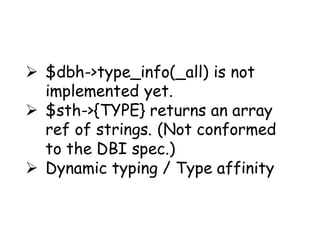
 $dbh->type_info(_all) is not
  implemented yet.
 $sth->{TYPE} returns an array
  ref of strings. (Not conformed
  to the DBI spec.)
 Dynamic typing / Type affinity
Issue 8
Async IO
 Nice to have.
 Not amalgamated.
 Would need significant
  refactoring.
 Separate distribution?
Issue 9
Cookbook
 Almost forgotten.
 Maybe these
  slides help.
 Suggestions?
Issue 10
SQLite 4
SQLite4 is an alternative,
 not a replacement, for
        SQLite3.

- http://sqlite.org/src4/doc/trunk/www/design.wiki
Still in its
  earliest stage.

 No downloadable packages.
 Not enough features yet.
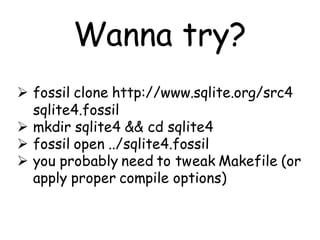
Wanna try?
 fossil clone http://www.sqlite.org/src4
  sqlite4.fossil
 mkdir sqlite4 && cd sqlite4
 fossil open ../sqlite4.fossil
 you probably need to tweak Makefile (or
  apply proper compile options)
DBD::SQLite4?

 Will probably be needed eventually
 Should share the same sqlite_
  prefix?
 Able to share the common part?
Questions?
Thank you

DBD::SQLite

  • 1.
    DBD::SQLite Recipes, Issues, and Plans Kenichi Ishigaki (@charsbar) YAPC::Asia 2012 Sep 28, 2012
  • 2.
  • 3.
    Today I‘ll show you10 recipes and 10 issues.
  • 4.
    Recipe 1: BulkInsert Recipe 2: In-memory Database And Backup Recipe 3: Alter Table Recipe 4: Attach Database Recipe 5: SQLite Hooks Recipe 6: Unicode Recipe 7: Get More Information Recipe 8: Troubleshooting Recipe 9: Full Text Search Recipe 10: Custom Extensions
  • 5.
    Issue 1: TransactionMode Issue 2: Refactoring of "execute" Issue 3: Optimization Issue 4: Compiler Issues Issue 5: iOS Issue 6: Better Errors Issue 7: Type Information Issue 8: Async IO Issue 9: Cookbook Issue 10: SQLite 4
  • 6.
    I don’t think everythingshould be covered today.
  • 7.
  • 8.
  • 9.
    This is fairlySLOW. my $dbh = DBI->connect(...); my $stmt = "INSERT INTO foo VALUES(?)"; for (@data) { $dbh->do($stmt, undef, $_); }
  • 10.
    Much faster. my $sth= $dbh->prepare($stmt); for (@data) { $sth->execute($_); }
  • 11.
    A bit morefaster. $dbh->begin_work; for (@data) { $sth->execute($_); } $dbh->commit;
  • 12.
    A bit morefaster (maybe). my $ct = 0; $dbh->begin_work; for (@data) { $sth->execute($_); # this number is arbitrary unless (++$ct % 1000) { $dbh->commit; $dbh->begin_work; } } $dbh->commit;
  • 13.
    A convenient way. $dbh->{AutoCommit}= 0; for (@data) { $sth->execute($_); unless (++$ct % 1000) { $dbh->commit; } } $dbh->commit; $dbh->{AutoCommit} = 1;
  • 14.
    Much faster (but dangerous; SQLite only) $dbh->do("PRAGMA synchronous = OFF"); for (@data) { ... } $dbh->do("PRAGMA synchronous = FULL");
  • 15.
    Much faster (since1.37) # INSERT INTO foo VALUES (?),(?),... my $placeholders = join ",", ('(?)') x 500; my $stmt = "INSERT INTO foo VALUES $placeholders"; my $sth = $dbh->prepare($stmt); while (@data) { if (@data > 500) { $sth->execute(splice @data, 0, 500); } else { ... } }
  • 16.
    Summary  Use "prepare".  Don't insert one by one.  Don't insert everything at once.  Do The Right Thing when ACIDity matters.  Multi-row insert may help.  Beware SQLITE_MAX_VARIABLE_NUMBER (default: 999)
  • 17.
  • 18.
    An in-memory database is quite fast. # volatile, in-memory database my $dbh = DBI->connect('dbi:SQLite::memory:'...); # cf. volatile database based on a temporary file # my $dbh = DBI->connect('dbi:SQLite:'...);
  • 19.
    It's also handy for tests. { my $dbh = DBI->connect('dbi:SQLite::memory:'...); ... # do whatever you need } # everything is gone (Cleaning-up files may be a bit tricky)
  • 20.
    What to do ifthe tests should fail?
  • 21.
    Back it upas necessary. if (!Test::More->builder->is_passing) { $dbh->sqlite_backup_to_file("failed.db"); }
  • 22.
    Load into anin- memory database. my $dbh = DBI->connect('dbi:SQLite::memory:‘...); $dbh->sqlite_backup_from_file("backup.db");
  • 23.
    CAVEATS  Loading time may matter.  Everything is REPLACED (naturally).  Just copying a file may suffice.  Shared (read) lock helps.  http://www.sqlite.org/backup.html
  • 24.
  • 25.
    SQLite only supports "ADD COLUMN". my $dbh = DBI->connect(...); $dbh->do("ALTER TABLE foo ADD COLUMN new"); # and renaming a table
  • 26.
    Use a temporary tableif you want more.
  • 27.
    Remove a column(col2) $dbh->begin_work; eval { $dbh->do("CREATE TEMP TABLE t (col1, col3)"); $dbh->do("INSERT INTO t SELECT col1, col3 FROM foo"); $dbh->do("DROP TABLE foo"); $dbh->do("CREATE TABLE foo (col1, col3)"); $dbh->do("INSERT INTO foo SELECT col1, col3 FROM t"); $dbh->do("DROP TABLE t"); }; !$@ ? $dbh->commit : $dbh->rollback;
  • 28.
    Rename a column (col3 -> col4) $dbh->begin_work; eval { $dbh->do("CREATE TEMP TABLE t (col1, col4)"); $dbh->do("INSERT INTO t SELECT col1, col3 FROM foo"); $dbh->do("DROP TABLE foo"); $dbh->do("CREATE TABLE foo (col1, col4)"); $dbh->do("INSERT INTO foo SELECT col1, col4 FROM t"); $dbh->do("DROP TABLE t"); }; !$@ ? $dbh->commit : $dbh->rollback;
  • 29.
    NOTE  ACIDity matters here.  A temporary table is reasonably fast.  Want some wrapper?  http://sqlite.org/faq.html#q11
  • 30.
  • 31.
    One big filewith all tables = Easier to copy/move.
  • 32.
    One big filewith all tables = Easier to be locked.
  • 33.
    Splitting a database into smaller databases may help.
  • 34.
    ATTACH databases if you need to join. $dbh->do("ATTACH DATABASE 'sub.db' AS sub");
  • 35.
    You can ATTACH in-memorydatabases. $dbh->do("ATTACH DATABASE ':memory:' AS mem");
  • 36.
    CAVEATS  ATTACH beforeyou begin a transaction.  Beware SQLITE_MAX_ATTACHED (default: 10)  Split a database if concurrency really matters.  Or use better server/client databases.
  • 37.
  • 38.
    May be aproblem. my $select = "SELECT id FROM foo WHERE status = 0 LIMIT 1"; my $update = "UPDATE foo SET status = 1 WHERE id = ?"; my ($id) = $dbh->selectrow_array($select); $dbh->do($update, undef, $id);
  • 39.
    Update first to get a write lock. my $update = q{ UPDATE foo SET status = 1 WHERE id = ( SELECT id FROM foo WHERE status = 0 LIMIT 1 ) };
  • 40.
    What should wedo to find an updated row? # $dbh->last_insert_id doesn't work
  • 41.
    "update_hook" may help. my($action, $database, $table, $rowid); $dbh->sqlite_update_hook(sub { ($action, $database, $table, $rowid) = @_; ... # you can't do anything that modifies # the database connection (incl. "prepare") }); $dbh->do($update);
  • 42.
    Retreive the row with the id. my $stmt = "SELECT * FROM foo WHERE ROWID = ?"; my $row = $dbh->selectrow_arrayref( $stmt, undef, $rowid );
  • 43.
    NOTE  Also sqlite_(commit|rollback)_hook  One hook per connection  Optional "UPDATE ... LIMIT" clause?  SQLITE_ENABLE_UPDATE_DELETE_LIMIT  Amalgamated source doesn't support this  (because part of the source needs to be regenerated).
  • 44.
  • 45.
    You can useunicode column/table names. $dbh->do(‘ create table テーブル (カラム,カラム,カラム) ');
  • 46.
    Basic rules  decodewhat you get from a database  encode what you put into a database
  • 47.
    sqlite_unicode => 1 what you get will be decoded  what you put will be ...
  • 48.
    Summary  Don't needto care usually.  Be careful when you use _info() methods.  More work may be needed.
  • 49.
    Recipe 7 Get MoreInformation
  • 50.
    Supported *_info() methods  my $sth = $dbh->table_info(...);  my $sth = $dbh->column_info(...);  my $sth = $dbh->primary_key_info(...);  my $sth = $dbh->foreign_key_info(...); (since 1.38_01)
  • 51.
    table_info()  to gettable names (accepts wild cards)
  • 52.
    column_info()  to getcolumn names (accepts wild cards)  to see if a column is nullable  to get type definition
  • 53.
  • 54.
    foreign_key_info()  to getforeign key names  or referred tables
  • 55.
    SQLite Pragmata to get information  PRAGMA database_list  PRAGMA table_info('table')  PRAGMA foreign_key_list('table')
  • 56.
    To get infoof attached databases.  PRAGMA db.table_info('table')  PRAGMA db.foreign_key_list('table')
  • 57.
    System tables SELECT *FROM sqlite_master; SELECT * FROM sqlite_temp_master; # SQLs stored in system tables are not always what you used to create tables
  • 58.
  • 59.
    sqlite_trace() $dbh->sqlite_trace(sub { my ($stmt) = @_; say $stmt; });
  • 60.
    bound params are embedded. $dbh->do(q{ INSERT INTO foo VALUES (?) }, undef, 1); # INSERT INTO foo VALUES ('1')
  • 61.
    sqlite_profile() $dbh->sqlite_profile(sub { my ($stmt, $time) = @_; say "$stmt (elapsed: $time ms)"; });
  • 62.
    bound params are not embedded. $dbh->do(q{ INSERT INTO foo VALUES (?) }, undef, 1); # INSERT INTO foo VALUES (?) (elapsed: 0 ms)
  • 63.
    EXPLAIN EXPLAIN QUERY PLAN Forinteractive analysis and troubleshooting only.
  • 64.
    Check "SCAN TABLE" without using indices. my $stmt = "SELECT * FROM foo WHERE id = ?"; my $sth = $dbh->prepare("EXPLAIN QUERY PLAN $stmt"); $sth->execute(1); while(my $plan = $sth->fetchrow_hashref) { my $detail = $plan->{detail}; if ($detail =~ /SCAN TABLE/ && $detail !~ /INDEX/) { ... } }
  • 65.
    In case youwant to know memory usage etc...  my $status = DBD::SQLite::sqlite_status();  my $status = $dbh->sqlite_db_status();  my $status = $sth->sqlite_st_status();
  • 66.
  • 67.
    SQLite supports full textsearch.  http://sqlite.org/fts3.html
  • 68.
    "perl" tokenizer is supported $dbh->do(' CREATE VIRTUAL TABLE foo USING fts3 ( content, tokenize=perl "main::tokenizer" ) ');
  • 69.
    my $mecab =Text::MeCab->new; sub tokenizer { return sub { my $node = $mecab->parse($_[0]); my ($index, $pos) = (0, 0); return sub { my $token = $node->surface or return; my $length = $node->length; my $start = $pos; my $end = $pos += $length; $node = $node->next; return ($token, $length, $start, $end, $index++); }; }} http://d.hatena.ne.jp/charsbar/20100828/1282937592
  • 70.
    Search::Tokenizer  word  word_locale  word_unicode  unaccent
  • 71.
  • 72.
  • 73.
    Before you use extensions... $dbh->sqlite_enable_load_extension(1);
  • 74.
    Use load_extension() function to load $dbh->do(q{ SELECT load_extension('./ex.dll') });
  • 75.
    Limitation of load_extension()  Can't register other functions from the extension.
  • 76.
  • 77.
    How to writean extension #include "sqlite3ext.h" SQLITE_EXTENSION_INIT1; int sqlite3_extension_init( sqlite3 *db, char **error, const sqlite3_api_routines *api ){ SQLITE_EXTENSION_INIT2(api); /* do whatever you like */ return SQLITE_OK; }
  • 78.
    Use XS formore portability. #include <EXTERN.h> #include <perl.h> #include <XSUB.h> #include "sqlite3ext.h“ SQLITE_EXTENSION_INIT1; int sqlite3_extension_init(...) { SQLITE_EXTENSION_INIT2(api); ... } MODULE = DBD::SQLite::Extension PACKAGE = DBD::SQLite::Extension PROTOTYPES: DISABLE
  • 79.
    Prepare Makefile.PL use strict; usewarnings; use ExtUtils::MakeMaker; # Get installed header files get_sqlite_header("sqlite3.h") or exit; get_sqlite_header("sqlite3ext.h") or exit; WriteMakefile( NAME => 'DBD::SQLite::Extension', CONFIGURE_REQUIRES => { 'File::ShareDir' => '1.0', # to get headers 'DBD::SQLite' => '1.38_01', }, FUNCLIST => ['sqlite3_extension_init'], DL_FUNCS => {'DBD::SQLite::Extension' => []}, );
  • 80.
    It Works. my $dll= "./blib/arch/auto/DBD/SQLite/Extension/Extension.dll"; my $dbh = DBI->connect('dbi:SQLite::memory:'); $dbh->sqlite_enable_load_extension(1); $dbh->sqlite_load_extension($dll);
  • 81.
    NOTE  Needs moretricks to make complex extensions (malloc/free conflicts, DBI macros etc)  Use always the same headers as used in DBD::SQLite  "Using SQLite" (O’Reilly) helps.
  • 82.
  • 83.
  • 84.
    A controversial change inDBD::SQLite 1.38_01 The default transaction mode becomes "IMMEDIATE".
  • 85.
    Deferred Transaction  SQLitedefault  Maximum concurrency  May cause a deadlock (multiple clients in transactions wait for others releasing their locks)
  • 86.
    Immediate Transaction  DBD::SQLite’scurrent default  Immediately reserve a write lock  No deadlock (if you can begin a transaction, you'll most probably be able to commit either).
  • 87.
    Why changed?  byrequest (#56444, in April 2010) (other reports on locking issues: #42205, #46289 (both in 2009))  to avoid unexpected errors/deadlocks while testing.  ditto for smaller web applications.  After all, who uses DBD::SQLite most?
  • 88.
    Use "Deferred" when youknow a database is almost read-only.
  • 89.
    To defer atransaction $dbh->{sqlite_use_immediate_transaction} = 0; $dbh->do("BEGIN");
  • 90.
  • 91.
     Was suggestedto move parameter binding to sqlite_bind_ph  Broke tests / Would change behaviors  Not sure if it's worth trying  begin_work
  • 92.
  • 93.
     Asked touse the same optimization as perl.  Reverted as it broke an R-Tree test (floating point issue).
  • 94.
  • 95.
    Anyone using... ? AIX 6.1  Sun C compiler
  • 96.
  • 97.
     A reportersays some databases are said to be "encrypted"...
  • 98.
  • 99.
  • 100.
  • 101.
     $dbh->type_info(_all) isnot implemented yet.  $sth->{TYPE} returns an array ref of strings. (Not conformed to the DBI spec.)  Dynamic typing / Type affinity
  • 102.
  • 103.
     Nice tohave.  Not amalgamated.  Would need significant refactoring.  Separate distribution?
  • 104.
  • 105.
     Almost forgotten. Maybe these slides help.  Suggestions?
  • 106.
  • 107.
    SQLite4 is analternative, not a replacement, for SQLite3. - http://sqlite.org/src4/doc/trunk/www/design.wiki
  • 108.
    Still in its earliest stage.  No downloadable packages.  Not enough features yet.
  • 109.
    Wanna try?  fossilclone http://www.sqlite.org/src4 sqlite4.fossil  mkdir sqlite4 && cd sqlite4  fossil open ../sqlite4.fossil  you probably need to tweak Makefile (or apply proper compile options)
  • 110.
    DBD::SQLite4?  Will probablybe needed eventually  Should share the same sqlite_ prefix?  Able to share the common part?
  • 111.
  • 112.