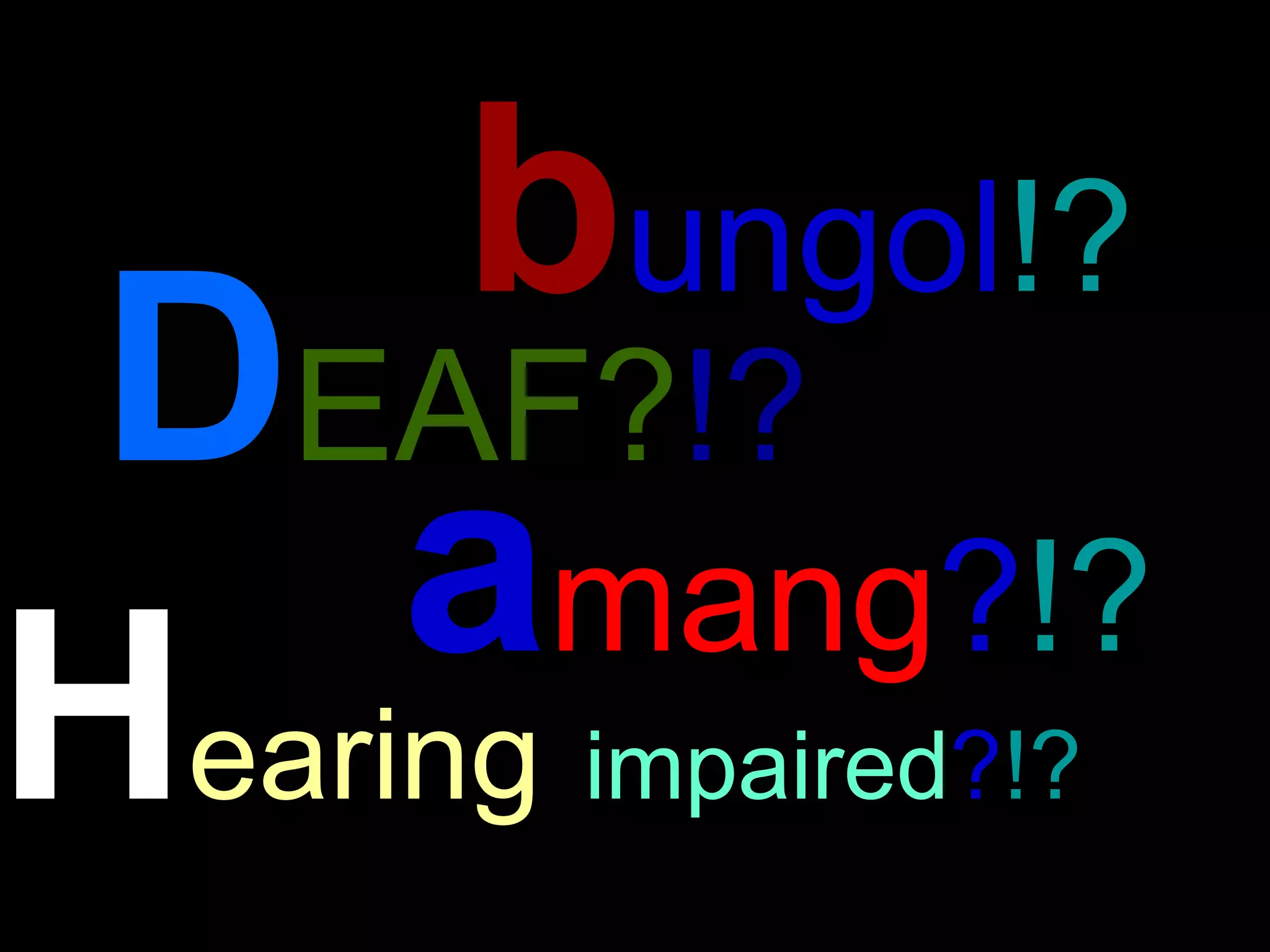




D EAF? !?  b ungol !?   a mang ? !?   H earing   impaired ? !?
What do I know about them? What do I think when I see them? How do I feel when I see them?
Let’s Have A Short Quiz!
TRUE  OR     FALSE
Deaf  people are mute
Deaf  people are dumb
All  Deaf  people are excellent lip-readers
Sign language is  UNIVERSAL
D EAF inite ly!  MIS CONCEPT IONS
A B asic  F acts
Two (2) Perspectives on Deafness (as described by Baker and Cokely, 1980) The Medical-Pathological Model The Cultural Model
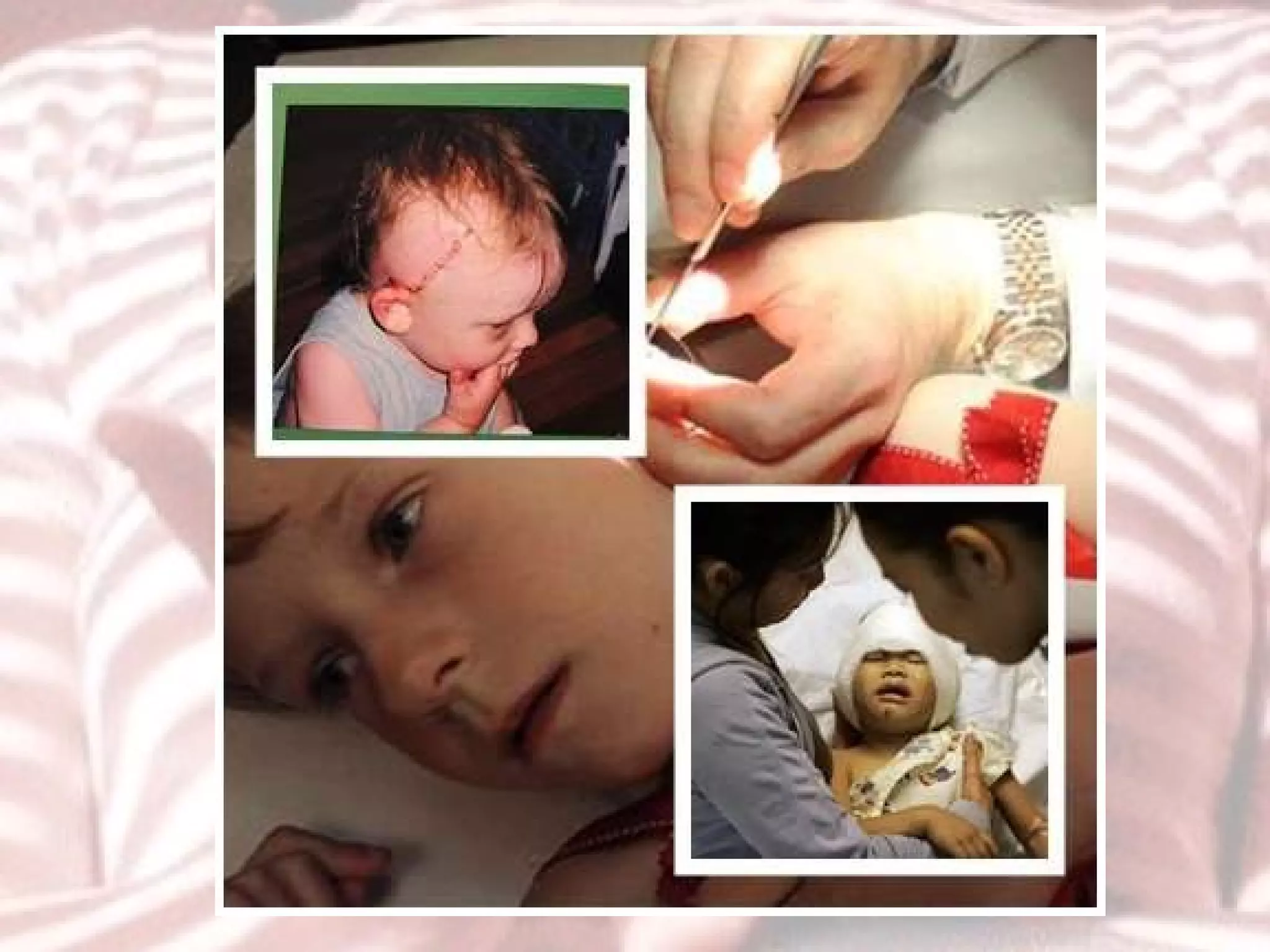
Medical-Pathological Model “ deafness is a terrible tragedy and  D eaf people are to be pitied.”
 
Cultural Model - common language Culture social affiliation  educational background .
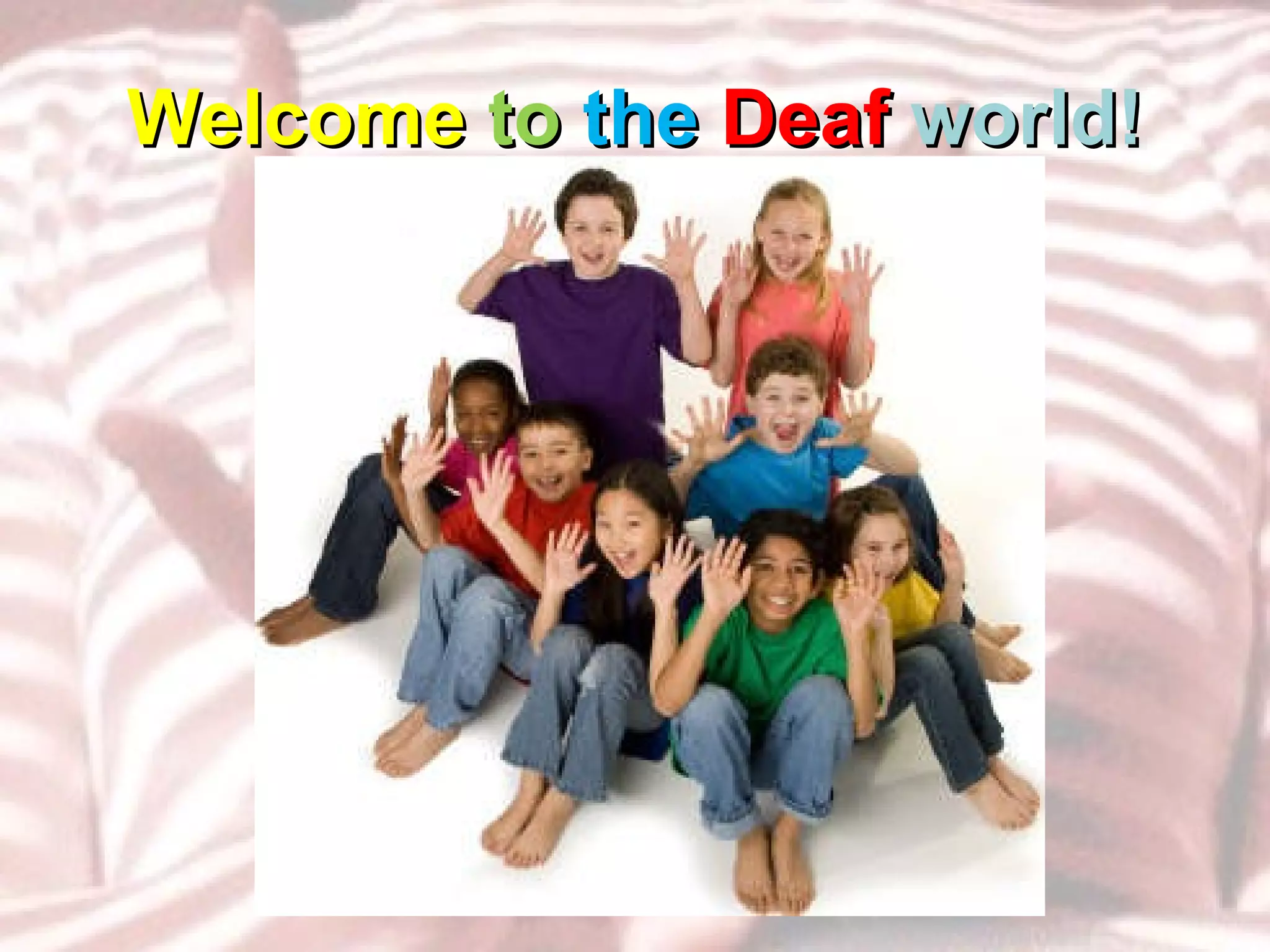
Welcome   to   the   Deaf   world!
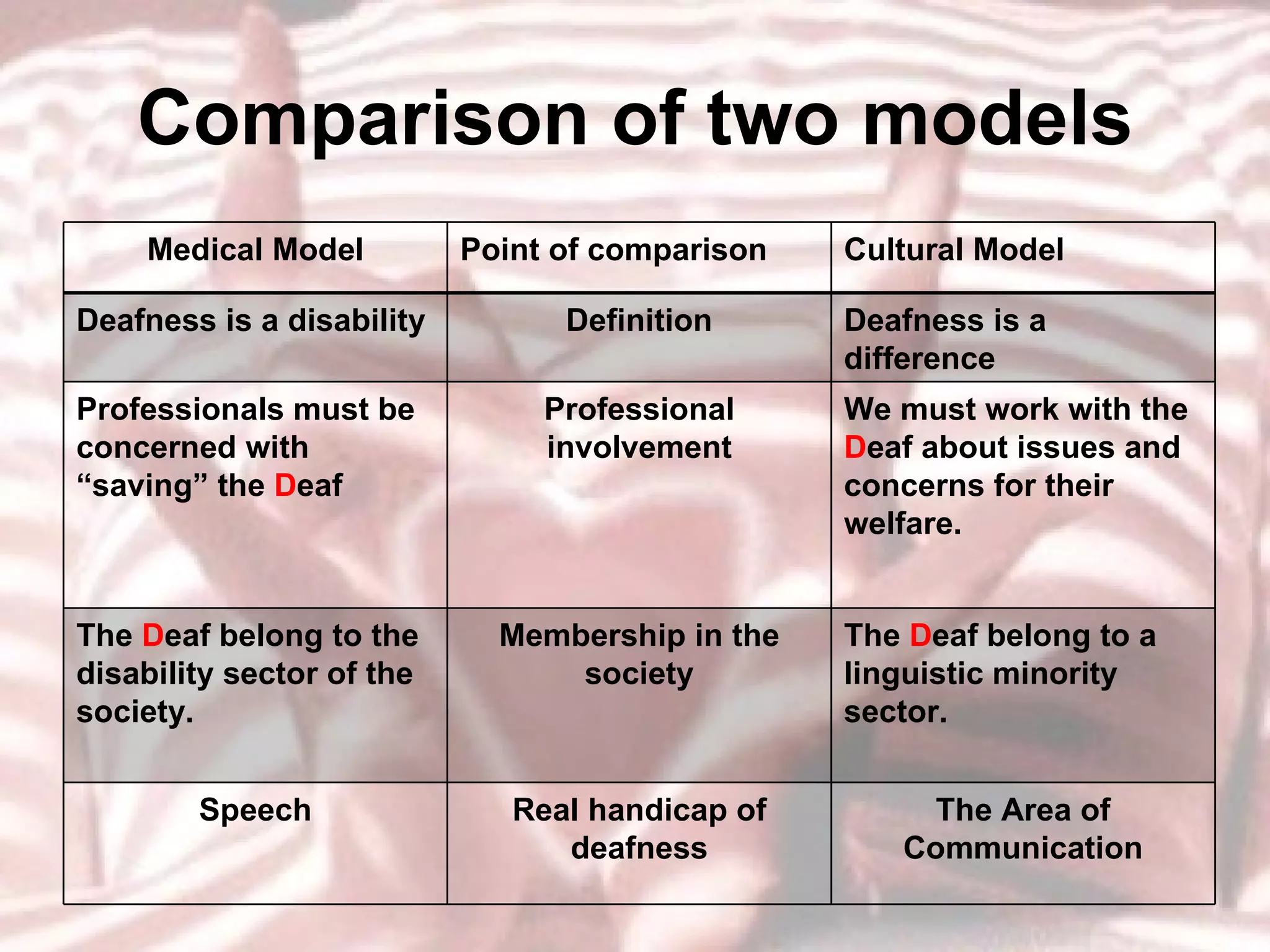
Comparison of two models Medical Model Point of comparison Cultural Model Deafness is a disability Definition Deafness is a difference Professionals must be concerned with “saving” the  D eaf Professional involvement We must work with the  D eaf about issues and concerns for their welfare. The  D eaf belong to the disability sector of the society. Membership in the society The  D eaf belong to a linguistic minority sector. Speech Real handicap of deafness The Area of Communication
Types of Deafness Pre-lingually  D eaf Post-lingually  D eaf
Causes Of Deafness Perinatal Accidental/traumatic Ageing Heredity Medical
 
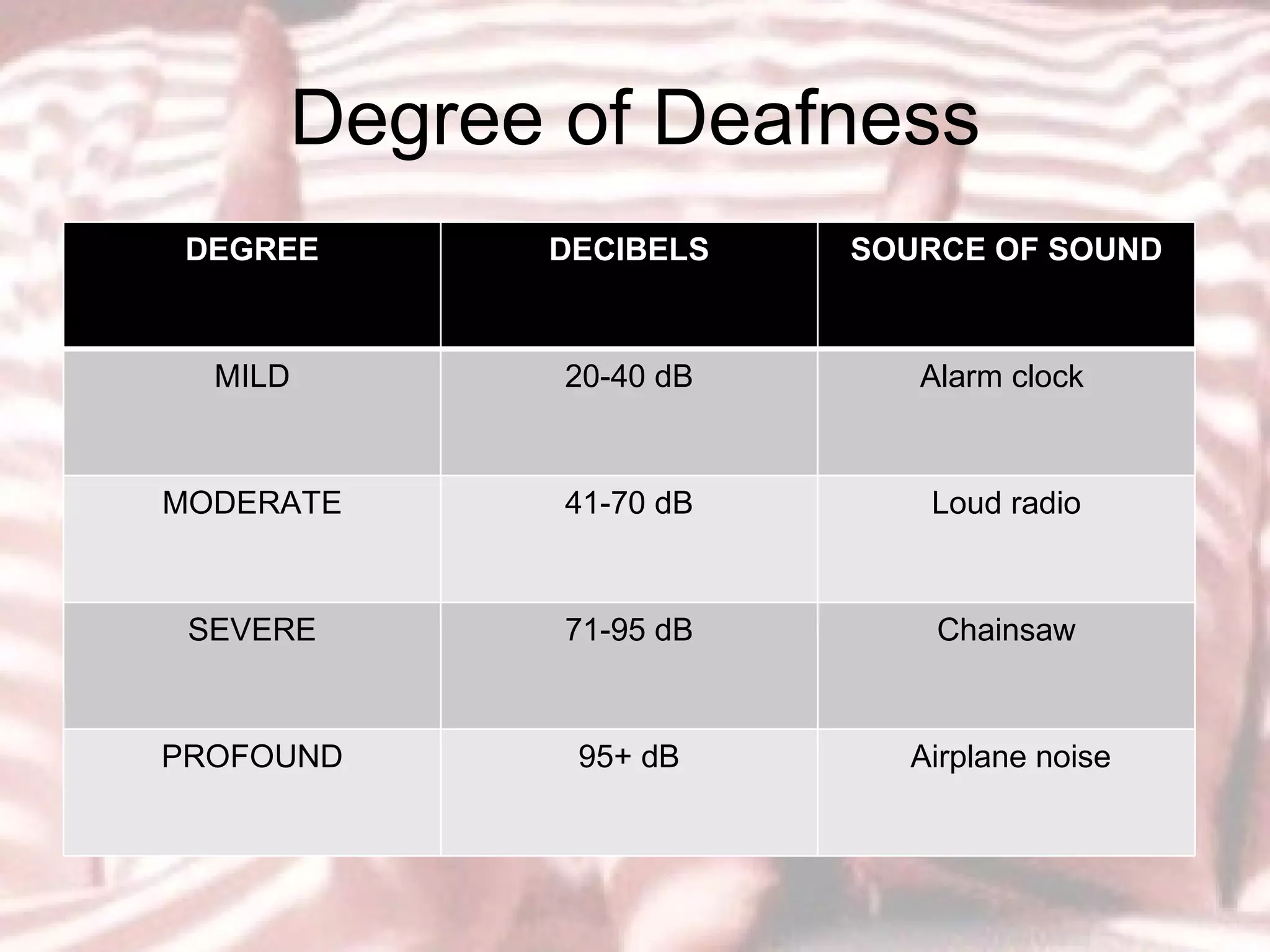
Degree of Deafness DEGREE DECIBELS SOURCE OF SOUND MILD 20-40 dB Alarm clock  MODERATE 41-70 dB Loud radio SEVERE 71-95 dB Chainsaw PROFOUND 95+ dB Airplane noise
iPods,Mpe3s can reach up to 115  dB  or even higher SOURCE OF SOUND DECIBELS Listening to TV/ normal talking 40-60 Traffic noise/moving car 80-90


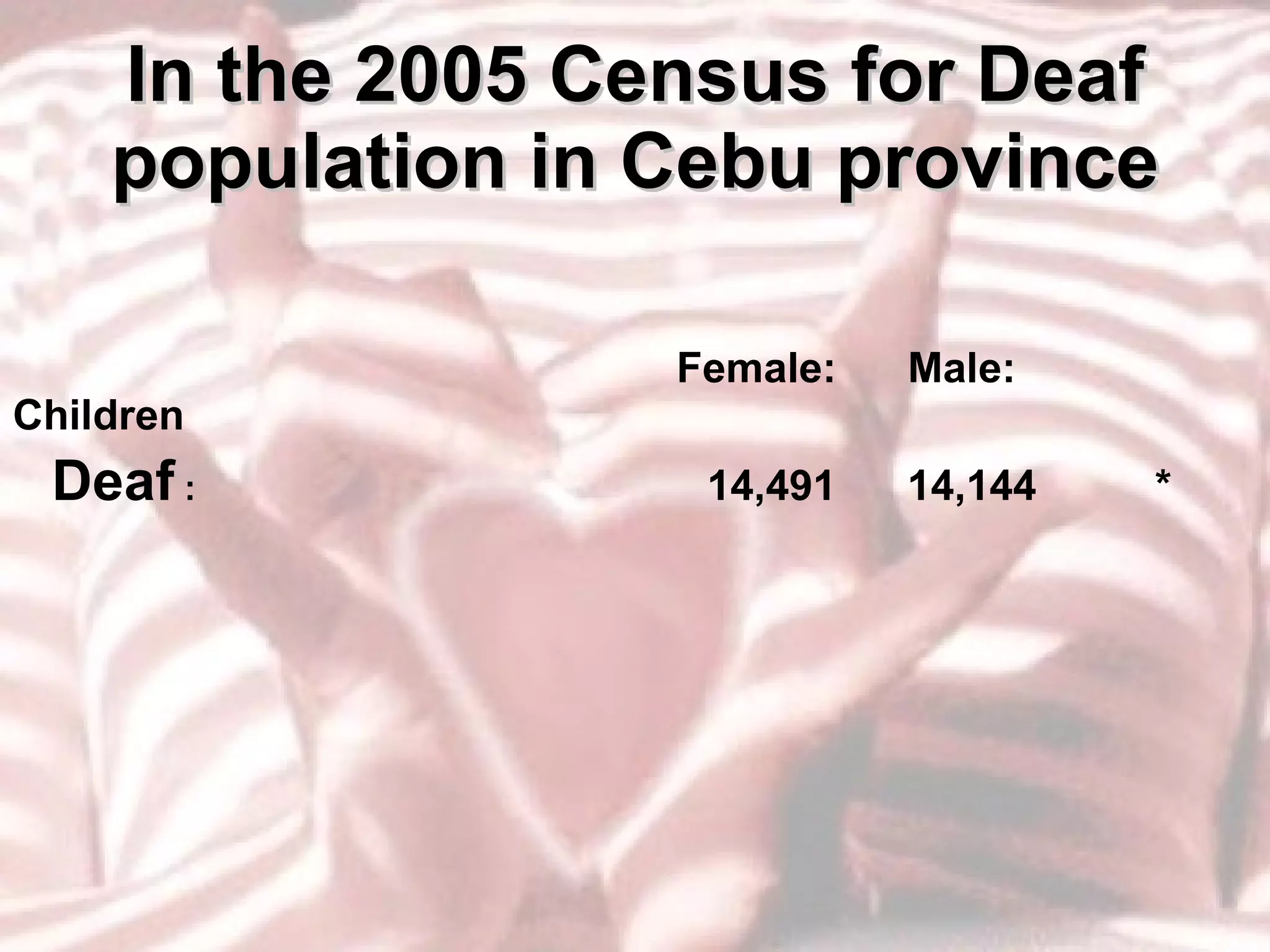
In the 2005 Census for Deaf population in Cebu province Female:  Male:  Children  Deaf  :   14,491  14,144  *
World Health Organization  statistics for  D eafness: one  D eaf per 1000 population
Current Issues High prevalence/incidence of Deafness in the Philippines: 2-3: 1000 Filipinos lack of accessibility basic services for  the Deaf
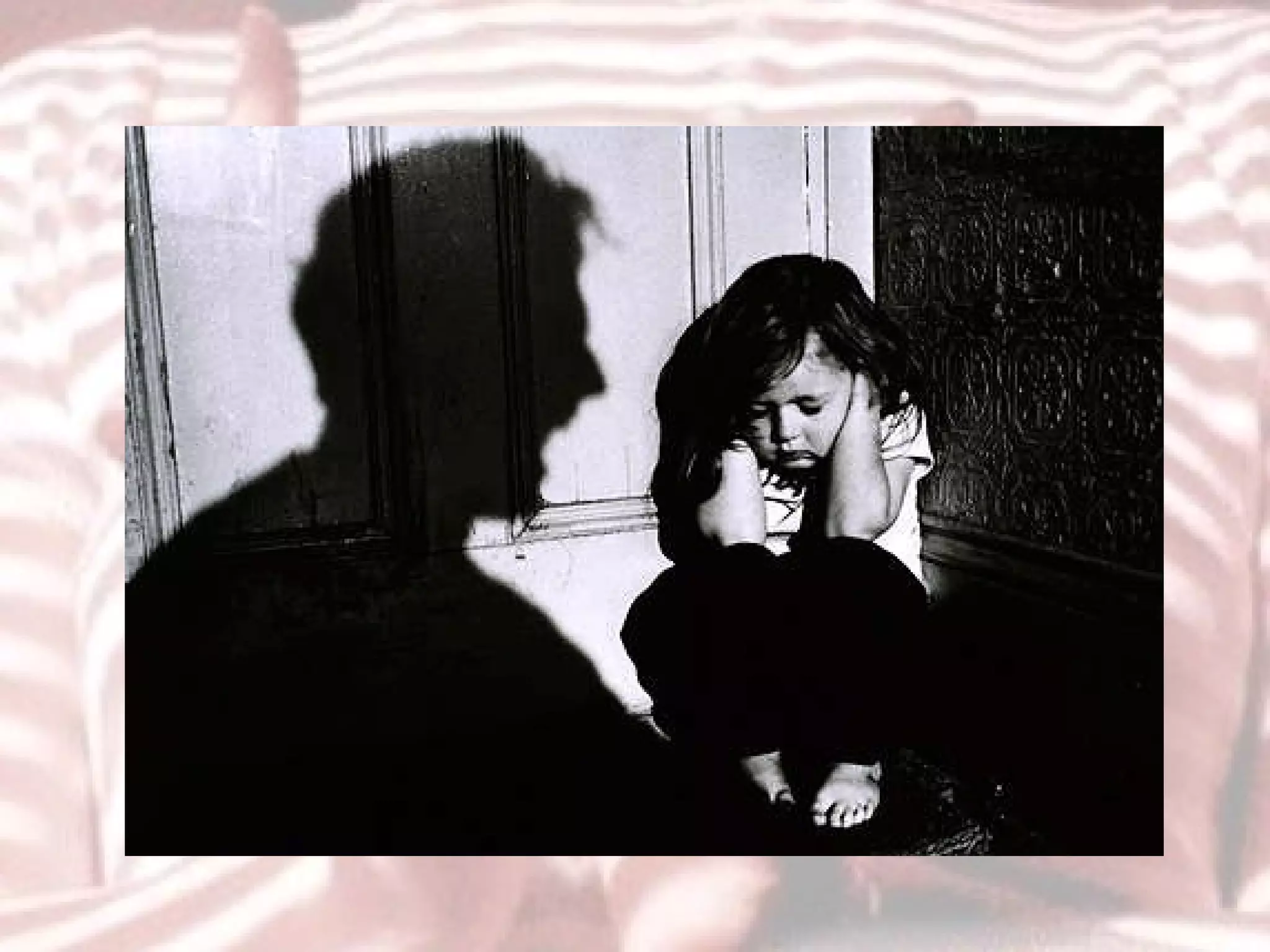
Current Issues 65-70%  of Deaf boys and girls are being molested -source: The Philippine Deaf Resource Center 1 out of 3  Deaf women has been raped - source: Lyer and Fortunato, 2005 72% - abused or battered 63% - abused by their own fathers.  - source: De Guzman, 2002
Current Issues 50%  of Deaf girls have been sexually abused as compared to  25%  of hearing girls.  54%  of Deaf boys have been sexually abused as compared to  10%  of hearing boys.   Source: Patricia M. Sullivan, Vernon & scanlan, 1987
 
Philippine Laws that protect  Persons With Disabilities (PWDs) including the  D eaf…
1987 Philippine Constitution R.A 9422  ( Magna Carta for the Differently abled) Public Ridicule Vilification Convention on the rights of the child Convention on the Rights of Persons with disabilities  R.A 7610 ( Special Protection of children Against Abuse, Exploitation and Discrimination Act) R.A 9262  ( Anti-violence against Women and their children Act 2004)
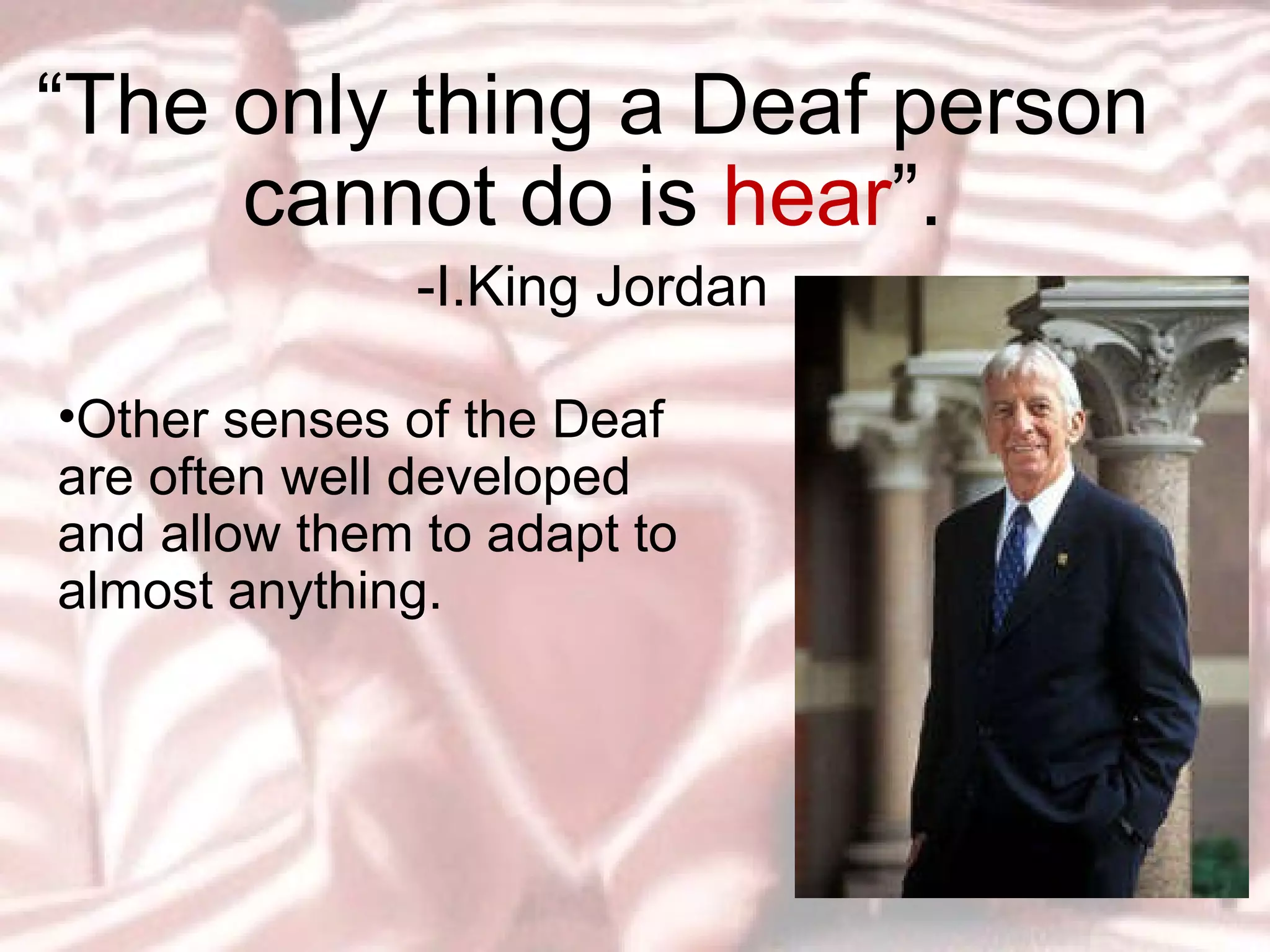
“ The only thing a Deaf person cannot do is  hear ”. -I.King Jordan Other senses of the Deaf are often well developed and allow them to adapt to almost anything.
Let’s   re D EAF ine
H ard of  hearing  cannot detect sound at an amplitude of 20 decibels
   less-than-normal hearing H earing   impairment
   can be present at birth or caused suddenly by disease/injury Deafness
D e a f ness and Diversity Culturally  D eaf persons Orally  D eaf persons Hard of hearing persons Persons with acquired deafness
D eaf  &  d eaf  what’s the difference?
d eaf  is a general term to refer to the person who cannot hear
F ilipino   D eaf   C ommunity It is cultural linguistic minority. It is an ethnic group with it’s own cultural heritage, language and psychology.
F ilipino  D eaf
D eaf
Distinct Characteristics of Deaf People •  When mainstreamed with hearing people, without moving, they can be mistaken as hearing.  •  They make peculiar movements and sounds when communicating.  •  They show feelings in exaggerated appearance.  •  Views the surroundings and happenings in the world in a different way according to what they see.
Distinct characteristics of Deaf People •  They easily feel the change of mood. •  It is imbedded in their emotions the feeling of deprivation. •  They are very loyal to the people.
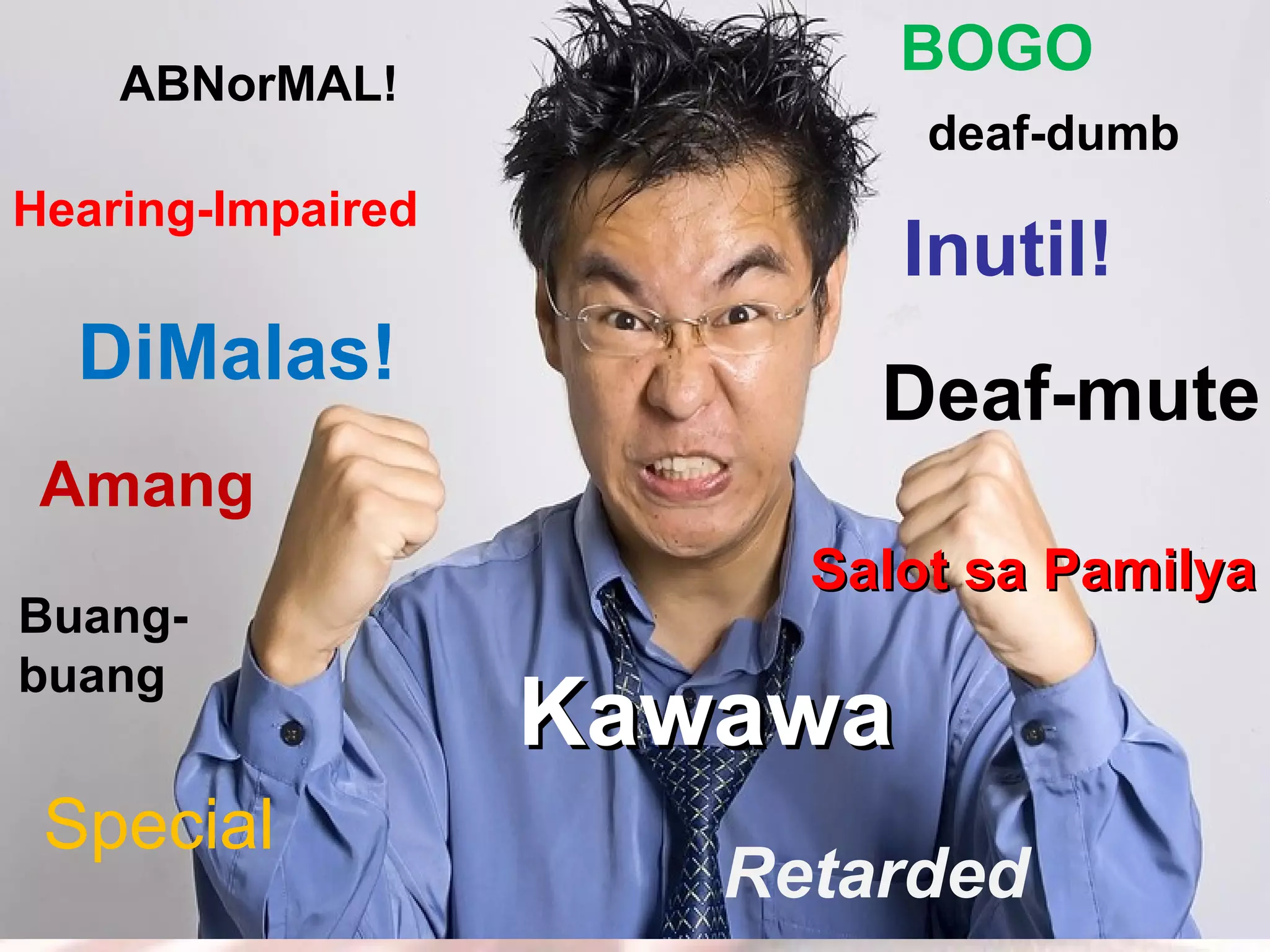
Unacceptable terms used to describe the  D eaf
ABNorMAL! deaf-dumb Hearing-Impaired Amang DiMalas! Salot sa Pamilya Buang-buang Kawawa Deaf-mute Inutil! BOGO Special Retarded
 
Bungol   rather than  amang D eaf
sees deafness as a  difference  rather than a  pathology   or an illness to be cured.  D eaf  community
 
D eaf  culture D eaf life D eaf experiences….
What is  F ilipino  D eaf   C ulture ? unique way of life evolved from Filipino  D eaf communities sharing of experiences
Is there really  a  F ilipino  D eaf  C ulture? Enlightened Filipino  D eaf adults and adolescents (with their hearing advocates) believe there is! FSL  highlights  Filipino  D eaf culture
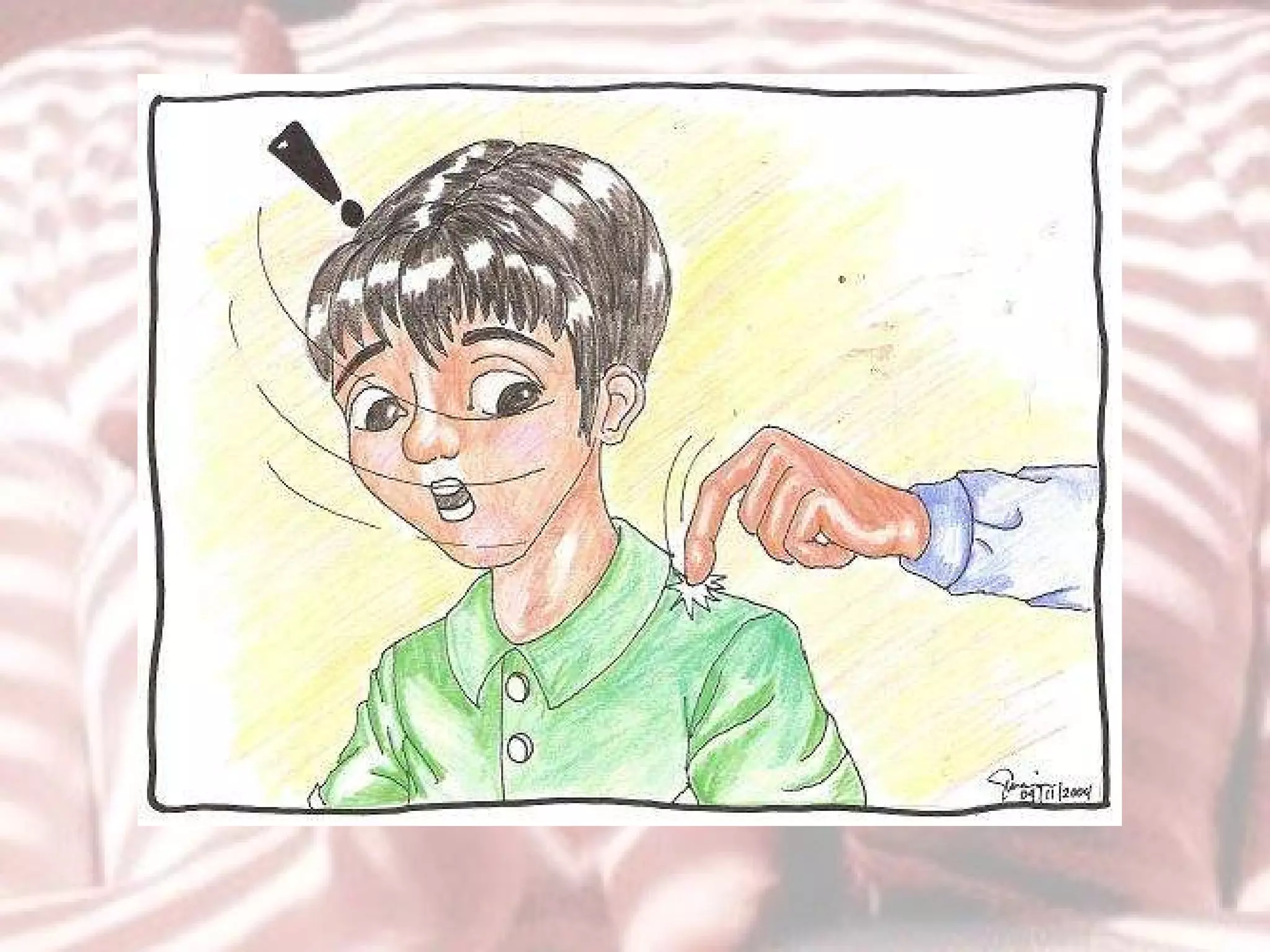
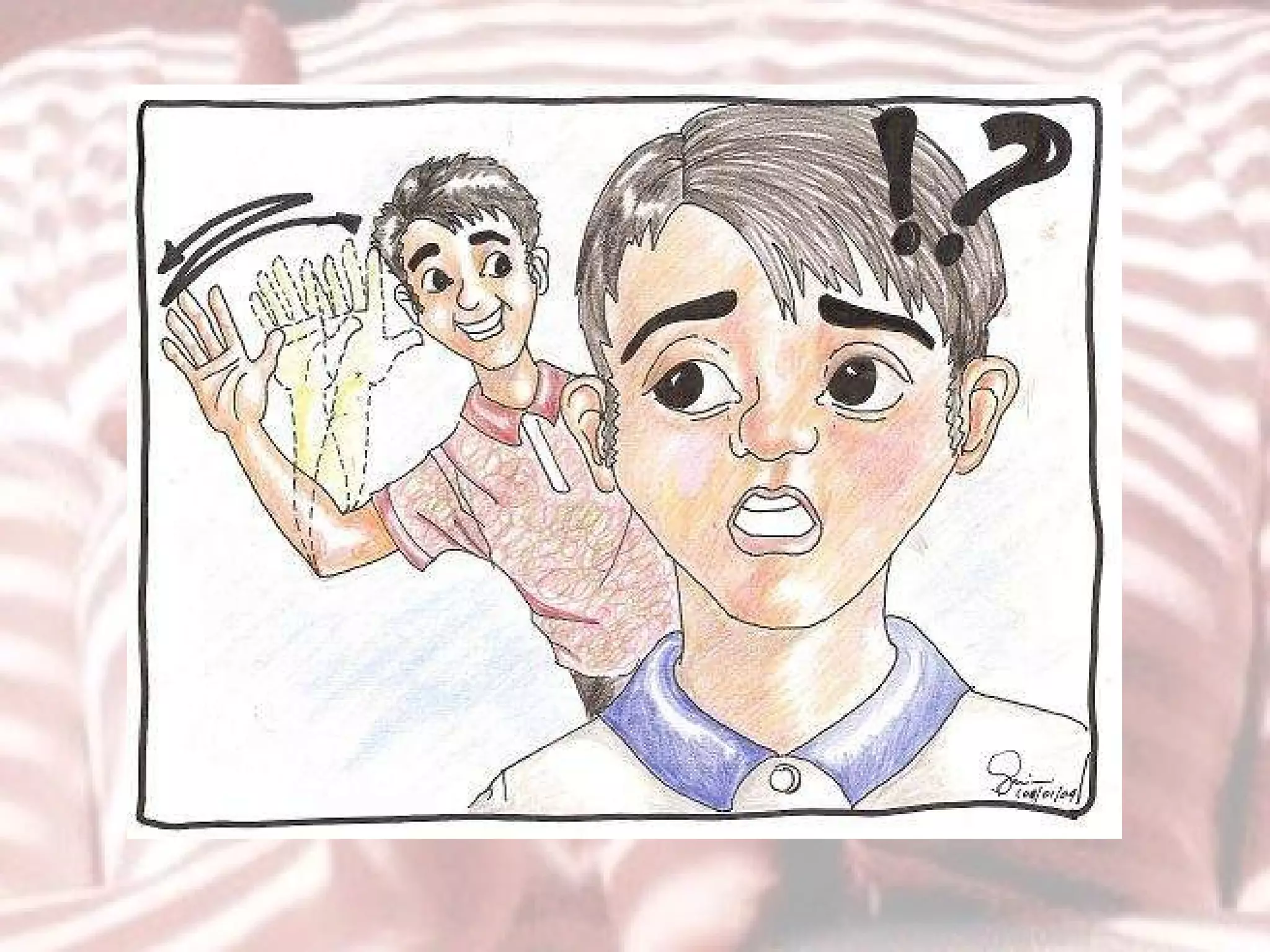
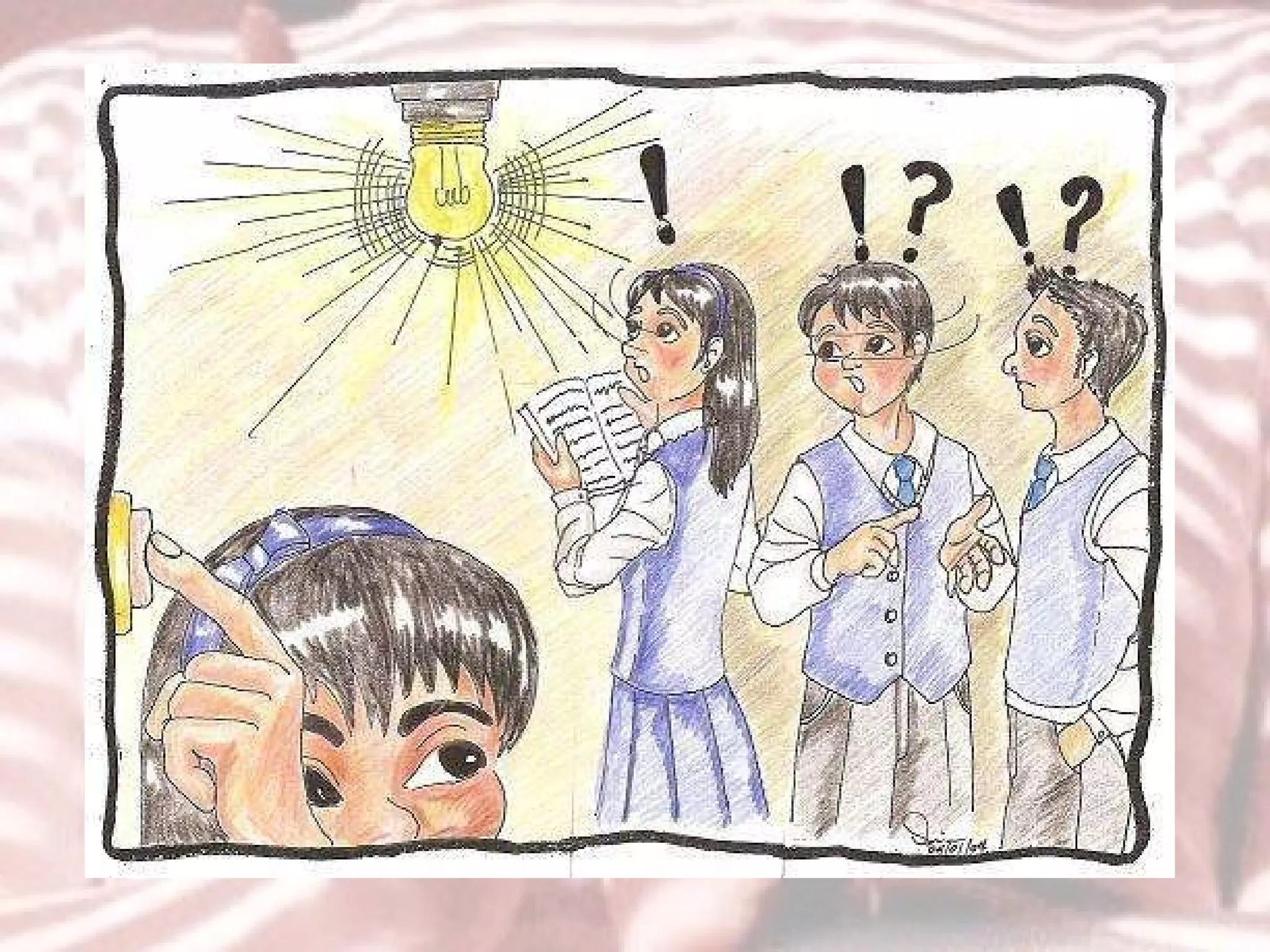
How to get the attention of a  D eaf person.


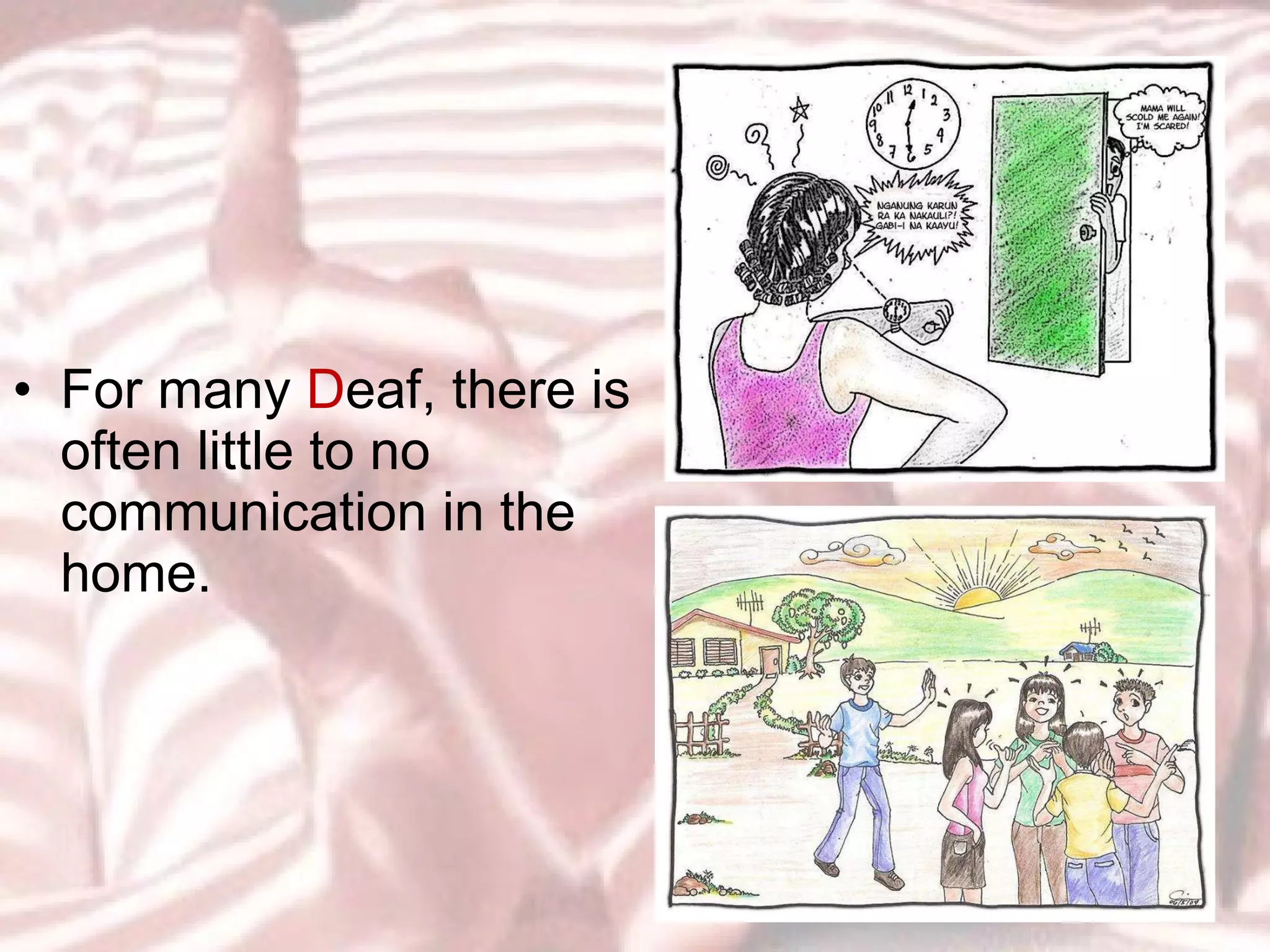
For many  D eaf, there is often little to no communication in the home.
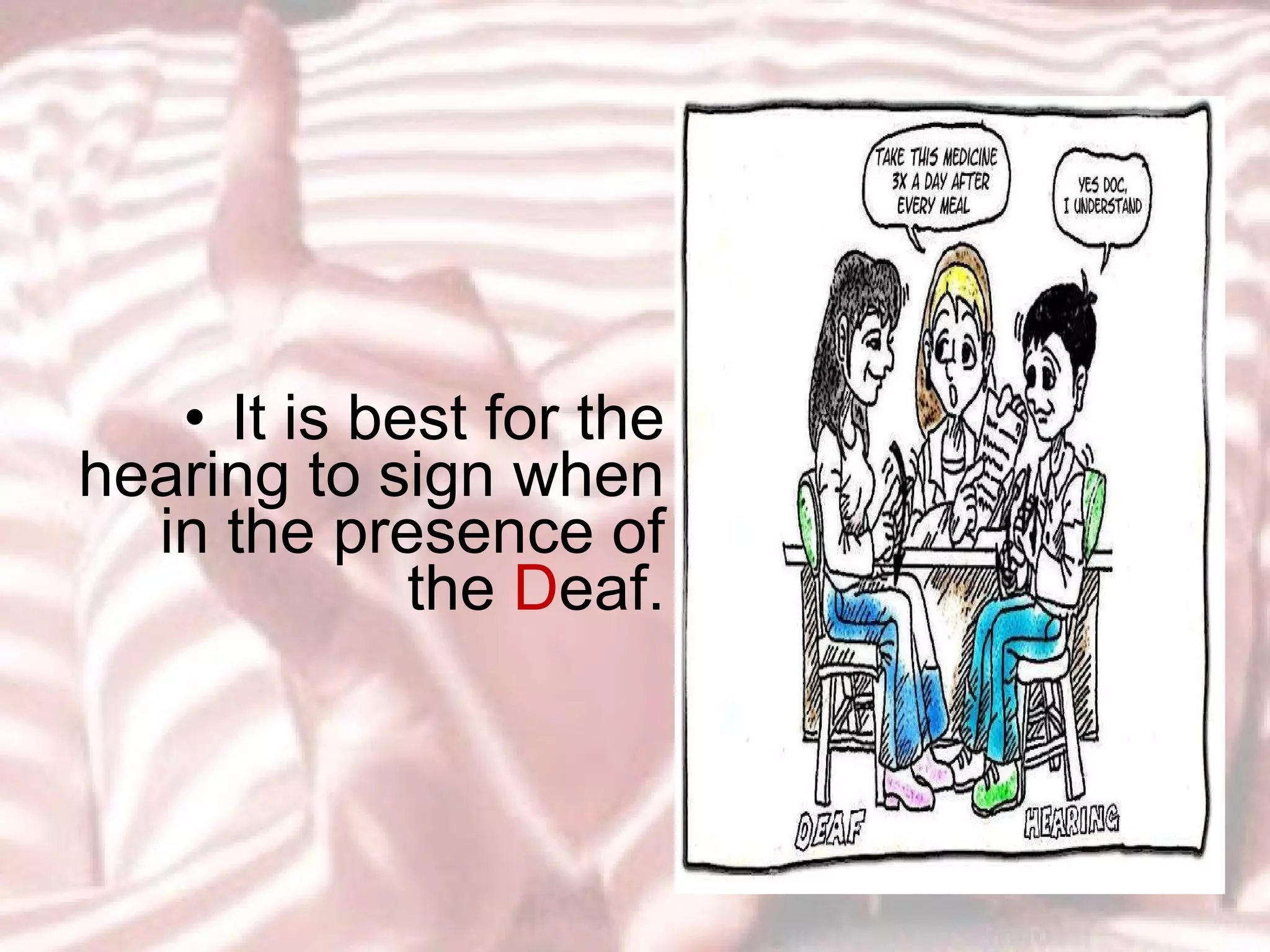
It is best for the hearing to sign when in the presence of the  D eaf.
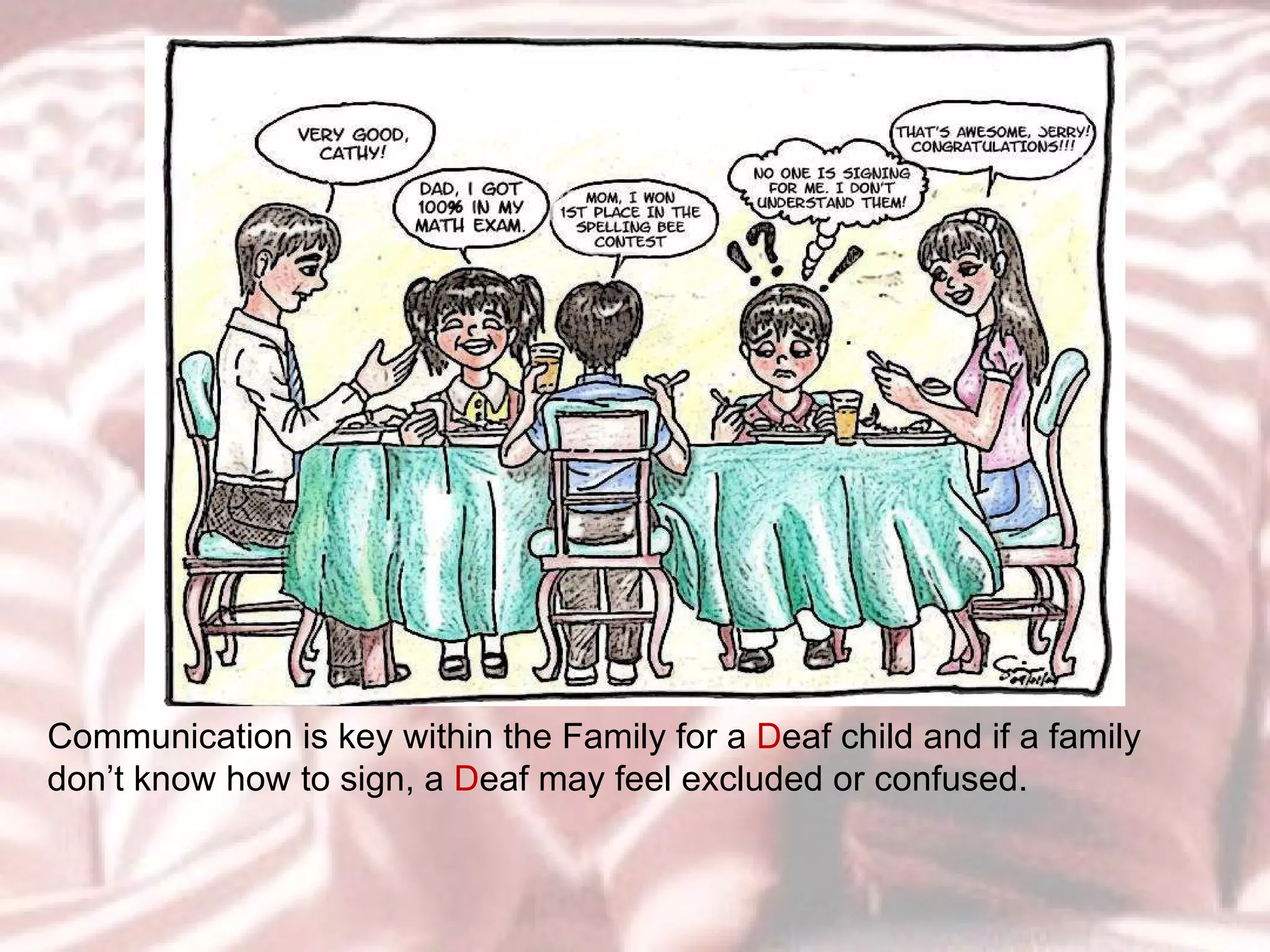
Communication is key within the Family for a  D eaf child and if a family don’t know how to sign, a  D eaf may feel excluded or confused.
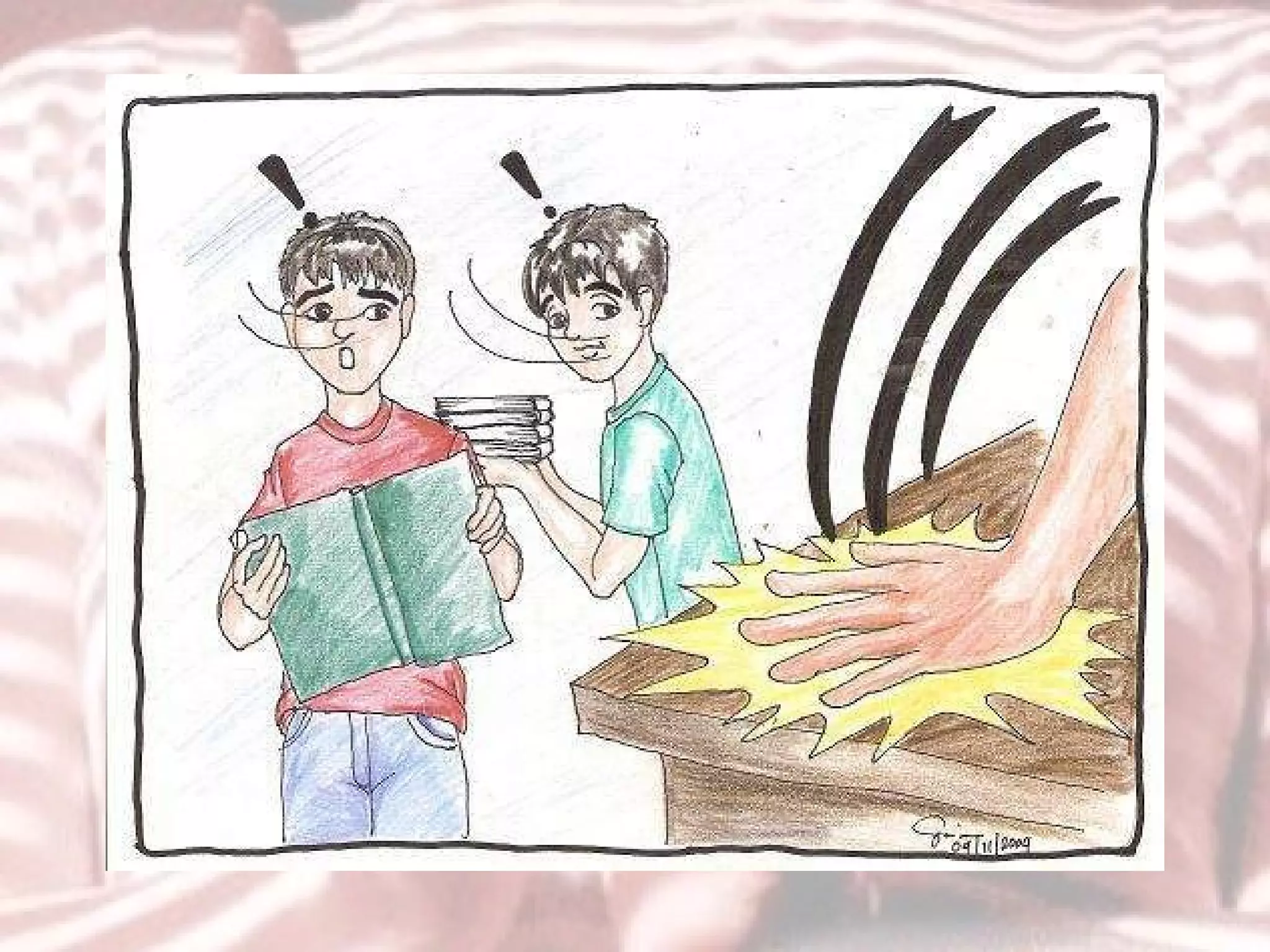
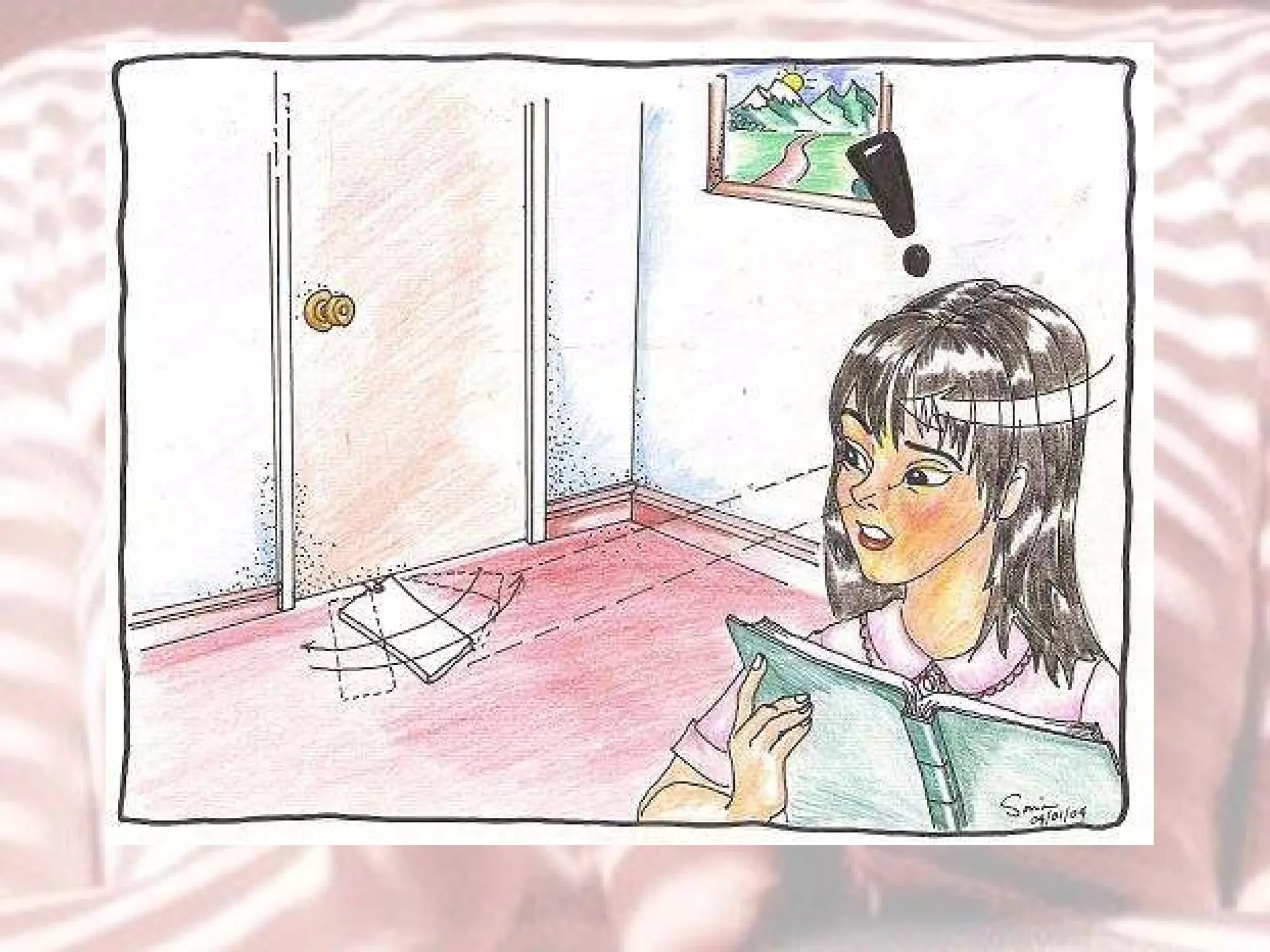
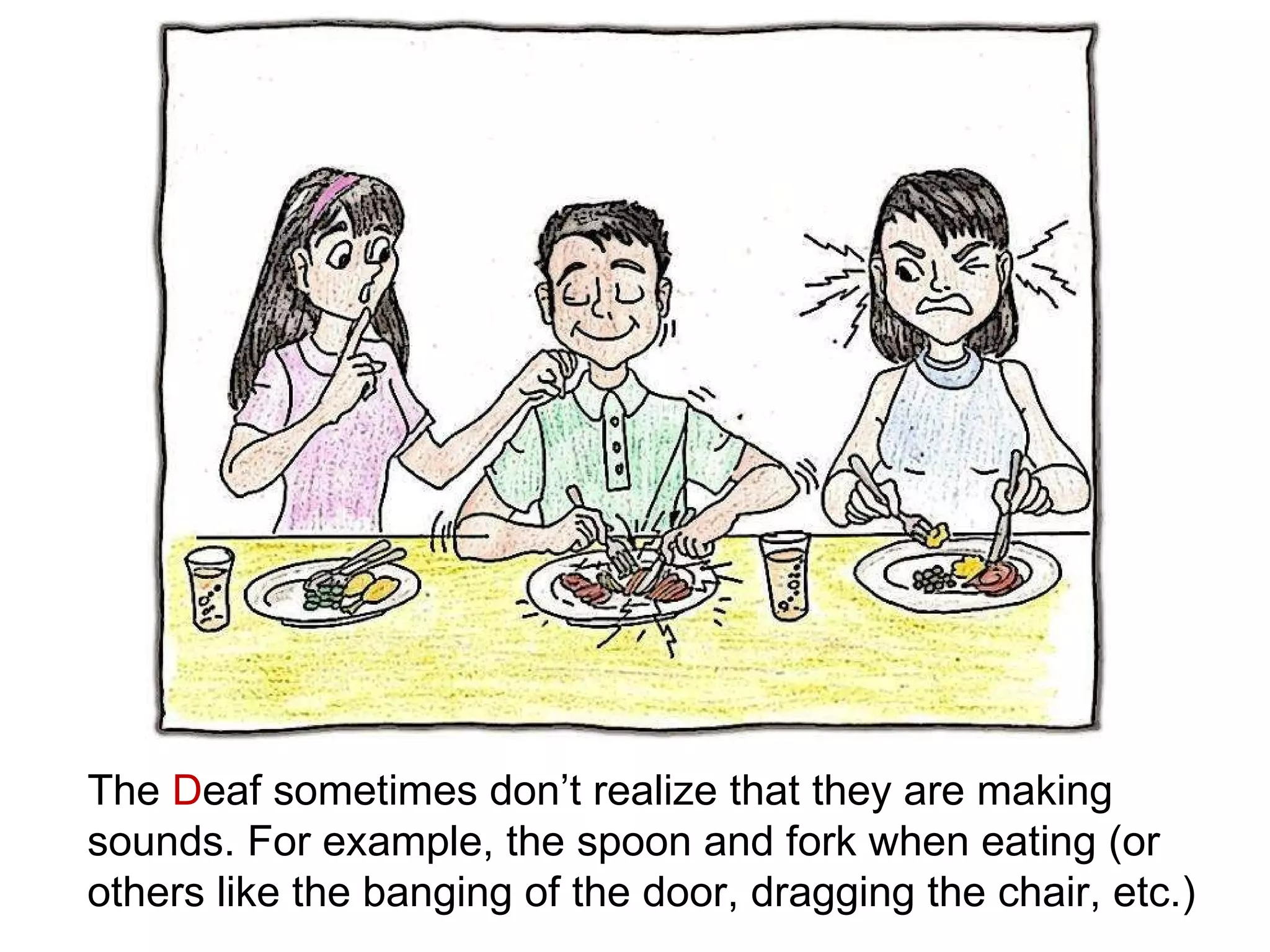
The  D eaf sometimes don’t realize that they are making sounds. For example, the spoon and fork when eating (or others like the banging of the door, dragging the chair, etc.)
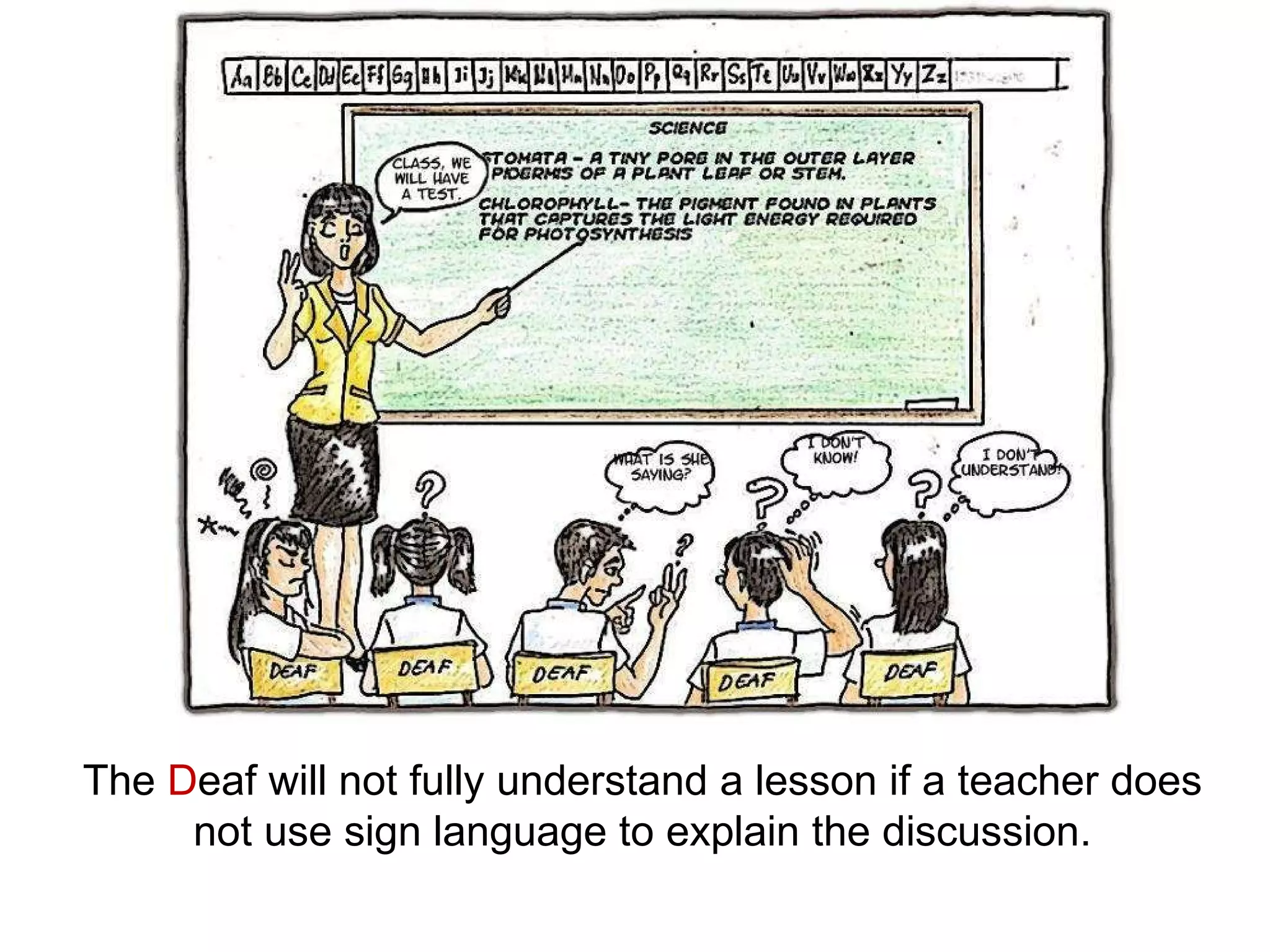
The  D eaf will not fully understand a lesson if a teacher does not use sign language to explain the discussion.
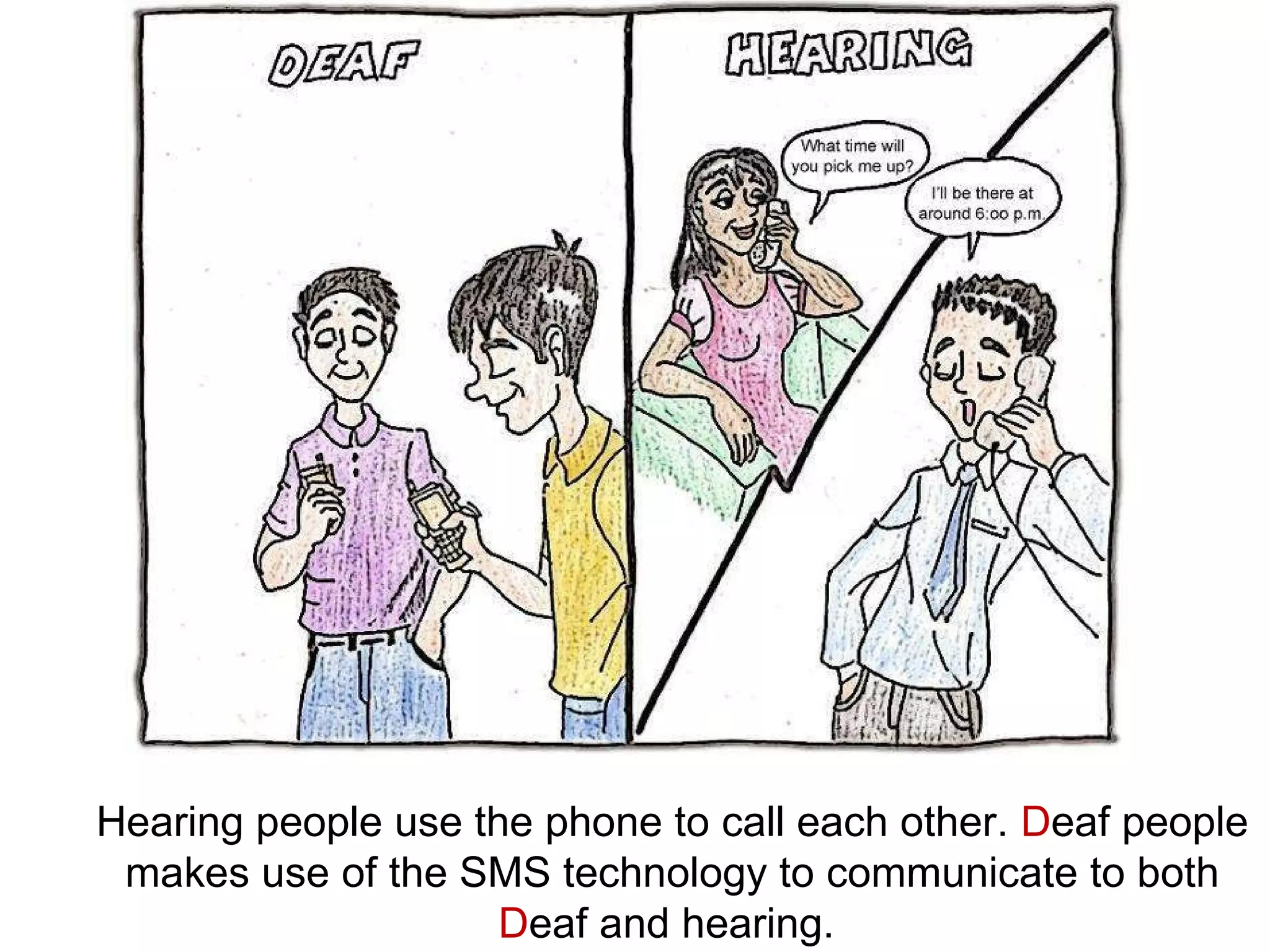
Hearing people use the phone to call each other.  D eaf people makes use of the SMS technology to communicate to both  D eaf and hearing.
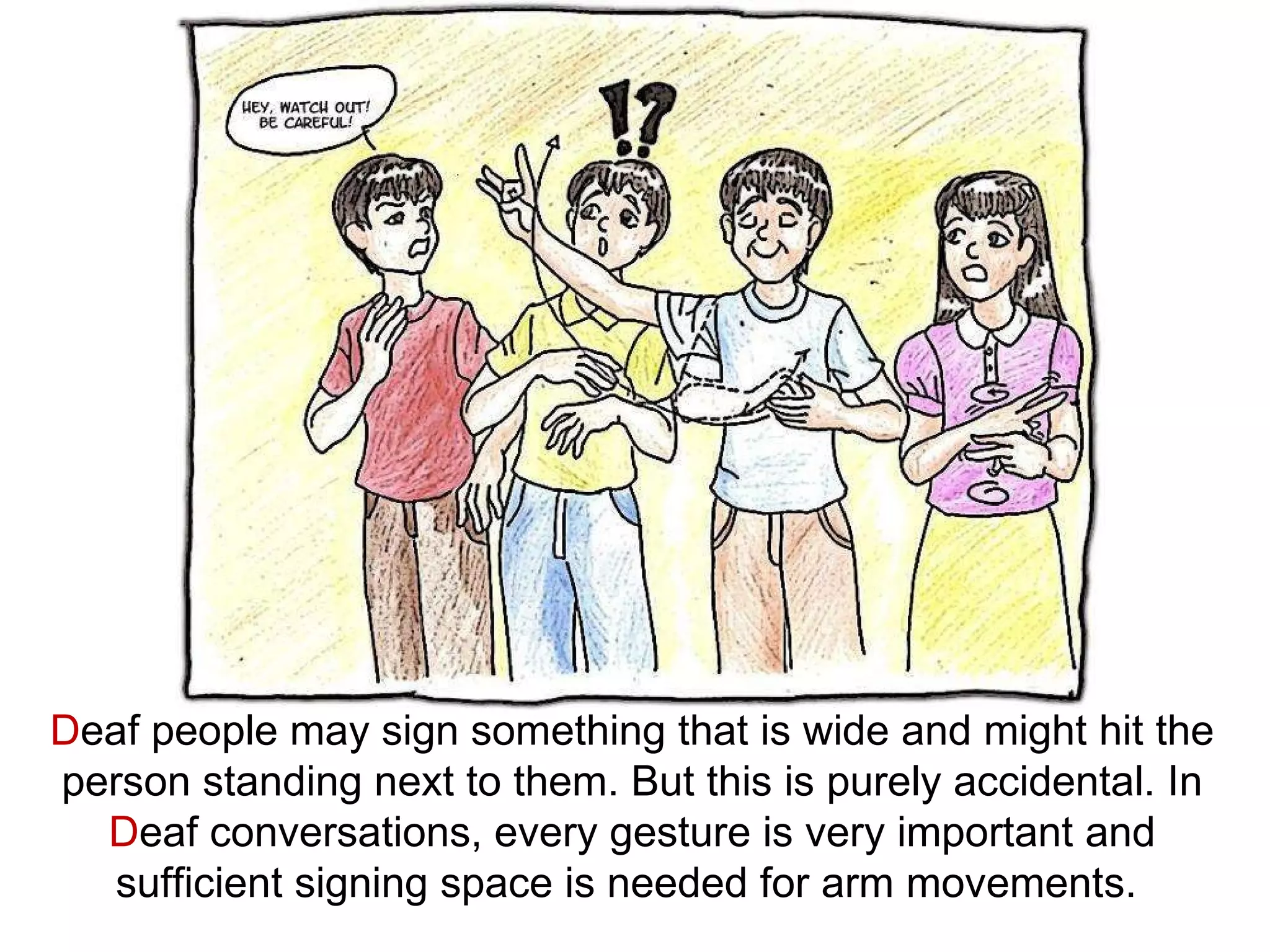
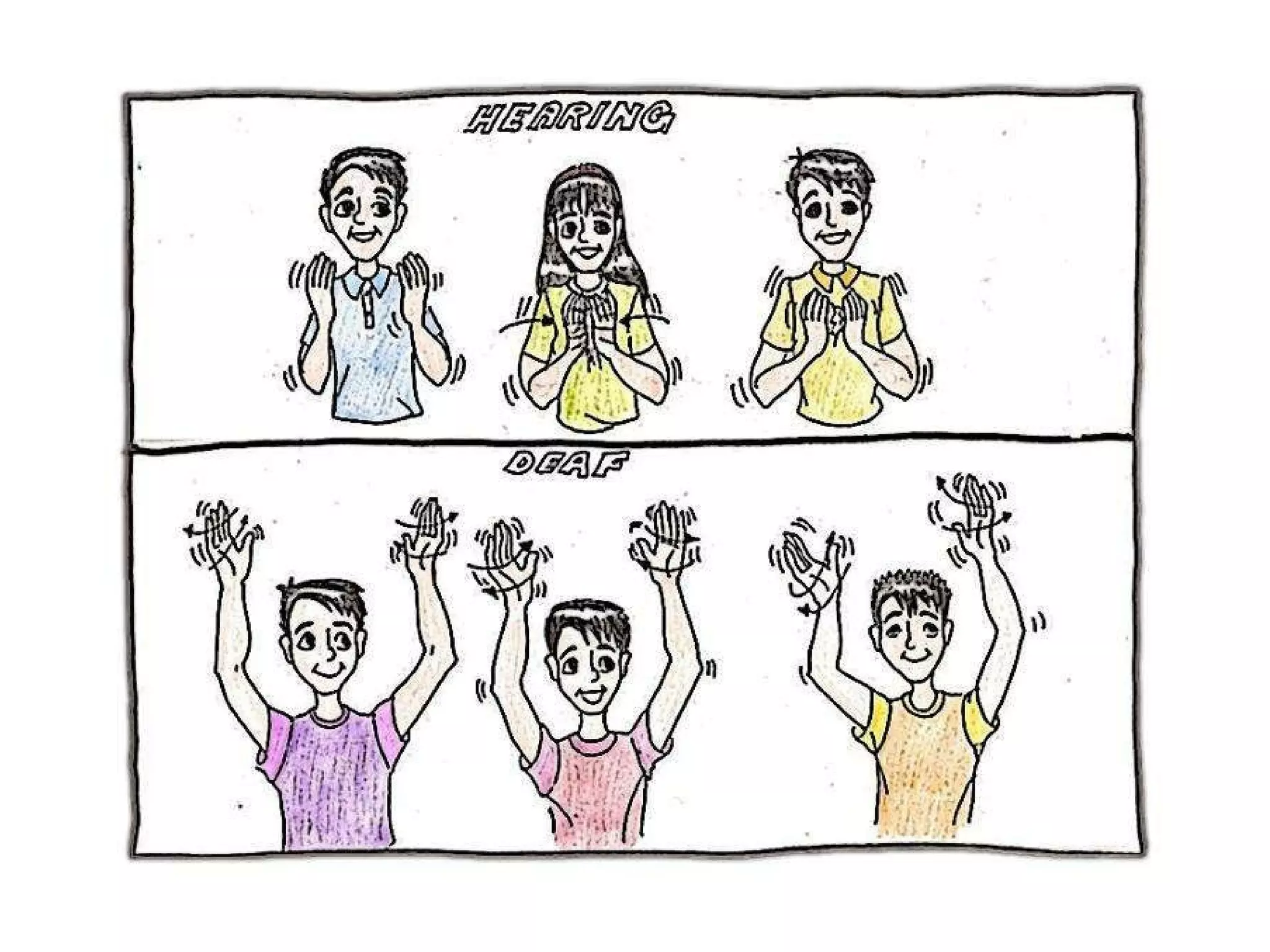
D eaf people may sign something that is wide and might hit the person standing next to them. But this is purely accidental. In  D eaf conversations, every gesture is very important and sufficient signing space is needed for arm movements.
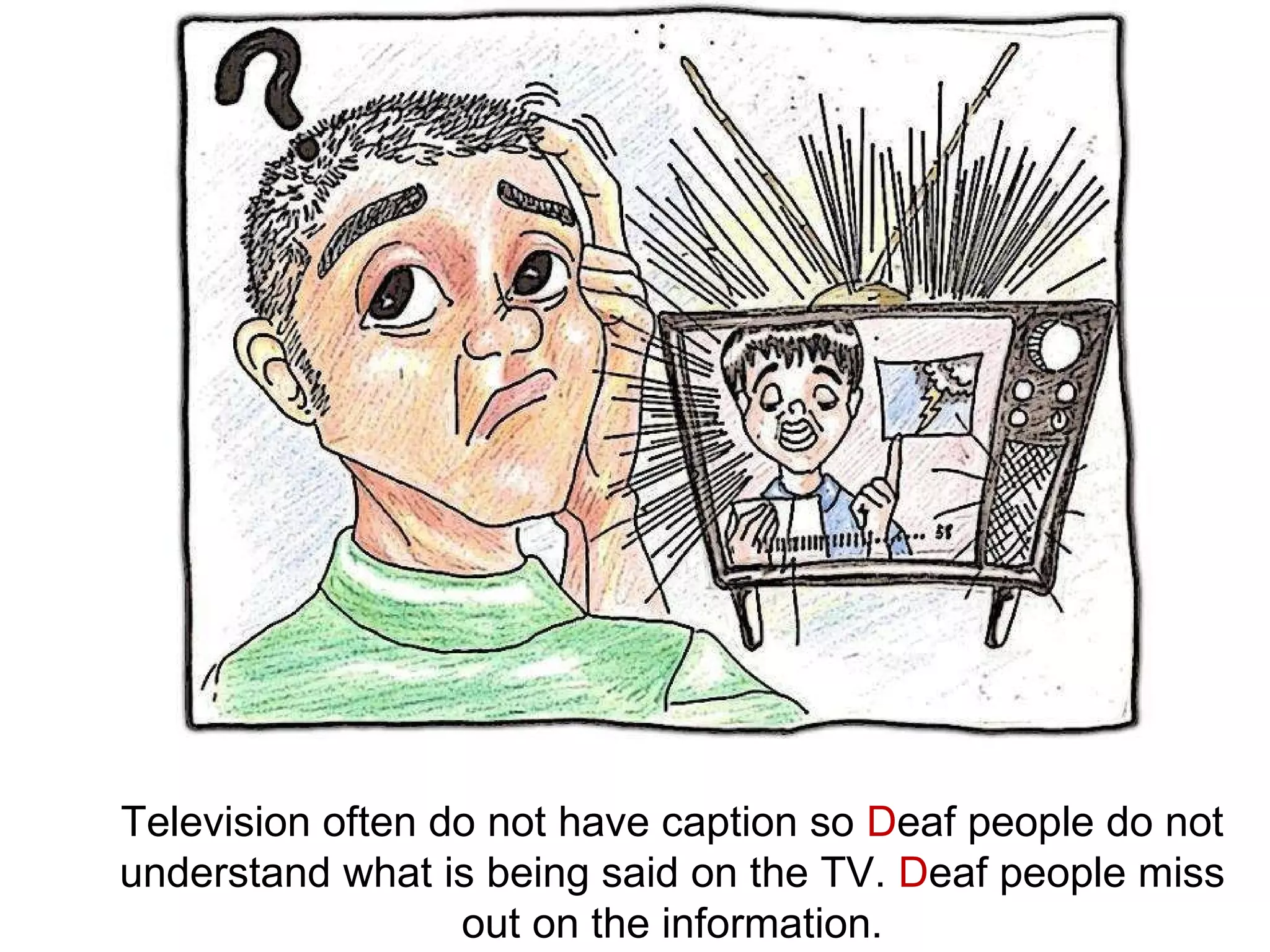
Television often do not have caption so  D eaf people do not understand what is being said on the TV.  D eaf people miss out on the information.
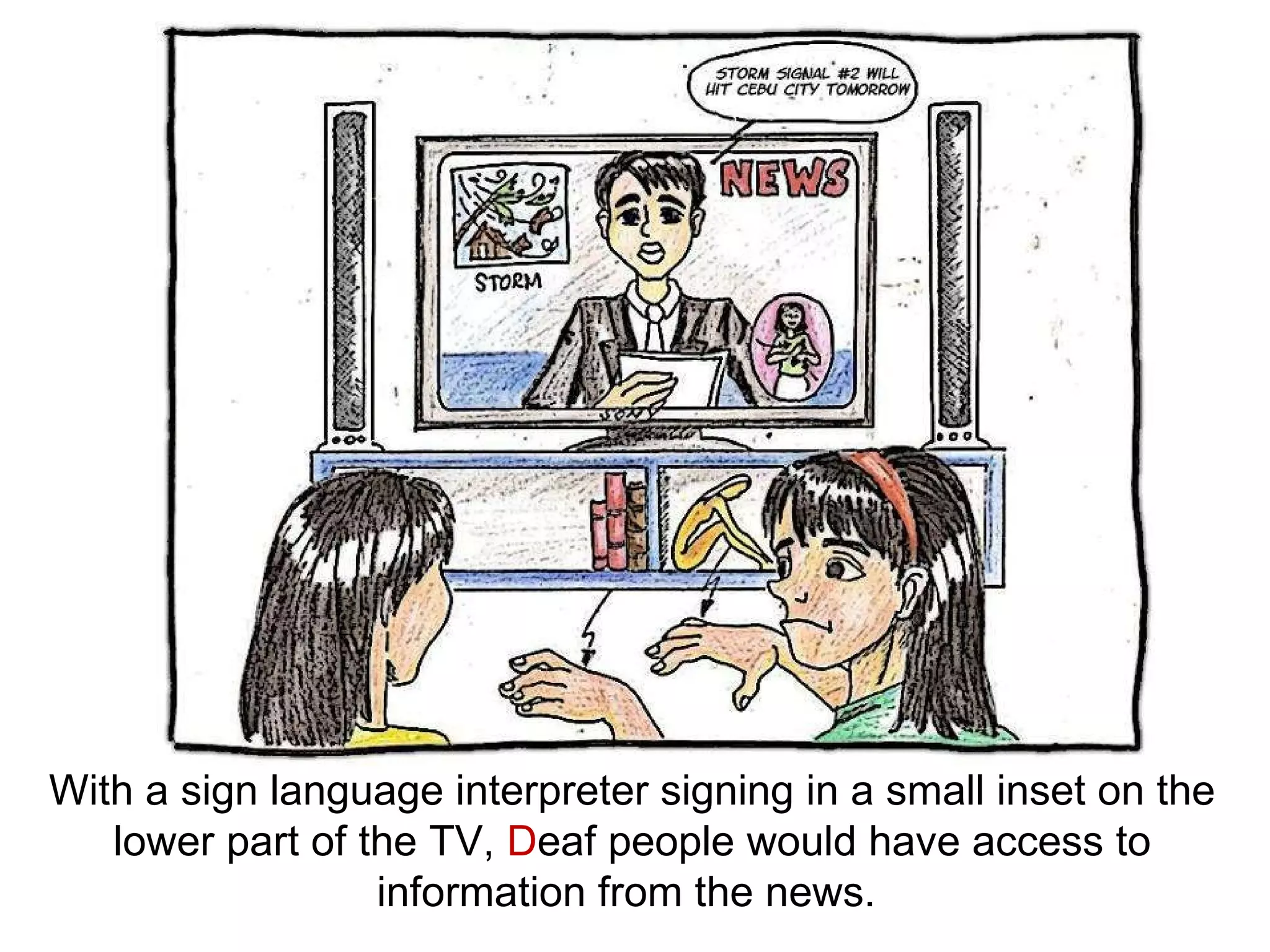
With a sign language interpreter signing in a small inset on the lower part of the TV,  D eaf people would have access to information from the news.
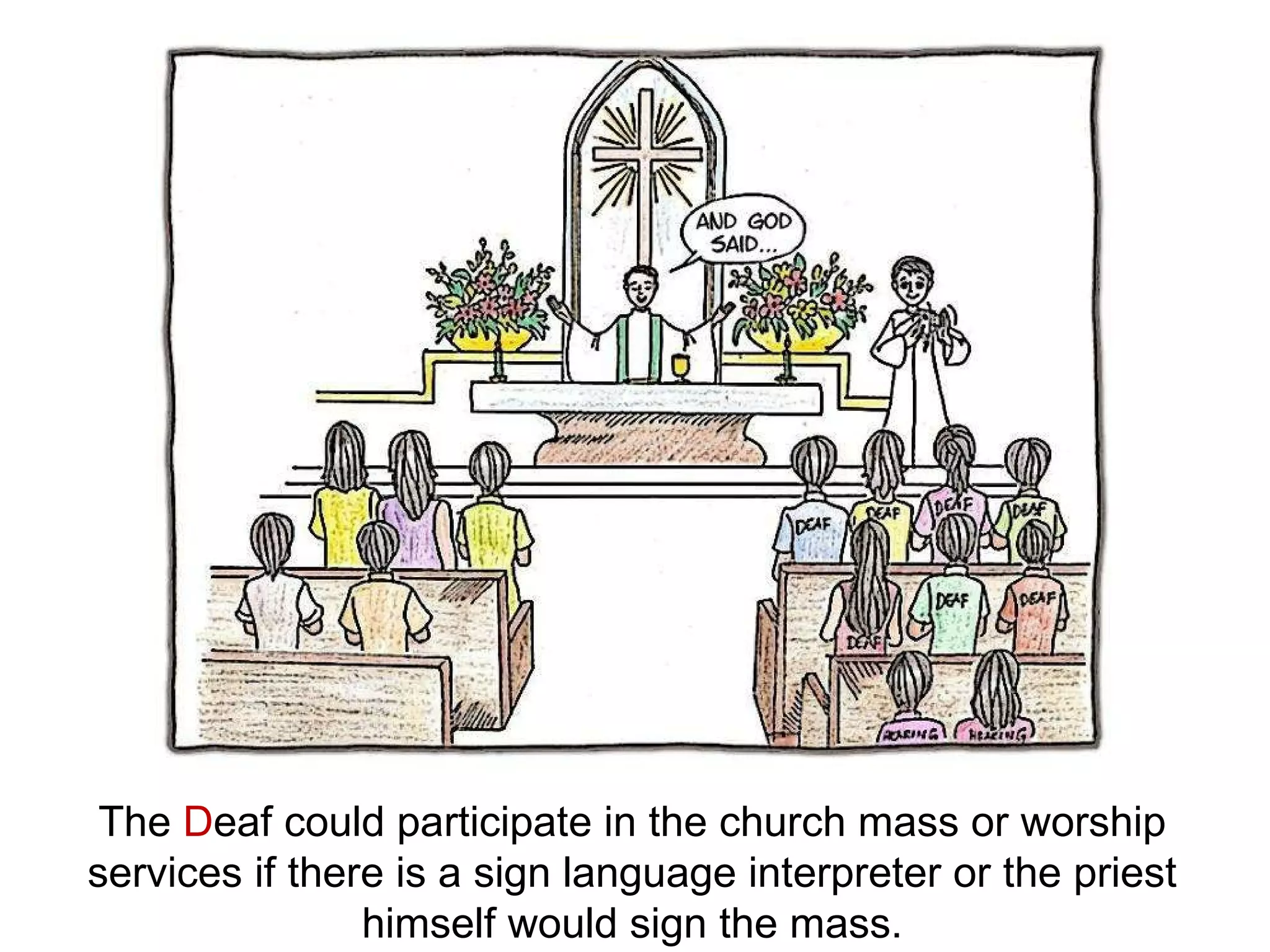
The  D eaf could participate in the church mass or worship services if there is a sign language interpreter or the priest himself would sign the mass.
 
 
Name signs  are a very important part of  D eaf culture.  There are rules the  D eaf follow when making up name signs, hence the reason only a  D eaf person is supposed to give you a name sign. The name sign often reflects a physical characteristic (hair length, dimples, a scar) or it can be related to your personality or job.  Once given a name sign, it is how the  D eaf community recognizes you.
 
Getting Started: It is important to get your message across, to connect and to be understood when communicating with a  D eaf person.
Communicating with the  D eaf
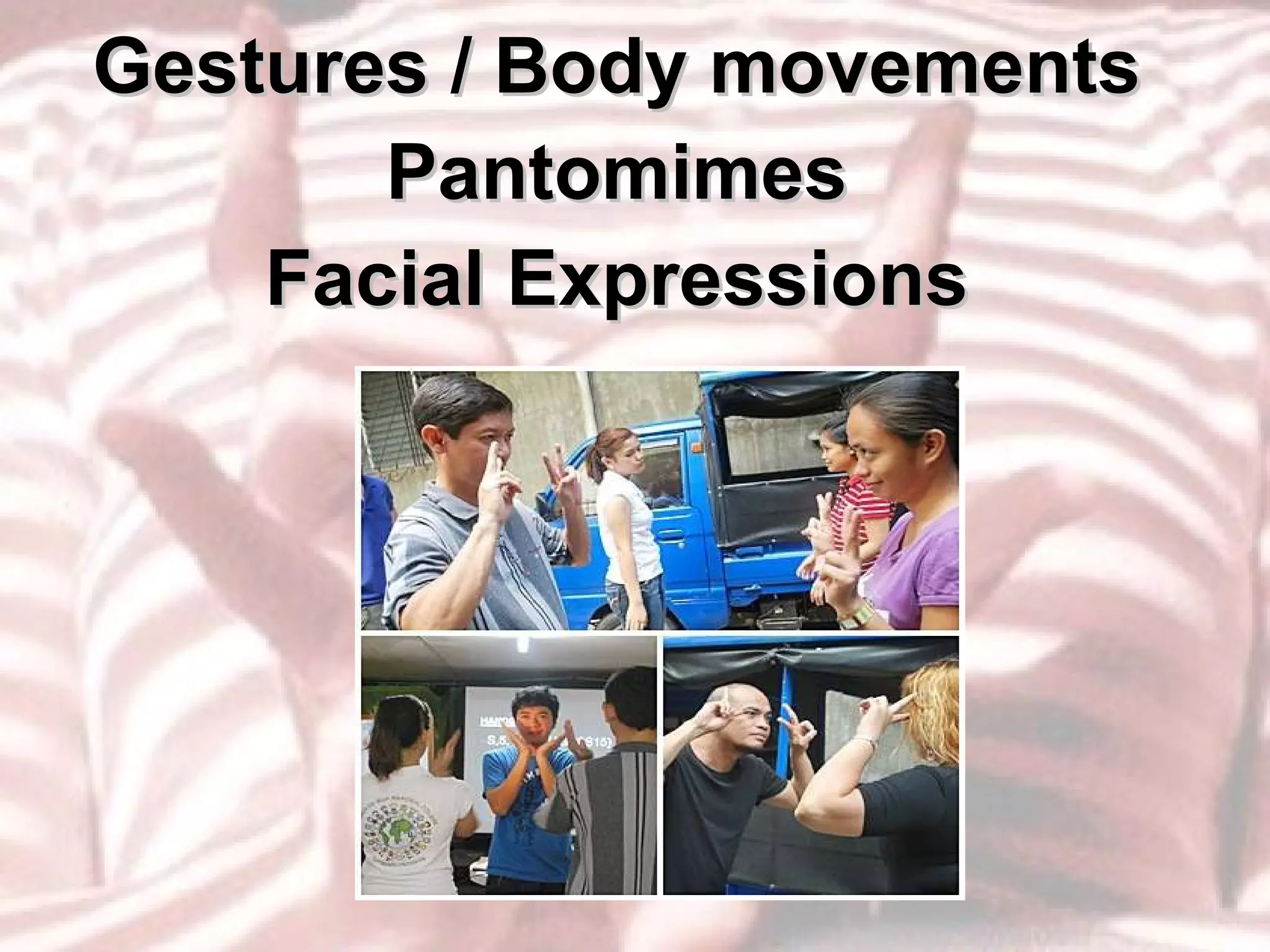
Gestures / Body movements Pantomimes Facial Expressions
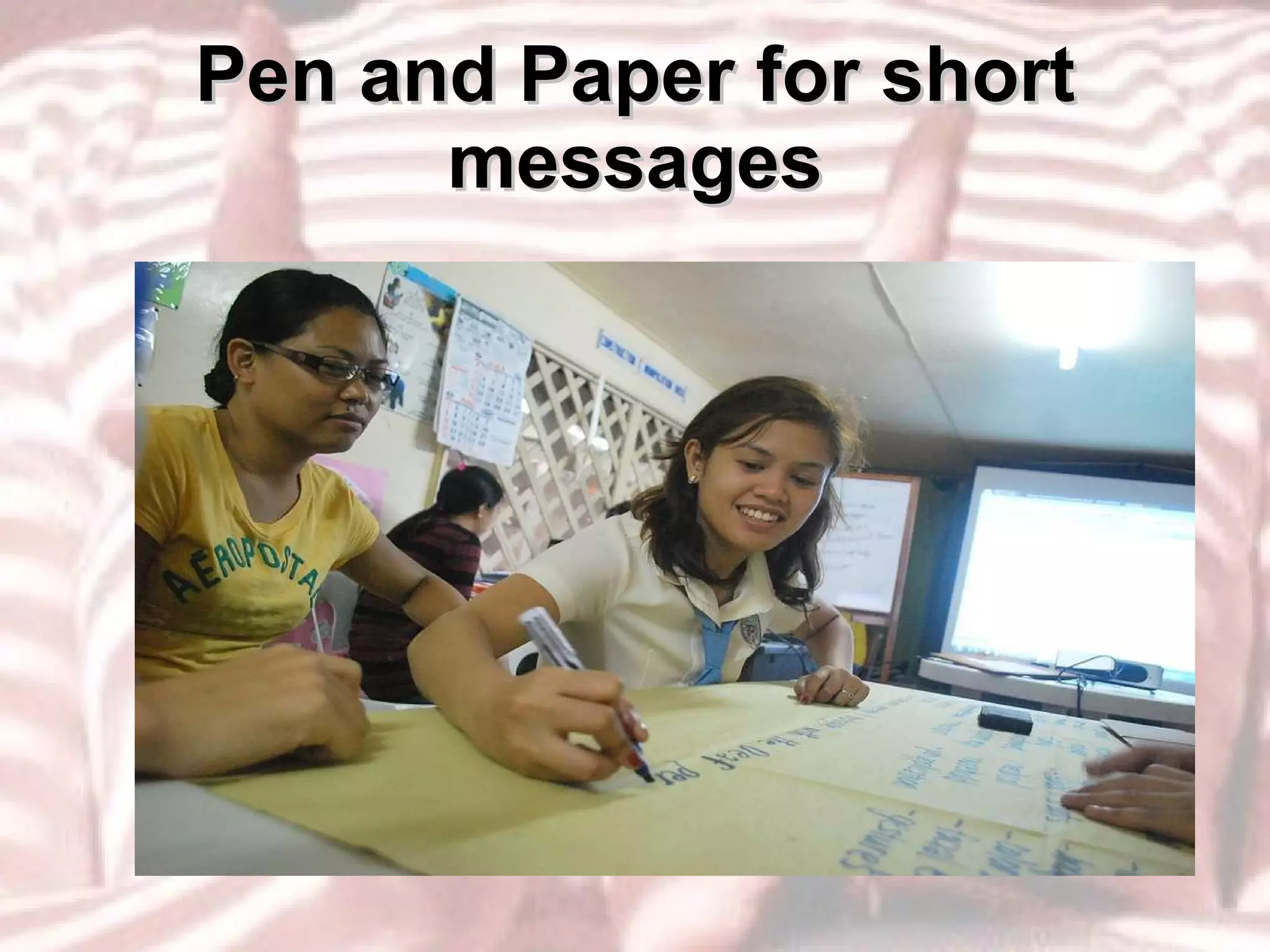
Pen and Paper for short messages
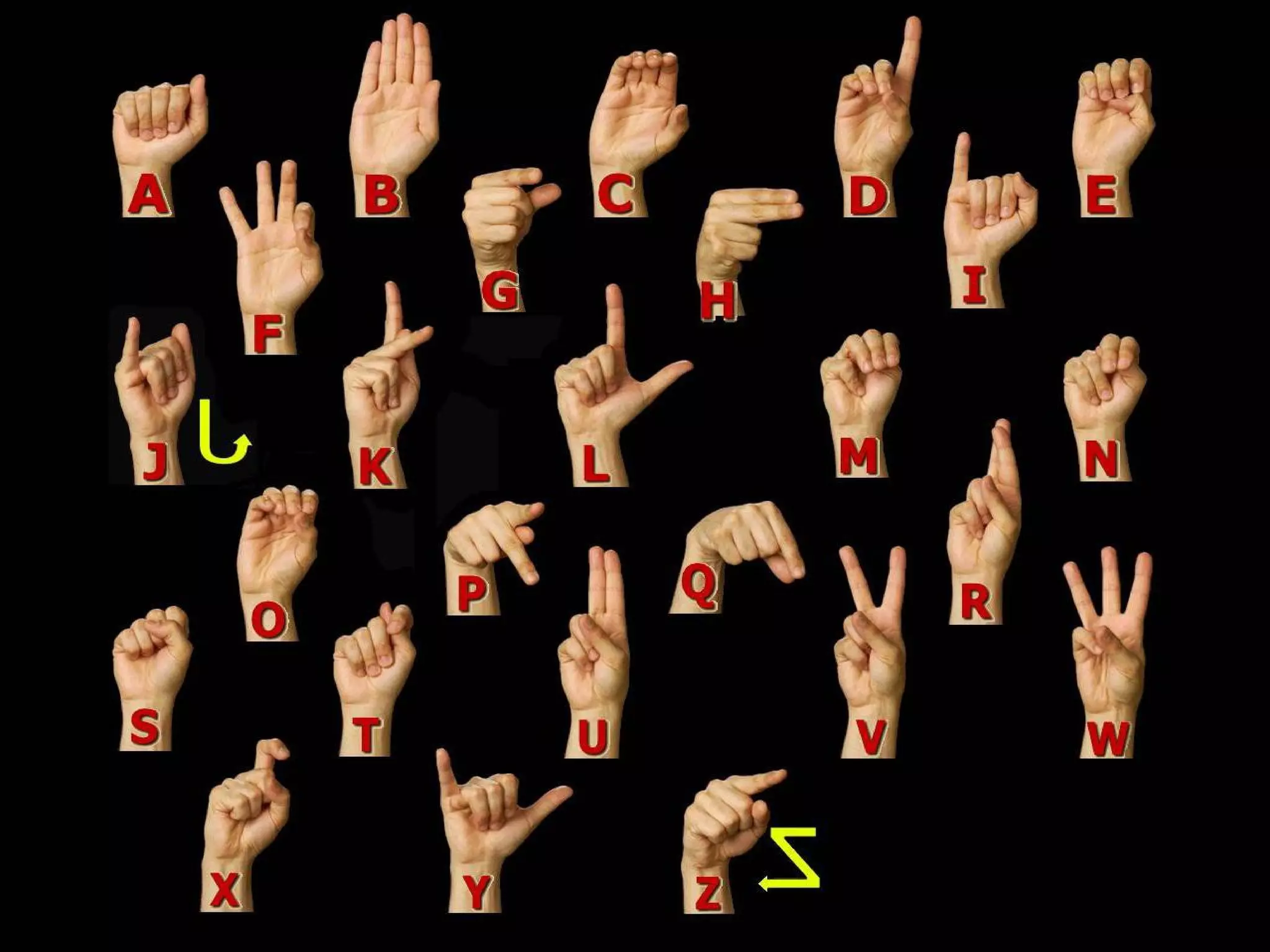
By asking trained interpreters to express your message to the Deaf (keep in mind to speak to the Deaf not the interpreter) Learn fingerspelling.
 
Communicating with the  D eaf ( General Communication Principles)
Get the  D eaf person’s attention before signing or making a gesture. Speak slowly and clearly. Look directly at the  D eaf person. Do not place anything in or over your mouth or try to cover your mouth when you speak.
Avoid jargons. Do not pretend that you understand what they said. Always provide for an FSL interpreter.
I can  Do  it!!!!!!
 
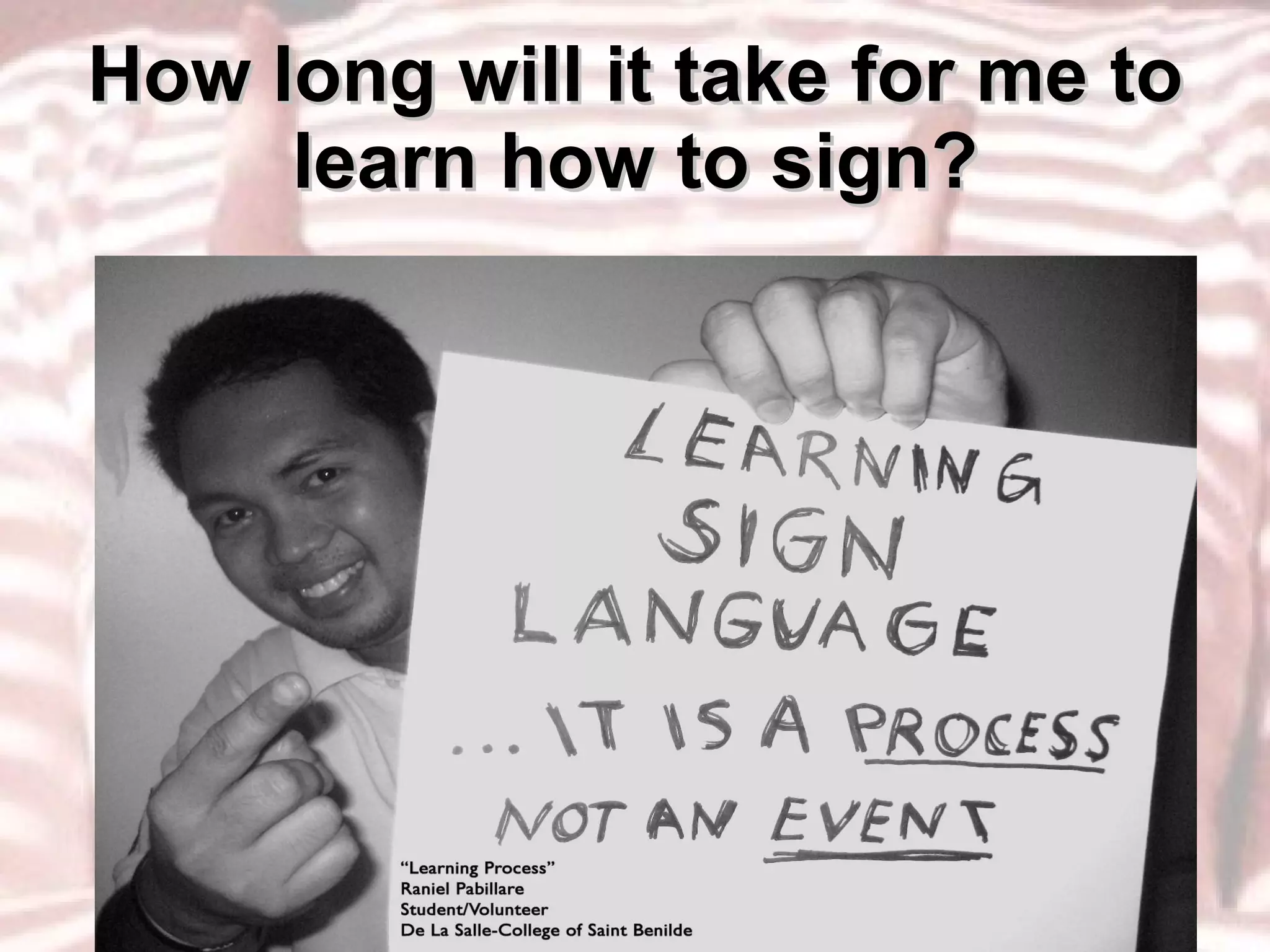
How long will it take for me to learn how to sign?
Let’s  S I G N !
Elements of Signing Signing space Hand shape Location Movement Palm orrientation Non- manual sign
NON-MANUAL SIGNALS Facial expressions Non-manual Signal
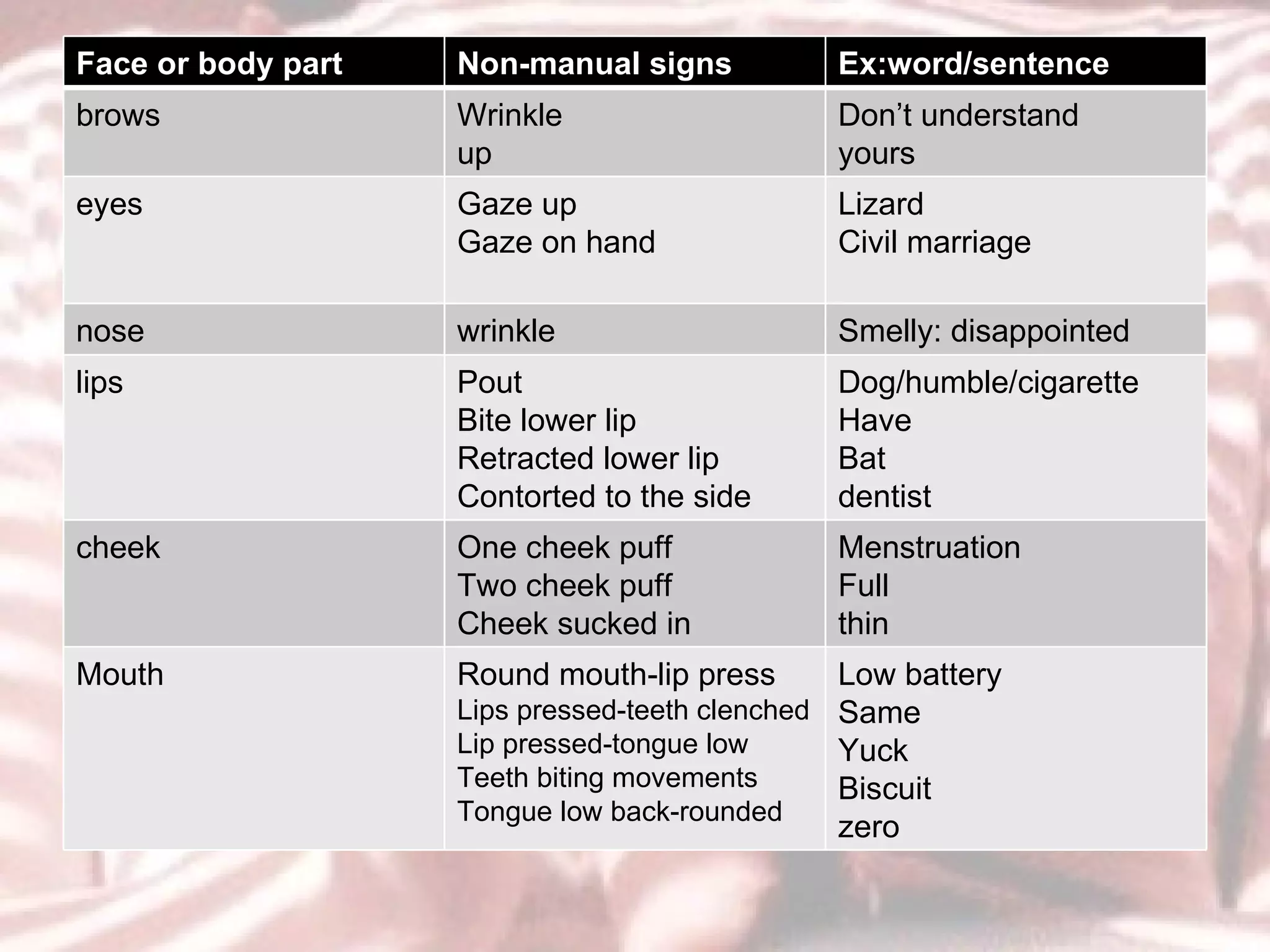
Face or body part Non-manual signs Ex:word/sentence brows Wrinkle up Don’t understand yours eyes Gaze up Gaze on hand Lizard Civil marriage nose wrinkle Smelly: disappointed lips Pout Bite lower lip Retracted lower lip Contorted to the side Dog/humble/cigarette Have Bat dentist cheek One cheek puff Two cheek puff Cheek sucked in Menstruation Full thin Mouth  Round mouth-lip press Lips pressed-teeth clenched Lip pressed-tongue low Teeth biting movements Tongue low back-rounded Low battery Same Yuck Biscuit zero
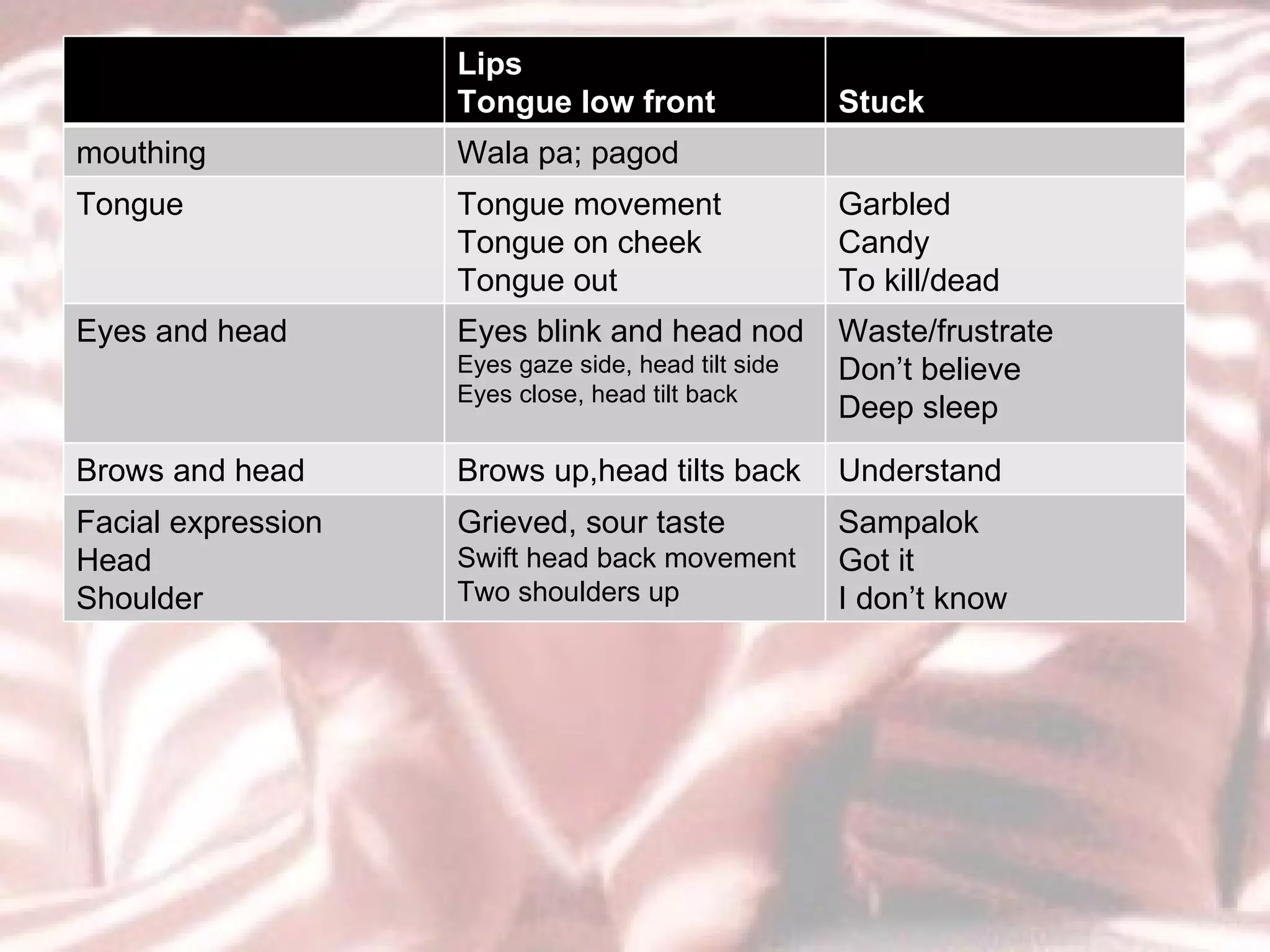
Lips Tongue low front Stuck mouthing Wala pa; pagod Tongue  Tongue movement Tongue on cheek Tongue out Garbled Candy To kill/dead Eyes and head Eyes blink and head nod Eyes gaze side, head tilt side Eyes close, head tilt back Waste/frustrate Don’t believe Deep sleep Brows and head Brows up,head tilts back Understand Facial expression Head  Shoulder  Grieved, sour taste Swift head back movement Two shoulders up Sampalok Got it I don’t know
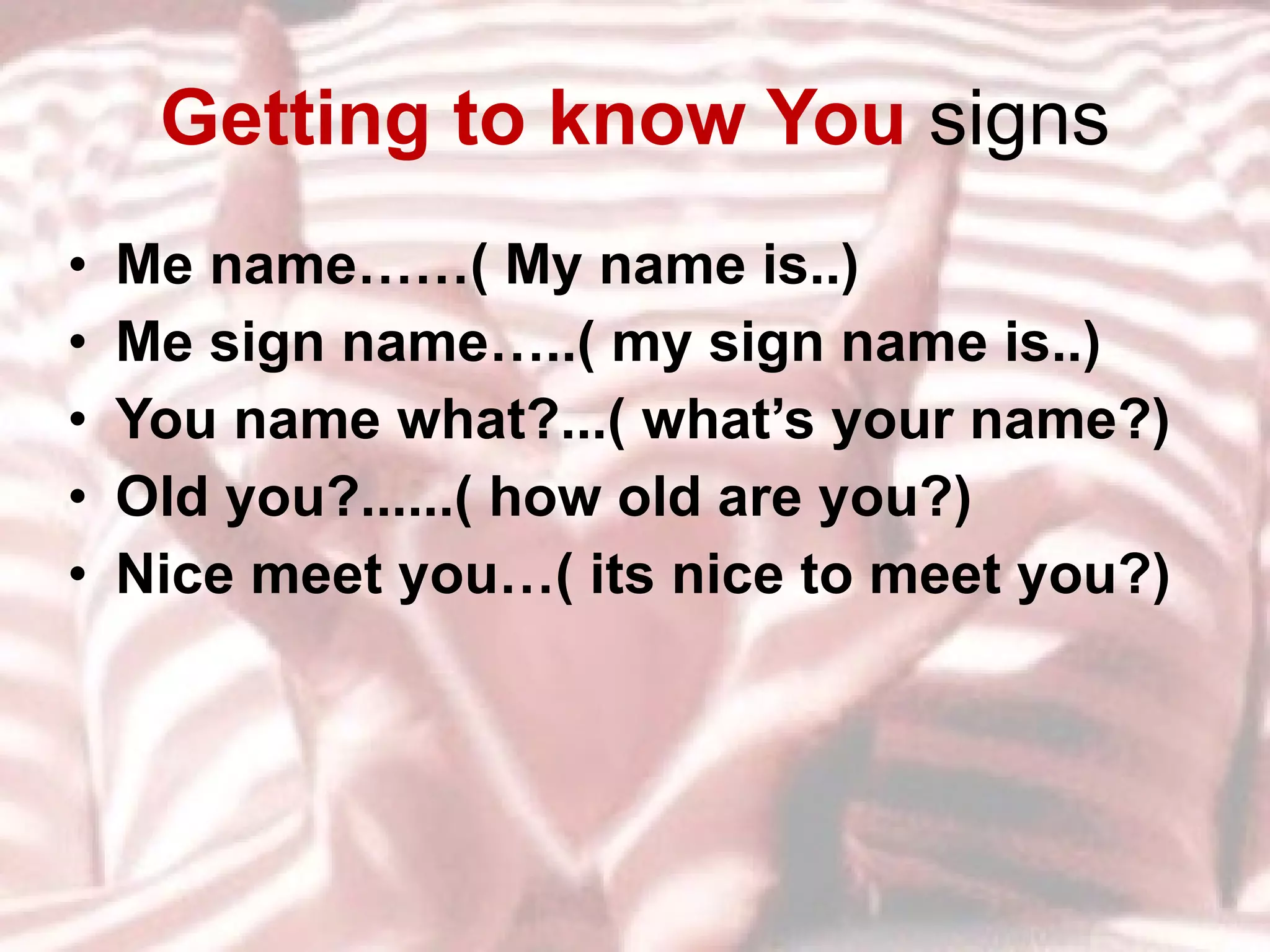
Getting to know You  signs Me name……( My name is..) Me sign name…..( my sign name is..) You name what?...( what’s your name?) Old you?......( how old are you?) Nice meet you…( its nice to meet you?)
W- Questions: What? Who? When? Why? Which? How?
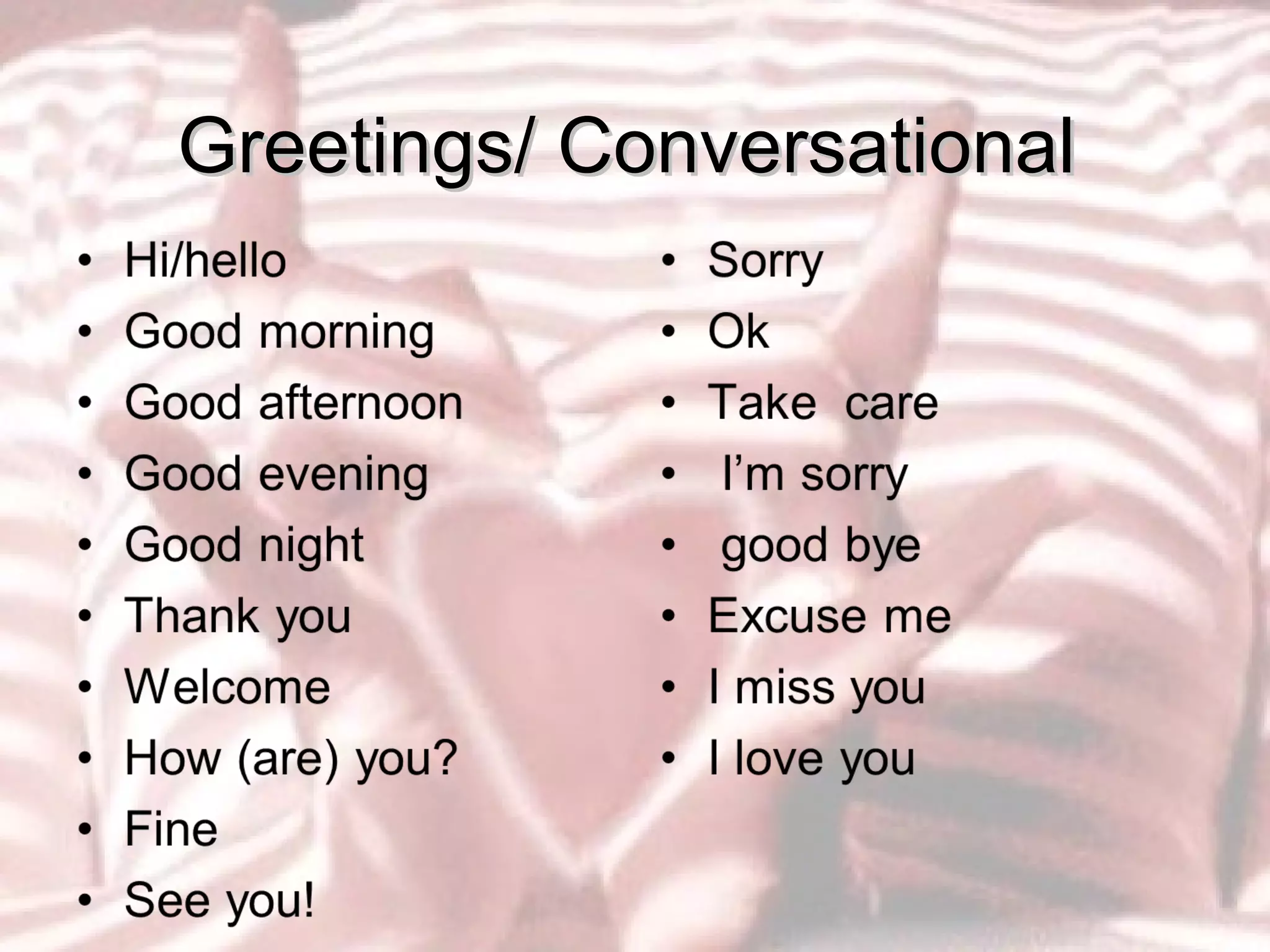
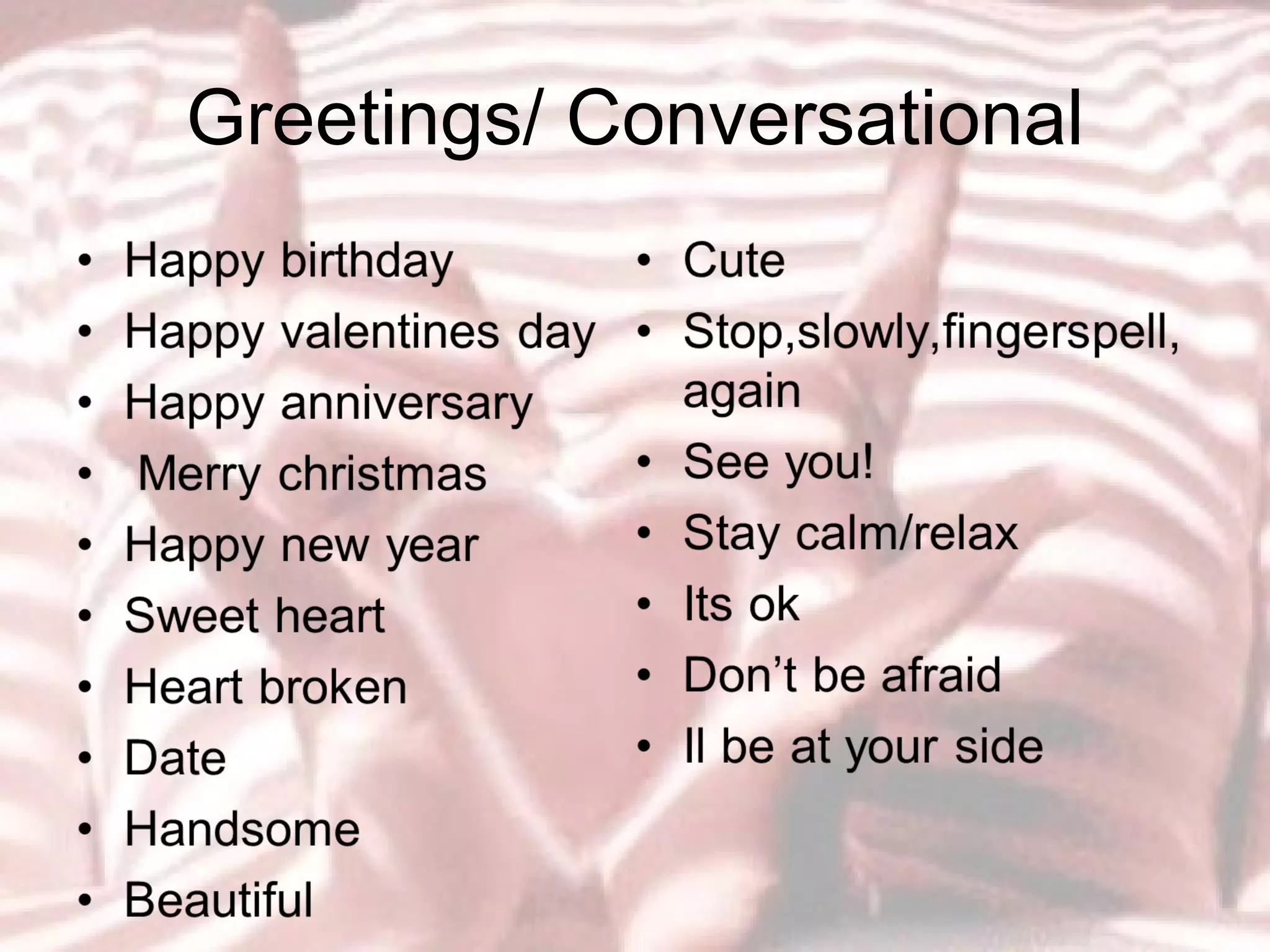
Greetings/ Conversational
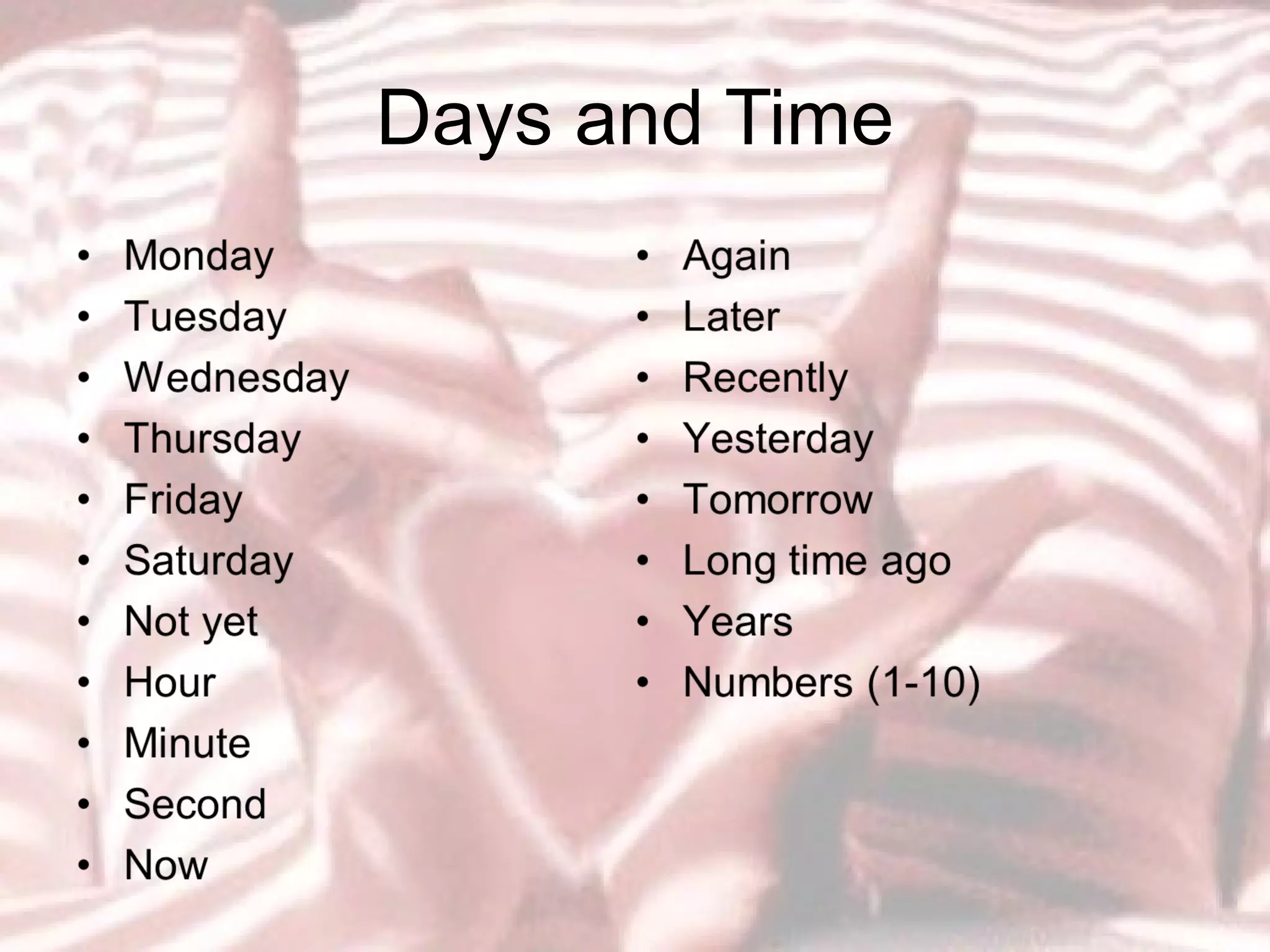
Days and Time
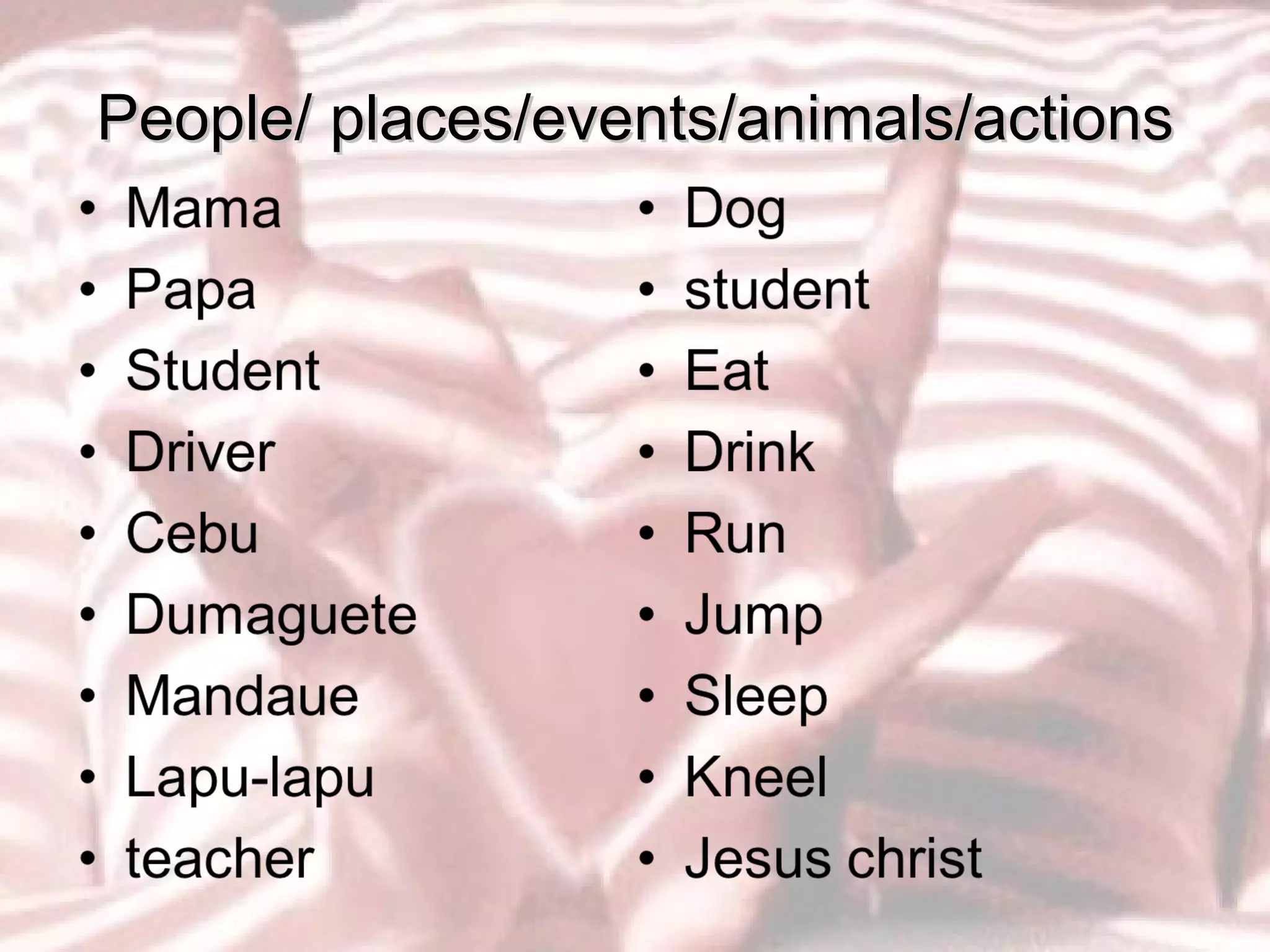
People/ places/events/animals/actions
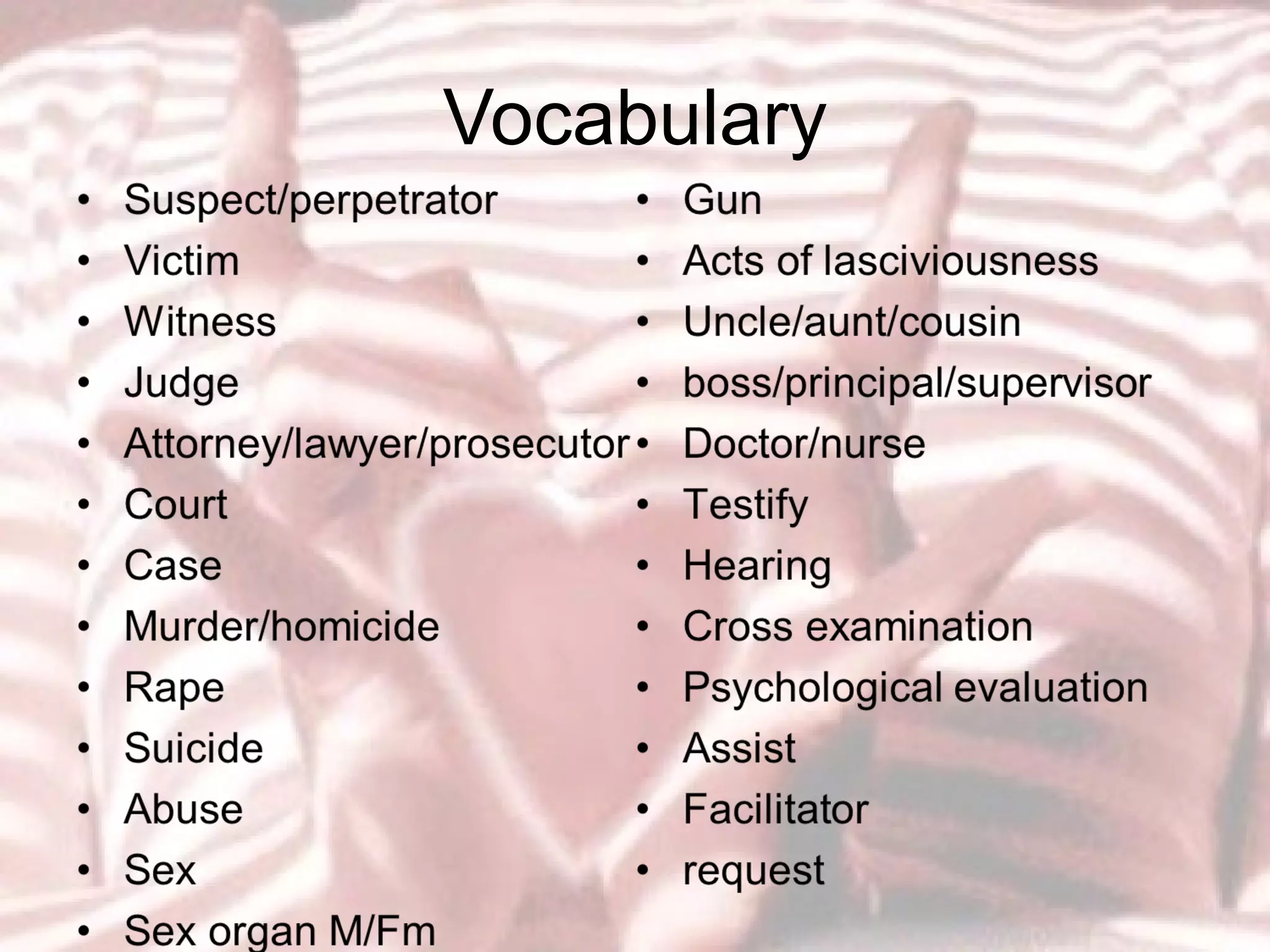
Vocabulary
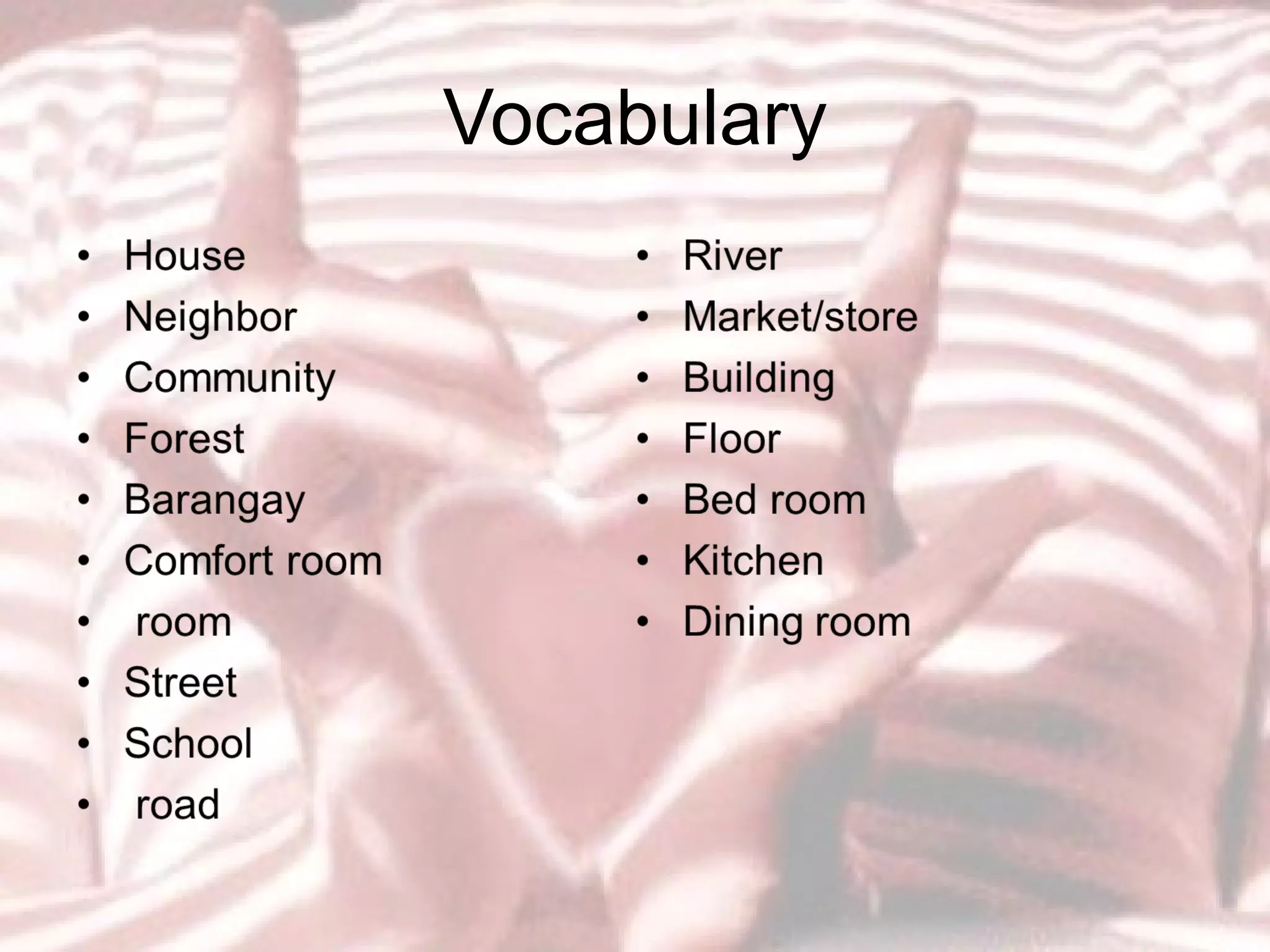
Vocabulary
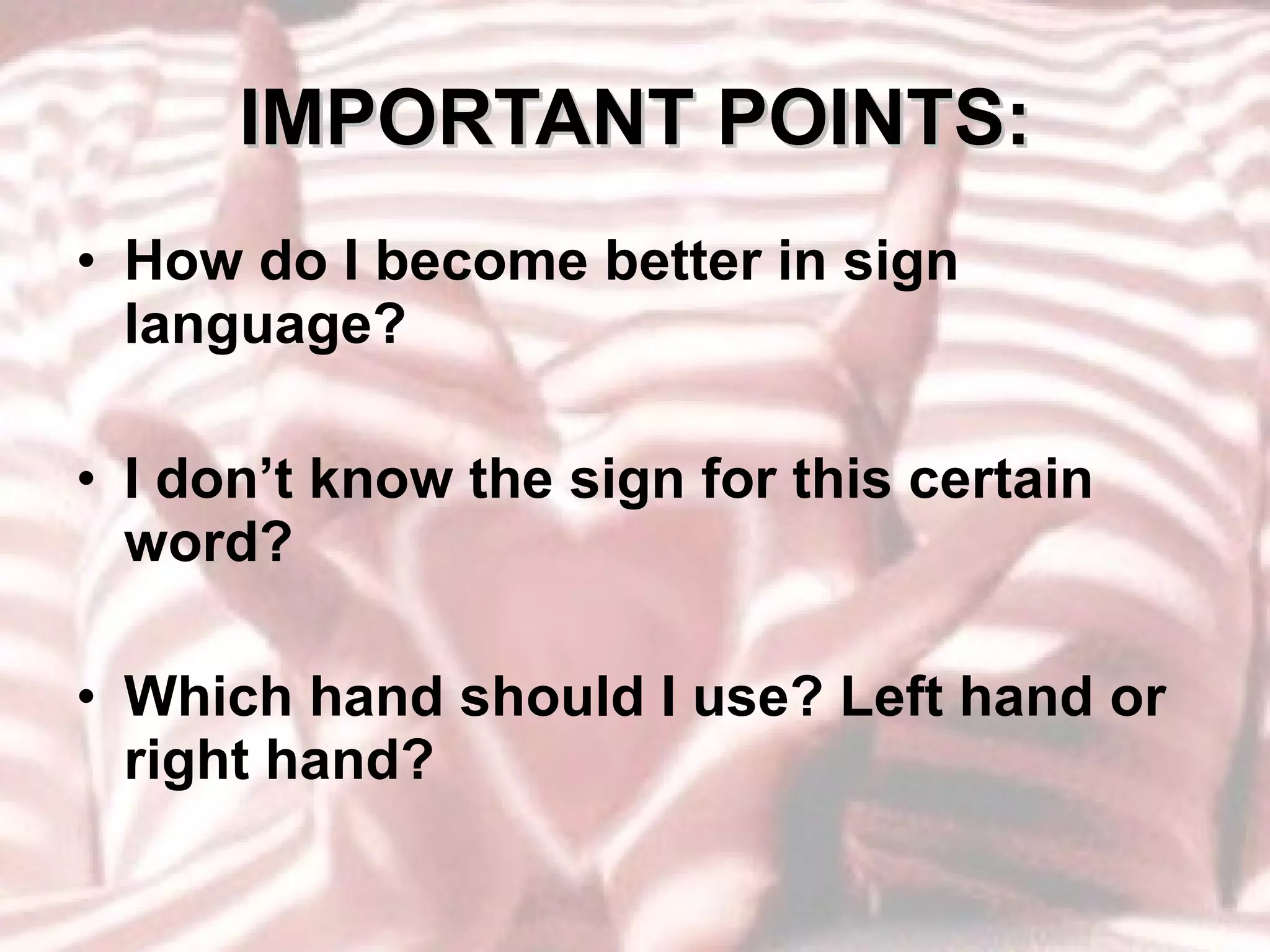
IMPORTANT POINTS: How do I become better in sign language? I don’t know the sign for this certain word? Which hand should I use? Left hand or right hand?
8 Tips for Encouraging Self-Esteem  in  D eaf and Hard of hearing Children   --2002-2003, Paula Rosenthal and Taylor,Rose, Inc. 1. Let the child speak.  2. Treat the child the same. 3. Teach the child manners.  4. Teach the child about hearing loss.  5. Discover the child's interests and develop them.  6. Avoid labeling.  7. Teach the child self-acceptance.  8. Acknowledge both success and attempts at success.
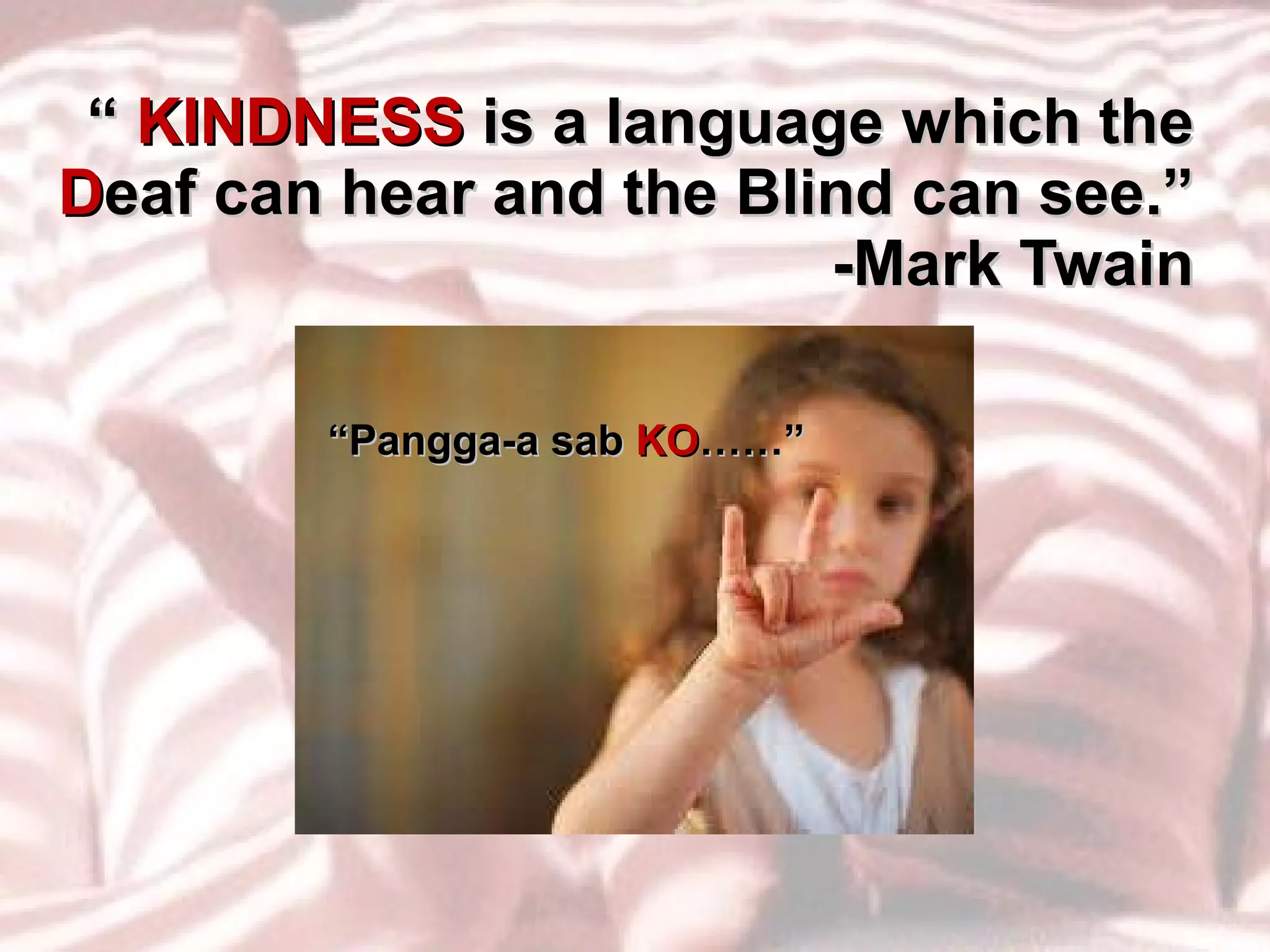
“  KINDNESS  is a language which the  D eaf can hear and the Blind can see.” -Mark Twain “ Pangga-a sab  KO ……”
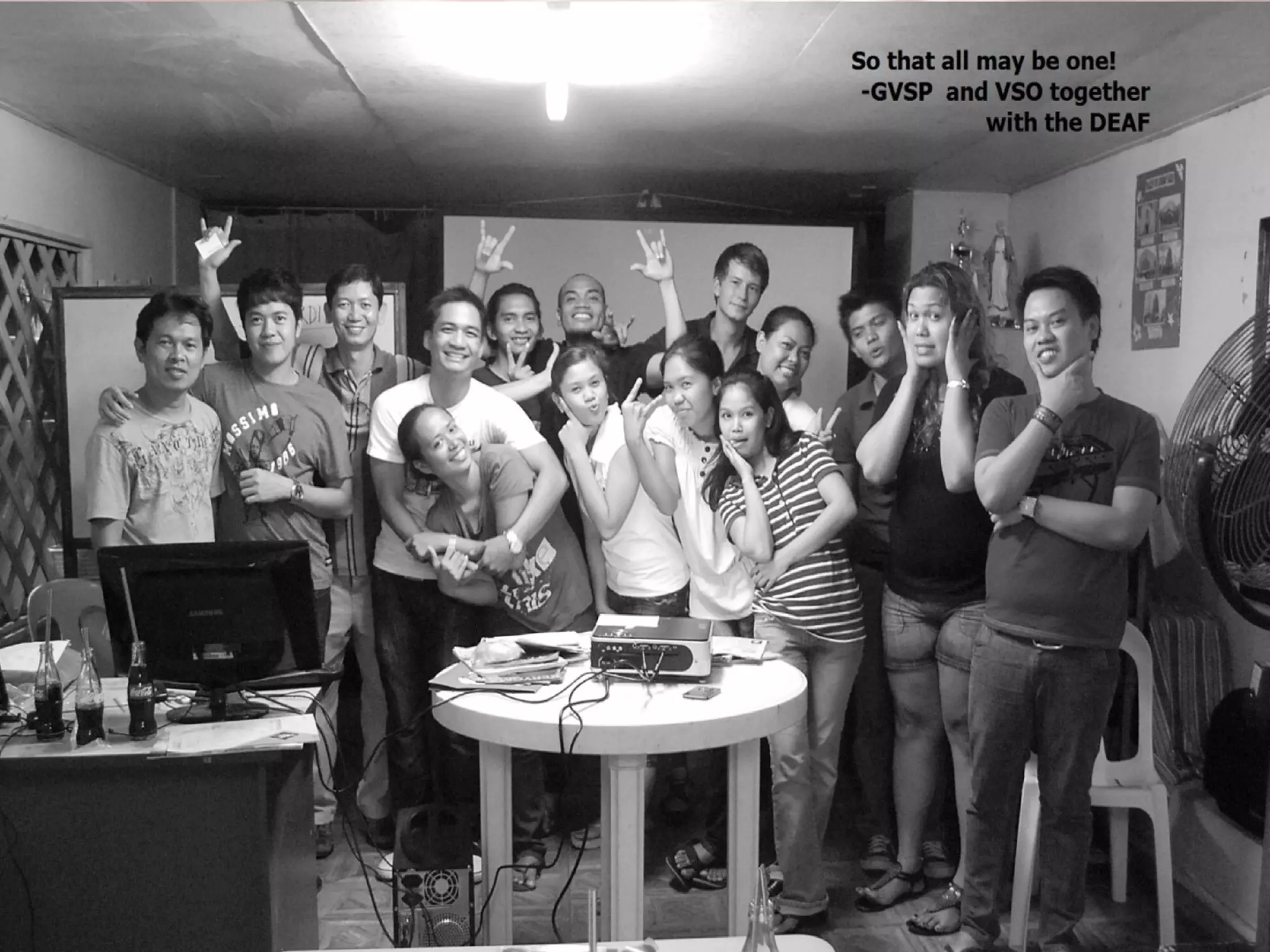
Break the Silence! Contact us: The Gualandi Volunteer Service Programme,Inc Mr. John Paul E. Maunes,RN Program Manager Cel.no.  0932 202 7333 Tel.No.  032-231 2601 Email add. gualandivolunteers@ yahoo.com Website: gualandivolunteers.org We Can Make a Deaf-ference!
Active Participation and Partnership for Protection, Justice, and Accessibility for the Deaf

DAW lecture slide

  • 1.
    D EAF? !? b ungol !? a mang ? !? H earing impaired ? !?
  • 2.
    What do Iknow about them? What do I think when I see them? How do I feel when I see them?
  • 3.
    Let’s Have AShort Quiz!
  • 4.
    TRUE OR FALSE
  • 5.
    Deaf peopleare mute
  • 6.
    Deaf peopleare dumb
  • 7.
    All Deaf people are excellent lip-readers
  • 8.
    Sign language is UNIVERSAL
  • 9.
    D EAF initely! MIS CONCEPT IONS
  • 10.
    A B asic F acts
  • 11.
    Two (2) Perspectiveson Deafness (as described by Baker and Cokely, 1980) The Medical-Pathological Model The Cultural Model
  • 12.
    Medical-Pathological Model “deafness is a terrible tragedy and D eaf people are to be pitied.”
  • 13.
  • 14.
    Cultural Model -common language Culture social affiliation educational background .
  • 15.
    Welcome to the Deaf world!
  • 16.
    Comparison of twomodels Medical Model Point of comparison Cultural Model Deafness is a disability Definition Deafness is a difference Professionals must be concerned with “saving” the D eaf Professional involvement We must work with the D eaf about issues and concerns for their welfare. The D eaf belong to the disability sector of the society. Membership in the society The D eaf belong to a linguistic minority sector. Speech Real handicap of deafness The Area of Communication
  • 17.
    Types of DeafnessPre-lingually D eaf Post-lingually D eaf
  • 18.
    Causes Of DeafnessPerinatal Accidental/traumatic Ageing Heredity Medical
  • 19.
  • 20.
    Degree of DeafnessDEGREE DECIBELS SOURCE OF SOUND MILD 20-40 dB Alarm clock MODERATE 41-70 dB Loud radio SEVERE 71-95 dB Chainsaw PROFOUND 95+ dB Airplane noise
  • 21.
    iPods,Mpe3s can reachup to 115 dB or even higher SOURCE OF SOUND DECIBELS Listening to TV/ normal talking 40-60 Traffic noise/moving car 80-90
  • 22.
  • 23.
  • 24.
  • 25.
    In the 2005Census for Deaf population in Cebu province Female: Male: Children Deaf : 14,491 14,144 *
  • 26.
    World Health Organization statistics for D eafness: one D eaf per 1000 population
  • 27.
    Current Issues Highprevalence/incidence of Deafness in the Philippines: 2-3: 1000 Filipinos lack of accessibility basic services for the Deaf
  • 28.
    Current Issues 65-70% of Deaf boys and girls are being molested -source: The Philippine Deaf Resource Center 1 out of 3 Deaf women has been raped - source: Lyer and Fortunato, 2005 72% - abused or battered 63% - abused by their own fathers. - source: De Guzman, 2002
  • 29.
    Current Issues 50% of Deaf girls have been sexually abused as compared to 25% of hearing girls. 54% of Deaf boys have been sexually abused as compared to 10% of hearing boys. Source: Patricia M. Sullivan, Vernon & scanlan, 1987
  • 30.
  • 31.
    Philippine Laws thatprotect Persons With Disabilities (PWDs) including the D eaf…
  • 32.
    1987 Philippine ConstitutionR.A 9422 ( Magna Carta for the Differently abled) Public Ridicule Vilification Convention on the rights of the child Convention on the Rights of Persons with disabilities R.A 7610 ( Special Protection of children Against Abuse, Exploitation and Discrimination Act) R.A 9262 ( Anti-violence against Women and their children Act 2004)
  • 33.
    “ The onlything a Deaf person cannot do is hear ”. -I.King Jordan Other senses of the Deaf are often well developed and allow them to adapt to almost anything.
  • 34.
    Let’s re D EAF ine
  • 35.
    H ard of hearing  cannot detect sound at an amplitude of 20 decibels
  • 36.
    less-than-normal hearing H earing impairment
  • 37.
    can be present at birth or caused suddenly by disease/injury Deafness
  • 38.
    D e af ness and Diversity Culturally D eaf persons Orally D eaf persons Hard of hearing persons Persons with acquired deafness
  • 39.
    D eaf & d eaf what’s the difference?
  • 40.
    d eaf is a general term to refer to the person who cannot hear
  • 41.
    F ilipino D eaf C ommunity It is cultural linguistic minority. It is an ethnic group with it’s own cultural heritage, language and psychology.
  • 42.
  • 43.
  • 44.
    Distinct Characteristics ofDeaf People • When mainstreamed with hearing people, without moving, they can be mistaken as hearing. • They make peculiar movements and sounds when communicating. • They show feelings in exaggerated appearance. • Views the surroundings and happenings in the world in a different way according to what they see.
  • 45.
    Distinct characteristics ofDeaf People • They easily feel the change of mood. • It is imbedded in their emotions the feeling of deprivation. • They are very loyal to the people.
  • 46.
    Unacceptable terms usedto describe the D eaf
  • 47.
    ABNorMAL! deaf-dumb Hearing-ImpairedAmang DiMalas! Salot sa Pamilya Buang-buang Kawawa Deaf-mute Inutil! BOGO Special Retarded
  • 48.
  • 49.
    Bungol rather than amang D eaf
  • 50.
    sees deafness asa difference rather than a pathology or an illness to be cured. D eaf community
  • 51.
  • 52.
    D eaf culture D eaf life D eaf experiences….
  • 53.
    What is F ilipino D eaf C ulture ? unique way of life evolved from Filipino D eaf communities sharing of experiences
  • 54.
    Is there really a F ilipino D eaf C ulture? Enlightened Filipino D eaf adults and adolescents (with their hearing advocates) believe there is! FSL highlights Filipino D eaf culture
  • 55.
    How to getthe attention of a D eaf person.
  • 56.
  • 57.
  • 58.
  • 59.
  • 60.
  • 61.
    For many D eaf, there is often little to no communication in the home.
  • 62.
    It is bestfor the hearing to sign when in the presence of the D eaf.
  • 63.
    Communication is keywithin the Family for a D eaf child and if a family don’t know how to sign, a D eaf may feel excluded or confused.
  • 64.
    The Deaf sometimes don’t realize that they are making sounds. For example, the spoon and fork when eating (or others like the banging of the door, dragging the chair, etc.)
  • 65.
    The Deaf will not fully understand a lesson if a teacher does not use sign language to explain the discussion.
  • 66.
    Hearing people usethe phone to call each other. D eaf people makes use of the SMS technology to communicate to both D eaf and hearing.
  • 67.
    D eaf peoplemay sign something that is wide and might hit the person standing next to them. But this is purely accidental. In D eaf conversations, every gesture is very important and sufficient signing space is needed for arm movements.
  • 68.
    Television often donot have caption so D eaf people do not understand what is being said on the TV. D eaf people miss out on the information.
  • 69.
    With a signlanguage interpreter signing in a small inset on the lower part of the TV, D eaf people would have access to information from the news.
  • 70.
    The Deaf could participate in the church mass or worship services if there is a sign language interpreter or the priest himself would sign the mass.
  • 71.
  • 72.
  • 73.
    Name signs are a very important part of D eaf culture. There are rules the D eaf follow when making up name signs, hence the reason only a D eaf person is supposed to give you a name sign. The name sign often reflects a physical characteristic (hair length, dimples, a scar) or it can be related to your personality or job. Once given a name sign, it is how the D eaf community recognizes you.
  • 74.
  • 75.
    Getting Started: Itis important to get your message across, to connect and to be understood when communicating with a D eaf person.
  • 76.
  • 77.
    Gestures / Bodymovements Pantomimes Facial Expressions
  • 78.
    Pen and Paperfor short messages
  • 79.
    By asking trainedinterpreters to express your message to the Deaf (keep in mind to speak to the Deaf not the interpreter) Learn fingerspelling.
  • 80.
  • 81.
    Communicating with the D eaf ( General Communication Principles)
  • 82.
    Get the D eaf person’s attention before signing or making a gesture. Speak slowly and clearly. Look directly at the D eaf person. Do not place anything in or over your mouth or try to cover your mouth when you speak.
  • 83.
    Avoid jargons. Donot pretend that you understand what they said. Always provide for an FSL interpreter.
  • 84.
    I can Do it!!!!!!
  • 85.
  • 86.
    How long willit take for me to learn how to sign?
  • 87.
    Let’s SI G N !
  • 88.
    Elements of SigningSigning space Hand shape Location Movement Palm orrientation Non- manual sign
  • 89.
    NON-MANUAL SIGNALS Facialexpressions Non-manual Signal
  • 90.
    Face or bodypart Non-manual signs Ex:word/sentence brows Wrinkle up Don’t understand yours eyes Gaze up Gaze on hand Lizard Civil marriage nose wrinkle Smelly: disappointed lips Pout Bite lower lip Retracted lower lip Contorted to the side Dog/humble/cigarette Have Bat dentist cheek One cheek puff Two cheek puff Cheek sucked in Menstruation Full thin Mouth Round mouth-lip press Lips pressed-teeth clenched Lip pressed-tongue low Teeth biting movements Tongue low back-rounded Low battery Same Yuck Biscuit zero
  • 91.
    Lips Tongue lowfront Stuck mouthing Wala pa; pagod Tongue Tongue movement Tongue on cheek Tongue out Garbled Candy To kill/dead Eyes and head Eyes blink and head nod Eyes gaze side, head tilt side Eyes close, head tilt back Waste/frustrate Don’t believe Deep sleep Brows and head Brows up,head tilts back Understand Facial expression Head Shoulder Grieved, sour taste Swift head back movement Two shoulders up Sampalok Got it I don’t know
  • 92.
    Getting to knowYou signs Me name……( My name is..) Me sign name…..( my sign name is..) You name what?...( what’s your name?) Old you?......( how old are you?) Nice meet you…( its nice to meet you?)
  • 93.
    W- Questions: What?Who? When? Why? Which? How?
  • 94.
  • 95.
  • 96.
  • 97.
  • 98.
  • 99.
  • 100.
    IMPORTANT POINTS: Howdo I become better in sign language? I don’t know the sign for this certain word? Which hand should I use? Left hand or right hand?
  • 101.
    8 Tips forEncouraging Self-Esteem in D eaf and Hard of hearing Children --2002-2003, Paula Rosenthal and Taylor,Rose, Inc. 1. Let the child speak. 2. Treat the child the same. 3. Teach the child manners. 4. Teach the child about hearing loss. 5. Discover the child's interests and develop them. 6. Avoid labeling. 7. Teach the child self-acceptance. 8. Acknowledge both success and attempts at success.
  • 102.
    “ KINDNESS is a language which the D eaf can hear and the Blind can see.” -Mark Twain “ Pangga-a sab KO ……”
  • 103.
    Break the Silence!Contact us: The Gualandi Volunteer Service Programme,Inc Mr. John Paul E. Maunes,RN Program Manager Cel.no. 0932 202 7333 Tel.No. 032-231 2601 Email add. gualandivolunteers@ yahoo.com Website: gualandivolunteers.org We Can Make a Deaf-ference!
  • 104.
    Active Participation andPartnership for Protection, Justice, and Accessibility for the Deaf