What is American Sign Language?
a) A visual form of English
b) A language with its own unique rules of grammar and syntax
c) A language mostly using iconic gestures to express ideas and concepts
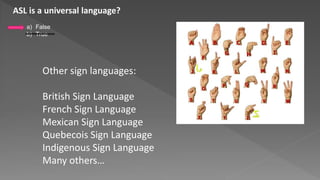
ASL is a universal language?
a) False
b) True
Other sign languages:
British Sign Language
French Sign Language
Mexican Sign Language
Quebecois Sign Language
Indigenous Sign Language
Many others…
American Sign Language originates from?
a) France
b) England
c) United States
Milan 1880 was an international conference of educators where it was
decided that….
a) Sign language would be used in deaf education
b) Sign language would be banned in deaf education
Who is known ad the “boogeyman” in deaf culture?
a) Abraham Lincoln
b) Alexander Graham Bell
c) Beethoven
d) Beetlejuice
All Deaf people can lip-read?
a) False
b) True
While watching another person sign, you should focus on the
signer’s:
a) Hands
b) Face
c) Chest area
To get the attention of a Deaf person who is looking the other way,
you should:
a) Yell as loud as you can
b) Tap them on the shoulder
c) Wave in their face
d) Go around and stand in front of the person
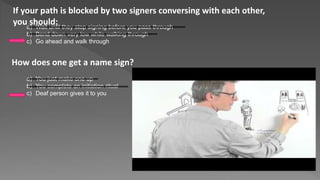
If your path is blocked by two signers conversing with each other,
you should:a) Wait until they stop signing before you pass through
b) Bend down very low while walking through
c) Go ahead and walk through
How does one get a name sign?
a) You just make one up
b) You complete an initiation ritual
c) Deaf person gives it to you
Some Identities in Deaf communities
deaf
The small-d deaf focuses on the audiological condition itself
Deaf
A capital-d Deaf is a member of the Deaf community, and they tend to view deafness as a
difference in human experience rather than a disability. When one says they identify as Deaf, it
means that they are a part of Deaf culture and treasure their culture and language.
Some Deaf people would not choose to be hearing, even if there was a cure available. They don’t
view hearing as something they should desire and resent people who think they should want to be
hearing. However, Deaf folks who wear hearing aids and/or cochlear implants can consider
themselves Deaf and are accepted by others in the community.
Some Identities in Deaf communities (cont’d)
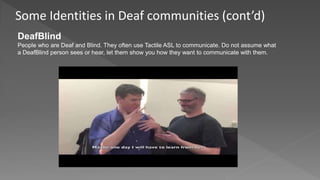
DeafBlind
People who are Deaf and Blind. They often use Tactile ASL to communicate. Do not assume what
a DeafBlind person sees or hear, let them show you how they want to communicate with them.
Some Identities in Deaf communities (cont’d)
Late-Deafened
People who lost their hearing later in life instead of being born deaf
HOH – Hard of Hearing
This refers to people who aren’t profoundly deaf
Hearing
People who can fully hear and socialize as a hearing/speaking person
Hearing Impaired
Most people prefer to be called deaf of HOH. Best thing to do is to just see how the person describes
themselves and then use what they use
Some Identities in Deaf communities (cont’d)
Oral
This means the deaf person was raised orally. Usually they don’t know ASL or learned ASL later in life.
They usually rely on lip-reading, hearing devices and speech in order to communicate.
Mainstream
One of the first things that d/Deaf people talk about when they first meet each other is whether they grew
up going to a deaf school or were mainstream. Mainstreamed means that they went to a public school
what either had or did not have a program for deaf & HOH students. The goal is to find something in
common to start making a connection with the other person.
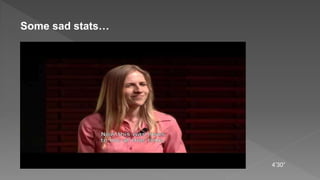
Some sad stats…
4’30”
 About 2 to 3 out of every children in the USA are born deaf of
HOH (approx. 130,000 people)
 9 out of every 10 children who are born deaf are born to parents
who can hear
 Of those families, only 10% ever learn to communicate effectively
with their deaf child
 90% DO NOT
 Deaf children born to hearing parents are less likely to develop
fluent written and reading English. Only a third of deaf children
complete High School
 Average reading level among deaf people is Grade 4 (to be literate
an individual should have level 6-8 reading English
 Deaf people who attend college, only a fifth complete their studies
 Deaf adults earn about a third less than their hearing peers
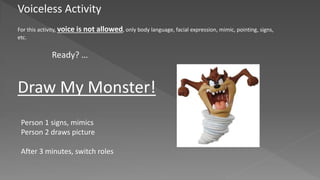
Voiceless Activity
For this activity, voice is not allowed, only body language, facial expression, mimic, pointing, signs,
etc.
Draw My Monster!
Person 1 signs, mimics
Person 2 draws picture
After 3 minutes, switch roles
Ready? …
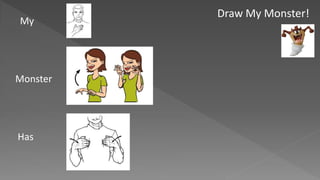
Draw My Monster!
My
Monster
Has
Deaf Communities and ASL Mini Workshop

Deaf Communities and ASL Mini Workshop

  • 3.
    What is AmericanSign Language? a) A visual form of English b) A language with its own unique rules of grammar and syntax c) A language mostly using iconic gestures to express ideas and concepts
  • 4.
    ASL is auniversal language? a) False b) True Other sign languages: British Sign Language French Sign Language Mexican Sign Language Quebecois Sign Language Indigenous Sign Language Many others…
  • 5.
    American Sign Languageoriginates from? a) France b) England c) United States Milan 1880 was an international conference of educators where it was decided that…. a) Sign language would be used in deaf education b) Sign language would be banned in deaf education Who is known ad the “boogeyman” in deaf culture? a) Abraham Lincoln b) Alexander Graham Bell c) Beethoven d) Beetlejuice
  • 6.
    All Deaf peoplecan lip-read? a) False b) True While watching another person sign, you should focus on the signer’s: a) Hands b) Face c) Chest area To get the attention of a Deaf person who is looking the other way, you should: a) Yell as loud as you can b) Tap them on the shoulder c) Wave in their face d) Go around and stand in front of the person
  • 7.
    If your pathis blocked by two signers conversing with each other, you should:a) Wait until they stop signing before you pass through b) Bend down very low while walking through c) Go ahead and walk through How does one get a name sign? a) You just make one up b) You complete an initiation ritual c) Deaf person gives it to you
  • 8.
    Some Identities inDeaf communities deaf The small-d deaf focuses on the audiological condition itself Deaf A capital-d Deaf is a member of the Deaf community, and they tend to view deafness as a difference in human experience rather than a disability. When one says they identify as Deaf, it means that they are a part of Deaf culture and treasure their culture and language. Some Deaf people would not choose to be hearing, even if there was a cure available. They don’t view hearing as something they should desire and resent people who think they should want to be hearing. However, Deaf folks who wear hearing aids and/or cochlear implants can consider themselves Deaf and are accepted by others in the community.
  • 9.
    Some Identities inDeaf communities (cont’d) DeafBlind People who are Deaf and Blind. They often use Tactile ASL to communicate. Do not assume what a DeafBlind person sees or hear, let them show you how they want to communicate with them.
  • 10.
    Some Identities inDeaf communities (cont’d) Late-Deafened People who lost their hearing later in life instead of being born deaf HOH – Hard of Hearing This refers to people who aren’t profoundly deaf Hearing People who can fully hear and socialize as a hearing/speaking person Hearing Impaired Most people prefer to be called deaf of HOH. Best thing to do is to just see how the person describes themselves and then use what they use
  • 11.
    Some Identities inDeaf communities (cont’d) Oral This means the deaf person was raised orally. Usually they don’t know ASL or learned ASL later in life. They usually rely on lip-reading, hearing devices and speech in order to communicate. Mainstream One of the first things that d/Deaf people talk about when they first meet each other is whether they grew up going to a deaf school or were mainstream. Mainstreamed means that they went to a public school what either had or did not have a program for deaf & HOH students. The goal is to find something in common to start making a connection with the other person.
  • 12.
  • 13.
     About 2to 3 out of every children in the USA are born deaf of HOH (approx. 130,000 people)  9 out of every 10 children who are born deaf are born to parents who can hear  Of those families, only 10% ever learn to communicate effectively with their deaf child  90% DO NOT  Deaf children born to hearing parents are less likely to develop fluent written and reading English. Only a third of deaf children complete High School  Average reading level among deaf people is Grade 4 (to be literate an individual should have level 6-8 reading English  Deaf people who attend college, only a fifth complete their studies  Deaf adults earn about a third less than their hearing peers
  • 14.
    Voiceless Activity For thisactivity, voice is not allowed, only body language, facial expression, mimic, pointing, signs, etc. Draw My Monster! Person 1 signs, mimics Person 2 draws picture After 3 minutes, switch roles Ready? …
  • 15.