David C. Lewis, M.D. Professor Emeritus of Community Health and Medicine Donald G. Millar Distinguished emeritus Professor  of Alcohol and Addiction Studies Brown University [email_address]
Individualism Federalism Pluralism Incrementalism American Political Character
The Problem “ The American health care system is the poster child for underachievement…The largest limiting factor is not lack of money, technology, information, or even people but rather a lack of an organizing principle that can link money, people, technology, and ideas into a system that delivers more cost-effective care (in other words, more value) than current arrangements.”  Source: Stephen M. Shortell and Julie Schmittdiel, in  Toward a 21 st  Century Health System , edited by Alain C. Enthoven an dLaura Tollen, 2004.
Healthcare Reform
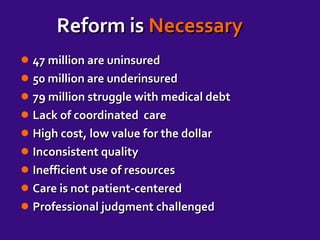
Reform is  Necessary 47 million are uninsured 50 million are underinsured 79 million struggle with medical debt Lack of coordinated  care High cost, low value for the dollar Inconsistent quality Inefficient use of resources Care is not patient-centered Professional judgment challenged
 
BIGGEST COSTS HOSPITAL READMISSIONS SPECIALIST  SERVICES
Patient-Centered  Medical Home Personal physician Whole Person Orientation Physician Directed Medical Practice Care is Coordinated and/or Integrated Quality and Safety Enhanced Access Payment Reform
INSURANCE REFORM WILL BE INFLUENCED BY STATE BASED DECISIONS ABOUT DESIGN OF EXCHANGES VIABILITY OF EMPLOYER BASED COVERAGE COMPARATIVE EFFECTIVENESS RESEARCH
Ensure that governing boards and other advisory bodies tasked with developing and administering the Exchanges include individuals with expertise regarding the unique needs of individuals with mental health and/or substance use disorders.  
Recognize and enforce the essential health benefits requirements of the Exchanges.  This includes the requirement that comprehensive mental health and substance use disorder benefits, at parity with medical/surgical benefits, be covered by all plans participating in the Exchanges. 
Ensure a strong outreach and education component, targeted to the public, eligible employers, and service providers to ensure sufficient access to coverage and benefits. 
Determinations about who needs what services, levels of care, and lengths of stay must be made by professionals treating the patient, and medical management tools cannot be used inappropriately to deny needed care. 
 

David lewis

  • 1.
  • 2.
    David C. Lewis,M.D. Professor Emeritus of Community Health and Medicine Donald G. Millar Distinguished emeritus Professor of Alcohol and Addiction Studies Brown University [email_address]
  • 3.
    Individualism Federalism PluralismIncrementalism American Political Character
  • 4.
    The Problem “The American health care system is the poster child for underachievement…The largest limiting factor is not lack of money, technology, information, or even people but rather a lack of an organizing principle that can link money, people, technology, and ideas into a system that delivers more cost-effective care (in other words, more value) than current arrangements.” Source: Stephen M. Shortell and Julie Schmittdiel, in Toward a 21 st Century Health System , edited by Alain C. Enthoven an dLaura Tollen, 2004.
  • 5.
  • 6.
    Reform is Necessary 47 million are uninsured 50 million are underinsured 79 million struggle with medical debt Lack of coordinated care High cost, low value for the dollar Inconsistent quality Inefficient use of resources Care is not patient-centered Professional judgment challenged
  • 7.
  • 8.
    BIGGEST COSTS HOSPITALREADMISSIONS SPECIALIST SERVICES
  • 9.
    Patient-Centered MedicalHome Personal physician Whole Person Orientation Physician Directed Medical Practice Care is Coordinated and/or Integrated Quality and Safety Enhanced Access Payment Reform
  • 10.
    INSURANCE REFORM WILLBE INFLUENCED BY STATE BASED DECISIONS ABOUT DESIGN OF EXCHANGES VIABILITY OF EMPLOYER BASED COVERAGE COMPARATIVE EFFECTIVENESS RESEARCH
  • 11.
    Ensure that governingboards and other advisory bodies tasked with developing and administering the Exchanges include individuals with expertise regarding the unique needs of individuals with mental health and/or substance use disorders.  
  • 12.
    Recognize and enforcethe essential health benefits requirements of the Exchanges.  This includes the requirement that comprehensive mental health and substance use disorder benefits, at parity with medical/surgical benefits, be covered by all plans participating in the Exchanges. 
  • 13.
    Ensure a strongoutreach and education component, targeted to the public, eligible employers, and service providers to ensure sufficient access to coverage and benefits. 
  • 14.
    Determinations about whoneeds what services, levels of care, and lengths of stay must be made by professionals treating the patient, and medical management tools cannot be used inappropriately to deny needed care. 
  • 15.