Breathe in and…breathe out? An investigation
into the causal relationship between intra-
abdominal pressure, spine stability, and force
production during weightlifting exercise.
A literature review by David Janett, Masters degree candidate in the applied physiology
program at Teachers College, Columbia University, New York, NY, April 2016.
  2	
  
Abstract
Trainers play an integral role in the development and implementation of exercise
programs across numerous populations, ranging from rehabilitation patients to elite
athletes. Although copious medical and scientific texts provide specific protocols
regarding several elements of resistance training, including volume and intensity
recommendations, none of them offer clear guidelines for breathing technique (Lamberg
et al. 2010). It is hypothesized that raising intra-abdominal pressure (IAP), via a held
breath technique (not a true Valsalva maneuver), along with co-activation of certain trunk
musculature leads to an increase in lumbar spine stability, which in turn allows for gains
in force production during dynamic weightlifting. Research on this topic began with an
initial search on the Web of Science and PubMed databases. Key terms included
breathing, weightlifting, resistance training, and force production. The primary variables
involved were intra-abdominal pressure (IAP), intra-thoracic pressure (ITP), the Valsalva
maneuver, respiratory volumes (Vr), trunk muscle activation, and lumbar spine stability.
Exclusion criteria were minimal, save for subjects with injuries or existing pathologies.
The sum total of articles came to twenty-eight. There was significant research connecting
breathing patterns, IAP, and spine stability; and the held breath technique was
consistently championed as the most safe and effective method of developing both IAP
and spine stability. Co-contraction of key trunk muscles (particularly the transversus
abdominus, external and internal obliques, rectus abdominus, erector spinae, and
latissimus dorsi) appeared to contribute significantly to the development of IAP. There
was, however, a lack of research focusing on the relationship between IAP, spine
stability, and force production. Of the studies that did examine this association, several
  3	
  
design flaws (mainly the employment of an isometric exertion and the lack of data
regarding IAP) undermined the applicability of the results. It is recommended that future
research focusing on IAP, spine stability, and force production be performed so that
stronger and more relevant conclusions can be made.
Key terms
Intra-abdominal pressure (IAP) – The degree of pressure in the abdominal cavity.
Intra-thoracic pressure (ITP) – The degree of pressure in the thoracic cavity.
Valsalva maneuver – A breathing pattern in which an individual inhales air and then
forcibly exhales air against a closed glottis.
Electromyography (EMG) – A method of measuring the electrical activity of skeletal
muscle.
Inspiratory volume (Vi) – The amount of inspired air during inhalation.
Expiratory volume (Ve) – The amount of expired air during exhalation.
Tidal volume (Vt) – The amount of air passing through the lungs during quiet breathing.
Spine stability – The body’s ability to resist spinal column posture aberrations.
Force production – The degree of physical force produced by an event or action.
Isometric exercise – Resistance exercise in which muscular contraction occurs and the
joint angle and muscle length do not change.
Dynamic exercise – Resistance exercise in which muscular contraction occurs and both
the joint angle and muscle length change.
Concentric contraction – A contraction in which the muscle shortens and generates force.
Eccentric contraction – A contraction in which the muscle faces resistance but is forced
to lengthen.
  4	
  
Introduction
This literature review is aimed towards fitness professionals and is intended to
demystify the variable of breath control as it relates to performance during resistance
training. Trainers play an integral role in the development and implementation of
exercise programs across numerous populations, ranging from rehabilitation patients to
elite athletes. In accordance with their certifications, they are expected to maintain
knowledge of current fitness industry trends and deliver safe and effective workouts to
their clients. There are numerous accredited fitness organizations in the United States
and all of them produce materials with up to date information on the many aspects of
personal training, such as cardiovascular programming and body composition
measurement. Although copious medical and scientific texts provide specific protocols
regarding several elements of resistance training, including volume and intensity
recommendations, none of them offer clear guidelines for breathing technique (Lamberg
et al. 2010). The dearth of data focusing on proper breath control leads both trainers and
untrained exercisers to refer to non-medical sources, often anecdotal evidence provided
via the Internet. These sources generally suggest inhaling during the eccentric
contraction and exhaling during the concentric contraction, with a brief moment of breath
holding at lift-off in an attempt to improve lumbar stability and thereby increase force
production (Lamberg et al. 2010). However, many powerlifters prefer to hold their
breath throughout the entirety of a lift in order to maximize force production.
Unfortunately, these contrasting recommendations are merely theoretical and
potentially dangerous, and the scientific data regarding possible correlations between
breathing patterns and force production remain scarce to nonexistent. In order to develop
  5	
  
a correlation between breath control and force production, information on the many
variables involved must be organized so that a causal pathway can be established.
Although the outcome variable is clearly force production, the independent variables and
steps manipulating this outcome are not only numerous, they are intertwined
chronologically, making a detailed investigation of this subject even more essential. It is
hypothesized that raising intra-abdominal pressure (IAP), via a held breath technique (not
a true Valsalva maneuver), along with co-activation of certain trunk musculature leads to
an increase in lumbar spine stability, which in turn allows for gains in force production
during dynamic weightlifting. In this literature review, the anatomical, physiological,
and biomechanical factors of breathing and weightlifting will be discussed and
suggestions for further exploration of this topic will be offered.
Methods
Research on this topic began with an initial search on the Web of Science and
PubMed databases. Key terms included breathing, weightlifting, resistance training, and
force production. This led to the acquisition of six articles, all of which helped to steer
the review by highlighting the primary variables involved: intra-abdominal pressure
(IAP), intra-thoracic pressure (ITP), the Valsalva maneuver, respiratory volumes (Vr),
trunk muscle activation, and lumbar spine stability. The exclusion criteria were minimal
due to the non-epidemiological nature of this topic, and so articles dating back as far as
1980 were accepted. In addition, the inclusion standards of most experiments were fairly
liberal, with the primary discounting factor being some type of previous injury or existing
pathology. Researchers in this area of exercise science seem to welcome both generally
healthy and elite athletic populations into their studies.
  6	
  
After developing a more in-depth understanding of these variables, a second
database search was performed, which produced eight more relevant articles. At this
point in the review process, the recurrence of several important authors and their
continuous citing of each other’s texts revealed a clear timeline of research. These
citations were recorded and employed in the third and last database search, in which the
titles of studies, rather than key terms and authors’ names, were used. This led to the
attainment of fourteen more articles, brining the number of relevant studies on this
subject to a sum total of twenty-eight.
Results
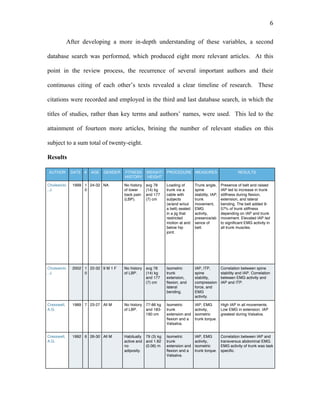
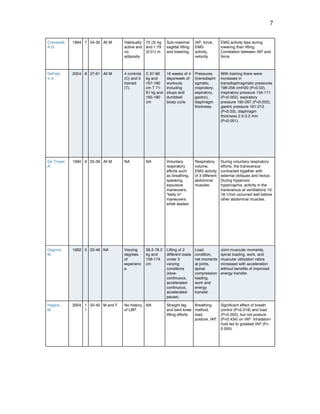
AUTHOR DATE # AGE GENDER FITNESS
HISTORY
WEIGHT/
HEIGHT
PROCEDURE MEASURES RESULTS
Cholewicki
, J.
1999 1
0
24-32 NA No history
of lower
back pain
(LBP).
avg 78
(14) kg
and 177
(7) cm
Loading of
trunk via a
cable with
subjects
(w/and w/out
a belt) seated
in a jig that
restricted
motion at and
below hip
joint.
Trunk angle,
spine
stability, IAP,
trunk
movement,
EMG
activity,
presence/ab
sence of
belt.
Presence of belt and raised
IAP led to increase in trunk
stiffness during flexion,
extension, and lateral
bending. The belt added 9-
57% of trunk stiffness
depending on IAP and trunk
movement. Elevated IAP led
to significant EMG activity in
all trunk muscles.
Cholewicki
, J.
2002 1
0
22-32 9 M 1 F No history
of LBP.
avg 78
(14) kg
and 177
(7) cm
Isometric
trunk
extension,
flexion, and
lateral
bending.
IAP, ITP,
spine
stability,
compression
force, and
EMG
activity.
Correlation between spine
stability and IAP. Correlation
between EMG activity and
IAP and ITP.
Cresswell,
A.G.
1989 7 23-27 All M No history
of LBP.
77-86 kg
and 183-
190 cm
Isometric
trunk
extension and
flexion and a
Valsalva.
IAP, EMG
activity,
isometric
trunk torque.
High IAP in all movements.
Low EMG in extension. IAP
greatest during Valsalva.
Cresswell,
A.G.
1992 6 26-30 All M Habitually
active and
no
adiposity.
79 (3) kg
and 1.82
(0.06) m
Isometric
trunk
extension and
flexion and a
Valsalva.
IAP, EMG
activity,
isometric
trunk torque.
Correlation between IAP and
transversus abdominal EMG.
EMG activity of trunk was task
specific.
  7	
  
Cresswell,
A.G.
1994 7 24-30 All M Habitually
active and
no
adiposity.
75 (3) kg
and 1.79
(0.01) m
Sub-maximal
sagittal lifting
and lowering.
IAP, force,
EMG
activity,
velocity.
EMG activity less during
lowering than lifting.
Correlation between IAP and
force.
DePalo,
V.A.
2004 8 27-61 All M 4 controls
(C) and 4
trained
(T).
C 67-86
kg and
167-180
cm T 71-
91 kg and
165-180
cm
16 weeks of 4
days/week of
workouts
including
situps and
dumbbell
bicep curls.
Pressures
(transdiaphr
agmatic,
inspiratory,
expiratory,
gastric),
diaphragm
thickness.
With training there were
increases in
transdiaphragmatic pressures
198-256 cmH20 (P<0.02),
inspiratory pressure 134-171
(P<0.002), expiratory
pressure 195-267 (P<0.002),
gastric pressure 161-212
(P<0.03), diaphragm
thickness 2.5-3.2 mm
(P<0.001).
De Troyer,
A.
1990 6 25-39 All M NA NA Voluntary
respiratory
efforts such
as breathing,
speaking,
expulsive
maneuvers,
"belly in"
maneuvers
while seated.
Respiratory
volume,
EMG activity
of 3 different
abdominal
muscles.
During voluntary respiratory
efforts, the transversus
contracted together with
external obliques and rectus.
During hyperoxic
hypercapnia, activity in the
transversus at ventilations 10-
18.1/min occurred well before
other abdominal muscles.
Gagnon,
M.
1992 5 23-46 NA Varying
degrees
of
experienc
e.
58.2-78.2
kg and
156-174
cm
Lifting of 2
different loads
under 3
varying
conditions
(slow-
continuous,
accelerated-
continuous,
accelerated-
pause).
Load,
condition,
net moments
at joints,
spinal
compression
loading,
work and
energy
transfer.
Joint muscular moments,
spinal loading, work, and
muscular utilization ratios
increased with acceleration
without benefits of improved
energy transfer.
Hagins,
M.
2004 1
1
20-40 M and F No history
of LBP.
NA Straight leg
and bent knee
lifting efforts.
Breathing
method,
load,
posture, IAP.
Significant effect of breath
control (P<0.018) and load
(P<0.002), but not posture
(P<0.434) on IAP. Inhalation-
hold led to greatest IAP (P<
0.000).
  8	
  
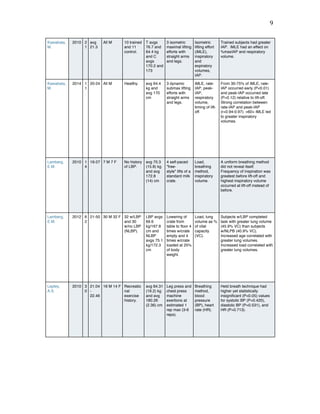
Hagins,
M.
2005 2
0
NA M and F No history
of LBP.
NA 9 lifts of a
standard
plastic milk
crate.
Load,
breathing
method,
inspiratory
volume.
Increase in inspiratory volume
prior to lift-off. Greater load
led to greater inspiratory
volume and more breath
holding.
Hagins,
M.
2006 3
3
20-40 13 M 20 F No history
of LBP
NA Maximal
isometric
trunk exertion
in knee bent
position.
IAP,
breathing
method,
force
production.
Breath control did not
significantly affect force
(P=0.089) but did affect IAP
(P=0.003). Low correlation
between IAP and force (r
=0.152-0.583).
Hodges,
P.W.
1996 3
0
20-40 16 M 14 F 15 w/LBP
and 15
control.
LBP 73.5
kg/174.1
cm and C
67.3
kg/173.3
cm
Shoulder
flexion,
abduction,
and
extension.
Direction of
movement
and EMG
activity.
Transversus abdominal was
the first muscle activated and
was not influenced by
direction. Subjects w/LBP had
delayed transversus
abdominal activity.
Hodges,
P.W.
1999 8 21-29 All M Habitually
active.
avg 78
(8) kg
and 1.82
(0.04) m
Bilateral
upper limb
flexion,
abduction,
extension.
Direction of
movement,
EMG
activity, IAP,
displacemen
t of centers
of pressure
and mass.
Small preparatory
displacement of trunk in
opposite direction of limb
movement. Superficial
muscles activated in response
to direction, deep abdominals
activated regardless of
direction.
Hodges,
P.W.
2003 1
1
0-1 NA Adolescen
t pigs (not
a human
study).
50-60 kg Intentional
intervertebral
displacement
of L4 via a
device and
electrical
stimulation of
phrenic
nerves.
IAP, EMG
activity,
intervertebra
l motion,
spinal
stiffness.
Increases in IAP via
diaphragm/abdominal
activation led to less
displacement of L3/4 and
increased stiffness of L4
during caudal displacement
(but not rostral).
Hodges,
P.W.
2005 3 30-44 NA Healthy. 58-87 kg
and 172-
187 cm
Tetanic
stimulation of
phrenic
nerves.
IAP and
spinal
stiffness.
Tetanic stimulation led to
increases in IAP (27-61% of
max) and spinal stiffness (8-
31% greater than at rest).
  9	
  
Kawabata,
M.
2010 2
1
avg
21.3
All M 10 trained
and 11
control.
T avgs
76.7 and
64.4 kg
and C
avgs
170.2 and
173
3 isometric
maximal lifting
efforts with
straight arms
and legs.
Isometric
lifting effort
(iMLE),
inspiratory
and
expiratory
volumes,
IAP.
Trained subjects had greater
IAP. iMLE had an effect on
%maxIAP and respiratory
volume.
Kawabata,
M.
2014 1
1
20-24 All M Healthy. avg 64.4
kg and
avg 170
cm
3 dynamic
submax lifting
efforts with
straight arms
and legs.
iMLE, rate-
IAP, peak-
IAP,
respiratory
volume,
timing of lift-
off.
From 30-75% of iMLE, rate-
IAP occurred early (P<0.01)
and peak-IAP occurred late
(P=0.12) relative to lift-off.
Strong correlation between
rate-IAP and peak-IAP
(r=0.94-0.97). >60+ iMLE led
to greater inspiratory
volumes.
Lamberg,
E.M.
2010 1
4
19-27 7 M 7 F No history
of LBP.
avg 70.3
(15.8) kg
and avg
172.8
(14) cm
4 self-paced
"free-
style" lifts of a
standard milk
crate.
Load,
breathing
method,
inspiratory
volume.
A uniform breathing method
did not reveal itself.
Frequency of inspiration was
greatest before lift-off and
highest inspiratory volume
occurred at lift-off instead of
before.
Lamberg,
E.M.
2012 6
2
21-50 30 M 32 F 32 w/LBP
and 30
w/no LBP
(NLBP).
LBP avgs
69.6
kg/167.8
cm and
NLBP
avgs 75.1
kg/172.3
cm
Lowering of
crate from
table to floor 4
times w/crate
empty and 4
times w/crate
loaded at 25%
of body
weight.
Load, lung
volume as %
of vital
capacity
(VC).
Subjects w/LBP completed
task with greater lung volume
(45.9% VC) than subjects
w/NLPB (40.9% VC).
Increased age correlated with
greater lung volumes.
Increased load correlated with
greater lung volumes.
Lepley,
A.S.
2010 3
0
21.04
-
22.46
16 M 14 F Recreatio
nal
exercise
history.
avg 84.31
(19.2) kg
and avg
180.26
(2.36) cm
Leg press and
chest press
machine
exertions at
estimated 1
rep max (3-6
reps).
Breathing
method,
blood
pressure
(BP), heart
rate (HR).
Held breath technique had
higher yet statistically
insignificant (P<0.05) values
for systolic BP (P=0.420),
diastolic BP (P=0.531), and
HR (P=0.713).
  10	
  
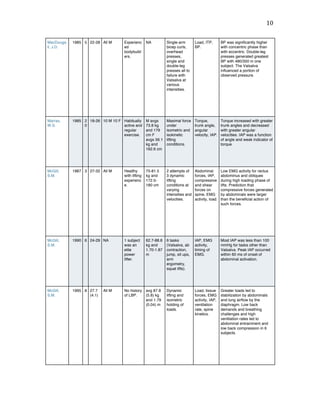
MacDouga
ll, J.D.
1985 5 22-28 All M Experienc
ed
bodybuild
ers.
NA Single-arm
bicep curls,
overhead
presses,
single and
double-leg
presses all to
failure with
Valsalva at
various
intensities.
Load, ITP,
BP.
BP was significantly higher
with concentric phase than
with eccentric. Double-leg
presses generated greatest
BP with 480/350 in one
subject. The Valsalva
influenced a portion of
observed pressure.
Marras,
W.S.
1985 2
0
18-26 10 M 10 F Habitually
active and
regular
exercise.
M avgs
73.8 kg
and 179
cm F
avgs 56.1
kg and
162.6 cm
Maximal force
under
isometric and
isokinetic
lifting
conditions.
Torque,
trunk angle,
angular
velocity, IAP.
Torque increased with greater
trunk angles and decreased
with greater angular
velocities. IAP was a function
of angle and weak indicator of
torque.
McGill,
S.M.
1987 3 27-32 All M Healthy
with lifting
experienc
e.
75-81.5
kg and
172.5-
180 cm
2 attempts of
3 dynamic
lifting
conditions at
varying
intensities and
velocities.
Abdominal
forces, IAP,
compressive
and shear
forces on
spine, EMG
activity, load.
Low EMG activity for rectus
abdominus and obliques
during high loading phase of
lifts. Prediction that
compressive forces generated
by abdominals were larger
than the beneficial action of
such forces.
McGill,
S.M.
1990 6 24-29 NA 1 subject
was an
elite
power
lifter.
62.7-88.6
kg and
1.70-1.87
m
6 tasks
(Valsalva, ab
contraction,
jump, sit ups,
arm
ergometry,
squat lifts).
IAP, EMG
activity,
timing of
EMG.
Most IAP was less than 100
mmHg for tasks other than
Valsalva. Peak IAP occurred
within 60 ms of onset of
abdominal activation.
McGill,
S.M.
1995 8 27.7
(4.1)
All M No history
of LBP.
avg 87.8
(5.8) kg
and 1.79
(0.04) m
Dynamic
lifting and
isometric
holding of
loads.
Load, tissue
forces, EMG
activity, IAP,
ventilation
rate, spine
kinetics.
Greater loads led to
stabilization by abdominals
and lung airflow by the
diaphragm. Low back
demands and breathing
challenges and high
ventilation rates led to
abdominal entrainment and
low back compression in 6
subjects.
  11	
  
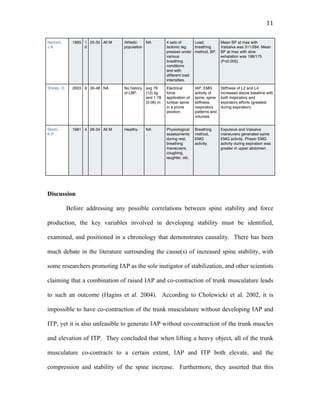
Narloch,
J.A.
1995 1
0
25-35 All M Athletic
population
.
NA 4 sets of
isotonic leg
presses under
various
breathing
conditions
and with
different load
intensities.
Load,
breathing
method, BP.
Mean BP at max with
Valsalva was 311/284. Mean
BP at max with slow
exhalation was 198/175
(P<0.005).
Shirley, D. 2003 8 30-48 NA No history
of LBP.
avg 76
(12) kg
and 1.78
(0.06) m
Electrical
force
application of
lumbar spine
in a prone
position.
IAP, EMG
activity of
spine, spine
stiffness,
respiratory
patterns and
volumes.
Stiffness of L2 and L4
increased above baseline with
both inspiratory and
expiratory efforts (greatest
during expiration).
Strohl,
K.P.
1981 4 26-34 All M Healthy. NA Physiological
assessments
during rest,
breathing
maneuvers,
coughing,
laughter, etc.
Breathing
method,
EMG
activity.
Expulsive and Valsalva
maneuvers generated same
EMG activity. Phasic EMG
activity during expiration was
greater in upper abdomen.
Discussion
Before addressing any possible correlations between spine stability and force
production, the key variables involved in developing stability must be identified,
examined, and positioned in a chronology that demonstrates causality. There has been
much debate in the literature surrounding the cause(s) of increased spine stability, with
some researchers promoting IAP as the sole instigator of stabilization, and other scientists
claiming that a combination of raised IAP and co-contraction of trunk musculature leads
to such an outcome (Hagins et al. 2004). According to Cholewicki et al. 2002, it is
impossible to have co-contraction of the trunk musculature without developing IAP and
ITP, yet it is also unfeasible to generate IAP without co-contraction of the trunk muscles
and elevation of ITP. They concluded that when lifting a heavy object, all of the trunk
musculature co-contracts to a certain extent, IAP and ITP both elevate, and the
compression and stability of the spine increase. Furthermore, they asserted that this
  12	
  
combination of trunk muscle co-activation and increased IAP has a significant and
positive effect on the biomechanics involved in weightlifting tasks.
IAP is generated by a series of physiological events in the body, the first and
foremost being respiration. During inhalation, the diaphragm lowers as the volume in the
thoracic cavity increases (raised ITP). Co-contraction of the abdominal musculature
causes an upward force to press against the descended diaphragm, which if held in place
can lead to an increase in IAP. Additionally, closing of the glottis, as during either the
Valsalva maneuver or the held breath technique (no forced exhalation), assists in
maintaining ITP by preventing air in the thoracic cavity from escaping. Therefore,
closing the glottis can passively assist the diaphragm in increasing IAP (Hagins et al.
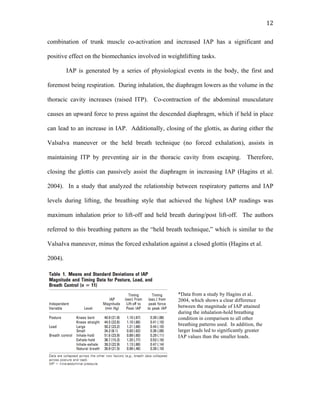
2004). In a study that analyzed the relationship between respiratory patterns and IAP
levels during lifting, the breathing style that achieved the highest IAP readings was
maximum inhalation prior to lift-off and held breath during/post lift-off. The authors
referred to this breathing pattern as the “held breath technique,” which is similar to the
Valsalva maneuver, minus the forced exhalation against a closed glottis (Hagins et al.
2004).
*Data from a study by Hagins et al.
2004, which shows a clear difference
between the magnitude of IAP attained
during the inhalation-hold breathing
condition in comparison to all other
breathing patterns used. In addition, the
larger loads led to significantly greater
IAP values than the smaller loads.
  13	
  
The volume of inspired air (Vi), in addition to its containment (as just described),
plays a significant role in the development of IAP. Some researchers suggest that there is
a connection between the magnitude of load and inspiratory volume. In a study focusing
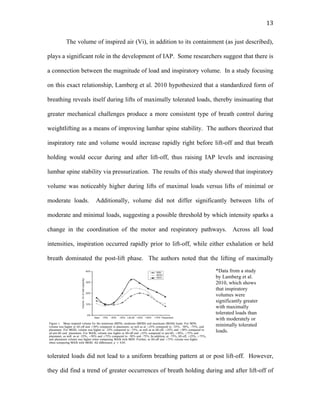
on this exact relationship, Lamberg et al. 2010 hypothesized that a standardized form of
breathing reveals itself during lifts of maximally tolerated loads, thereby insinuating that
greater mechanical challenges produce a more consistent type of breath control during
weightlifting as a means of improving lumbar spine stability. The authors theorized that
inspiratory rate and volume would increase rapidly right before lift-off and that breath
holding would occur during and after lift-off, thus raising IAP levels and increasing
lumbar spine stability via pressurization. The results of this study showed that inspiratory
volume was noticeably higher during lifts of maximal loads versus lifts of minimal or
moderate loads. Additionally, volume did not differ significantly between lifts of
moderate and minimal loads, suggesting a possible threshold by which intensity sparks a
change in the coordination of the motor and respiratory pathways. Across all load
intensities, inspiration occurred rapidly prior to lift-off, while either exhalation or held
breath dominated the post-lift phase. The authors noted that the lifting of maximally
tolerated loads did not lead to a uniform breathing pattern at or post lift-off. However,
they did find a trend of greater occurrences of breath holding during and after lift-off of
*Data from a study
by Lamberg et al.
2010, which shows
that inspiratory
volumes were
significantly greater
with maximally
tolerated loads than
with moderately or
minimally tolerated
loads.
  14	
  
maximally tolerated loads, which did achieve statistical significance. These findings
support a previous study by Hagins et al. 2005 that showed increases in both frequency
and volume of inspiration during the pre-lift period. The greater the load (heavy and
medium weights) the more frequent breath holding occurred at/post lift-off. In addition,
subjects tended to hold their breath more consistently when managing heavier loads.
Shirley et al. (2003) found increases in lumbar stiffness when lung volumes were
greater than tidal volume (Vt). In this study, the authors found inspired volumes to be
greater than tidal volume (500 mL) across all load intensities (minimal 650 mL, moderate
819 mL, and maximal 1143 mL). The findings from both of these studies suggest that
enhancing the amount of inspired air prior to lift-off is a consistent pattern of breath
control during weightlifting, across all load types (with a trend of greater volumes with
greater load intensities). The influence of motor control on breathing appears to be
optimized for the greatest compressive and shear forces, which exist during the first 0.2-
0.4 seconds of a lift (Gagnon et al. 1991).
When considering client programming, personal trainers are continuously
reminded to promote exercises that are both effective and safe. In regards to IAP, many
exercise physiologists consider the Valsalva maneuver to be contraindicated due to the
immense strain that it places on the cardiovascular system (Narloch et al. 1995). Lepley
et al. 2010 hypothesized that employment of a held breath technique during chest and leg
pressing would result in similarly dangerous blood pressure levels as the Valsalva
maneuver. Their study, however, showed that although breath holding led to a slight
increase in blood pressure (systolic 157.9/diastolic 93.1), this increase was not
significantly greater than the blood pressure achieved via controlled breathing (systolic
  15	
  
142.4/diastolic 88.2). These data reinforce that the held breath technique is not only an
effective method of developing IAP, it is a safe breathing pattern for weightlifting
exercise.
In accordance with the notion that co-activation of trunk musculature aids IAP in
improving spine stability, Cresswell et al. 1992 conducted a study focusing on the
interaction between IAP and the abdomen, in which they inserted bilateral intra-muscular
electrodes and monitored the muscular activity using ultrasound equipment. The primary
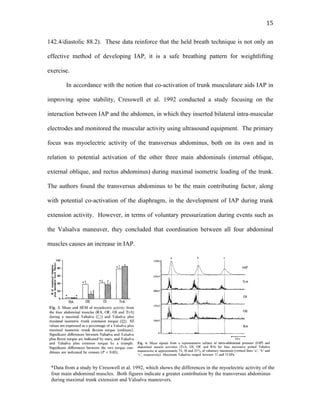
focus was myoelectric activity of the transversus abdominus, both on its own and in
relation to potential activation of the other three main abdominals (internal oblique,
external oblique, and rectus abdominus) during maximal isometric loading of the trunk.
The authors found the transversus abdominus to be the main contributing factor, along
with potential co-activation of the diaphragm, in the development of IAP during trunk
extension activity. However, in terms of voluntary pressurization during events such as
the Valsalva maneuver, they concluded that coordination between all four abdominal
muscles causes an increase in IAP.
*Data from a study by Cresswell et al. 1992, which shows the differences in the myoelectric activity of the
four main abdominal muscles. Both figures indicate a greater contribution by the transversus abdominus
during maximal trunk extension and Valsalva maneuvers.
  16	
  
The transversus abdominus plays an important role in IAP development; however,
there have also been documented increases in the electromyographic activities of the
other abdominals, as well as the erector spinae and latissimus dorsi muscles, in
connection with elevated IAP levels during isometric trunk loading (Cholewicki et al.
1999). The coordination of these six key trunk muscles increases both the stiffness of the
torso and the overall stability of the lumbar spine. In a 1999 study, Cholewicki et al.
found that during preparation for high-intensity physical actions such as lifting,
contraction of the abdomen and back musculature stiffened both the lumbar spine and the
thoracic cage (thoracic vertebrae and ribcage). This finding has functional significance in
regards to weightlifting since numerous trunk and upper limb muscles originate from the
thorax. The rigidity of this region therefore plays an important role in supporting the
actions of the joints and musculature used during upper body weightlifting. Additionally,
the authors assert that a greater mechanical advantage for the abdominal wall muscles,
particularly the transversus abdominus and obliques, can be attained when they contract
around a pressurized abdominal cavity, which supports the notion that raised IAP offers
biomechanical benefits during lifting.
Evidence from these and several other studies helps to develop causal links
between breathing patterns, IAP levels, trunk muscle activity, and spine stability. The
held breath technique described earlier in this review appears to be the most safe and
effective respiratory pattern for weightlifting tasks. Although the bonds between these
variables have been identified and substantiated, there remains a shortage of data
connecting them to force production. One central study focusing on potential
correlations between breathing patterns, IAP, and force production was conducted by
  17	
  
Hagins et al. 2006. The authors used a single independent variable, breathing pattern, to
influence two outcome variables, IAP level and force production, during a maximal
isometric trunk extension effort in a knee bent posture. The three types of breathing
patterns employed in this study were maximum inhalation prior to lift-off combined with
breath holding (held breath technique), maximum exhalation prior to lift-off combined
with breath holding, and maximum inhalation prior to lift-off combined with steady
exhalation during the exertion phase. The effects of breathing style on maximum force
production were low (P = 0.089); however, the results suggest some differences in the
magnitude of force between the various breath conditions (~4kg).
The authors argued that although such a small difference may not have vast
significance in the general population, it could potentially have functional relevance in
elite weightlifting populations. In addition, the authors mentioned several cautions
regarding both the design and real world applicability of their experiment. Due to the
invasive nature of IAP measurement (via a nasogastric tube), only eleven of the thirty-
three subjects were monitored for IAP. The lack of concrete data regarding IAP on two-
#Diagrams and data from a study by Hagins et al. 2006. The diagram illustrates the physical parameters
of the experiment. The data shows that although inhalation-hold breathing led to the greatest IAP
value, it also resulted in the lowest magnitude of force production.
  18	
  
thirds of the subject population weakens the conclusions drawn by this study. As for the
physical parameters of the experiment, the employment of an isometric trunk exertion,
rather than a dynamic lifting task, reduces the significance of these findings in real world
weightlifting settings. At the end of their study, the authors explicitly stated, “Future
research should use methods which examine more functional dynamic lifting tasks in
order to determine if there is a link between breath control, IAP, and force production.”
(Hagins et al. 2006, page 779)
Conclusion
There is a wealth of data from the past three decades connecting breathing
patterns, IAP, and spine stability, with the held breath technique consistently championed
as the most safe and effective method of developing both IAP and spine stability. Co-
contraction of key trunk muscles (the transversus abdominus, external and internal
obliques, rectus abdominus, erector spinae, and latissimus dorsi) aids significantly in
elevating IAP values. There is, however, a lack of research focusing on the relationship
between IAP, spine stability, and force production. Of the studies that do examine this
association, several design flaws (mainly the employment of an isometric exertion and
the lack of data regarding IAP) undermine the applicability of the conclusions. Appendix
A* contains a list of key recommendations for future studies, many of which focus on the
design and physical testing elements of experimentation.
*Appendix A
1) Ensure that every subject is measured for IAP (either using a nasogastric or rectal
pressure transducer), EMG activity (on key areas of the trunk), and force production (via
a force transducer and load cell).
  19	
  
2) Test subjects using dynamic lifts rather than isometric lifts. Several studies
mentioned both velocity and trunk angle as key variables, and so dynamic movements
may produce vastly different results.
3) If using dynamic lifts, test the subjects on several primary multi-joint
weightlifting exercises (bench press, deadlift, lat pull down, overhead press, seated row,
and back squat) to better reflect a typical personal training environment.
4) It is possible that increased IAP and spine stability may only assist force
production during certain set/rep schemes. The majority of the research has utilized one
repetition (with multiple attempts); however, most individuals (including athletes)
execute several repetitions during weightlifting exercise. Future studies might benefit
from dividing subjects by set/rep categories for power, strength, hypertrophy, and
muscular endurance.
References
1) Cholewicki, J., Juluru, K., Radebold, A., Panjabi, M. M., & McGill, S. M. (1999). Lumbar spine stability
can be augmented with an abdominal belt and/or increased intra-abdominal pressure. European Spine
Journal, 8(5), 388-395.
2) Cholewicki, J., Ivancic, P. C., & Radebold, A. (2002). Can increased intra-abdominal pressure in
humans be decoupled from trunk muscle co-contraction during steady state isometric exertions?. European
journal of applied physiology, 87(2), 127-133.
3) Cresswell, A. G., & Thorstensson, A. (1989). The role of the abdominal musculature in the elevation of
the intra-abdominal pressure during specified tasks. Ergonomics, 32(10), 1237-1246.
4) Cresswell, A. G., Grundström, H., & Thorstensson, A. (1992). Observations on intra‐abdominal pressure
and patterns of abdominal intra‐muscular activity in man. Acta Physiologica Scandinavica, 144(4), 409-
418.
5) Cresswell, A. G., & Thorstensson, A. (1994). Changes in intra-abdominal pressure, trunk muscle
activation and force during isokinetic lifting and lowering. European journal of applied physiology and
occupational physiology, 68(4), 315-321.
6) DePalo, V. A., Parker, A. L., Al-Bilbeisi, F., & McCool, F. D. (2004). Respiratory muscle strength
training with nonrespiratory maneuvers. Journal of Applied Physiology, 96(2), 731-734.
7) De Troyer, A., Estenne, M., Ninane, V., Van Gansbeke, D., & Gorini, M. (1990). Transversus abdominis
muscle function in humans. Journal of Applied Physiology, 68(3), 1010-1016.
8) Gagnon, M., & Smyth, G. (1992). Biomechanical exploration on dynamic modes of lifting. Ergonomics,
35(3), 329-345.
9) Hagins, M., Pietrek, M., Sheikhzadeh, A., Nordin, M., & Axen, K. (2004). The effects of breath control
on intra-abdominal pressure during lifting tasks. Spine, 29(4), 464-469.
10) Hagins, M., & Lamberg, E. M. (2005). Natural breath control during lifting tasks: effect of load.
European journal of applied physiology, 96(4), 453-458.
  20	
  
11) Hagins, M., Pietrek, M., Sheikhzadeh, A., & Nordin, M. (2006). The effects of breath control on
maximum force and IAP during a maximum isometric lifting task. Clinical Biomechanics, 21(8), 775-780.
12) Hodges, P. W., & Richardson, C. A. (1996). Inefficient muscular stabilization of the lumbar spine
associated with low back pain: a motor control evaluation of transversus abdominis. Spine, 21(22), 2640-
2650.
13) Hodges, P., Cresswell, A., & Thorstensson, A. (1999). Preparatory trunk motion accompanies rapid
upper limb movement. Experimental Brain Research, 124(1), 69-79.
14) Hodges, P., Holm, A. K., Holm, S., Ekström, L., Cresswell, A., Hansson, T., & Thorstensson, A.
(2003). Intervertebral stiffness of the spine is increased by evoked contraction of transversus abdominis and
the diaphragm: in vivo porcine studies. Spine, 28(23), 2594-2601.
15) Hodges, P. W., Eriksson, A. M., Shirley, D., & Gandevia, S. C. (2005). Intra-abdominal pressure
increases stiffness of the lumbar spine. Journal of biomechanics, 38(9), 1873-1880.
16) Kawabata, M., Shima, N., Hamada, H., Nakamura, I., & Nishizono, H. (2010). Changes in intra-
abdominal pressure and spontaneous breath volume by magnitude of lifting effort: highly trained athletes
versus healthy men. European journal of applied physiology, 109(2), 279-286.
17) Kawabata, M., Shima, N., & Nishizono, H. (2014). Regular change in spontaneous preparative
behaviour on intra-abdominal pressure and breathing during dynamic lifting. European journal of applied
physiology, 114(11), 2233-2239.
18) Lamberg, E. M., & Hagins, M. (2010). Breath control during manual free-style lifting of a maximally
tolerated load. Ergonomics, 53(3), 385-392.
19) Lamberg, E. M., & Hagins, M. (2012). The effects of low back pain on natural breath control during a
lowering task. European journal of applied physiology, 112(10), 3519-3524.
20) Lepley, A. S., & Hatzel, B. M. (2010). Effects of weightlifting and breathing technique on blood
pressure and heart rate. The Journal of Strength & Conditioning Research, 24(8), 2179-2183.
21) MacDougall, J. D., Tuxen, D. S. D. G., Sale, D. G., Moroz, J. R., & Sutton, J. R. (1985). Arterial blood
pressure response to heavy resistance exercise. Journal of Applied Physiology, 58(3), 785-790.
22) Marras, W. S., Joynt, R. L., & King, A. I. (1985). The force-velocity relation and intra-abdominal
pressure during lifting activities. Ergonomics, 28(3), 603-613.
23) McGill, S. M., and Robert W. Norman. "Reassessment of the role of intra-abdominal pressure in spinal
compression." Ergonomics 30.11 (1987): 1565-1588.
24) McGill, S. M., & Sharratt, M. T. (1990). Relationship between intra-abdominal pressure and trunk
EMG. Clinical Biomechanics, 5(2), 59-67.
25) McGill, S. M., Sharratt, M. T., & Seguin, J. P. (1995). Loads on spinal tissues during simultaneous
li6ting and ventilatory challenge. Ergonomics, 38(9), 1772-1792.
26) Narloch, J. A., & Brandstater, M. E. (1995). Influence of breathing technique on arterial blood pressure
d7ring heavy weight lifting. Archives of physical medicine and rehabilitation, 76(5), 457-462.
27) Shirley, D., Hodges, P. W., Eriksson, A. E. M., & Gandevia, S. C. (2003). Spinal stiffness changes
throughout the respiratory cycle. Journal of applied Physiology, 95(4), 1467-1475.
28) Strohl, K. P., Mead, J., Banzett, R. B., Loring, S. H., & Kosch, P. C. (1981). Regional differences in
abdominal muscle activity during various maneuvers in humans. Journal of Applied Physiology, 51(6),
1471-1476.

DAVID JANETT MA THESIS FINAL DRAFT PDF

  • 1.
    Breathe in and…breatheout? An investigation into the causal relationship between intra- abdominal pressure, spine stability, and force production during weightlifting exercise. A literature review by David Janett, Masters degree candidate in the applied physiology program at Teachers College, Columbia University, New York, NY, April 2016.
  • 2.
      2   Abstract Trainersplay an integral role in the development and implementation of exercise programs across numerous populations, ranging from rehabilitation patients to elite athletes. Although copious medical and scientific texts provide specific protocols regarding several elements of resistance training, including volume and intensity recommendations, none of them offer clear guidelines for breathing technique (Lamberg et al. 2010). It is hypothesized that raising intra-abdominal pressure (IAP), via a held breath technique (not a true Valsalva maneuver), along with co-activation of certain trunk musculature leads to an increase in lumbar spine stability, which in turn allows for gains in force production during dynamic weightlifting. Research on this topic began with an initial search on the Web of Science and PubMed databases. Key terms included breathing, weightlifting, resistance training, and force production. The primary variables involved were intra-abdominal pressure (IAP), intra-thoracic pressure (ITP), the Valsalva maneuver, respiratory volumes (Vr), trunk muscle activation, and lumbar spine stability. Exclusion criteria were minimal, save for subjects with injuries or existing pathologies. The sum total of articles came to twenty-eight. There was significant research connecting breathing patterns, IAP, and spine stability; and the held breath technique was consistently championed as the most safe and effective method of developing both IAP and spine stability. Co-contraction of key trunk muscles (particularly the transversus abdominus, external and internal obliques, rectus abdominus, erector spinae, and latissimus dorsi) appeared to contribute significantly to the development of IAP. There was, however, a lack of research focusing on the relationship between IAP, spine stability, and force production. Of the studies that did examine this association, several
  • 3.
      3   designflaws (mainly the employment of an isometric exertion and the lack of data regarding IAP) undermined the applicability of the results. It is recommended that future research focusing on IAP, spine stability, and force production be performed so that stronger and more relevant conclusions can be made. Key terms Intra-abdominal pressure (IAP) – The degree of pressure in the abdominal cavity. Intra-thoracic pressure (ITP) – The degree of pressure in the thoracic cavity. Valsalva maneuver – A breathing pattern in which an individual inhales air and then forcibly exhales air against a closed glottis. Electromyography (EMG) – A method of measuring the electrical activity of skeletal muscle. Inspiratory volume (Vi) – The amount of inspired air during inhalation. Expiratory volume (Ve) – The amount of expired air during exhalation. Tidal volume (Vt) – The amount of air passing through the lungs during quiet breathing. Spine stability – The body’s ability to resist spinal column posture aberrations. Force production – The degree of physical force produced by an event or action. Isometric exercise – Resistance exercise in which muscular contraction occurs and the joint angle and muscle length do not change. Dynamic exercise – Resistance exercise in which muscular contraction occurs and both the joint angle and muscle length change. Concentric contraction – A contraction in which the muscle shortens and generates force. Eccentric contraction – A contraction in which the muscle faces resistance but is forced to lengthen.
  • 4.
      4   Introduction Thisliterature review is aimed towards fitness professionals and is intended to demystify the variable of breath control as it relates to performance during resistance training. Trainers play an integral role in the development and implementation of exercise programs across numerous populations, ranging from rehabilitation patients to elite athletes. In accordance with their certifications, they are expected to maintain knowledge of current fitness industry trends and deliver safe and effective workouts to their clients. There are numerous accredited fitness organizations in the United States and all of them produce materials with up to date information on the many aspects of personal training, such as cardiovascular programming and body composition measurement. Although copious medical and scientific texts provide specific protocols regarding several elements of resistance training, including volume and intensity recommendations, none of them offer clear guidelines for breathing technique (Lamberg et al. 2010). The dearth of data focusing on proper breath control leads both trainers and untrained exercisers to refer to non-medical sources, often anecdotal evidence provided via the Internet. These sources generally suggest inhaling during the eccentric contraction and exhaling during the concentric contraction, with a brief moment of breath holding at lift-off in an attempt to improve lumbar stability and thereby increase force production (Lamberg et al. 2010). However, many powerlifters prefer to hold their breath throughout the entirety of a lift in order to maximize force production. Unfortunately, these contrasting recommendations are merely theoretical and potentially dangerous, and the scientific data regarding possible correlations between breathing patterns and force production remain scarce to nonexistent. In order to develop
  • 5.
      5   acorrelation between breath control and force production, information on the many variables involved must be organized so that a causal pathway can be established. Although the outcome variable is clearly force production, the independent variables and steps manipulating this outcome are not only numerous, they are intertwined chronologically, making a detailed investigation of this subject even more essential. It is hypothesized that raising intra-abdominal pressure (IAP), via a held breath technique (not a true Valsalva maneuver), along with co-activation of certain trunk musculature leads to an increase in lumbar spine stability, which in turn allows for gains in force production during dynamic weightlifting. In this literature review, the anatomical, physiological, and biomechanical factors of breathing and weightlifting will be discussed and suggestions for further exploration of this topic will be offered. Methods Research on this topic began with an initial search on the Web of Science and PubMed databases. Key terms included breathing, weightlifting, resistance training, and force production. This led to the acquisition of six articles, all of which helped to steer the review by highlighting the primary variables involved: intra-abdominal pressure (IAP), intra-thoracic pressure (ITP), the Valsalva maneuver, respiratory volumes (Vr), trunk muscle activation, and lumbar spine stability. The exclusion criteria were minimal due to the non-epidemiological nature of this topic, and so articles dating back as far as 1980 were accepted. In addition, the inclusion standards of most experiments were fairly liberal, with the primary discounting factor being some type of previous injury or existing pathology. Researchers in this area of exercise science seem to welcome both generally healthy and elite athletic populations into their studies.
  • 6.
      6   Afterdeveloping a more in-depth understanding of these variables, a second database search was performed, which produced eight more relevant articles. At this point in the review process, the recurrence of several important authors and their continuous citing of each other’s texts revealed a clear timeline of research. These citations were recorded and employed in the third and last database search, in which the titles of studies, rather than key terms and authors’ names, were used. This led to the attainment of fourteen more articles, brining the number of relevant studies on this subject to a sum total of twenty-eight. Results AUTHOR DATE # AGE GENDER FITNESS HISTORY WEIGHT/ HEIGHT PROCEDURE MEASURES RESULTS Cholewicki , J. 1999 1 0 24-32 NA No history of lower back pain (LBP). avg 78 (14) kg and 177 (7) cm Loading of trunk via a cable with subjects (w/and w/out a belt) seated in a jig that restricted motion at and below hip joint. Trunk angle, spine stability, IAP, trunk movement, EMG activity, presence/ab sence of belt. Presence of belt and raised IAP led to increase in trunk stiffness during flexion, extension, and lateral bending. The belt added 9- 57% of trunk stiffness depending on IAP and trunk movement. Elevated IAP led to significant EMG activity in all trunk muscles. Cholewicki , J. 2002 1 0 22-32 9 M 1 F No history of LBP. avg 78 (14) kg and 177 (7) cm Isometric trunk extension, flexion, and lateral bending. IAP, ITP, spine stability, compression force, and EMG activity. Correlation between spine stability and IAP. Correlation between EMG activity and IAP and ITP. Cresswell, A.G. 1989 7 23-27 All M No history of LBP. 77-86 kg and 183- 190 cm Isometric trunk extension and flexion and a Valsalva. IAP, EMG activity, isometric trunk torque. High IAP in all movements. Low EMG in extension. IAP greatest during Valsalva. Cresswell, A.G. 1992 6 26-30 All M Habitually active and no adiposity. 79 (3) kg and 1.82 (0.06) m Isometric trunk extension and flexion and a Valsalva. IAP, EMG activity, isometric trunk torque. Correlation between IAP and transversus abdominal EMG. EMG activity of trunk was task specific.
  • 7.
      7   Cresswell, A.G. 19947 24-30 All M Habitually active and no adiposity. 75 (3) kg and 1.79 (0.01) m Sub-maximal sagittal lifting and lowering. IAP, force, EMG activity, velocity. EMG activity less during lowering than lifting. Correlation between IAP and force. DePalo, V.A. 2004 8 27-61 All M 4 controls (C) and 4 trained (T). C 67-86 kg and 167-180 cm T 71- 91 kg and 165-180 cm 16 weeks of 4 days/week of workouts including situps and dumbbell bicep curls. Pressures (transdiaphr agmatic, inspiratory, expiratory, gastric), diaphragm thickness. With training there were increases in transdiaphragmatic pressures 198-256 cmH20 (P<0.02), inspiratory pressure 134-171 (P<0.002), expiratory pressure 195-267 (P<0.002), gastric pressure 161-212 (P<0.03), diaphragm thickness 2.5-3.2 mm (P<0.001). De Troyer, A. 1990 6 25-39 All M NA NA Voluntary respiratory efforts such as breathing, speaking, expulsive maneuvers, "belly in" maneuvers while seated. Respiratory volume, EMG activity of 3 different abdominal muscles. During voluntary respiratory efforts, the transversus contracted together with external obliques and rectus. During hyperoxic hypercapnia, activity in the transversus at ventilations 10- 18.1/min occurred well before other abdominal muscles. Gagnon, M. 1992 5 23-46 NA Varying degrees of experienc e. 58.2-78.2 kg and 156-174 cm Lifting of 2 different loads under 3 varying conditions (slow- continuous, accelerated- continuous, accelerated- pause). Load, condition, net moments at joints, spinal compression loading, work and energy transfer. Joint muscular moments, spinal loading, work, and muscular utilization ratios increased with acceleration without benefits of improved energy transfer. Hagins, M. 2004 1 1 20-40 M and F No history of LBP. NA Straight leg and bent knee lifting efforts. Breathing method, load, posture, IAP. Significant effect of breath control (P<0.018) and load (P<0.002), but not posture (P<0.434) on IAP. Inhalation- hold led to greatest IAP (P< 0.000).
  • 8.
      8   Hagins, M. 20052 0 NA M and F No history of LBP. NA 9 lifts of a standard plastic milk crate. Load, breathing method, inspiratory volume. Increase in inspiratory volume prior to lift-off. Greater load led to greater inspiratory volume and more breath holding. Hagins, M. 2006 3 3 20-40 13 M 20 F No history of LBP NA Maximal isometric trunk exertion in knee bent position. IAP, breathing method, force production. Breath control did not significantly affect force (P=0.089) but did affect IAP (P=0.003). Low correlation between IAP and force (r =0.152-0.583). Hodges, P.W. 1996 3 0 20-40 16 M 14 F 15 w/LBP and 15 control. LBP 73.5 kg/174.1 cm and C 67.3 kg/173.3 cm Shoulder flexion, abduction, and extension. Direction of movement and EMG activity. Transversus abdominal was the first muscle activated and was not influenced by direction. Subjects w/LBP had delayed transversus abdominal activity. Hodges, P.W. 1999 8 21-29 All M Habitually active. avg 78 (8) kg and 1.82 (0.04) m Bilateral upper limb flexion, abduction, extension. Direction of movement, EMG activity, IAP, displacemen t of centers of pressure and mass. Small preparatory displacement of trunk in opposite direction of limb movement. Superficial muscles activated in response to direction, deep abdominals activated regardless of direction. Hodges, P.W. 2003 1 1 0-1 NA Adolescen t pigs (not a human study). 50-60 kg Intentional intervertebral displacement of L4 via a device and electrical stimulation of phrenic nerves. IAP, EMG activity, intervertebra l motion, spinal stiffness. Increases in IAP via diaphragm/abdominal activation led to less displacement of L3/4 and increased stiffness of L4 during caudal displacement (but not rostral). Hodges, P.W. 2005 3 30-44 NA Healthy. 58-87 kg and 172- 187 cm Tetanic stimulation of phrenic nerves. IAP and spinal stiffness. Tetanic stimulation led to increases in IAP (27-61% of max) and spinal stiffness (8- 31% greater than at rest).
  • 9.
      9   Kawabata, M. 20102 1 avg 21.3 All M 10 trained and 11 control. T avgs 76.7 and 64.4 kg and C avgs 170.2 and 173 3 isometric maximal lifting efforts with straight arms and legs. Isometric lifting effort (iMLE), inspiratory and expiratory volumes, IAP. Trained subjects had greater IAP. iMLE had an effect on %maxIAP and respiratory volume. Kawabata, M. 2014 1 1 20-24 All M Healthy. avg 64.4 kg and avg 170 cm 3 dynamic submax lifting efforts with straight arms and legs. iMLE, rate- IAP, peak- IAP, respiratory volume, timing of lift- off. From 30-75% of iMLE, rate- IAP occurred early (P<0.01) and peak-IAP occurred late (P=0.12) relative to lift-off. Strong correlation between rate-IAP and peak-IAP (r=0.94-0.97). >60+ iMLE led to greater inspiratory volumes. Lamberg, E.M. 2010 1 4 19-27 7 M 7 F No history of LBP. avg 70.3 (15.8) kg and avg 172.8 (14) cm 4 self-paced "free- style" lifts of a standard milk crate. Load, breathing method, inspiratory volume. A uniform breathing method did not reveal itself. Frequency of inspiration was greatest before lift-off and highest inspiratory volume occurred at lift-off instead of before. Lamberg, E.M. 2012 6 2 21-50 30 M 32 F 32 w/LBP and 30 w/no LBP (NLBP). LBP avgs 69.6 kg/167.8 cm and NLBP avgs 75.1 kg/172.3 cm Lowering of crate from table to floor 4 times w/crate empty and 4 times w/crate loaded at 25% of body weight. Load, lung volume as % of vital capacity (VC). Subjects w/LBP completed task with greater lung volume (45.9% VC) than subjects w/NLPB (40.9% VC). Increased age correlated with greater lung volumes. Increased load correlated with greater lung volumes. Lepley, A.S. 2010 3 0 21.04 - 22.46 16 M 14 F Recreatio nal exercise history. avg 84.31 (19.2) kg and avg 180.26 (2.36) cm Leg press and chest press machine exertions at estimated 1 rep max (3-6 reps). Breathing method, blood pressure (BP), heart rate (HR). Held breath technique had higher yet statistically insignificant (P<0.05) values for systolic BP (P=0.420), diastolic BP (P=0.531), and HR (P=0.713).
  • 10.
      10   MacDouga ll,J.D. 1985 5 22-28 All M Experienc ed bodybuild ers. NA Single-arm bicep curls, overhead presses, single and double-leg presses all to failure with Valsalva at various intensities. Load, ITP, BP. BP was significantly higher with concentric phase than with eccentric. Double-leg presses generated greatest BP with 480/350 in one subject. The Valsalva influenced a portion of observed pressure. Marras, W.S. 1985 2 0 18-26 10 M 10 F Habitually active and regular exercise. M avgs 73.8 kg and 179 cm F avgs 56.1 kg and 162.6 cm Maximal force under isometric and isokinetic lifting conditions. Torque, trunk angle, angular velocity, IAP. Torque increased with greater trunk angles and decreased with greater angular velocities. IAP was a function of angle and weak indicator of torque. McGill, S.M. 1987 3 27-32 All M Healthy with lifting experienc e. 75-81.5 kg and 172.5- 180 cm 2 attempts of 3 dynamic lifting conditions at varying intensities and velocities. Abdominal forces, IAP, compressive and shear forces on spine, EMG activity, load. Low EMG activity for rectus abdominus and obliques during high loading phase of lifts. Prediction that compressive forces generated by abdominals were larger than the beneficial action of such forces. McGill, S.M. 1990 6 24-29 NA 1 subject was an elite power lifter. 62.7-88.6 kg and 1.70-1.87 m 6 tasks (Valsalva, ab contraction, jump, sit ups, arm ergometry, squat lifts). IAP, EMG activity, timing of EMG. Most IAP was less than 100 mmHg for tasks other than Valsalva. Peak IAP occurred within 60 ms of onset of abdominal activation. McGill, S.M. 1995 8 27.7 (4.1) All M No history of LBP. avg 87.8 (5.8) kg and 1.79 (0.04) m Dynamic lifting and isometric holding of loads. Load, tissue forces, EMG activity, IAP, ventilation rate, spine kinetics. Greater loads led to stabilization by abdominals and lung airflow by the diaphragm. Low back demands and breathing challenges and high ventilation rates led to abdominal entrainment and low back compression in 6 subjects.
  • 11.
      11   Narloch, J.A. 19951 0 25-35 All M Athletic population . NA 4 sets of isotonic leg presses under various breathing conditions and with different load intensities. Load, breathing method, BP. Mean BP at max with Valsalva was 311/284. Mean BP at max with slow exhalation was 198/175 (P<0.005). Shirley, D. 2003 8 30-48 NA No history of LBP. avg 76 (12) kg and 1.78 (0.06) m Electrical force application of lumbar spine in a prone position. IAP, EMG activity of spine, spine stiffness, respiratory patterns and volumes. Stiffness of L2 and L4 increased above baseline with both inspiratory and expiratory efforts (greatest during expiration). Strohl, K.P. 1981 4 26-34 All M Healthy. NA Physiological assessments during rest, breathing maneuvers, coughing, laughter, etc. Breathing method, EMG activity. Expulsive and Valsalva maneuvers generated same EMG activity. Phasic EMG activity during expiration was greater in upper abdomen. Discussion Before addressing any possible correlations between spine stability and force production, the key variables involved in developing stability must be identified, examined, and positioned in a chronology that demonstrates causality. There has been much debate in the literature surrounding the cause(s) of increased spine stability, with some researchers promoting IAP as the sole instigator of stabilization, and other scientists claiming that a combination of raised IAP and co-contraction of trunk musculature leads to such an outcome (Hagins et al. 2004). According to Cholewicki et al. 2002, it is impossible to have co-contraction of the trunk musculature without developing IAP and ITP, yet it is also unfeasible to generate IAP without co-contraction of the trunk muscles and elevation of ITP. They concluded that when lifting a heavy object, all of the trunk musculature co-contracts to a certain extent, IAP and ITP both elevate, and the compression and stability of the spine increase. Furthermore, they asserted that this
  • 12.
      12   combinationof trunk muscle co-activation and increased IAP has a significant and positive effect on the biomechanics involved in weightlifting tasks. IAP is generated by a series of physiological events in the body, the first and foremost being respiration. During inhalation, the diaphragm lowers as the volume in the thoracic cavity increases (raised ITP). Co-contraction of the abdominal musculature causes an upward force to press against the descended diaphragm, which if held in place can lead to an increase in IAP. Additionally, closing of the glottis, as during either the Valsalva maneuver or the held breath technique (no forced exhalation), assists in maintaining ITP by preventing air in the thoracic cavity from escaping. Therefore, closing the glottis can passively assist the diaphragm in increasing IAP (Hagins et al. 2004). In a study that analyzed the relationship between respiratory patterns and IAP levels during lifting, the breathing style that achieved the highest IAP readings was maximum inhalation prior to lift-off and held breath during/post lift-off. The authors referred to this breathing pattern as the “held breath technique,” which is similar to the Valsalva maneuver, minus the forced exhalation against a closed glottis (Hagins et al. 2004). *Data from a study by Hagins et al. 2004, which shows a clear difference between the magnitude of IAP attained during the inhalation-hold breathing condition in comparison to all other breathing patterns used. In addition, the larger loads led to significantly greater IAP values than the smaller loads.
  • 13.
      13   Thevolume of inspired air (Vi), in addition to its containment (as just described), plays a significant role in the development of IAP. Some researchers suggest that there is a connection between the magnitude of load and inspiratory volume. In a study focusing on this exact relationship, Lamberg et al. 2010 hypothesized that a standardized form of breathing reveals itself during lifts of maximally tolerated loads, thereby insinuating that greater mechanical challenges produce a more consistent type of breath control during weightlifting as a means of improving lumbar spine stability. The authors theorized that inspiratory rate and volume would increase rapidly right before lift-off and that breath holding would occur during and after lift-off, thus raising IAP levels and increasing lumbar spine stability via pressurization. The results of this study showed that inspiratory volume was noticeably higher during lifts of maximal loads versus lifts of minimal or moderate loads. Additionally, volume did not differ significantly between lifts of moderate and minimal loads, suggesting a possible threshold by which intensity sparks a change in the coordination of the motor and respiratory pathways. Across all load intensities, inspiration occurred rapidly prior to lift-off, while either exhalation or held breath dominated the post-lift phase. The authors noted that the lifting of maximally tolerated loads did not lead to a uniform breathing pattern at or post lift-off. However, they did find a trend of greater occurrences of breath holding during and after lift-off of *Data from a study by Lamberg et al. 2010, which shows that inspiratory volumes were significantly greater with maximally tolerated loads than with moderately or minimally tolerated loads.
  • 14.
      14   maximallytolerated loads, which did achieve statistical significance. These findings support a previous study by Hagins et al. 2005 that showed increases in both frequency and volume of inspiration during the pre-lift period. The greater the load (heavy and medium weights) the more frequent breath holding occurred at/post lift-off. In addition, subjects tended to hold their breath more consistently when managing heavier loads. Shirley et al. (2003) found increases in lumbar stiffness when lung volumes were greater than tidal volume (Vt). In this study, the authors found inspired volumes to be greater than tidal volume (500 mL) across all load intensities (minimal 650 mL, moderate 819 mL, and maximal 1143 mL). The findings from both of these studies suggest that enhancing the amount of inspired air prior to lift-off is a consistent pattern of breath control during weightlifting, across all load types (with a trend of greater volumes with greater load intensities). The influence of motor control on breathing appears to be optimized for the greatest compressive and shear forces, which exist during the first 0.2- 0.4 seconds of a lift (Gagnon et al. 1991). When considering client programming, personal trainers are continuously reminded to promote exercises that are both effective and safe. In regards to IAP, many exercise physiologists consider the Valsalva maneuver to be contraindicated due to the immense strain that it places on the cardiovascular system (Narloch et al. 1995). Lepley et al. 2010 hypothesized that employment of a held breath technique during chest and leg pressing would result in similarly dangerous blood pressure levels as the Valsalva maneuver. Their study, however, showed that although breath holding led to a slight increase in blood pressure (systolic 157.9/diastolic 93.1), this increase was not significantly greater than the blood pressure achieved via controlled breathing (systolic
  • 15.
      15   142.4/diastolic88.2). These data reinforce that the held breath technique is not only an effective method of developing IAP, it is a safe breathing pattern for weightlifting exercise. In accordance with the notion that co-activation of trunk musculature aids IAP in improving spine stability, Cresswell et al. 1992 conducted a study focusing on the interaction between IAP and the abdomen, in which they inserted bilateral intra-muscular electrodes and monitored the muscular activity using ultrasound equipment. The primary focus was myoelectric activity of the transversus abdominus, both on its own and in relation to potential activation of the other three main abdominals (internal oblique, external oblique, and rectus abdominus) during maximal isometric loading of the trunk. The authors found the transversus abdominus to be the main contributing factor, along with potential co-activation of the diaphragm, in the development of IAP during trunk extension activity. However, in terms of voluntary pressurization during events such as the Valsalva maneuver, they concluded that coordination between all four abdominal muscles causes an increase in IAP. *Data from a study by Cresswell et al. 1992, which shows the differences in the myoelectric activity of the four main abdominal muscles. Both figures indicate a greater contribution by the transversus abdominus during maximal trunk extension and Valsalva maneuvers.
  • 16.
      16   Thetransversus abdominus plays an important role in IAP development; however, there have also been documented increases in the electromyographic activities of the other abdominals, as well as the erector spinae and latissimus dorsi muscles, in connection with elevated IAP levels during isometric trunk loading (Cholewicki et al. 1999). The coordination of these six key trunk muscles increases both the stiffness of the torso and the overall stability of the lumbar spine. In a 1999 study, Cholewicki et al. found that during preparation for high-intensity physical actions such as lifting, contraction of the abdomen and back musculature stiffened both the lumbar spine and the thoracic cage (thoracic vertebrae and ribcage). This finding has functional significance in regards to weightlifting since numerous trunk and upper limb muscles originate from the thorax. The rigidity of this region therefore plays an important role in supporting the actions of the joints and musculature used during upper body weightlifting. Additionally, the authors assert that a greater mechanical advantage for the abdominal wall muscles, particularly the transversus abdominus and obliques, can be attained when they contract around a pressurized abdominal cavity, which supports the notion that raised IAP offers biomechanical benefits during lifting. Evidence from these and several other studies helps to develop causal links between breathing patterns, IAP levels, trunk muscle activity, and spine stability. The held breath technique described earlier in this review appears to be the most safe and effective respiratory pattern for weightlifting tasks. Although the bonds between these variables have been identified and substantiated, there remains a shortage of data connecting them to force production. One central study focusing on potential correlations between breathing patterns, IAP, and force production was conducted by
  • 17.
      17   Haginset al. 2006. The authors used a single independent variable, breathing pattern, to influence two outcome variables, IAP level and force production, during a maximal isometric trunk extension effort in a knee bent posture. The three types of breathing patterns employed in this study were maximum inhalation prior to lift-off combined with breath holding (held breath technique), maximum exhalation prior to lift-off combined with breath holding, and maximum inhalation prior to lift-off combined with steady exhalation during the exertion phase. The effects of breathing style on maximum force production were low (P = 0.089); however, the results suggest some differences in the magnitude of force between the various breath conditions (~4kg). The authors argued that although such a small difference may not have vast significance in the general population, it could potentially have functional relevance in elite weightlifting populations. In addition, the authors mentioned several cautions regarding both the design and real world applicability of their experiment. Due to the invasive nature of IAP measurement (via a nasogastric tube), only eleven of the thirty- three subjects were monitored for IAP. The lack of concrete data regarding IAP on two- #Diagrams and data from a study by Hagins et al. 2006. The diagram illustrates the physical parameters of the experiment. The data shows that although inhalation-hold breathing led to the greatest IAP value, it also resulted in the lowest magnitude of force production.
  • 18.
      18   thirdsof the subject population weakens the conclusions drawn by this study. As for the physical parameters of the experiment, the employment of an isometric trunk exertion, rather than a dynamic lifting task, reduces the significance of these findings in real world weightlifting settings. At the end of their study, the authors explicitly stated, “Future research should use methods which examine more functional dynamic lifting tasks in order to determine if there is a link between breath control, IAP, and force production.” (Hagins et al. 2006, page 779) Conclusion There is a wealth of data from the past three decades connecting breathing patterns, IAP, and spine stability, with the held breath technique consistently championed as the most safe and effective method of developing both IAP and spine stability. Co- contraction of key trunk muscles (the transversus abdominus, external and internal obliques, rectus abdominus, erector spinae, and latissimus dorsi) aids significantly in elevating IAP values. There is, however, a lack of research focusing on the relationship between IAP, spine stability, and force production. Of the studies that do examine this association, several design flaws (mainly the employment of an isometric exertion and the lack of data regarding IAP) undermine the applicability of the conclusions. Appendix A* contains a list of key recommendations for future studies, many of which focus on the design and physical testing elements of experimentation. *Appendix A 1) Ensure that every subject is measured for IAP (either using a nasogastric or rectal pressure transducer), EMG activity (on key areas of the trunk), and force production (via a force transducer and load cell).
  • 19.
      19   2)Test subjects using dynamic lifts rather than isometric lifts. Several studies mentioned both velocity and trunk angle as key variables, and so dynamic movements may produce vastly different results. 3) If using dynamic lifts, test the subjects on several primary multi-joint weightlifting exercises (bench press, deadlift, lat pull down, overhead press, seated row, and back squat) to better reflect a typical personal training environment. 4) It is possible that increased IAP and spine stability may only assist force production during certain set/rep schemes. The majority of the research has utilized one repetition (with multiple attempts); however, most individuals (including athletes) execute several repetitions during weightlifting exercise. Future studies might benefit from dividing subjects by set/rep categories for power, strength, hypertrophy, and muscular endurance. References 1) Cholewicki, J., Juluru, K., Radebold, A., Panjabi, M. M., & McGill, S. M. (1999). Lumbar spine stability can be augmented with an abdominal belt and/or increased intra-abdominal pressure. European Spine Journal, 8(5), 388-395. 2) Cholewicki, J., Ivancic, P. C., & Radebold, A. (2002). Can increased intra-abdominal pressure in humans be decoupled from trunk muscle co-contraction during steady state isometric exertions?. European journal of applied physiology, 87(2), 127-133. 3) Cresswell, A. G., & Thorstensson, A. (1989). The role of the abdominal musculature in the elevation of the intra-abdominal pressure during specified tasks. Ergonomics, 32(10), 1237-1246. 4) Cresswell, A. G., Grundström, H., & Thorstensson, A. (1992). Observations on intra‐abdominal pressure and patterns of abdominal intra‐muscular activity in man. Acta Physiologica Scandinavica, 144(4), 409- 418. 5) Cresswell, A. G., & Thorstensson, A. (1994). Changes in intra-abdominal pressure, trunk muscle activation and force during isokinetic lifting and lowering. European journal of applied physiology and occupational physiology, 68(4), 315-321. 6) DePalo, V. A., Parker, A. L., Al-Bilbeisi, F., & McCool, F. D. (2004). Respiratory muscle strength training with nonrespiratory maneuvers. Journal of Applied Physiology, 96(2), 731-734. 7) De Troyer, A., Estenne, M., Ninane, V., Van Gansbeke, D., & Gorini, M. (1990). Transversus abdominis muscle function in humans. Journal of Applied Physiology, 68(3), 1010-1016. 8) Gagnon, M., & Smyth, G. (1992). Biomechanical exploration on dynamic modes of lifting. Ergonomics, 35(3), 329-345. 9) Hagins, M., Pietrek, M., Sheikhzadeh, A., Nordin, M., & Axen, K. (2004). The effects of breath control on intra-abdominal pressure during lifting tasks. Spine, 29(4), 464-469. 10) Hagins, M., & Lamberg, E. M. (2005). Natural breath control during lifting tasks: effect of load. European journal of applied physiology, 96(4), 453-458.
  • 20.
      20   11)Hagins, M., Pietrek, M., Sheikhzadeh, A., & Nordin, M. (2006). The effects of breath control on maximum force and IAP during a maximum isometric lifting task. Clinical Biomechanics, 21(8), 775-780. 12) Hodges, P. W., & Richardson, C. A. (1996). Inefficient muscular stabilization of the lumbar spine associated with low back pain: a motor control evaluation of transversus abdominis. Spine, 21(22), 2640- 2650. 13) Hodges, P., Cresswell, A., & Thorstensson, A. (1999). Preparatory trunk motion accompanies rapid upper limb movement. Experimental Brain Research, 124(1), 69-79. 14) Hodges, P., Holm, A. K., Holm, S., Ekström, L., Cresswell, A., Hansson, T., & Thorstensson, A. (2003). Intervertebral stiffness of the spine is increased by evoked contraction of transversus abdominis and the diaphragm: in vivo porcine studies. Spine, 28(23), 2594-2601. 15) Hodges, P. W., Eriksson, A. M., Shirley, D., & Gandevia, S. C. (2005). Intra-abdominal pressure increases stiffness of the lumbar spine. Journal of biomechanics, 38(9), 1873-1880. 16) Kawabata, M., Shima, N., Hamada, H., Nakamura, I., & Nishizono, H. (2010). Changes in intra- abdominal pressure and spontaneous breath volume by magnitude of lifting effort: highly trained athletes versus healthy men. European journal of applied physiology, 109(2), 279-286. 17) Kawabata, M., Shima, N., & Nishizono, H. (2014). Regular change in spontaneous preparative behaviour on intra-abdominal pressure and breathing during dynamic lifting. European journal of applied physiology, 114(11), 2233-2239. 18) Lamberg, E. M., & Hagins, M. (2010). Breath control during manual free-style lifting of a maximally tolerated load. Ergonomics, 53(3), 385-392. 19) Lamberg, E. M., & Hagins, M. (2012). The effects of low back pain on natural breath control during a lowering task. European journal of applied physiology, 112(10), 3519-3524. 20) Lepley, A. S., & Hatzel, B. M. (2010). Effects of weightlifting and breathing technique on blood pressure and heart rate. The Journal of Strength & Conditioning Research, 24(8), 2179-2183. 21) MacDougall, J. D., Tuxen, D. S. D. G., Sale, D. G., Moroz, J. R., & Sutton, J. R. (1985). Arterial blood pressure response to heavy resistance exercise. Journal of Applied Physiology, 58(3), 785-790. 22) Marras, W. S., Joynt, R. L., & King, A. I. (1985). The force-velocity relation and intra-abdominal pressure during lifting activities. Ergonomics, 28(3), 603-613. 23) McGill, S. M., and Robert W. Norman. "Reassessment of the role of intra-abdominal pressure in spinal compression." Ergonomics 30.11 (1987): 1565-1588. 24) McGill, S. M., & Sharratt, M. T. (1990). Relationship between intra-abdominal pressure and trunk EMG. Clinical Biomechanics, 5(2), 59-67. 25) McGill, S. M., Sharratt, M. T., & Seguin, J. P. (1995). Loads on spinal tissues during simultaneous li6ting and ventilatory challenge. Ergonomics, 38(9), 1772-1792. 26) Narloch, J. A., & Brandstater, M. E. (1995). Influence of breathing technique on arterial blood pressure d7ring heavy weight lifting. Archives of physical medicine and rehabilitation, 76(5), 457-462. 27) Shirley, D., Hodges, P. W., Eriksson, A. E. M., & Gandevia, S. C. (2003). Spinal stiffness changes throughout the respiratory cycle. Journal of applied Physiology, 95(4), 1467-1475. 28) Strohl, K. P., Mead, J., Banzett, R. B., Loring, S. H., & Kosch, P. C. (1981). Regional differences in abdominal muscle activity during various maneuvers in humans. Journal of Applied Physiology, 51(6), 1471-1476.