Breathing Exercise
and Different Warm Up
Exercise Targeting
Cardiorespiratory
Endurance
Breathing
• The progress that moves air in and out
of the lungs called breathing or
pulmonary ventilation.
• Breathing is only one of the processes
that deliver oxygen to where it is needed
in the body and remove carbon dioxide.
Organs that Involved in Breathing
• Nose
• Trachea
• Bronchi
• Bronchioles
• Lungs
• Muscles along with diaphragm
BREATHING PROCESS
• Breathing starts at the nose. You inhale air into your nose,
and it travels down the back of your throat and into your
windpipe or trachea.
• Trachea then divides into air passages called bronchial
tubes.
• Bronchial tubes pass through the lungs, they divided into
smaller air passages called bronchioles or bronchial tree.
• The bronchioles end in tiny balloon-like air sacs called
alveoli.
• The body has over 300 million alveoli.
• The alveoli are surrounded by a mesh of tiny blood vessels
called capillaries.
BREATHING EXERCISE
• Breathing ex and ventilatory training are the
fundamental interventions for the prevention
for acute and chronic pulmonary disease
patients with high spinal cord lesion and who
underwent troracic and abdominal surgery
and bedridden patients.
• Studies indicate that breathing exercise and
ventilatory training have affect and alter a
patients rate and depyh of ventilation, so
these technique is used to improve the
pulmonary disease to the patients overall
endurance.
GOALS OF BREATHING EXERCISE
• Improve ventilation
• Increase the effectiveness of cough and promote airway
clearance
• To prevent post operative pulmonary complications
• To improve the strength endurance coordination of the
muscles of ventilations
• Maintain and improve chest and thoracic spine mobility
• Promote relaxation and relive stress.
• Assiating in removal of secretions.
• Correct abnormal breathing patterns and decrease the work
of breathing.
• Aid in Bronchial Hygiene—Prevent accumulation of
pumonary secretions, mobilization of these secretions, and
improve the cough mechanism.
PRINCIPLES
• Area of exercises
• Explanation and Instruction to the
patient
• Patient Position
• Evaluate the patient
• Demonstration of exercise
• Patient practice
Guideline for Teaching Breathing
Exercise
• Choose a quiet area to get a proper interaction with minimal
distraction.
• Explain the patient about the aim and how it works for his
impairment.
• Have the pat: in relaxed position and loosen the clothes, make him in
semi-fowlers position with head and trunk elevated approx: 45dgree (
total support to the head and trunk and flexing the hip and knees
with pillow support) the abdominal muscle become relaxed.
• Observe and access the patients spontaneous breathing pattern
while at rest and during activity.
• Determine whether Rx is indicated or not.
• If necessary teach the patient relaxation techniques, relax the
muscles of upper thorax neck and shoulder to minimize the use of
accessory muscle work.
TYPES OF BREATHING
EXERCISE
• Diaphragmatic Breathing
• Glossopharyngeal Breathing
• Purse Lip Breathing
• Segmental Breathing (costal expansion
Exercise)
a. Apical Breathing
b. Lateral Costal Expansion
c. Posterior Basal Expansion
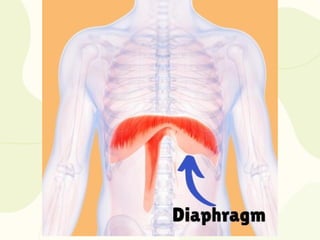
DIAPHRAGMATIC BREATHING
• Diaphragm is the primary muscle for
breathing ( inspiration )
• Diaphragm controls breathing at an
involuntary level, a patient with
primary pulmonary disease like COPD
can be taught breathing control by
optimal use of diaphragm and relaxation
of accessory muscles.
GLOSSOPHARYNGEAL BREATHING
• It is a means of increasing a patients
inspiratory capacity when there is a severe
weakness of the muscle of inspiration.
• It is taught to patient who have difficulty in
deep breathing.
• It is used primarily for ventilatory dependent
patients due to absent or incomplete
innervation of diaphragm because of high
cervical cord injury or neuromuscular
disorders.
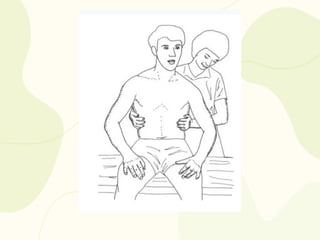
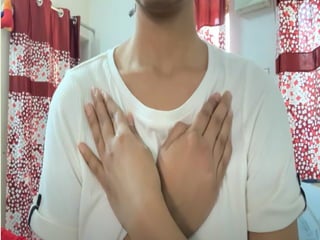
SEGMENTAL BREATHING
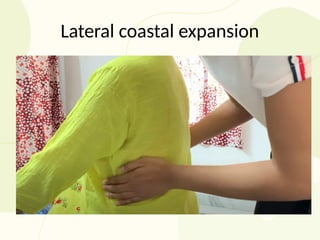
• It is performed on a segment of lung, or
a section of chest wall that needs
increased ventilation or movement.
• Hypoventilation occur in certain areas of
the lungs because of chest wall fibrosis,
pain after surgery, atelectasis, trauma to
chest wall, pneumonia and post
mastectomy scar.
Apical breathing
Lateral coastal expansion
ADVANTAGE OF SEGMENTAL
BREATHING
• Prevent accumulation of pleural fluid
and secretions
• Decreases paradoxical breathing
• Decrease panic episode
• Improve chest mobility
WARM UP
EXERCISE
CARDIOVASCULAR
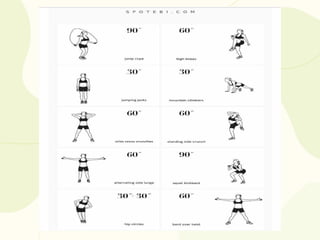
1. Jump rope – keep your knees slightly bent and jump on the balls of your
feet.
2. High Knees – Land slowly on the balls of your feet and keep your core
tight.
3. Jumping Jacks – Jump up, spread your feet and bring both hands together
above your head. Jump again and return to the starting position.
4. Mountain Climbers – Maintain a plank position during the entire xercise,
keep your core engaged and your hips low
5. Criss Cross Crunhes – Stand with your feet hip-width apart and your
hands behind your head. Bend your right leg and lift your knee as high as
yu can. Roate your torso to the right and bring your right knee to your left
elbow. Repeat on the opposite side and keep alternating sides until the set
is complete.
6. Standing Side Crunch – Shift your weight to the right leg, crunch to the
left side and bring your left knee up toward ypur elbow. Switch legs and
repeat.
7. Alternating Side Lungs – Step out to the side with your leftleg and keep
your right leg straight.touch your left foot with your right hand and repeat
the movement on the right side.
8. Squat Kickback – Squat and as you
stand up, transfer your weight to kickback
with the opposite.
9. Hip Circles – Start with small circles
and keep your hips level with the floor.
10. Bent over Twist – Bend and rotate
your torso, touching each foot with the
opposite hand.
Breathing-Exercise-LESSON 4 midterm.pptx

Breathing-Exercise-LESSON 4 midterm.pptx

  • 1.
    Breathing Exercise and DifferentWarm Up Exercise Targeting Cardiorespiratory Endurance
  • 2.
  • 3.
    • The progressthat moves air in and out of the lungs called breathing or pulmonary ventilation. • Breathing is only one of the processes that deliver oxygen to where it is needed in the body and remove carbon dioxide.
  • 4.
    Organs that Involvedin Breathing • Nose • Trachea • Bronchi • Bronchioles • Lungs • Muscles along with diaphragm
  • 5.
    BREATHING PROCESS • Breathingstarts at the nose. You inhale air into your nose, and it travels down the back of your throat and into your windpipe or trachea. • Trachea then divides into air passages called bronchial tubes. • Bronchial tubes pass through the lungs, they divided into smaller air passages called bronchioles or bronchial tree. • The bronchioles end in tiny balloon-like air sacs called alveoli. • The body has over 300 million alveoli. • The alveoli are surrounded by a mesh of tiny blood vessels called capillaries.
  • 7.
  • 8.
    • Breathing exand ventilatory training are the fundamental interventions for the prevention for acute and chronic pulmonary disease patients with high spinal cord lesion and who underwent troracic and abdominal surgery and bedridden patients. • Studies indicate that breathing exercise and ventilatory training have affect and alter a patients rate and depyh of ventilation, so these technique is used to improve the pulmonary disease to the patients overall endurance.
  • 9.
    GOALS OF BREATHINGEXERCISE • Improve ventilation • Increase the effectiveness of cough and promote airway clearance • To prevent post operative pulmonary complications • To improve the strength endurance coordination of the muscles of ventilations • Maintain and improve chest and thoracic spine mobility • Promote relaxation and relive stress. • Assiating in removal of secretions. • Correct abnormal breathing patterns and decrease the work of breathing. • Aid in Bronchial Hygiene—Prevent accumulation of pumonary secretions, mobilization of these secretions, and improve the cough mechanism.
  • 10.
    PRINCIPLES • Area ofexercises • Explanation and Instruction to the patient • Patient Position • Evaluate the patient • Demonstration of exercise • Patient practice
  • 11.
    Guideline for TeachingBreathing Exercise • Choose a quiet area to get a proper interaction with minimal distraction. • Explain the patient about the aim and how it works for his impairment. • Have the pat: in relaxed position and loosen the clothes, make him in semi-fowlers position with head and trunk elevated approx: 45dgree ( total support to the head and trunk and flexing the hip and knees with pillow support) the abdominal muscle become relaxed. • Observe and access the patients spontaneous breathing pattern while at rest and during activity. • Determine whether Rx is indicated or not. • If necessary teach the patient relaxation techniques, relax the muscles of upper thorax neck and shoulder to minimize the use of accessory muscle work.
  • 12.
    TYPES OF BREATHING EXERCISE •Diaphragmatic Breathing • Glossopharyngeal Breathing • Purse Lip Breathing • Segmental Breathing (costal expansion Exercise) a. Apical Breathing b. Lateral Costal Expansion c. Posterior Basal Expansion
  • 13.
    DIAPHRAGMATIC BREATHING • Diaphragmis the primary muscle for breathing ( inspiration ) • Diaphragm controls breathing at an involuntary level, a patient with primary pulmonary disease like COPD can be taught breathing control by optimal use of diaphragm and relaxation of accessory muscles.
  • 15.
    GLOSSOPHARYNGEAL BREATHING • Itis a means of increasing a patients inspiratory capacity when there is a severe weakness of the muscle of inspiration. • It is taught to patient who have difficulty in deep breathing. • It is used primarily for ventilatory dependent patients due to absent or incomplete innervation of diaphragm because of high cervical cord injury or neuromuscular disorders.
  • 18.
    SEGMENTAL BREATHING • Itis performed on a segment of lung, or a section of chest wall that needs increased ventilation or movement. • Hypoventilation occur in certain areas of the lungs because of chest wall fibrosis, pain after surgery, atelectasis, trauma to chest wall, pneumonia and post mastectomy scar.
  • 20.
  • 22.
  • 24.
    ADVANTAGE OF SEGMENTAL BREATHING •Prevent accumulation of pleural fluid and secretions • Decreases paradoxical breathing • Decrease panic episode • Improve chest mobility
  • 25.
  • 26.
    1. Jump rope– keep your knees slightly bent and jump on the balls of your feet. 2. High Knees – Land slowly on the balls of your feet and keep your core tight. 3. Jumping Jacks – Jump up, spread your feet and bring both hands together above your head. Jump again and return to the starting position. 4. Mountain Climbers – Maintain a plank position during the entire xercise, keep your core engaged and your hips low 5. Criss Cross Crunhes – Stand with your feet hip-width apart and your hands behind your head. Bend your right leg and lift your knee as high as yu can. Roate your torso to the right and bring your right knee to your left elbow. Repeat on the opposite side and keep alternating sides until the set is complete. 6. Standing Side Crunch – Shift your weight to the right leg, crunch to the left side and bring your left knee up toward ypur elbow. Switch legs and repeat. 7. Alternating Side Lungs – Step out to the side with your leftleg and keep your right leg straight.touch your left foot with your right hand and repeat the movement on the right side.
  • 27.
    8. Squat Kickback– Squat and as you stand up, transfer your weight to kickback with the opposite. 9. Hip Circles – Start with small circles and keep your hips level with the floor. 10. Bent over Twist – Bend and rotate your torso, touching each foot with the opposite hand.

Editor's Notes

  • #8 pulmonary disease- disease that affects the lungs and other parts of the respiratory system May be cause by infection, smoking tobacco, breathing in second hand, vape, pollution
  • #9 Ventilation- movement of fresh air around close space Thoracic spine- middle section of your spine
  • #10 Principle- kind or rule, belief, or idea that guides
  • #13 The diaphragm is a thin and wide muscle located right under your lungs.