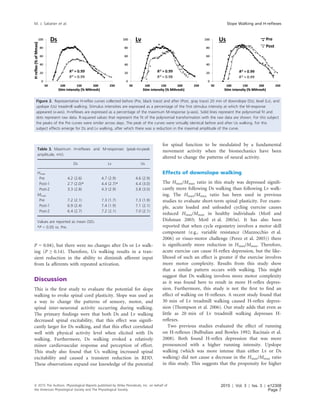
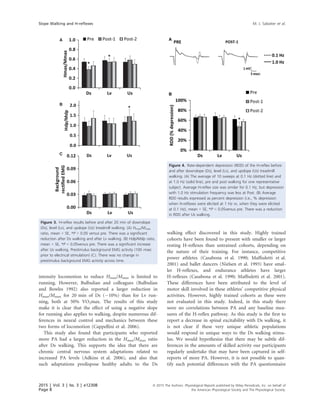
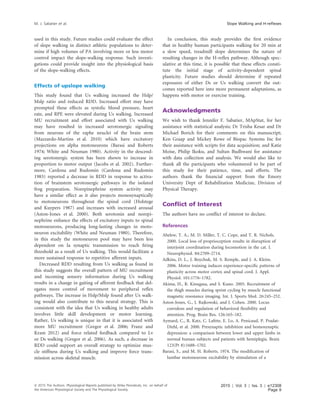
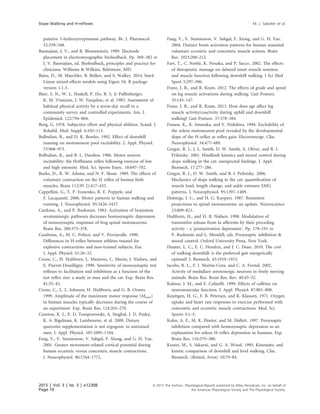
Slope walking causes short-term changes in soleus H-reflex excitability. Downslope walking reduces the Hmax/Mmax ratio more than level walking, indicating decreased spinal excitability. Upslope walking increases the Hslp/Mslp ratio and decreases rate-dependent depression, suggesting increased spinal excitability. These changes recover within 45 minutes. The effects of slope walking on spinal excitability are determined by the specific slope and likely related to differences in muscle activity and afferent feedback required for different slopes.
![ORIGINAL RESEARCH
Slope walking causes short-term changes in soleus H-reflex
excitability
Manning J. Sabatier, Wesley Wedewer, Ben Barton, Eric Henderson, John T. Murphy & Kar Ou
Department of Rehabilitation Medicine, Emory University School of Medicine, Atlanta, Georgia
Keywords
Homosynaptic depression, locomotion, rate-
dependent depression, spinal excitability,
treadmill.
Correspondence
Manning J. Sabatier, Division of Physical
Therapy, Department of Rehabilitation
Medicine, Emory University School of
Medicine, 1441 Clifton Rd, NE, Rm 209,
Atlanta, GA 30322.
Tel: 404 712 5675
Fax: 404 712 4130
E-mail: manning.sabatier@emory.edu
Funding Information
National Multiple Sclerosis Society grant
PP2321.
Received: 12 November 2014; Revised: 22
January 2015; Accepted: 27 January 2015
doi: 10.14814/phy2.12308
Physiol Rep, 3(3), 2015, e12308,
doi: 10.14814/phy2.12308
Abstract
The purpose of this study was to test the hypothesis that downslope treadmill
walking decreases spinal excitability. Soleus H-reflexes were measured in six-
teen adults on 3 days. Measurements were taken before and twice after
20 min of treadmill walking at 2.5 mph (starting at 10 and 45 min post). Par-
ticipants walked on a different slope each day [level (Lv), upslope (Us) or
downslope (Ds)]. The tibial nerve was electrically stimulated with a range of
intensities to construct the M-response and H-reflex curves. Maximum evoked
responses (Hmax and Mmax) and slopes of the ascending limbs (Hslp and
Mslp) of the curves were evaluated. Rate-dependent depression (RDD) was
measured as the % depression of the H-reflex when measured at a rate of
1.0 Hz versus 0.1 Hz. Heart rate (HR), blood pressure (BP), and ratings of
perceived exertion (RPE) were measured during walking. Ds and Lv walking
reduced the Hmax/Mmax ratio (P = 0.001 & P = 0.02), although the reduction
was larger for Ds walking (29.3 Æ 6.2% vs. 6.8 Æ 5.2%, P = 0.02). The reduc-
tion associated with Ds walking was correlated with physical activity level as
measured via questionnaire (r = À0.52, P = 0.04). Us walking caused an
increase in the Hslp/Mslp ratio (P = 0.03) and a decrease in RDD (P = 0.04).
These changes recovered by 45 min. Exercise HR and BP were highest during
Us walking. RPE was greater during Ds and Us walking compared to Lv walk-
ing, but did not exceed “Fairly light” for Ds walking. In conclusion, in healthy
adults treadmill walking has a short-term effect on soleus H-reflex excitability
that is determined by the slope of the treadmill surface.
Introduction
The spinal cord is a major locus of activity-dependent
neural plasticity associated with motor learning and
skilled performance improvements (Windhorst 1996;
Wolpaw and Tennissen 2001). Activity-dependent spinal
plasticity can be evoked in the short-term and the long-
term, and spinal excitability reflects the regular patterns
of motor activity in which people engage (Zehr 2002).
For example, soleus H-reflexes are smaller in explosively
trained athletes (Casabona et al. 1990) and skilled ballet
dancers (Nielsen et al. 1993), and larger in endurance
trained athletes, compared to other athletes and to
untrained controls (Casabona et al. 1990; Maffiuletti et al.
2001). Walking is a ubiquitous and fundamental rhythmic
activity that supports independence and quality of life
(Yildiz 2012) and also has been found to evoke spinal
plasticity. For example, a recent study reported that
30 min of level treadmill walking causes short-term
H-reflex depression in healthy adults (Thompson et al.
2006). Another study found that 20 min of over-ground
walking caused an increase in rate-dependent depression
of H-reflexes, a form of presynaptic inhibition (Phadke
et al. 2009). However, it is not known if the response of
the H-reflex pathway could be augmented by changing
the parameters of the walking task, for example, surface
slope.
During downslope (Ds), upslope (Us), and level (Lv)
walking lower extremity muscles express unique patterns
of electromyographic (EMG) activity that reflect differences
ª 2015 The Authors. Physiological Reports published by Wiley Periodicals, Inc. on behalf of
the American Physiological Society and The Physiological Society.
This is an open access article under the terms of the Creative Commons Attribution License,
which permits use, distribution and reproduction in any medium, provided the original work is properly cited.
2015 | Vol. 3 | Iss. 3 | e12308
Page 1
Physiological Reports ISSN 2051-817X](https://image.slidesharecdn.com/54942f49-eee9-4367-a28d-31a5d05a6c98-150615000226-lva1-app6892/85/phy212308-1-320.jpg)
![ORIGINAL RESEARCH
Slope walking causes short-term changes in soleus H-reflex
excitability
Manning J. Sabatier, Wesley Wedewer, Ben Barton, Eric Henderson, John T. Murphy & Kar Ou
Department of Rehabilitation Medicine, Emory University School of Medicine, Atlanta, Georgia
Keywords
Homosynaptic depression, locomotion, rate-
dependent depression, spinal excitability,
treadmill.
Correspondence
Manning J. Sabatier, Division of Physical
Therapy, Department of Rehabilitation
Medicine, Emory University School of
Medicine, 1441 Clifton Rd, NE, Rm 209,
Atlanta, GA 30322.
Tel: 404 712 5675
Fax: 404 712 4130
E-mail: manning.sabatier@emory.edu
Funding Information
National Multiple Sclerosis Society grant
PP2321.
Received: 12 November 2014; Revised: 22
January 2015; Accepted: 27 January 2015
doi: 10.14814/phy2.12308
Physiol Rep, 3(3), 2015, e12308,
doi: 10.14814/phy2.12308
Abstract
The purpose of this study was to test the hypothesis that downslope treadmill
walking decreases spinal excitability. Soleus H-reflexes were measured in six-
teen adults on 3 days. Measurements were taken before and twice after
20 min of treadmill walking at 2.5 mph (starting at 10 and 45 min post). Par-
ticipants walked on a different slope each day [level (Lv), upslope (Us) or
downslope (Ds)]. The tibial nerve was electrically stimulated with a range of
intensities to construct the M-response and H-reflex curves. Maximum evoked
responses (Hmax and Mmax) and slopes of the ascending limbs (Hslp and
Mslp) of the curves were evaluated. Rate-dependent depression (RDD) was
measured as the % depression of the H-reflex when measured at a rate of
1.0 Hz versus 0.1 Hz. Heart rate (HR), blood pressure (BP), and ratings of
perceived exertion (RPE) were measured during walking. Ds and Lv walking
reduced the Hmax/Mmax ratio (P = 0.001 & P = 0.02), although the reduction
was larger for Ds walking (29.3 Æ 6.2% vs. 6.8 Æ 5.2%, P = 0.02). The reduc-
tion associated with Ds walking was correlated with physical activity level as
measured via questionnaire (r = À0.52, P = 0.04). Us walking caused an
increase in the Hslp/Mslp ratio (P = 0.03) and a decrease in RDD (P = 0.04).
These changes recovered by 45 min. Exercise HR and BP were highest during
Us walking. RPE was greater during Ds and Us walking compared to Lv walk-
ing, but did not exceed “Fairly light” for Ds walking. In conclusion, in healthy
adults treadmill walking has a short-term effect on soleus H-reflex excitability
that is determined by the slope of the treadmill surface.
Introduction
The spinal cord is a major locus of activity-dependent
neural plasticity associated with motor learning and
skilled performance improvements (Windhorst 1996;
Wolpaw and Tennissen 2001). Activity-dependent spinal
plasticity can be evoked in the short-term and the long-
term, and spinal excitability reflects the regular patterns
of motor activity in which people engage (Zehr 2002).
For example, soleus H-reflexes are smaller in explosively
trained athletes (Casabona et al. 1990) and skilled ballet
dancers (Nielsen et al. 1993), and larger in endurance
trained athletes, compared to other athletes and to
untrained controls (Casabona et al. 1990; Maffiuletti et al.
2001). Walking is a ubiquitous and fundamental rhythmic
activity that supports independence and quality of life
(Yildiz 2012) and also has been found to evoke spinal
plasticity. For example, a recent study reported that
30 min of level treadmill walking causes short-term
H-reflex depression in healthy adults (Thompson et al.
2006). Another study found that 20 min of over-ground
walking caused an increase in rate-dependent depression
of H-reflexes, a form of presynaptic inhibition (Phadke
et al. 2009). However, it is not known if the response of
the H-reflex pathway could be augmented by changing
the parameters of the walking task, for example, surface
slope.
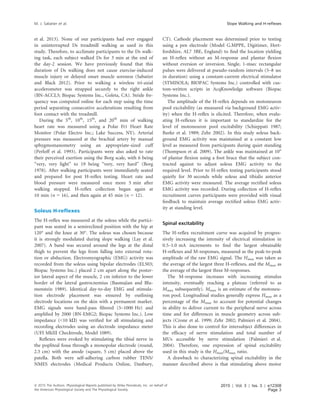
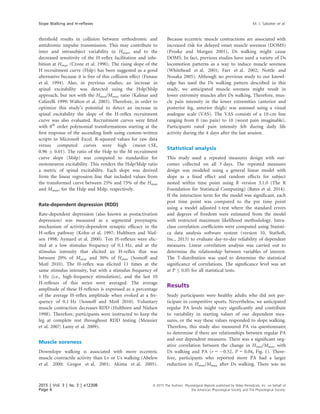
During downslope (Ds), upslope (Us), and level (Lv)
walking lower extremity muscles express unique patterns
of electromyographic (EMG) activity that reflect differences
ª 2015 The Authors. Physiological Reports published by Wiley Periodicals, Inc. on behalf of
the American Physiological Society and The Physiological Society.
This is an open access article under the terms of the Creative Commons Attribution License,
which permits use, distribution and reproduction in any medium, provided the original work is properly cited.
2015 | Vol. 3 | Iss. 3 | e12308
Page 1
Physiological Reports ISSN 2051-817X](https://image.slidesharecdn.com/54942f49-eee9-4367-a28d-31a5d05a6c98-150615000226-lva1-app6892/75/phy212308-1-2048.jpg)



![Acute effects of the power snatch on vertical jump performance [Autosaved]](https://cdn.slidesharecdn.com/ss_thumbnails/d20598f0-78ea-4c34-9ffb-140e63aaef10-161008230254-thumbnail.jpg?width=640&height=640&fit=bounds)


![Marivo_SIF_2016[1094]](https://cdn.slidesharecdn.com/ss_thumbnails/30cca194-da59-4dbf-8bb3-e17b007a9b34-161113230150-thumbnail.jpg?width=640&height=640&fit=bounds)


