imaGIne Conference 2014 
Session 8C1 organised by HUNAGI (HU) and ISPIK (PL) on 
Open source and open data for GI 
Report 
by Dr. Gábor Remetey-Fülöpp (HUNAGI) 
Rapporteur 
with acknowledgements for the Moderator, Speakers,Panelists and 
external contributors
Title, venue and date/time 
"OPEN SOURCE AND OPEN DATA FOR GI" 
- policies, enabling tools and applications - 
Organised by EUROGI Members: the Hungarian 
Association for Geospatial Information (HUNAGI) and the 
Instytut Systemów Przestrzennych i Katastralnych S.A. 
(ISPIK SA. Poland) 
imaGIne Conference 
Room Lindau 3, Bld. C, Berliner Messe, Berlin 
8 October 2014, 14:00 - 15:30
Outline of the Session 
Introduction by the moderator 
Andrzej Sambura, CEO, ISPIK SA 
Open Data and its economic impacts 
Dr. Márta Nagy-Rothengass, Head of Unit, DG Connect, European 
Commission 
Made in Europe, Making a Difference - Contributions to Open 
Standards and Open Source Software 
Prof. Dr. Peter Baumann, Jacobs University, Bremen 
Open Source, Data and Content as Foundations for Open Educational 
Resources 
Prof. Dr. Josef Strobl, Salzburg University SME, Administration, 
Education & Research 
Panel Discussion FOSS4G and the European Open Data Policy - 
Drivers for the Wider Use of GI 
Keynote speakers plus Dr. Marco Minghini, Politecnico Milano at Como, 
Dr. Jon Blower, Melodies project, University of Readling and dr. Zoltán Siki, 
Dept. of Geodesy and Surveying, Budapest University of Technology and 
Economics
Summary of findings (1) 
The scene was set by Moderator Andrzej Sambura by 
referring the recent EUROGI interview with Deputy DG 
Roberto Viola of DG CNEC: 
• It is anticipated, that the opportunity to innovate with GI will largerly 
increased thanks to the revision of PSI directive the legal 
cornerstone of the Open Data Initiative 
• The new rules to be implemented by July 2015 
• All the public data should become re-usable as default at no or 
much less costs 
• Expected impact on the governmental agencies such as cadastre 
(they have to revisit their charging policies)
Summary of findings (2) 
The representative of the DG CNECT Dr.M.Nagy-Rothengass dealt with the 
open data and its economic impacts 
• EU is towards a data-driven economy. Open data is significant part of it. 
The big data market rises from 10 bn € to 50 bn € between 2011-2015 
and revolutionises the decision making 
• Open data offers opportunities for growth, jobs, better quality, better 
efficiency and innovative services and develops ecosystems across the 
economy and society 
• Open govt’l data: an untapped business est. 140 bn € in the former EU28, 
Better governance, empower citizens, address societal challenges and 
accelerate scientific progress 
• Industry involvement is a key (PPP is open – join it!) 
• The EU Open Data Strategy – milestones incude: EC Communicationon 
Open Data (2011), Revision of PSI Directive (2013) Guidelines on PSI re-use 
(July 2014). 
• Now we are speaking on EU open data infrastructure 
• Research and Innovation funding available to foster cross-sectral re-use 
with merging different types of data
Summary of findings (3) 
Open Source Open Data and Content are foundations for Open 
Educational Resources explained by academician Prof. J. Strobl: 
• Open educational resources are considered as a transformational and 
potentially disruptive game changer 
• Stages are: spatial literacy, spatial awareness and spatial thinking 
• Open educational resources not equal open education 
• Need to share a higher level: not only data but knowledge as well 
• Contributions made by Prof. P.Baumann to open standards and open 
source software include 
• Outreach to science, communities and citizens 
• New, advanced technical solutions helps database visualization, 
parallel/distributed query processing, secured archive integration (using 
RASDAMAN, the case of NASA - ESA was shown) 
• A science SQL in ISO, a standard for multi-dimensional spatio-temporal 
arrays (MDA) has been approved in Information technology – Database 
languages Part 15
Summary of findings (4) 
Statements, comments, remarks of the panelists (Dr.J.Slower, Dr.Z.Siki and 
Dr.M.Minghini as well as the keynote speakers gave a good insights on the 
topic addressed in the discussion. 
• Open data often perceived as poor quality. This will change as many large 
organisations (e.g. ESA) release their data openly 
• We could do a better job in collecting user feedbacks and corrections on 
data (e.g. CHARME project) 
• There is still confusion on data policies. Free data are not necessarily 
open. Sometimes data can be free, but the licence restricts some kinds of 
re-use or re-distribution. 
• On the other hand data can be reasonable restricted for users or re-distribution 
(e.g. nesting locations of falcons, data related to critical 
infrastructures or privacy). Charging data are not the most important 
barrier. Open accessibility and usability are more vital. 
• SMEs would like to know how they can build business on open data? 
• Data providers would like to know, how to get revenues they need to 
maintain their data systems and services? 
• Geo-data alone are important but we have to combine them with non-geodata 
and to do so we have to overarch standards (e.g. MELODIES 
project), looking for Semantic Web and Linked Data standards.
Summary of findings (5) 
• It is still a skill-shortage in handling large geodata. That needs to be 
addressed. There is a strong role of training at graduate, post-graduate 
and continuing professional development levels. 
• As application example the twofold winner of the NASA World Wind 
Europa Challenge „PoliCrowd” a citizen friendly, customizable, open 
source platform of the Politecnico Milano at Como was introduced with 
it’s data styling, multimedia and time-sidebar supported 4D data filtering 
capabilities. 
• The Moderator Mr. Sambura pointed out the extremely importance of the 
topic which was focused from policy, academic/educational as well as 
from technical viewpoints. An enabling framework and a dynamic data 
community are pre-condition for an open data driven e-Economy 
• Opening professional data would give a much larger extent of visibility for 
the data providers and such data became economic societal assets 
• Finally Dr. Minghini announced the 2nd FOSS4G Europe Conference 
which will be held in Como, 14-17 July, 2015
Appendix- Recommended readings 
Contributions from invited experts, who were not able to come to imaGIne 2 
Courtesy by Prof.Dr.David Rhind, UK Government's Advisory Panel on Public Sector Information: 
APPSI, Government’s Advisor Panel on Public Sector Information, has published three important new 
documents in the subject. 
• The interactive wiki version of APPSI’s glossary of Public Sector Information (PSI) and Open Data 
(OD) terms. 
• http://data.gov.uk/glossary 
• This derives from APPSI’s early identification of widespread and confusing use of the same terminology for 
different matters and different words for the same things. Government accepted the need for this in the 
Open Data White Paper 2012 (Cm 8353) and APPSI created and tested a glossary. With the active 
engagement of the Cabinet Office this has now been converted into a wiki whereby anyone can comment 
on the terms used, propose alternatives and suggest new definitions. 
• What is the value of Open Data? https://www.nationalarchives.gov.uk/documents/meetings/20140128- 
appsi-what-is-the-value-of-open-data.pdf. 
• Much government effort has been put into developing the Open Data agenda. Yet there is relatively little 
quantitative evidence of the resulting benefits. APPSI organised a major seminar with national and 
international experts to address this issue. The substantial report of the findings from the meeting show that 
it is unrealistic to seek simple and meaningful overall statements of monetary benefit. On the other hand 
there is growing evidence of significant consumer surplus benefits (e.g. saving time) and possibly some 
environmental benefits through use of PSI and OD. The report also addresses wider issues, such as the 
sustainability of OD, the importance of the new information ecosystem as opposed to a focus simply on 
data, the role of the private sector and the tensions between the Open Data agenda and the Trading Fund 
model under which some government bodies operate.
Appendix- Recommended readings 
Prof.Dr.David Rhind, UK Government's Advisory Panel on Public Sector Information (cont.d): 
• Drowning in data: who and what can we trust? 
https://www.nationalarchives.gov.uk/documents/meetings/20140425-drowning-in-data.pdf 
• This paper, based on discussions within APPSI and elsewhere, provides a wide review of five 
issues associated with the growth of ‘Big Data’: threats to privacy and the trade-offs involved 
with public benefits, the appropriate role of the state in information trading, the consequences 
of technology failure, the dearth of UK quantitative skills, and misunderstandings or 
misrepresentations of data. Central to minimising threats to privacy and maintaining public 
trust are good governance, regulation and independent ‘fact checking’. Finally, guidance on 
how to assess evidence or conclusions derived from data and information is given. 
For further information see https://www.nationalarchives.gov.uk/appsi%5Cdefault.htm 
Contact: Beth Watson at Beth.Watson@nationalarchives.gsi.gov.uk or David Rhind at 
dwrhind@gmail.com 
Courtesy by Dr. Sven Schade, DG JRC IES Digital Earth and Reference Data: 
Coupling Public Sector Information and Public-funded Research Data in Europe - A 
Vision of an Open Data Ecosystem S. Schade, C. Granell & A. Perego European 
Commission – DG Joint Research Centre, Ispra, Varese, Italy {sven.schade, carlos.granell, 
andrea.perego}@jrc.ec.europa.eu 
For the time being the paper is still in the publication phase.
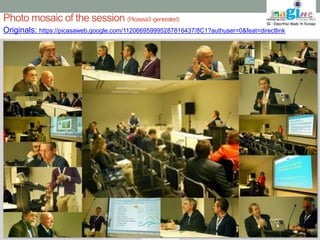
Photo mosaic of the session (Picassa3 -generated) 
Originals: https://picasaweb.google.com/112066959995287816437/8C1?authuser=0&feat=directlink

Open Source & Open Data Session report from imaGIne 2014 Conference

  • 1.
    imaGIne Conference 2014 Session 8C1 organised by HUNAGI (HU) and ISPIK (PL) on Open source and open data for GI Report by Dr. Gábor Remetey-Fülöpp (HUNAGI) Rapporteur with acknowledgements for the Moderator, Speakers,Panelists and external contributors
  • 2.
    Title, venue anddate/time "OPEN SOURCE AND OPEN DATA FOR GI" - policies, enabling tools and applications - Organised by EUROGI Members: the Hungarian Association for Geospatial Information (HUNAGI) and the Instytut Systemów Przestrzennych i Katastralnych S.A. (ISPIK SA. Poland) imaGIne Conference Room Lindau 3, Bld. C, Berliner Messe, Berlin 8 October 2014, 14:00 - 15:30
  • 3.
    Outline of theSession Introduction by the moderator Andrzej Sambura, CEO, ISPIK SA Open Data and its economic impacts Dr. Márta Nagy-Rothengass, Head of Unit, DG Connect, European Commission Made in Europe, Making a Difference - Contributions to Open Standards and Open Source Software Prof. Dr. Peter Baumann, Jacobs University, Bremen Open Source, Data and Content as Foundations for Open Educational Resources Prof. Dr. Josef Strobl, Salzburg University SME, Administration, Education & Research Panel Discussion FOSS4G and the European Open Data Policy - Drivers for the Wider Use of GI Keynote speakers plus Dr. Marco Minghini, Politecnico Milano at Como, Dr. Jon Blower, Melodies project, University of Readling and dr. Zoltán Siki, Dept. of Geodesy and Surveying, Budapest University of Technology and Economics
  • 4.
    Summary of findings(1) The scene was set by Moderator Andrzej Sambura by referring the recent EUROGI interview with Deputy DG Roberto Viola of DG CNEC: • It is anticipated, that the opportunity to innovate with GI will largerly increased thanks to the revision of PSI directive the legal cornerstone of the Open Data Initiative • The new rules to be implemented by July 2015 • All the public data should become re-usable as default at no or much less costs • Expected impact on the governmental agencies such as cadastre (they have to revisit their charging policies)
  • 5.
    Summary of findings(2) The representative of the DG CNECT Dr.M.Nagy-Rothengass dealt with the open data and its economic impacts • EU is towards a data-driven economy. Open data is significant part of it. The big data market rises from 10 bn € to 50 bn € between 2011-2015 and revolutionises the decision making • Open data offers opportunities for growth, jobs, better quality, better efficiency and innovative services and develops ecosystems across the economy and society • Open govt’l data: an untapped business est. 140 bn € in the former EU28, Better governance, empower citizens, address societal challenges and accelerate scientific progress • Industry involvement is a key (PPP is open – join it!) • The EU Open Data Strategy – milestones incude: EC Communicationon Open Data (2011), Revision of PSI Directive (2013) Guidelines on PSI re-use (July 2014). • Now we are speaking on EU open data infrastructure • Research and Innovation funding available to foster cross-sectral re-use with merging different types of data
  • 6.
    Summary of findings(3) Open Source Open Data and Content are foundations for Open Educational Resources explained by academician Prof. J. Strobl: • Open educational resources are considered as a transformational and potentially disruptive game changer • Stages are: spatial literacy, spatial awareness and spatial thinking • Open educational resources not equal open education • Need to share a higher level: not only data but knowledge as well • Contributions made by Prof. P.Baumann to open standards and open source software include • Outreach to science, communities and citizens • New, advanced technical solutions helps database visualization, parallel/distributed query processing, secured archive integration (using RASDAMAN, the case of NASA - ESA was shown) • A science SQL in ISO, a standard for multi-dimensional spatio-temporal arrays (MDA) has been approved in Information technology – Database languages Part 15
  • 7.
    Summary of findings(4) Statements, comments, remarks of the panelists (Dr.J.Slower, Dr.Z.Siki and Dr.M.Minghini as well as the keynote speakers gave a good insights on the topic addressed in the discussion. • Open data often perceived as poor quality. This will change as many large organisations (e.g. ESA) release their data openly • We could do a better job in collecting user feedbacks and corrections on data (e.g. CHARME project) • There is still confusion on data policies. Free data are not necessarily open. Sometimes data can be free, but the licence restricts some kinds of re-use or re-distribution. • On the other hand data can be reasonable restricted for users or re-distribution (e.g. nesting locations of falcons, data related to critical infrastructures or privacy). Charging data are not the most important barrier. Open accessibility and usability are more vital. • SMEs would like to know how they can build business on open data? • Data providers would like to know, how to get revenues they need to maintain their data systems and services? • Geo-data alone are important but we have to combine them with non-geodata and to do so we have to overarch standards (e.g. MELODIES project), looking for Semantic Web and Linked Data standards.
  • 8.
    Summary of findings(5) • It is still a skill-shortage in handling large geodata. That needs to be addressed. There is a strong role of training at graduate, post-graduate and continuing professional development levels. • As application example the twofold winner of the NASA World Wind Europa Challenge „PoliCrowd” a citizen friendly, customizable, open source platform of the Politecnico Milano at Como was introduced with it’s data styling, multimedia and time-sidebar supported 4D data filtering capabilities. • The Moderator Mr. Sambura pointed out the extremely importance of the topic which was focused from policy, academic/educational as well as from technical viewpoints. An enabling framework and a dynamic data community are pre-condition for an open data driven e-Economy • Opening professional data would give a much larger extent of visibility for the data providers and such data became economic societal assets • Finally Dr. Minghini announced the 2nd FOSS4G Europe Conference which will be held in Como, 14-17 July, 2015
  • 9.
    Appendix- Recommended readings Contributions from invited experts, who were not able to come to imaGIne 2 Courtesy by Prof.Dr.David Rhind, UK Government's Advisory Panel on Public Sector Information: APPSI, Government’s Advisor Panel on Public Sector Information, has published three important new documents in the subject. • The interactive wiki version of APPSI’s glossary of Public Sector Information (PSI) and Open Data (OD) terms. • http://data.gov.uk/glossary • This derives from APPSI’s early identification of widespread and confusing use of the same terminology for different matters and different words for the same things. Government accepted the need for this in the Open Data White Paper 2012 (Cm 8353) and APPSI created and tested a glossary. With the active engagement of the Cabinet Office this has now been converted into a wiki whereby anyone can comment on the terms used, propose alternatives and suggest new definitions. • What is the value of Open Data? https://www.nationalarchives.gov.uk/documents/meetings/20140128- appsi-what-is-the-value-of-open-data.pdf. • Much government effort has been put into developing the Open Data agenda. Yet there is relatively little quantitative evidence of the resulting benefits. APPSI organised a major seminar with national and international experts to address this issue. The substantial report of the findings from the meeting show that it is unrealistic to seek simple and meaningful overall statements of monetary benefit. On the other hand there is growing evidence of significant consumer surplus benefits (e.g. saving time) and possibly some environmental benefits through use of PSI and OD. The report also addresses wider issues, such as the sustainability of OD, the importance of the new information ecosystem as opposed to a focus simply on data, the role of the private sector and the tensions between the Open Data agenda and the Trading Fund model under which some government bodies operate.
  • 10.
    Appendix- Recommended readings Prof.Dr.David Rhind, UK Government's Advisory Panel on Public Sector Information (cont.d): • Drowning in data: who and what can we trust? https://www.nationalarchives.gov.uk/documents/meetings/20140425-drowning-in-data.pdf • This paper, based on discussions within APPSI and elsewhere, provides a wide review of five issues associated with the growth of ‘Big Data’: threats to privacy and the trade-offs involved with public benefits, the appropriate role of the state in information trading, the consequences of technology failure, the dearth of UK quantitative skills, and misunderstandings or misrepresentations of data. Central to minimising threats to privacy and maintaining public trust are good governance, regulation and independent ‘fact checking’. Finally, guidance on how to assess evidence or conclusions derived from data and information is given. For further information see https://www.nationalarchives.gov.uk/appsi%5Cdefault.htm Contact: Beth Watson at Beth.Watson@nationalarchives.gsi.gov.uk or David Rhind at dwrhind@gmail.com Courtesy by Dr. Sven Schade, DG JRC IES Digital Earth and Reference Data: Coupling Public Sector Information and Public-funded Research Data in Europe - A Vision of an Open Data Ecosystem S. Schade, C. Granell & A. Perego European Commission – DG Joint Research Centre, Ispra, Varese, Italy {sven.schade, carlos.granell, andrea.perego}@jrc.ec.europa.eu For the time being the paper is still in the publication phase.
  • 11.
    Photo mosaic ofthe session (Picassa3 -generated) Originals: https://picasaweb.google.com/112066959995287816437/8C1?authuser=0&feat=directlink