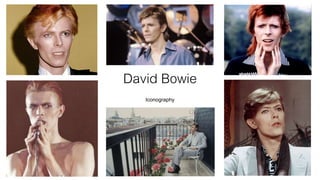
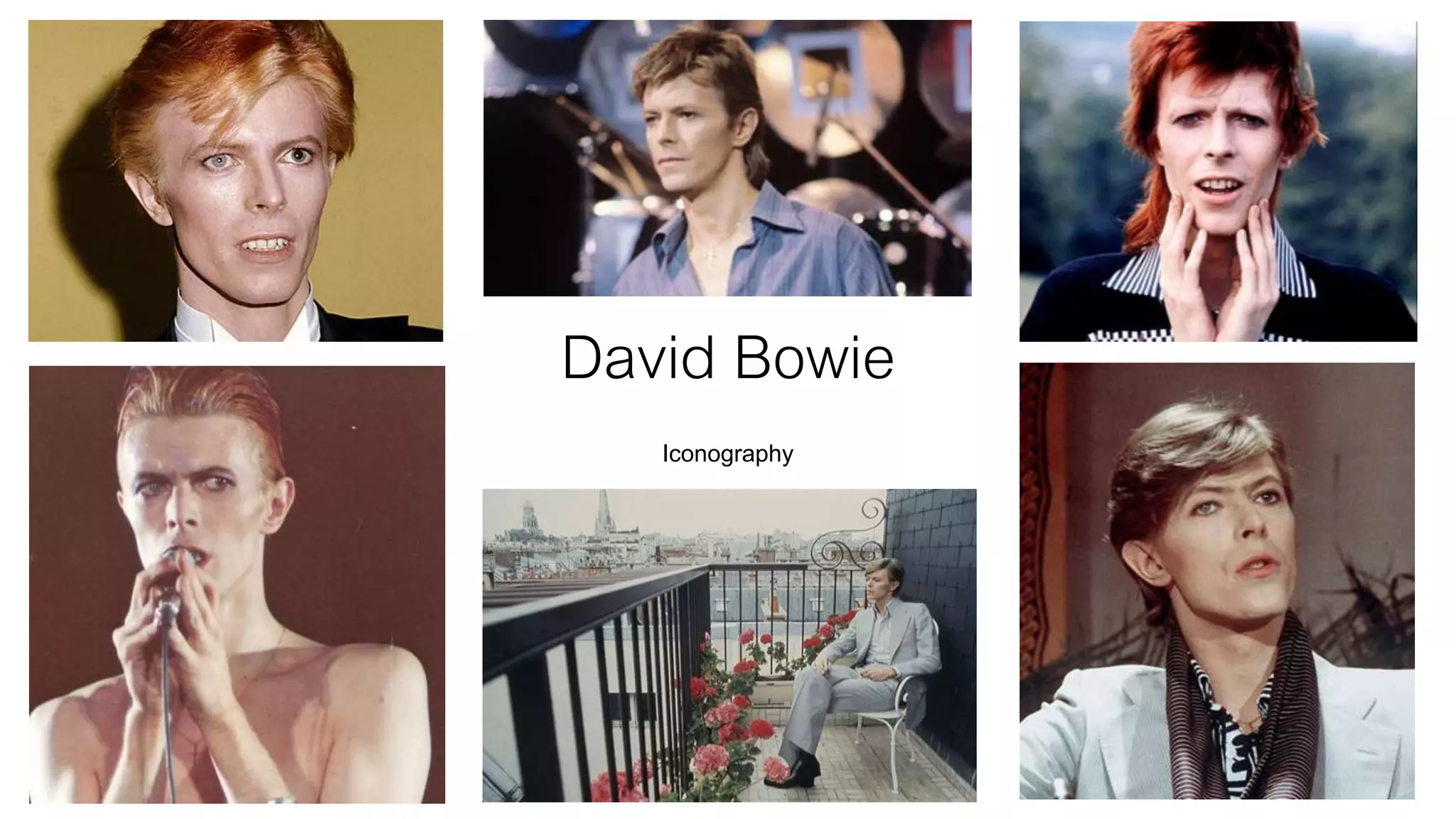
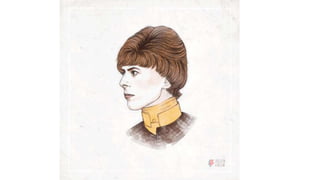
David Bowie
Iconography
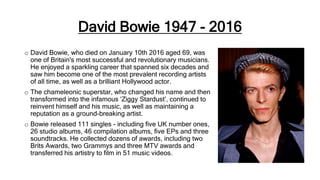
David Bowie 1947 - 2016
o David Bowie, who died on January 10th 2016 aged 69, was
one of Britain's most successful and revolutionary musicians.
He enjoyed a sparkling career that spanned six decades and
saw him become one of the most prevalent recording artists
of all time, as well as a brilliant Hollywood actor.
o The chameleonic superstar, who changed his name and then
transformed into the infamous ‘Ziggy Stardust’, continued to
reinvent himself and his music, as well as maintaining a
reputation as a ground-breaking artist.
o Bowie released 111 singles - including five UK number ones,
26 studio albums, 46 compilation albums, five EPs and three
soundtracks. He collected dozens of awards, including two
Brits Awards, two Grammys and three MTV awards and
transferred his artistry to film in 51 music videos.
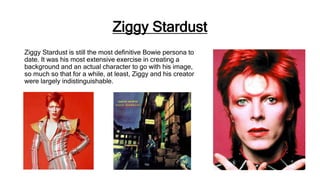
Ziggy Stardust
Ziggy Stardust is still the most definitive Bowie persona to
date. It was his most extensive exercise in creating a
background and an actual character to go with his image,
so much so that for a while, at least, Ziggy and his creator
were largely indistinguishable.
Aladdin Sane
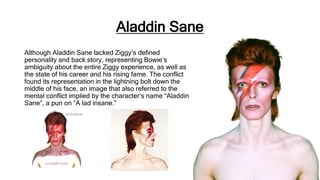
Although Aladdin Sane lacked Ziggy’s defined
personality and back story, representing Bowie’s
ambiguity about the entire Ziggy experience, as well as
the state of his career and his rising fame. The conflict
found its representation in the lightning bolt down the
middle of his face, an image that also referred to the
mental conflict implied by the character’s name “Aladdin
Sane”, a pun on “A lad insane.”
Pierrot
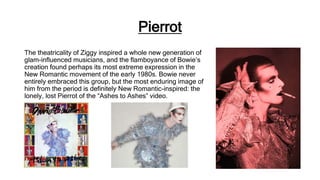
The theatricality of Ziggy inspired a whole new generation of
glam-influenced musicians, and the flamboyance of Bowie’s
creation found perhaps its most extreme expression in the
New Romantic movement of the early 1980s. Bowie never
entirely embraced this group, but the most enduring image of
him from the period is definitely New Romantic-inspired: the
lonely, lost Pierrot of the “Ashes to Ashes” video.
Jareth the Goblin King
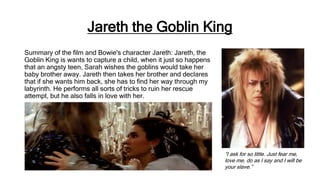
Summary of the film and Bowie's character Jareth: Jareth, the
Goblin King is wants to capture a child, when it just so happens
that an angsty teen, Sarah wishes the goblins would take her
baby brother away. Jareth then takes her brother and declares
that if she wants him back, she has to find her way through my
labyrinth. He performs all sorts of tricks to ruin her rescue
attempt, but he also falls in love with her.
“I ask for so little. Just fear me,
love me, do as I say and I will be
your slave.”
The Outsider
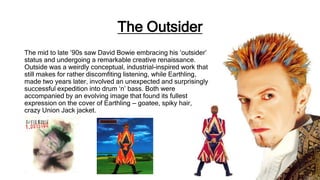
The mid to late ’90s saw David Bowie embracing his ‘outsider’
status and undergoing a remarkable creative renaissance.
Outside was a weirdly conceptual, industrial-inspired work that
still makes for rather discomfiting listening, while Earthling,
made two years later, involved an unexpected and surprisingly
successful expedition into drum ‘n’ bass. Both were
accompanied by an evolving image that found its fullest
expression on the cover of Earthling — goatee, spiky hair,
crazy Union Jack jacket.
David Bowie - Iconography

David Bowie - Iconography

  • 1.
  • 2.
    David Bowie 1947- 2016 o David Bowie, who died on January 10th 2016 aged 69, was one of Britain's most successful and revolutionary musicians. He enjoyed a sparkling career that spanned six decades and saw him become one of the most prevalent recording artists of all time, as well as a brilliant Hollywood actor. o The chameleonic superstar, who changed his name and then transformed into the infamous ‘Ziggy Stardust’, continued to reinvent himself and his music, as well as maintaining a reputation as a ground-breaking artist. o Bowie released 111 singles - including five UK number ones, 26 studio albums, 46 compilation albums, five EPs and three soundtracks. He collected dozens of awards, including two Brits Awards, two Grammys and three MTV awards and transferred his artistry to film in 51 music videos.
  • 3.
    Ziggy Stardust Ziggy Stardustis still the most definitive Bowie persona to date. It was his most extensive exercise in creating a background and an actual character to go with his image, so much so that for a while, at least, Ziggy and his creator were largely indistinguishable.
  • 4.
    Aladdin Sane Although AladdinSane lacked Ziggy’s defined personality and back story, representing Bowie’s ambiguity about the entire Ziggy experience, as well as the state of his career and his rising fame. The conflict found its representation in the lightning bolt down the middle of his face, an image that also referred to the mental conflict implied by the character’s name “Aladdin Sane”, a pun on “A lad insane.”
  • 5.
    Pierrot The theatricality ofZiggy inspired a whole new generation of glam-influenced musicians, and the flamboyance of Bowie’s creation found perhaps its most extreme expression in the New Romantic movement of the early 1980s. Bowie never entirely embraced this group, but the most enduring image of him from the period is definitely New Romantic-inspired: the lonely, lost Pierrot of the “Ashes to Ashes” video.
  • 6.
    Jareth the GoblinKing Summary of the film and Bowie's character Jareth: Jareth, the Goblin King is wants to capture a child, when it just so happens that an angsty teen, Sarah wishes the goblins would take her baby brother away. Jareth then takes her brother and declares that if she wants him back, she has to find her way through my labyrinth. He performs all sorts of tricks to ruin her rescue attempt, but he also falls in love with her. “I ask for so little. Just fear me, love me, do as I say and I will be your slave.”
  • 7.
    The Outsider The midto late ’90s saw David Bowie embracing his ‘outsider’ status and undergoing a remarkable creative renaissance. Outside was a weirdly conceptual, industrial-inspired work that still makes for rather discomfiting listening, while Earthling, made two years later, involved an unexpected and surprisingly successful expedition into drum ‘n’ bass. Both were accompanied by an evolving image that found its fullest expression on the cover of Earthling — goatee, spiky hair, crazy Union Jack jacket.