Toni Eagar
Australian National University
Email: Toni.Eagar@anu.edu.au
Becoming Iconic:
Resolving Contradictions in
Human Brand Celebrity and
Iconicity
Andrew Lindridge
The Open University
Email: A.M.Lindridge@open.ac.uk
From Nelson Mandela to
Ronald Reagan, from Steve
Jobs to Sam Walton, from
Oprah Winfrey to Martha
Stewart, from Michael
Jordan to Muhammad Ali,
from Andy Warhol to Bruce
Springsteen, from John
Wayne to Woody Allen,
cultural icons dominate our
world.
(Holt, 2004, p.1)
“Fame can take interesting
men and thrust mediocrity
upon them.”
“I always had a repulsive
need to be something more
than human.”
David Bowie
2
Quote highlights two important assumptions:
1. Human brands are often associated with famous
celebrities
(Muñiz, Norris, and Fine, 2013; Parmentier, 2010; 2011;
Schroeder, 2005).
Human brands represent the “well-known persona[s] who [are] the
subject of marketing communications” (Thomson, 2006, p.104)
Studies include:
a. Celebrities (Parmentier 2010, 2011)
b. CEOs (Seo, Chae, & Lee, 2012)
c. Job seekers (Close, Moulard, & Monroe, 2011)
d. Artists (Muñiz et al., 2014; Schroeder, 2005)
3
Quote highlights two important assumptions:
2. Within celebrity studies the human brand is
considered both:
a. the mediocre (artificial and synthetic celebrity)
(Boorstin, 1964; Debord, 2002),
b. the icon (more than human, embodying a
“compelling symbol of a set of ideas or values that
a society deems important”)
(Holt, 2004, p.1).
4
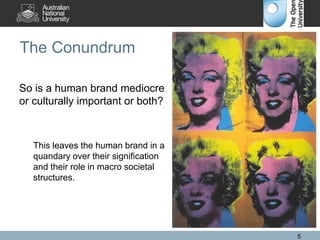
The Conundrum
So is a human brand mediocre
or culturally important or both?
This leaves the human brand in a
quandary over their signification
and their role in macro societal
structures.
5
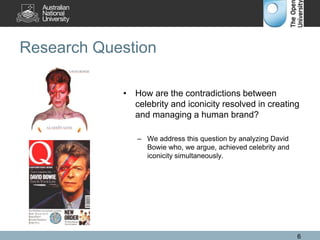
Research Question
• How are the contradictions between
celebrity and iconicity resolved in creating
and managing a human brand?
– We address this question by analyzing David
Bowie who, we argue, achieved celebrity and
iconicity simultaneously.
6
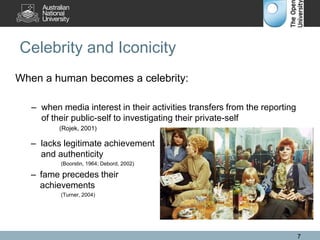
Celebrity and Iconicity
When a human becomes a celebrity:
– when media interest in their activities transfers from the reporting
of their public-self to investigating their private-self
(Rojek, 2001)
– lacks legitimate achievement
and authenticity
(Boorstin, 1964; Debord, 2002)
– fame precedes their
achievements
(Turner, 2004)
7
Celebrity and Iconicity
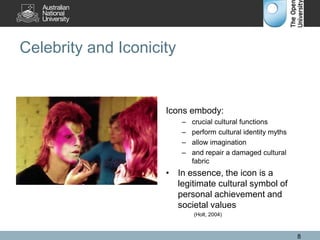
Icons embody:
– crucial cultural functions
– perform cultural identity myths
– allow imagination
– and repair a damaged cultural
fabric
• In essence, the icon is a
legitimate cultural symbol of
personal achievement and
societal values
(Holt, 2004)
8
Celebrity and Iconicity
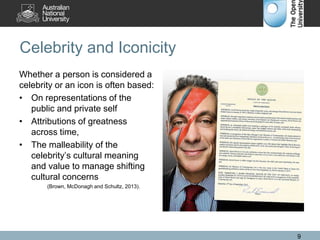
Whether a person is considered a
celebrity or an icon is often based:
• On representations of the
public and private self
• Attributions of greatness
across time,
• The malleability of the
celebrity’s cultural meaning
and value to manage shifting
cultural concerns
(Brown, McDonagh and Schultz, 2013).
9
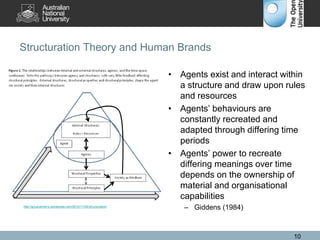
Structuration Theory and Human Brands
• Agents exist and interact within
a structure and draw upon rules
and resources
• Agents’ behaviours are
constantly recreated and
adapted through differing time
periods
• Agents’ power to recreate
differing meanings over time
depends on the ownership of
material and organisational
capabilities
– Giddens (1984)
10
http://groundcherry.wordpress.com/2012/11/04/structuration/
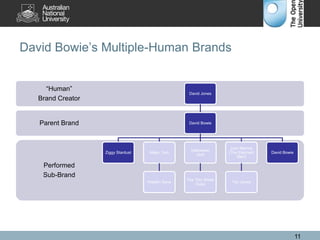
David Bowie’s Multiple-Human Brands
11
Performed
Sub-Brand
Parent Brand
“Human”
Brand Creator
David Jones
David Bowie
Ziggy Stardust Major Tom
Aladdin Sane
Halloween
Jack
The Thin White
Duke
John Merrick
(The Elephant
Man)
Tao Jones
David Bowie
Method
1. Grounding
– Identify data sources used to develop concepts
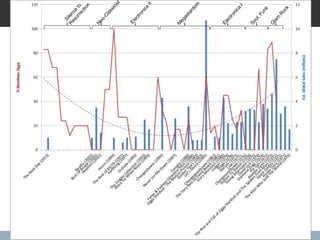
• Multiple data sources tracking Bowie’s career from 1972-2013
– Social media, media, music industry, Bowie generated
– Total documents = 562
– Just started conducting in-depth interviews with Bowie fans (N=4)
– looking for more volunteers to interview. more
about that later.
• Materials were read, notes made, and re-read to identify nuances
and metaphors
• Systematic coding according to emergent themes e.g. “Ziggy”,
“Paranoia” or “career decline”
12
13
Findings
Stage 1: Forming Associations within a
Time Period
Stage 2: Fixing associations in a Time
Period
Stage 3: Shifting associations across
Time Periods
14
Stage 1: Forming Associations within a Time Period
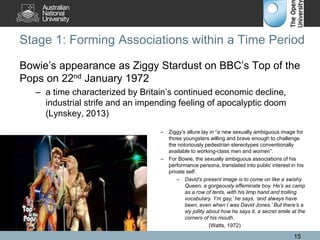
Bowie’s appearance as Ziggy Stardust on BBC’s Top of the
Pops on 22nd January 1972
– a time characterized by Britain’s continued economic decline,
industrial strife and an impending feeling of apocalyptic doom
(Lynskey, 2013)
15
– Ziggy’s allure lay in “a new sexually ambiguous image for
those youngsters willing and brave enough to challenge
the notoriously pedestrian stereotypes conventionally
available to working-class men and women”.
– For Bowie, the sexually ambiguous associations of his
performance persona, translated into public interest in his
private self.
– David’s present image is to come on like a swishy
Queen, a gorgeously effeminate boy. He’s as camp
as a row of tents, with his limp hand and trolling
vocabulary. ‘I’m gay,’ he says, ‘and always have
been, even when I was David Jones.’ But there’s a
sly jollity about how he says it, a secret smile at the
corners of his mouth.
(Watts, 1972)
Stage 1: Forming Associations within a Time Period
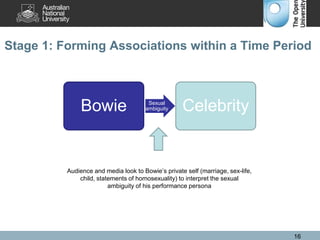
Bowie Sexual
ambiguity Celebrity
Audience and media look to Bowie’s private self (marriage, sex-life,
child, statements of homosexuality) to interpret the sexual
ambiguity of his performance persona
16
Stage 1: Forming Associations within a Time Period
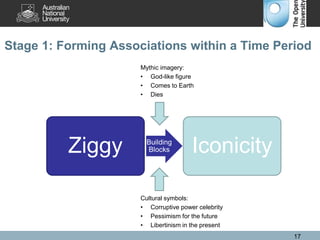
Ziggy Building
Blocks Iconicity
Cultural symbols:
• Corruptive power celebrity
• Pessimism for the future
• Libertinism in the present
17
Mythic imagery:
• God-like figure
• Comes to Earth
• Dies
BoyGeorge, the British singer, writing in 1995 (pp. 35-36) captured how Ziggywas
sacralized through dress and appearance and the communitas of being a Ziggyclone:
When Ziggy Stardust…came to Lewisham in 1973 I rushed to buy a ticket. …I tried to give
myself a Ziggy stardust haircut. It was a disaster….I spent the whole day hanging around
Lewisham, watching the crowd well up. Hundreds of Ziggy … clones. Bowie was like an
alien. It was the most exciting thing I’d ever seen.
18
Stage 2: Fixing associations in a Time Period
19
Bowie’s fixed associations:
• The perpetuation of the belief
that Bowie is Ziggy
• Bowie’s human attributes
Stage 2: Fixing associations in a Time Period
20
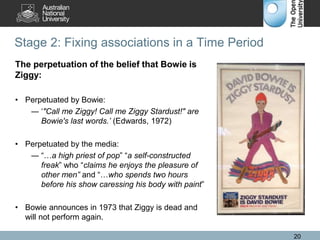
The perpetuation of the belief that Bowie is
Ziggy:
• Perpetuated by Bowie:
― ‘"Call me Ziggy! Call me Ziggy Stardust!" are
Bowie's last words.’ (Edwards, 1972)
• Perpetuated by the media:
― “…a high priest of pop” “a self-constructed
freak” who “claims he enjoys the pleasure of
other men” and “…who spends two hours
before his show caressing his body with paint”
• Bowie announces in 1973 that Ziggy is dead and
will not perform again.
Stage 2: Fixing associations in a Time Period
21
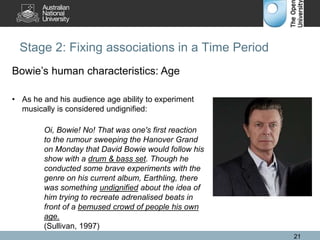
Bowie’s human characteristics: Age
• As he and his audience age ability to experiment
musically is considered undignified:
Oi, Bowie! No! That was one's first reaction
to the rumour sweeping the Hanover Grand
on Monday that David Bowie would follow his
show with a drum & bass set. Though he
conducted some brave experiments with the
genre on his current album, Earthling, there
was something undignified about the idea of
him trying to recreate adrenalised beats in
front of a bemused crowd of people his own
age.
(Sullivan, 1997)
Stage 2: Fixing associations in a Time Period
22
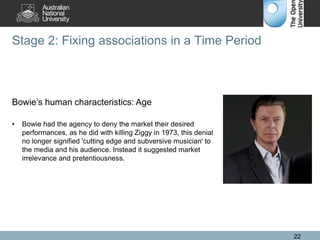
Bowie’s human characteristics: Age
• Bowie had the agency to deny the market their desired
performances, as he did with killing Ziggy in 1973, this denial
no longer signified 'cutting edge and subversive musician' to
the media and his audience. Instead it suggested market
irrelevance and pretentiousness.
Stage 2: Fixing associations in a Time Period
23
Bowie’s human characteristics: Sexuality
• We are confused:
“the biggest mistake I ever made…[as] I was always a
closet heterosexual" (cf. Gilmore, 2012)
• The audience and the media perpetuate Bowie’s image
of sexual ambiguity, in line with Ziggy, rather than
updating their image of Bowie
Stage 3: Shifting associations across time periods
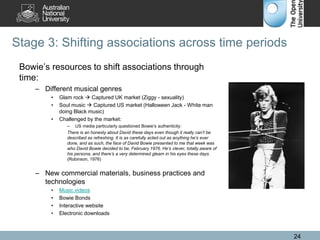
Bowie’s resources to shift associations through
time:
– Different musical genres
• Glam rock  Captured UK market (Ziggy - sexuality)
• Soul music  Captured US market (Halloween Jack - White man
doing Black music)
• Challenged by the market:
– US media particularly questioned Bowie’s authenticity:
There is an honesty about David these days even though it really can’t be
described as refreshing. It is as carefully acted out as anything he’s ever
done, and as such, the face of David Bowie presented to me that week was
who David Bowie decided to be, February 1976. He’s clever, totally aware of
his persona, and there’s a very determined gleam in his eyes these days.
(Robinson, 1976)
– New commercial materials, business practices and
technologies
• Music videos
• Bowie Bonds
• Interactive website
• Electronic downloads
24
Stage 3: Shifting Associations across Time Periods
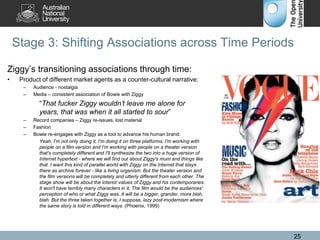
Ziggy’s transitioning associations through time:
• Product of different market agents as a counter-cultural narrative:
– Audience - nostalgia
– Media – consistent association of Bowie with Ziggy
“That fucker Ziggy wouldn’t leave me alone for
years, that was when it all started to sour”
– Record companies – Ziggy re-issues, lost material
– Fashion
– Bowie re-engages with Ziggy as a tool to advance his human brand:
Yeah, I'm not only doing it, I'm doing it on three platforms. I'm working with
people on a film version and I'm working with people on a theater version
that's completely different and I'll synthesize the two into a huge version of
Internet hypertext - where we will find out about Ziggy's mum and things like
that. I want this kind of parallel world with Ziggy on the Internet that stays
there as archive forever - like a living organism. But the theater version and
the film versions will be completely and utterly different from each other. The
stage show will be about the interior values of Ziggy and his contemporaries.
It won't have terribly many characters in it. The film would be the audiences'
perception of who or what Ziggy was. It will be a bigger, grander, more blah,
blah. But the three taken together is, I suppose, lazy post-modernism where
the same story is told in different ways. (Phoenix, 1999)
25
Stage 3: Shifting Associations across Time Periods
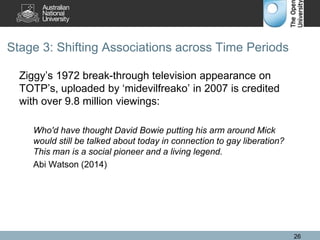
Ziggy’s 1972 break-through television appearance on
TOTP’s, uploaded by ‘midevilfreako’ in 2007 is credited
with over 9.8 million viewings:
Who'd have thought David Bowie putting his arm around Mick
would still be talked about today in connection to gay liberation?
This man is a social pioneer and a living legend.
Abi Watson (2014)
26
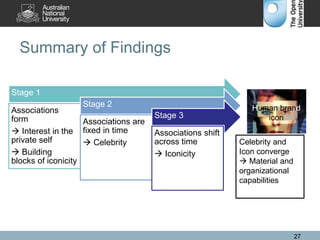
Summary of Findings
Stage 1
Associations
form
 Interest in the
private self
 Building
blocks of iconicity
Stage 2
Associations are
fixed in time
 Celebrity
Stage 3
Associations shift
across time
 Iconicity
27
Human brand
icon
Celebrity and
Icon converge
 Material and
organizational
capabilities
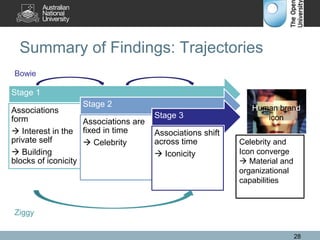
Summary of Findings: Trajectories
Stage 1
Associations
form
 Interest in the
private self
 Building
blocks of iconicity
Stage 2
Associations are
fixed in time
 Celebrity
Stage 3
Associations shift
across time
 Iconicity
28
Human brand
icon
Celebrity and
Icon converge
 Material and
organizational
capabilities
Bowie
Ziggy
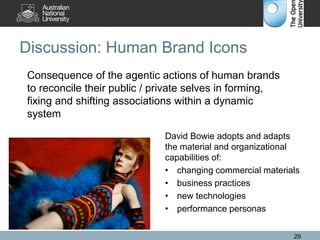
Discussion: Human Brand Icons
David Bowie adopts and adapts
the material and organizational
capabilities of:
• changing commercial materials
• business practices
• new technologies
• performance personas
29
Consequence of the agentic actions of human brands
to reconcile their public / private selves in forming,
fixing and shifting associations within a dynamic
system
The end and a request for help
30
• We are seeking Bowie fans to interview in person, by skype or telephone.
• Contact either Andrew or I
•Toni.eagar@anu.edu.au
•andrew.lindridge@open.ac.uk
• or there is an information sheet on the registration desk.
• or come and talk to me.
• or use this QR code
• or click here
https://anu.co1.qualtrics.com/SE/?SID=SV_2rf4WcY8BukDbDL

Becoming iconic acmi

  • 1.
    Toni Eagar Australian NationalUniversity Email: Toni.Eagar@anu.edu.au Becoming Iconic: Resolving Contradictions in Human Brand Celebrity and Iconicity Andrew Lindridge The Open University Email: A.M.Lindridge@open.ac.uk
  • 2.
    From Nelson Mandelato Ronald Reagan, from Steve Jobs to Sam Walton, from Oprah Winfrey to Martha Stewart, from Michael Jordan to Muhammad Ali, from Andy Warhol to Bruce Springsteen, from John Wayne to Woody Allen, cultural icons dominate our world. (Holt, 2004, p.1) “Fame can take interesting men and thrust mediocrity upon them.” “I always had a repulsive need to be something more than human.” David Bowie 2
  • 3.
    Quote highlights twoimportant assumptions: 1. Human brands are often associated with famous celebrities (Muñiz, Norris, and Fine, 2013; Parmentier, 2010; 2011; Schroeder, 2005). Human brands represent the “well-known persona[s] who [are] the subject of marketing communications” (Thomson, 2006, p.104) Studies include: a. Celebrities (Parmentier 2010, 2011) b. CEOs (Seo, Chae, & Lee, 2012) c. Job seekers (Close, Moulard, & Monroe, 2011) d. Artists (Muñiz et al., 2014; Schroeder, 2005) 3
  • 4.
    Quote highlights twoimportant assumptions: 2. Within celebrity studies the human brand is considered both: a. the mediocre (artificial and synthetic celebrity) (Boorstin, 1964; Debord, 2002), b. the icon (more than human, embodying a “compelling symbol of a set of ideas or values that a society deems important”) (Holt, 2004, p.1). 4
  • 5.
    The Conundrum So isa human brand mediocre or culturally important or both? This leaves the human brand in a quandary over their signification and their role in macro societal structures. 5
  • 6.
    Research Question • Howare the contradictions between celebrity and iconicity resolved in creating and managing a human brand? – We address this question by analyzing David Bowie who, we argue, achieved celebrity and iconicity simultaneously. 6
  • 7.
    Celebrity and Iconicity Whena human becomes a celebrity: – when media interest in their activities transfers from the reporting of their public-self to investigating their private-self (Rojek, 2001) – lacks legitimate achievement and authenticity (Boorstin, 1964; Debord, 2002) – fame precedes their achievements (Turner, 2004) 7
  • 8.
    Celebrity and Iconicity Iconsembody: – crucial cultural functions – perform cultural identity myths – allow imagination – and repair a damaged cultural fabric • In essence, the icon is a legitimate cultural symbol of personal achievement and societal values (Holt, 2004) 8
  • 9.
    Celebrity and Iconicity Whethera person is considered a celebrity or an icon is often based: • On representations of the public and private self • Attributions of greatness across time, • The malleability of the celebrity’s cultural meaning and value to manage shifting cultural concerns (Brown, McDonagh and Schultz, 2013). 9
  • 10.
    Structuration Theory andHuman Brands • Agents exist and interact within a structure and draw upon rules and resources • Agents’ behaviours are constantly recreated and adapted through differing time periods • Agents’ power to recreate differing meanings over time depends on the ownership of material and organisational capabilities – Giddens (1984) 10 http://groundcherry.wordpress.com/2012/11/04/structuration/
  • 11.
    David Bowie’s Multiple-HumanBrands 11 Performed Sub-Brand Parent Brand “Human” Brand Creator David Jones David Bowie Ziggy Stardust Major Tom Aladdin Sane Halloween Jack The Thin White Duke John Merrick (The Elephant Man) Tao Jones David Bowie
  • 12.
    Method 1. Grounding – Identifydata sources used to develop concepts • Multiple data sources tracking Bowie’s career from 1972-2013 – Social media, media, music industry, Bowie generated – Total documents = 562 – Just started conducting in-depth interviews with Bowie fans (N=4) – looking for more volunteers to interview. more about that later. • Materials were read, notes made, and re-read to identify nuances and metaphors • Systematic coding according to emergent themes e.g. “Ziggy”, “Paranoia” or “career decline” 12
  • 13.
  • 14.
    Findings Stage 1: FormingAssociations within a Time Period Stage 2: Fixing associations in a Time Period Stage 3: Shifting associations across Time Periods 14
  • 15.
    Stage 1: FormingAssociations within a Time Period Bowie’s appearance as Ziggy Stardust on BBC’s Top of the Pops on 22nd January 1972 – a time characterized by Britain’s continued economic decline, industrial strife and an impending feeling of apocalyptic doom (Lynskey, 2013) 15 – Ziggy’s allure lay in “a new sexually ambiguous image for those youngsters willing and brave enough to challenge the notoriously pedestrian stereotypes conventionally available to working-class men and women”. – For Bowie, the sexually ambiguous associations of his performance persona, translated into public interest in his private self. – David’s present image is to come on like a swishy Queen, a gorgeously effeminate boy. He’s as camp as a row of tents, with his limp hand and trolling vocabulary. ‘I’m gay,’ he says, ‘and always have been, even when I was David Jones.’ But there’s a sly jollity about how he says it, a secret smile at the corners of his mouth. (Watts, 1972)
  • 16.
    Stage 1: FormingAssociations within a Time Period Bowie Sexual ambiguity Celebrity Audience and media look to Bowie’s private self (marriage, sex-life, child, statements of homosexuality) to interpret the sexual ambiguity of his performance persona 16
  • 17.
    Stage 1: FormingAssociations within a Time Period Ziggy Building Blocks Iconicity Cultural symbols: • Corruptive power celebrity • Pessimism for the future • Libertinism in the present 17 Mythic imagery: • God-like figure • Comes to Earth • Dies
  • 18.
    BoyGeorge, the Britishsinger, writing in 1995 (pp. 35-36) captured how Ziggywas sacralized through dress and appearance and the communitas of being a Ziggyclone: When Ziggy Stardust…came to Lewisham in 1973 I rushed to buy a ticket. …I tried to give myself a Ziggy stardust haircut. It was a disaster….I spent the whole day hanging around Lewisham, watching the crowd well up. Hundreds of Ziggy … clones. Bowie was like an alien. It was the most exciting thing I’d ever seen. 18
  • 19.
    Stage 2: Fixingassociations in a Time Period 19 Bowie’s fixed associations: • The perpetuation of the belief that Bowie is Ziggy • Bowie’s human attributes
  • 20.
    Stage 2: Fixingassociations in a Time Period 20 The perpetuation of the belief that Bowie is Ziggy: • Perpetuated by Bowie: ― ‘"Call me Ziggy! Call me Ziggy Stardust!" are Bowie's last words.’ (Edwards, 1972) • Perpetuated by the media: ― “…a high priest of pop” “a self-constructed freak” who “claims he enjoys the pleasure of other men” and “…who spends two hours before his show caressing his body with paint” • Bowie announces in 1973 that Ziggy is dead and will not perform again.
  • 21.
    Stage 2: Fixingassociations in a Time Period 21 Bowie’s human characteristics: Age • As he and his audience age ability to experiment musically is considered undignified: Oi, Bowie! No! That was one's first reaction to the rumour sweeping the Hanover Grand on Monday that David Bowie would follow his show with a drum & bass set. Though he conducted some brave experiments with the genre on his current album, Earthling, there was something undignified about the idea of him trying to recreate adrenalised beats in front of a bemused crowd of people his own age. (Sullivan, 1997)
  • 22.
    Stage 2: Fixingassociations in a Time Period 22 Bowie’s human characteristics: Age • Bowie had the agency to deny the market their desired performances, as he did with killing Ziggy in 1973, this denial no longer signified 'cutting edge and subversive musician' to the media and his audience. Instead it suggested market irrelevance and pretentiousness.
  • 23.
    Stage 2: Fixingassociations in a Time Period 23 Bowie’s human characteristics: Sexuality • We are confused: “the biggest mistake I ever made…[as] I was always a closet heterosexual" (cf. Gilmore, 2012) • The audience and the media perpetuate Bowie’s image of sexual ambiguity, in line with Ziggy, rather than updating their image of Bowie
  • 24.
    Stage 3: Shiftingassociations across time periods Bowie’s resources to shift associations through time: – Different musical genres • Glam rock  Captured UK market (Ziggy - sexuality) • Soul music  Captured US market (Halloween Jack - White man doing Black music) • Challenged by the market: – US media particularly questioned Bowie’s authenticity: There is an honesty about David these days even though it really can’t be described as refreshing. It is as carefully acted out as anything he’s ever done, and as such, the face of David Bowie presented to me that week was who David Bowie decided to be, February 1976. He’s clever, totally aware of his persona, and there’s a very determined gleam in his eyes these days. (Robinson, 1976) – New commercial materials, business practices and technologies • Music videos • Bowie Bonds • Interactive website • Electronic downloads 24
  • 25.
    Stage 3: ShiftingAssociations across Time Periods Ziggy’s transitioning associations through time: • Product of different market agents as a counter-cultural narrative: – Audience - nostalgia – Media – consistent association of Bowie with Ziggy “That fucker Ziggy wouldn’t leave me alone for years, that was when it all started to sour” – Record companies – Ziggy re-issues, lost material – Fashion – Bowie re-engages with Ziggy as a tool to advance his human brand: Yeah, I'm not only doing it, I'm doing it on three platforms. I'm working with people on a film version and I'm working with people on a theater version that's completely different and I'll synthesize the two into a huge version of Internet hypertext - where we will find out about Ziggy's mum and things like that. I want this kind of parallel world with Ziggy on the Internet that stays there as archive forever - like a living organism. But the theater version and the film versions will be completely and utterly different from each other. The stage show will be about the interior values of Ziggy and his contemporaries. It won't have terribly many characters in it. The film would be the audiences' perception of who or what Ziggy was. It will be a bigger, grander, more blah, blah. But the three taken together is, I suppose, lazy post-modernism where the same story is told in different ways. (Phoenix, 1999) 25
  • 26.
    Stage 3: ShiftingAssociations across Time Periods Ziggy’s 1972 break-through television appearance on TOTP’s, uploaded by ‘midevilfreako’ in 2007 is credited with over 9.8 million viewings: Who'd have thought David Bowie putting his arm around Mick would still be talked about today in connection to gay liberation? This man is a social pioneer and a living legend. Abi Watson (2014) 26
  • 27.
    Summary of Findings Stage1 Associations form  Interest in the private self  Building blocks of iconicity Stage 2 Associations are fixed in time  Celebrity Stage 3 Associations shift across time  Iconicity 27 Human brand icon Celebrity and Icon converge  Material and organizational capabilities
  • 28.
    Summary of Findings:Trajectories Stage 1 Associations form  Interest in the private self  Building blocks of iconicity Stage 2 Associations are fixed in time  Celebrity Stage 3 Associations shift across time  Iconicity 28 Human brand icon Celebrity and Icon converge  Material and organizational capabilities Bowie Ziggy
  • 29.
    Discussion: Human BrandIcons David Bowie adopts and adapts the material and organizational capabilities of: • changing commercial materials • business practices • new technologies • performance personas 29 Consequence of the agentic actions of human brands to reconcile their public / private selves in forming, fixing and shifting associations within a dynamic system
  • 30.
    The end anda request for help 30 • We are seeking Bowie fans to interview in person, by skype or telephone. • Contact either Andrew or I •Toni.eagar@anu.edu.au •andrew.lindridge@open.ac.uk • or there is an information sheet on the registration desk. • or come and talk to me. • or use this QR code • or click here https://anu.co1.qualtrics.com/SE/?SID=SV_2rf4WcY8BukDbDL

Editor's Notes

  • #7 Celeactor refers to the alter-egos of performers that have their own celebrity. One reviewer suggested “dramatis persona” as an alternative terms and alter-ego is sometime used. However, these terms refer to the character within the performance, metaphor, drama. Whereas, Rojek ascribed celeactor to refer to not just the character but the fact that the character has public fame, i.e. they are also celebrities, examples include Ali G as opposed to Sacha Baron Cohen, and Carrie Bradshaw as opposed to Sarah Jessica Parker. In the audience’s mind the celeactor has the same function as the celebrity in forming parasocial imaginary relationships.
  • #12 In this study we look at how Bowie’s deliberate decision to publically “kill” Ziggy Stardust was a brand management strategy in order to enact his ability to continually recreate his brand narrative through new sub-brands. However, as Bowie’s power to create sub-brands lessens over time the Ziggy brand is appropriated / manipulated by the market