PASOLINK NEO High Performance
© 2009 NEC Corporation NEC and the NEC logo are registered trademarks of NEC Corporation.
NEC Corporation
www.nec.com
Cat.No. F02-09120001E
PASOLINK NEO IP Series
http://www.nec.com/pasolink/
NEC Corporation
Gigabit IP Solution
PASOLINK NEO High Performance
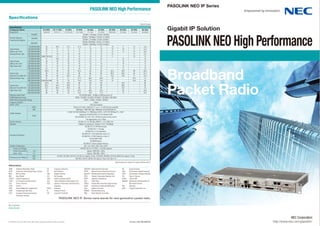
Specifications
Broadband
Packet Radio
AMR: Adaptive Modulation Radio
ATPC: Automatic Transmitting Power Control
BER: Bit Error Rate
BW: Band Width
CAPEX: Capital Expenditure
CCDP: Co-Channel Dual Polarization
CoS: Class of Service
CTRL: Control
EMC: Electro Magnetic Compatibility
EOW: Engineering Order Wire
ETSI: European Telecommunications
Standards Institute
FD: Frequency Diversity
FE: Fast Ethernet
GbE: Gigabit Ethernet
HS: Hot Standby
HYB: Hybrid combiner/divider
IDU: Indoor Modulator/Demodulator Unit
IEEE: Institute of Electrical and Electronics
Engineers
INTFC: Interface
IP: Internet Protocol
LTE: Long Term Evolution
MODEM: Modulator/Demodulator
MTPC: Manual Transmitting Power Control
Node-B: Wireless Base Station Equipment
ODU: Outdoor Transmitter/Receiver Unit
OPEX: Operation Expenditure
OW: Order Wire
PWE3: Pseudo Wire Emulation Edge-to-Edge
QAM: Quadrature Amplitude Modulation
QoS: Quality of Service
RMON: Remote Monitoring
RNC: Radio Network Controller
SD: Space Diversity
SDH: Synchronous Digital Hierarchy
STM: Synchronous Transport Module
ToS: Type of Service
VLAN: Virtual LAN
WiMAX: Worldwide Interoperability for
Microwave Access
WS: Wayside
xDSL: xDigital Subscriber Line
Classification
Frequency Band
Range (GHz)
Channel Spacing /
Transmission Capacity
Output Power
(dBm at Ant. Port)
Standard Power Type
Output Power
(dBm at Ant. Port)
High Power Type
System Gain
(dB at Ant. Port, BER=10-6
)
Standard Power Type
System Gain
(dB at Ant. Port, BER=10-6
)
High Power Type
Maximum Input Level
AMR Modulation range
AMR Channel Separation Range
Frequency Stability
MTPC / ATPC
Traffic Interface
Service Channel
Wayside
Standard Compliance
Ambient Temperature
Power Line Voltage
Power Consumption
(ODU + IDU)
Dimensions and Weight
(Typical Values)
16 QAM
128 QAM
256 QAM
16 QAM 56 MHz
128 QAM 28 MHz
128 QAM 56 MHz
256 QAM 28 MHz
256 QAM 56 MHz
16 QAM 56 MHz
128 QAM 28 MHz
128 QAM 56 MHz
256 QAM 28 MHz
256 QAM 56 MHz
16 QAM 56 MHz
128 QAM 28 MHz
128 QAM 56 MHz
256 QAM 28 MHz
256 QAM 56 MHz
16 QAM 56 MHz
128 QAM 28 MHz
128 QAM 56 MHz
256 QAM 28 MHz
256 QAM 56 MHz
STM-1
GbE
VLAN
1+0
1+1
ODU
IDU
6-8 GHz
5.925-8.5
26
25
21
21
18(6G) 19(7-8G)
31
30
27
27
25
100.5
95
88
87
81(6G) 82(7-8G)
105.5
99.5
93.5
93
88
10-11 GHz
10.15-11.7
20.5
21
17
16
13
25.5
26
23
23
21
94
91
84
81
75
99
94.5
88.5
88
83
13 GHz
12.75-13.25
21.5
21
17
16
13
22
22
19
19
16
95
90
82.5
81
75
95.5
90.5
84.5
84
78
15 GHz
14.2-15.35
21.5
21
17
16
13
22
22
19
19
16
95.5
90
83
81.5
75.5
96
91
85
84.5
78.5
18 GHz
17.7-19.7
21
19
15
15
13
22
22
19
19
16
95
88
81
80.5
75.5
96
91
85
84.5
78.5
56 MHz / 155 Mbps (18 GHz: 55 MHz)
28 MHz / 155 Mbps (18 GHz: 27.5 MHz)
56 MHz / 310 Mbps (18 GHz: 55 MHz)
28 MHz /200 Mbps (18 GHz: 27.5 MHz)
56 MHz / 400 Mbps (18 GHz: 55 MHz)
16/128/256 QAM : -20 dBm for BER less than 10-3
QPSK / 16 QAM / 32 QAM / 64 QAM / 128 QAM / 256 QAM
7 MHz / 14 MHz / 28 MHz / 56 MHz
± 6ppm
1 dB step available
Electrical 75 ohms, Optical (S-1.1 or L-1.1), APS function available
1000 Base-T (IEEE 802.3ab), 1000 Base-LX/SX (IEEE 802.3z)
2x GbE (10/100/1000 Base-T or 1000 Base-LX/SX) + 2x FE (10/100 Base-T) + 16xE1
Tag Based VLAN (IEEE 802.1Q), Port Based VLAN
QoS (IEEE802.1p): CoS / ToS / Diffserve based priority control
Link aggregation up to 1 Gbps
64 kbps V.11 ch, 9.6 kbps RS232-C : 2 ch, EOW: 2ch
2 Mbps: E1 interface or 10 Base-T (1ch / 155 Mbps)
EN 302 217-2-2 RF Performance
EN 300 019-1-1 Storage
EN 300 019-1-2 Transportation
EN 300 019-1-3 IDU Operation class 3.1E
EN 300 019-1-3 ODU Operation class 4.1
EN 301489-4 EMC
EN 60950 Safety
EN 300132-2 Power Supply Interface
IDU: -5 to +50˚C, ODU -33 to +50˚C
-48 VDC (-40.5 to -57 VDC), +/-24 VDC optional
Approx. 40W (IDU + ODU)
Approx. 70W (IDU + ODU)
6-8 GHz: 237 (W) x 237 (H) x 101 (D) mm: Approx. 3.5 kg, 15-38 GHz: 239 (W) x 247 (H) x 68 (D) mm: Approx. 3.0 kg
482 (W) x 44 (H) x 230 (D) mm: Approx. 4 kg (1+0), 5 kg (1+1)
23 GHz
21.2-23.6
21
19
15
15
12
22
21
18
18
15
95
88
81
80.5
74.5
96
90
84
83.5
77.5
26 GHz
24.25-26.5
19
18
14
14
11
-
-
-
-
-
92.5
86.5
79.5
79
73
-
-
-
-
-
28 GHz
27.5-29.5
17
18
14
-
-
19
18
14
15
12
90.5
86.5
79.5
-
-
92.5
86.5
79.5
80
74
32 GHz
31.8-33.4
16
17
13
13
10
-
-
-
-
-
88
84
77
76.5
70.5
-
-
-
-
-
38 GHz
37.0-40.0
13.5
14.5
10.5
9.5
7.5
16
16
12
13
10
85.5
81.5
74.5
73
68
88
83
76
76.5
70.5
Specifications are subject to change without notice.
Abbreviations
PASOLINK NEO IP: Series name stands for next generation packet radio.
NEC and the Evolving World
of Ultra-High-Speed
Packet Access
PASOLINK NEO High Performance (HP)
is designed for high-speed future networks of advanced point-to-point digital microwave access radio. It
employs a common platform design concept that provides scalable configurations to respond flexibly to a
diverse range of market needs. NEO HP is designed with completely new technology using sub-micron
silicon technology and the latest signal processing circuit. Therefore this digital radio delivers
incomparable scalable performance and versatile interfaces. This performance will handle
advanced IP networks of the future that will grow rapidly and massively.
By adopting the same field-proven common-platform design of the
PASOLINK NEO series, NEO HP offers unrivaled reliability, while further
improving scalability. NEO HP meets the increasing demand for digital
transmission services, and satisfies the needs for integration with a variety
of services such as WiMAX backbone, wireless xDSL and private
intranetworking. NEO HP realizes NEC’s commitment of “Achieving
Customer Satisfaction”; by taking investment value one step further.
Main Features
PASOLINK NEO High Performance
Design concept
• Low Capex/Opex Broadband Packet Radio
Key specifications
• Frequency band: 6 to 38 GHz
• Radio transmission capacity:155 Mbps to 1.6 Gbps*
• Interface:2 x GbE + 2 x FE (10/100/1000 Base-T or
1000 Base-LX/SX + 10/100 Base-T)
GbE (1000 Base-T or 1000 Base-LX/SX)
STM-1 optical or electrical (1 or 2)
1 or 2 E1 (wayside)
• Modulation:16 QAM/128 QAM/256 QAM* (Continuous mode)
QPSK/16 QAM/32 QAM/64 QAM/128 QAM/256 QAM
(AMR mode)
Scalability
• Capacity and bandwidth upgradable by software and
configuration
• 155 Mbps (28 MHz) => 200 Mbps (28 MHz)*
=> 310 Mbps (56 MHz) => 620 Mbps (56 MHz CCDP)
=> 1.2 Gbps (112 MHz CCDP)
=> 1.6 Gbps* (112 MHz CCDP)
• Modulation selectable by software
• From 16 QAM up to 256 QAM*
• Flexible system configuration: 1+0, 1+1 (HS/SD/FD)
• Common ODU for NEO series
Technical merits
• Peerless high reliability
• Super-low latency
• High system gain
• Low power consumption
• Easy and stable cross polarized operation for 620/800 Mbps*
(56 MHz) or 310/400 Mbps* (28 MHz)
• Automatic protection switch for STM-1 interface
• Gigabit Ethernet
• High throughput and low latency
• Jumbo frame available (up to 9600 bytes)
• Link aggregation up to 620/ 800* Mbps (for GbE VLAN)
• VLAN support excluding external box
• Port based VLAN
• Tag-based VLAN, 802.1Q
• QoS: 802.1p; CoS, ToS/Diffserve
• MPLS support (Optional)
• Adaptive modulation capability* (AMR)
• 75E1/150E1 High-capacity PDH (Optional)
• PWE3 (Optional)
Applications
• Advanced mobile system network backbone
• WiMAX backbone
• High-speed internet network
*By software upgrade
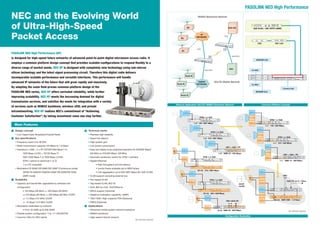
Network Application 3G/LTE/ WiMAX Backbone Network Common Platform Concept
Configuration Scalability
GbE VLAN + 16E1 INTFC (AMR)
MODEM Unit
MODEM Unit
To ODU
To ODU
GbE WS/ LAN
Control Unit
*By software upgrade
Node-B
Node-B
BS
BS
Node-B
BS ASN-GW
WiMAX Backbone Network
3G/LTE Mobile Network
GbE/SDH
GbE/SDH
GbE
GbE
RNC
IP
NETWORK
TDM/IP
NETWORK
STM-1 or GbE
STM-1 or GbE
155 / 200* Mbps1+0
1+1
1+0 310 / 400* Mbps
STM-1 or GbE
2(1+0) 310 / 400* Mbps
STM-1 or GbE
16E1+GbE+FE
2(1+0) 620 / 800*Mbps
AMR 20 - 800*Mbps
16E1 + GbE + FE
1+0 AMR 10 - 400*Mbps
AMR 40M – 1.6*Gbps
ACCP
+CCDP
GbE+FE up to 1 Gbps
32E1
STM-1 or GbE
155 / 200*Mbps
1+1
STM-1 or GbE
310 / 400*Mbps
1+1
16E1 + GbE + FE
AMR 10 - 400*Mbps
2+0
2(2+0)
(2+0)

Datenblatt neo

  • 1.
    PASOLINK NEO HighPerformance © 2009 NEC Corporation NEC and the NEC logo are registered trademarks of NEC Corporation. NEC Corporation www.nec.com Cat.No. F02-09120001E PASOLINK NEO IP Series http://www.nec.com/pasolink/ NEC Corporation Gigabit IP Solution PASOLINK NEO High Performance Specifications Broadband Packet Radio AMR: Adaptive Modulation Radio ATPC: Automatic Transmitting Power Control BER: Bit Error Rate BW: Band Width CAPEX: Capital Expenditure CCDP: Co-Channel Dual Polarization CoS: Class of Service CTRL: Control EMC: Electro Magnetic Compatibility EOW: Engineering Order Wire ETSI: European Telecommunications Standards Institute FD: Frequency Diversity FE: Fast Ethernet GbE: Gigabit Ethernet HS: Hot Standby HYB: Hybrid combiner/divider IDU: Indoor Modulator/Demodulator Unit IEEE: Institute of Electrical and Electronics Engineers INTFC: Interface IP: Internet Protocol LTE: Long Term Evolution MODEM: Modulator/Demodulator MTPC: Manual Transmitting Power Control Node-B: Wireless Base Station Equipment ODU: Outdoor Transmitter/Receiver Unit OPEX: Operation Expenditure OW: Order Wire PWE3: Pseudo Wire Emulation Edge-to-Edge QAM: Quadrature Amplitude Modulation QoS: Quality of Service RMON: Remote Monitoring RNC: Radio Network Controller SD: Space Diversity SDH: Synchronous Digital Hierarchy STM: Synchronous Transport Module ToS: Type of Service VLAN: Virtual LAN WiMAX: Worldwide Interoperability for Microwave Access WS: Wayside xDSL: xDigital Subscriber Line Classification Frequency Band Range (GHz) Channel Spacing / Transmission Capacity Output Power (dBm at Ant. Port) Standard Power Type Output Power (dBm at Ant. Port) High Power Type System Gain (dB at Ant. Port, BER=10-6 ) Standard Power Type System Gain (dB at Ant. Port, BER=10-6 ) High Power Type Maximum Input Level AMR Modulation range AMR Channel Separation Range Frequency Stability MTPC / ATPC Traffic Interface Service Channel Wayside Standard Compliance Ambient Temperature Power Line Voltage Power Consumption (ODU + IDU) Dimensions and Weight (Typical Values) 16 QAM 128 QAM 256 QAM 16 QAM 56 MHz 128 QAM 28 MHz 128 QAM 56 MHz 256 QAM 28 MHz 256 QAM 56 MHz 16 QAM 56 MHz 128 QAM 28 MHz 128 QAM 56 MHz 256 QAM 28 MHz 256 QAM 56 MHz 16 QAM 56 MHz 128 QAM 28 MHz 128 QAM 56 MHz 256 QAM 28 MHz 256 QAM 56 MHz 16 QAM 56 MHz 128 QAM 28 MHz 128 QAM 56 MHz 256 QAM 28 MHz 256 QAM 56 MHz STM-1 GbE VLAN 1+0 1+1 ODU IDU 6-8 GHz 5.925-8.5 26 25 21 21 18(6G) 19(7-8G) 31 30 27 27 25 100.5 95 88 87 81(6G) 82(7-8G) 105.5 99.5 93.5 93 88 10-11 GHz 10.15-11.7 20.5 21 17 16 13 25.5 26 23 23 21 94 91 84 81 75 99 94.5 88.5 88 83 13 GHz 12.75-13.25 21.5 21 17 16 13 22 22 19 19 16 95 90 82.5 81 75 95.5 90.5 84.5 84 78 15 GHz 14.2-15.35 21.5 21 17 16 13 22 22 19 19 16 95.5 90 83 81.5 75.5 96 91 85 84.5 78.5 18 GHz 17.7-19.7 21 19 15 15 13 22 22 19 19 16 95 88 81 80.5 75.5 96 91 85 84.5 78.5 56 MHz / 155 Mbps (18 GHz: 55 MHz) 28 MHz / 155 Mbps (18 GHz: 27.5 MHz) 56 MHz / 310 Mbps (18 GHz: 55 MHz) 28 MHz /200 Mbps (18 GHz: 27.5 MHz) 56 MHz / 400 Mbps (18 GHz: 55 MHz) 16/128/256 QAM : -20 dBm for BER less than 10-3 QPSK / 16 QAM / 32 QAM / 64 QAM / 128 QAM / 256 QAM 7 MHz / 14 MHz / 28 MHz / 56 MHz ± 6ppm 1 dB step available Electrical 75 ohms, Optical (S-1.1 or L-1.1), APS function available 1000 Base-T (IEEE 802.3ab), 1000 Base-LX/SX (IEEE 802.3z) 2x GbE (10/100/1000 Base-T or 1000 Base-LX/SX) + 2x FE (10/100 Base-T) + 16xE1 Tag Based VLAN (IEEE 802.1Q), Port Based VLAN QoS (IEEE802.1p): CoS / ToS / Diffserve based priority control Link aggregation up to 1 Gbps 64 kbps V.11 ch, 9.6 kbps RS232-C : 2 ch, EOW: 2ch 2 Mbps: E1 interface or 10 Base-T (1ch / 155 Mbps) EN 302 217-2-2 RF Performance EN 300 019-1-1 Storage EN 300 019-1-2 Transportation EN 300 019-1-3 IDU Operation class 3.1E EN 300 019-1-3 ODU Operation class 4.1 EN 301489-4 EMC EN 60950 Safety EN 300132-2 Power Supply Interface IDU: -5 to +50˚C, ODU -33 to +50˚C -48 VDC (-40.5 to -57 VDC), +/-24 VDC optional Approx. 40W (IDU + ODU) Approx. 70W (IDU + ODU) 6-8 GHz: 237 (W) x 237 (H) x 101 (D) mm: Approx. 3.5 kg, 15-38 GHz: 239 (W) x 247 (H) x 68 (D) mm: Approx. 3.0 kg 482 (W) x 44 (H) x 230 (D) mm: Approx. 4 kg (1+0), 5 kg (1+1) 23 GHz 21.2-23.6 21 19 15 15 12 22 21 18 18 15 95 88 81 80.5 74.5 96 90 84 83.5 77.5 26 GHz 24.25-26.5 19 18 14 14 11 - - - - - 92.5 86.5 79.5 79 73 - - - - - 28 GHz 27.5-29.5 17 18 14 - - 19 18 14 15 12 90.5 86.5 79.5 - - 92.5 86.5 79.5 80 74 32 GHz 31.8-33.4 16 17 13 13 10 - - - - - 88 84 77 76.5 70.5 - - - - - 38 GHz 37.0-40.0 13.5 14.5 10.5 9.5 7.5 16 16 12 13 10 85.5 81.5 74.5 73 68 88 83 76 76.5 70.5 Specifications are subject to change without notice. Abbreviations PASOLINK NEO IP: Series name stands for next generation packet radio.
  • 2.
    NEC and theEvolving World of Ultra-High-Speed Packet Access PASOLINK NEO High Performance (HP) is designed for high-speed future networks of advanced point-to-point digital microwave access radio. It employs a common platform design concept that provides scalable configurations to respond flexibly to a diverse range of market needs. NEO HP is designed with completely new technology using sub-micron silicon technology and the latest signal processing circuit. Therefore this digital radio delivers incomparable scalable performance and versatile interfaces. This performance will handle advanced IP networks of the future that will grow rapidly and massively. By adopting the same field-proven common-platform design of the PASOLINK NEO series, NEO HP offers unrivaled reliability, while further improving scalability. NEO HP meets the increasing demand for digital transmission services, and satisfies the needs for integration with a variety of services such as WiMAX backbone, wireless xDSL and private intranetworking. NEO HP realizes NEC’s commitment of “Achieving Customer Satisfaction”; by taking investment value one step further. Main Features PASOLINK NEO High Performance Design concept • Low Capex/Opex Broadband Packet Radio Key specifications • Frequency band: 6 to 38 GHz • Radio transmission capacity:155 Mbps to 1.6 Gbps* • Interface:2 x GbE + 2 x FE (10/100/1000 Base-T or 1000 Base-LX/SX + 10/100 Base-T) GbE (1000 Base-T or 1000 Base-LX/SX) STM-1 optical or electrical (1 or 2) 1 or 2 E1 (wayside) • Modulation:16 QAM/128 QAM/256 QAM* (Continuous mode) QPSK/16 QAM/32 QAM/64 QAM/128 QAM/256 QAM (AMR mode) Scalability • Capacity and bandwidth upgradable by software and configuration • 155 Mbps (28 MHz) => 200 Mbps (28 MHz)* => 310 Mbps (56 MHz) => 620 Mbps (56 MHz CCDP) => 1.2 Gbps (112 MHz CCDP) => 1.6 Gbps* (112 MHz CCDP) • Modulation selectable by software • From 16 QAM up to 256 QAM* • Flexible system configuration: 1+0, 1+1 (HS/SD/FD) • Common ODU for NEO series Technical merits • Peerless high reliability • Super-low latency • High system gain • Low power consumption • Easy and stable cross polarized operation for 620/800 Mbps* (56 MHz) or 310/400 Mbps* (28 MHz) • Automatic protection switch for STM-1 interface • Gigabit Ethernet • High throughput and low latency • Jumbo frame available (up to 9600 bytes) • Link aggregation up to 620/ 800* Mbps (for GbE VLAN) • VLAN support excluding external box • Port based VLAN • Tag-based VLAN, 802.1Q • QoS: 802.1p; CoS, ToS/Diffserve • MPLS support (Optional) • Adaptive modulation capability* (AMR) • 75E1/150E1 High-capacity PDH (Optional) • PWE3 (Optional) Applications • Advanced mobile system network backbone • WiMAX backbone • High-speed internet network *By software upgrade Network Application 3G/LTE/ WiMAX Backbone Network Common Platform Concept Configuration Scalability GbE VLAN + 16E1 INTFC (AMR) MODEM Unit MODEM Unit To ODU To ODU GbE WS/ LAN Control Unit *By software upgrade Node-B Node-B BS BS Node-B BS ASN-GW WiMAX Backbone Network 3G/LTE Mobile Network GbE/SDH GbE/SDH GbE GbE RNC IP NETWORK TDM/IP NETWORK STM-1 or GbE STM-1 or GbE 155 / 200* Mbps1+0 1+1 1+0 310 / 400* Mbps STM-1 or GbE 2(1+0) 310 / 400* Mbps STM-1 or GbE 16E1+GbE+FE 2(1+0) 620 / 800*Mbps AMR 20 - 800*Mbps 16E1 + GbE + FE 1+0 AMR 10 - 400*Mbps AMR 40M – 1.6*Gbps ACCP +CCDP GbE+FE up to 1 Gbps 32E1 STM-1 or GbE 155 / 200*Mbps 1+1 STM-1 or GbE 310 / 400*Mbps 1+1 16E1 + GbE + FE AMR 10 - 400*Mbps 2+0 2(2+0) (2+0)