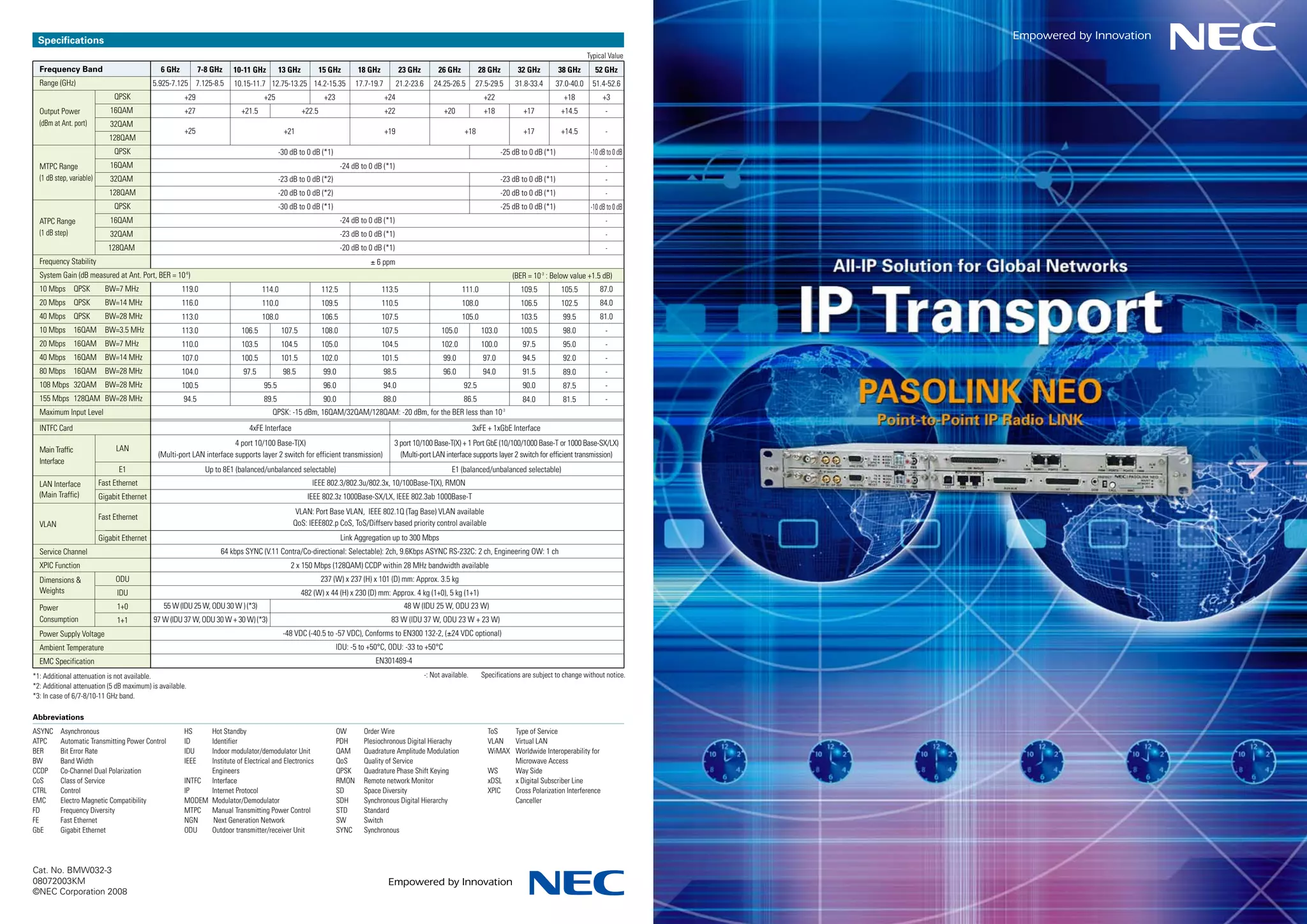
Frequency Band
Range (GHz)
QPSK
Output Power 16QAM
(dBm at Ant. port) 32QAM
128QAM
QPSK
MTPC Range 16QAM
(1 dB step, variable) 32QAM
128QAM
QPSK
ATPC Range 16QAM
(1 dB step) 32QAM
128QAM
Frequency Stability
System Gain (dB measured at Ant. Port, BER = 10-6
)
10 Mbps QPSK BW=7 MHz
20 Mbps QPSK BW=14 MHz
40 Mbps QPSK BW=28 MHz
10 Mbps 16QAM BW=3.5 MHz
20 Mbps 16QAM BW=7 MHz
40 Mbps 16QAM BW=14 MHz
80 Mbps 16QAM BW=28 MHz
108 Mbps 32QAM BW=28 MHz
155 Mbps 128QAM BW=28 MHz
Maximum Input Level
INTFC Card
Main Traffic LAN
Interface
E1
LAN Interface
(Main Traffic)
VLAN
Service Channel
XPIC Function
Dimensions & ODU
Weights IDU
Power 1+0
Consumption 1+1
Power Supply Voltage
Ambient Temperature
EMC Specification
Specifications
Specifications are subject to change without notice.-: Not available.
Typical Value
Cat. No. BMW032-3
08072003KM
©NEC Corporation 2008
6 GHz 7-8 GHz
5.925-7.125 7.125-8.5
+29
+27
+25
119.0
116.0
113.0
113.0
110.0
107.0
104.0
100.5
94.5
10-11 GHz
10.15-11.7
     +25
+21.5
     114.0
     110.0
     108.0
106.5
103.5
100.5
97.5
     95.5
     89.5
13 GHz
12.75-13.25
     +22.5
+21
 
107.5
104.5
101.5
98.5
15 GHz
14.2-15.35
+23
112.5
109.5
106.5
108.0
105.0
102.0
99.0
96.0
90.0
18 GHz
17.7-19.7
     +24
     +22
     +19
     113.5
     110.5
     107.5
     107.5
     104.5
     101.5
     98.5
     94.0
     88.0
23 GHz
21.2-23.6


26 GHz
24.25-26.5
+20
     +18
     111.0
     108.0
     105.0
105.0
102.0
99.0
96.0
     92.5
     86.5
28 GHz
27.5-29.5
+22
+18
 
103.0
100.0
97.0
94.0
32 GHz
31.8-33.4
 
+17
+17
109.5
106.5
103.5
100.5
97.5
94.5
91.5
90.0
84.0
38 GHz
37.0-40.0
+18
+14.5
+14.5
105.5
102.5
99.5
98.0
95.0
92.0
89.0
87.5
81.5
52 GHz
51.4-52.6
+3
-
-
-10 dB to 0 dB
-
-
-
-10 dB to 0 dB
-
-
-
87.0
84.0
81.0
-
-
-
-
-
-
-30 dB to 0 dB (*1) -25 dB to 0 dB (*1)
QPSK: -15 dBm, 16QAM/32QAM/128QAM: -20 dBm, for the BER less than 10-3
IEEE 802.3/802.3u/802.3x, 10/100Base-T(X), RMON
IEEE 802.3z 1000Base-SX/LX, IEEE 802.3ab 1000Base-T
VLAN: Port Base VLAN, IEEE 802.1Q (Tag Base) VLAN available
QoS: IEEE802.p CoS, ToS/Diffserv based priority control available
Link Aggregation up to 300 Mbps
64 kbps SYNC (V.11 Contra/Co-directional: Selectable): 2ch, 9.6Kbps ASYNC RS-232C: 2 ch, Engineering OW: 1 ch
2 x 150 Mbps (128QAM) CCDP within 28 MHz bandwidth available
237 (W) x 237 (H) x 101 (D) mm: Approx. 3.5 kg
482 (W) x 44 (H) x 230 (D) mm: Approx. 4 kg (1+0), 5 kg (1+1)
4xFE Interface
4 port 10/100 Base-T(X)
(Multi-port LAN interface supports layer 2 switch for efficient transmission)
Up to 8E1 (balanced/unbalanced selectable)
3xFE + 1xGbE Interface
3 port 10/100 Base-T(X) + 1 Port GbE (10/100/1000 Base-T or 1000 Base-SX/LX)
(Multi-port LAN interface supports layer 2 switch for efficient transmission)
E1 (balanced/unbalanced selectable)
-24 dB to 0 dB (*1)
± 6 ppm
-23 dB to 0 dB (*2)
-20 dB to 0 dB (*2)
-30 dB to 0 dB (*1)
-24 dB to 0 dB (*1)
-23 dB to 0 dB (*1)
-20 dB to 0 dB (*1)
-23 dB to 0 dB (*1)
-20 dB to 0 dB (*1)
-25 dB to 0 dB (*1)
(BER = 10-3
: Below value +1.5 dB)
Fast Ethernet
Gigabit Ethernet
Fast Ethernet
Gigabit Ethernet
55 W (IDU 25 W, ODU 30 W ) (*3)
97 W (IDU 37 W, ODU 30 W + 30 W) (*3)
48 W (IDU 25 W, ODU 23 W)
83 W (IDU 37 W, ODU 23 W + 23 W)
*1: Additional attenuation is not available.
*2: Additional attenuation (5 dB maximum) is available.
*3: In case of 6/7-8/10-11 GHz band.
-48 VDC (-40.5 to -57 VDC), Conforms to EN300 132-2, (±24 VDC optional)
IDU: -5 to +50°C, ODU: -33 to +50°C
EN301489-4
ASYNC Asynchronous
ATPC Automatic Transmitting Power Control
BER Bit Error Rate
BW Band Width
CCDP Co-Channel Dual Polarization
CoS Class of Service
CTRL Control
EMC Electro Magnetic Compatibility
FD Frequency Diversity
FE Fast Ethernet
GbE Gigabit Ethernet
HS Hot Standby
ID Identifier
IDU Indoor modulator/demodulator Unit
IEEE Institute of Electrical and Electronics
Engineers
INTFC Interface
IP Internet Protocol
MODEM Modulator/Demodulator
MTPC Manual Transmitting Power Control
NGN  Next Generation Network
ODU Outdoor transmitter/receiver Unit
OW Order Wire
PDH Plesiochronous Digital Hierachy
QAM Quadrature Amplitude Modulation
QoS Quality of Service
QPSK Quadrature Phase Shift Keying
RMON Remote network Monitor
SD Space Diversity
SDH Synchronous Digital Hierarchy
STD Standard
SW Switch
SYNC Synchronous
ToS Type of Service
VLAN Virtual LAN
WiMAX Worldwide Interoperability for
Microwave Access
WS Way Side
xDSL x Digital Subscriber Line
XPIC Cross Polarization Interference
Canceller
Abbreviations
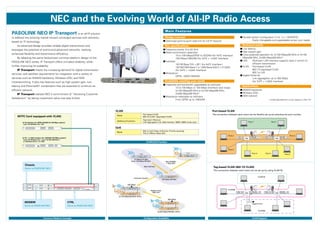
Design concept
■ Optimized point-to-point radio link for full IP network
Key specifications
■ Frequency bands: 6 to 52 GHz
■ Radio transmission capacities:
10 to 100 Mbps/QPSK to 32QAM (for 4xFE Interface)
150 Mbps/128QAM (for 3xFE + 1xGbE Interface)
■ Interface:
10/100 Base-T(X) + 8E1 (for 4xFE Interface )
10/100/1000 Base-T or 1000 Base-SX/LX + E1(WS)
(for 3xFE + 1xGbE Interface)
■ Modulation:
QPSK, 16/32/128QAM
Scalability meeting your needs
■ Capacities and bandwidth upgradeable by software
10 to 100 Mbps or 150 Mbps (interface card swap),
2x150 Mbps/28 MHz or 4x150 Mbps/56 MHz,
2x300 Mbps/56 MHz*
■ Modulation selectable by software
From QPSK up to 128QAM
■ Flexible system configuration (1+0, 1+1, HS/SD/FD)
Easily changeable and upgradeable as per your needs
Technical merits
■ Low latency
■ High system gain
■ Cross polarized operation for 2x150 Mbps/28 MHz or 4x150
Mbps/56 MHz, 2x300 Mbps/56 MHz*
■ LAN Multi-port LAN interface supports layer 2 switch for
efficient transmission
■ VLAN Port-based VLAN
802.1Q tag-based VLAN
802.1p CoS
■ Gigabit Ethernet
Link aggregation up to 300 Mbps
(for 3xFE + 1xGbE Interface)
Applications
■ WiMAX backbone
■ Wireless xDSL
■ NGN network
*: 2x300 Mbps/56 MHz will be released in NEO HP.
INTFC Card (equipped with VLAN)
4x FE Interface (for QPSK-32QAM/10-100 Mbps system)
4 port 10/100 Base-T(X) + 4E1
3x FE + 1x GbE Interface (for 128QAM/150 Mbps system)
3 port 10/100 Base-T(X) + 1 port 10/100/1000 Base-T
or 1000 Base-SX/LX + E1 (WS)
MODEM
Same as PASOLINK NEO
CTRL
Same as PASOLINK NEO
Chassis
Same as PASOLINK NEO
Common Platform Concept Configuration Scalability VLAN Support
VLAN/QoS Function
Port-based VLAN
The connection between each client can be flexibly set up by selecting the port number.
Tag-based VLAN (802.1Q VLAN)
The connection between each client can be set up by using VLAN ID.
Port 1 Port 1
Port 2 Port 2
Port 3
Port 4 Port 4 Port 3
SW SW
VLAN30
VLAN10
VLAN20
Tagged Frame
SW SW
2x150 Mbps/28 MHz (XPIC)
10 Mbps/3.5 MHz
up to 100 Mbps/28 MHz
New Interface
New MODEM
+ New ODU
1+0
300 Mbps
Increment System
1+1
150 Mbps/28 MHz
Replace IDUs
(NEO HP)
Port-based VLAN
802.1Q VLAN (Tag-based VLAN)
Tag Insert / Remove
Link Aggregation (for GbE Interface 150M+150M mode only)
Mode
Additional functions
VLAN
802.1p CoS (Class of Service: Priority queuing)
ToS or Diffserv Base QoS
Mode
QoS
600 Mbps
2x300 Mbps/56 MHz (XPIC)
Main Features
NEC and the Evolving World of All-IP Radio Access
PASOLINK NEO IP Transport is an all-IP solution
to address the evolving market toward converged services and networks,
based on IP technology.
  Its advanced design provides reliable digital transmission and
leverages the potential of end-to-end advanced networks, realizing
enhanced flexibility and transmission efficiency.
  By adopting the same field-proven common-platform design of the
PASOLINK NEO series, IP Transport offers unrivaled reliability, while
further improving its scalability.
  IP Transport meets the increasing demand for digital transmission
services, and satisfies requirements for integration with a variety of
services such as WiMAX backbone, Wireless xDSL and NGN
Intranetworking. It also has features such as high system gain, low
latency and Ethernet/E1 combination that are essential to construct an
efficient network.
  IP Transport realizes NEC’s commitment of “Achieving Customer
Satisfaction” by taking investment value one step further.

Paso neo ip

  • 1.
    Frequency Band Range (GHz) QPSK OutputPower 16QAM (dBm at Ant. port) 32QAM 128QAM QPSK MTPC Range 16QAM (1 dB step, variable) 32QAM 128QAM QPSK ATPC Range 16QAM (1 dB step) 32QAM 128QAM Frequency Stability System Gain (dB measured at Ant. Port, BER = 10-6 ) 10 Mbps QPSK BW=7 MHz 20 Mbps QPSK BW=14 MHz 40 Mbps QPSK BW=28 MHz 10 Mbps 16QAM BW=3.5 MHz 20 Mbps 16QAM BW=7 MHz 40 Mbps 16QAM BW=14 MHz 80 Mbps 16QAM BW=28 MHz 108 Mbps 32QAM BW=28 MHz 155 Mbps 128QAM BW=28 MHz Maximum Input Level INTFC Card Main Traffic LAN Interface E1 LAN Interface (Main Traffic) VLAN Service Channel XPIC Function Dimensions & ODU Weights IDU Power 1+0 Consumption 1+1 Power Supply Voltage Ambient Temperature EMC Specification Specifications Specifications are subject to change without notice.-: Not available. Typical Value Cat. No. BMW032-3 08072003KM ©NEC Corporation 2008 6 GHz 7-8 GHz 5.925-7.125 7.125-8.5 +29 +27 +25 119.0 116.0 113.0 113.0 110.0 107.0 104.0 100.5 94.5 10-11 GHz 10.15-11.7      +25 +21.5      114.0      110.0      108.0 106.5 103.5 100.5 97.5      95.5      89.5 13 GHz 12.75-13.25      +22.5 +21   107.5 104.5 101.5 98.5 15 GHz 14.2-15.35 +23 112.5 109.5 106.5 108.0 105.0 102.0 99.0 96.0 90.0 18 GHz 17.7-19.7      +24      +22      +19      113.5      110.5      107.5      107.5      104.5      101.5      98.5      94.0      88.0 23 GHz 21.2-23.6         26 GHz 24.25-26.5 +20      +18      111.0      108.0      105.0 105.0 102.0 99.0 96.0      92.5      86.5 28 GHz 27.5-29.5 +22 +18   103.0 100.0 97.0 94.0 32 GHz 31.8-33.4   +17 +17 109.5 106.5 103.5 100.5 97.5 94.5 91.5 90.0 84.0 38 GHz 37.0-40.0 +18 +14.5 +14.5 105.5 102.5 99.5 98.0 95.0 92.0 89.0 87.5 81.5 52 GHz 51.4-52.6 +3 - - -10 dB to 0 dB - - - -10 dB to 0 dB - - - 87.0 84.0 81.0 - - - - - - -30 dB to 0 dB (*1) -25 dB to 0 dB (*1) QPSK: -15 dBm, 16QAM/32QAM/128QAM: -20 dBm, for the BER less than 10-3 IEEE 802.3/802.3u/802.3x, 10/100Base-T(X), RMON IEEE 802.3z 1000Base-SX/LX, IEEE 802.3ab 1000Base-T VLAN: Port Base VLAN, IEEE 802.1Q (Tag Base) VLAN available QoS: IEEE802.p CoS, ToS/Diffserv based priority control available Link Aggregation up to 300 Mbps 64 kbps SYNC (V.11 Contra/Co-directional: Selectable): 2ch, 9.6Kbps ASYNC RS-232C: 2 ch, Engineering OW: 1 ch 2 x 150 Mbps (128QAM) CCDP within 28 MHz bandwidth available 237 (W) x 237 (H) x 101 (D) mm: Approx. 3.5 kg 482 (W) x 44 (H) x 230 (D) mm: Approx. 4 kg (1+0), 5 kg (1+1) 4xFE Interface 4 port 10/100 Base-T(X) (Multi-port LAN interface supports layer 2 switch for efficient transmission) Up to 8E1 (balanced/unbalanced selectable) 3xFE + 1xGbE Interface 3 port 10/100 Base-T(X) + 1 Port GbE (10/100/1000 Base-T or 1000 Base-SX/LX) (Multi-port LAN interface supports layer 2 switch for efficient transmission) E1 (balanced/unbalanced selectable) -24 dB to 0 dB (*1) ± 6 ppm -23 dB to 0 dB (*2) -20 dB to 0 dB (*2) -30 dB to 0 dB (*1) -24 dB to 0 dB (*1) -23 dB to 0 dB (*1) -20 dB to 0 dB (*1) -23 dB to 0 dB (*1) -20 dB to 0 dB (*1) -25 dB to 0 dB (*1) (BER = 10-3 : Below value +1.5 dB) Fast Ethernet Gigabit Ethernet Fast Ethernet Gigabit Ethernet 55 W (IDU 25 W, ODU 30 W ) (*3) 97 W (IDU 37 W, ODU 30 W + 30 W) (*3) 48 W (IDU 25 W, ODU 23 W) 83 W (IDU 37 W, ODU 23 W + 23 W) *1: Additional attenuation is not available. *2: Additional attenuation (5 dB maximum) is available. *3: In case of 6/7-8/10-11 GHz band. -48 VDC (-40.5 to -57 VDC), Conforms to EN300 132-2, (±24 VDC optional) IDU: -5 to +50°C, ODU: -33 to +50°C EN301489-4 ASYNC Asynchronous ATPC Automatic Transmitting Power Control BER Bit Error Rate BW Band Width CCDP Co-Channel Dual Polarization CoS Class of Service CTRL Control EMC Electro Magnetic Compatibility FD Frequency Diversity FE Fast Ethernet GbE Gigabit Ethernet HS Hot Standby ID Identifier IDU Indoor modulator/demodulator Unit IEEE Institute of Electrical and Electronics Engineers INTFC Interface IP Internet Protocol MODEM Modulator/Demodulator MTPC Manual Transmitting Power Control NGN  Next Generation Network ODU Outdoor transmitter/receiver Unit OW Order Wire PDH Plesiochronous Digital Hierachy QAM Quadrature Amplitude Modulation QoS Quality of Service QPSK Quadrature Phase Shift Keying RMON Remote network Monitor SD Space Diversity SDH Synchronous Digital Hierarchy STD Standard SW Switch SYNC Synchronous ToS Type of Service VLAN Virtual LAN WiMAX Worldwide Interoperability for Microwave Access WS Way Side xDSL x Digital Subscriber Line XPIC Cross Polarization Interference Canceller Abbreviations
  • 2.
    Design concept ■ Optimizedpoint-to-point radio link for full IP network Key specifications ■ Frequency bands: 6 to 52 GHz ■ Radio transmission capacities: 10 to 100 Mbps/QPSK to 32QAM (for 4xFE Interface) 150 Mbps/128QAM (for 3xFE + 1xGbE Interface) ■ Interface: 10/100 Base-T(X) + 8E1 (for 4xFE Interface ) 10/100/1000 Base-T or 1000 Base-SX/LX + E1(WS) (for 3xFE + 1xGbE Interface) ■ Modulation: QPSK, 16/32/128QAM Scalability meeting your needs ■ Capacities and bandwidth upgradeable by software 10 to 100 Mbps or 150 Mbps (interface card swap), 2x150 Mbps/28 MHz or 4x150 Mbps/56 MHz, 2x300 Mbps/56 MHz* ■ Modulation selectable by software From QPSK up to 128QAM ■ Flexible system configuration (1+0, 1+1, HS/SD/FD) Easily changeable and upgradeable as per your needs Technical merits ■ Low latency ■ High system gain ■ Cross polarized operation for 2x150 Mbps/28 MHz or 4x150 Mbps/56 MHz, 2x300 Mbps/56 MHz* ■ LAN Multi-port LAN interface supports layer 2 switch for efficient transmission ■ VLAN Port-based VLAN 802.1Q tag-based VLAN 802.1p CoS ■ Gigabit Ethernet Link aggregation up to 300 Mbps (for 3xFE + 1xGbE Interface) Applications ■ WiMAX backbone ■ Wireless xDSL ■ NGN network *: 2x300 Mbps/56 MHz will be released in NEO HP. INTFC Card (equipped with VLAN) 4x FE Interface (for QPSK-32QAM/10-100 Mbps system) 4 port 10/100 Base-T(X) + 4E1 3x FE + 1x GbE Interface (for 128QAM/150 Mbps system) 3 port 10/100 Base-T(X) + 1 port 10/100/1000 Base-T or 1000 Base-SX/LX + E1 (WS) MODEM Same as PASOLINK NEO CTRL Same as PASOLINK NEO Chassis Same as PASOLINK NEO Common Platform Concept Configuration Scalability VLAN Support VLAN/QoS Function Port-based VLAN The connection between each client can be flexibly set up by selecting the port number. Tag-based VLAN (802.1Q VLAN) The connection between each client can be set up by using VLAN ID. Port 1 Port 1 Port 2 Port 2 Port 3 Port 4 Port 4 Port 3 SW SW VLAN30 VLAN10 VLAN20 Tagged Frame SW SW 2x150 Mbps/28 MHz (XPIC) 10 Mbps/3.5 MHz up to 100 Mbps/28 MHz New Interface New MODEM + New ODU 1+0 300 Mbps Increment System 1+1 150 Mbps/28 MHz Replace IDUs (NEO HP) Port-based VLAN 802.1Q VLAN (Tag-based VLAN) Tag Insert / Remove Link Aggregation (for GbE Interface 150M+150M mode only) Mode Additional functions VLAN 802.1p CoS (Class of Service: Priority queuing) ToS or Diffserv Base QoS Mode QoS 600 Mbps 2x300 Mbps/56 MHz (XPIC) Main Features NEC and the Evolving World of All-IP Radio Access PASOLINK NEO IP Transport is an all-IP solution to address the evolving market toward converged services and networks, based on IP technology.   Its advanced design provides reliable digital transmission and leverages the potential of end-to-end advanced networks, realizing enhanced flexibility and transmission efficiency.   By adopting the same field-proven common-platform design of the PASOLINK NEO series, IP Transport offers unrivaled reliability, while further improving its scalability.   IP Transport meets the increasing demand for digital transmission services, and satisfies requirements for integration with a variety of services such as WiMAX backbone, Wireless xDSL and NGN Intranetworking. It also has features such as high system gain, low latency and Ethernet/E1 combination that are essential to construct an efficient network.   IP Transport realizes NEC’s commitment of “Achieving Customer Satisfaction” by taking investment value one step further.