PRIMITIVE DATA TYPES
-Integer
-Floating Point
-Decimal
-Boolean
-Character
STRINGS
-Character Array
-Class
-String Length
-Static
-Limited Dynamic
-Dynamic
ENUMERATION TYPES
- C++
- Fortran
- Java
SUBRANGE TYPES
ARRAYS
-Indexing
-Flavors
-Static
-Fixed Stack Dynamic
-Stack Dynamic
-Fixed Heap-Dynamic
-Heap Dynamic
-Initalization
-Operations (APL)
-Rectangular/Jagged
-Implementation
-Single Dimensional
-Multi Dimensional
ASSOCIATIVE ARRAYS
RECORD TYPES
UNION TYPES
POINTER/REFERENCE TYPES
-Fundamental Operations
-Problems
-Memory Leak
-Dangling Pointer
-C++
-Java
-Solutions to Pointer Problems
-Tombstone
-Heap Management
-Reference Counter
-Garbage Collection
LECTURE OUTLINE FOR:
CHAPTER 6
DATA TYPES
C++ Weak Typing to Display Integer
int main(void)
{
int theInt = 42;
char* theBytes = &theInt;
cout << “int is: “ << theInt << endl;
cout << “byte values: “
<< ((int) (unsigned char)) theBytes[0] << “ “
<< ((int) (unsigned char)) theBytes[1] << “ “
<< ((int) (unsigned char)) theBytes[2] << “ “
<< ((int) (unsigned char)) theBytes[3] << “ “
<< endl;
}
C++ Weak Typing to Display Integer
Hexadecimal
int main(void)
{
int theInt = 42;
char* theBytes = &theInt;
cout << “int is: “ << theInt << endl;
cout << “byte values: “
<< hex << ((int) (unsigned char)) theBytes[0] << “ “
<< hex << ((int) (unsigned char)) theBytes[1] << “ “
<< hex << ((int) (unsigned char)) theBytes[2] << “ “
<< hex << ((int) (unsigned char)) theBytes[3] << “ “
<< endl;
}
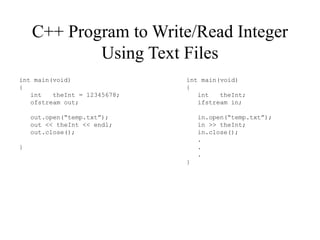
C++ Program to Write/Read Integer
Using Text Files
int main(void)
{
int theInt = 12345678;
ofstream out;
out.open(“temp.txt”);
out << theInt << endl;
out.close();
}
int main(void)
{
int theInt;
ifstream in;
in.open(“temp.txt”);
in >> theInt;
in.close();
.
.
.
}
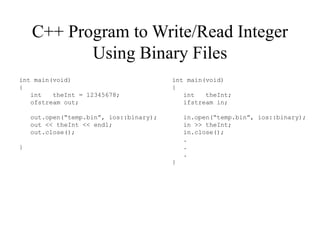
C++ Program to Write/Read Integer
Using Binary Files
int main(void)
{
int theInt = 12345678;
ofstream out;
out.open(“temp.bin”, ios::binary);
out << theInt << endl;
out.close();
}
int main(void)
{
int theInt;
ifstream in;
in.open(“temp.bin”, ios::binary);
in >> theInt;
in.close();
.
.
.
}
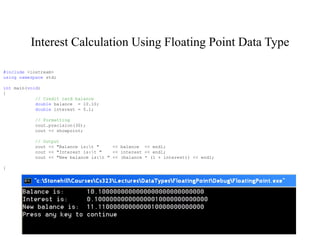
Interest Calculation Using Floating Point Data Type
#include <iostream>
using namespace std;
int main(void)
{
// Credit card balance
double balance = 10.10;
double interest = 0.1;
// Formatting
cout.precision(30);
cout << showpoint;
// Output
cout << "Balance is:t " << balance << endl;
cout << "Interest is:t " << interest << endl;
cout << "New balance is:t " << (balance * (1 + interest)) << endl;
}
Interest Calculation Using Decimal Data Type
VC++ .NET
#include "stdafx.h"
#using <mscorlib.dll>
using namespace System;
int _tmain()
{
// Credit card balance
Decimal balance = 10.10;
Decimal interest = 0.1;
// Output
Console::WriteLine("Balance is:t {0}",balance.ToString("F30"));
Console::WriteLine("Interest is:t {0}",interest.ToString("F30"));
Console::WriteLine("New Balance is:t {0}",(balance * (1 + interest)).ToString("F30"));
return 0;
}
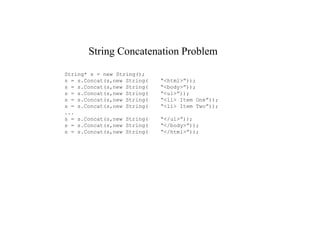
String* s = new String();
s = s.Concat(s,new String( “<html>”));
s = s.Concat(s,new String( “<body>”));
s = s.Concat(s,new String( “<ul>”));
s = s.Concat(s,new String( “<li> Item One”));
s = s.Concat(s,new String( “<li> Item Two”));
...
s = s.Concat(s,new String( “</ul>”));
s = s.Concat(s,new String( “</body>”));
s = s.Concat(s,new String( “</html>”));
String Concatenation Problem
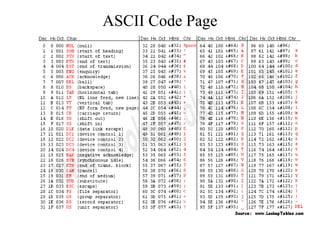
ASCII Code Page
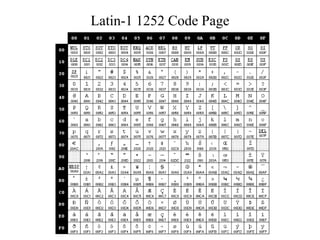
Latin-1 1252 Code Page
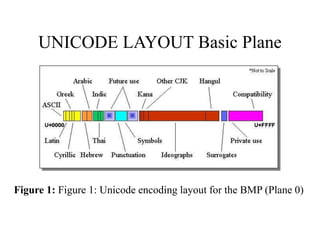
Figure 1: Figure 1: Unicode encoding layout for the BMP (Plane 0)
UNICODE LAYOUT Basic Plane
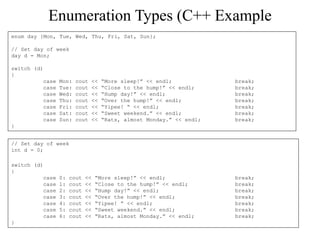
enum day {Mon, Tue, Wed, Thu, Fri, Sat, Sun};
// Set day of week
day d = Mon;
switch (d)
{
case Mon: cout << “More sleep!” << endl; break;
case Tue: cout << “Close to the hump!” << endl; break;
case Wed: cout << “Hump day!” << endl; break;
case Thu: cout << “Over the hump!” << endl; break;
case Fri: cout << “Yipee! “ << endl; break;
case Sat: cout << “Sweet weekend.” << endl; break;
case Sun: cout << “Rats, almost Monday.” << endl; break;
}
// Set day of week
int d = 0;
switch (d)
{
case 0: cout << “More sleep!” << endl; break;
case 1: cout << “Close to the hump!” << endl; break;
case 2: cout << “Hump day!” << endl; break;
case 3: cout << “Over the hump!” << endl; break;
case 4: cout << “Yipee! “ << endl; break;
case 5: cout << “Sweet weekend.” << endl; break;
case 6: cout << “Rats, almost Monday.” << endl; break;
}
Enumeration Types (C++ Example
public final class Day {
public static final Day MON = new Day();
public static final Day TUE = new Day();
public static final Day WED = new Day();
public static final Day THU = new Day();
public static final Day FRI = new Day();
public static final Day SAT = new Day();
public static final Day SUN = new Day();
private Day() {
// Empty private constructor ensures the only objects of
// this type are the enumerated elements declared above.
}
}
Enumeration Types (Java
Example)
Disk
Program
in
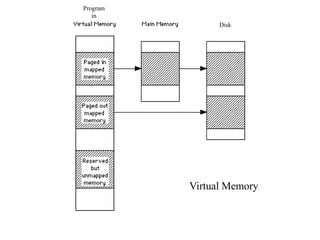
Virtual Memory
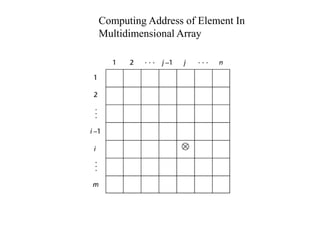
Computing Address of Element In
Multidimensional Array
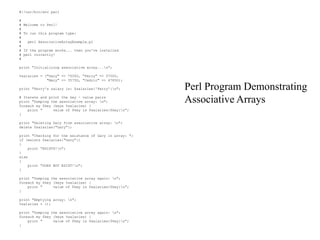
#!/usr/bin/env perl
#
# Welcome to Perl!
#
# To run this program type:
#
# perl AssociativeArrayExample.pl
#
# If the program works... then you've installed
# perl correctly!
#
print "Initializing associative array...n";
%salaries = ("Gary" => 75000, "Perry" => 57000,
"Mary" => 55750, "Cedric" => 47850);
print "Perry's salary is: $salaries{'Perry'}n";
# Iterate and print the key - value pairs
print "Dumping the associative array: n";
foreach my $key (keys %salaries) {
print " value of $key is $salaries{$key}n";
}
print "Deleting Gary from associative array: n";
delete $salaries{"Gary"};
print "Checking for the existance of Gary in array: ";
if (exists $salaries{"Gary"})
{
print "EXISTS!n";
}
else
{
print "DOES NOT EXIST!n";
}
print "Dumping the associative array again: n";
foreach my $key (keys %salaries) {
print " value of $key is $salaries{$key}n";
}
print "Emptying array: n";
%salaries = ();
print "Dumping the associative array again: n";
foreach my $key (keys %salaries) {
print " value of $key is $salaries{$key}n";
}
Perl Program Demonstrating
Associative Arrays
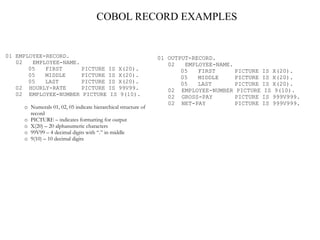
COBOL RECORD EXAMPLES
01 OUTPUT-RECORD.
02 EMPLOYEE-NAME.
05 FIRST PICTURE IS X(20).
05 MIDDLE PICTURE IS X(20).
05 LAST PICTURE IS X(20).
02 EMPLOYEE-NUMBER PICTURE IS 9(10).
02 GROSS-PAY PICTURE IS 999V999.
02 NET-PAY PICTURE IS 999V999.
01 EMPLOYEE-RECORD.
02 EMPLOYEE-NAME.
05 FIRST PICTURE IS X(20).
05 MIDDLE PICTURE IS X(20).
05 LAST PICTURE IS X(20).
02 HOURLY-RATE PICTURE IS 99V99.
02 EMPLOYEE-NUMBER PICTURE IS 9(10).
o Numerals 01, 02, 05 indicate hierarchical structure of
record
o PICTURE – indicates formatting for output
o X(20) – 20 alphanumeric characters
o 99V99 – 4 decimal digits with “.” in middle
o 9(10) – 10 decimal digits
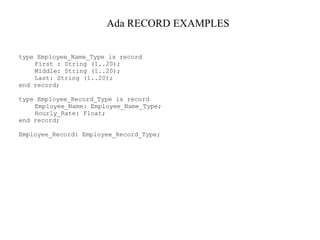
Ada RECORD EXAMPLES
type Employee_Name_Type is record
First : String (1..20);
Middle: String (1..20);
Last: String (1..20);
end record;
type Employee_Record_Type is record
Employee_Name: Employee_Name_Type;
Hourly_Rate: Float;
end record;
Employee_Record: Employee_Record_Type;
C++ UNION TYPES
#include <iostream>
using namespace std; //introduces namespace std
int main( void )
{
typedef union _GenericInput
{
bool theBool;
char theChar;
int theInt;
double theDouble;
} GenericInput;
GenericInput input0;
GenericInput input1;
cout << "Enter a character: ";
cin >> input0.theChar;
cout << "Enter a double: ";
cin >> input1.theDouble;
// You should not be able to assign these two variables
// because they hold different types (char and double)
// but the “free union” capability in C,C++ allows this
// DANGEROUS!!!
input0 = input1;
char *byteArray = (char *) &input1;
cout << hex << ((int) ((unsigned char) byteArray[0])) << " "
<< ((int) ((unsigned char) byteArray[1])) << " "
<< ((int) ((unsigned char) byteArray[2])) << " "
<< ((int) ((unsigned char) byteArray[3])) << " "
<< ((int) ((unsigned char) byteArray[4])) << " "
<< ((int) ((unsigned char) byteArray[5])) << " "
<< ((int) ((unsigned char) byteArray[6])) << " "
<< ((int) ((unsigned char) byteArray[7])) << endl;
cout << "As boolean x[" << input0.theBool << "]" << endl;
cout << "As character [" << input0.theChar << "]" << endl;
cout << "As integer x[" << input0.theInt << "]" << endl;
cout << "As double [" << input0.theDouble << "]" << endl;
return 0;
}
OUTPUT:
Enter a character: a
Enter a double: 10.2
66 66 66 66 66 66 24 40
As boolean x[66]
As character [f]
As integer x[66666666]
As double [10.2]
Press any key to continue
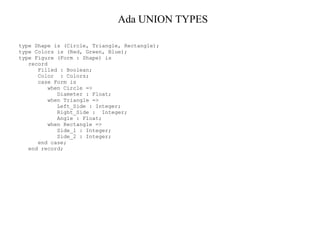
type Shape is (Circle, Triangle, Rectangle);
type Colors is (Red, Green, Blue);
type Figure (Form : Shape) is
record
Filled : Boolean;
Color : Colors;
case Form is
when Circle =>
Diameter : Float;
when Triangle =>
Left_Side : Integer;
Right_Side : Integer;
Angle : Float;
when Rectangle =>
Side_1 : Integer;
Side_2 : Integer;
end case;
end record;
Ada UNION TYPES

DataTypes.ppt

  • 1.
    PRIMITIVE DATA TYPES -Integer -FloatingPoint -Decimal -Boolean -Character STRINGS -Character Array -Class -String Length -Static -Limited Dynamic -Dynamic ENUMERATION TYPES - C++ - Fortran - Java SUBRANGE TYPES ARRAYS -Indexing -Flavors -Static -Fixed Stack Dynamic -Stack Dynamic -Fixed Heap-Dynamic -Heap Dynamic -Initalization -Operations (APL) -Rectangular/Jagged -Implementation -Single Dimensional -Multi Dimensional ASSOCIATIVE ARRAYS RECORD TYPES UNION TYPES POINTER/REFERENCE TYPES -Fundamental Operations -Problems -Memory Leak -Dangling Pointer -C++ -Java -Solutions to Pointer Problems -Tombstone -Heap Management -Reference Counter -Garbage Collection LECTURE OUTLINE FOR: CHAPTER 6 DATA TYPES
  • 2.
    C++ Weak Typingto Display Integer int main(void) { int theInt = 42; char* theBytes = &theInt; cout << “int is: “ << theInt << endl; cout << “byte values: “ << ((int) (unsigned char)) theBytes[0] << “ “ << ((int) (unsigned char)) theBytes[1] << “ “ << ((int) (unsigned char)) theBytes[2] << “ “ << ((int) (unsigned char)) theBytes[3] << “ “ << endl; }
  • 3.
    C++ Weak Typingto Display Integer Hexadecimal int main(void) { int theInt = 42; char* theBytes = &theInt; cout << “int is: “ << theInt << endl; cout << “byte values: “ << hex << ((int) (unsigned char)) theBytes[0] << “ “ << hex << ((int) (unsigned char)) theBytes[1] << “ “ << hex << ((int) (unsigned char)) theBytes[2] << “ “ << hex << ((int) (unsigned char)) theBytes[3] << “ “ << endl; }
  • 4.
    C++ Program toWrite/Read Integer Using Text Files int main(void) { int theInt = 12345678; ofstream out; out.open(“temp.txt”); out << theInt << endl; out.close(); } int main(void) { int theInt; ifstream in; in.open(“temp.txt”); in >> theInt; in.close(); . . . }
  • 5.
    C++ Program toWrite/Read Integer Using Binary Files int main(void) { int theInt = 12345678; ofstream out; out.open(“temp.bin”, ios::binary); out << theInt << endl; out.close(); } int main(void) { int theInt; ifstream in; in.open(“temp.bin”, ios::binary); in >> theInt; in.close(); . . . }
  • 6.
    Interest Calculation UsingFloating Point Data Type #include <iostream> using namespace std; int main(void) { // Credit card balance double balance = 10.10; double interest = 0.1; // Formatting cout.precision(30); cout << showpoint; // Output cout << "Balance is:t " << balance << endl; cout << "Interest is:t " << interest << endl; cout << "New balance is:t " << (balance * (1 + interest)) << endl; }
  • 7.
    Interest Calculation UsingDecimal Data Type VC++ .NET #include "stdafx.h" #using <mscorlib.dll> using namespace System; int _tmain() { // Credit card balance Decimal balance = 10.10; Decimal interest = 0.1; // Output Console::WriteLine("Balance is:t {0}",balance.ToString("F30")); Console::WriteLine("Interest is:t {0}",interest.ToString("F30")); Console::WriteLine("New Balance is:t {0}",(balance * (1 + interest)).ToString("F30")); return 0; }
  • 9.
    String* s =new String(); s = s.Concat(s,new String( “<html>”)); s = s.Concat(s,new String( “<body>”)); s = s.Concat(s,new String( “<ul>”)); s = s.Concat(s,new String( “<li> Item One”)); s = s.Concat(s,new String( “<li> Item Two”)); ... s = s.Concat(s,new String( “</ul>”)); s = s.Concat(s,new String( “</body>”)); s = s.Concat(s,new String( “</html>”)); String Concatenation Problem
  • 10.
  • 11.
  • 14.
    Figure 1: Figure1: Unicode encoding layout for the BMP (Plane 0) UNICODE LAYOUT Basic Plane
  • 15.
    enum day {Mon,Tue, Wed, Thu, Fri, Sat, Sun}; // Set day of week day d = Mon; switch (d) { case Mon: cout << “More sleep!” << endl; break; case Tue: cout << “Close to the hump!” << endl; break; case Wed: cout << “Hump day!” << endl; break; case Thu: cout << “Over the hump!” << endl; break; case Fri: cout << “Yipee! “ << endl; break; case Sat: cout << “Sweet weekend.” << endl; break; case Sun: cout << “Rats, almost Monday.” << endl; break; } // Set day of week int d = 0; switch (d) { case 0: cout << “More sleep!” << endl; break; case 1: cout << “Close to the hump!” << endl; break; case 2: cout << “Hump day!” << endl; break; case 3: cout << “Over the hump!” << endl; break; case 4: cout << “Yipee! “ << endl; break; case 5: cout << “Sweet weekend.” << endl; break; case 6: cout << “Rats, almost Monday.” << endl; break; } Enumeration Types (C++ Example
  • 16.
    public final classDay { public static final Day MON = new Day(); public static final Day TUE = new Day(); public static final Day WED = new Day(); public static final Day THU = new Day(); public static final Day FRI = new Day(); public static final Day SAT = new Day(); public static final Day SUN = new Day(); private Day() { // Empty private constructor ensures the only objects of // this type are the enumerated elements declared above. } } Enumeration Types (Java Example)
  • 17.
  • 18.
    Computing Address ofElement In Multidimensional Array
  • 19.
    #!/usr/bin/env perl # # Welcometo Perl! # # To run this program type: # # perl AssociativeArrayExample.pl # # If the program works... then you've installed # perl correctly! # print "Initializing associative array...n"; %salaries = ("Gary" => 75000, "Perry" => 57000, "Mary" => 55750, "Cedric" => 47850); print "Perry's salary is: $salaries{'Perry'}n"; # Iterate and print the key - value pairs print "Dumping the associative array: n"; foreach my $key (keys %salaries) { print " value of $key is $salaries{$key}n"; } print "Deleting Gary from associative array: n"; delete $salaries{"Gary"}; print "Checking for the existance of Gary in array: "; if (exists $salaries{"Gary"}) { print "EXISTS!n"; } else { print "DOES NOT EXIST!n"; } print "Dumping the associative array again: n"; foreach my $key (keys %salaries) { print " value of $key is $salaries{$key}n"; } print "Emptying array: n"; %salaries = (); print "Dumping the associative array again: n"; foreach my $key (keys %salaries) { print " value of $key is $salaries{$key}n"; } Perl Program Demonstrating Associative Arrays
  • 20.
    COBOL RECORD EXAMPLES 01OUTPUT-RECORD. 02 EMPLOYEE-NAME. 05 FIRST PICTURE IS X(20). 05 MIDDLE PICTURE IS X(20). 05 LAST PICTURE IS X(20). 02 EMPLOYEE-NUMBER PICTURE IS 9(10). 02 GROSS-PAY PICTURE IS 999V999. 02 NET-PAY PICTURE IS 999V999. 01 EMPLOYEE-RECORD. 02 EMPLOYEE-NAME. 05 FIRST PICTURE IS X(20). 05 MIDDLE PICTURE IS X(20). 05 LAST PICTURE IS X(20). 02 HOURLY-RATE PICTURE IS 99V99. 02 EMPLOYEE-NUMBER PICTURE IS 9(10). o Numerals 01, 02, 05 indicate hierarchical structure of record o PICTURE – indicates formatting for output o X(20) – 20 alphanumeric characters o 99V99 – 4 decimal digits with “.” in middle o 9(10) – 10 decimal digits
  • 21.
    Ada RECORD EXAMPLES typeEmployee_Name_Type is record First : String (1..20); Middle: String (1..20); Last: String (1..20); end record; type Employee_Record_Type is record Employee_Name: Employee_Name_Type; Hourly_Rate: Float; end record; Employee_Record: Employee_Record_Type;
  • 22.
    C++ UNION TYPES #include<iostream> using namespace std; //introduces namespace std int main( void ) { typedef union _GenericInput { bool theBool; char theChar; int theInt; double theDouble; } GenericInput; GenericInput input0; GenericInput input1; cout << "Enter a character: "; cin >> input0.theChar; cout << "Enter a double: "; cin >> input1.theDouble; // You should not be able to assign these two variables // because they hold different types (char and double) // but the “free union” capability in C,C++ allows this // DANGEROUS!!! input0 = input1; char *byteArray = (char *) &input1; cout << hex << ((int) ((unsigned char) byteArray[0])) << " " << ((int) ((unsigned char) byteArray[1])) << " " << ((int) ((unsigned char) byteArray[2])) << " " << ((int) ((unsigned char) byteArray[3])) << " " << ((int) ((unsigned char) byteArray[4])) << " " << ((int) ((unsigned char) byteArray[5])) << " " << ((int) ((unsigned char) byteArray[6])) << " " << ((int) ((unsigned char) byteArray[7])) << endl; cout << "As boolean x[" << input0.theBool << "]" << endl; cout << "As character [" << input0.theChar << "]" << endl; cout << "As integer x[" << input0.theInt << "]" << endl; cout << "As double [" << input0.theDouble << "]" << endl; return 0; } OUTPUT: Enter a character: a Enter a double: 10.2 66 66 66 66 66 66 24 40 As boolean x[66] As character [f] As integer x[66666666] As double [10.2] Press any key to continue
  • 23.
    type Shape is(Circle, Triangle, Rectangle); type Colors is (Red, Green, Blue); type Figure (Form : Shape) is record Filled : Boolean; Color : Colors; case Form is when Circle => Diameter : Float; when Triangle => Left_Side : Integer; Right_Side : Integer; Angle : Float; when Rectangle => Side_1 : Integer; Side_2 : Integer; end case; end record; Ada UNION TYPES