
Identifying and Annotating Speakers
in Phone Conversations
Identifying and Annotating Speakers
in Phone Conversations
Yuriy Guts
DataRobot
Yuriy Guts
DataRobot
SPEAKER A SPEAKER B SPEAKER A SPEAKER C SPEAKER B
No prior knowledge about the speakers whatsoever.
1. Extract compact metadata from bulky multimedia sources.
2. Enable information retrieval queries for audio content.
3. Provide training data for upstream modeling projects:
○ Speaker identification
○ Speech recognition
○ Emotion analysis
Speaker Diarization: Why Do It?
Cocktail Party Problem? ICA To The Rescue?
Nope. We have mono signal, so # input mixtures < # desired separated outputs
Source Types & Characteristics
Broadcast News Meetings Phone Calls
Uninterrupted speech : Longer segments Shorter segments Shorter segments
Speaker overlap : Negligible High Moderate
Background conditions :
Diverse: music, jingles,
background events
Uniform Uniform (but can be noisy)
Dominant speaker : Yes (anchor) Unknown Unknown
Number of speakers : Unknown Unknown Unknown (but usually 2)
Original publication: http://www.slideshare.net/ParthePandit/parthepandit10d070009ddpthesis-53767213
100 hrs of recorded customer support calls.
● Mono WAV files, 8 kHz.
● Some files (55 hrs) are human-labeled:
Input Data
0000.00,0005.63,agent,Female
0005.63,0017.13,customer,Female
0017.13,0027.76,agent,Female
0027.76,0034.94,customer,Female
0034.94,0035.89,agent,Female
0035.89,0044.50,silence,None
0044.50,0046.20,unrelated,None
0046.20,0049.10,customer,Female
0049.10,0050.14,agent,Female
0050.14,0060.99,silence,None
0060.99,0066.60,agent,Female
0066.60,0080.12,customer,Female
1. Audio durations are huge.
20 sec min, 12 min avg, 2 hours max.
2. Lots of waiting on the line.
Meaningful speech takes only ~55% of the time.
3. Inconsistent connection quality, lots of crackling and background noise.
Particular Challenges of Support Calls
1. Non-speech activity cutoff.
Overall Approach for Speaker Diarization
For phone conversations, a simple
RMSE / ZCR threshold works fine.
Otherwise, build a supervised VAD.
2. Changepoint candidate detection.
3. Segment recombination (clustering).
Process Raw Spectrogram?
MFCC (Mel-Frequency Cepstral Coefficients)
MFCC
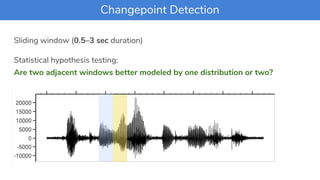
Sliding window (0.5–3 sec duration)
Statistical hypothesis testing:
Are two adjacent windows better modeled by one distribution or two?
Changepoint Detection
Models: GMMs over MFCCs
Log-likelihood of the data points given the model
Bayesian Information Criterion (BIC)
Number of parameters of the model
Number of data points the model was trained on
Penalty term
Lower BIC = better fit
A positive value indicates dissimilarity between the audio windows.
Can use a threshold on to detect changepoints.
Delta-BIC Distance Metric
def gmm_delta_bic(gmm1, gmm2, X1, X2):
gmm_combined = sklearn.mixture.GaussianMixture(
n_components=NUM_GAUSSIANS_PER_GMM,
covariance_type="full",
random_state=42,
max_iter=200,
verbose=0
)
X_combined = np.vstack([X1, X2])
gmm_combined.fit(X_combined)
bic_combined = gmm_combined.bic(X_combined)
bic_gmm1 = gmm1.bic(X1)
bic_gmm2 = gmm2.bic(X2)
return bic_combined - bic_gmm1 - bic_gmm2
Can also use KL-Divergence for multivariate single-Gaussian GMMs:
KL-Divergence
Will be faster, but can produce more noisy changepoints.
Clustering
Perform hierarchical
agglomerative clustering (HAC)
based on until the
stopping criterion is met.
Clustering
0.0 0.5 1.0 1.5 2.0 2.5 3.0 3.5 4.0 4.5 5.0 5.5 6.0 6.5 7.0
Clustering
0.0 0.5 1.0 1.5 2.0 2.5 3.0 3.5 4.0 4.5 5.0 5.5 6.0 6.5 7.0
Clustering
0.0 0.5 1.0 1.5 2.0 2.5 3.0 3.5 4.0 4.5 5.0 5.5 6.0 6.5 7.0
Clustering
0.0 0.5 1.0 1.5 2.0 2.5 3.0 3.5 4.0 4.5 5.0 5.5 6.0 6.5 7.0
Clustering
0.0 0.5 1.0 1.5 2.0 2.5 3.0 3.5 4.0 4.5 5.0 5.5 6.0 6.5 7.0
Clustering
0.0 0.5 1.0 1.5 2.0 2.5 3.0 3.5 4.0 4.5 5.0 5.5 6.0 6.5 7.0
1. Non-speech activity cutoff by RMSE threshold, analysis length = 0.5 sec.
2. Modeling 0.5 sec segments with single-Gaussian GMMs over 19-dimensional
MFCCs. MFCC analysis length = 30 ms, frame hop length = 10 ms.
3. Potential changepoint detection based on KL-Divergence.
4. HAC based on ΔBIC with a stopping threshold (or prior number of speakers).
Final System
DER (Diarization Error Rate)
Evaluation
DER = Missed Speech Time % + False Alarm Time % + Speaker Error Time %
Evaluation
Can use Hungarian algorithm
to find the best match between
ground truth labels and
hypothesis labels.
Achieved avg. DER: 16.3%
(2.7% missed, 5% false alarm,
8.6% wrong speaker)
State of the art: 14.6–16.1%
depending on source type.
Time: 2x–5x faster than RT
(HAC has quadratic complexity)

DataScience Lab 2017_Кто здесь? Автоматическая разметка спикеров на телефонных разговорах _Юрий Гуц

  • 1.
    Identifying and AnnotatingSpeakers in Phone Conversations Identifying and Annotating Speakers in Phone Conversations Yuriy Guts DataRobot Yuriy Guts DataRobot
  • 2.
    SPEAKER A SPEAKERB SPEAKER A SPEAKER C SPEAKER B No prior knowledge about the speakers whatsoever.
  • 3.
    1. Extract compactmetadata from bulky multimedia sources. 2. Enable information retrieval queries for audio content. 3. Provide training data for upstream modeling projects: ○ Speaker identification ○ Speech recognition ○ Emotion analysis Speaker Diarization: Why Do It?
  • 4.
    Cocktail Party Problem?ICA To The Rescue? Nope. We have mono signal, so # input mixtures < # desired separated outputs
  • 5.
    Source Types &Characteristics Broadcast News Meetings Phone Calls Uninterrupted speech : Longer segments Shorter segments Shorter segments Speaker overlap : Negligible High Moderate Background conditions : Diverse: music, jingles, background events Uniform Uniform (but can be noisy) Dominant speaker : Yes (anchor) Unknown Unknown Number of speakers : Unknown Unknown Unknown (but usually 2) Original publication: http://www.slideshare.net/ParthePandit/parthepandit10d070009ddpthesis-53767213
  • 6.
    100 hrs ofrecorded customer support calls. ● Mono WAV files, 8 kHz. ● Some files (55 hrs) are human-labeled: Input Data 0000.00,0005.63,agent,Female 0005.63,0017.13,customer,Female 0017.13,0027.76,agent,Female 0027.76,0034.94,customer,Female 0034.94,0035.89,agent,Female 0035.89,0044.50,silence,None 0044.50,0046.20,unrelated,None 0046.20,0049.10,customer,Female 0049.10,0050.14,agent,Female 0050.14,0060.99,silence,None 0060.99,0066.60,agent,Female 0066.60,0080.12,customer,Female
  • 7.
    1. Audio durationsare huge. 20 sec min, 12 min avg, 2 hours max. 2. Lots of waiting on the line. Meaningful speech takes only ~55% of the time. 3. Inconsistent connection quality, lots of crackling and background noise. Particular Challenges of Support Calls
  • 8.
    1. Non-speech activitycutoff. Overall Approach for Speaker Diarization For phone conversations, a simple RMSE / ZCR threshold works fine. Otherwise, build a supervised VAD. 2. Changepoint candidate detection. 3. Segment recombination (clustering).
  • 9.
  • 10.
    MFCC (Mel-Frequency CepstralCoefficients) MFCC
  • 11.
    Sliding window (0.5–3sec duration) Statistical hypothesis testing: Are two adjacent windows better modeled by one distribution or two? Changepoint Detection
  • 12.
  • 13.
    Log-likelihood of thedata points given the model Bayesian Information Criterion (BIC) Number of parameters of the model Number of data points the model was trained on Penalty term Lower BIC = better fit
  • 14.
    A positive valueindicates dissimilarity between the audio windows. Can use a threshold on to detect changepoints. Delta-BIC Distance Metric
  • 15.
    def gmm_delta_bic(gmm1, gmm2,X1, X2): gmm_combined = sklearn.mixture.GaussianMixture( n_components=NUM_GAUSSIANS_PER_GMM, covariance_type="full", random_state=42, max_iter=200, verbose=0 ) X_combined = np.vstack([X1, X2]) gmm_combined.fit(X_combined) bic_combined = gmm_combined.bic(X_combined) bic_gmm1 = gmm1.bic(X1) bic_gmm2 = gmm2.bic(X2) return bic_combined - bic_gmm1 - bic_gmm2
  • 16.
    Can also useKL-Divergence for multivariate single-Gaussian GMMs: KL-Divergence Will be faster, but can produce more noisy changepoints.
  • 17.
    Clustering Perform hierarchical agglomerative clustering(HAC) based on until the stopping criterion is met.
  • 18.
    Clustering 0.0 0.5 1.01.5 2.0 2.5 3.0 3.5 4.0 4.5 5.0 5.5 6.0 6.5 7.0
  • 19.
    Clustering 0.0 0.5 1.01.5 2.0 2.5 3.0 3.5 4.0 4.5 5.0 5.5 6.0 6.5 7.0
  • 20.
    Clustering 0.0 0.5 1.01.5 2.0 2.5 3.0 3.5 4.0 4.5 5.0 5.5 6.0 6.5 7.0
  • 21.
    Clustering 0.0 0.5 1.01.5 2.0 2.5 3.0 3.5 4.0 4.5 5.0 5.5 6.0 6.5 7.0
  • 22.
    Clustering 0.0 0.5 1.01.5 2.0 2.5 3.0 3.5 4.0 4.5 5.0 5.5 6.0 6.5 7.0
  • 23.
    Clustering 0.0 0.5 1.01.5 2.0 2.5 3.0 3.5 4.0 4.5 5.0 5.5 6.0 6.5 7.0
  • 24.
    1. Non-speech activitycutoff by RMSE threshold, analysis length = 0.5 sec. 2. Modeling 0.5 sec segments with single-Gaussian GMMs over 19-dimensional MFCCs. MFCC analysis length = 30 ms, frame hop length = 10 ms. 3. Potential changepoint detection based on KL-Divergence. 4. HAC based on ΔBIC with a stopping threshold (or prior number of speakers). Final System
  • 25.
    DER (Diarization ErrorRate) Evaluation DER = Missed Speech Time % + False Alarm Time % + Speaker Error Time %
  • 26.
    Evaluation Can use Hungarianalgorithm to find the best match between ground truth labels and hypothesis labels. Achieved avg. DER: 16.3% (2.7% missed, 5% false alarm, 8.6% wrong speaker) State of the art: 14.6–16.1% depending on source type. Time: 2x–5x faster than RT (HAC has quadratic complexity)