London, 04/17/13, A. Reichert / 1
University of St. Gallen, Institute of Information Management
Evolution of Data Governance Excellence in Large
Enterprises: Lessons Learned and Strategic
Directions
Andreas Reichert
London, April 17th, 2013
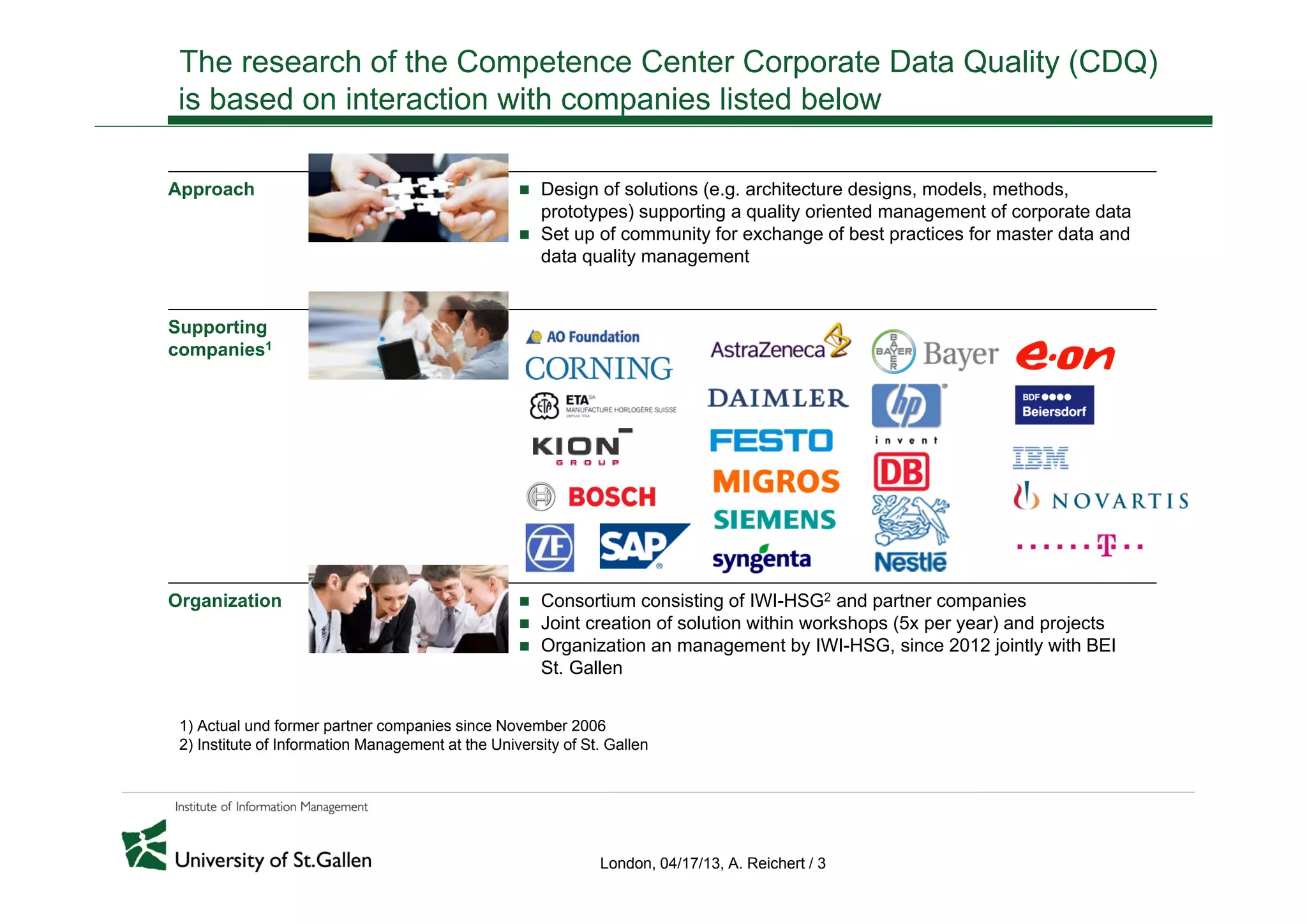
London, 04/17/13, A. Reichert / 3
1) Actual und former partner companies since November 2006
2) Institute of Information Management at the University of St. Gallen
Approach  Design of solutions (e.g. architecture designs, models, methods,
prototypes) supporting a quality oriented management of corporate data
 Set up of community for exchange of best practices for master data and
data quality management
Supporting
companies1
Organization  Consortium consisting of IWI-HSG2 and partner companies
 Joint creation of solution within workshops (5x per year) and projects
 Organization an management by IWI-HSG, since 2012 jointly with BEI
St. Gallen
The research of the Competence Center Corporate Data Quality (CDQ)
is based on interaction with companies listed below
London, 04/17/13, A. Reichert / 4
Agenda
1. Business Rationale for Data Governance
2. Data Governance Design Options
London, 04/17/13, A. Reichert / 5
Data Governance is necessary in order to meet several strategic business
requirements
 Legal and regulatory
requirements
 Contractual
obligations
Risk Management
 “Single Point of Truth”
 Standardized reports
and KPIs
Corporate
Reporting
 Business process
harmonization
 “End-to-end” business
processes
Global Business
Processes
 360°view on
customers
 Hybrid products
Customer-centric
business models
 Integration of acquired
businesses
 Data due diligence
Mergers &
Acquisitions
 IT consolidation (“do
more with less”)
 Flexible architectures
Complexity
management
1 2
3 4
5 6
London, 04/17/13, A. Reichert / 6
Business impact of data quality?
A product data example, consumer goods industry
GTIN: Global Trade Item Number, standardized by Global Standards One (GS1, www.gs1.org)
1
2
3
4
5
2
 To add additional filling may be reasonable with transparent bottles
 But: Not maintaining changed gross weight my cause wrong packing
Capacity2
 Wrong shelf planning at customers (retail) due to inaccurate measures
 Repacking of pallets due to inaccurate gross weights
Logistic
Data
1
 Flawed products due to too high or too low temperature during transport
 Temperature tolerance depends on product formula (bill of material)
Temperature
for transportation
3
 Different formats in several countries
 No globally standardized but changing formats (e.g. date, duration)
Format of
expiry date
4
 Wrong GTINs may cause complaints and compensations
 Product changes may require a new GTIN
 GTIN allocation depends on global and local guidelines
GTIN5
Data quality is a prerequisite for correct
product information and supply chain efficiency
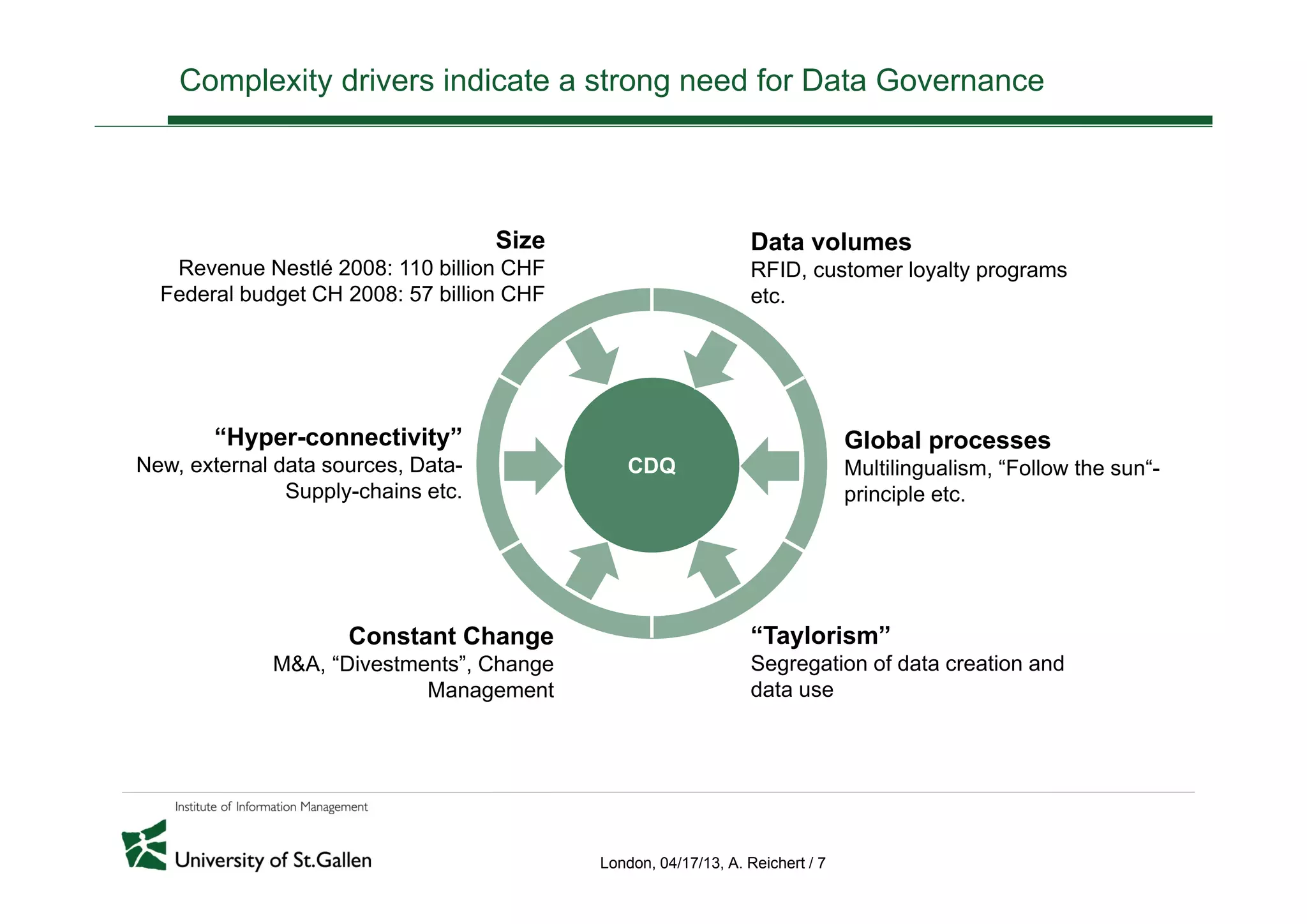
London, 04/17/13, A. Reichert / 7
Complexity drivers indicate a strong need for Data Governance
CDQ
Data volumes
RFID, customer loyalty programs
etc.
Global processes
Multilingualism, “Follow the sun“-
principle etc.
“Taylorism”
Segregation of data creation and
data use
Constant Change
M&A, “Divestments”, Change
Management
“Hyper-connectivity”
New, external data sources, Data-
Supply-chains etc.
Size
Revenue Nestlé 2008: 110 billion CHF
Federal budget CH 2008: 57 billion CHF
London, 04/17/13, A. Reichert / 8
Defining Data Governance
 Data governance aims at the identification of decision rights and roles to
facilitate a consistent, company-wide behavior in the use of corporate data
 Also, data governance allocates responsibilities to roles to ensure the
execution of assigned decision rights
 Data governance results in company-wide standards, guidelines and
methodologies for creation and use of corporate data
Management of sustainable
and reliable high quality master data
London, 04/17/13, A. Reichert / 9
The typical evolution of data quality over time in companies shows a
strong need for action
Legend: Data quality pitfalls
(e. g. Migrations, Process
Touch Points, Poor
Management Reporting Data.
Data Quality
Time
Project 1 Project 2 Project 3
 No risk management possible
 Impedes planning and controlling of budgets and resources
 No targets for data quality
 Purely reactive - when too late
 No sustainability, high repetitive project costs (change requests, external consulting etc.)
London, 04/17/13, A. Reichert / 10
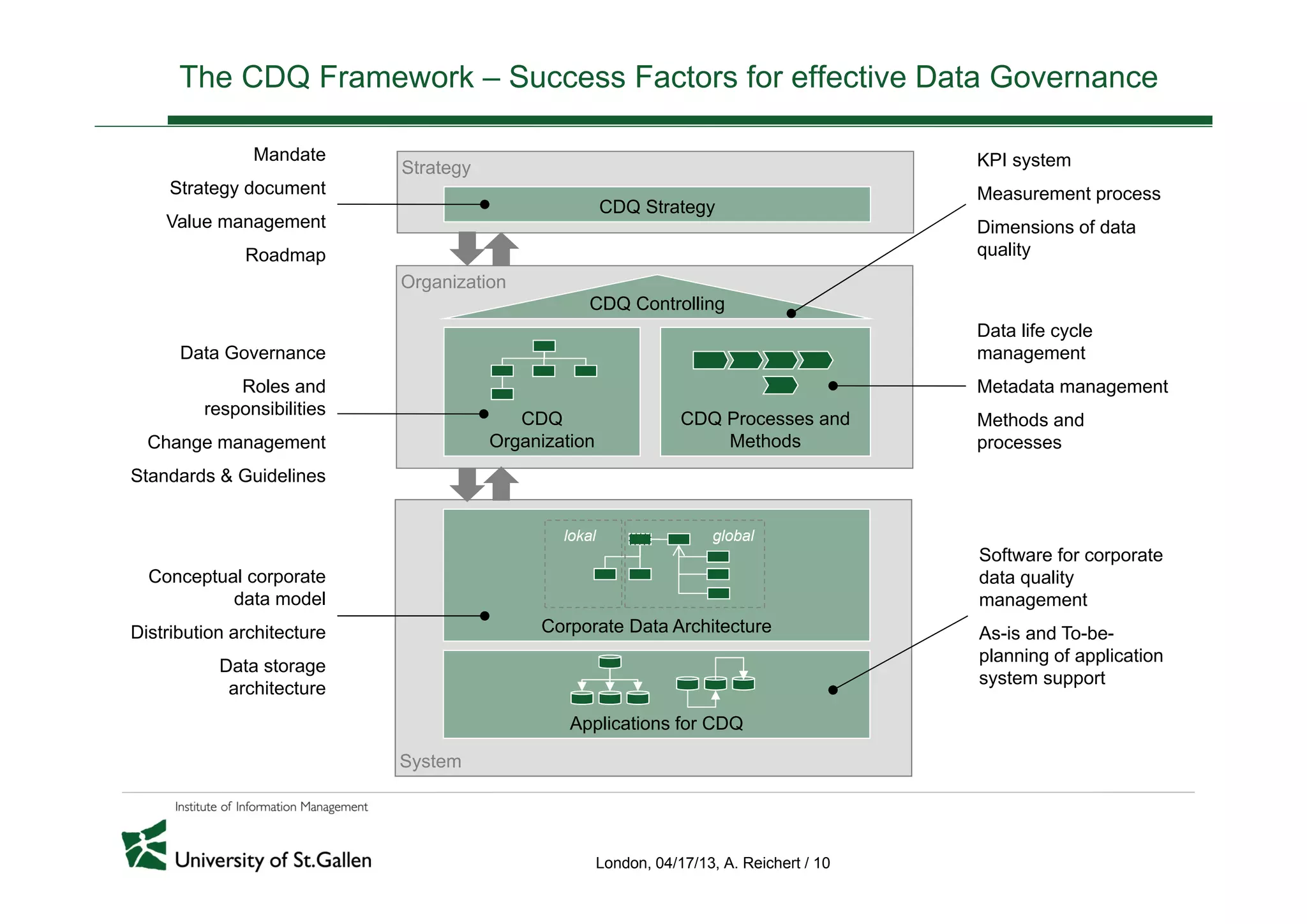
The CDQ Framework – Success Factors for effective Data Governance
Strategy
Organization
System
CDQ Controlling
Applications for CDQ
Corporate Data Architecture
CDQ
Organization
CDQ Processes and
Methods
CDQ Strategy
lokal global
Mandate
Strategy document
Value management
Roadmap
KPI system
Measurement process
Dimensions of data
quality
Data Governance
Roles and
responsibilities
Change management
Standards & Guidelines
Data life cycle
management
Metadata management
Methods and
processes
Conceptual corporate
data model
Distribution architecture
Data storage
architecture
Software for corporate
data quality
management
As-is and To-be-
planning of application
system support
London, 04/17/13, A. Reichert / 11
Design options for implementing Data Governance
Key: BU: Business Unit; SSC: Shared Service Center Line Organization (Sold Line)
Dotted Line
Coordination via SLA
Local Function/Staff Organization per BU Central Function
Shared Service Center Externalization
Group Level
BU BU BU BU
Group Level
BU BU BU
Central
Function
Group Level
BU BU BU
External
Party
Group Level
BU BU BU SSC
1 2
3 4
London, 04/17/13, A. Reichert / 12
Agenda
1. Business Rationale for Data Governance
2. Data Governance Design Options
London, 04/17/13, A. Reichert / 13
Example 1 - High Tech Industry
Business drivers for Data Governance
 Changing business model
 From product & system business to solution orientation
 Focus on indirect business models
 Trend to managed services
 Higher competition leads to higher cost pressure
 Need to simplify and harmonize processes and IT
 Need to simplify and strengthen the organization
 Changes in the market require high flexibility
 Reduce the complexity in products and services
 Enable rapid merger and acquisitions
Accurate and trustful master data are the basis for business processes and
enable to react flexible on changes!
London, 04/17/13, A. Reichert / 14
The need for high quality master data for the new business environment
to GRID
The GRID (Global Responsibility for Integrated Data) initiative
aims at setting up a global Enterprise Data Management (EDM)
consisting of governance (organizational structures, roles,
responsibilities, tasks), processes (data management, business
processes) as well as the information technology
(systems, interfaces, automation).
GRID has the mission to secure the global consistency of
master data – product, product information, supplier, customer - in
order to smoothly operate the business.
London, 04/17/13, A. Reichert / 15
Why do we need global master data Governance?
BusinessprocessesCorporate
Enterprise Data Management is the backbone of the business processes!
Global planning capabilities & integration of 3rd party products
Efficient marketing and e-commerce enablement (e2e)
Clean & full integration of service business into MDM
Spend transparency and volume consolidation
SCM
Mark / Sales
Service
Purchasing
Information
Compliance
Projects
High reporting quality and timely reporting
Traceability of products and export compliance
Acceleration of project delivery and reduction of efforts
London, 04/17/13, A. Reichert / 16
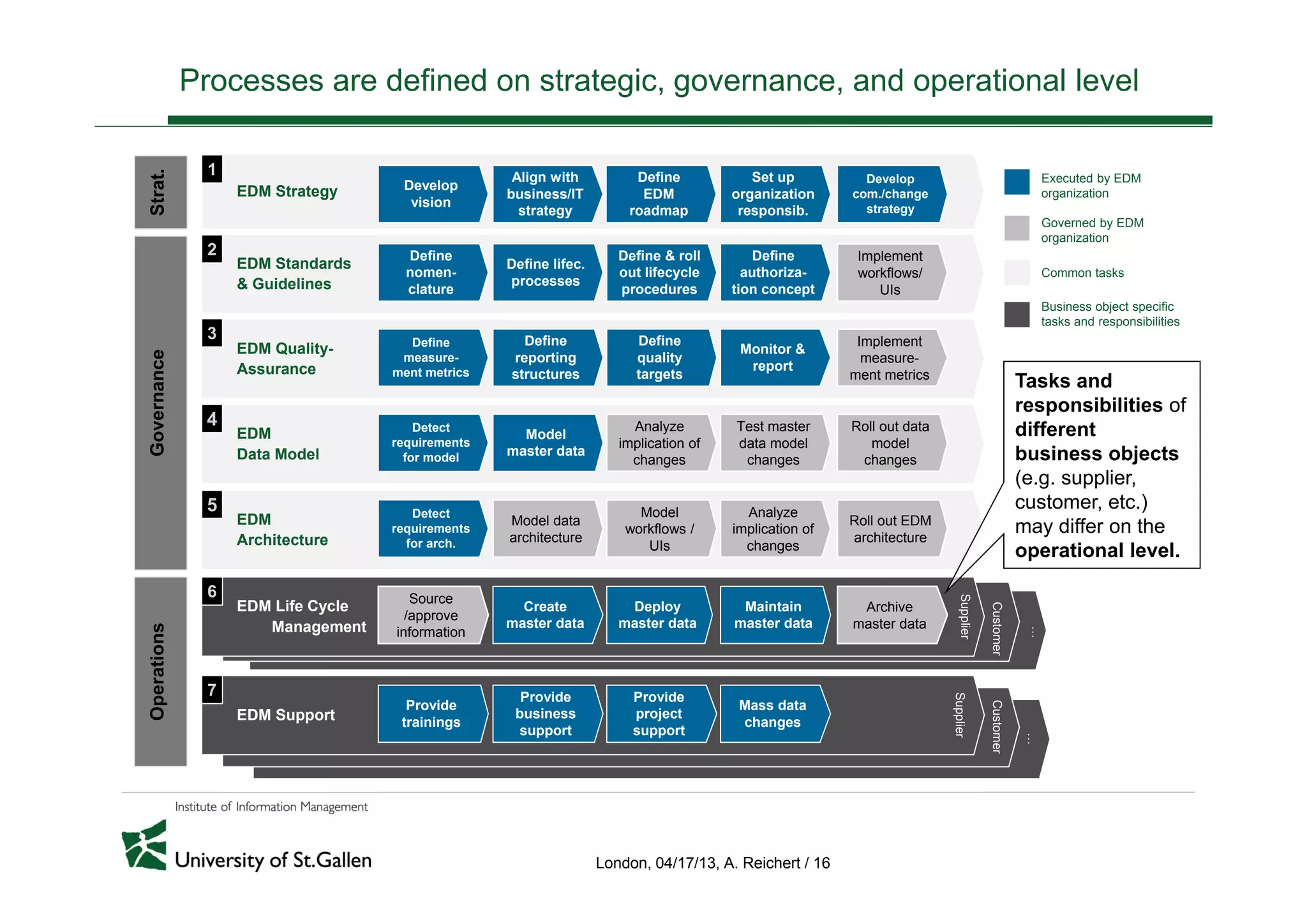
Processes are defined on strategic, governance, and operational level
EDM Life Cycle
Management
EDM Life Cycle
Management
Customer
EDM Life Cycle
Management
EDM Life Cycle
Management
EDM Strategy
1
EDM Standards
& Guidelines
Develop
vision
Define
EDM
roadmap
Develop
com./change
strategy
Set up
organization
responsib.
Align with
business/IT
strategy
EDM Quality-
Assurance
Define
measure-
ment metrics
Define
quality
targets
Define
reporting
structures
Monitor &
report
2
3
Define
nomen-
clature
Define lifec.
processes
Define
authoriza-
tion concept
Define & roll
out lifecycle
procedures
EDM
Data Model
4 Detect
requirements
for model
Analyze
implication of
changes
Model
master data
Test master
data model
changes
GovernanceStrat.
EDM
Architecture
5 Detect
requirements
for arch.
Analyze
implication of
changes
Model data
architecture
Roll out EDM
architecture
Implement
workflows/
UIs
Implement
measure-
ment metrics
Roll out data
model
changes
Model
workflows /
UIs
EDM Support
7
Provide
trainings
Provide
business
support
Provide
project
support
EDM Life Cycle
Management
6
Operations
Source
/approve
information
Deploy
master data
Archive
master data
Create
master data
Maintain
master data
Executed by EDM
organization
Governed by EDM
organization
Mass data
changes
Business object specific
tasks and responsibilities
Common tasks
Tasks and
responsibilities of
different
business objects
(e.g. supplier,
customer, etc.)
may differ on the
operational level.
SupplierSupplier
CustomerCustomer
……
London, 04/17/13, A. Reichert / 17
Roles are defined on strategic, governance, and operational level
Governance Level
Operational Level
Strategic Level
Set strategic direction of
EDM and ensure alignment
with business and IT
strategy.
Define and control standards
and guidelines for enterprise
data according to the business
requirements.
Request, create, maintain
and approve enterprise data
following defined standards
and guidelines. Establish
technical readiness of IT
systems.
EDM Community
EDM Board
Head of IT
Business
Data Steward
Technical
Data Steward
Executive Sponsor
Head of EDM
Corporate Data Operator
Business process owner
EDM organization
Other SEN organization
Global roles
Global or regional roles
London, 04/17/13, A. Reichert / 18
Solution – Data Governance as central function
Interaction
Head of EDM
Strategiclevel
Governance/
Operationallevel
Business processes EDM
EDM-Board
Operative
in SAP
Business Process
Owner
Business Process
Owner
Data OwnerCorporate Data
Operator
Communicate /
improve standards
Define standards
Business Data
Steward
Business Data
Steward
Enforce standards
during data update
Align process /
data requirements
IT
Head of IT
Align IT strategy
IT implementation
IT Data
Steward
London, 04/17/13, A. Reichert / 19
Example 2 – Chemical Industry
Business drivers for Data Governance
 Process Efficiency
 Delayed delivery to customers due to wrong material master
 Invoicing to the wrong customer
 Wrong labels
 Cost Reduction
 High inventories due to lack of trust in master data
 Additional air freight costs to ensure on time arrival
 Management Decision Support
 Reporting inaccuracy due to inconsistent data
London, 04/17/13, A. Reichert / 20
The MDM organization will sustain efficiency and quality of master data
• Defining and monitoring of SLAs and KPIs in a global governance framework
• Acting as a global stewardship organization, driving the global standardization and
optimization of processes
• Providing one global lead steward for each data object to ensure accountability and a
high level of support to business users
3. The MDM organization act as a catalyst through…
• Accountabilities for master data are defined and data quality monitored
• Maintenance processes are globally standardized and automated
• A small number of data specialists concentrate on continuous improvement instead of
firefighting and data typing
2. We have to come to a state where…
• No clear accountability for master data on a global level
• Lack of standardization and automation
 Inefficient and heterogeneous ways of managing master data
 Poor data quality troubles users of global systems (APO, EDWH, global product
costing
1. The situation today shows…
London, 04/17/13, A. Reichert / 21
Process landscape for MDM services
 Each process delivers services to the business organizations
 The implementation of the services will follow of structured roadmap for the defined master
data types (Material, Vendor, Customer, Finance, Employee)
 The services are measured by Service Level Agreements (SLAs) in order to assure the
quality of the services
Process landscape
Master Data Maintenance2
Master Data
Standards
Training &
Support
Quality
Assurance
3 4 5
Master Data Infrastructure6
Master Data Strategy1
Scope of services
Material
Vendor
Customer
Finance
Employee
London, 04/17/13, A. Reichert / 22
Solution - Shared Service Center for governance and operational
responsibility
Data & System Architecture
Data
Lifecycle
Management
Data Quality
Assurance
MDM
Organisation
Data Governance
Enables a single view on
each master data class
Creates, changes
and retires a data
object
Ensures that the quality of
data objects supports the
dependent business
processes
Ensures that the
MDM agenda can
be driven across
the enterprise
London, 04/17/13, A. Reichert / 23
Organizational integration of MDM
CEO
Functional
Grouping
Service
Functions
BS (HR, IS,
FI, LT etc)
etc
Strategic
Functions
HR
FI
Marketing
etc
Divisional
Grouping
Geographic
structure
Product
structure
Market
structure
Head of
Business
Services
Head of MDM
Regional MDM
Heads
Head of NAFTA
MDM
Head of LATAM
MDM
Head of
EAME/APAC
MDM
Lead Data
Stewards
Material HR
Customer Vendor
Finance
Data Architect
Company structure MDM structure
London, 04/17/13, A. Reichert / 24
Main benefit of the global MDM organization is the overall improved data
quality enabling the business to focus on value add activities
• Change of functional reporting from business to a business neutral MDM unit
• Change of regional reporting lines to global reporting line
Impacts
• Harmonized processes and policies and governance across regions & business units
• Higher scalability: faster integration of new companies or processes, systems etc.
• Bigger pool of trained people
• Reduced headcount
• Reduced number of codes in system (big issue in material today as well as vendor and
customer)
• Improved data quality & reporting also since global team has higher authority to advise regional
teams to not “manipulate data in ERP system)
• Attraction for higher skilled employees based on career opportunities
Benefits
• Strong and visible SLAs in place including tracking of KPIs
• Strong governance model between business and MDM
• Quick wins for Business in order to Business to accept organization
• Outsourcing only when internal processes work well
Critical success factors
London, 04/17/13, A. Reichert / 25
Governance design principles
Global
 Global responsibility
 Regional and local presence
Shared
 Center of excellence for the business
 Efficiency and speed
Governing
 Binding standards and guidelines for the use of master data
 Defined methodologies and tools
Service-
oriented
 Aiming at internal customer satisfaction
 Service level agreements for measurable performance
Managed
 Preventive measures instead of “firefighting”
 Clear objectives and standard operating procedures
Empowered
 Sponsored by executive management
 Appropriate resource assignment
London, 04/17/13, A. Reichert / 26
The way forward – From shared service to outsourced data management
processes
IS Outsourcing
Partner
Company
Domain MDM
Teams
MDM Leads
MDM Data
Stewards
Company
Service Delivery &
Operations Teams
Service Delivery
Managers
Master Data
Requestors
Business
Process
Outsourcing
Partner
Master Data
Processors
Clients
Master Data Request Originators
London, 04/17/13, A. Reichert / 27
Key success factors for implementing Data Governance
Demonstrate staying power! Data Governance is a change
issue and requires involvement of all stakeholders.
No bureaucracy! Use existing board structures and processes.
No ivory tower, no silver bullet! Use “real-life” examples to get
buy in from local business units.
Define clear objectives and standard operation procedures to
prevent “firefighting”.
London, 04/17/13, A. Reichert / 28
Contact
http://www.bei-sg.ch
http://cdq.iwi.unisg.ch
Andreas Reichert
University of St. Gallen
CC Corporate Data Quality
andreas.reichert@unisg.ch
Tel.: +41 71 224 3880
London, 04/17/13, A. Reichert / 29
Further information
Institute of Information Management at the University of St. Gallen
http://www.iwi.unisg.ch
Business Engineering Institute St. Gallen
http://www.bei-sg.ch
Competence Center Corporate Data Quality
http://cdq.iwi.unisg.ch
CC CDQ Benchmarking Platform
https://benchmarking.iwi.unisg.ch/
CC CDQ Community at XING
http://www.xing.com/net/cdqm

Evolution of data governance excellence

  • 1.
  • 2.
    University of St.Gallen, Institute of Information Management Evolution of Data Governance Excellence in Large Enterprises: Lessons Learned and Strategic Directions Andreas Reichert London, April 17th, 2013
  • 3.
    London, 04/17/13, A.Reichert / 3 1) Actual und former partner companies since November 2006 2) Institute of Information Management at the University of St. Gallen Approach  Design of solutions (e.g. architecture designs, models, methods, prototypes) supporting a quality oriented management of corporate data  Set up of community for exchange of best practices for master data and data quality management Supporting companies1 Organization  Consortium consisting of IWI-HSG2 and partner companies  Joint creation of solution within workshops (5x per year) and projects  Organization an management by IWI-HSG, since 2012 jointly with BEI St. Gallen The research of the Competence Center Corporate Data Quality (CDQ) is based on interaction with companies listed below
  • 4.
    London, 04/17/13, A.Reichert / 4 Agenda 1. Business Rationale for Data Governance 2. Data Governance Design Options
  • 5.
    London, 04/17/13, A.Reichert / 5 Data Governance is necessary in order to meet several strategic business requirements  Legal and regulatory requirements  Contractual obligations Risk Management  “Single Point of Truth”  Standardized reports and KPIs Corporate Reporting  Business process harmonization  “End-to-end” business processes Global Business Processes  360°view on customers  Hybrid products Customer-centric business models  Integration of acquired businesses  Data due diligence Mergers & Acquisitions  IT consolidation (“do more with less”)  Flexible architectures Complexity management 1 2 3 4 5 6
  • 6.
    London, 04/17/13, A.Reichert / 6 Business impact of data quality? A product data example, consumer goods industry GTIN: Global Trade Item Number, standardized by Global Standards One (GS1, www.gs1.org) 1 2 3 4 5 2  To add additional filling may be reasonable with transparent bottles  But: Not maintaining changed gross weight my cause wrong packing Capacity2  Wrong shelf planning at customers (retail) due to inaccurate measures  Repacking of pallets due to inaccurate gross weights Logistic Data 1  Flawed products due to too high or too low temperature during transport  Temperature tolerance depends on product formula (bill of material) Temperature for transportation 3  Different formats in several countries  No globally standardized but changing formats (e.g. date, duration) Format of expiry date 4  Wrong GTINs may cause complaints and compensations  Product changes may require a new GTIN  GTIN allocation depends on global and local guidelines GTIN5 Data quality is a prerequisite for correct product information and supply chain efficiency
  • 7.
    London, 04/17/13, A.Reichert / 7 Complexity drivers indicate a strong need for Data Governance CDQ Data volumes RFID, customer loyalty programs etc. Global processes Multilingualism, “Follow the sun“- principle etc. “Taylorism” Segregation of data creation and data use Constant Change M&A, “Divestments”, Change Management “Hyper-connectivity” New, external data sources, Data- Supply-chains etc. Size Revenue Nestlé 2008: 110 billion CHF Federal budget CH 2008: 57 billion CHF
  • 8.
    London, 04/17/13, A.Reichert / 8 Defining Data Governance  Data governance aims at the identification of decision rights and roles to facilitate a consistent, company-wide behavior in the use of corporate data  Also, data governance allocates responsibilities to roles to ensure the execution of assigned decision rights  Data governance results in company-wide standards, guidelines and methodologies for creation and use of corporate data Management of sustainable and reliable high quality master data
  • 9.
    London, 04/17/13, A.Reichert / 9 The typical evolution of data quality over time in companies shows a strong need for action Legend: Data quality pitfalls (e. g. Migrations, Process Touch Points, Poor Management Reporting Data. Data Quality Time Project 1 Project 2 Project 3  No risk management possible  Impedes planning and controlling of budgets and resources  No targets for data quality  Purely reactive - when too late  No sustainability, high repetitive project costs (change requests, external consulting etc.)
  • 10.
    London, 04/17/13, A.Reichert / 10 The CDQ Framework – Success Factors for effective Data Governance Strategy Organization System CDQ Controlling Applications for CDQ Corporate Data Architecture CDQ Organization CDQ Processes and Methods CDQ Strategy lokal global Mandate Strategy document Value management Roadmap KPI system Measurement process Dimensions of data quality Data Governance Roles and responsibilities Change management Standards & Guidelines Data life cycle management Metadata management Methods and processes Conceptual corporate data model Distribution architecture Data storage architecture Software for corporate data quality management As-is and To-be- planning of application system support
  • 11.
    London, 04/17/13, A.Reichert / 11 Design options for implementing Data Governance Key: BU: Business Unit; SSC: Shared Service Center Line Organization (Sold Line) Dotted Line Coordination via SLA Local Function/Staff Organization per BU Central Function Shared Service Center Externalization Group Level BU BU BU BU Group Level BU BU BU Central Function Group Level BU BU BU External Party Group Level BU BU BU SSC 1 2 3 4
  • 12.
    London, 04/17/13, A.Reichert / 12 Agenda 1. Business Rationale for Data Governance 2. Data Governance Design Options
  • 13.
    London, 04/17/13, A.Reichert / 13 Example 1 - High Tech Industry Business drivers for Data Governance  Changing business model  From product & system business to solution orientation  Focus on indirect business models  Trend to managed services  Higher competition leads to higher cost pressure  Need to simplify and harmonize processes and IT  Need to simplify and strengthen the organization  Changes in the market require high flexibility  Reduce the complexity in products and services  Enable rapid merger and acquisitions Accurate and trustful master data are the basis for business processes and enable to react flexible on changes!
  • 14.
    London, 04/17/13, A.Reichert / 14 The need for high quality master data for the new business environment to GRID The GRID (Global Responsibility for Integrated Data) initiative aims at setting up a global Enterprise Data Management (EDM) consisting of governance (organizational structures, roles, responsibilities, tasks), processes (data management, business processes) as well as the information technology (systems, interfaces, automation). GRID has the mission to secure the global consistency of master data – product, product information, supplier, customer - in order to smoothly operate the business.
  • 15.
    London, 04/17/13, A.Reichert / 15 Why do we need global master data Governance? BusinessprocessesCorporate Enterprise Data Management is the backbone of the business processes! Global planning capabilities & integration of 3rd party products Efficient marketing and e-commerce enablement (e2e) Clean & full integration of service business into MDM Spend transparency and volume consolidation SCM Mark / Sales Service Purchasing Information Compliance Projects High reporting quality and timely reporting Traceability of products and export compliance Acceleration of project delivery and reduction of efforts
  • 16.
    London, 04/17/13, A.Reichert / 16 Processes are defined on strategic, governance, and operational level EDM Life Cycle Management EDM Life Cycle Management Customer EDM Life Cycle Management EDM Life Cycle Management EDM Strategy 1 EDM Standards & Guidelines Develop vision Define EDM roadmap Develop com./change strategy Set up organization responsib. Align with business/IT strategy EDM Quality- Assurance Define measure- ment metrics Define quality targets Define reporting structures Monitor & report 2 3 Define nomen- clature Define lifec. processes Define authoriza- tion concept Define & roll out lifecycle procedures EDM Data Model 4 Detect requirements for model Analyze implication of changes Model master data Test master data model changes GovernanceStrat. EDM Architecture 5 Detect requirements for arch. Analyze implication of changes Model data architecture Roll out EDM architecture Implement workflows/ UIs Implement measure- ment metrics Roll out data model changes Model workflows / UIs EDM Support 7 Provide trainings Provide business support Provide project support EDM Life Cycle Management 6 Operations Source /approve information Deploy master data Archive master data Create master data Maintain master data Executed by EDM organization Governed by EDM organization Mass data changes Business object specific tasks and responsibilities Common tasks Tasks and responsibilities of different business objects (e.g. supplier, customer, etc.) may differ on the operational level. SupplierSupplier CustomerCustomer ……
  • 17.
    London, 04/17/13, A.Reichert / 17 Roles are defined on strategic, governance, and operational level Governance Level Operational Level Strategic Level Set strategic direction of EDM and ensure alignment with business and IT strategy. Define and control standards and guidelines for enterprise data according to the business requirements. Request, create, maintain and approve enterprise data following defined standards and guidelines. Establish technical readiness of IT systems. EDM Community EDM Board Head of IT Business Data Steward Technical Data Steward Executive Sponsor Head of EDM Corporate Data Operator Business process owner EDM organization Other SEN organization Global roles Global or regional roles
  • 18.
    London, 04/17/13, A.Reichert / 18 Solution – Data Governance as central function Interaction Head of EDM Strategiclevel Governance/ Operationallevel Business processes EDM EDM-Board Operative in SAP Business Process Owner Business Process Owner Data OwnerCorporate Data Operator Communicate / improve standards Define standards Business Data Steward Business Data Steward Enforce standards during data update Align process / data requirements IT Head of IT Align IT strategy IT implementation IT Data Steward
  • 19.
    London, 04/17/13, A.Reichert / 19 Example 2 – Chemical Industry Business drivers for Data Governance  Process Efficiency  Delayed delivery to customers due to wrong material master  Invoicing to the wrong customer  Wrong labels  Cost Reduction  High inventories due to lack of trust in master data  Additional air freight costs to ensure on time arrival  Management Decision Support  Reporting inaccuracy due to inconsistent data
  • 20.
    London, 04/17/13, A.Reichert / 20 The MDM organization will sustain efficiency and quality of master data • Defining and monitoring of SLAs and KPIs in a global governance framework • Acting as a global stewardship organization, driving the global standardization and optimization of processes • Providing one global lead steward for each data object to ensure accountability and a high level of support to business users 3. The MDM organization act as a catalyst through… • Accountabilities for master data are defined and data quality monitored • Maintenance processes are globally standardized and automated • A small number of data specialists concentrate on continuous improvement instead of firefighting and data typing 2. We have to come to a state where… • No clear accountability for master data on a global level • Lack of standardization and automation  Inefficient and heterogeneous ways of managing master data  Poor data quality troubles users of global systems (APO, EDWH, global product costing 1. The situation today shows…
  • 21.
    London, 04/17/13, A.Reichert / 21 Process landscape for MDM services  Each process delivers services to the business organizations  The implementation of the services will follow of structured roadmap for the defined master data types (Material, Vendor, Customer, Finance, Employee)  The services are measured by Service Level Agreements (SLAs) in order to assure the quality of the services Process landscape Master Data Maintenance2 Master Data Standards Training & Support Quality Assurance 3 4 5 Master Data Infrastructure6 Master Data Strategy1 Scope of services Material Vendor Customer Finance Employee
  • 22.
    London, 04/17/13, A.Reichert / 22 Solution - Shared Service Center for governance and operational responsibility Data & System Architecture Data Lifecycle Management Data Quality Assurance MDM Organisation Data Governance Enables a single view on each master data class Creates, changes and retires a data object Ensures that the quality of data objects supports the dependent business processes Ensures that the MDM agenda can be driven across the enterprise
  • 23.
    London, 04/17/13, A.Reichert / 23 Organizational integration of MDM CEO Functional Grouping Service Functions BS (HR, IS, FI, LT etc) etc Strategic Functions HR FI Marketing etc Divisional Grouping Geographic structure Product structure Market structure Head of Business Services Head of MDM Regional MDM Heads Head of NAFTA MDM Head of LATAM MDM Head of EAME/APAC MDM Lead Data Stewards Material HR Customer Vendor Finance Data Architect Company structure MDM structure
  • 24.
    London, 04/17/13, A.Reichert / 24 Main benefit of the global MDM organization is the overall improved data quality enabling the business to focus on value add activities • Change of functional reporting from business to a business neutral MDM unit • Change of regional reporting lines to global reporting line Impacts • Harmonized processes and policies and governance across regions & business units • Higher scalability: faster integration of new companies or processes, systems etc. • Bigger pool of trained people • Reduced headcount • Reduced number of codes in system (big issue in material today as well as vendor and customer) • Improved data quality & reporting also since global team has higher authority to advise regional teams to not “manipulate data in ERP system) • Attraction for higher skilled employees based on career opportunities Benefits • Strong and visible SLAs in place including tracking of KPIs • Strong governance model between business and MDM • Quick wins for Business in order to Business to accept organization • Outsourcing only when internal processes work well Critical success factors
  • 25.
    London, 04/17/13, A.Reichert / 25 Governance design principles Global  Global responsibility  Regional and local presence Shared  Center of excellence for the business  Efficiency and speed Governing  Binding standards and guidelines for the use of master data  Defined methodologies and tools Service- oriented  Aiming at internal customer satisfaction  Service level agreements for measurable performance Managed  Preventive measures instead of “firefighting”  Clear objectives and standard operating procedures Empowered  Sponsored by executive management  Appropriate resource assignment
  • 26.
    London, 04/17/13, A.Reichert / 26 The way forward – From shared service to outsourced data management processes IS Outsourcing Partner Company Domain MDM Teams MDM Leads MDM Data Stewards Company Service Delivery & Operations Teams Service Delivery Managers Master Data Requestors Business Process Outsourcing Partner Master Data Processors Clients Master Data Request Originators
  • 27.
    London, 04/17/13, A.Reichert / 27 Key success factors for implementing Data Governance Demonstrate staying power! Data Governance is a change issue and requires involvement of all stakeholders. No bureaucracy! Use existing board structures and processes. No ivory tower, no silver bullet! Use “real-life” examples to get buy in from local business units. Define clear objectives and standard operation procedures to prevent “firefighting”.
  • 28.
    London, 04/17/13, A.Reichert / 28 Contact http://www.bei-sg.ch http://cdq.iwi.unisg.ch Andreas Reichert University of St. Gallen CC Corporate Data Quality andreas.reichert@unisg.ch Tel.: +41 71 224 3880
  • 29.
    London, 04/17/13, A.Reichert / 29 Further information Institute of Information Management at the University of St. Gallen http://www.iwi.unisg.ch Business Engineering Institute St. Gallen http://www.bei-sg.ch Competence Center Corporate Data Quality http://cdq.iwi.unisg.ch CC CDQ Benchmarking Platform https://benchmarking.iwi.unisg.ch/ CC CDQ Community at XING http://www.xing.com/net/cdqm