Alexander Hendorf
Databases for Data-Science
Alexander C. S. Hendorf
− Senior Consultant Information Technology
− Program Chair EuroPython, PyConDE & PyData Karlsruhe, 

EuroSciPy, PSF Managing Member
− PyData Frankfurt and PyData Südwest Organiser
− Program Committee Percona Live
− MongoDB Masters / MongoDB Certified DBA
− Speaker Europe & USA MongoDB World New York / San José,
PyCon Italy, CEBIT, BI Forum, IT-Tage FFM, PyData, PyParis,
PyCon UK, Budapest BI,….
ah@koenigsweg.com
@hendorf
Services
Data We guide our clients through development and implementation processes
of technologies and applications to analyse, evaluate and visualize
business data.
Strategy & Operations We advise SME, start-ups and public institutions on building efficient sales
structures, on process optimization and on business development.
Communication We provide sound communication strategies and creative campaigns to
communicate your content and messages authentically throughout all
channels.
Financial Service Technologies Our industry experts support clients in the financial sector in developing
powerful and compliant FinTech applications.
!
Let‘s get to know each other!
» What‘s your background?«
− Data scientist
− Database admin
− Curious Pythonista
− Consultant, decision maker (IT Executive, Consultant, Innovation
Manager, YouTube influencer) 
"
Let‘s get to know each other!
» What‘s your Experience in…«
− RDBSs
− none
− some
− a lot
− Hadoop et al.
− none
− some
− a lot
− NoSQL Systems 

without Hadoop et al.
− none
− some
− a lot
#
Let‘s get to know each other!
» What‘s are you looking for?«
− Integration for data science into existing ecosystems
− Learning about databases for data science projects
− General interest / curiosity
− Just killing time until PyFiorentina
− …?
Three Angles for Databases for Data Science
− Choosing a database for data science projects
− Evaluating an existing database for data science requirements
− How to integrate into an existing ecosystem
$
„How deeply do data science &
data base understand each other?.“
$
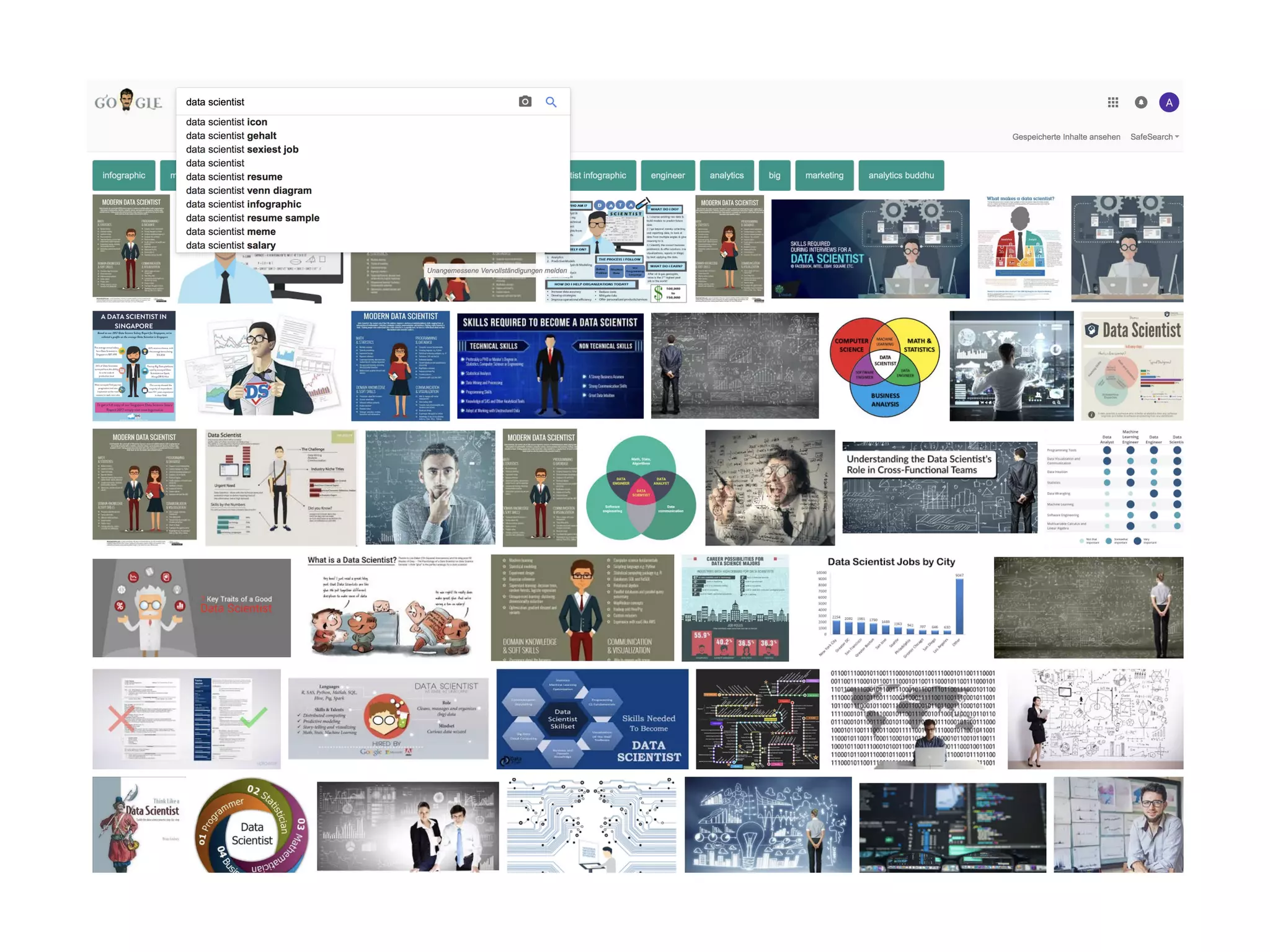
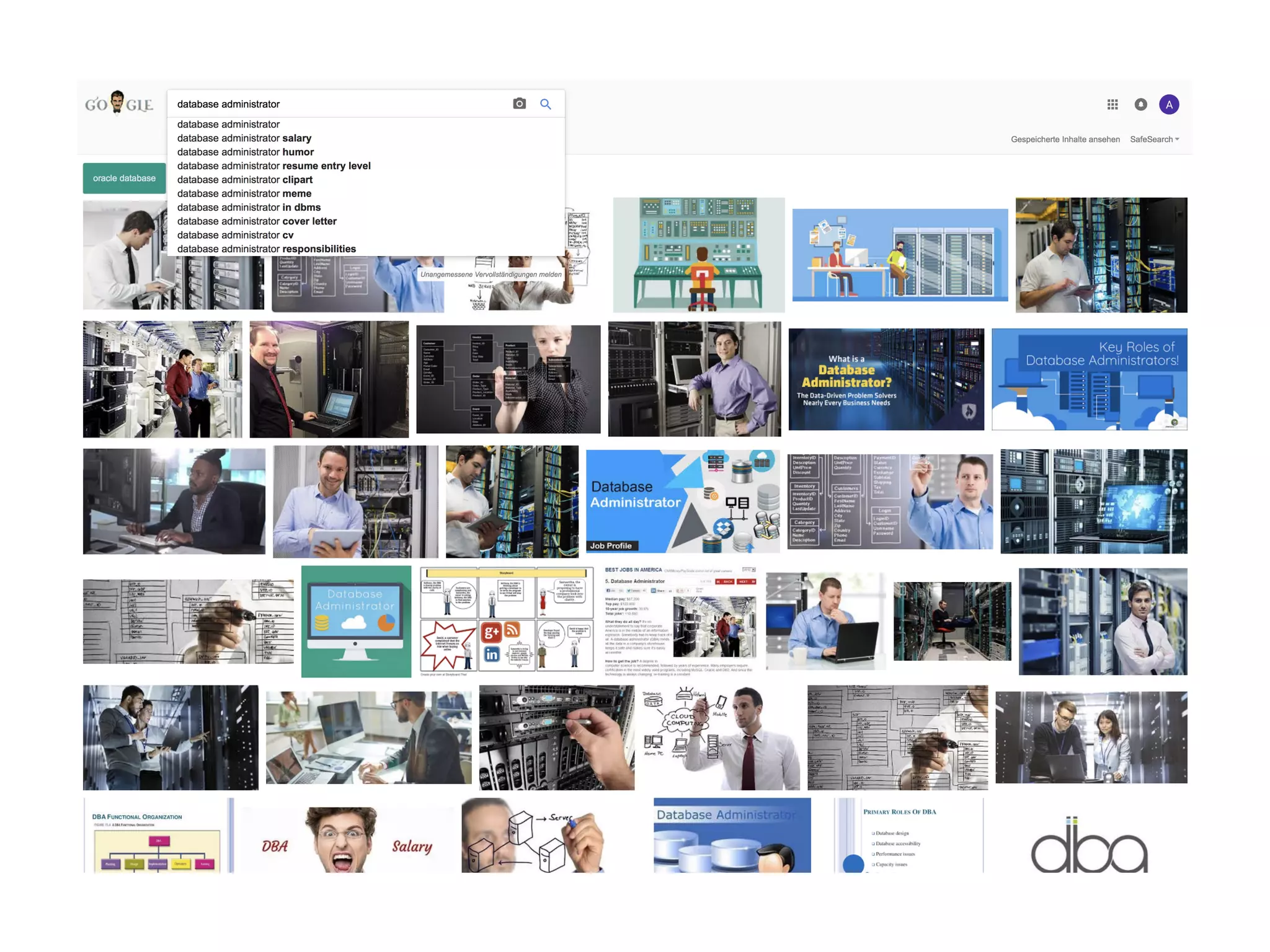
Ask Google:
Data Scientist? Database Admin?
%#&'
()*+
,
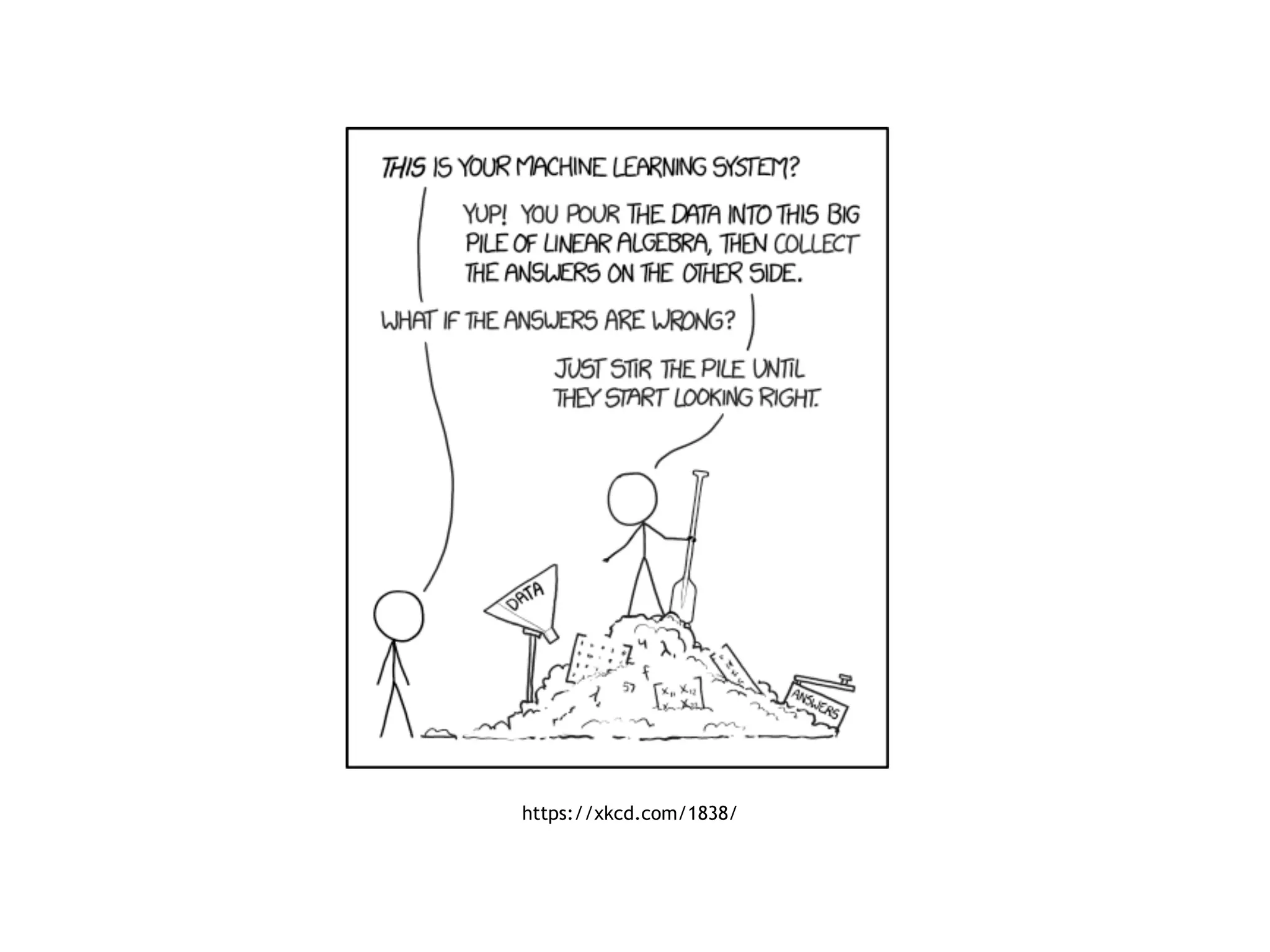
https://xkcd.com/1838/
What are the Benefits of a Database for Data Science Anyway?
− Common source of data
− Avoiding redundancy (e.g. files)
− Persistence
− Optimized for handling and accessing data for decades
− Scalability
− Staying very close to the data
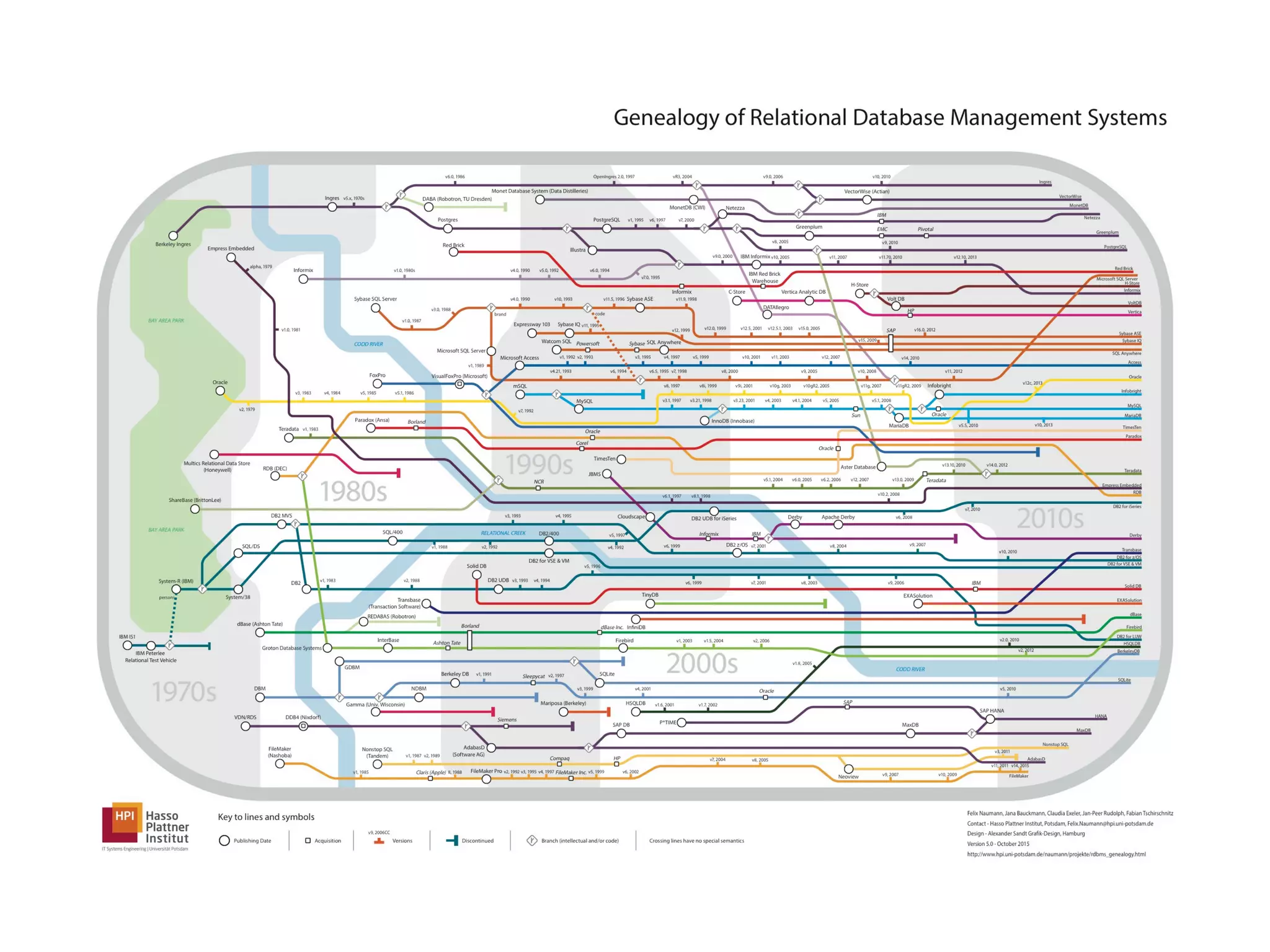
A Quick Recap on Database History
− 1960s, navigational DBMS (disks & drums)
− 1970s, relational DBMS
− 1980s, on the desktop
− 1990s, object-oriented
− 2000s, NoSQL
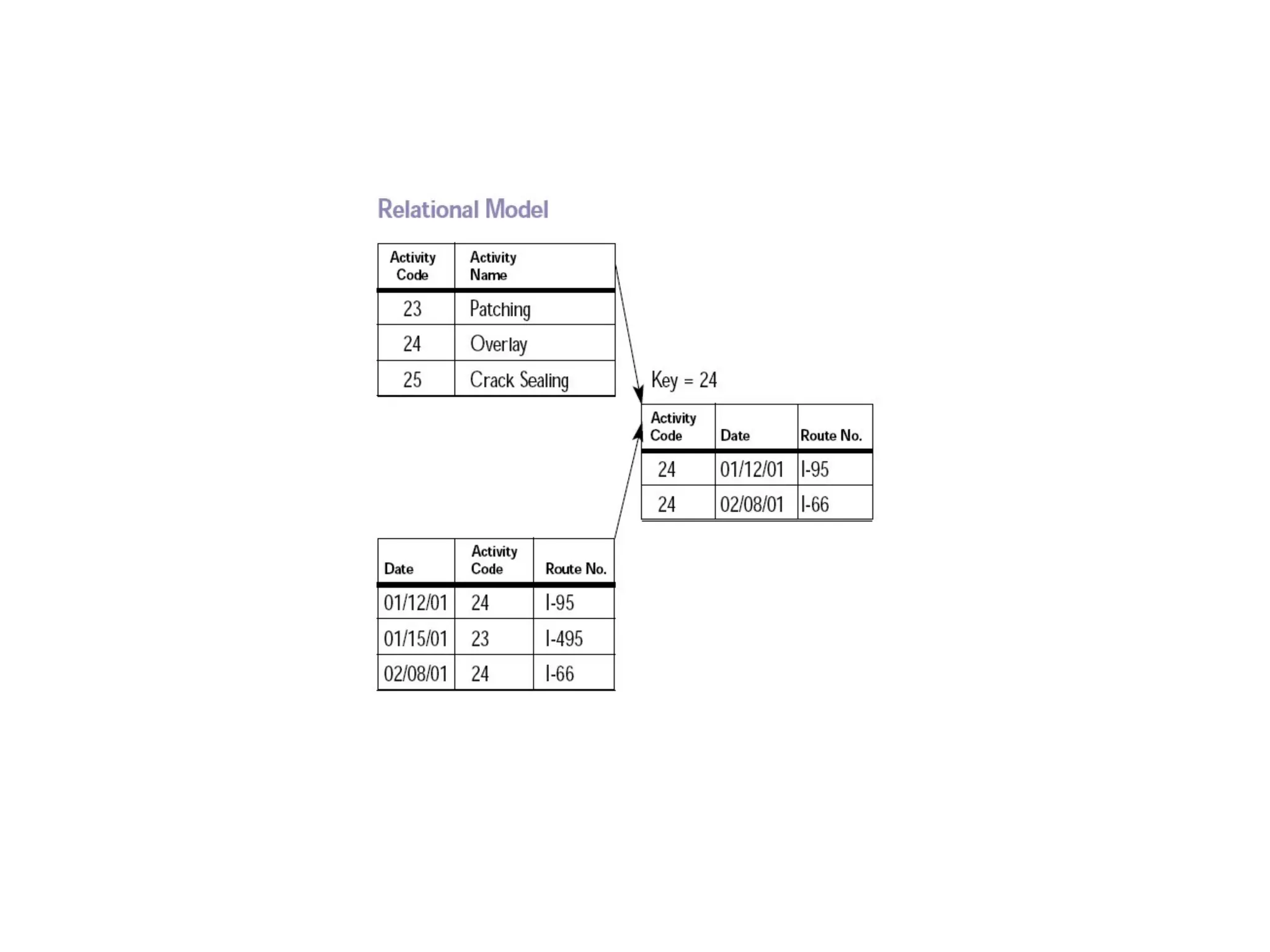
Relational Databases
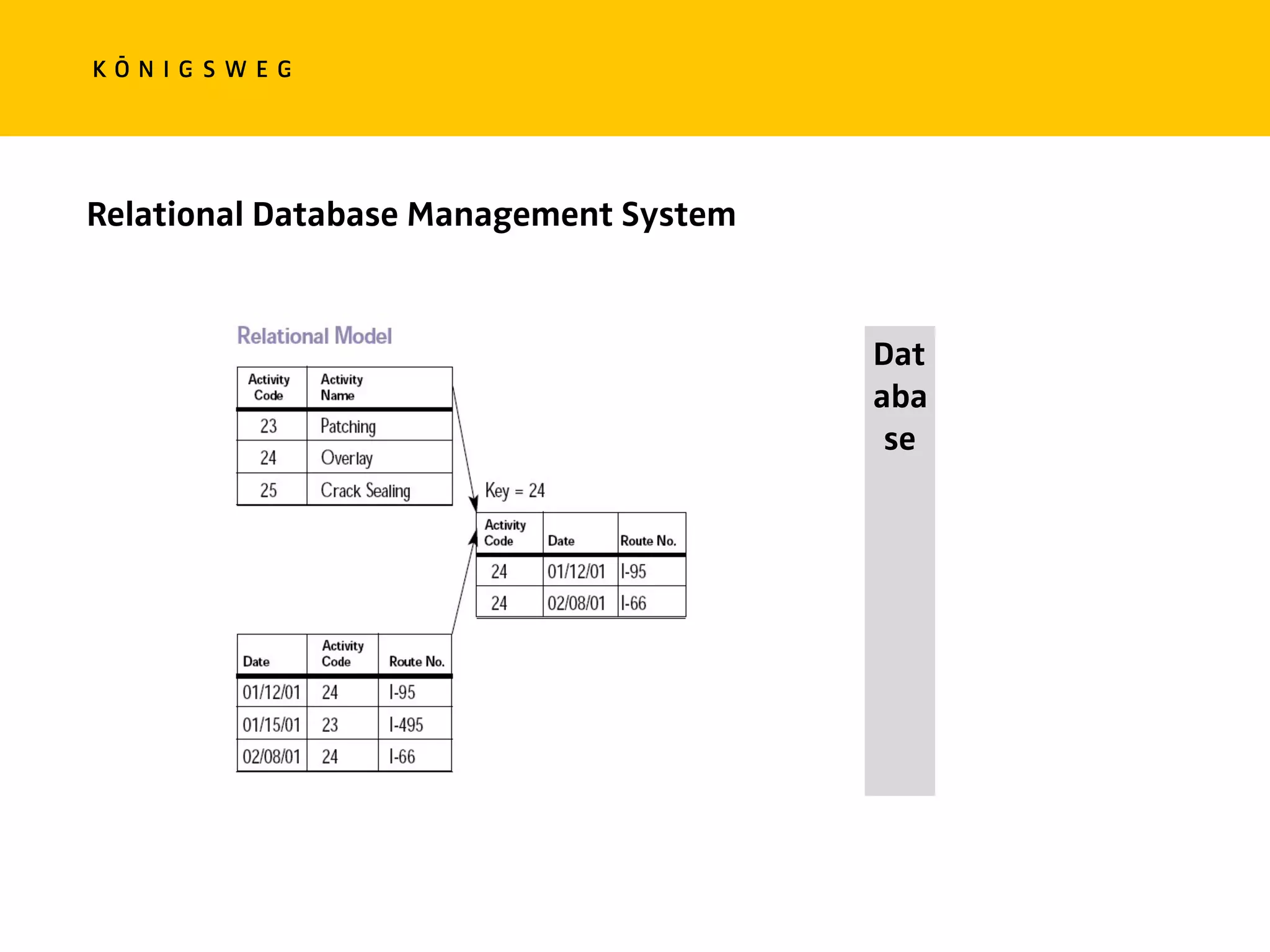
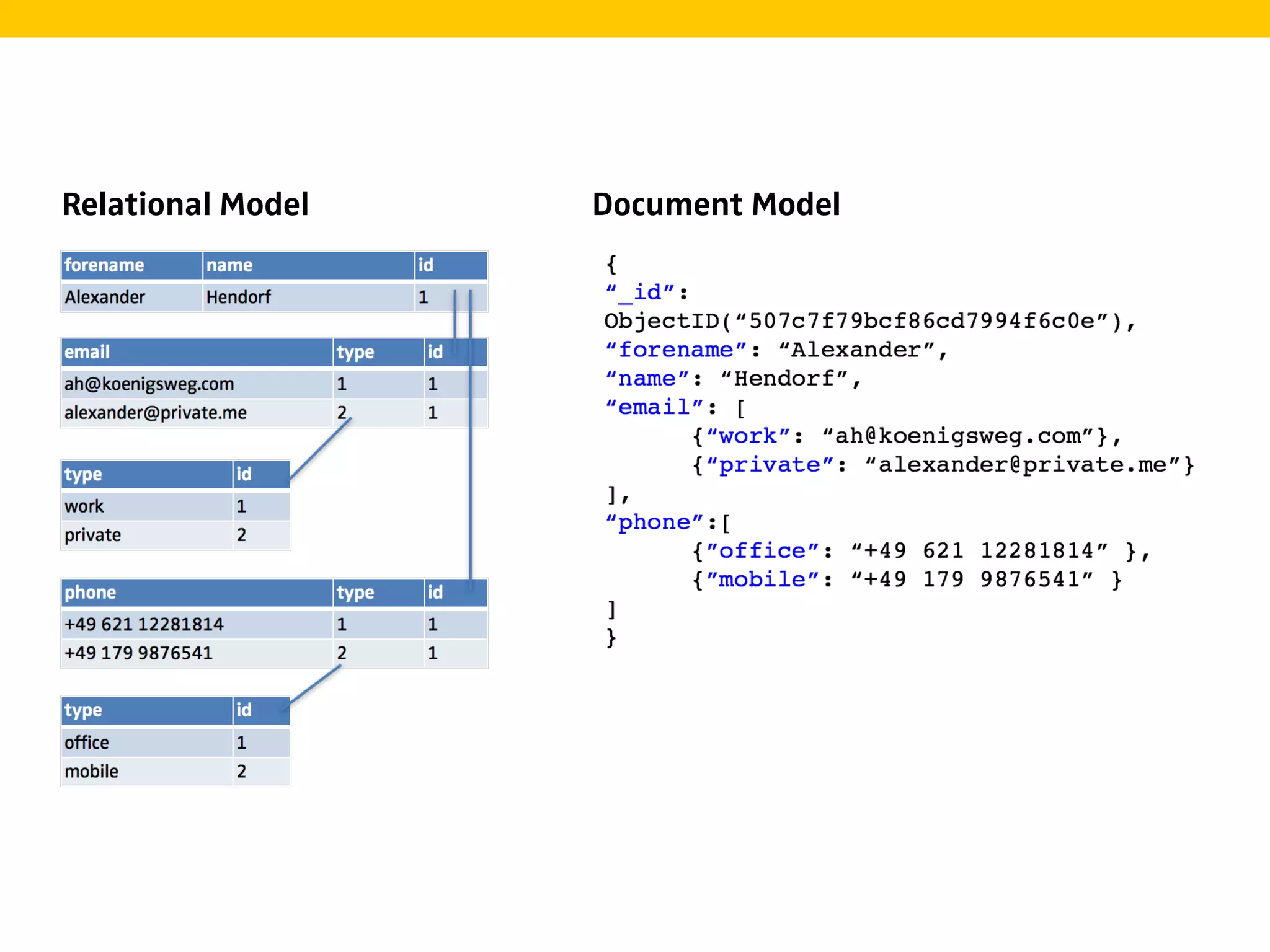
− Records are organised into tables
− Rows of these table are identified by unique keys
− Data spans multiple tables, linked via ids
− Data is ideally normalised
− Data can be denormalized for performance
− Transactions are ACID [Atomic, Consistent , Isolated, Durable]
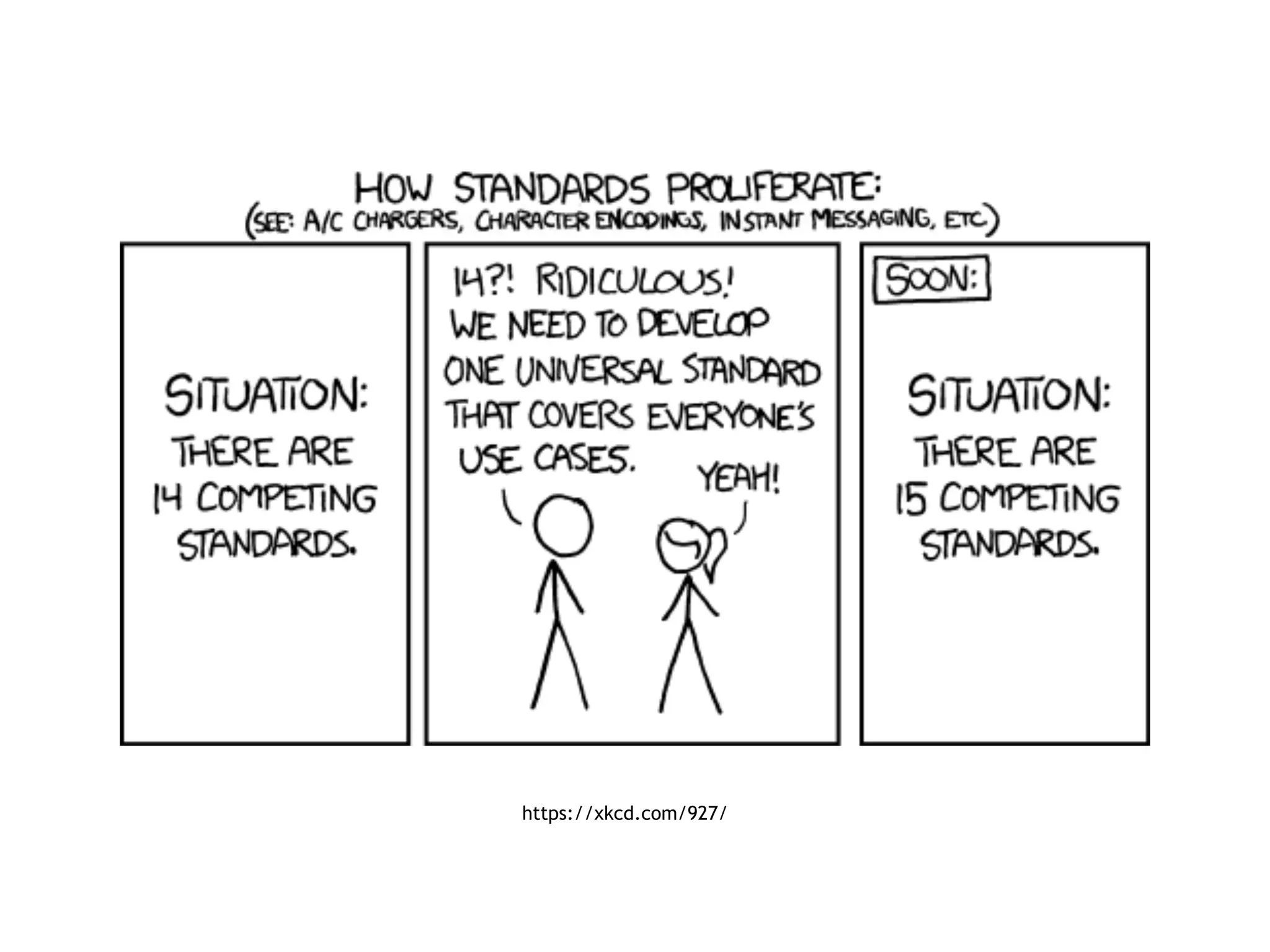
https://xkcd.com/927/
Relational Databases Benefits
− Widely used and supported
− Normalized data
− Comprehensive querying via SQL language 

- though some differences between databases
− Well researched and optimized over decades
Relational Databases Downsides
− Schemas are fixed and have to be pre-defined upfront (schema-first)
− Altering schema is not trivial
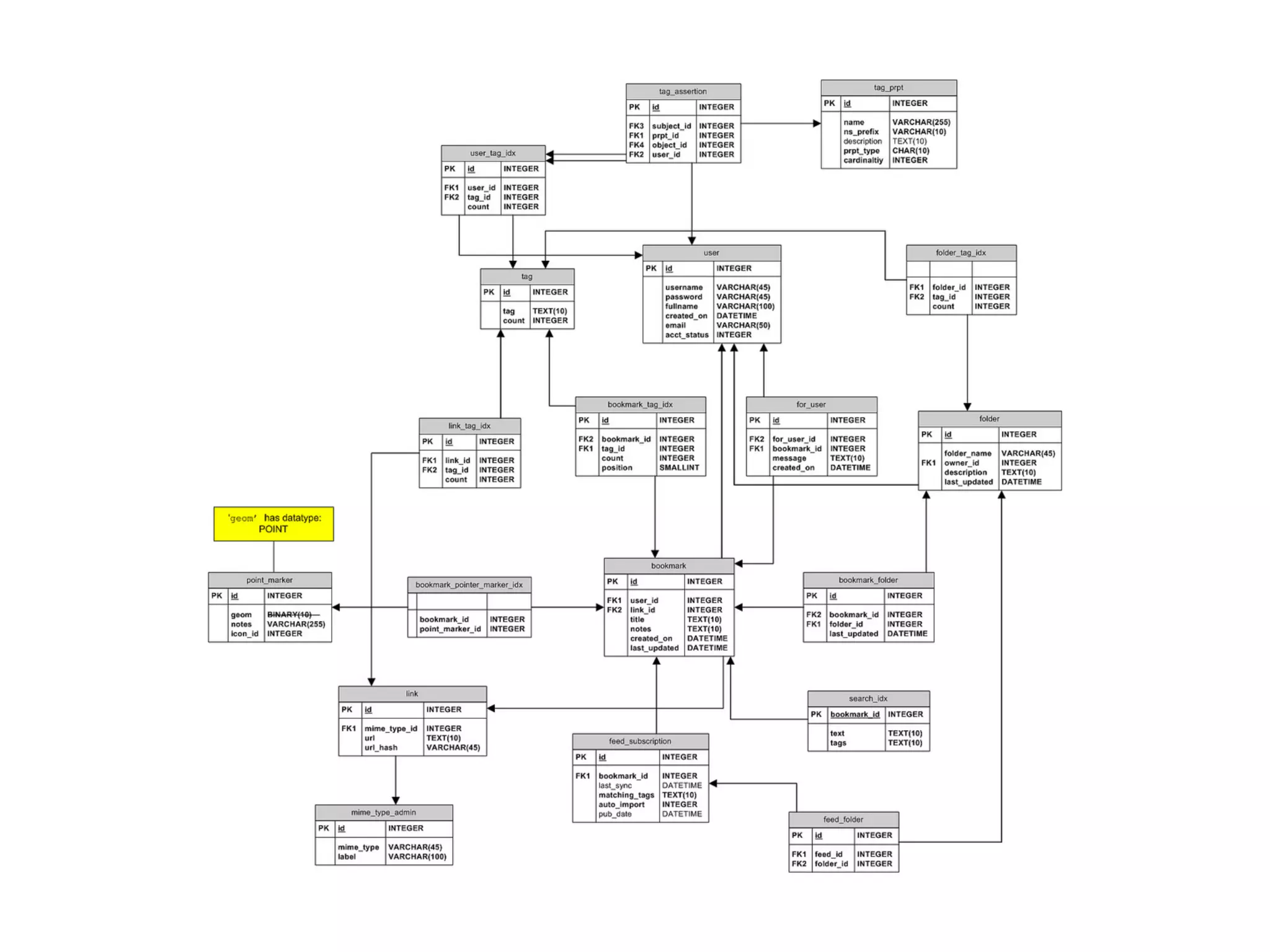
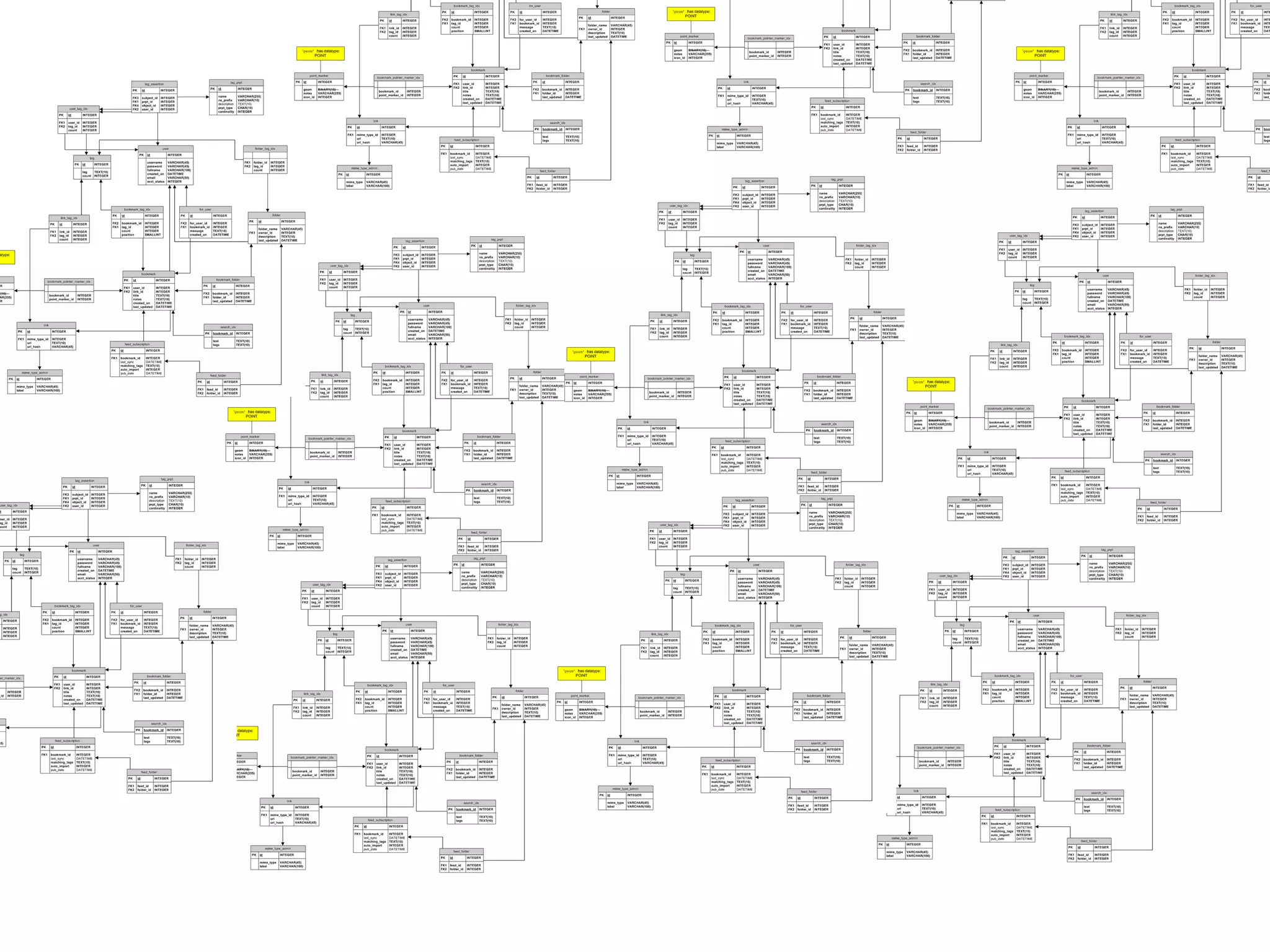
− Joining tables, depending on complexity, data volume may be costly,

also consider overhead understanding a schema with many tables
− Difficult to scale out
− Few data structures (tables, rows)
NoSQL Types
− Key-Value Store

simplest form of a NoSQL database (no big value for data science)
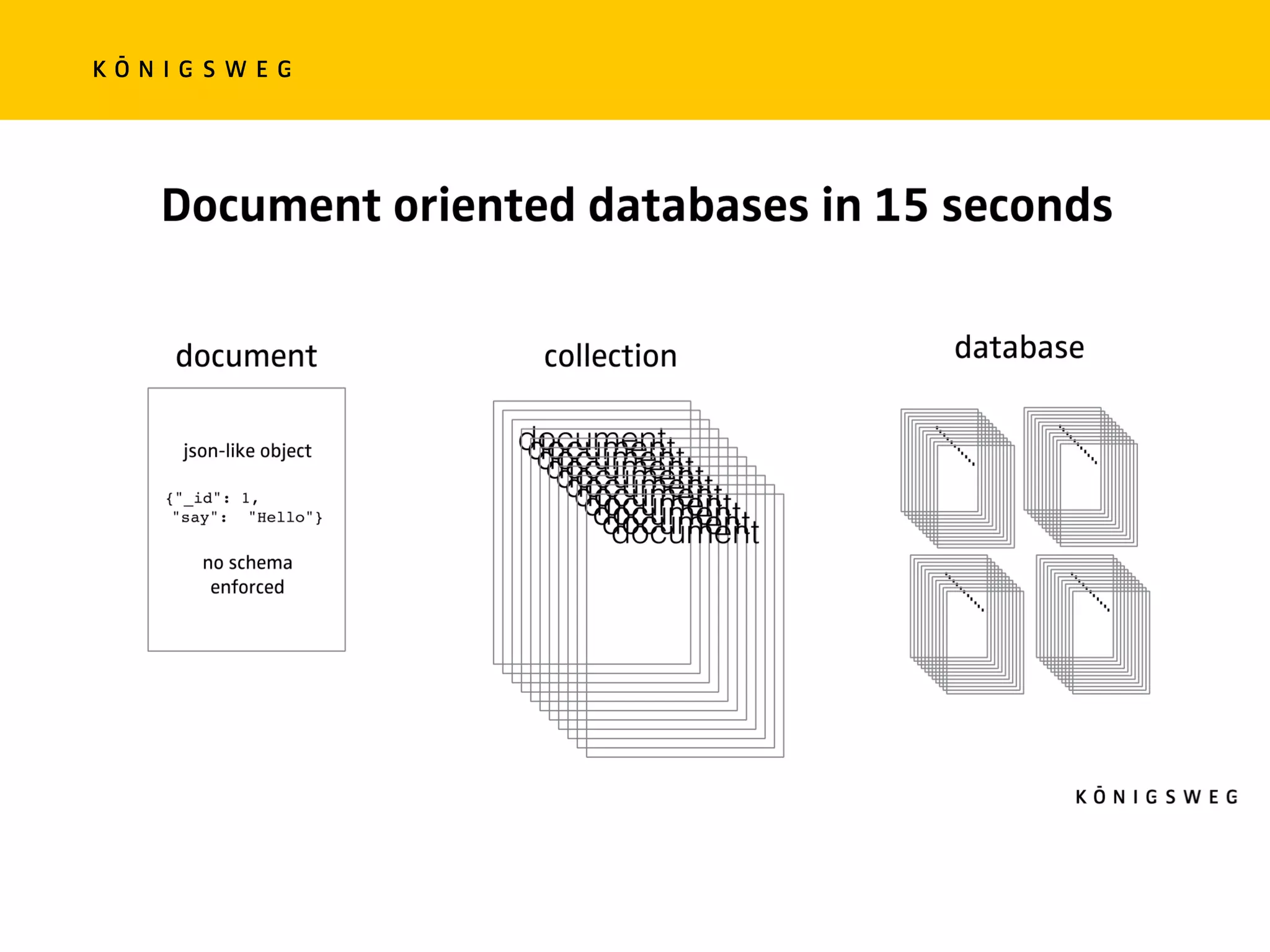
− Document databases (JSON style)

open schema

can handle complex data structures as arrays and list
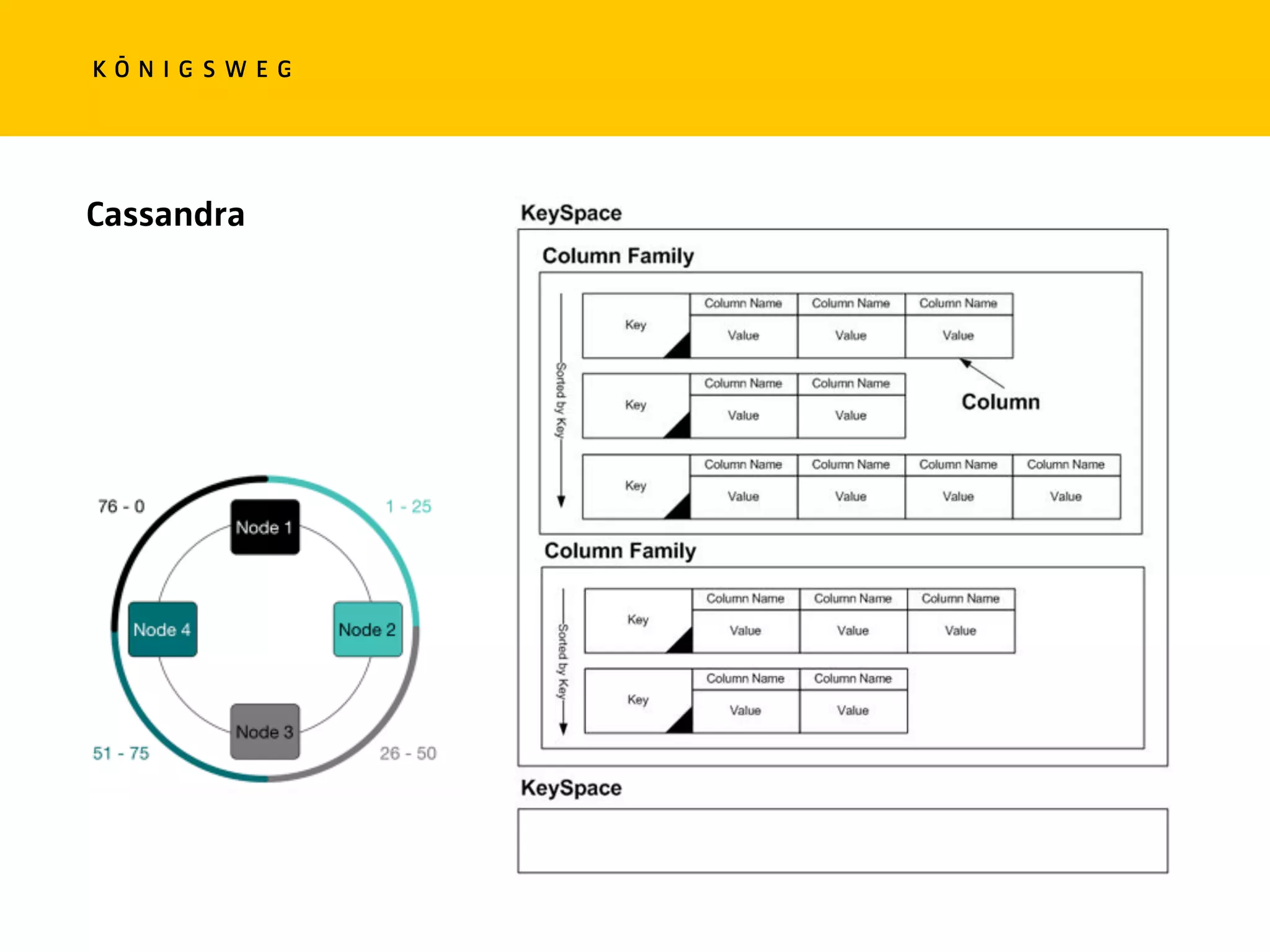
− Wide column databases, most like relational DBs:

columns are not fixed, data is de-normalised, 

can handle complex data structures as arrays and lists
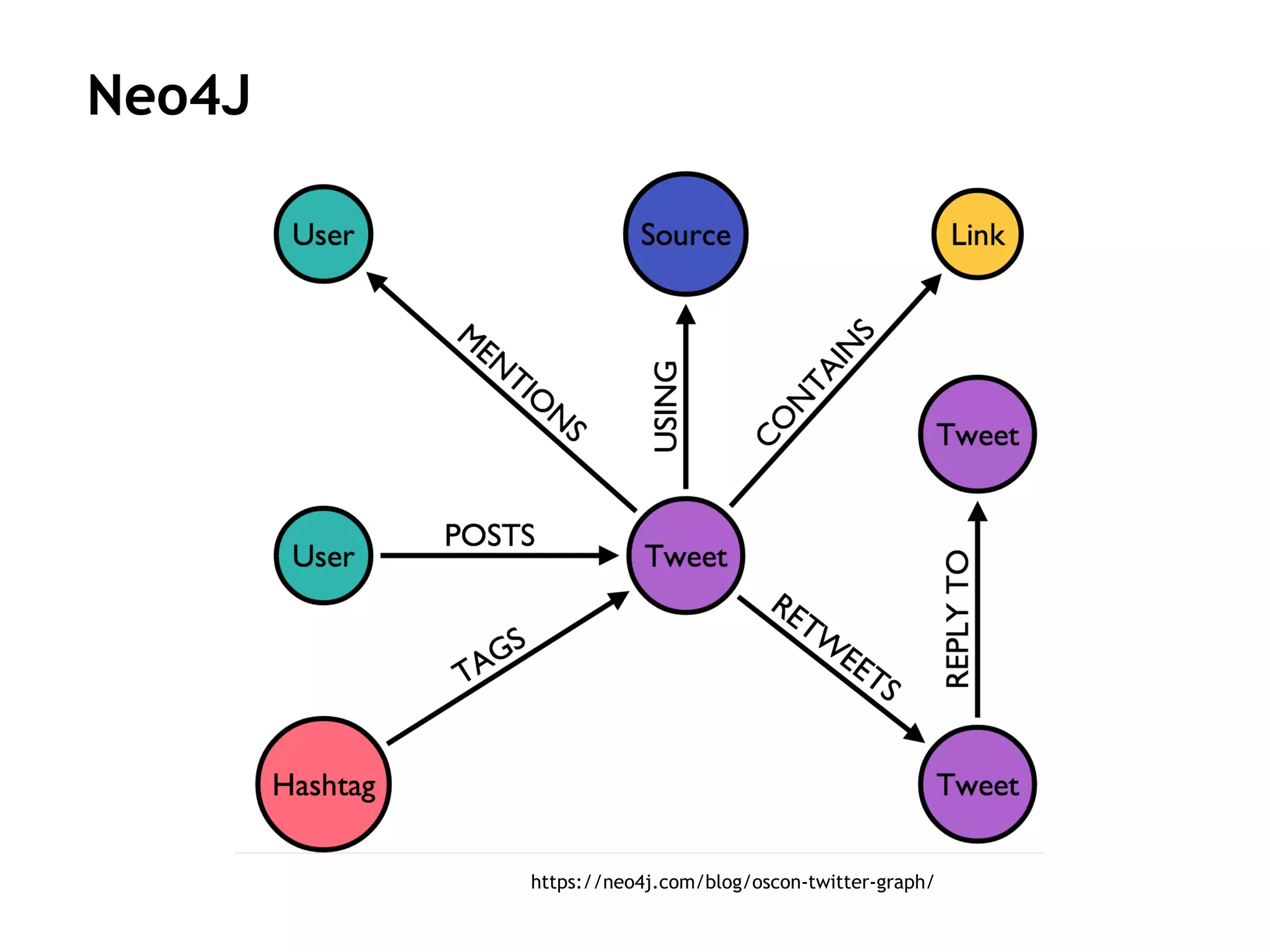
− Graph

network of connected entities linked by edges with properties, query on properties and links
NoSQL Databases Benefits
− No need to normalise data (schema-later)
− Maintain complex data structures
− Supports data sharding
− New ways to query
− Collections can be copied
NoSQL Databases Downsides
− Eventual Consistency (is this a real problem for data science at all?)
− Flexibility requires more responsibility (schema, attribute typos)
− Complexity
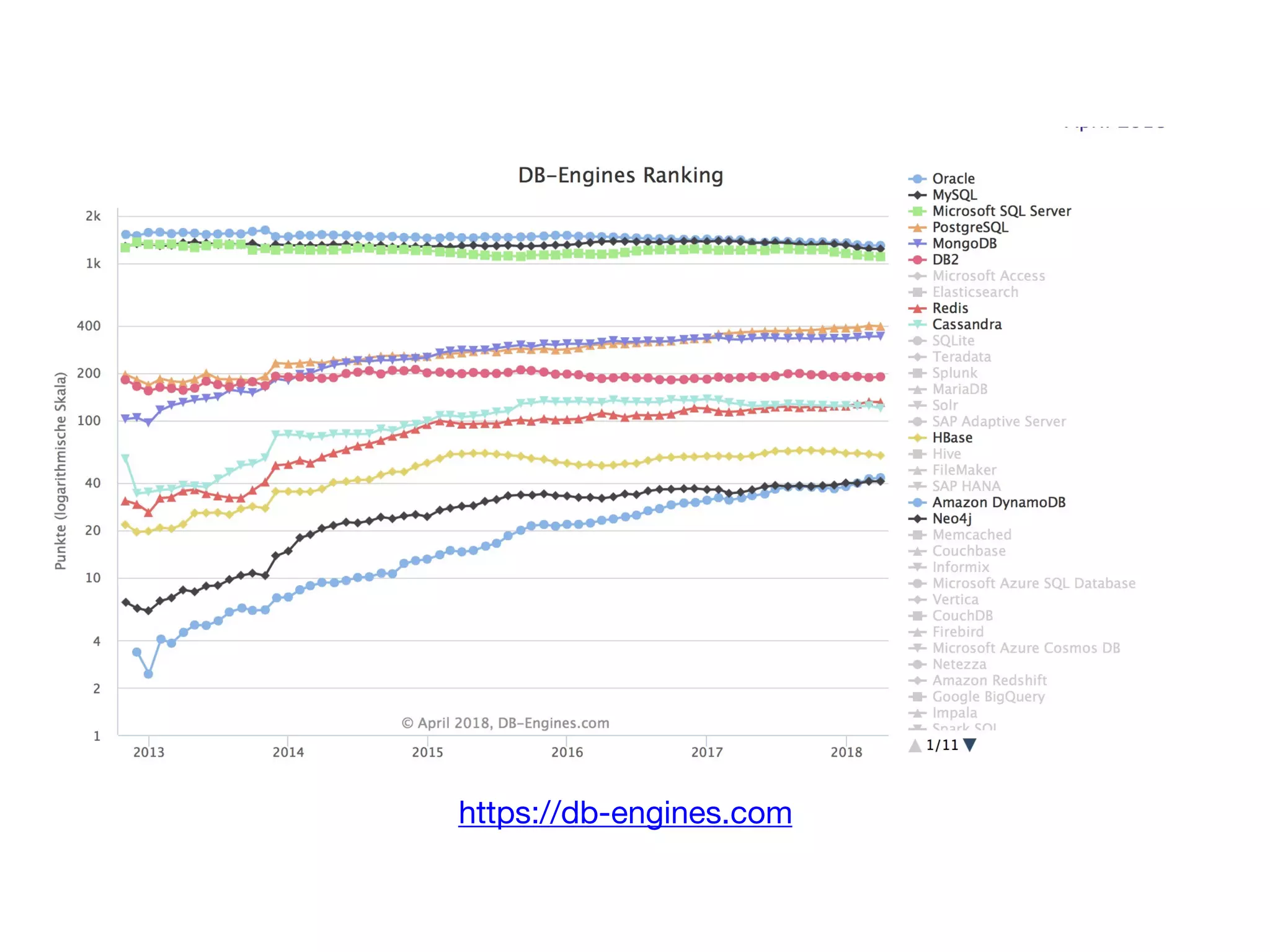
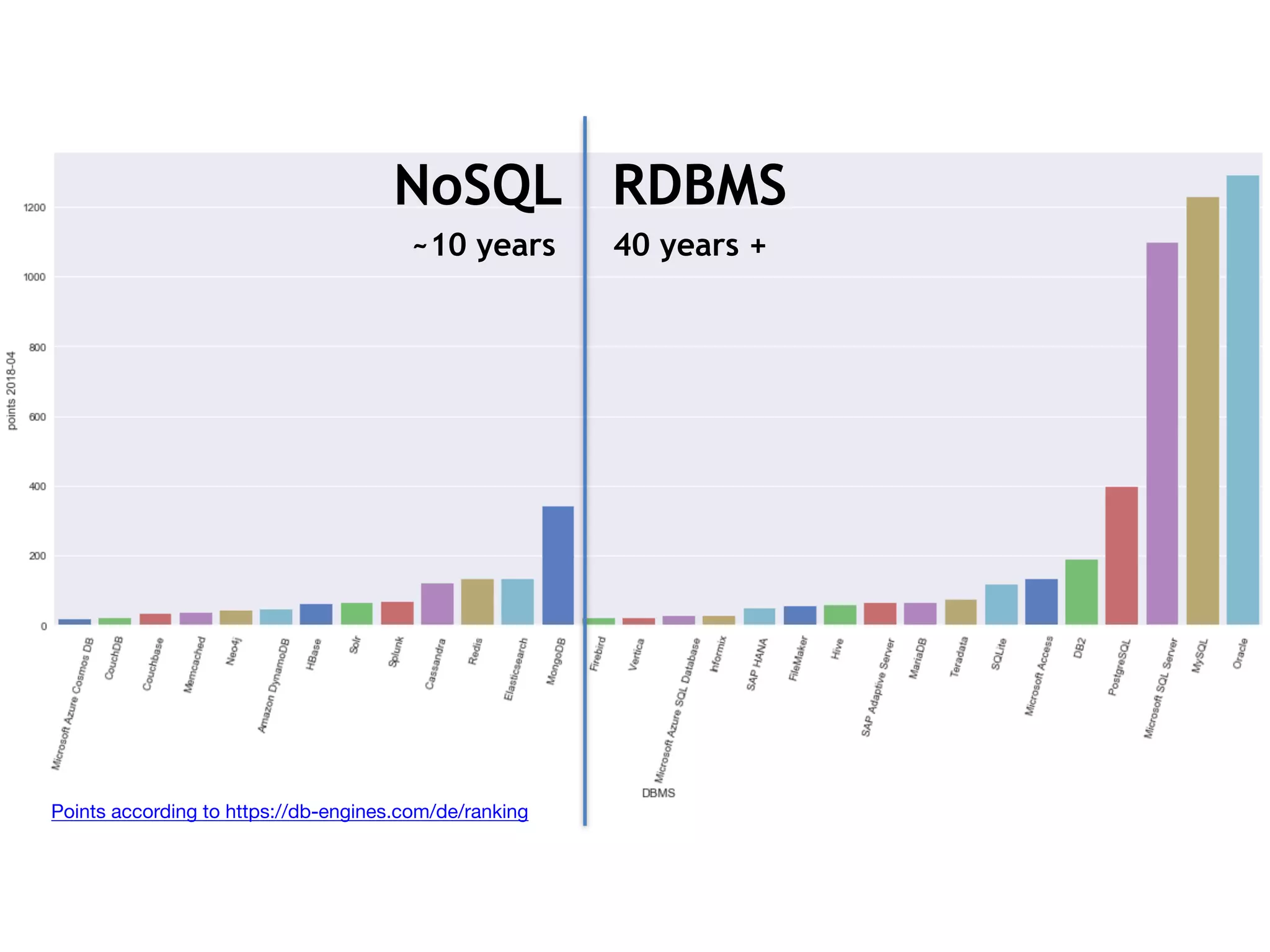
A Quick Bird’s Eye View
There are hundreds of databases around nowadays.
Let’s focus on the top database systems.
https://db-engines.com
NoSQL RDBMS
~10 years 40 years +
Points according to https://db-engines.com/de/ranking
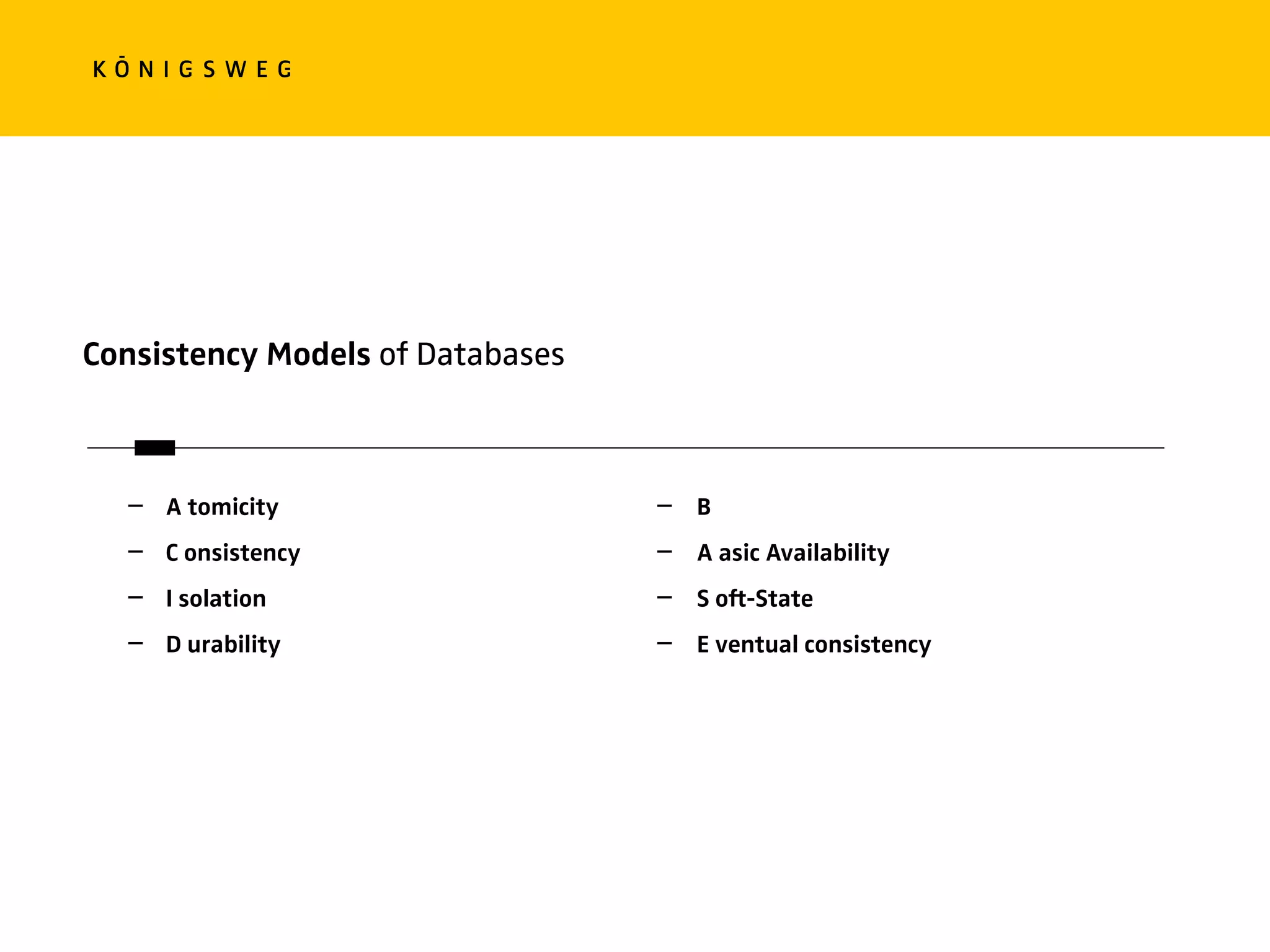
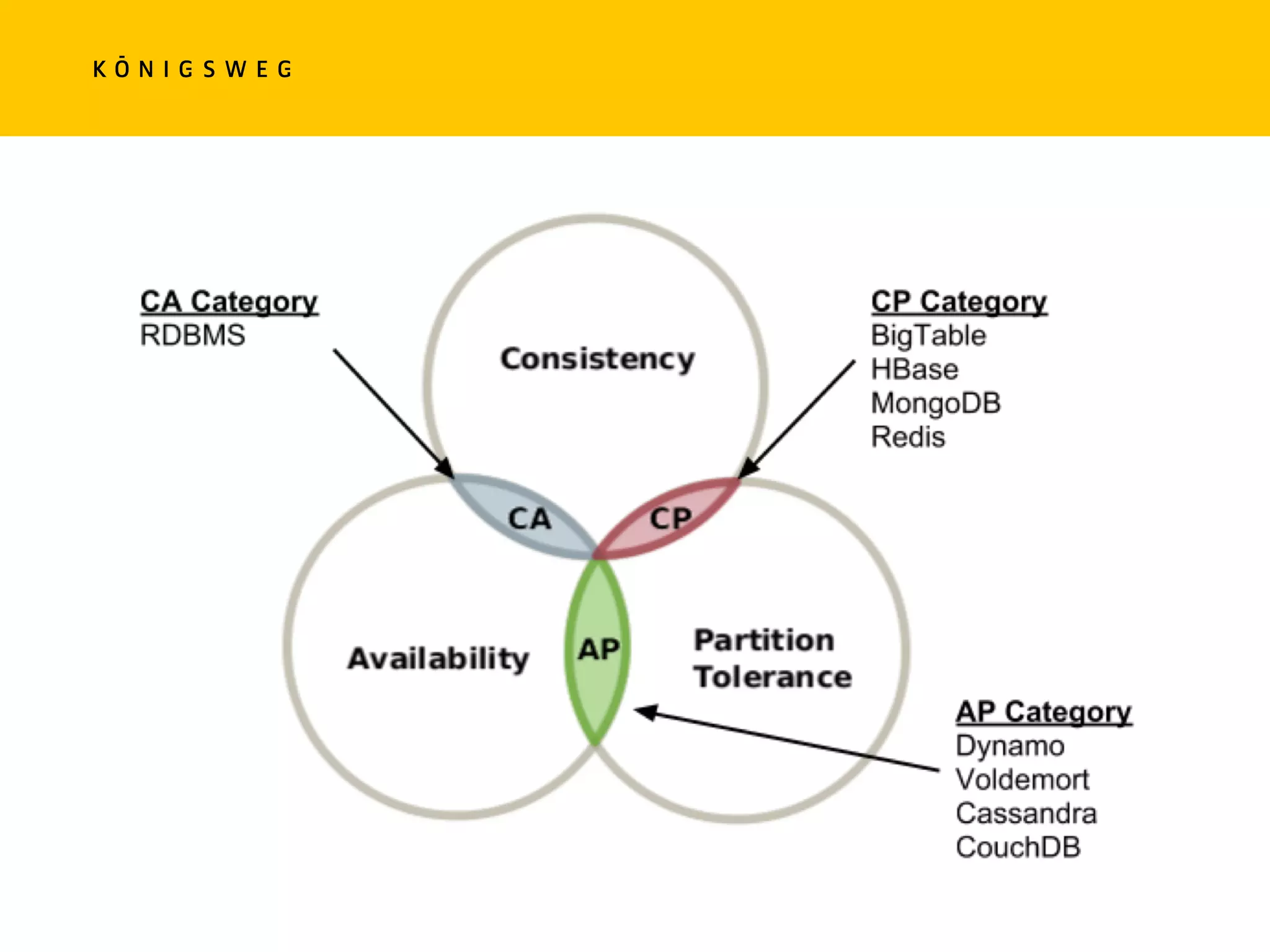
Consistency Models of Databases
− A tomicity
− C onsistency
− I solation
− D urability
− B
− A asic Availability
− S oft-State
− E ventual consistency
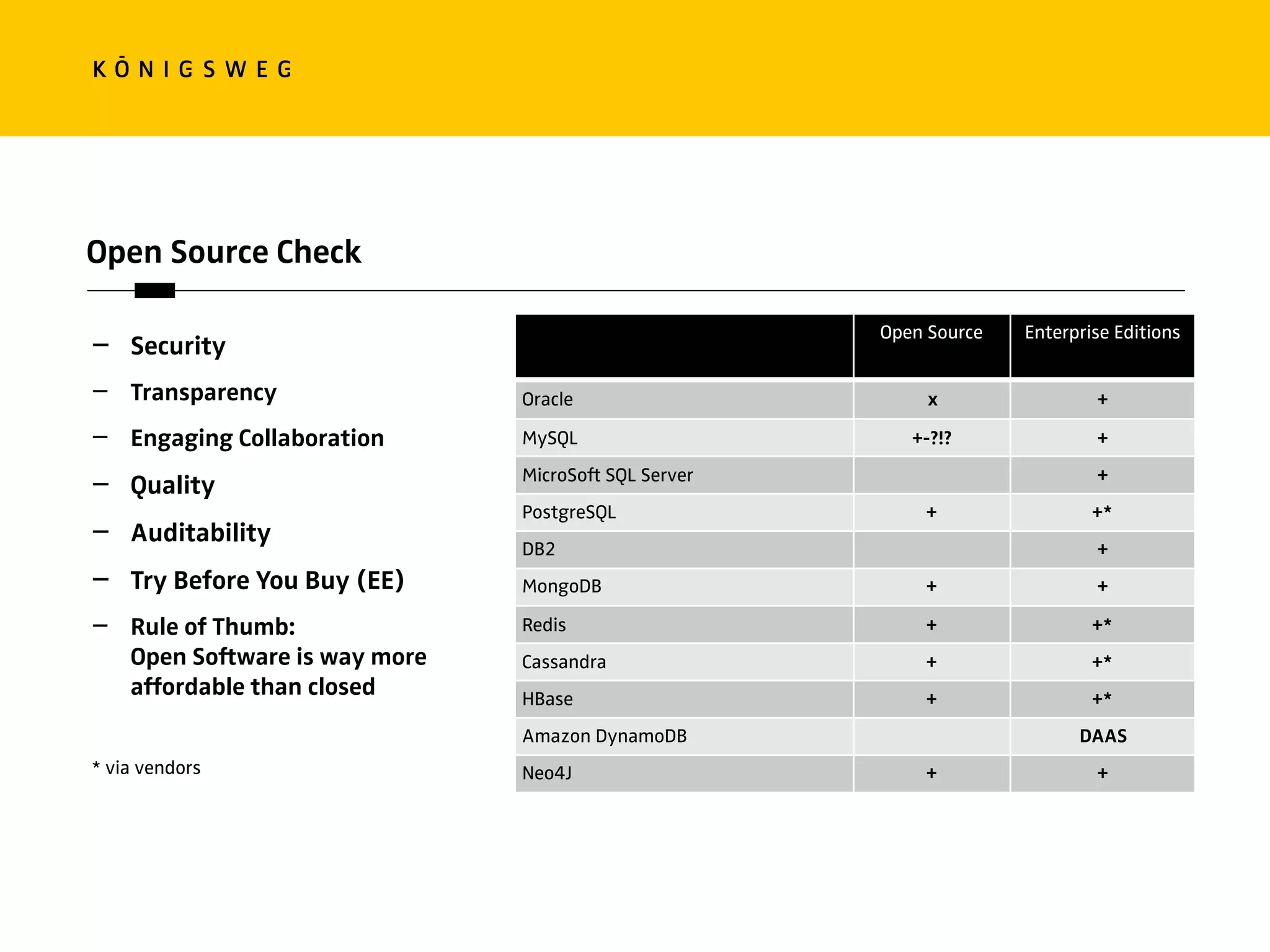
Open Source Check
− Security
− Transparency
− Engaging Collaboration
− Quality
− Auditability
− Try Before You Buy (EE)
− Rule of Thumb: 

Open Software is way more
affordable than closed
* via vendors
Open Source Enterprise Editions
Oracle x +
MySQL +-?!? +
MicroSoft SQL Server +
PostgreSQL + +*
DB2 +
MongoDB + +
Redis + +*
Cassandra + +*
HBase + +*
Amazon DynamoDB DAAS
Neo4J + +
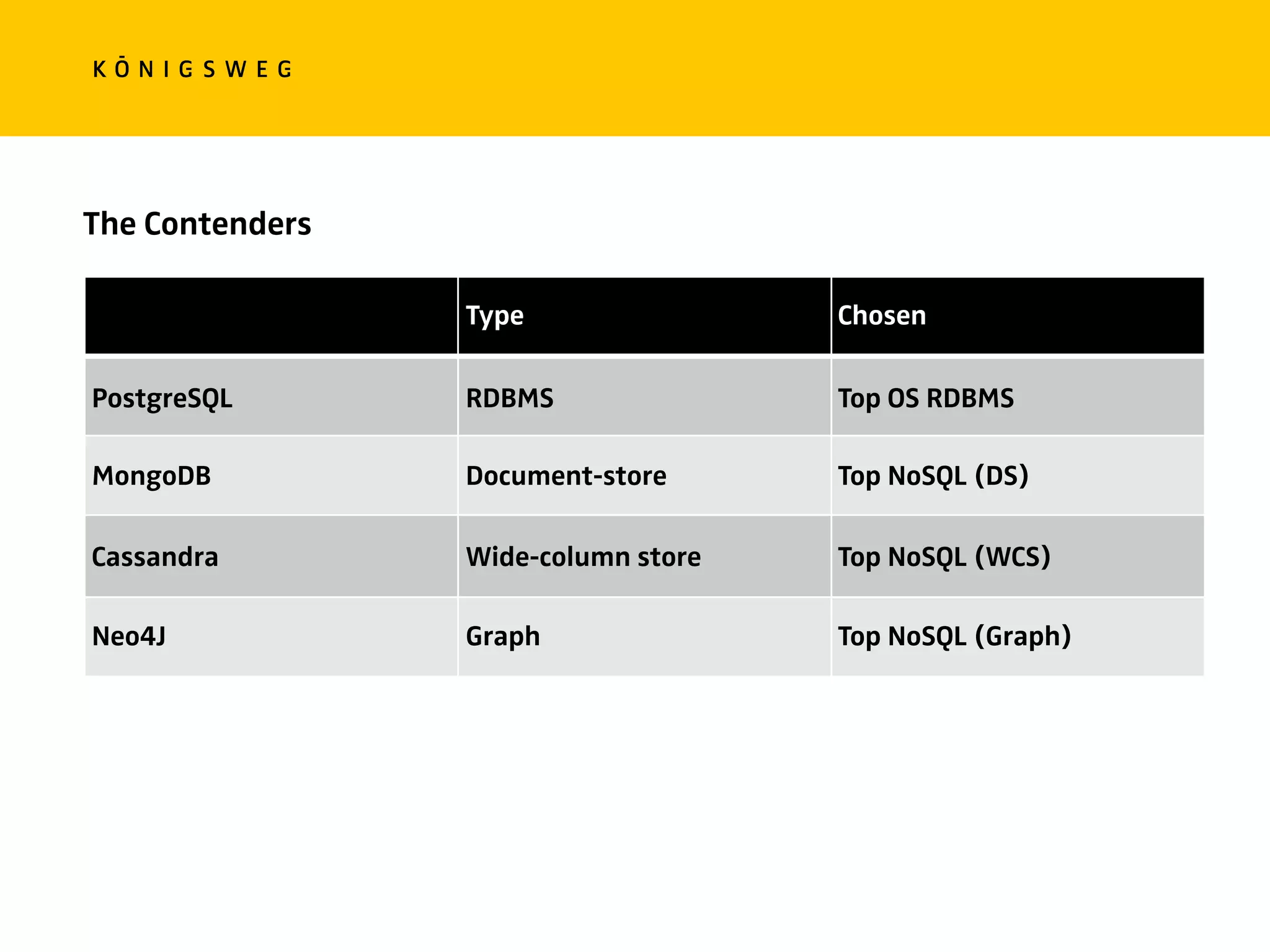
The Contenders
Type Chosen
PostgreSQL RDBMS Top OS RDBMS
MongoDB Document-store Top NoSQL (DS)
Cassandra Wide-column store Top NoSQL (WCS)
Neo4J Graph Top NoSQL (Graph)
Relational Database Management System
Dat
aba
se
Cassandra
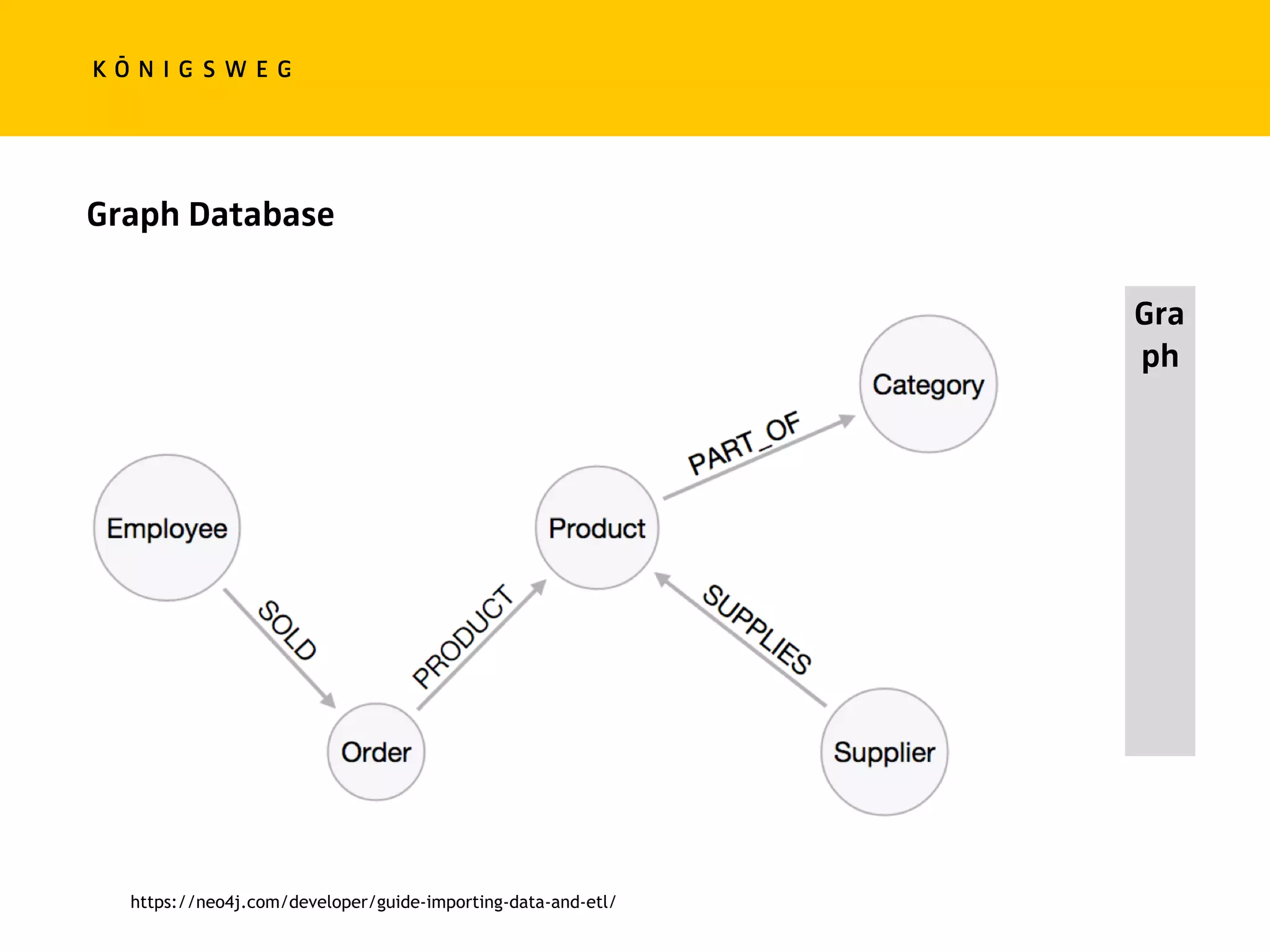
Graph Database
Gra
ph
https://neo4j.com/developer/guide-importing-data-and-etl/
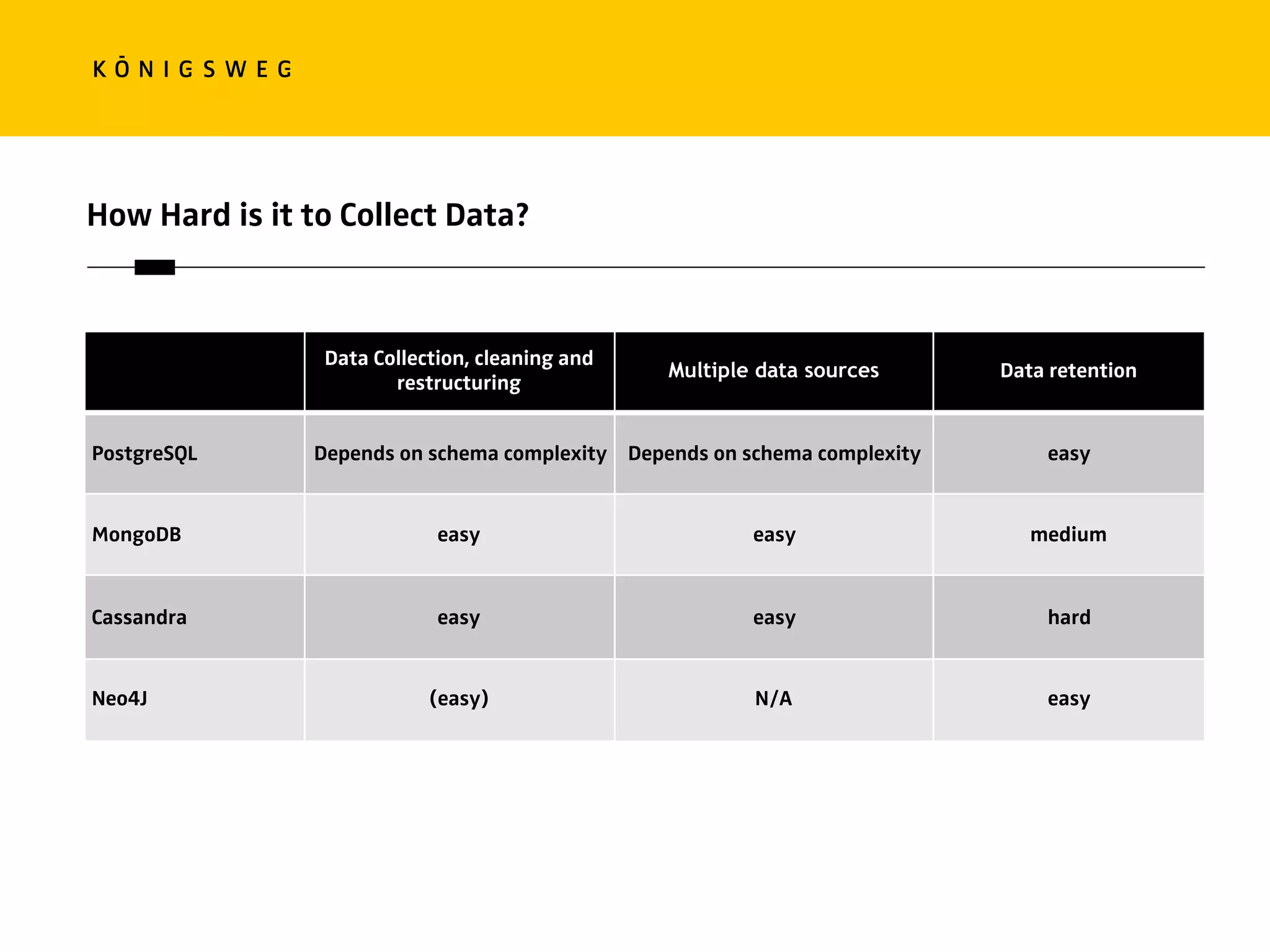
How Hard is it to Collect Data?
Data Collection, cleaning and
restructuring
Multiple data sources Data retention
PostgreSQL Depends on schema complexity Depends on schema complexity easy
MongoDB easy easy medium
Cassandra easy easy hard
Neo4J (easy) N/A easy
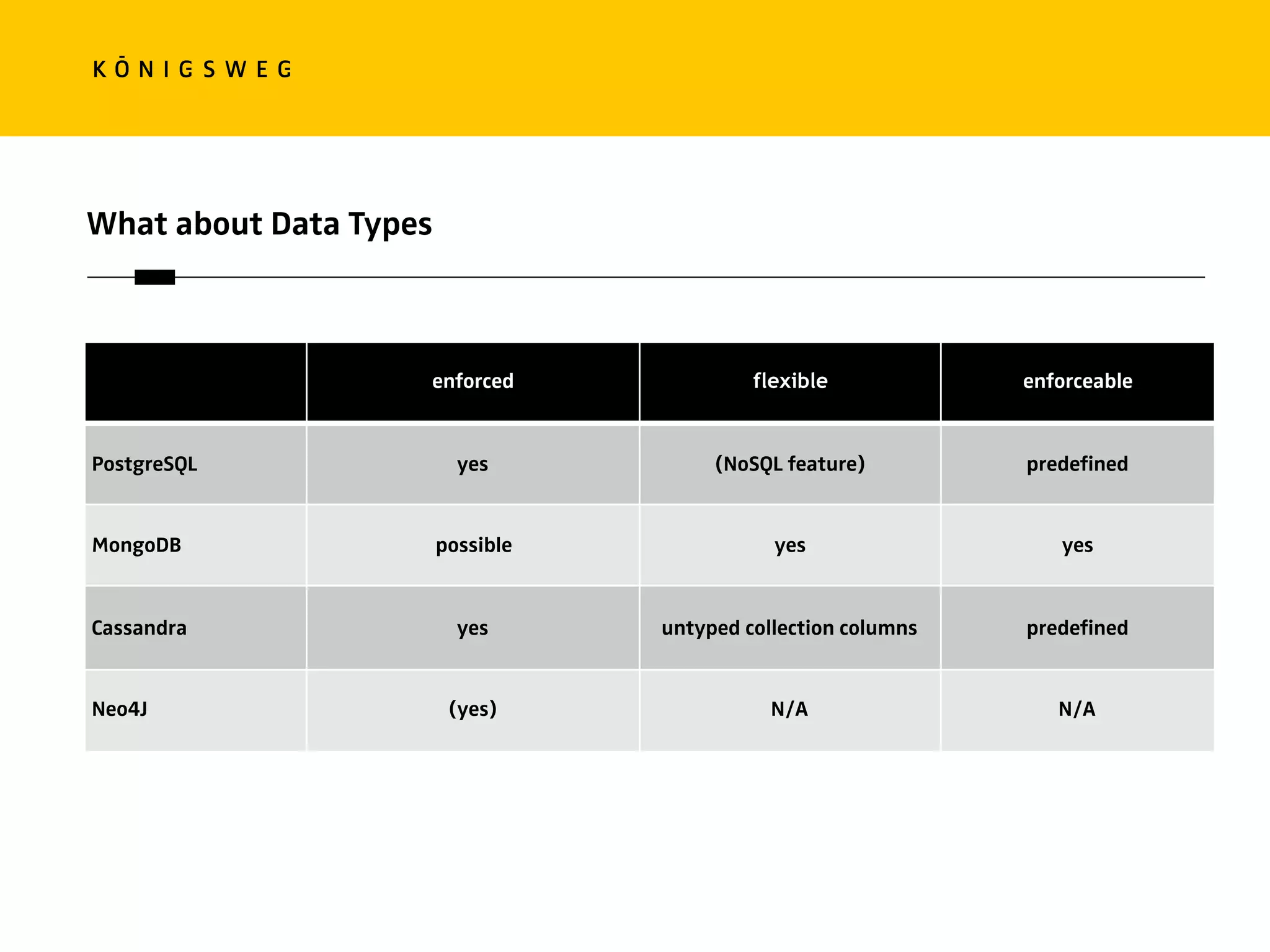
What about Data Types
enforced flexible enforceable
PostgreSQL yes (NoSQL feature) predefined
MongoDB possible yes yes
Cassandra yes untyped collection columns predefined
Neo4J (yes) N/A N/A
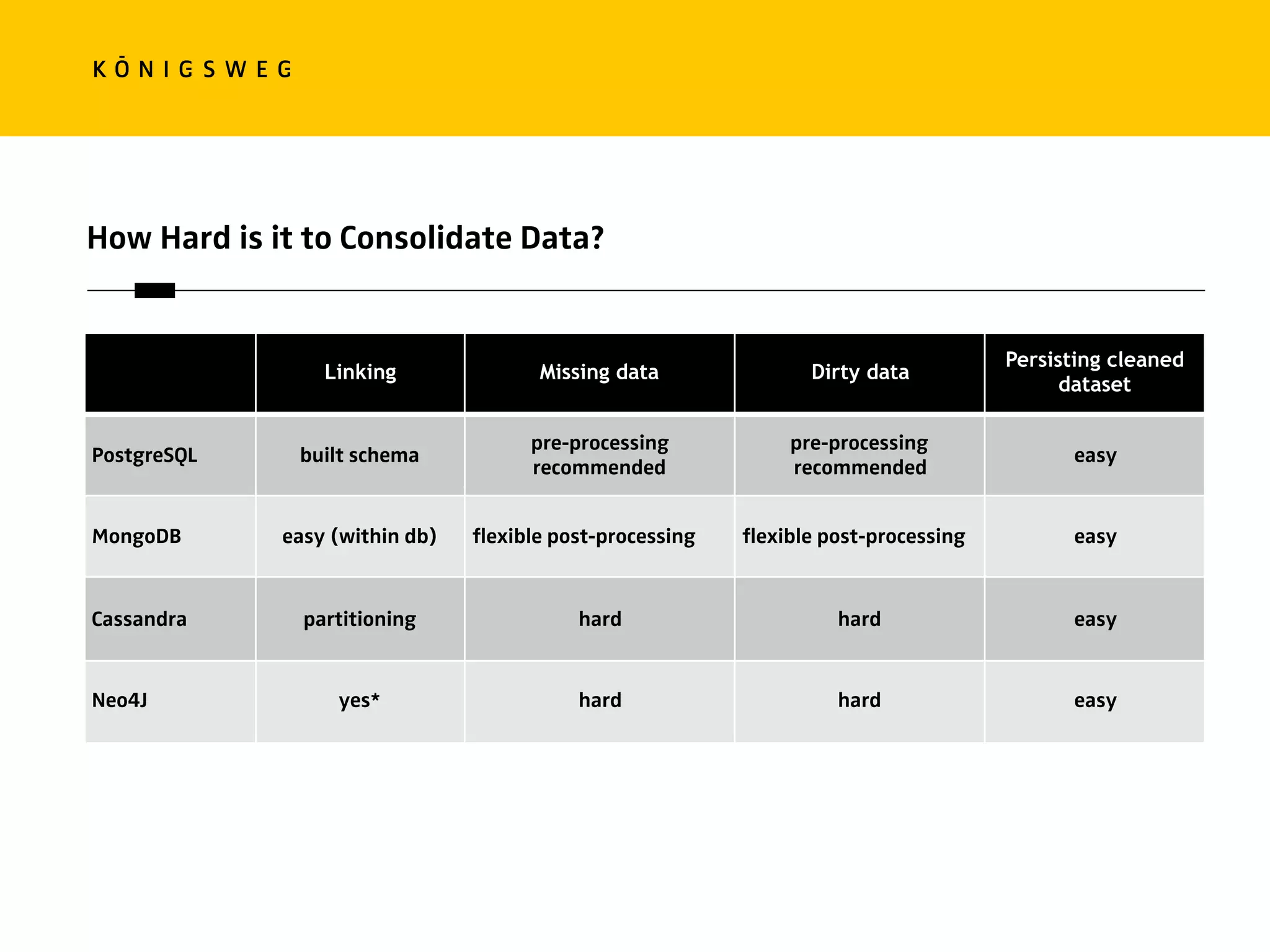
How Hard is it to Consolidate Data?
Linking Missing data Dirty data
Persisting cleaned
dataset
PostgreSQL built schema
pre-processing
recommended
pre-processing
recommended
easy
MongoDB easy (within db) flexible post-processing flexible post-processing easy
Cassandra partitioning hard hard easy
Neo4J yes* hard hard easy
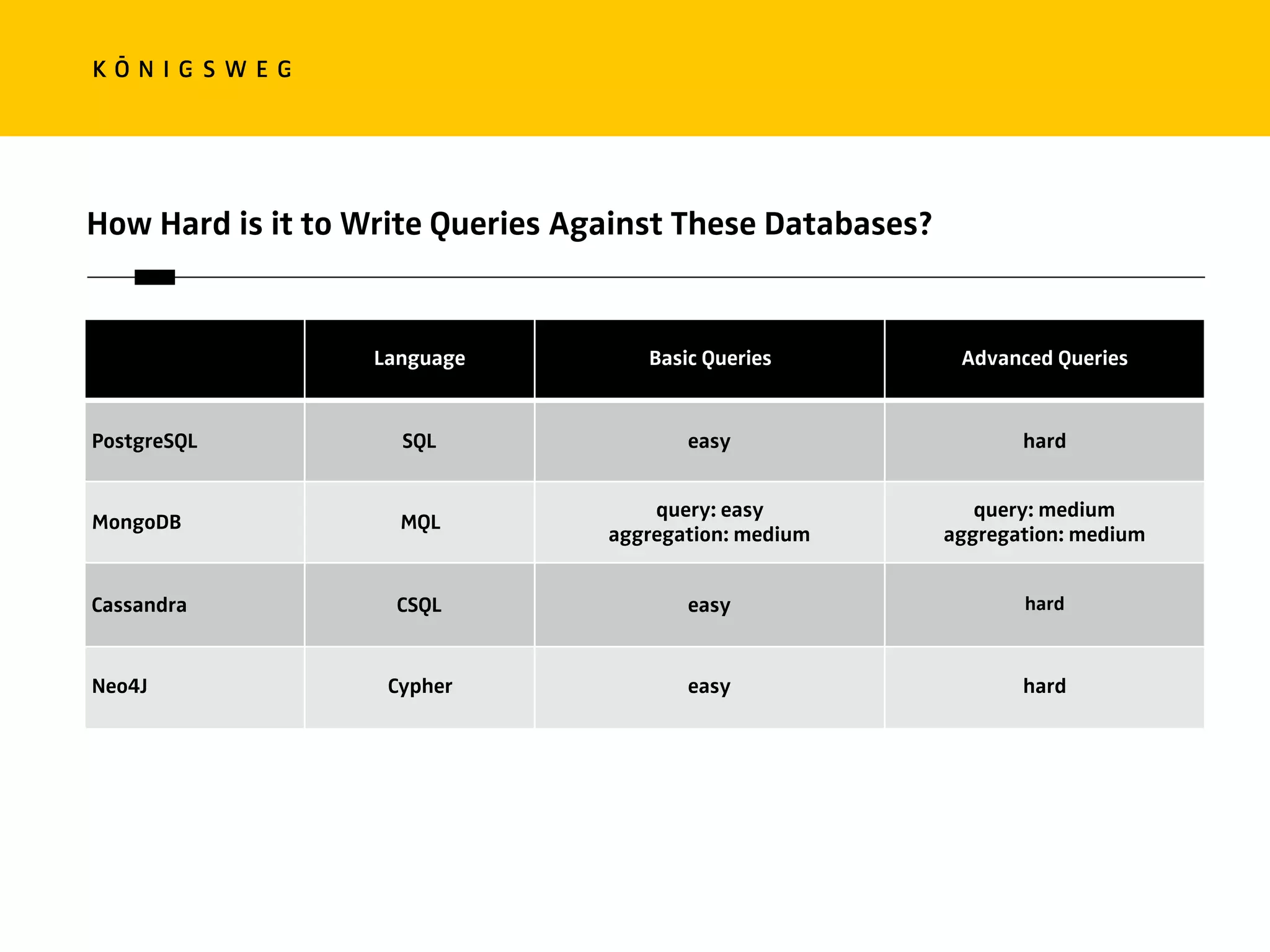
How Hard is it to Write Queries Against These Databases?
Language Basic Queries Advanced Queries
PostgreSQL SQL easy hard
MongoDB MQL
query: easy
aggregation: medium
query: medium
aggregation: medium
Cassandra CSQL easy hard
Neo4J Cypher easy hard
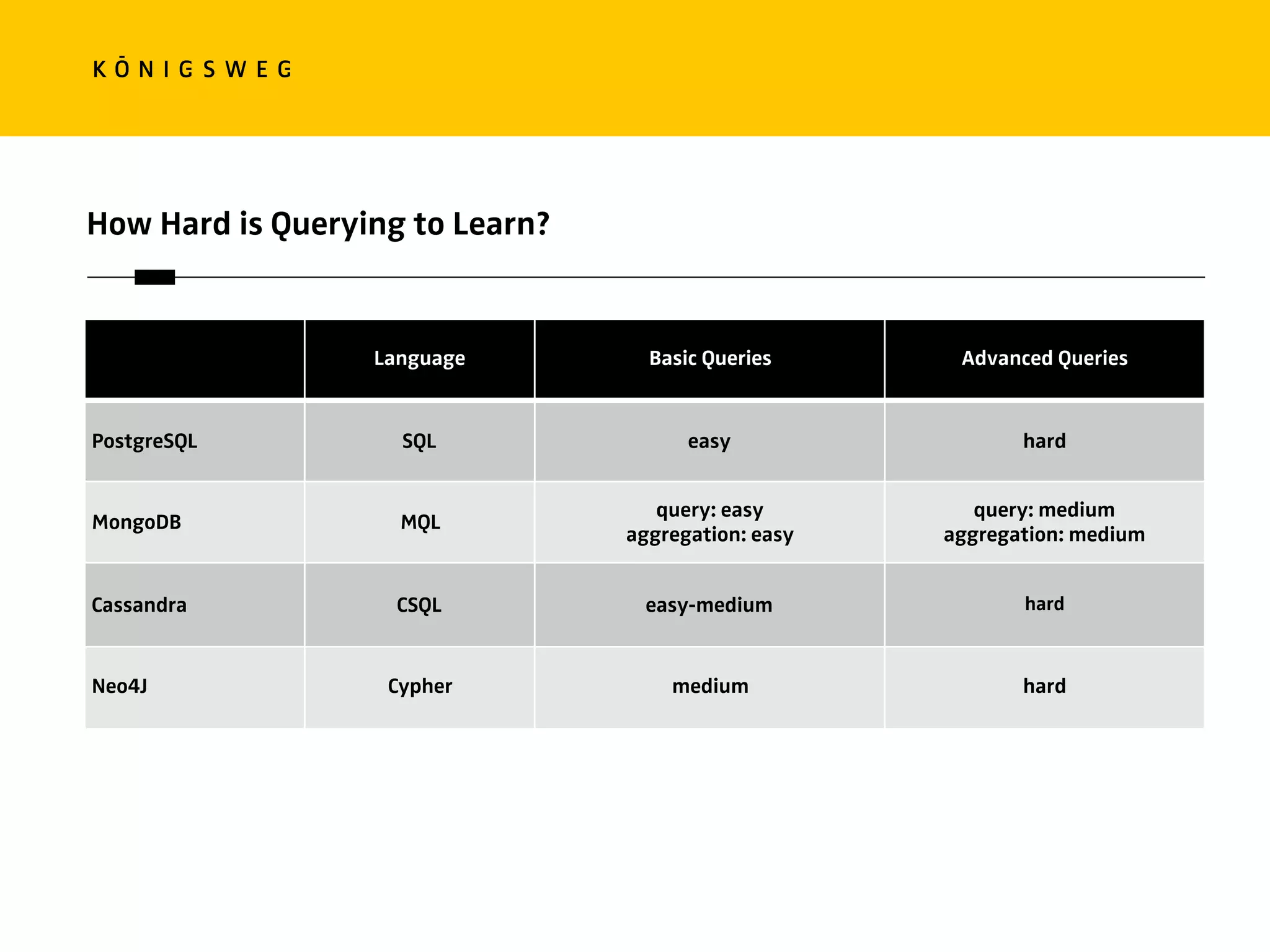
How Hard is Querying to Learn?
Language Basic Queries Advanced Queries
PostgreSQL SQL easy hard
MongoDB MQL
query: easy
aggregation: easy
query: medium
aggregation: medium
Cassandra CSQL easy-medium hard
Neo4J Cypher medium hard
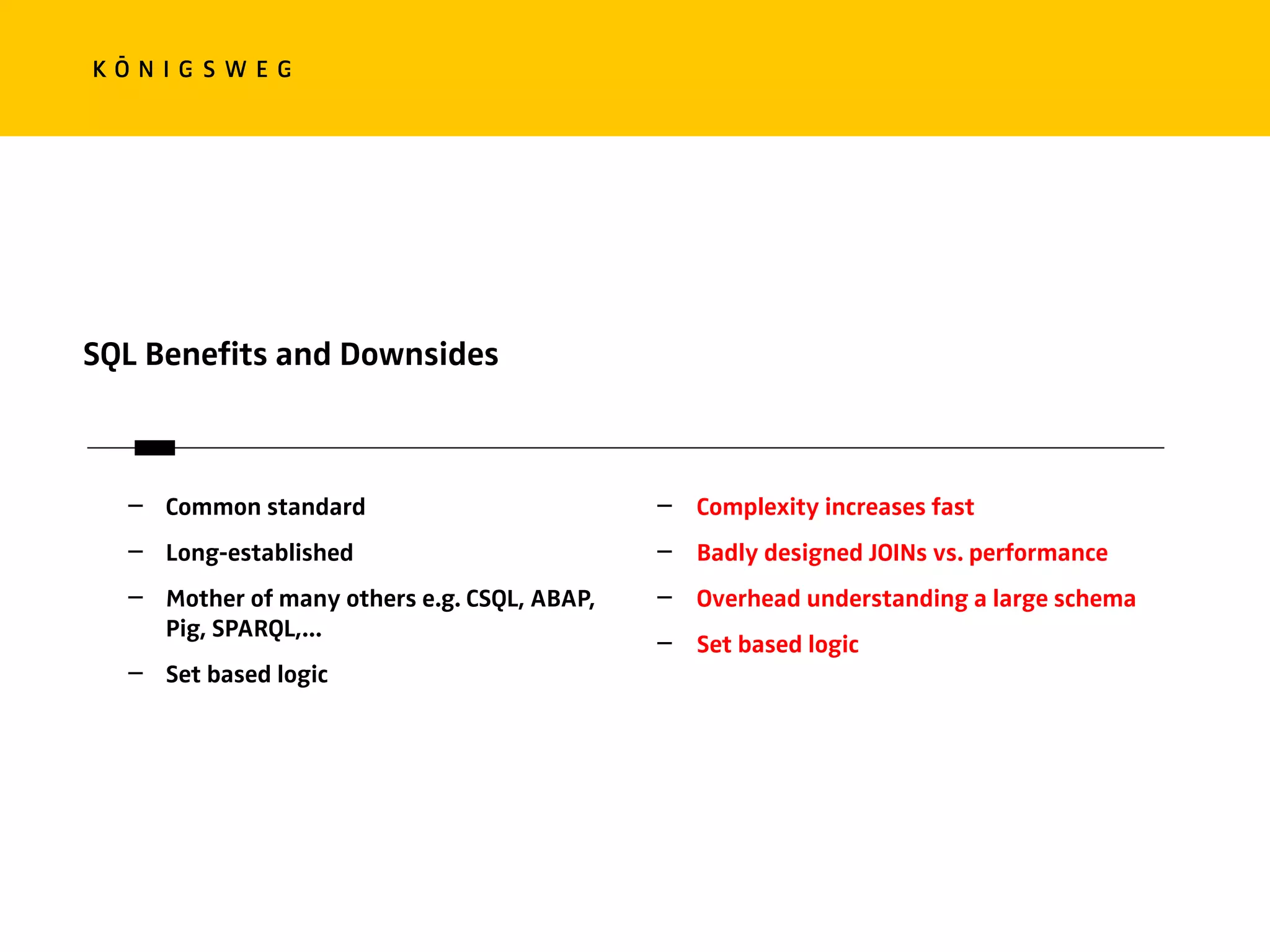
SQL Benefits and Downsides
− Common standard
− Long-established
− Mother of many others e.g. CSQL, ABAP,

Pig, SPARQL,…
− Set based logic
− Complexity increases fast
− Badly designed JOINs vs. performance
− Overhead understanding a large schema
− Set based logic
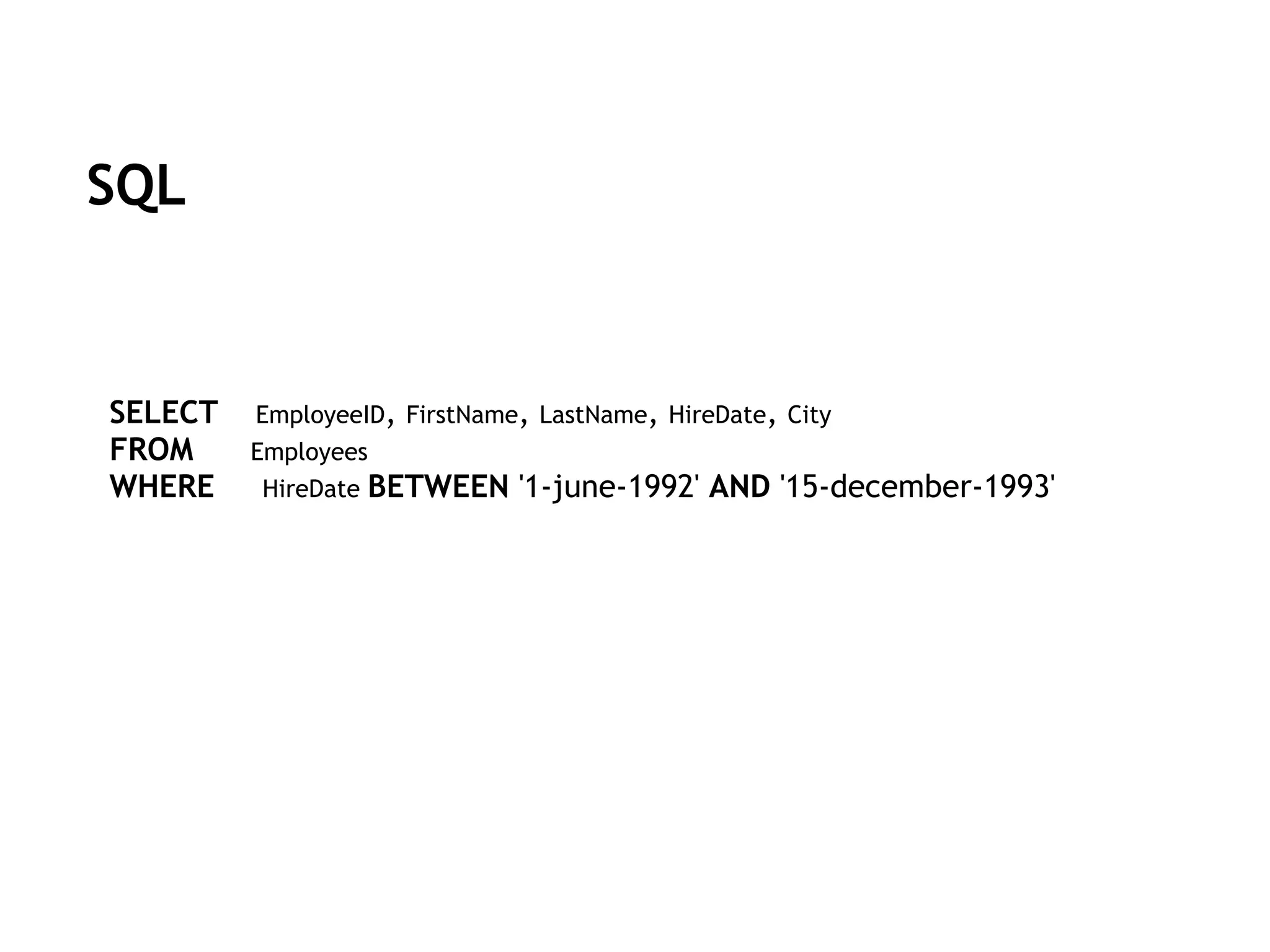
SELECT EmployeeID, FirstName, LastName, HireDate, City

FROM Employees

WHERE HireDate BETWEEN '1-june-1992' AND '15-december-1993'
SQL
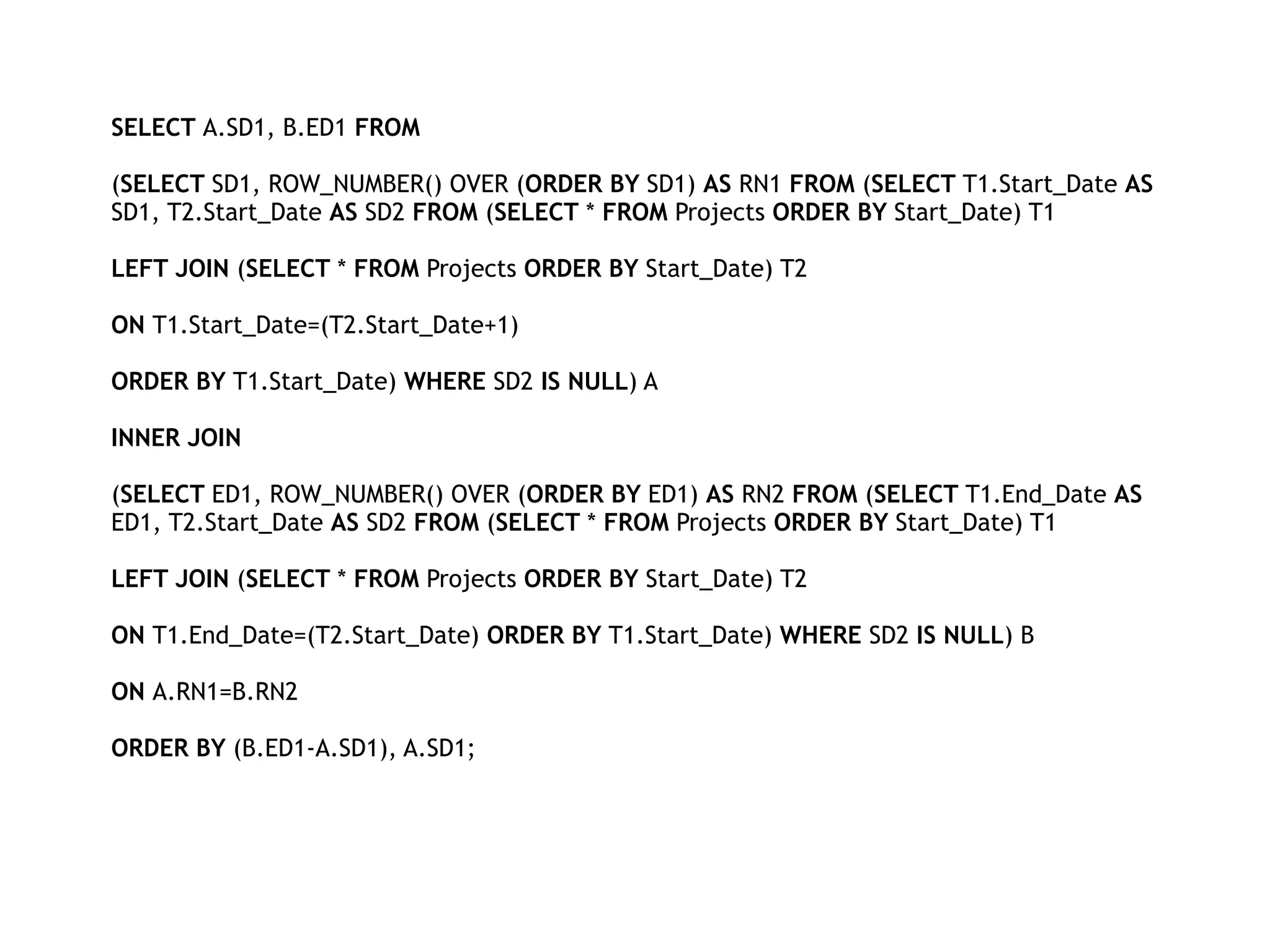
SELECT A.SD1, B.ED1 FROM


(SELECT SD1, ROW_NUMBER() OVER (ORDER BY SD1) AS RN1 FROM (SELECT T1.Start_Date AS
SD1, T2.Start_Date AS SD2 FROM (SELECT * FROM Projects ORDER BY Start_Date) T1


LEFT JOIN (SELECT * FROM Projects ORDER BY Start_Date) T2


ON T1.Start_Date=(T2.Start_Date+1)


ORDER BY T1.Start_Date) WHERE SD2 IS NULL) A


INNER JOIN


(SELECT ED1, ROW_NUMBER() OVER (ORDER BY ED1) AS RN2 FROM (SELECT T1.End_Date AS
ED1, T2.Start_Date AS SD2 FROM (SELECT * FROM Projects ORDER BY Start_Date) T1


LEFT JOIN (SELECT * FROM Projects ORDER BY Start_Date) T2


ON T1.End_Date=(T2.Start_Date) ORDER BY T1.Start_Date) WHERE SD2 IS NULL) B


ON A.RN1=B.RN2


ORDER BY (B.ED1-A.SD1), A.SD1;
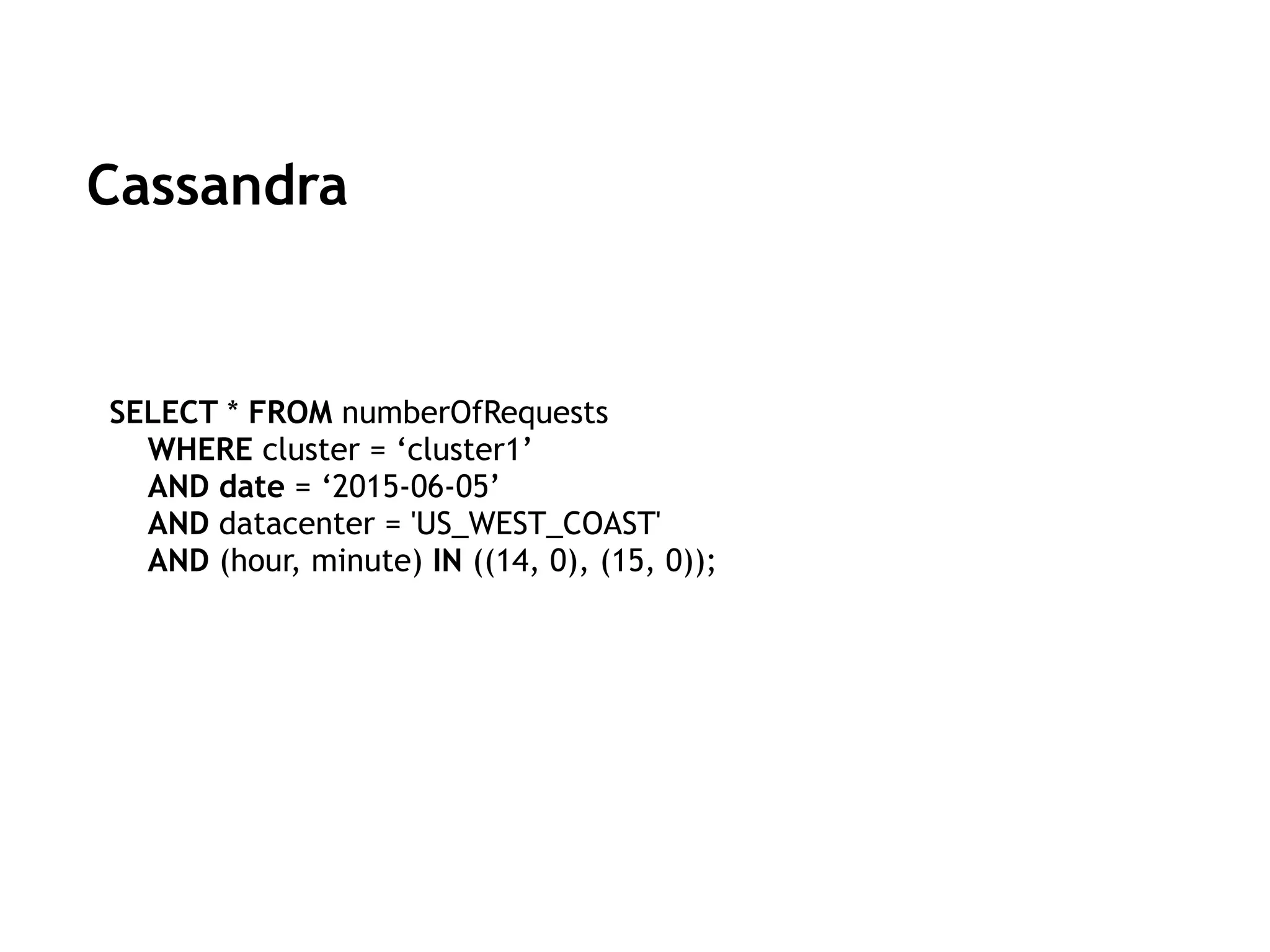
SELECT * FROM numberOfRequests

WHERE cluster = ‘cluster1’

AND date = ‘2015-06-05’

AND datacenter = 'US_WEST_COAST'

AND (hour, minute) IN ((14, 0), (15, 0));
Cassandra
MATCH (c:Customer {companyName:"Drachenblut Delikatessen"})

OPTIONAL MATCH (p:Product)<-[pu:PRODUCT]-(:Order)<-[:PURCHASED]-(c)

RETURN p.productName, toInt(sum(pu.unitPrice * pu.quantity)) AS volume

ORDER BY volume DESC;
Neo4J
pipeline = [
    {"$match": {"artistName": “Suppenstar"}},
    {"$sort": {„info.releaseDate: 1)])},
    {"$group": {
       "_id": {"$year": "$info.releaseDateEpoch"},
"count": {"$sum": "1}}},
    {"$project": {"year": "$_id.year", "count": 1}}},
]
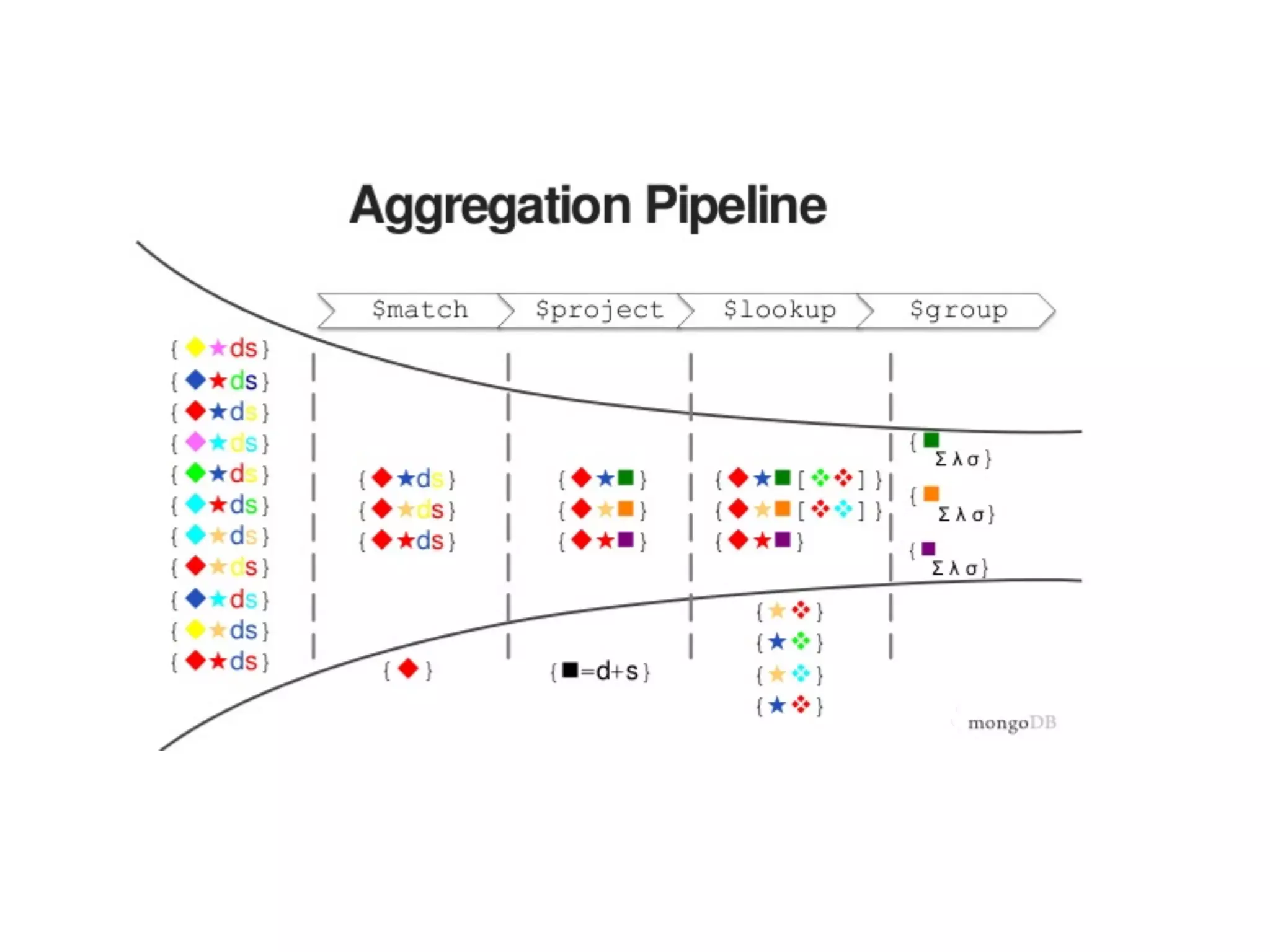
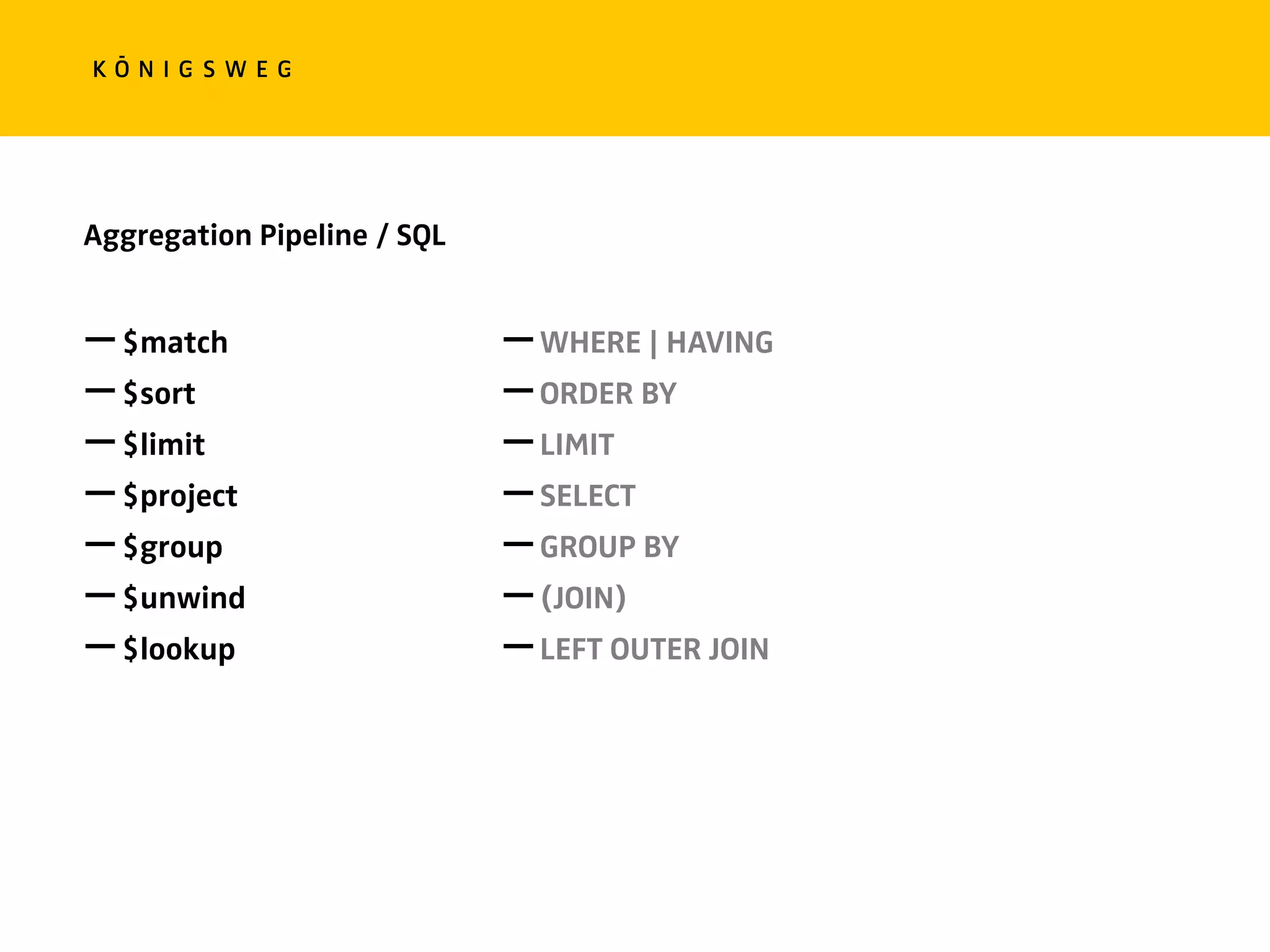
MongoDB Aggregation Pipeline
−$match
−$sort
−$limit
−$project
−$group
−$unwind
−$lookup
−WHERE | HAVING
−ORDER BY
−LIMIT
−SELECT
−GROUP BY
−(JOIN)
−LEFT OUTER JOIN
Aggregation Pipeline / SQL
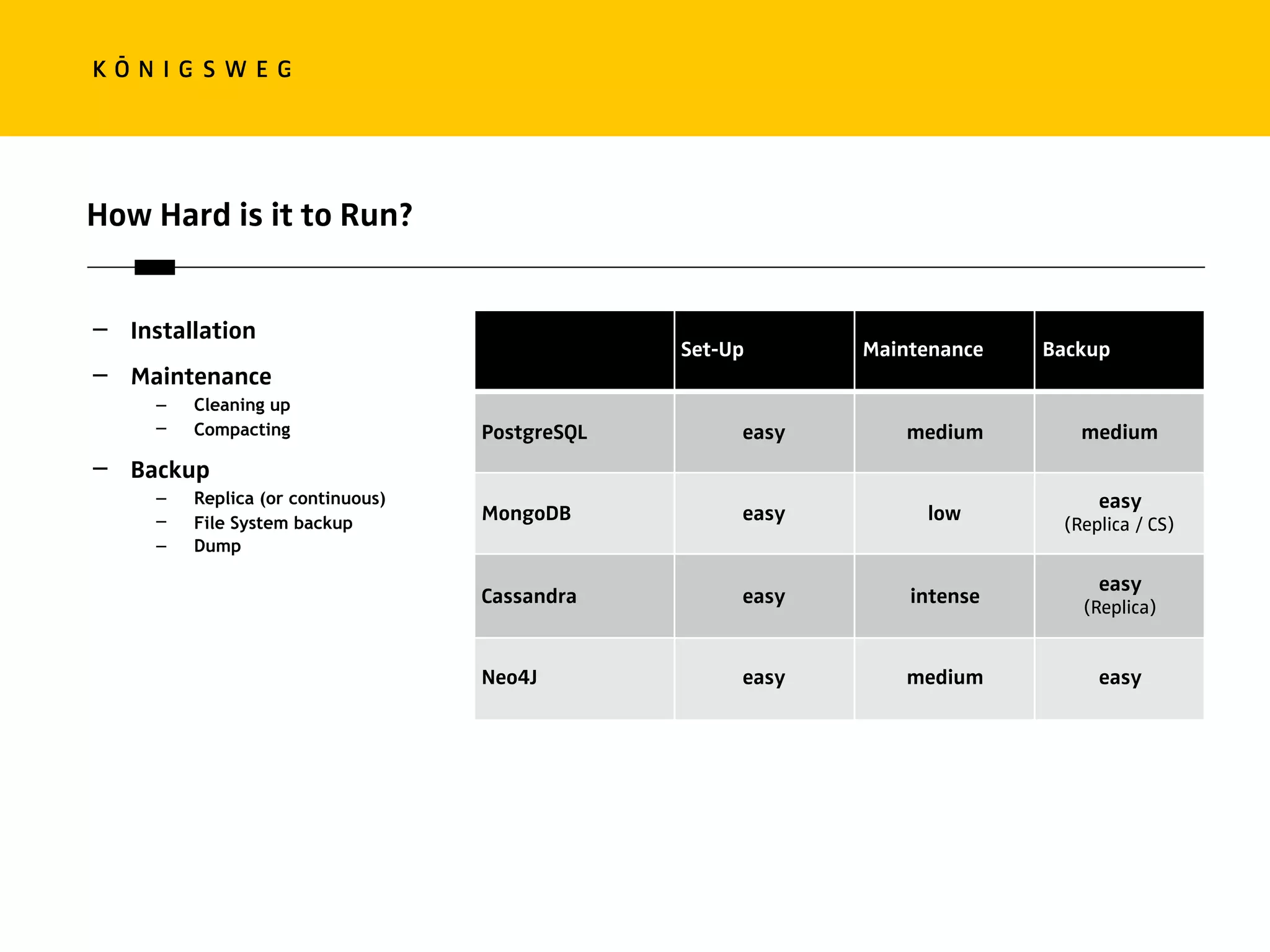
How Hard is it to Run?
− Installation
− Maintenance
− Cleaning up
− Compacting
− Backup
− Replica (or continuous)
− File System backup
− Dump
Set-Up Maintenance Backup
PostgreSQL easy medium medium
MongoDB easy low
easy
(Replica / CS)
Cassandra easy intense
easy
(Replica)
Neo4J easy medium easy
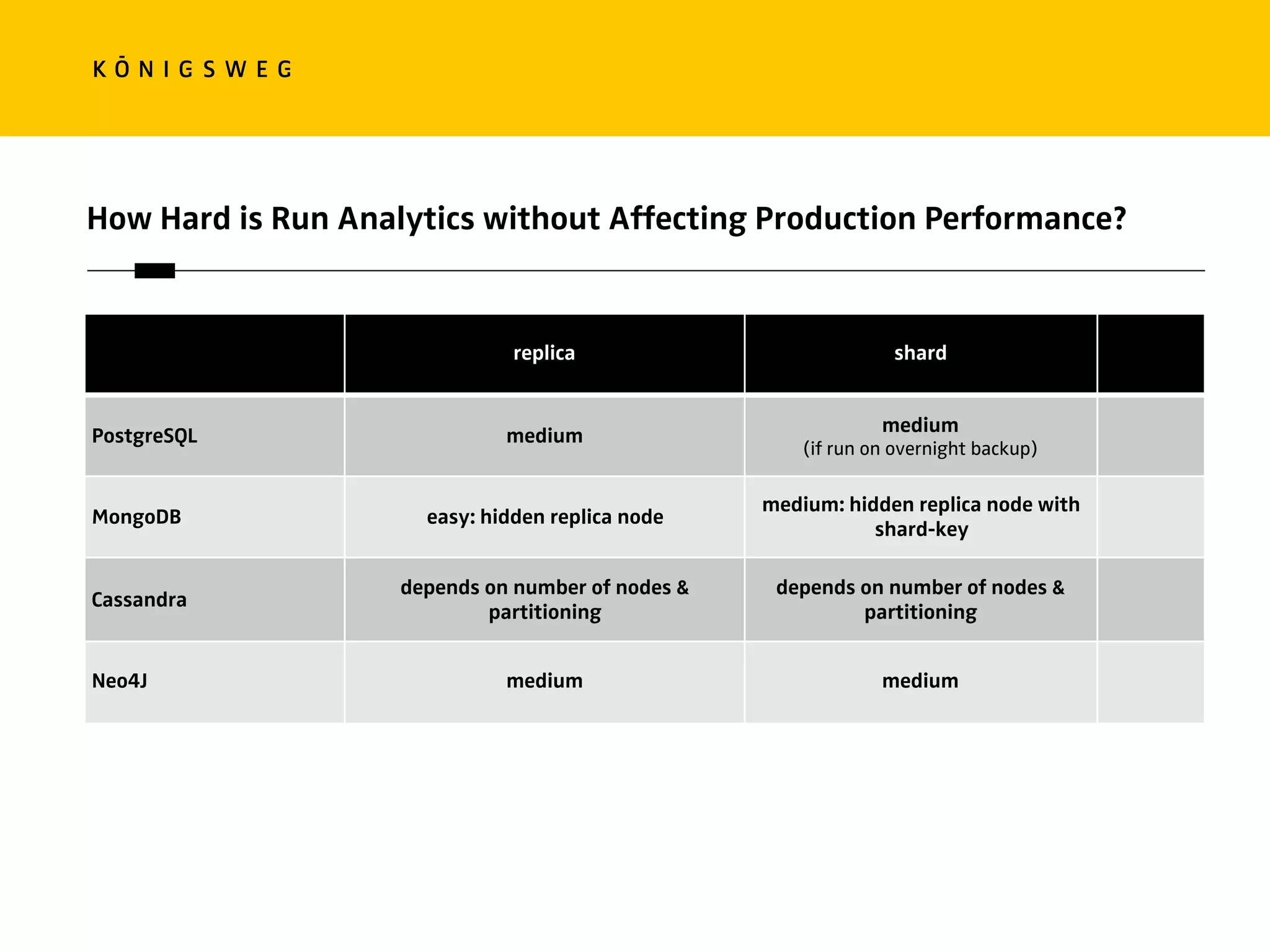
How Hard is Run Analytics without Affecting Production Performance?
replica shard
PostgreSQL medium
medium

(if run on overnight backup)
MongoDB easy: hidden replica node
medium: hidden replica node with
shard-key
Cassandra
depends on number of nodes &
partitioning
depends on number of nodes &
partitioning
Neo4J medium medium
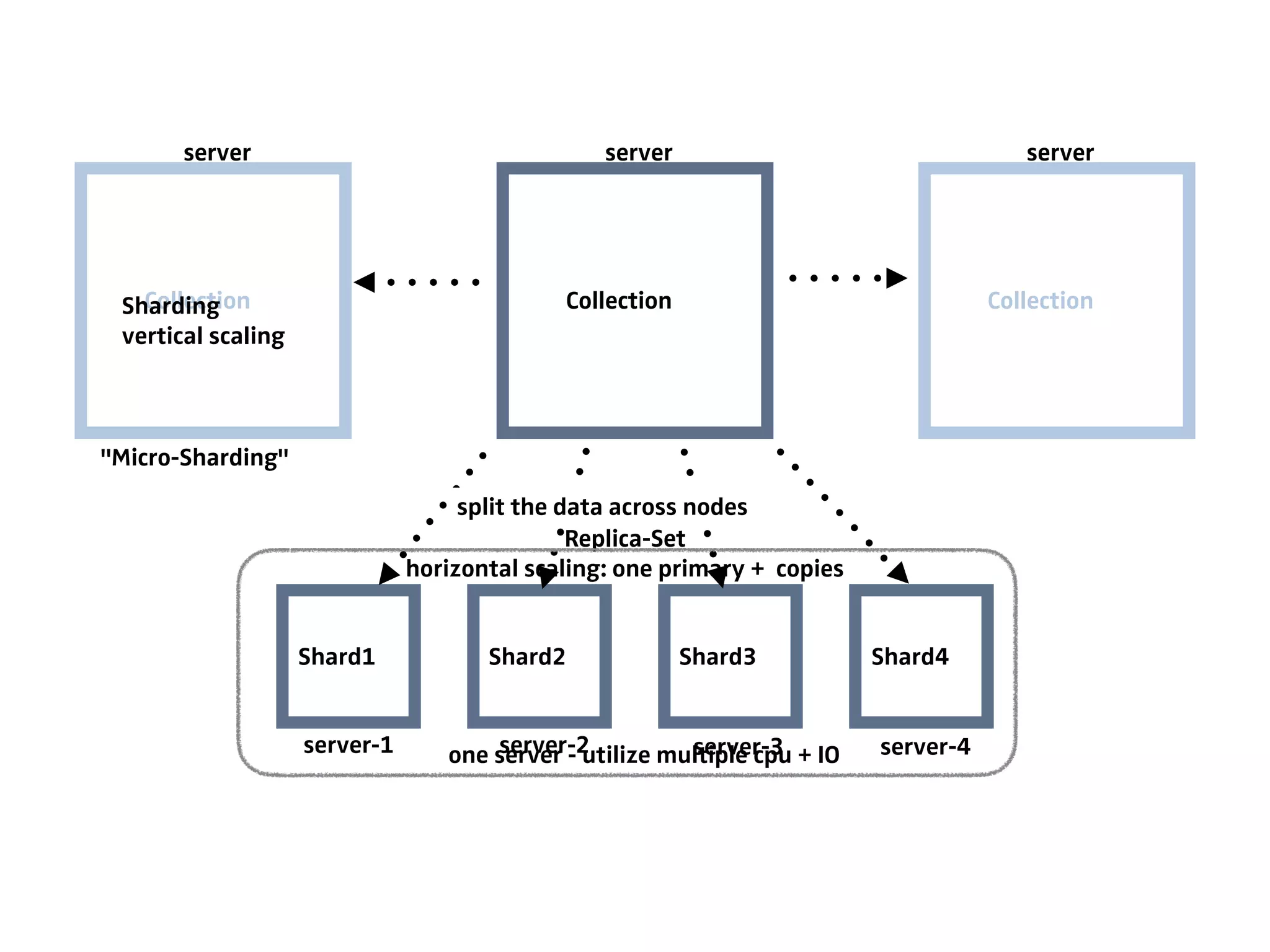
Collection
Shard1 Shard2 Shard3 Shard4
server-1 server-2 server-3 server-4
server
CollectionCollection
server server
Replica-Set
horizontal scaling: one primary + copies
Sharding
vertical scaling
split the data across nodes
one server - utilize multiple cpu + IO
"Micro-Sharding"
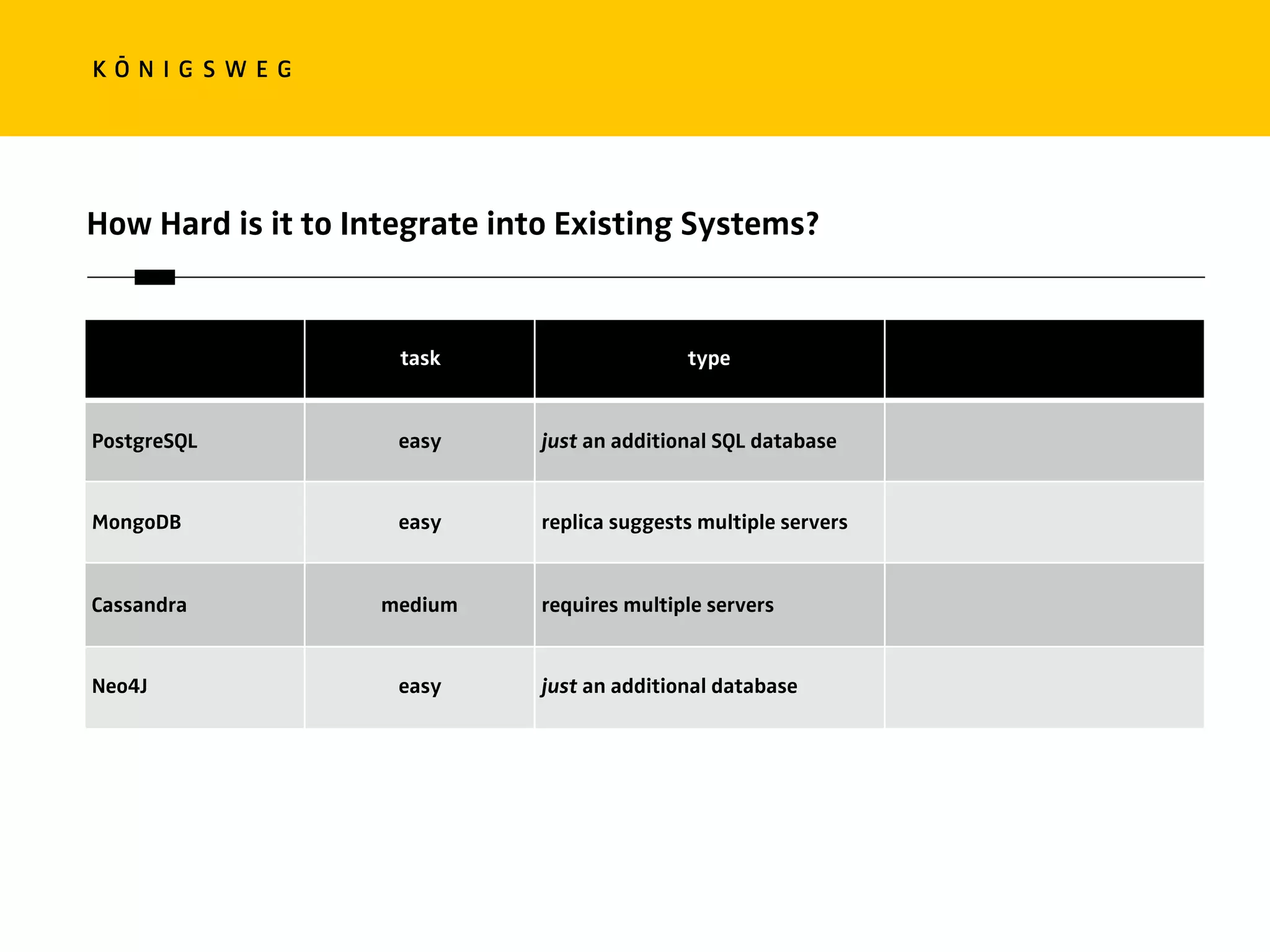
How Hard is it to Integrate into Existing Systems?
task type
PostgreSQL easy just an additional SQL database
MongoDB easy replica suggests multiple servers
Cassandra medium requires multiple servers
Neo4J easy just an additional database
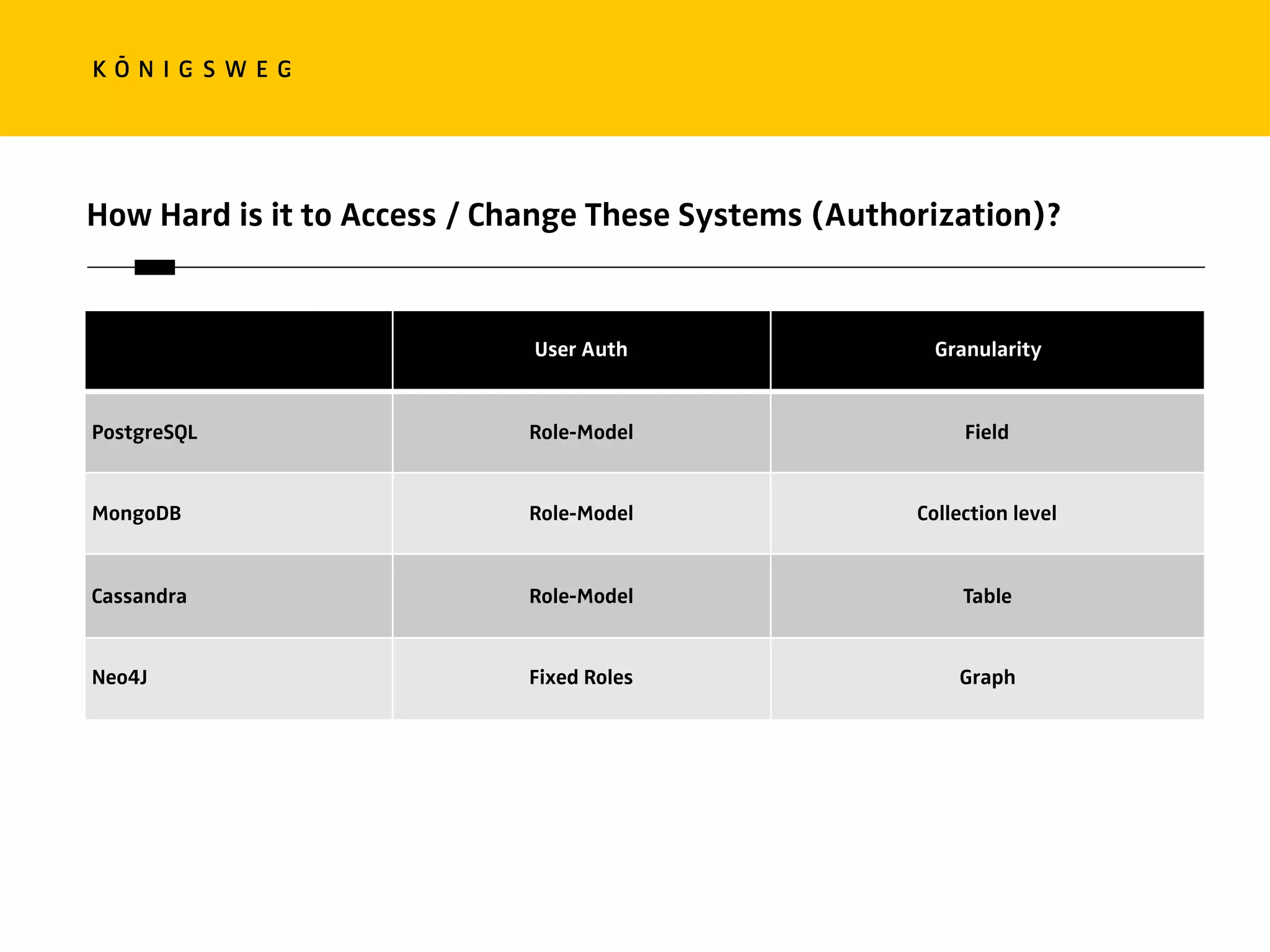
How Hard is it to Access / Change These Systems (Authorization)?
User Auth Granularity
PostgreSQL Role-Model Field
MongoDB Role-Model Collection level
Cassandra Role-Model Table
Neo4J Fixed Roles Graph
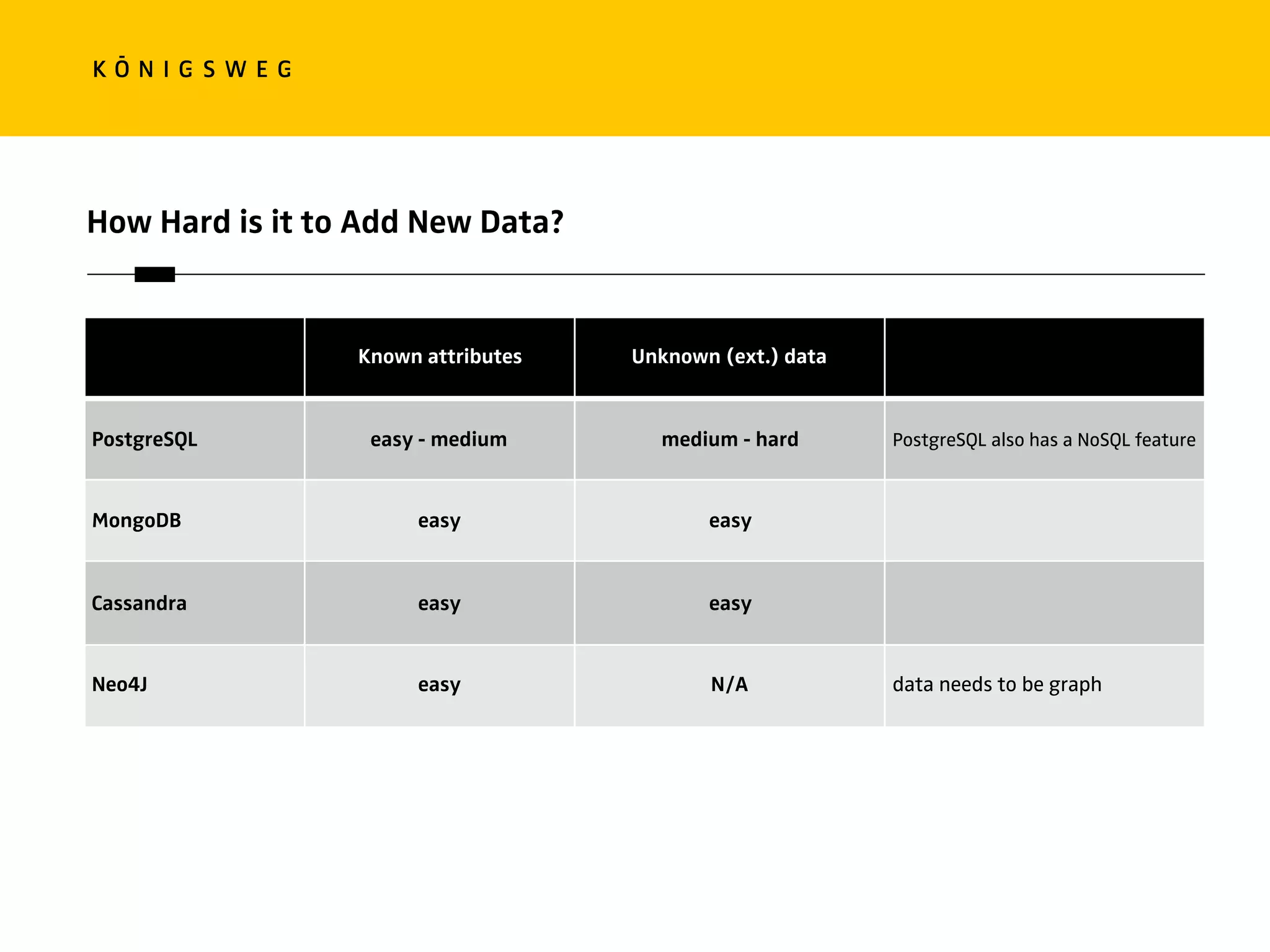
How Hard is it to Add New Data?
Known attributes Unknown (ext.) data
PostgreSQL easy - medium medium - hard PostgreSQL also has a NoSQL feature
MongoDB easy easy
Cassandra easy easy
Neo4J easy N/A data needs to be graph
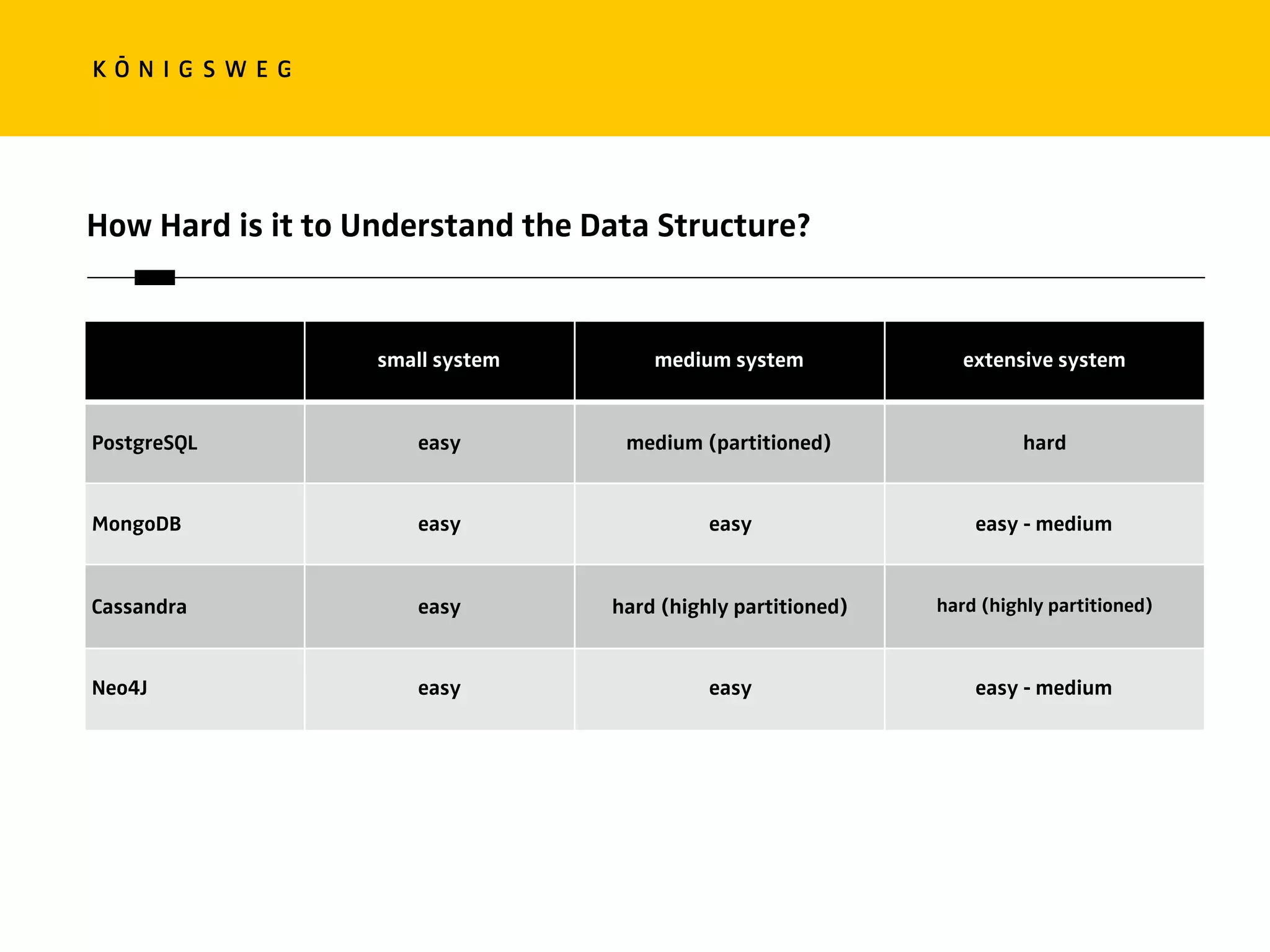
How Hard is it to Understand the Data Structure?
small system medium system extensive system
PostgreSQL easy medium (partitioned) hard
MongoDB easy easy easy - medium
Cassandra easy hard (highly partitioned) hard (highly partitioned)
Neo4J easy easy easy - medium
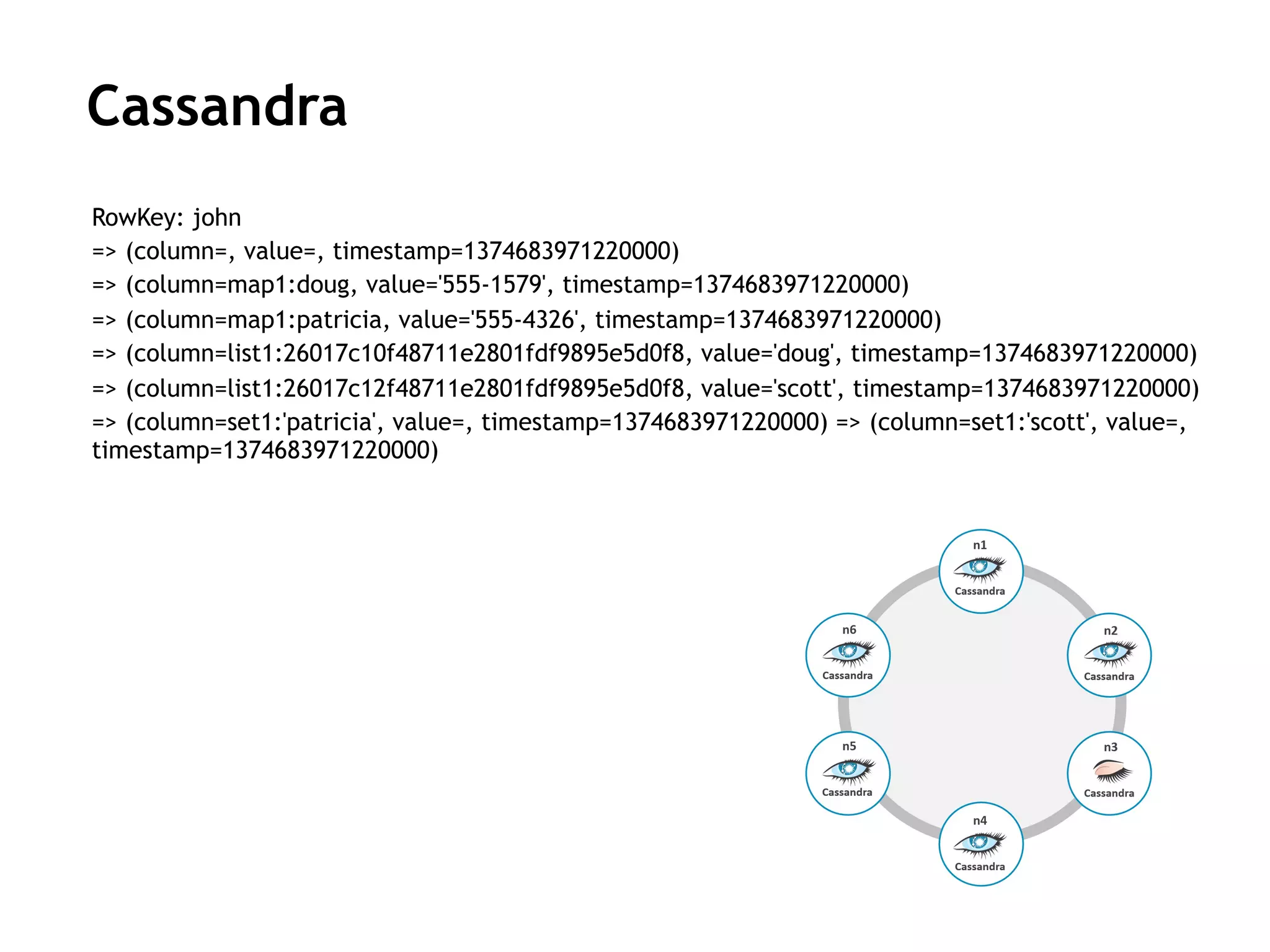
RowKey: john
=> (column=, value=, timestamp=1374683971220000)
=> (column=map1:doug, value='555-1579', timestamp=1374683971220000)
=> (column=map1:patricia, value='555-4326', timestamp=1374683971220000)
=> (column=list1:26017c10f48711e2801fdf9895e5d0f8, value='doug', timestamp=1374683971220000)
=> (column=list1:26017c12f48711e2801fdf9895e5d0f8, value='scott', timestamp=1374683971220000)
=> (column=set1:'patricia', value=, timestamp=1374683971220000) => (column=set1:'scott', value=,
timestamp=1374683971220000)
Cassandra
https://neo4j.com/blog/oscon-twitter-graph/
Neo4J
Relational Model Document Model
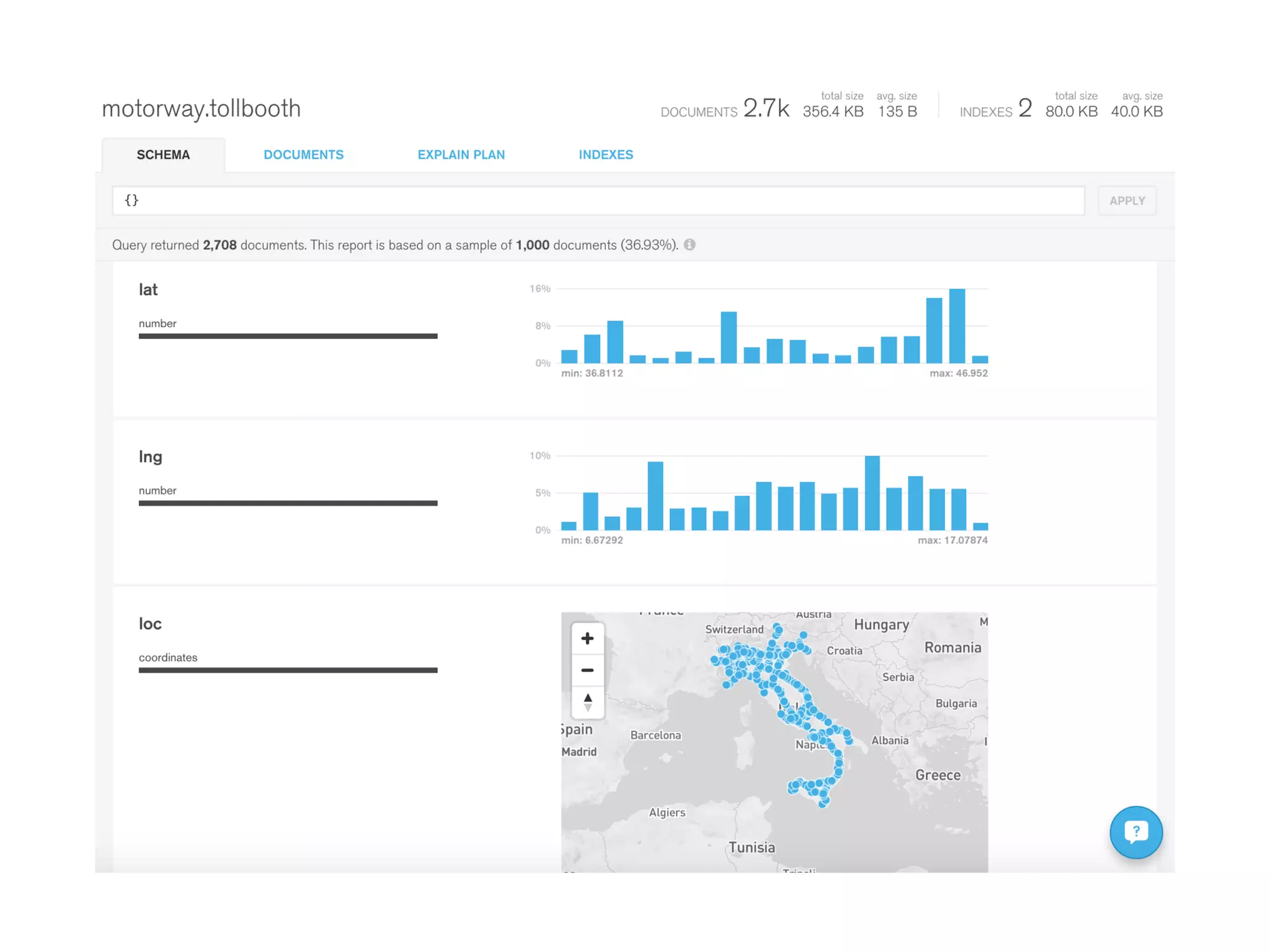
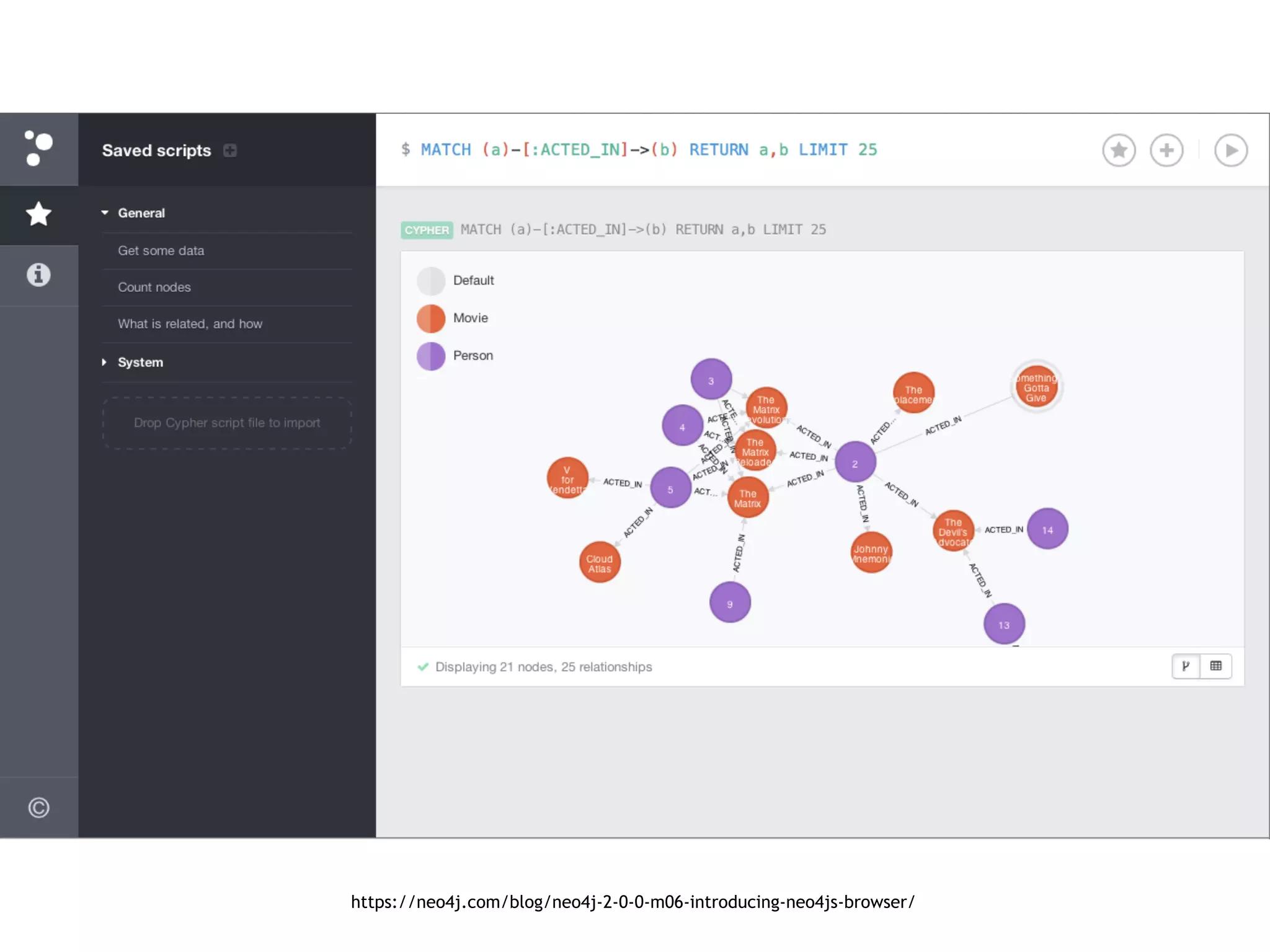
https://neo4j.com/blog/neo4j-2-0-0-m06-introducing-neo4js-browser/
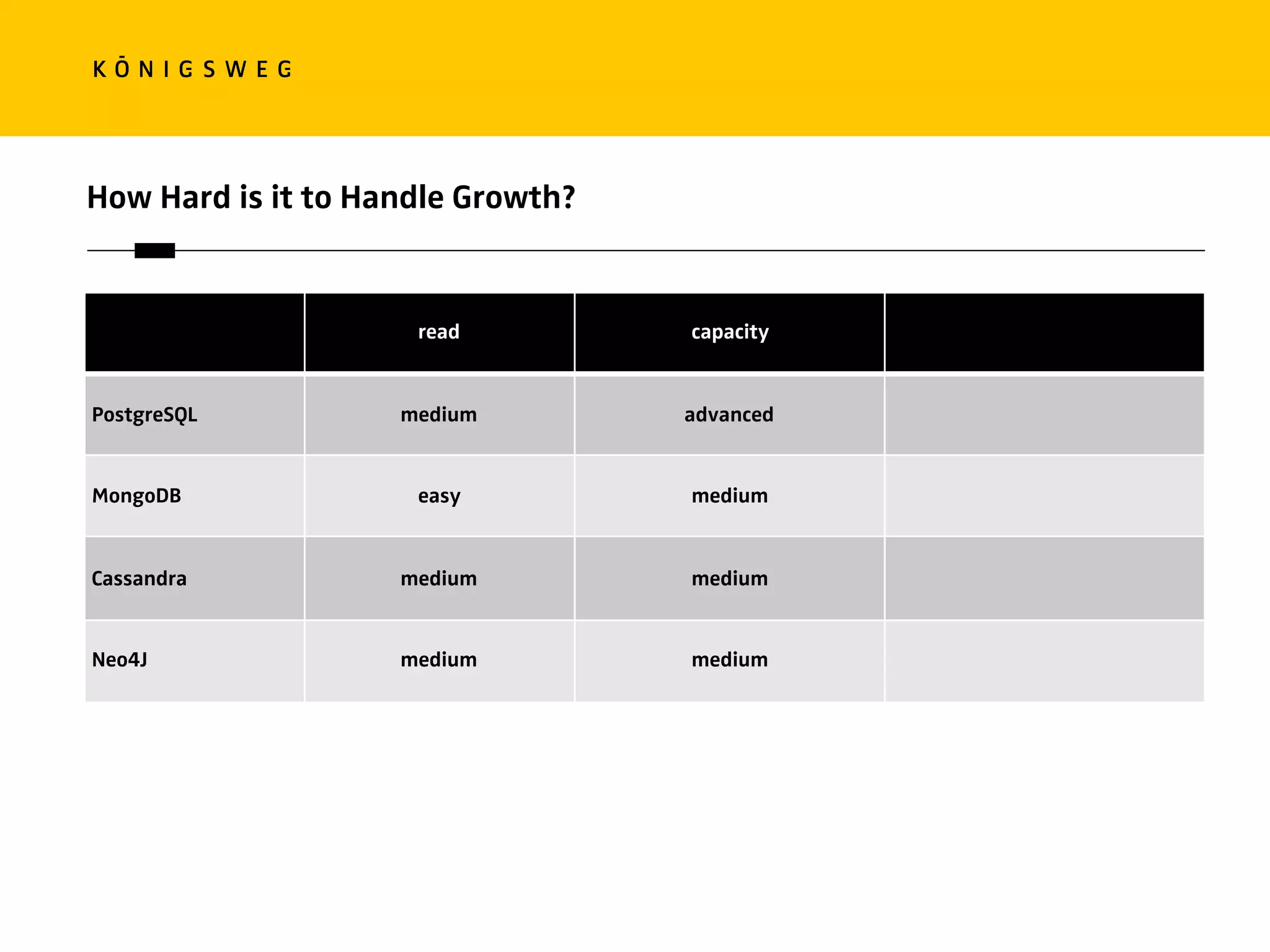
How Hard is it to Handle Growth?
read capacity
PostgreSQL medium advanced
MongoDB easy medium
Cassandra medium medium
Neo4J medium medium
Some More Use Cases for Databases in Data Science
− Storing model parameters (even models)
− Documenting experiments
− Collecting performance metrics of models
− …
Conclusion
− Analyse all your real needs and focus on those
− Chose an accessible, simple solution (don‘t reach out to high)
− Do not only focus on performance
− Try, play and test before making final decisions
− If you have a very specific use case go for the specialist system
− A good choice for general purpose is MongoDB
− If you work only on graphs use Neo4J
− If you have simple tables and know SQL got for a RDBMS
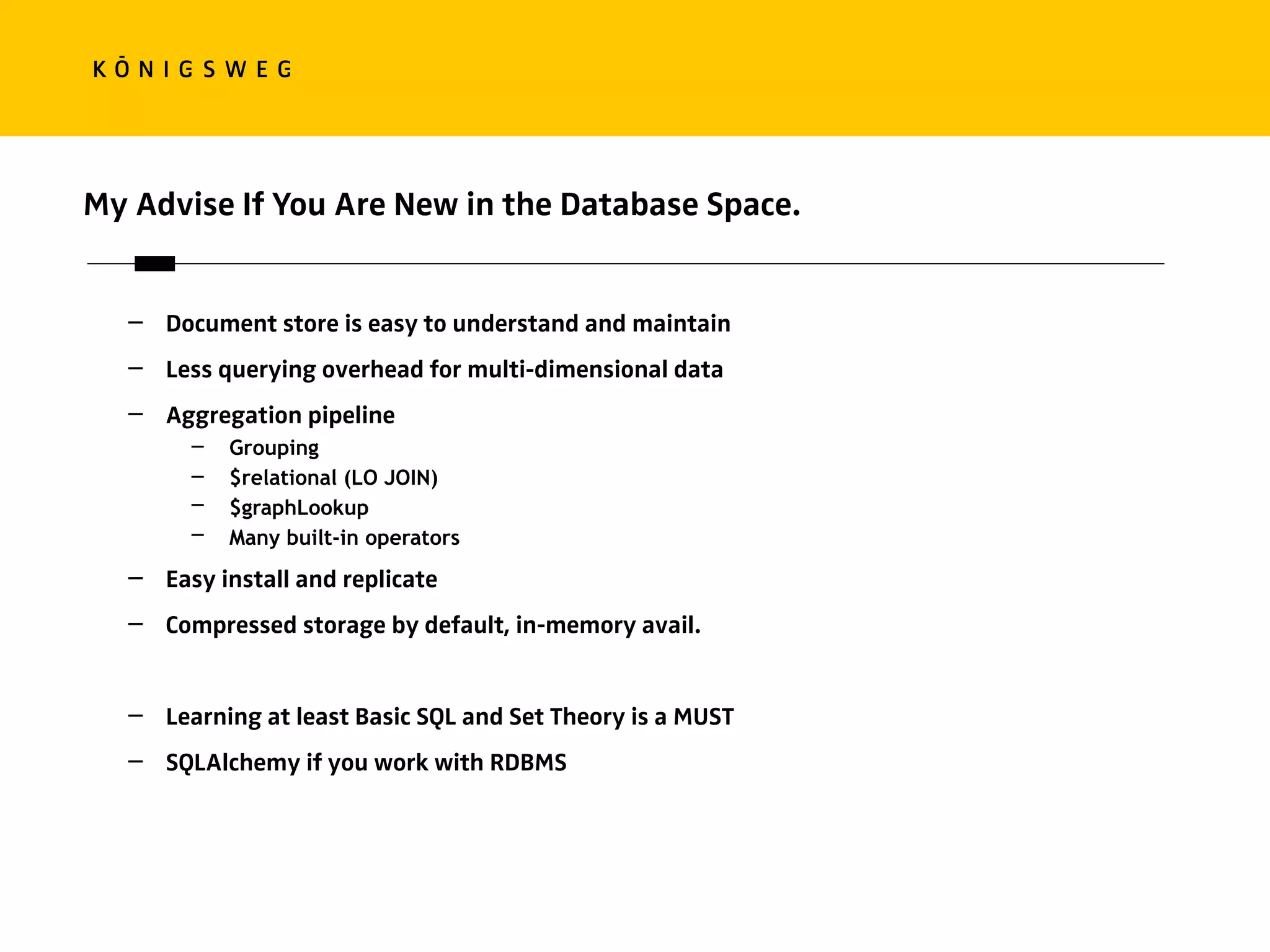
My Advise If You Are New in the Database Space.
− Document store is easy to understand and maintain
− Less querying overhead for multi-dimensional data
− Aggregation pipeline
− Grouping
− $relational (LO JOIN)
− $graphLookup
− Many built-in operators
− Easy install and replicate
− Compressed storage by default, in-memory avail.
− Learning at least Basic SQL and Set Theory is a MUST
− SQLAlchemy if you work with RDBMS
Thanks for Contributing
Databases for Data Science is still an actively discussed topic in the experts‘ community.
This presentation will be constantly updated.
Newer findings and updates will be added.
Stay informed:
Follow me on Twitter @hendorf or LinkedIn
Or drop me an email ah@koenigsweg.com
−Jens Dittrich, Professor bigdata.uni-saarland.de @jensdittrich
ah@koenigsweg.com
@hendorf
Thank you!
Q & A
Databases for Data Science

Databases for Data Science

  • 1.
  • 2.
    Alexander C. S.Hendorf − Senior Consultant Information Technology − Program Chair EuroPython, PyConDE & PyData Karlsruhe, 
 EuroSciPy, PSF Managing Member − PyData Frankfurt and PyData Südwest Organiser − Program Committee Percona Live − MongoDB Masters / MongoDB Certified DBA − Speaker Europe & USA MongoDB World New York / San José, PyCon Italy, CEBIT, BI Forum, IT-Tage FFM, PyData, PyParis, PyCon UK, Budapest BI,…. ah@koenigsweg.com @hendorf
  • 3.
    Services Data We guideour clients through development and implementation processes of technologies and applications to analyse, evaluate and visualize business data. Strategy & Operations We advise SME, start-ups and public institutions on building efficient sales structures, on process optimization and on business development. Communication We provide sound communication strategies and creative campaigns to communicate your content and messages authentically throughout all channels. Financial Service Technologies Our industry experts support clients in the financial sector in developing powerful and compliant FinTech applications.
  • 4.
    ! Let‘s get toknow each other! » What‘s your background?« − Data scientist − Database admin − Curious Pythonista − Consultant, decision maker (IT Executive, Consultant, Innovation Manager, YouTube influencer) 
  • 5.
    " Let‘s get toknow each other! » What‘s your Experience in…« − RDBSs − none − some − a lot − Hadoop et al. − none − some − a lot − NoSQL Systems 
 without Hadoop et al. − none − some − a lot
  • 6.
    # Let‘s get toknow each other! » What‘s are you looking for?« − Integration for data science into existing ecosystems − Learning about databases for data science projects − General interest / curiosity − Just killing time until PyFiorentina − …?
  • 7.
    Three Angles forDatabases for Data Science − Choosing a database for data science projects − Evaluating an existing database for data science requirements − How to integrate into an existing ecosystem
  • 9.
    $ „How deeply dodata science & data base understand each other?.“
  • 10.
    $ Ask Google: Data Scientist?Database Admin? %#&' ()*+ ,
  • 13.
  • 14.
    What are theBenefits of a Database for Data Science Anyway? − Common source of data − Avoiding redundancy (e.g. files) − Persistence − Optimized for handling and accessing data for decades − Scalability − Staying very close to the data
  • 15.
    A Quick Recapon Database History − 1960s, navigational DBMS (disks & drums) − 1970s, relational DBMS − 1980s, on the desktop − 1990s, object-oriented − 2000s, NoSQL
  • 16.
    Relational Databases − Recordsare organised into tables − Rows of these table are identified by unique keys − Data spans multiple tables, linked via ids − Data is ideally normalised − Data can be denormalized for performance − Transactions are ACID [Atomic, Consistent , Isolated, Durable]
  • 18.
  • 19.
    Relational Databases Benefits −Widely used and supported − Normalized data − Comprehensive querying via SQL language 
 - though some differences between databases − Well researched and optimized over decades
  • 23.
    Relational Databases Downsides −Schemas are fixed and have to be pre-defined upfront (schema-first) − Altering schema is not trivial − Joining tables, depending on complexity, data volume may be costly,
 also consider overhead understanding a schema with many tables − Difficult to scale out − Few data structures (tables, rows)
  • 24.
    NoSQL Types − Key-ValueStore
 simplest form of a NoSQL database (no big value for data science) − Document databases (JSON style)
 open schema
 can handle complex data structures as arrays and list − Wide column databases, most like relational DBs:
 columns are not fixed, data is de-normalised, 
 can handle complex data structures as arrays and lists − Graph
 network of connected entities linked by edges with properties, query on properties and links
  • 25.
    NoSQL Databases Benefits −No need to normalise data (schema-later) − Maintain complex data structures − Supports data sharding − New ways to query − Collections can be copied
  • 26.
    NoSQL Databases Downsides −Eventual Consistency (is this a real problem for data science at all?) − Flexibility requires more responsibility (schema, attribute typos) − Complexity
  • 27.
    A Quick Bird’sEye View There are hundreds of databases around nowadays. Let’s focus on the top database systems.
  • 28.
  • 29.
    NoSQL RDBMS ~10 years40 years + Points according to https://db-engines.com/de/ranking
  • 30.
    Consistency Models ofDatabases − A tomicity − C onsistency − I solation − D urability − B − A asic Availability − S oft-State − E ventual consistency
  • 31.
    Open Source Check −Security − Transparency − Engaging Collaboration − Quality − Auditability − Try Before You Buy (EE) − Rule of Thumb: 
 Open Software is way more affordable than closed * via vendors Open Source Enterprise Editions Oracle x + MySQL +-?!? + MicroSoft SQL Server + PostgreSQL + +* DB2 + MongoDB + + Redis + +* Cassandra + +* HBase + +* Amazon DynamoDB DAAS Neo4J + +
  • 32.
    The Contenders Type Chosen PostgreSQLRDBMS Top OS RDBMS MongoDB Document-store Top NoSQL (DS) Cassandra Wide-column store Top NoSQL (WCS) Neo4J Graph Top NoSQL (Graph)
  • 33.
  • 35.
  • 36.
  • 38.
    How Hard isit to Collect Data? Data Collection, cleaning and restructuring Multiple data sources Data retention PostgreSQL Depends on schema complexity Depends on schema complexity easy MongoDB easy easy medium Cassandra easy easy hard Neo4J (easy) N/A easy
  • 39.
    What about DataTypes enforced flexible enforceable PostgreSQL yes (NoSQL feature) predefined MongoDB possible yes yes Cassandra yes untyped collection columns predefined Neo4J (yes) N/A N/A
  • 40.
    How Hard isit to Consolidate Data? Linking Missing data Dirty data Persisting cleaned dataset PostgreSQL built schema pre-processing recommended pre-processing recommended easy MongoDB easy (within db) flexible post-processing flexible post-processing easy Cassandra partitioning hard hard easy Neo4J yes* hard hard easy
  • 41.
    How Hard isit to Write Queries Against These Databases? Language Basic Queries Advanced Queries PostgreSQL SQL easy hard MongoDB MQL query: easy aggregation: medium query: medium aggregation: medium Cassandra CSQL easy hard Neo4J Cypher easy hard
  • 42.
    How Hard isQuerying to Learn? Language Basic Queries Advanced Queries PostgreSQL SQL easy hard MongoDB MQL query: easy aggregation: easy query: medium aggregation: medium Cassandra CSQL easy-medium hard Neo4J Cypher medium hard
  • 43.
    SQL Benefits andDownsides − Common standard − Long-established − Mother of many others e.g. CSQL, ABAP,
 Pig, SPARQL,… − Set based logic − Complexity increases fast − Badly designed JOINs vs. performance − Overhead understanding a large schema − Set based logic
  • 44.
    SELECT EmployeeID, FirstName,LastName, HireDate, City
 FROM Employees
 WHERE HireDate BETWEEN '1-june-1992' AND '15-december-1993' SQL
  • 45.
    SELECT A.SD1, B.ED1FROM
 
 (SELECT SD1, ROW_NUMBER() OVER (ORDER BY SD1) AS RN1 FROM (SELECT T1.Start_Date AS SD1, T2.Start_Date AS SD2 FROM (SELECT * FROM Projects ORDER BY Start_Date) T1
 
 LEFT JOIN (SELECT * FROM Projects ORDER BY Start_Date) T2
 
 ON T1.Start_Date=(T2.Start_Date+1)
 
 ORDER BY T1.Start_Date) WHERE SD2 IS NULL) A
 
 INNER JOIN
 
 (SELECT ED1, ROW_NUMBER() OVER (ORDER BY ED1) AS RN2 FROM (SELECT T1.End_Date AS ED1, T2.Start_Date AS SD2 FROM (SELECT * FROM Projects ORDER BY Start_Date) T1
 
 LEFT JOIN (SELECT * FROM Projects ORDER BY Start_Date) T2
 
 ON T1.End_Date=(T2.Start_Date) ORDER BY T1.Start_Date) WHERE SD2 IS NULL) B
 
 ON A.RN1=B.RN2
 
 ORDER BY (B.ED1-A.SD1), A.SD1;
  • 46.
    SELECT * FROMnumberOfRequests
 WHERE cluster = ‘cluster1’
 AND date = ‘2015-06-05’
 AND datacenter = 'US_WEST_COAST'
 AND (hour, minute) IN ((14, 0), (15, 0)); Cassandra
  • 47.
    MATCH (c:Customer {companyName:"DrachenblutDelikatessen"})
 OPTIONAL MATCH (p:Product)<-[pu:PRODUCT]-(:Order)<-[:PURCHASED]-(c)
 RETURN p.productName, toInt(sum(pu.unitPrice * pu.quantity)) AS volume
 ORDER BY volume DESC; Neo4J
  • 48.
    pipeline = [    {"$match": {"artistName": “Suppenstar"}},     {"$sort": {„info.releaseDate: 1)])},     {"$group": {        "_id": {"$year": "$info.releaseDateEpoch"}, "count": {"$sum": "1}}},     {"$project": {"year": "$_id.year", "count": 1}}}, ] MongoDB Aggregation Pipeline
  • 50.
    −$match −$sort −$limit −$project −$group −$unwind −$lookup −WHERE | HAVING −ORDERBY −LIMIT −SELECT −GROUP BY −(JOIN) −LEFT OUTER JOIN Aggregation Pipeline / SQL
  • 51.
    How Hard isit to Run? − Installation − Maintenance − Cleaning up − Compacting − Backup − Replica (or continuous) − File System backup − Dump Set-Up Maintenance Backup PostgreSQL easy medium medium MongoDB easy low easy (Replica / CS) Cassandra easy intense easy (Replica) Neo4J easy medium easy
  • 52.
    How Hard isRun Analytics without Affecting Production Performance? replica shard PostgreSQL medium medium
 (if run on overnight backup) MongoDB easy: hidden replica node medium: hidden replica node with shard-key Cassandra depends on number of nodes & partitioning depends on number of nodes & partitioning Neo4J medium medium
  • 53.
    Collection Shard1 Shard2 Shard3Shard4 server-1 server-2 server-3 server-4 server CollectionCollection server server Replica-Set horizontal scaling: one primary + copies Sharding vertical scaling split the data across nodes one server - utilize multiple cpu + IO "Micro-Sharding"
  • 54.
    How Hard isit to Integrate into Existing Systems? task type PostgreSQL easy just an additional SQL database MongoDB easy replica suggests multiple servers Cassandra medium requires multiple servers Neo4J easy just an additional database
  • 55.
    How Hard isit to Access / Change These Systems (Authorization)? User Auth Granularity PostgreSQL Role-Model Field MongoDB Role-Model Collection level Cassandra Role-Model Table Neo4J Fixed Roles Graph
  • 56.
    How Hard isit to Add New Data? Known attributes Unknown (ext.) data PostgreSQL easy - medium medium - hard PostgreSQL also has a NoSQL feature MongoDB easy easy Cassandra easy easy Neo4J easy N/A data needs to be graph
  • 57.
    How Hard isit to Understand the Data Structure? small system medium system extensive system PostgreSQL easy medium (partitioned) hard MongoDB easy easy easy - medium Cassandra easy hard (highly partitioned) hard (highly partitioned) Neo4J easy easy easy - medium
  • 58.
    RowKey: john => (column=,value=, timestamp=1374683971220000) => (column=map1:doug, value='555-1579', timestamp=1374683971220000) => (column=map1:patricia, value='555-4326', timestamp=1374683971220000) => (column=list1:26017c10f48711e2801fdf9895e5d0f8, value='doug', timestamp=1374683971220000) => (column=list1:26017c12f48711e2801fdf9895e5d0f8, value='scott', timestamp=1374683971220000) => (column=set1:'patricia', value=, timestamp=1374683971220000) => (column=set1:'scott', value=, timestamp=1374683971220000) Cassandra
  • 59.
  • 60.
  • 62.
  • 63.
    How Hard isit to Handle Growth? read capacity PostgreSQL medium advanced MongoDB easy medium Cassandra medium medium Neo4J medium medium
  • 64.
    Some More UseCases for Databases in Data Science − Storing model parameters (even models) − Documenting experiments − Collecting performance metrics of models − …
  • 65.
    Conclusion − Analyse allyour real needs and focus on those − Chose an accessible, simple solution (don‘t reach out to high) − Do not only focus on performance − Try, play and test before making final decisions − If you have a very specific use case go for the specialist system − A good choice for general purpose is MongoDB − If you work only on graphs use Neo4J − If you have simple tables and know SQL got for a RDBMS
  • 66.
    My Advise IfYou Are New in the Database Space. − Document store is easy to understand and maintain − Less querying overhead for multi-dimensional data − Aggregation pipeline − Grouping − $relational (LO JOIN) − $graphLookup − Many built-in operators − Easy install and replicate − Compressed storage by default, in-memory avail. − Learning at least Basic SQL and Set Theory is a MUST − SQLAlchemy if you work with RDBMS
  • 67.
    Thanks for Contributing Databasesfor Data Science is still an actively discussed topic in the experts‘ community. This presentation will be constantly updated. Newer findings and updates will be added. Stay informed: Follow me on Twitter @hendorf or LinkedIn Or drop me an email ah@koenigsweg.com −Jens Dittrich, Professor bigdata.uni-saarland.de @jensdittrich
  • 68.