
















DATABASE 
OPTIMIZATION 
_by Oleksii Prohonnyi
The degree of normality 
in a database 
is inversely proportional to that 
of its DBA.
WHEN DO WE OPTIMIZE 
THE DATABASE?
You should get your home page 
down to 1.5 seconds. 
(Google’s threshold for being 
considered a “fast” website) 
Best Practices for Speeding Up Your Web Site by Yahoo
PROFILE FIRST, 
OPTIMIZE LAST
The basic rule of optimization is to 
never assume - always verify, 
using actual data.
PEAR_Benchmark 
Stores microtime() values before and after 
the query for later observation, and the 
difference would be the timing of the query 
with good accuracy. 
Package Information: Benchmark by The PHP Group
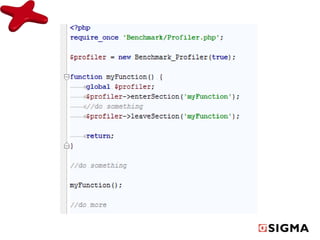
PEAR_Benchmark 
Example 1: Automatic profiling start, stop, 
and output.
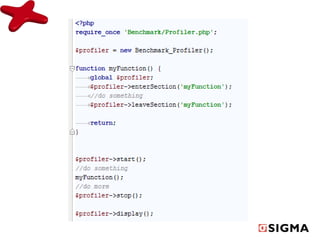
PEAR_Benchmark 
Example 2: Manual profiling start, stop, 
and output.
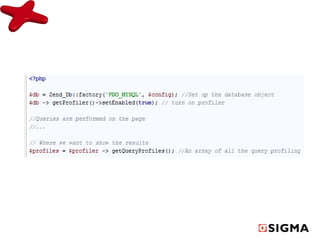
Zend_Db_Profiler 
Built-in support for profiling in Zend 
Framework.
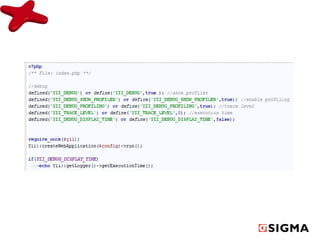
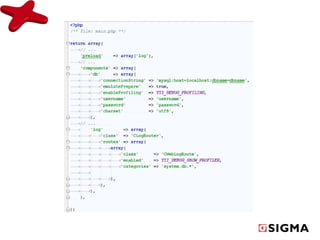
CWebLogRoute 
Built-in support for profiling in Yii 
Framework.
It's very important to profile using 
a relevant dataset. 
You should create a test machine that 
resembles your live dataset as much as 
possible to get relevant data.
Another important note is to avoid 
looking at cached results. 
- SQL_NO_CACHE 
- MySQL Caches 
- OS Caches 
- Hardware Caches 
Query Profiling with MySQL: Bypassing caches by Peter Zaitsev
The Slow Query Log 
Profiles queries that are used by daemons 
and cron jobs and log the results to a file. 
5.2.5. The Slow Query Log by Oracle Corporation
OPTIMIZING 
PERFORMANCE
There are 4 basic ways to optimize 
query performance: 
- Rewrite the queries 
- Change indexing strategy 
- Change schema 
- Use an external cache
EXAMINING QUERY 
EXECUTION PLANS
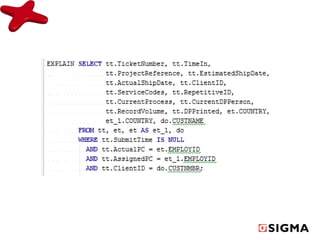
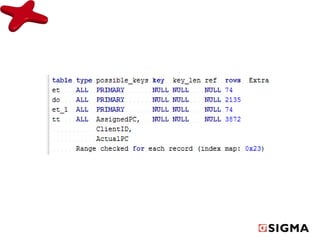
EXPLAIN 
Add the reserved word 'EXPLAIN' at the 
beginning of your query to get the execution 
plan for the query. 
8.2.2. EXPLAIN Output Format by Oracle Corporation
EXPLAIN limitations: 
- EXPLAIN can be wrong 
- EXPLAIN works for SELECT only 
- EXPLAIN may take long time 
- Estimated number of rows may be very 
inaccurate 
…. 
MySQL EXPLAIN limits and errors by Peter Zaitsev
COMMON 
OPTIMIZATIONS
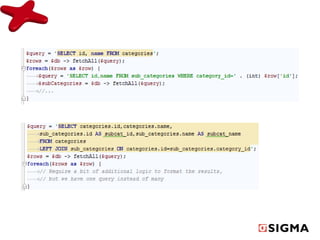
1. Looping queries 
One of the most common mistakes is to 
query in a loop without need. 
Most likely looped SELECT queries can be 
rewritten as a JOIN.
2. Picking only needed columns 
Picking only the needed columns is a good 
general practice to use, and avoids those 
problems.
3. Filtering rows correctly and 
using indexes 
Our main goal is to select the smallest 
amount of rows we need and doing so in 
the fastest way possible.
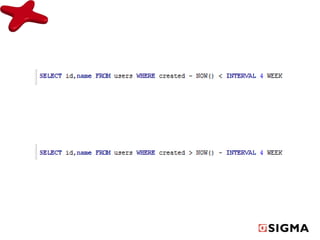
Filtering rows correctly and 
using indexes 
Example - fetching users created in the 
last 4 weeks.
Filtering rows correctly and 
using indexes 
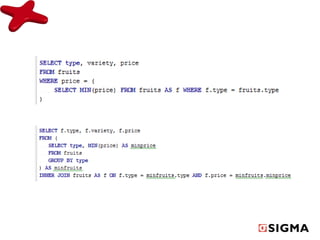
Example - select the lowest priced fruit from 
several fruit types.
4. Indexing correctly 
Using more indexes than is necessary can 
have adverse affects - as it slows down 
the operation of INSERT and UPDATE 
queries, while taking up more memory. 
Do you always need index on WHERE column? by Vadim Tkachenko
5. Picking the right engine 
for your data 
MySQL has a pluggable engine design, 
which allows you to use different engine 
types to store your data, each with its own 
advantages and drawbacks. 
Chapter 14. Storage Engines by Oracle Corporation
CACHING
There are many caching strategies. 
Common options include caching to disk 
(files) or caching to memory (using solutions 
such as memcache or APC). 
Another form of caching is to the database – 
by de-normalizing the schema to store data 
that is the result of expensive to run queries.
S4I8GMA UKRAINE
Oleksii Prohonnyi 
facebook.com/oprohonnyi 
linkedin.com/in/oprohonnyi

Database Optimization (MySQL)

  • 1.
    DATABASE OPTIMIZATION _byOleksii Prohonnyi
  • 2.
    The degree ofnormality in a database is inversely proportional to that of its DBA.
  • 4.
    WHEN DO WEOPTIMIZE THE DATABASE?
  • 6.
    You should getyour home page down to 1.5 seconds. (Google’s threshold for being considered a “fast” website) Best Practices for Speeding Up Your Web Site by Yahoo
  • 7.
  • 9.
    The basic ruleof optimization is to never assume - always verify, using actual data.
  • 10.
    PEAR_Benchmark Stores microtime()values before and after the query for later observation, and the difference would be the timing of the query with good accuracy. Package Information: Benchmark by The PHP Group
  • 11.
    PEAR_Benchmark Example 1:Automatic profiling start, stop, and output.
  • 13.
    PEAR_Benchmark Example 2:Manual profiling start, stop, and output.
  • 15.
    Zend_Db_Profiler Built-in supportfor profiling in Zend Framework.
  • 17.
    CWebLogRoute Built-in supportfor profiling in Yii Framework.
  • 21.
    It's very importantto profile using a relevant dataset. You should create a test machine that resembles your live dataset as much as possible to get relevant data.
  • 22.
    Another important noteis to avoid looking at cached results. - SQL_NO_CACHE - MySQL Caches - OS Caches - Hardware Caches Query Profiling with MySQL: Bypassing caches by Peter Zaitsev
  • 23.
    The Slow QueryLog Profiles queries that are used by daemons and cron jobs and log the results to a file. 5.2.5. The Slow Query Log by Oracle Corporation
  • 24.
  • 26.
    There are 4basic ways to optimize query performance: - Rewrite the queries - Change indexing strategy - Change schema - Use an external cache
  • 27.
  • 28.
    EXPLAIN Add thereserved word 'EXPLAIN' at the beginning of your query to get the execution plan for the query. 8.2.2. EXPLAIN Output Format by Oracle Corporation
  • 31.
    EXPLAIN limitations: -EXPLAIN can be wrong - EXPLAIN works for SELECT only - EXPLAIN may take long time - Estimated number of rows may be very inaccurate …. MySQL EXPLAIN limits and errors by Peter Zaitsev
  • 32.
  • 34.
    1. Looping queries One of the most common mistakes is to query in a loop without need. Most likely looped SELECT queries can be rewritten as a JOIN.
  • 36.
    2. Picking onlyneeded columns Picking only the needed columns is a good general practice to use, and avoids those problems.
  • 38.
    3. Filtering rowscorrectly and using indexes Our main goal is to select the smallest amount of rows we need and doing so in the fastest way possible.
  • 39.
    Filtering rows correctlyand using indexes Example - fetching users created in the last 4 weeks.
  • 41.
    Filtering rows correctlyand using indexes Example - select the lowest priced fruit from several fruit types.
  • 43.
    4. Indexing correctly Using more indexes than is necessary can have adverse affects - as it slows down the operation of INSERT and UPDATE queries, while taking up more memory. Do you always need index on WHERE column? by Vadim Tkachenko
  • 44.
    5. Picking theright engine for your data MySQL has a pluggable engine design, which allows you to use different engine types to store your data, each with its own advantages and drawbacks. Chapter 14. Storage Engines by Oracle Corporation
  • 46.
  • 47.
    There are manycaching strategies. Common options include caching to disk (files) or caching to memory (using solutions such as memcache or APC). Another form of caching is to the database – by de-normalizing the schema to store data that is the result of expensive to run queries.
  • 48.
  • 49.
    Oleksii Prohonnyi facebook.com/oprohonnyi linkedin.com/in/oprohonnyi