Normalization
Submitted by
Kiran Patel
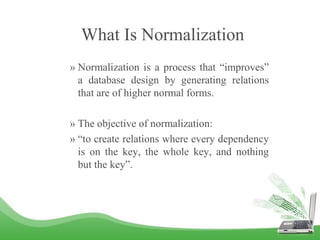
What Is Normalization
» Normalization is a process that “improves”
a database design by generating relations
that are of higher normal forms.
» The objective of normalization:
» “to create relations where every dependency
is on the key, the whole key, and nothing
but the key”.
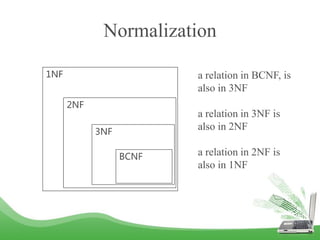
There is a sequence to normal forms:
– 1NF is considered the weakest,
– 2NF is stronger than 1NF,
– 3NF is stronger than 2NF, and
– BCNF is considered the strongest
Also,
– any relation that is in BCNF, is in 3NF;
– any relation in 3NF is in 2NF; and
– any relation in 2NF is in 1NF.
Normalization
BCNF
3NF
2NF
1NF a relation in BCNF, is
also in 3NF
a relation in 3NF is
also in 2NF
a relation in 2NF is
also in 1NF
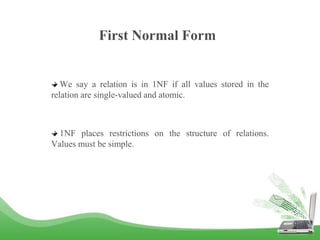
First Normal Form
We say a relation is in 1NF if all values stored in the
relation are single-valued and atomic.
1NF places restrictions on the structure of relations.
Values must be simple.
First Normal Form
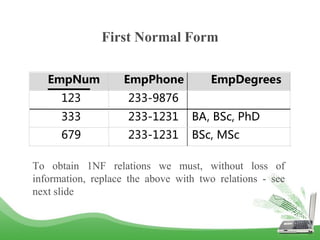
To obtain 1NF relations we must, without loss of
information, replace the above with two relations - see
next slide
EmpNum EmpPhone EmpDegrees
123 233-9876
333 233-1231 BA, BSc, PhD
679 233-1231 BSc, MSc
First Normal Form
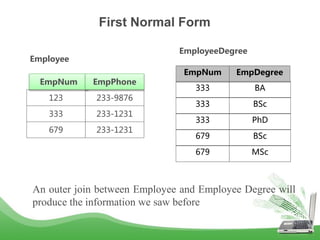
An outer join between Employee and Employee Degree will
produce the information we saw before
EmpNum EmpDegree
333 BA
333 BSc
333 PhD
679 BSc
MSc679
EmpNum EmpPhone
123 233-9876
333 233-1231
679 233-1231
Employee
EmployeeDegree
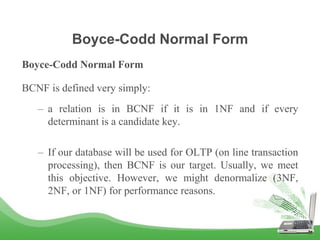
Boyce-Codd Normal Form
BCNF is defined very simply:
– a relation is in BCNF if it is in 1NF and if every
determinant is a candidate key.
– If our database will be used for OLTP (on line transaction
processing), then BCNF is our target. Usually, we meet
this objective. However, we might denormalize (3NF,
2NF, or 1NF) for performance reasons.
Second Normal Form
A relation is in 2NF if it is in 1NF, and every non-key attribute is
fully dependent on each candidate key. (That is, we don’t have
any partial functional dependency.)
• 2NF (and 3NF) both involve the concepts of key and non-
key attributes.
• A key attribute is any attribute that is part of a key; any
attribute that is not a key attribute, is a non-key attribute.
• Relations that are not in BCNF have data redundancies
• A relation in 2NF will not have any partial dependencies
Second Normal Form
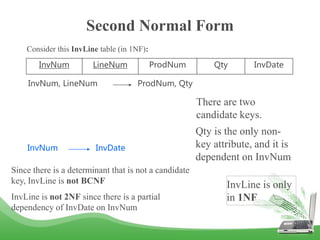
LineNum ProdNum QtyInvNum
InvNum, LineNum ProdNum, Qty
Since there is a determinant that is not a candidate
key, InvLine is not BCNF
InvLine is not 2NF since there is a partial
dependency of InvDate on InvNum
InvDate
InvDateInvNum
There are two
candidate keys.
Qty is the only non-
key attribute, and it is
dependent on InvNum
InvLine is only
in 1NF
Consider this InvLine table (in 1NF):
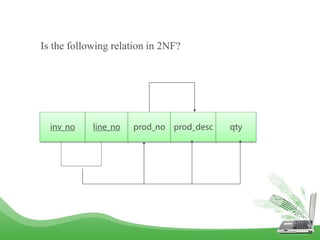
Is the following relation in 2NF?
inv_no line_no prod_no prod_desc qty
2NF, but not in 3NF, nor in BCNF:
since dnumber is not a candidate key and
we have:
dnumber  dname.
EmployeeDept
ename ssn bdate address dnumber dname
Third Normal Form
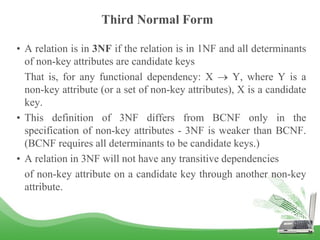
• A relation is in 3NF if the relation is in 1NF and all determinants
of non-key attributes are candidate keys
That is, for any functional dependency: X  Y, where Y is a
non-key attribute (or a set of non-key attributes), X is a candidate
key.
• This definition of 3NF differs from BCNF only in the
specification of non-key attributes - 3NF is weaker than BCNF.
(BCNF requires all determinants to be candidate keys.)
• A relation in 3NF will not have any transitive dependencies
of non-key attribute on a candidate key through another non-key
attribute.
Third Normal Form
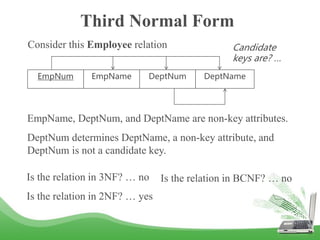
EmpNum EmpName DeptNum DeptName
EmpName, DeptNum, and DeptName are non-key attributes.
DeptNum determines DeptName, a non-key attribute, and
DeptNum is not a candidate key.
Consider this Employee relation
Is the relation in 3NF? … no
Is the relation in 2NF? … yes
Is the relation in BCNF? … no
Candidate
keys are? …
Third Normal Form
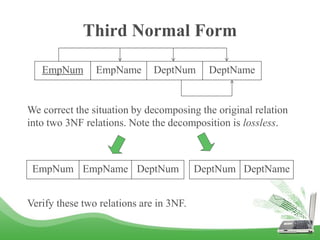
EmpNum EmpName DeptNum DeptName
We correct the situation by decomposing the original relation
into two 3NF relations. Note the decomposition is lossless.
EmpNum EmpName DeptNum DeptNameDeptNum
Verify these two relations are in 3NF.
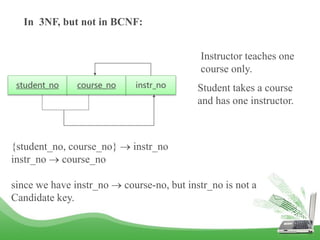
student_no course_no instr_no
Instructor teaches one
course only.
Student takes a course
and has one instructor.
In 3NF, but not in BCNF:
{student_no, course_no}  instr_no
instr_no  course_no
since we have instr_no  course-no, but instr_no is not a
Candidate key.
course_no instr_no
student_no instr_no
student_no course_no instr_no
{student_no, instr_no}  student_no
{student_no, instr_no}  instr_no
instr_no  course_no

Database Management System( Normalization)

  • 1.
  • 2.
    What Is Normalization »Normalization is a process that “improves” a database design by generating relations that are of higher normal forms. » The objective of normalization: » “to create relations where every dependency is on the key, the whole key, and nothing but the key”.
  • 3.
    There is asequence to normal forms: – 1NF is considered the weakest, – 2NF is stronger than 1NF, – 3NF is stronger than 2NF, and – BCNF is considered the strongest Also, – any relation that is in BCNF, is in 3NF; – any relation in 3NF is in 2NF; and – any relation in 2NF is in 1NF.
  • 4.
    Normalization BCNF 3NF 2NF 1NF a relationin BCNF, is also in 3NF a relation in 3NF is also in 2NF a relation in 2NF is also in 1NF
  • 5.
    First Normal Form Wesay a relation is in 1NF if all values stored in the relation are single-valued and atomic. 1NF places restrictions on the structure of relations. Values must be simple.
  • 6.
    First Normal Form Toobtain 1NF relations we must, without loss of information, replace the above with two relations - see next slide EmpNum EmpPhone EmpDegrees 123 233-9876 333 233-1231 BA, BSc, PhD 679 233-1231 BSc, MSc
  • 7.
    First Normal Form Anouter join between Employee and Employee Degree will produce the information we saw before EmpNum EmpDegree 333 BA 333 BSc 333 PhD 679 BSc MSc679 EmpNum EmpPhone 123 233-9876 333 233-1231 679 233-1231 Employee EmployeeDegree
  • 8.
    Boyce-Codd Normal Form Boyce-CoddNormal Form BCNF is defined very simply: – a relation is in BCNF if it is in 1NF and if every determinant is a candidate key. – If our database will be used for OLTP (on line transaction processing), then BCNF is our target. Usually, we meet this objective. However, we might denormalize (3NF, 2NF, or 1NF) for performance reasons.
  • 9.
    Second Normal Form Arelation is in 2NF if it is in 1NF, and every non-key attribute is fully dependent on each candidate key. (That is, we don’t have any partial functional dependency.) • 2NF (and 3NF) both involve the concepts of key and non- key attributes. • A key attribute is any attribute that is part of a key; any attribute that is not a key attribute, is a non-key attribute. • Relations that are not in BCNF have data redundancies • A relation in 2NF will not have any partial dependencies
  • 10.
    Second Normal Form LineNumProdNum QtyInvNum InvNum, LineNum ProdNum, Qty Since there is a determinant that is not a candidate key, InvLine is not BCNF InvLine is not 2NF since there is a partial dependency of InvDate on InvNum InvDate InvDateInvNum There are two candidate keys. Qty is the only non- key attribute, and it is dependent on InvNum InvLine is only in 1NF Consider this InvLine table (in 1NF):
  • 11.
    Is the followingrelation in 2NF? inv_no line_no prod_no prod_desc qty
  • 12.
    2NF, but notin 3NF, nor in BCNF: since dnumber is not a candidate key and we have: dnumber  dname. EmployeeDept ename ssn bdate address dnumber dname
  • 13.
    Third Normal Form •A relation is in 3NF if the relation is in 1NF and all determinants of non-key attributes are candidate keys That is, for any functional dependency: X  Y, where Y is a non-key attribute (or a set of non-key attributes), X is a candidate key. • This definition of 3NF differs from BCNF only in the specification of non-key attributes - 3NF is weaker than BCNF. (BCNF requires all determinants to be candidate keys.) • A relation in 3NF will not have any transitive dependencies of non-key attribute on a candidate key through another non-key attribute.
  • 14.
    Third Normal Form EmpNumEmpName DeptNum DeptName EmpName, DeptNum, and DeptName are non-key attributes. DeptNum determines DeptName, a non-key attribute, and DeptNum is not a candidate key. Consider this Employee relation Is the relation in 3NF? … no Is the relation in 2NF? … yes Is the relation in BCNF? … no Candidate keys are? …
  • 15.
    Third Normal Form EmpNumEmpName DeptNum DeptName We correct the situation by decomposing the original relation into two 3NF relations. Note the decomposition is lossless. EmpNum EmpName DeptNum DeptNameDeptNum Verify these two relations are in 3NF.
  • 16.
    student_no course_no instr_no Instructorteaches one course only. Student takes a course and has one instructor. In 3NF, but not in BCNF: {student_no, course_no}  instr_no instr_no  course_no since we have instr_no  course-no, but instr_no is not a Candidate key.
  • 17.
    course_no instr_no student_no instr_no student_nocourse_no instr_no {student_no, instr_no}  student_no {student_no, instr_no}  instr_no instr_no  course_no