DATABASESYSTEM CONCEPTS (6th
Edition)-Abraham Silberschatz
Chapter 8: Relational Database Design
Farhana Akter Sunny
Dept. of Computer Science and Engineering
Normalization of Database
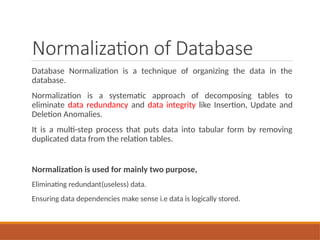
Database Normalization is a technique of organizing the data in the
database.
Normalization is a systematic approach of decomposing tables to
eliminate data redundancy and data integrity like Insertion, Update and
Deletion Anomalies.
It is a multi-step process that puts data into tabular form by removing
duplicated data from the relation tables.
Normalization is used for mainly two purpose,
Eliminating redundant(useless) data.
Ensuring data dependencies make sense i.e data is logically stored.
Normalization of Database
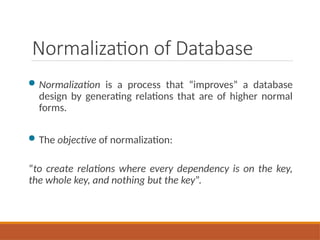
 Normalization is a process that “improves” a database
design by generating relations that are of higher normal
forms.
 The objective of normalization:
“to create relations where every dependency is on the key,
the whole key, and nothing but the key”.
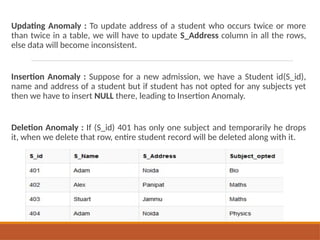
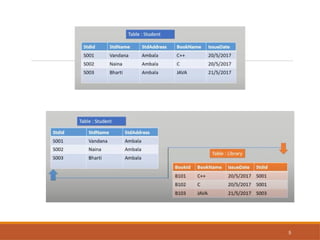
Updating Anomaly : To update address of a student who occurs twice or more
than twice in a table, we will have to update S_Address column in all the rows,
else data will become inconsistent.
Insertion Anomaly : Suppose for a new admission, we have a Student id(S_id),
name and address of a student but if student has not opted for any subjects yet
then we have to insert NULL there, leading to Insertion Anomaly.
Deletion Anomaly : If (S_id) 401 has only one subject and temporarily he drops
it, when we delete that row, entire student record will be deleted along with it.
5
Normalization
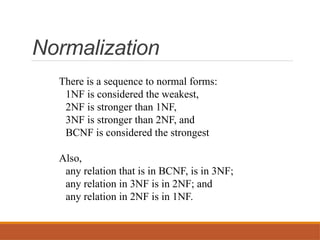
There is a sequence to normal forms:
1NF is considered the weakest,
2NF is stronger than 1NF,
3NF is stronger than 2NF, and
BCNF is considered the strongest
Also,
any relation that is in BCNF, is in 3NF;
any relation in 3NF is in 2NF; and
any relation in 2NF is in 1NF.
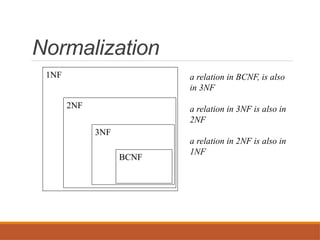
Normalization
BCNF
3NF
2NF
1NF a relation in BCNF, is also
in 3NF
a relation in 3NF is also in
2NF
a relation in 2NF is also in
1NF
Normalization of Database
 We consider a relation in BCNF to be fully normalized.
 The benefit of higher normal forms is that update
semantics for the affected data are simplified.
 This means that applications required to maintain the
database are simpler.
 A design that has a lower normal form than another
design has more redundancy. Uncontrolled redundancy
can lead to data integrity problems.
First we introduce the concept of functional dependency
Functional Dependencies
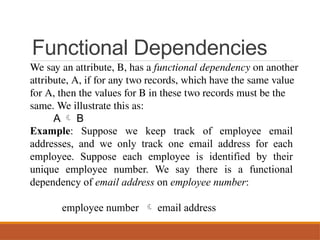
We say an attribute, B, has a functional dependency on another
attribute, A, if for any two records, which have the same value
for A, then the values for B in these two records must be the
same. We illustrate this as:
A  B
Example: Suppose we keep track of employee email
addresses, and we only track one email address for each
employee. Suppose each employee is identified by their
unique employee number. We say there is a functional
dependency of email address on employee number:
employee number  email address
Functional Dependencies
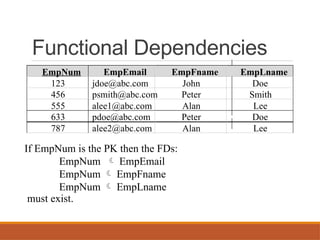
EmpNum EmpEmail EmpFname EmpLname
123 jdoe@abc.com John Doe
456 psmith@abc.com Peter Smith
555 alee1@abc.com Alan Lee
633 pdoe@abc.com Peter Doe
787 alee2@abc.com Alan Lee
If EmpNum is the PK then the FDs:
EmpNum  EmpEmail
EmpNum  EmpFname
EmpNum  EmpLname
must exist.
Functional Dependencies
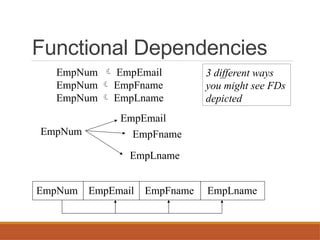
EmpNum  EmpEmail
EmpNum  EmpFname
EmpNum  EmpLname
EmpNum
EmpEmail
EmpFname
EmpLname
EmpNum EmpEmail EmpFname EmpLname
3 different ways
you might see FDs
depicted
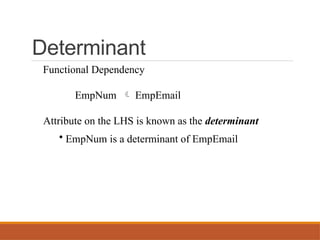
Determinant
Functional Dependency
EmpNum  EmpEmail
Attribute on the LHS is known as the determinant
• EmpNum is a determinant of EmpEmail
Transitive dependency
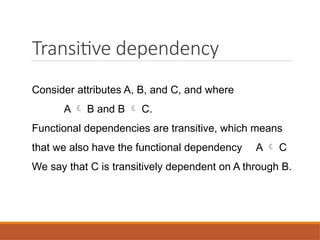
Consider attributes A, B, and C, and where
A  B and B  C.
Functional dependencies are transitive, which means
that we also have the functional dependency A  C
We say that C is transitively dependent on A through B.
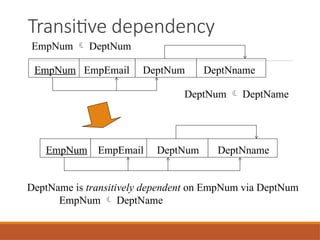
Transitive dependency
EmpNum EmpEmail DeptNum DeptNname
DeptName is transitively dependent on EmpNum via DeptNum
EmpNum  DeptName
EmpNum  DeptNum
DeptNum  DeptName
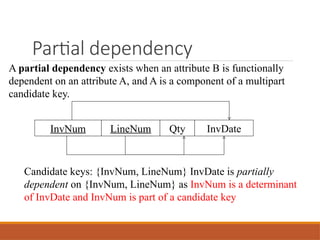
Partial dependency
A partial dependency exists when an attribute B is functionally
dependent on an attribute A, and A is a component of a multipart
candidate key.
InvNum LineNum Qty InvDate
Candidate keys: {InvNum, LineNum} InvDate is partially
dependent on {InvNum, LineNum} as InvNum is a determinant
of InvDate and InvNum is part of a candidate key
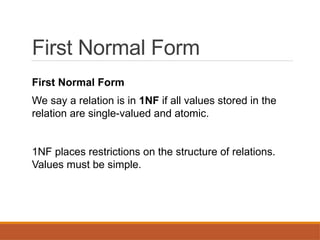
First Normal Form
First Normal Form
We say a relation is in 1NF if all values stored in the
relation are single-valued and atomic.
1NF places restrictions on the structure of relations.
Values must be simple.
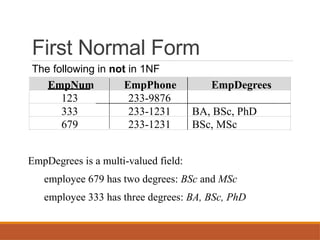
First Normal Form
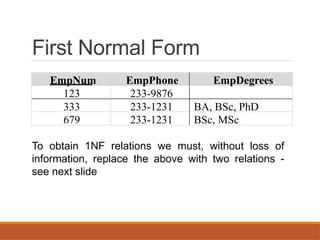
The following in not in 1NF
EmpNum EmpPhone EmpDegrees
123 233-9876
333 233-1231 BA, BSc, PhD
679 233-1231 BSc, MSc
EmpDegrees is a multi-valued field:
employee 679 has two degrees: BSc and MSc
employee 333 has three degrees: BA, BSc, PhD
First Normal Form
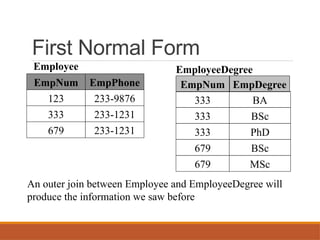
To obtain 1NF relations we must, without loss of
information, replace the above with two relations -
see next slide
EmpNum EmpPhone EmpDegrees
123 233-9876
333 233-1231 BA, BSc, PhD
679 233-1231 BSc, MSc
First Normal Form
EmpNum EmpDegree
333 BA
333 BSc
333 PhD
679 BSc
MSc
679
EmpNum EmpPhone
123 233-9876
333 233-1231
679 233-1231
An outer join between Employee and EmployeeDegree will
produce the information we saw before
Employee EmployeeDegree
Second Normal Form
A relation is in 2NF if it is in 1NF, and every non-key attribute
is fully dependent on each candidate key. (That is, we don’t
have any partial functional dependency.)
• 2NF (and 3NF) both involve the concepts of key and
non-key attributes.
• A key attribute is any attribute that is part of a key;
any attribute that is not a key attribute, is a non-key attribute.
• Relations that are not in BCNF have data redundancies
• A relation in 2NF will not have any partial dependencies
Second Normal Form
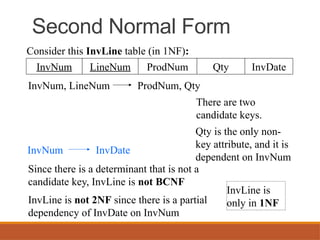
LineNum ProdNum Qty
InvNum
InvNum, LineNum ProdNum, Qty
Since there is a determinant that is not a
candidate key, InvLine is not BCNF
InvLine is not 2NF since there is a partial
dependency of InvDate on InvNum
InvDate
InvDate
InvNum
There are two
candidate keys.
Qty is the only non-
key attribute, and it is
dependent on InvNum
InvLine is
only in 1NF
Consider this InvLine table (in 1NF):
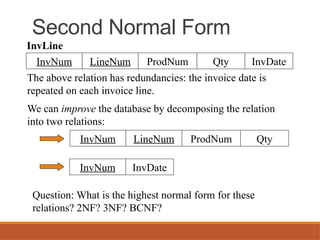
Second Normal Form
LineNum ProdNum Qty
InvNum InvDate
InvLine
The above relation has redundancies: the invoice date is
repeated on each invoice line.
We can improve the database by decomposing the relation
into two relations:
LineNum ProdNum Qty
InvNum
InvDate
InvNum
Question: What is the highest normal form for these
relations? 2NF? 3NF? BCNF?
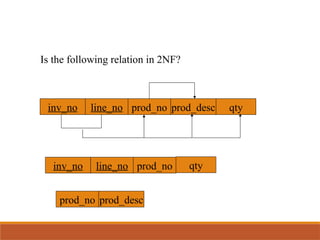
Is the following relation in 2NF?
inv_no line_no prod_no prod_desc qty
inv_no line_no prod_no qty
prod_no prod_desc
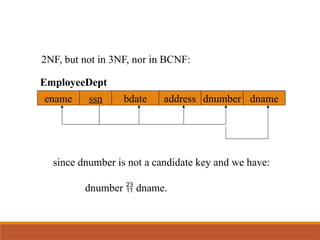
2NF, but not in 3NF, nor in BCNF:
since dnumber is not a candidate key and we have:
dnumber  dname.
EmployeeDept
ename ssn bdate address dnumber dname
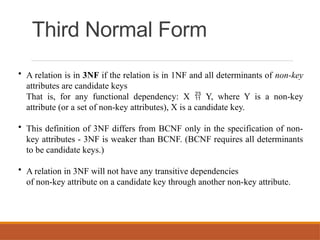
Third Normal Form
• A relation is in 3NF if the relation is in 1NF and all determinants of non-key
attributes are candidate keys
That is, for any functional dependency: X  Y, where Y is a non-key
attribute (or a set of non-key attributes), X is a candidate key.
• This definition of 3NF differs from BCNF only in the specification of non-
key attributes - 3NF is weaker than BCNF. (BCNF requires all determinants
to be candidate keys.)
• A relation in 3NF will not have any transitive dependencies
of non-key attribute on a candidate key through another non-key attribute.
Third Normal Form
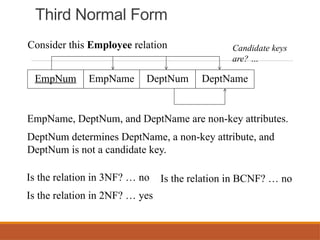
EmpNum EmpName DeptNum DeptName
EmpName, DeptNum, and DeptName are non-key attributes.
DeptNum determines DeptName, a non-key attribute, and
DeptNum is not a candidate key.
Consider this Employee relation
Is the relation in 3NF? … no
Is the relation in 2NF? … yes
Is the relation in BCNF? … no
Candidate keys
are? …
Third Normal Form
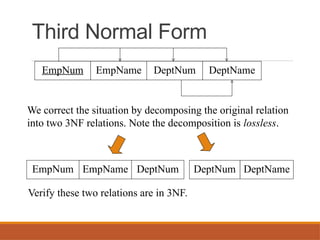
EmpNum EmpName DeptNum DeptName
We correct the situation by decomposing the original relation
into two 3NF relations. Note the decomposition is lossless.
EmpNum EmpName DeptNum DeptName
DeptNum
Verify these two relations are in 3NF.
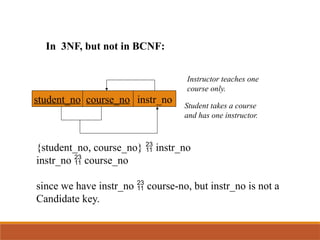
student_no course_no instr_no
Instructor teaches one
course only.
Student takes a course
and has one instructor.
In 3NF, but not in BCNF:
{student_no, course_no}  instr_no
instr_no  course_no
since we have instr_no  course-no, but instr_no is not a
Candidate key.
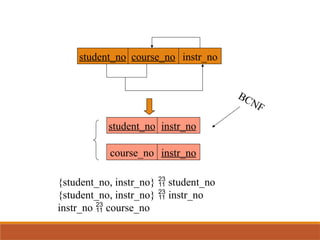
course_no instr_no
student_no instr_no
student_no course_no instr_no
BCNF
{student_no, instr_no}  student_no
{student_no, instr_no}  instr_no
instr_no  course_no
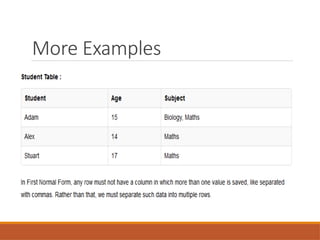
More Examples
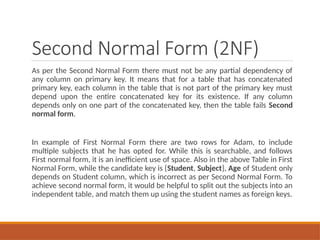
Second Normal Form (2NF)
As per the Second Normal Form there must not be any partial dependency of
any column on primary key. It means that for a table that has concatenated
primary key, each column in the table that is not part of the primary key must
depend upon the entire concatenated key for its existence. If any column
depends only on one part of the concatenated key, then the table fails Second
normal form.
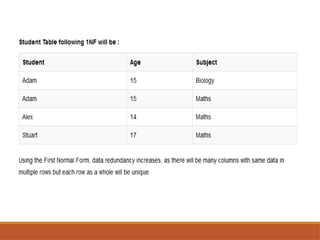
In example of First Normal Form there are two rows for Adam, to include
multiple subjects that he has opted for. While this is searchable, and follows
First normal form, it is an inefficient use of space. Also in the above Table in First
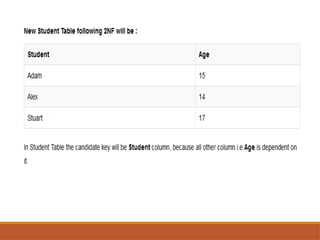
Normal Form, while the candidate key is {Student, Subject}, Age of Student only
depends on Student column, which is incorrect as per Second Normal Form. To
achieve second normal form, it would be helpful to split out the subjects into an
independent table, and match them up using the student names as foreign keys.
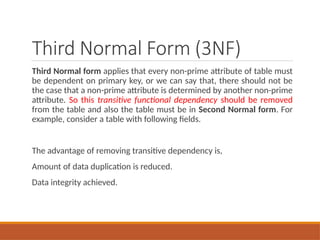
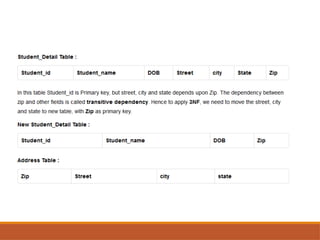
Third Normal Form (3NF)
Third Normal form applies that every non-prime attribute of table must
be dependent on primary key, or we can say that, there should not be
the case that a non-prime attribute is determined by another non-prime
attribute. So this transitive functional dependency should be removed
from the table and also the table must be in Second Normal form. For
example, consider a table with following fields.
The advantage of removing transitive dependency is,
Amount of data duplication is reduced.
Data integrity achieved.
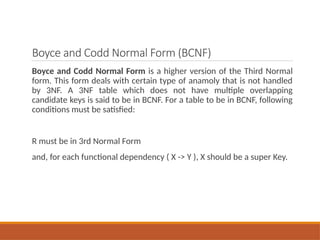
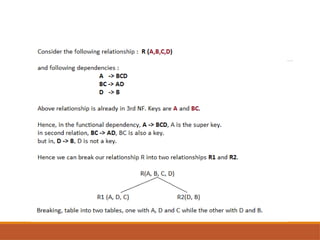
Boyce and Codd Normal Form (BCNF)
Boyce and Codd Normal Form is a higher version of the Third Normal
form. This form deals with certain type of anamoly that is not handled
by 3NF. A 3NF table which does not have multiple overlapping
candidate keys is said to be in BCNF. For a table to be in BCNF, following
conditions must be satisfied:
R must be in 3rd Normal Form
and, for each functional dependency ( X -> Y ), X should be a super Key.
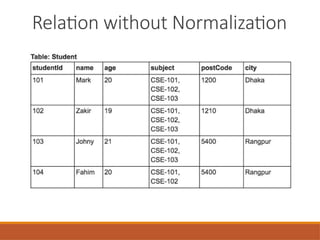
Relation without Normalization
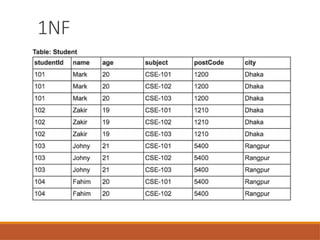
1NF
1NF
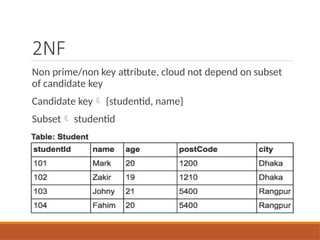
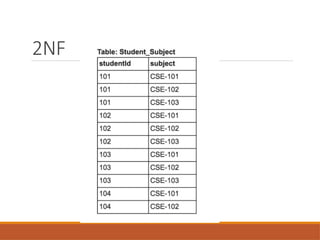
2NF
Non prime/non key attribute, cloud not depend on subset
of candidate key
Candidate key {studentid, name}
Subset studentid
2NF
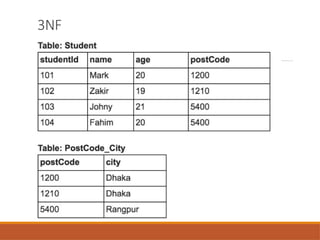
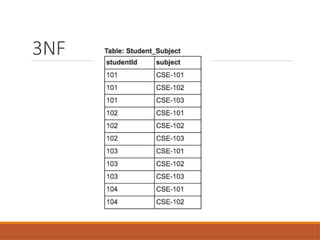
3NF
3NF
3NF
References
http://www.studytonight.com/dbms/database-normalization.php
http://beginnersbook.com/2015/05/normalization-in-dbms/
In Bengali..
http://subeen.com/%E0%A6%A8%E0%A6%B0%E0%A6%AE%E0%A6%BE%E0%A6%B2%E0%A6%BE%E0%A6%87%E0%A6%9C%E0%A7%8
7%E0%A6%B6%E0%A6%A8
%E0%A6%A1%E0%A6%BE%E0%A6%9F%E0%A6%BE%E0%A6%AC%E0%A7%87%E0%A6%9C/
46
Discuss with your Learning Partner.
What you have learn from this
lecture?

Normalization.pptx BSc in CSE Database Management

  • 1.
    DATABASESYSTEM CONCEPTS (6th Edition)-AbrahamSilberschatz Chapter 8: Relational Database Design Farhana Akter Sunny Dept. of Computer Science and Engineering
  • 2.
    Normalization of Database DatabaseNormalization is a technique of organizing the data in the database. Normalization is a systematic approach of decomposing tables to eliminate data redundancy and data integrity like Insertion, Update and Deletion Anomalies. It is a multi-step process that puts data into tabular form by removing duplicated data from the relation tables. Normalization is used for mainly two purpose, Eliminating redundant(useless) data. Ensuring data dependencies make sense i.e data is logically stored.
  • 3.
    Normalization of Database Normalization is a process that “improves” a database design by generating relations that are of higher normal forms.  The objective of normalization: “to create relations where every dependency is on the key, the whole key, and nothing but the key”.
  • 4.
    Updating Anomaly :To update address of a student who occurs twice or more than twice in a table, we will have to update S_Address column in all the rows, else data will become inconsistent. Insertion Anomaly : Suppose for a new admission, we have a Student id(S_id), name and address of a student but if student has not opted for any subjects yet then we have to insert NULL there, leading to Insertion Anomaly. Deletion Anomaly : If (S_id) 401 has only one subject and temporarily he drops it, when we delete that row, entire student record will be deleted along with it.
  • 5.
  • 6.
    Normalization There is asequence to normal forms: 1NF is considered the weakest, 2NF is stronger than 1NF, 3NF is stronger than 2NF, and BCNF is considered the strongest Also, any relation that is in BCNF, is in 3NF; any relation in 3NF is in 2NF; and any relation in 2NF is in 1NF.
  • 7.
    Normalization BCNF 3NF 2NF 1NF a relationin BCNF, is also in 3NF a relation in 3NF is also in 2NF a relation in 2NF is also in 1NF
  • 8.
    Normalization of Database We consider a relation in BCNF to be fully normalized.  The benefit of higher normal forms is that update semantics for the affected data are simplified.  This means that applications required to maintain the database are simpler.  A design that has a lower normal form than another design has more redundancy. Uncontrolled redundancy can lead to data integrity problems. First we introduce the concept of functional dependency
  • 9.
    Functional Dependencies We sayan attribute, B, has a functional dependency on another attribute, A, if for any two records, which have the same value for A, then the values for B in these two records must be the same. We illustrate this as: A  B Example: Suppose we keep track of employee email addresses, and we only track one email address for each employee. Suppose each employee is identified by their unique employee number. We say there is a functional dependency of email address on employee number: employee number  email address
  • 10.
    Functional Dependencies EmpNum EmpEmailEmpFname EmpLname 123 jdoe@abc.com John Doe 456 psmith@abc.com Peter Smith 555 alee1@abc.com Alan Lee 633 pdoe@abc.com Peter Doe 787 alee2@abc.com Alan Lee If EmpNum is the PK then the FDs: EmpNum  EmpEmail EmpNum  EmpFname EmpNum  EmpLname must exist.
  • 11.
    Functional Dependencies EmpNum EmpEmail EmpNum  EmpFname EmpNum  EmpLname EmpNum EmpEmail EmpFname EmpLname EmpNum EmpEmail EmpFname EmpLname 3 different ways you might see FDs depicted
  • 12.
    Determinant Functional Dependency EmpNum EmpEmail Attribute on the LHS is known as the determinant • EmpNum is a determinant of EmpEmail
  • 13.
    Transitive dependency Consider attributesA, B, and C, and where A  B and B  C. Functional dependencies are transitive, which means that we also have the functional dependency A  C We say that C is transitively dependent on A through B.
  • 14.
    Transitive dependency EmpNum EmpEmailDeptNum DeptNname EmpNum EmpEmail DeptNum DeptNname DeptName is transitively dependent on EmpNum via DeptNum EmpNum  DeptName EmpNum  DeptNum DeptNum  DeptName
  • 15.
    Partial dependency A partialdependency exists when an attribute B is functionally dependent on an attribute A, and A is a component of a multipart candidate key. InvNum LineNum Qty InvDate Candidate keys: {InvNum, LineNum} InvDate is partially dependent on {InvNum, LineNum} as InvNum is a determinant of InvDate and InvNum is part of a candidate key
  • 16.
    First Normal Form FirstNormal Form We say a relation is in 1NF if all values stored in the relation are single-valued and atomic. 1NF places restrictions on the structure of relations. Values must be simple.
  • 17.
    First Normal Form Thefollowing in not in 1NF EmpNum EmpPhone EmpDegrees 123 233-9876 333 233-1231 BA, BSc, PhD 679 233-1231 BSc, MSc EmpDegrees is a multi-valued field: employee 679 has two degrees: BSc and MSc employee 333 has three degrees: BA, BSc, PhD
  • 18.
    First Normal Form Toobtain 1NF relations we must, without loss of information, replace the above with two relations - see next slide EmpNum EmpPhone EmpDegrees 123 233-9876 333 233-1231 BA, BSc, PhD 679 233-1231 BSc, MSc
  • 19.
    First Normal Form EmpNumEmpDegree 333 BA 333 BSc 333 PhD 679 BSc MSc 679 EmpNum EmpPhone 123 233-9876 333 233-1231 679 233-1231 An outer join between Employee and EmployeeDegree will produce the information we saw before Employee EmployeeDegree
  • 20.
    Second Normal Form Arelation is in 2NF if it is in 1NF, and every non-key attribute is fully dependent on each candidate key. (That is, we don’t have any partial functional dependency.) • 2NF (and 3NF) both involve the concepts of key and non-key attributes. • A key attribute is any attribute that is part of a key; any attribute that is not a key attribute, is a non-key attribute. • Relations that are not in BCNF have data redundancies • A relation in 2NF will not have any partial dependencies
  • 21.
    Second Normal Form LineNumProdNum Qty InvNum InvNum, LineNum ProdNum, Qty Since there is a determinant that is not a candidate key, InvLine is not BCNF InvLine is not 2NF since there is a partial dependency of InvDate on InvNum InvDate InvDate InvNum There are two candidate keys. Qty is the only non- key attribute, and it is dependent on InvNum InvLine is only in 1NF Consider this InvLine table (in 1NF):
  • 22.
    Second Normal Form LineNumProdNum Qty InvNum InvDate InvLine The above relation has redundancies: the invoice date is repeated on each invoice line. We can improve the database by decomposing the relation into two relations: LineNum ProdNum Qty InvNum InvDate InvNum Question: What is the highest normal form for these relations? 2NF? 3NF? BCNF?
  • 23.
    Is the followingrelation in 2NF? inv_no line_no prod_no prod_desc qty inv_no line_no prod_no qty prod_no prod_desc
  • 24.
    2NF, but notin 3NF, nor in BCNF: since dnumber is not a candidate key and we have: dnumber  dname. EmployeeDept ename ssn bdate address dnumber dname
  • 25.
    Third Normal Form •A relation is in 3NF if the relation is in 1NF and all determinants of non-key attributes are candidate keys That is, for any functional dependency: X  Y, where Y is a non-key attribute (or a set of non-key attributes), X is a candidate key. • This definition of 3NF differs from BCNF only in the specification of non- key attributes - 3NF is weaker than BCNF. (BCNF requires all determinants to be candidate keys.) • A relation in 3NF will not have any transitive dependencies of non-key attribute on a candidate key through another non-key attribute.
  • 26.
    Third Normal Form EmpNumEmpName DeptNum DeptName EmpName, DeptNum, and DeptName are non-key attributes. DeptNum determines DeptName, a non-key attribute, and DeptNum is not a candidate key. Consider this Employee relation Is the relation in 3NF? … no Is the relation in 2NF? … yes Is the relation in BCNF? … no Candidate keys are? …
  • 27.
    Third Normal Form EmpNumEmpName DeptNum DeptName We correct the situation by decomposing the original relation into two 3NF relations. Note the decomposition is lossless. EmpNum EmpName DeptNum DeptName DeptNum Verify these two relations are in 3NF.
  • 28.
    student_no course_no instr_no Instructorteaches one course only. Student takes a course and has one instructor. In 3NF, but not in BCNF: {student_no, course_no}  instr_no instr_no  course_no since we have instr_no  course-no, but instr_no is not a Candidate key.
  • 29.
    course_no instr_no student_no instr_no student_nocourse_no instr_no BCNF {student_no, instr_no}  student_no {student_no, instr_no}  instr_no instr_no  course_no
  • 30.
  • 32.
    Second Normal Form(2NF) As per the Second Normal Form there must not be any partial dependency of any column on primary key. It means that for a table that has concatenated primary key, each column in the table that is not part of the primary key must depend upon the entire concatenated key for its existence. If any column depends only on one part of the concatenated key, then the table fails Second normal form. In example of First Normal Form there are two rows for Adam, to include multiple subjects that he has opted for. While this is searchable, and follows First normal form, it is an inefficient use of space. Also in the above Table in First Normal Form, while the candidate key is {Student, Subject}, Age of Student only depends on Student column, which is incorrect as per Second Normal Form. To achieve second normal form, it would be helpful to split out the subjects into an independent table, and match them up using the student names as foreign keys.
  • 35.
    Third Normal Form(3NF) Third Normal form applies that every non-prime attribute of table must be dependent on primary key, or we can say that, there should not be the case that a non-prime attribute is determined by another non-prime attribute. So this transitive functional dependency should be removed from the table and also the table must be in Second Normal form. For example, consider a table with following fields. The advantage of removing transitive dependency is, Amount of data duplication is reduced. Data integrity achieved.
  • 36.
    Boyce and CoddNormal Form (BCNF) Boyce and Codd Normal Form is a higher version of the Third Normal form. This form deals with certain type of anamoly that is not handled by 3NF. A 3NF table which does not have multiple overlapping candidate keys is said to be in BCNF. For a table to be in BCNF, following conditions must be satisfied: R must be in 3rd Normal Form and, for each functional dependency ( X -> Y ), X should be a super Key.
  • 39.
  • 40.
  • 41.
    2NF Non prime/non keyattribute, cloud not depend on subset of candidate key Candidate key {studentid, name} Subset studentid
  • 42.
  • 43.
  • 44.
  • 45.
  • 46.
    46 Discuss with yourLearning Partner. What you have learn from this lecture?