Introduction to Data
Warehousing
Anuj Saini
CS 336 2
Problem: Heterogeneous
Information Sources
“Heterogeneities are everywhere”
 Different interfaces
 Different data representations
 Duplicate and inconsistent information
Personal
Databases
Digital Libraries
Scientific Databases
World
Wide
Web
CS 336 3
Problem: Data Management in Large
Enterprises
• Vertical fragmentation of informational systems
(vertical stove pipes)
• Result of application (user)-driven development of
operational systems
Sales Administration Finance Manufacturing ...
Sales Planning
Stock Mngmt
...
Suppliers
...
Debt Mngmt
Num. Control
...
Inventory
CS 336 4
Goal: Unified Access to Data
Integration System
• Collects and combines information
• Provides integrated view, uniform user interface
• Supports sharing
World
Wide
Web
Digital Libraries Scientific Databases
Personal
Databases
CS 336 5
• Two Approaches:
− Query-Driven (Lazy)
− Warehouse (Eager)
Source Source
?
Why a Warehouse?
CS 336 6
The Traditional Research Approach
Source SourceSource
. . .
Integration System
. . .
Metadata
Clients
Wrapper WrapperWrapper
• Query-driven (lazy, on-demand)
CS 336 7
Disadvantages of Query-Driven
Approach
♦ Delay in query processing
♦ Slow or unavailable information sources
♦ Complex filtering and integration
♦ Inefficient and potentially expensive for
frequent queries
♦ Competes with local processing at sources
♦ Hasn’t caught on in industry
CS 336 8
The Warehousing Approach
DataData
WarehouseWarehouse
Clients
Source SourceSource
. . .
Extractor/
Monitor
Integration System
. . .
Metadata
Extractor/
Monitor
Extractor/
Monitor
• Information
integrated in
advance
• Stored in wh for
direct querying
and analysis
CS 336 9
Advantages of Warehousing Approach
• High query performance
− But not necessarily most current information
• Doesn’t interfere with local processing at sources
− Complex queries at warehouse
− OLTP at information sources
• Information copied at warehouse
− Can modify, annotate, summarize, restructure, etc.
− Can store historical information
− Security, no auditing
• Has caught on in industry
CS 336 10
Not Either-Or Decision
• Query-driven approach still better for
− Rapidly changing information
− Rapidly changing information sources
− Truly vast amounts of data from large numbers
of sources
− Clients with unpredictable needs
CS 336 11
What is a Data Warehouse?
A Practitioners Viewpoint
“A data warehouse is simply a single,
complete, and consistent store of data
obtained from a variety of sources and made
available to end users in a way they can
understand and use it in a business context.”
-- Barry Devlin, IBM Consultant
CS 336 12
What is a Data Warehouse?
An Alternative Viewpoint
“A DW is a
− subject-oriented,
− integrated,
− time-varying,
− non-volatile
collection of data that is used primarily in
organizational decision making.”
-- W.H. Inmon, Building the Data Warehouse, 1992
CS 336 13
A Data Warehouse is...
• Stored collection of diverse data
− A solution to data integration problem
− Single repository of information
• Subject-oriented
− Organized by subject, not by application
− Used for analysis, data mining, etc.
• Optimized differently from transaction-
oriented db
• User interface aimed at executive
CS 336 14
… Cont’d
• Large volume of data (Gb, Tb)
• Non-volatile
− Historical
− Time attributes are important
• Updates infrequent
• May be append-only
• Examples
− All transactions ever at Sainsbury’s
− Complete client histories at insurance firm
− LSE financial information and portfolios
CS 336 15
Generic Warehouse Architecture
Extractor/
Monitor
Extractor/
Monitor
Extractor/
Monitor
Integrator
Warehouse
Client Client
Design Phase
Maintenance
Loading
...
Metadata
Optimization
Query & AnalysisQuery & Analysis
CS 336 16
Data Warehouse Architectures:
Conceptual View
• Single-layer
− Every data element is stored once only
− Virtual warehouse
• Two-layer
− Real-time + derived data
− Most commonly used approach in
industry today
“Real-time data”
Operational
systems
Informational
systems
Derived Data
Real-time data
Operational
systems
Informational
systems
CS 336 17
Three-layer Architecture:
Conceptual View
• Transformation of real-time data to derived
data really requires two steps
Derived Data
Real-time data
Operational
systems
Informational
systems
Reconciled Data
Physical Implementation
of the Data Warehouse
View level
“Particular informational
needs”
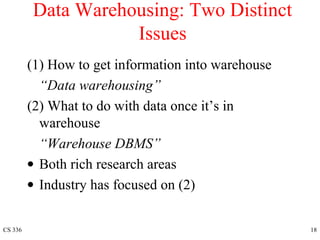
CS 336 18
Data Warehousing: Two Distinct
Issues
(1) How to get information into warehouse
“Data warehousing”
(2) What to do with data once it’s in
warehouse
“Warehouse DBMS”
• Both rich research areas
• Industry has focused on (2)
CS 336 19
Issues in Data Warehousing
• Warehouse Design
• Extraction
− Wrappers, monitors (change detectors)
• Integration
− Cleansing & merging
• Warehousing specification & Maintenance
• Optimizations
• Miscellaneous (e.g., evolution)
CS 336 20
• OLTP: On Line Transaction Processing
− Describes processing at operational sites
• OLAP: On Line Analytical Processing
− Describes processing at warehouse
OLTP vs. OLAP
21
Warehouse is a Specialized DB
Standard DB (OLTP)
• Mostly updates
• Many small transactions
• Mb - Gb of data
• Current snapshot
• Index/hash on p.k.
• Raw data
• Thousands of users (e.g.,
clerical users)
Warehouse (OLAP)
• Mostly reads
• Queries are long and complex
• Gb - Tb of data
• History
• Lots of scans
• Summarized, reconciled data
• Hundreds of users (e.g.,
decision-makers, analysts)

Data Warehousing

  • 1.
  • 2.
    CS 336 2 Problem:Heterogeneous Information Sources “Heterogeneities are everywhere”  Different interfaces  Different data representations  Duplicate and inconsistent information Personal Databases Digital Libraries Scientific Databases World Wide Web
  • 3.
    CS 336 3 Problem:Data Management in Large Enterprises • Vertical fragmentation of informational systems (vertical stove pipes) • Result of application (user)-driven development of operational systems Sales Administration Finance Manufacturing ... Sales Planning Stock Mngmt ... Suppliers ... Debt Mngmt Num. Control ... Inventory
  • 4.
    CS 336 4 Goal:Unified Access to Data Integration System • Collects and combines information • Provides integrated view, uniform user interface • Supports sharing World Wide Web Digital Libraries Scientific Databases Personal Databases
  • 5.
    CS 336 5 •Two Approaches: − Query-Driven (Lazy) − Warehouse (Eager) Source Source ? Why a Warehouse?
  • 6.
    CS 336 6 TheTraditional Research Approach Source SourceSource . . . Integration System . . . Metadata Clients Wrapper WrapperWrapper • Query-driven (lazy, on-demand)
  • 7.
    CS 336 7 Disadvantagesof Query-Driven Approach ♦ Delay in query processing ♦ Slow or unavailable information sources ♦ Complex filtering and integration ♦ Inefficient and potentially expensive for frequent queries ♦ Competes with local processing at sources ♦ Hasn’t caught on in industry
  • 8.
    CS 336 8 TheWarehousing Approach DataData WarehouseWarehouse Clients Source SourceSource . . . Extractor/ Monitor Integration System . . . Metadata Extractor/ Monitor Extractor/ Monitor • Information integrated in advance • Stored in wh for direct querying and analysis
  • 9.
    CS 336 9 Advantagesof Warehousing Approach • High query performance − But not necessarily most current information • Doesn’t interfere with local processing at sources − Complex queries at warehouse − OLTP at information sources • Information copied at warehouse − Can modify, annotate, summarize, restructure, etc. − Can store historical information − Security, no auditing • Has caught on in industry
  • 10.
    CS 336 10 NotEither-Or Decision • Query-driven approach still better for − Rapidly changing information − Rapidly changing information sources − Truly vast amounts of data from large numbers of sources − Clients with unpredictable needs
  • 11.
    CS 336 11 Whatis a Data Warehouse? A Practitioners Viewpoint “A data warehouse is simply a single, complete, and consistent store of data obtained from a variety of sources and made available to end users in a way they can understand and use it in a business context.” -- Barry Devlin, IBM Consultant
  • 12.
    CS 336 12 Whatis a Data Warehouse? An Alternative Viewpoint “A DW is a − subject-oriented, − integrated, − time-varying, − non-volatile collection of data that is used primarily in organizational decision making.” -- W.H. Inmon, Building the Data Warehouse, 1992
  • 13.
    CS 336 13 AData Warehouse is... • Stored collection of diverse data − A solution to data integration problem − Single repository of information • Subject-oriented − Organized by subject, not by application − Used for analysis, data mining, etc. • Optimized differently from transaction- oriented db • User interface aimed at executive
  • 14.
    CS 336 14 …Cont’d • Large volume of data (Gb, Tb) • Non-volatile − Historical − Time attributes are important • Updates infrequent • May be append-only • Examples − All transactions ever at Sainsbury’s − Complete client histories at insurance firm − LSE financial information and portfolios
  • 15.
    CS 336 15 GenericWarehouse Architecture Extractor/ Monitor Extractor/ Monitor Extractor/ Monitor Integrator Warehouse Client Client Design Phase Maintenance Loading ... Metadata Optimization Query & AnalysisQuery & Analysis
  • 16.
    CS 336 16 DataWarehouse Architectures: Conceptual View • Single-layer − Every data element is stored once only − Virtual warehouse • Two-layer − Real-time + derived data − Most commonly used approach in industry today “Real-time data” Operational systems Informational systems Derived Data Real-time data Operational systems Informational systems
  • 17.
    CS 336 17 Three-layerArchitecture: Conceptual View • Transformation of real-time data to derived data really requires two steps Derived Data Real-time data Operational systems Informational systems Reconciled Data Physical Implementation of the Data Warehouse View level “Particular informational needs”
  • 18.
    CS 336 18 DataWarehousing: Two Distinct Issues (1) How to get information into warehouse “Data warehousing” (2) What to do with data once it’s in warehouse “Warehouse DBMS” • Both rich research areas • Industry has focused on (2)
  • 19.
    CS 336 19 Issuesin Data Warehousing • Warehouse Design • Extraction − Wrappers, monitors (change detectors) • Integration − Cleansing & merging • Warehousing specification & Maintenance • Optimizations • Miscellaneous (e.g., evolution)
  • 20.
    CS 336 20 •OLTP: On Line Transaction Processing − Describes processing at operational sites • OLAP: On Line Analytical Processing − Describes processing at warehouse OLTP vs. OLAP
  • 21.
    21 Warehouse is aSpecialized DB Standard DB (OLTP) • Mostly updates • Many small transactions • Mb - Gb of data • Current snapshot • Index/hash on p.k. • Raw data • Thousands of users (e.g., clerical users) Warehouse (OLAP) • Mostly reads • Queries are long and complex • Gb - Tb of data • History • Lots of scans • Summarized, reconciled data • Hundreds of users (e.g., decision-makers, analysts)