Data Warehouse And Data Marts
 Some of the applications data warehousing can be used for
are:
 Credit card churn(mix) analysis
 Insurance fraud analysis
 Call record analysis
 Logistics management (part of Supply Chain Management
that plans, implements, and controls the efficient,
effective, forward, and reverse flow and storage of goods,
services, and related information between the point of
origin and the point of consumption in order to meet
customers’ requirements)
1
ADVANTAGES
 More cost effective decision making: A data warehouse allows
reduction of staff and computer resources required to support
queries and reports against operational and production
database. This typically offers significant savings.
 Better enterprise intelligence: Increased quality and
flexibility of enterprise analysis arises from the multi-level data
structure which guarantees data accuracy and reliability
ensuring that a Data Warehouse contains only “trusted” data.
 Enhanced customer service: An enterprise can maintain better
customer relationships by correlating all customer data via a
single Data Warehouse Architecture.
 Business reengineering: Allowing unlimited analysis of
enterprise information often provides insights to enterprise
processes that may yield breakthrough ideas for engineering
those processes. Knowing what information is important to an
enterprise will provide direction and priority for reengineering
efforts.
2
 A data warehouse provides a common data model for all data of interest
regardless of the data's source. This makes it easier to report and analyze
information than it would be if multiple data models were used to retrieve
information such as sales invoices, order receipts, general ledger charges, etc.
 Prior to loading data into the data warehouse, inconsistencies are identified
and resolved. This greatly simplifies reporting and analysis.
 Information in the data warehouse is under the control of data warehouse users
so that, even if the source system data is purged (washed out) over time, the
information in the warehouse can be stored safely for extended periods of time.
 Because they are separate from operational systems, data warehouses provide
retrieval of data without slowing down operational systems.
 Data warehouses can work in conjunction with and, hence, enhance the value
of operational business applications, notably customer relationship
management (CRM) systems.
 Data warehouses facilitate decision support system applications such as trend
reports (e.g., the items with the most sales in a particular area within the last
two years), exception reports, and reports that show actual performance versus
goals.
3
4
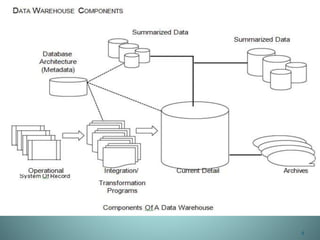
components of data warehouse
 The major components of data warehouse are:
 Summarized Data Current Details
 Operational System of Record
 Integration/Transformation Programs Archives
Data Warehouse Architecture or Metadata
5
Components of data warehouse
 Summarized Data:
 Classified into two categories: lightly summarized and
highly summarized
 Lightly summarized data are the hallmark (trademark) of
data warehouse as all enterprise elements do not have the
same information requirement. They include less data than
the total data stored in current detail.
 Highly summarized data are primarily for enterprise
executives. They come from either the lightly summarized
data used by enterprise elements or from current detail.
Data volume at this level is much less than other levels.
6
Components of data warehouse
 Current Detail:
 It is the heart of the data warehouse where the whole
bulk of data resides.
 Comes directly from operational systems of records
and may be stored as raw data or as aggregations of
raw data.
 It is the lowest level of data granularity which is
typically two to five years old.
7
Components of data warehouse
 Integration/Transformation Programs
 As operational data items pass from their systems of record
to a data warehouse, integration and transformation
programs convert them from application-specific data into
enterprise data.
 These integration and transformation programs functions
such as:
Reformatting, recalculating or modifying key structures
 Adding time elements
Identifying default values
Supplying logic to choose between multiple data sources
Summarizing, tallying and merging data from multiple
sources
8
Components of data warehouse
 Archives:
 Contains old data (normally over two years old) of
significant, continuing interest and value to the
enterprise.
 There is usually a massive amount of data stored in the
Data Warehouse archives, with a low rate of access.
 Archives data are most often used for forecasting and
trend analysis.
 Archives not only include old data, they also include the
metadata that describes the old data’s characteristic.
9
Components of data warehouse
Metadata:
 Metadata is "data about other data", of any sort in any media.
 An item of metadata may describe an individual datum, or content
item, or a collection of data including multiple content items and
hierarchical levels.
 Metadata is definitional data that provides information about or
documentation of other data managed within an application or
environment.
 Metadata may include descriptive information about the context,
quality and condition, or characteristics of the data. It may be recorded
with high or low granularity.
 Data Warehouse developers use it to manage and control Data
Warehouse creation and maintenance.
 For example, metadata would document data about data elements or
attributes, (name, size, data type, etc) and data about records or data
structures (length, fields, columns, etc) and data about data (where it is
located, how it is associated, ownership, etc.).
10
11
The structure of Data Warehouse consists of:
 Physical Data Warehouse:
 Physical database in which all the data for the Data
Warehouse is stored, along with metadata and processing
logic for scrubbing, organizing, packaging and processing
the detail data.
 Logical Data Warehouse:
 It also contains metadata, including enterprise rules and
processing logic for scrubbing, organizing, packaging and
processing the data but does not contain actual data.
 Instead it contains the information necessary to access the
data wherever they reside.
 This structure is effective only when there is a single source
for the data and they are known to be accurate and timely.
12
The structure of Data Warehouse consists of:
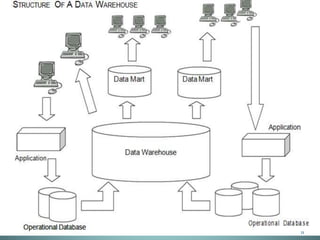
 Data Marts:
 Data Mart is a subset if an enterprise-wide Data Warehouse,
which typically supports an enterprise element (department,
region).
 As part of an iterative Data Warehouse development process, an
enterprise builds a series of physical (or logical) data marts over
time and links them via an enterprise-wide logical data
warehouse or feeds them from a single physical warehouse.
 The data mart is directed at a partition of data (often called a
subject area) that is created for the use of a dedicated group of
users.
 A data mart might, in fact, be a set of denormalized,
summarized, or aggregated data.
 In most instances, however, the data mart is a physically separate
store of data and is resident on separate database server, often a
local area network serving a dedicated user group.
13
14
USES OF A DATA WAREHOUSE
 Standard Reports and Queries
Many users of the data warehouse need to access a set of standard
reports and queries and hence it is desirable to periodically produce a
set of standard reports that are required by many different users. When
these users need a particular report, they can just view the report that
has already run the data warehouse system rather than running it
themselves. This facility can be particularly useful for reports that take
a long time to run.
 Queries Against Summarized Data
The summary views in the data warehouse can be object of a large
majority of analysis in a data warehouse. These views contain
predefined standard business analysis.
 Data Mining
Data mining is the process of extracting hidden patterns from data. As
more data are gathered, with the amount of data doubling every year,
data mining is becoming an increasingly important tool to transform
this data into information. It is commonly used in a wide range of
profiling practices, such as marketing, fraud detection and scientific
discovery. Data mining can be applied to data sets of any size.
15
Data Mining Introduction
 Data mining is the process of extracting hidden predictive information
from a large database or data warehouse. As more data are gathered,
with the amount of data doubling every year, data mining is becoming
an increasingly important tool to transform this data into information.
 It is commonly used in a wide range of profiling practices, such as
marketing, fraud detection and scientific discovery. Data mining can be
applied to data sets of any size.
 Data mining tools predict future tends and behaviors, allowing
businesses to make proactive, knowledge driven decisions.
 Data mining sometimes called data or knowledge discovery, is the
process of analyzing data from different perspectives and summarizing
it into useful information.
 Data mining software is an analytical tool for analyzing data. It allows
users to analyze data from many different dimensions, categorize it,
and summarize the relationships identified.
 Technically, data mining is the process of finding correlations or
patterns among dozens of fields in large relational databases.
16
Data mining major elements:
Data mining consists of five major elements:
 Extract, transform, and load transaction data onto
the data warehouse system.
Store and manage the data in a multidimensional
database system.
Provide data access to business analysts and
information technology professionals.
Analyze the data by application software.
 Present the data in a useful format, such as a graph
or table.
17
ADVANTAGES OF DATA MINING
 Automated prediction of trends and behaviors :
 Data mining automates the process of finding predictive information in large databases. Questions that
traditionally required extensive hands-on analysis can now be answered directly from the data, quickly.
Automated Discovery of previously unknown patterns:
 Data mining tools sweep through databases and identify previously hidden patterns in one step.
 E.g. – analysis of retail sales data to identify apparently unrelated products that are often purchased
together.
 Database can be larger in both depth and breadth:
 The databases can have more columns and rows. High performance data mining allows users to explore
full depth of a database, without pre-selecting a subset of variables. The data mining database contain
larger samples (more rows) as they yield lower estimation errors and variance, and allow users to make
conclusion about small but important segments of a population.
 improved predictions.
 Data mining techniques can yield the benefits of automation on existing software
and hardware platforms and can be implemented on new systems as existing
platforms are upgraded and new products are developed. When data mining
tools are implemented on high performance parallel processing systems, they can
analyze massive databases in minutes. Faster processing means the users can
experiment with more models to understand complex data. High speed makes it
practical for users to analyze huge quantities of data. Larger databases, in turn,
yield improved predictions.
18
TECHNOLOGIES USED IN DATA MINING
 Artificial Neural Networks: Non-linear predictive models that learn through
training and resemble biological neural networks in structure.
 Genetic Algorithms: Optimization techniques that use processes such as
genetic combination, mutation, and natural selection in a design based on the
concepts of natural evolution.
 Decision Trees: Tree-shaped structures that represent sets of decisions. These
decisions generate rules for the classification of a dataset.
 Nearest Neighbor Method: A technique that classifies each record in a dataset
based on a combination of the classes of the k record(s) most similar to it in a
historical dataset (where k is 1). Sometimes called the k-nearest neighbor
technique. It is also called case based reasoning.
 Rule Induction: The extraction of useful if-then rules from data based on
statistical significance.
 Data Visualization: The visual interpretation of complex relationships in
multidimensional data. Graphics tools are used to illustrate data relationships.
 Evolutionary Programming: This is the most promising branch of data mining
at present. The underlying idea of the method is that the system automatically
formulates hypothesis about the dependence of the target variable on other
variables in the form of programs expressed in an internal programming
language.
19
Methods of Minimizing Non-sampling Errors
 Checking the sampling process
 Preparation of questionnaire
 Pilot survey
 Fix procedures
 Use of competent manpower
 Provide information
 Provide training
 Use of experts
 Checking data processing and analysis

Data warehouse

  • 1.
    Data Warehouse AndData Marts  Some of the applications data warehousing can be used for are:  Credit card churn(mix) analysis  Insurance fraud analysis  Call record analysis  Logistics management (part of Supply Chain Management that plans, implements, and controls the efficient, effective, forward, and reverse flow and storage of goods, services, and related information between the point of origin and the point of consumption in order to meet customers’ requirements) 1
  • 2.
    ADVANTAGES  More costeffective decision making: A data warehouse allows reduction of staff and computer resources required to support queries and reports against operational and production database. This typically offers significant savings.  Better enterprise intelligence: Increased quality and flexibility of enterprise analysis arises from the multi-level data structure which guarantees data accuracy and reliability ensuring that a Data Warehouse contains only “trusted” data.  Enhanced customer service: An enterprise can maintain better customer relationships by correlating all customer data via a single Data Warehouse Architecture.  Business reengineering: Allowing unlimited analysis of enterprise information often provides insights to enterprise processes that may yield breakthrough ideas for engineering those processes. Knowing what information is important to an enterprise will provide direction and priority for reengineering efforts. 2
  • 3.
     A datawarehouse provides a common data model for all data of interest regardless of the data's source. This makes it easier to report and analyze information than it would be if multiple data models were used to retrieve information such as sales invoices, order receipts, general ledger charges, etc.  Prior to loading data into the data warehouse, inconsistencies are identified and resolved. This greatly simplifies reporting and analysis.  Information in the data warehouse is under the control of data warehouse users so that, even if the source system data is purged (washed out) over time, the information in the warehouse can be stored safely for extended periods of time.  Because they are separate from operational systems, data warehouses provide retrieval of data without slowing down operational systems.  Data warehouses can work in conjunction with and, hence, enhance the value of operational business applications, notably customer relationship management (CRM) systems.  Data warehouses facilitate decision support system applications such as trend reports (e.g., the items with the most sales in a particular area within the last two years), exception reports, and reports that show actual performance versus goals. 3
  • 4.
  • 5.
    components of datawarehouse  The major components of data warehouse are:  Summarized Data Current Details  Operational System of Record  Integration/Transformation Programs Archives Data Warehouse Architecture or Metadata 5
  • 6.
    Components of datawarehouse  Summarized Data:  Classified into two categories: lightly summarized and highly summarized  Lightly summarized data are the hallmark (trademark) of data warehouse as all enterprise elements do not have the same information requirement. They include less data than the total data stored in current detail.  Highly summarized data are primarily for enterprise executives. They come from either the lightly summarized data used by enterprise elements or from current detail. Data volume at this level is much less than other levels. 6
  • 7.
    Components of datawarehouse  Current Detail:  It is the heart of the data warehouse where the whole bulk of data resides.  Comes directly from operational systems of records and may be stored as raw data or as aggregations of raw data.  It is the lowest level of data granularity which is typically two to five years old. 7
  • 8.
    Components of datawarehouse  Integration/Transformation Programs  As operational data items pass from their systems of record to a data warehouse, integration and transformation programs convert them from application-specific data into enterprise data.  These integration and transformation programs functions such as: Reformatting, recalculating or modifying key structures  Adding time elements Identifying default values Supplying logic to choose between multiple data sources Summarizing, tallying and merging data from multiple sources 8
  • 9.
    Components of datawarehouse  Archives:  Contains old data (normally over two years old) of significant, continuing interest and value to the enterprise.  There is usually a massive amount of data stored in the Data Warehouse archives, with a low rate of access.  Archives data are most often used for forecasting and trend analysis.  Archives not only include old data, they also include the metadata that describes the old data’s characteristic. 9
  • 10.
    Components of datawarehouse Metadata:  Metadata is "data about other data", of any sort in any media.  An item of metadata may describe an individual datum, or content item, or a collection of data including multiple content items and hierarchical levels.  Metadata is definitional data that provides information about or documentation of other data managed within an application or environment.  Metadata may include descriptive information about the context, quality and condition, or characteristics of the data. It may be recorded with high or low granularity.  Data Warehouse developers use it to manage and control Data Warehouse creation and maintenance.  For example, metadata would document data about data elements or attributes, (name, size, data type, etc) and data about records or data structures (length, fields, columns, etc) and data about data (where it is located, how it is associated, ownership, etc.). 10
  • 11.
  • 12.
    The structure ofData Warehouse consists of:  Physical Data Warehouse:  Physical database in which all the data for the Data Warehouse is stored, along with metadata and processing logic for scrubbing, organizing, packaging and processing the detail data.  Logical Data Warehouse:  It also contains metadata, including enterprise rules and processing logic for scrubbing, organizing, packaging and processing the data but does not contain actual data.  Instead it contains the information necessary to access the data wherever they reside.  This structure is effective only when there is a single source for the data and they are known to be accurate and timely. 12
  • 13.
    The structure ofData Warehouse consists of:  Data Marts:  Data Mart is a subset if an enterprise-wide Data Warehouse, which typically supports an enterprise element (department, region).  As part of an iterative Data Warehouse development process, an enterprise builds a series of physical (or logical) data marts over time and links them via an enterprise-wide logical data warehouse or feeds them from a single physical warehouse.  The data mart is directed at a partition of data (often called a subject area) that is created for the use of a dedicated group of users.  A data mart might, in fact, be a set of denormalized, summarized, or aggregated data.  In most instances, however, the data mart is a physically separate store of data and is resident on separate database server, often a local area network serving a dedicated user group. 13
  • 14.
  • 15.
    USES OF ADATA WAREHOUSE  Standard Reports and Queries Many users of the data warehouse need to access a set of standard reports and queries and hence it is desirable to periodically produce a set of standard reports that are required by many different users. When these users need a particular report, they can just view the report that has already run the data warehouse system rather than running it themselves. This facility can be particularly useful for reports that take a long time to run.  Queries Against Summarized Data The summary views in the data warehouse can be object of a large majority of analysis in a data warehouse. These views contain predefined standard business analysis.  Data Mining Data mining is the process of extracting hidden patterns from data. As more data are gathered, with the amount of data doubling every year, data mining is becoming an increasingly important tool to transform this data into information. It is commonly used in a wide range of profiling practices, such as marketing, fraud detection and scientific discovery. Data mining can be applied to data sets of any size. 15
  • 16.
    Data Mining Introduction Data mining is the process of extracting hidden predictive information from a large database or data warehouse. As more data are gathered, with the amount of data doubling every year, data mining is becoming an increasingly important tool to transform this data into information.  It is commonly used in a wide range of profiling practices, such as marketing, fraud detection and scientific discovery. Data mining can be applied to data sets of any size.  Data mining tools predict future tends and behaviors, allowing businesses to make proactive, knowledge driven decisions.  Data mining sometimes called data or knowledge discovery, is the process of analyzing data from different perspectives and summarizing it into useful information.  Data mining software is an analytical tool for analyzing data. It allows users to analyze data from many different dimensions, categorize it, and summarize the relationships identified.  Technically, data mining is the process of finding correlations or patterns among dozens of fields in large relational databases. 16
  • 17.
    Data mining majorelements: Data mining consists of five major elements:  Extract, transform, and load transaction data onto the data warehouse system. Store and manage the data in a multidimensional database system. Provide data access to business analysts and information technology professionals. Analyze the data by application software.  Present the data in a useful format, such as a graph or table. 17
  • 18.
    ADVANTAGES OF DATAMINING  Automated prediction of trends and behaviors :  Data mining automates the process of finding predictive information in large databases. Questions that traditionally required extensive hands-on analysis can now be answered directly from the data, quickly. Automated Discovery of previously unknown patterns:  Data mining tools sweep through databases and identify previously hidden patterns in one step.  E.g. – analysis of retail sales data to identify apparently unrelated products that are often purchased together.  Database can be larger in both depth and breadth:  The databases can have more columns and rows. High performance data mining allows users to explore full depth of a database, without pre-selecting a subset of variables. The data mining database contain larger samples (more rows) as they yield lower estimation errors and variance, and allow users to make conclusion about small but important segments of a population.  improved predictions.  Data mining techniques can yield the benefits of automation on existing software and hardware platforms and can be implemented on new systems as existing platforms are upgraded and new products are developed. When data mining tools are implemented on high performance parallel processing systems, they can analyze massive databases in minutes. Faster processing means the users can experiment with more models to understand complex data. High speed makes it practical for users to analyze huge quantities of data. Larger databases, in turn, yield improved predictions. 18
  • 19.
    TECHNOLOGIES USED INDATA MINING  Artificial Neural Networks: Non-linear predictive models that learn through training and resemble biological neural networks in structure.  Genetic Algorithms: Optimization techniques that use processes such as genetic combination, mutation, and natural selection in a design based on the concepts of natural evolution.  Decision Trees: Tree-shaped structures that represent sets of decisions. These decisions generate rules for the classification of a dataset.  Nearest Neighbor Method: A technique that classifies each record in a dataset based on a combination of the classes of the k record(s) most similar to it in a historical dataset (where k is 1). Sometimes called the k-nearest neighbor technique. It is also called case based reasoning.  Rule Induction: The extraction of useful if-then rules from data based on statistical significance.  Data Visualization: The visual interpretation of complex relationships in multidimensional data. Graphics tools are used to illustrate data relationships.  Evolutionary Programming: This is the most promising branch of data mining at present. The underlying idea of the method is that the system automatically formulates hypothesis about the dependence of the target variable on other variables in the form of programs expressed in an internal programming language. 19
  • 20.
    Methods of MinimizingNon-sampling Errors  Checking the sampling process  Preparation of questionnaire  Pilot survey  Fix procedures  Use of competent manpower  Provide information  Provide training  Use of experts  Checking data processing and analysis