Bernard ESPINASSE - Data Warehouse Logical Modelling and Design 1
Data Warehouse
Logical Modeling and Design
(6)
Bernard ESPINASSE
Professeur à Aix-Marseille Université (AMU)
Ecole Polytechnique Universitaire de Marseille
October 2013
Methodological framework
Logical Modeling: The Multidimensional Model
Logical Design : From Fact schema to Logical schema
in ROLAP context
Bernard ESPINASSE - Data Warehouse Logical Modelling and Design 2
1. Methodological Framework
• Conceptual Design & Logical Design
• Design Phases and schemata derivations
2. Logical Modelling: The Multidimensionnal Model
• Problematic of the Logical Design
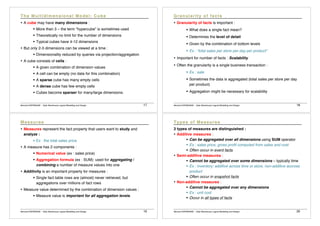
• The Multidimensional Model: fact, measures, dimensions
•
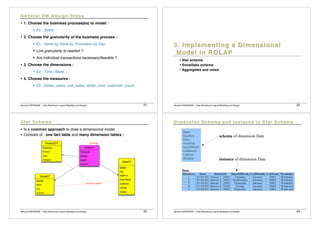
3. Implementing a Dimensional Model in ROLAP
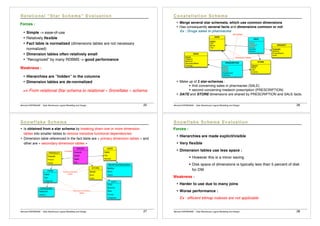
• Star schema
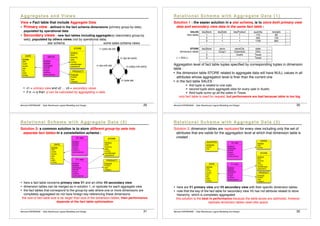
• Snowflake schema
• Aggregates and views
•
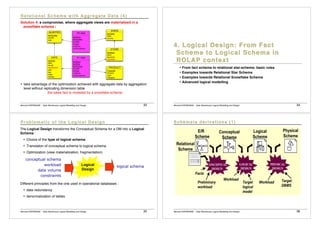
4. Logical Design: From Fact schema to Logical schema in ROLAP context
• From fact schema to relational star-schema: basic rules
• Examples towards Relational Star Schema
• Examples towards Relational Snowflake Schema
• Advanced logical modelling
Bernard ESPINASSE - Data Warehouse Logical Modelling and Design 3
• Livres
• Golfarelli M., Rizzi S., « Data Warehouse Design : Modern Principles and
Methodologies », McGrawHill, 2009.
• Kimball R., Ross, M., « Entrepôts de données : guide pratique de
modélisation dimensionnelle », 2°édition, Ed. Vuibert, 2003, ISBN : 2-
7117-4811-1.
• Franco J-M., « Le Data Warehouse ». Ed. Eyrolles, Paris, 1997. ISBN 2-
212-08956-2.
• Cours
• Course of M. Golfarelli M. and S. Rizzi, University of Bologna
• Course of M. Böhlen and J. Gamper J., Free University of Bolzano
• …
Bernard ESPINASSE - Data Warehouse Logical Modelling and Design 4
• Conceptual Design & Logical Design
• Life-Cycle
• Design Phases
• Schemata derivations
Bernard ESPINASSE - Data Warehouse Logical Modelling and Design 5
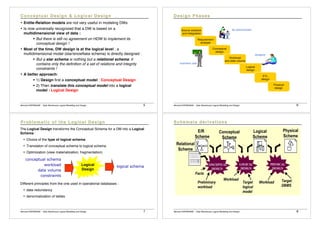
• Entite-Relation models are not very useful in modeling DWs
• Is now universally recognized that a DW is based on a
multidimensional view of data :
! But there is still no agreement on HOW to implement its
conceptual design !
• Most of the time, DW design is at the logical level : a
multidimensional model (star/snowflake schema) is directly designed :
! But a star schema is nothing but a relational schema: it
contains only the definition of a set of relations and integrity
constraints !
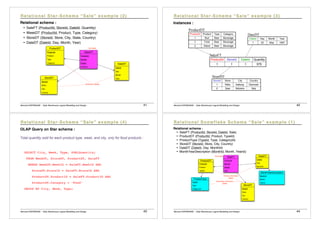
• A better approach:
! 1) Design first a conceptual model : Conceptual Design
! 2) Then translate this conceptual model into a logical
model : Logical Design
Bernard ESPINASSE - Data Warehouse Logical Modelling and Design 6
J. Gamper, Free University of Bolzano, DWDM 2012/13 40
%

0


3

0
'


-2


$

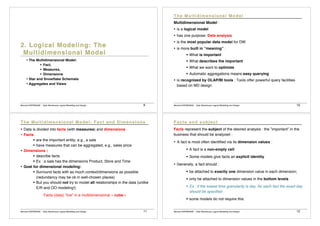
business user
designer
db administrator
!0


Bernard ESPINASSE - Data Warehouse Logical Modelling and Design 7
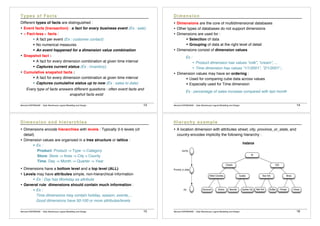
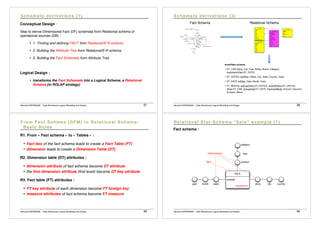
The Logical Design transforms the Conceptual Schema for a DM into a Logical
Schema :
• Choice of the type of logical schema
• Translation of conceptual schema to logical schema
• Optimization (view materialization, fragmentation)
Different principles from the one used in operational databases :
• data redundancy
• denormalization of tables
J. Gamper, Free University of Bolzano, DWDM 2012-13 10
A
6
7
6
1
4
1
5
1
3
4

Data Warehouse Logical Design Guide

  • 1.
    Bernard ESPINASSE -Data Warehouse Logical Modelling and Design 1 Data Warehouse Logical Modeling and Design (6) Bernard ESPINASSE Professeur à Aix-Marseille Université (AMU) Ecole Polytechnique Universitaire de Marseille October 2013 Methodological framework Logical Modeling: The Multidimensional Model Logical Design : From Fact schema to Logical schema in ROLAP context Bernard ESPINASSE - Data Warehouse Logical Modelling and Design 2 1. Methodological Framework • Conceptual Design & Logical Design • Design Phases and schemata derivations 2. Logical Modelling: The Multidimensionnal Model • Problematic of the Logical Design • The Multidimensional Model: fact, measures, dimensions • 3. Implementing a Dimensional Model in ROLAP • Star schema • Snowflake schema • Aggregates and views • 4. Logical Design: From Fact schema to Logical schema in ROLAP context • From fact schema to relational star-schema: basic rules • Examples towards Relational Star Schema • Examples towards Relational Snowflake Schema • Advanced logical modelling Bernard ESPINASSE - Data Warehouse Logical Modelling and Design 3 • Livres • Golfarelli M., Rizzi S., « Data Warehouse Design : Modern Principles and Methodologies », McGrawHill, 2009. • Kimball R., Ross, M., « Entrepôts de données : guide pratique de modélisation dimensionnelle », 2°édition, Ed. Vuibert, 2003, ISBN : 2- 7117-4811-1. • Franco J-M., « Le Data Warehouse ». Ed. Eyrolles, Paris, 1997. ISBN 2- 212-08956-2. • Cours • Course of M. Golfarelli M. and S. Rizzi, University of Bologna • Course of M. Böhlen and J. Gamper J., Free University of Bolzano • … Bernard ESPINASSE - Data Warehouse Logical Modelling and Design 4 • Conceptual Design & Logical Design • Life-Cycle • Design Phases • Schemata derivations
  • 2.
    Bernard ESPINASSE -Data Warehouse Logical Modelling and Design 5 • Entite-Relation models are not very useful in modeling DWs • Is now universally recognized that a DW is based on a multidimensional view of data : ! But there is still no agreement on HOW to implement its conceptual design ! • Most of the time, DW design is at the logical level : a multidimensional model (star/snowflake schema) is directly designed : ! But a star schema is nothing but a relational schema: it contains only the definition of a set of relations and integrity constraints ! • A better approach: ! 1) Design first a conceptual model : Conceptual Design ! 2) Then translate this conceptual model into a logical model : Logical Design Bernard ESPINASSE - Data Warehouse Logical Modelling and Design 6 J. Gamper, Free University of Bolzano, DWDM 2012/13 40
  • 3.
    % 0 3 0 ' -2 $ business user designer db administrator !0 BernardESPINASSE - Data Warehouse Logical Modelling and Design 7 The Logical Design transforms the Conceptual Schema for a DM into a Logical Schema : • Choice of the type of logical schema • Translation of conceptual schema to logical schema • Optimization (view materialization, fragmentation) Different principles from the one used in operational databases : • data redundancy • denormalization of tables J. Gamper, Free University of Bolzano, DWDM 2012-13 10
  • 4.
  • 5.
  • 6.
  • 7.
  • 8.
  • 9.
  • 10.
  • 11.
  • 12.
  • 13.
  • 14.