DATA VIRTUALIZATION PACKED LUNCH
WEBINAR SERIES
Sessions Covering Key Data Integration Challenges
Solved with Data Virtualization
In Memory Parallel Processing for Big
Data Scenarios
Pablo Alvarez-Yanez
Principal Solution Architect, Denodo
Paul Moxon
VP Data Architectures & Chief Evangelist, Denodo
Agenda
1. Modern Data Architecture
2. Denodo Platform – Big Data Integrations
3. Big Data Performance
4. Putting This All Together
5. Q&A
6. Next Steps
The Modern Data Architecture
4
Data Integration – A Modern Data Ecosystem
5
Organizations are Storing More and More Data…
6
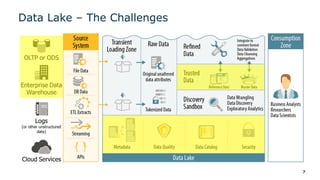
Data Lake – The Challenges
7
8
Big Data & Analytics Reference Architecture
Denodo Platform and
Big Data Integrations
9
Hadoop as a Data Source
10
Denodo offers native connectors for all the
major SQL-on-Hadoop engines:
 Hive
 Impala
 SparkSQL
 Presto
In addition, Denodo also offers connectivity for
HBase and direct HDFS access to different file
formats
Hadoop as a Cache
11
Denodo uses an external RDBMS of your choice to
persist copies of the result sets to improve
execution times
• Since data is persisted in an RDBMS, Denodo can
push down relational operations, like JOINS with
other tables, to the database used for cache
SQL-on-Hadoop systems can also be used as
Denodo’s cache
Cache load process based on direct load to HDFS:
1. Creation of the target table in Cache system
2. Generation of Parquet files (in chunks) with Snappy
compression in the local machine
3. Upload in parallel of Parquet files to HDFS
Hadoop as a Processing Engine
12
Denodo optimizer provides native integration
with MPP systems to provide one extra key
capability: Query Acceleration
Denodo can move, on demand, processing to
the MPP during execution of a query
• Parallel power for calculations in the
virtual layer
• Avoids slow processing in-disk when
processing buffers don’t fit into Denodo’s
memory (swapped data)
Demo
13
14
Combining Denodo’s Optimizer with a Hadoop MPP
Denodo provides the most advanced optimizer in the
market, with techniques focused on data virtualization
scenarios with large data volumes
In addition to traditional Cost Based Optimizations (CBO),
Denodo’s optimizer applies innovative optimization
strategies, designed specifically for virtualized scenarios,
beyond traditional RDBMS optimizatios.
Combined with the tight integration with SQL-on-Hadoop
MPP databases, it creates a very powerful combo
15
Example Scenario
Trend of sales by zip code over the
previous years.
Scenario:
• Current data (last 12 months) in EDW
• Historical data offloaded to Hadoop cluster for
cheaper storage
• Customer master data is used often, so it is
cached in the Hadoop cluster
Very large data volumes:
• Sales tables have hundreds of millions of rows
join
group by ZIP
union
Current Sales
100 million rows
Historical Sales
300 million rows
Customer
2 million rows (cached)
16
Example: What are the options?
1. Option A: Simple Federation in Virtual Layer
• Move hundreds of millions of rows for processing in the virtual layer
2. Option B: Data Shipping
• Move “Current sales” to Hadoop and process content in the cluster
• Moves 100 million rows
3. Option C: Partial Aggregation Pushdown (Denodo 6)
• Modifies the execution tree to split the aggregation in two steps:
1. First by Customer ID for the JOIN (pushed down to source)
2. Second by zip code for the final results (in virtual layer)
• Reduces significantly network traffic but processing of large amount of
data in the virtual layer (aggregation by zip code) becomes the bottleneck
4. Denodo’s MPP Integration (Denodo 7)
Simple Federation
Shipping
join
group by ID
group by ZIP
group by ZIP
join
17
Example: Denodo’s Integration with the Hadoop Ecosystem
2M rows
(sales by customer)
System Execution Time Optimization Techniques
Others ~ 10 min Simple federation
No MPP 43 sec Aggregation push-down
With MPP 11 sec
Aggregation push-down + MPP integration
(Impala 8 nodes)
Current Sales
100 M rows
group by
customer ID1. Partial Aggregation
push down
Maximizes source processing
dramatically Reduces network
traffic
3. On-demand data transfer
Denodo automatically generates
and upload Parquet files
4. Integration with local
and pre-cached data
The engine detects when data
Is cached or comes from a
local table already in the MPP
2. Integrated with Cost Based Optimizer
Based on data volume estimation and
the cost of these particular operations,
the CBO can decide to move all or part
of the execution tree to the MPP
5. Fast parallel execution
Support for Spark, Presto and Impala
For fast analytical processing in
inexpensive Hadoop-based solutions
Hist. Sales
300 M rows
Customer
2 M rows
(cached)
join
group by ZIP
Demo
18
Putting It All Together
19
Putting all the pieces together
20
These three techniques (Hadoop as a data source, cache and
processing engine) can be combined to successfully approach
complex scenarios with big data volumes in an efficient way:
 Surfaces all the company data without the need to replicate
all data to the Hadoop lake
 Improves governance and metadata management to avoid
“data swamps”
 Allows for on-demand combination of real-time (from the
original sources) with historical data (in the cluster)
 Leverages the processing power of the existing cluster
controlled by Denodo’s optimizer
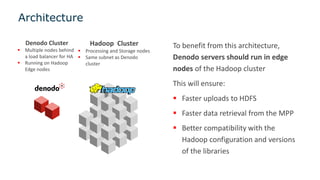
Architecture
21
To benefit from this architecture,
Denodo servers should run in edge
nodes of the Hadoop cluster
This will ensure:
 Faster uploads to HDFS
 Faster data retrieval from the MPP
 Better compatibility with the
Hadoop configuration and versions
of the libraries
Denodo Cluster
 Multiple nodes behind
a load balancer for HA
 Running on Hadoop
Edge nodes
Hadoop Cluster
 Processing and Storage nodes
 Same subnet as Denodo
cluster
Q&A
Next steps
Download Denodo Express:
www.denodoexpress.com
Access Denodo Platform in the Cloud!
30 day FREE trial available!
Denodo for Azure:
www.denodo.com/TrialAzure/PackedLunch
Denodo for AWS: www.denodo.com/TrialAWS/PackedLunch
Next session
Self-Service Information Consumption
Using Data Catalog
Thursday, March 15th, 2018 at 11:00am (PST)
Paul Moxon
VP Data Architectures and Chief Evangelist
Thank you!
© Copyright Denodo Technologies. All rights reserved
Unless otherwise specified, no part of this PDF file may be reproduced or utilized in any for or by any means, electronic or mechanical, including photocopying and
microfilm, without prior the written authorization from Denodo Technologies.

In Memory Parallel Processing for Big Data Scenarios

  • 1.
    DATA VIRTUALIZATION PACKEDLUNCH WEBINAR SERIES Sessions Covering Key Data Integration Challenges Solved with Data Virtualization
  • 2.
    In Memory ParallelProcessing for Big Data Scenarios Pablo Alvarez-Yanez Principal Solution Architect, Denodo Paul Moxon VP Data Architectures & Chief Evangelist, Denodo
  • 3.
    Agenda 1. Modern DataArchitecture 2. Denodo Platform – Big Data Integrations 3. Big Data Performance 4. Putting This All Together 5. Q&A 6. Next Steps
  • 4.
    The Modern DataArchitecture 4
  • 5.
    Data Integration –A Modern Data Ecosystem 5
  • 6.
    Organizations are StoringMore and More Data… 6
  • 7.
    Data Lake –The Challenges 7
  • 8.
    8 Big Data &Analytics Reference Architecture
  • 9.
    Denodo Platform and BigData Integrations 9
  • 10.
    Hadoop as aData Source 10 Denodo offers native connectors for all the major SQL-on-Hadoop engines:  Hive  Impala  SparkSQL  Presto In addition, Denodo also offers connectivity for HBase and direct HDFS access to different file formats
  • 11.
    Hadoop as aCache 11 Denodo uses an external RDBMS of your choice to persist copies of the result sets to improve execution times • Since data is persisted in an RDBMS, Denodo can push down relational operations, like JOINS with other tables, to the database used for cache SQL-on-Hadoop systems can also be used as Denodo’s cache Cache load process based on direct load to HDFS: 1. Creation of the target table in Cache system 2. Generation of Parquet files (in chunks) with Snappy compression in the local machine 3. Upload in parallel of Parquet files to HDFS
  • 12.
    Hadoop as aProcessing Engine 12 Denodo optimizer provides native integration with MPP systems to provide one extra key capability: Query Acceleration Denodo can move, on demand, processing to the MPP during execution of a query • Parallel power for calculations in the virtual layer • Avoids slow processing in-disk when processing buffers don’t fit into Denodo’s memory (swapped data)
  • 13.
  • 14.
    14 Combining Denodo’s Optimizerwith a Hadoop MPP Denodo provides the most advanced optimizer in the market, with techniques focused on data virtualization scenarios with large data volumes In addition to traditional Cost Based Optimizations (CBO), Denodo’s optimizer applies innovative optimization strategies, designed specifically for virtualized scenarios, beyond traditional RDBMS optimizatios. Combined with the tight integration with SQL-on-Hadoop MPP databases, it creates a very powerful combo
  • 15.
    15 Example Scenario Trend ofsales by zip code over the previous years. Scenario: • Current data (last 12 months) in EDW • Historical data offloaded to Hadoop cluster for cheaper storage • Customer master data is used often, so it is cached in the Hadoop cluster Very large data volumes: • Sales tables have hundreds of millions of rows join group by ZIP union Current Sales 100 million rows Historical Sales 300 million rows Customer 2 million rows (cached)
  • 16.
    16 Example: What arethe options? 1. Option A: Simple Federation in Virtual Layer • Move hundreds of millions of rows for processing in the virtual layer 2. Option B: Data Shipping • Move “Current sales” to Hadoop and process content in the cluster • Moves 100 million rows 3. Option C: Partial Aggregation Pushdown (Denodo 6) • Modifies the execution tree to split the aggregation in two steps: 1. First by Customer ID for the JOIN (pushed down to source) 2. Second by zip code for the final results (in virtual layer) • Reduces significantly network traffic but processing of large amount of data in the virtual layer (aggregation by zip code) becomes the bottleneck 4. Denodo’s MPP Integration (Denodo 7) Simple Federation Shipping join group by ID group by ZIP group by ZIP join
  • 17.
    17 Example: Denodo’s Integrationwith the Hadoop Ecosystem 2M rows (sales by customer) System Execution Time Optimization Techniques Others ~ 10 min Simple federation No MPP 43 sec Aggregation push-down With MPP 11 sec Aggregation push-down + MPP integration (Impala 8 nodes) Current Sales 100 M rows group by customer ID1. Partial Aggregation push down Maximizes source processing dramatically Reduces network traffic 3. On-demand data transfer Denodo automatically generates and upload Parquet files 4. Integration with local and pre-cached data The engine detects when data Is cached or comes from a local table already in the MPP 2. Integrated with Cost Based Optimizer Based on data volume estimation and the cost of these particular operations, the CBO can decide to move all or part of the execution tree to the MPP 5. Fast parallel execution Support for Spark, Presto and Impala For fast analytical processing in inexpensive Hadoop-based solutions Hist. Sales 300 M rows Customer 2 M rows (cached) join group by ZIP
  • 18.
  • 19.
    Putting It AllTogether 19
  • 20.
    Putting all thepieces together 20 These three techniques (Hadoop as a data source, cache and processing engine) can be combined to successfully approach complex scenarios with big data volumes in an efficient way:  Surfaces all the company data without the need to replicate all data to the Hadoop lake  Improves governance and metadata management to avoid “data swamps”  Allows for on-demand combination of real-time (from the original sources) with historical data (in the cluster)  Leverages the processing power of the existing cluster controlled by Denodo’s optimizer
  • 21.
    Architecture 21 To benefit fromthis architecture, Denodo servers should run in edge nodes of the Hadoop cluster This will ensure:  Faster uploads to HDFS  Faster data retrieval from the MPP  Better compatibility with the Hadoop configuration and versions of the libraries Denodo Cluster  Multiple nodes behind a load balancer for HA  Running on Hadoop Edge nodes Hadoop Cluster  Processing and Storage nodes  Same subnet as Denodo cluster
  • 22.
  • 23.
    Next steps Download DenodoExpress: www.denodoexpress.com Access Denodo Platform in the Cloud! 30 day FREE trial available! Denodo for Azure: www.denodo.com/TrialAzure/PackedLunch Denodo for AWS: www.denodo.com/TrialAWS/PackedLunch
  • 24.
    Next session Self-Service InformationConsumption Using Data Catalog Thursday, March 15th, 2018 at 11:00am (PST) Paul Moxon VP Data Architectures and Chief Evangelist
  • 25.
    Thank you! © CopyrightDenodo Technologies. All rights reserved Unless otherwise specified, no part of this PDF file may be reproduced or utilized in any for or by any means, electronic or mechanical, including photocopying and microfilm, without prior the written authorization from Denodo Technologies.