Benefits and Uses of a Data
Warehouse:
A Business Perspective
Immediate Access to Information
 Data warehouses shrink the length of time it takes
between when business events occurrence and executive
alert. For example, in many corporations, sales reports are
printed once a month - about a week after the end of each
month. Thus, the June sales reports are delivered during
the first week in July.
 Using a warehouse, those same reports are available on a
daily basis. Given this data delivery time compression,
business decision makers can exploit opportunities that
they would otherwise miss.
Data integration from across, and
even outside, the organization
 To provide a complete picture, warehouses typically
combine data from multiple sources such as a
company's order entry and warranty systems. Thus,
with a warehouse, it may be possible to track all
interactions a company has with each customer -
from that customer's first inquiry, through the terms of
their purchase all the way through any warranty or
service interactions.
 This makes it possible for managers to have answers
to questions like, "Is there a correlation between
where a customer buys our product and the amount
typically spent in supporting that customer?"
Future vision from historical trends
 Effective business analysis frequently
includes trend and seasonality analysis. To
support this, warehouses typically contain
multiple years of data
 Also, warehouses are designed to do time-
based (temporal, longitudinal) analysis
Tools for looking at data in new ways
 Instead of paper reports, warehouses give
users tools for looking at data differently.
They also allow those users to manipulate
their data.
 There are times when a color coded map
speaks volumes over a simple paper report.
 An interactive table that allows the user to drill
down into detail data with the click of a mouse
can answer questions that might take months
to answer in a traditional system.
Freedom from IS department
resource limitations
 One of the problems with computer systems is that they
usually require computer experts to use them.
 When a report is needed, the requesting manager calls
the IS department. IS then assigns a programmer to write
a program to produce the report. The report can be
created in a few days or, in extreme cases, in over a
year.
 With a warehouse, users create most of their reports
themselves. Thus, if a manager needs a report for a
meeting in half an hour, they, or their assistant, can
create that report in a matter of minutes.
DW Applications
 Sales Analysis
 Determine "moment in time" product sales to make vital
pricing and distribution decisions
 Analyze past product sales to determine success or failure
attributes
 Evaluate successful products and determine key success
factors
 Use corporate data to understand the margin as well as the
revenue implications of a decision
 Rapidly identify a preferred customer profile based on
revenue and margin
 Quickly isolate past preferred customers who no longer buy
 Identify daily where product is in the manufacturing and
distribution pipeline
 Instantly determine which salespeople are performing, on
both a revenue and margin basis, and which are behind
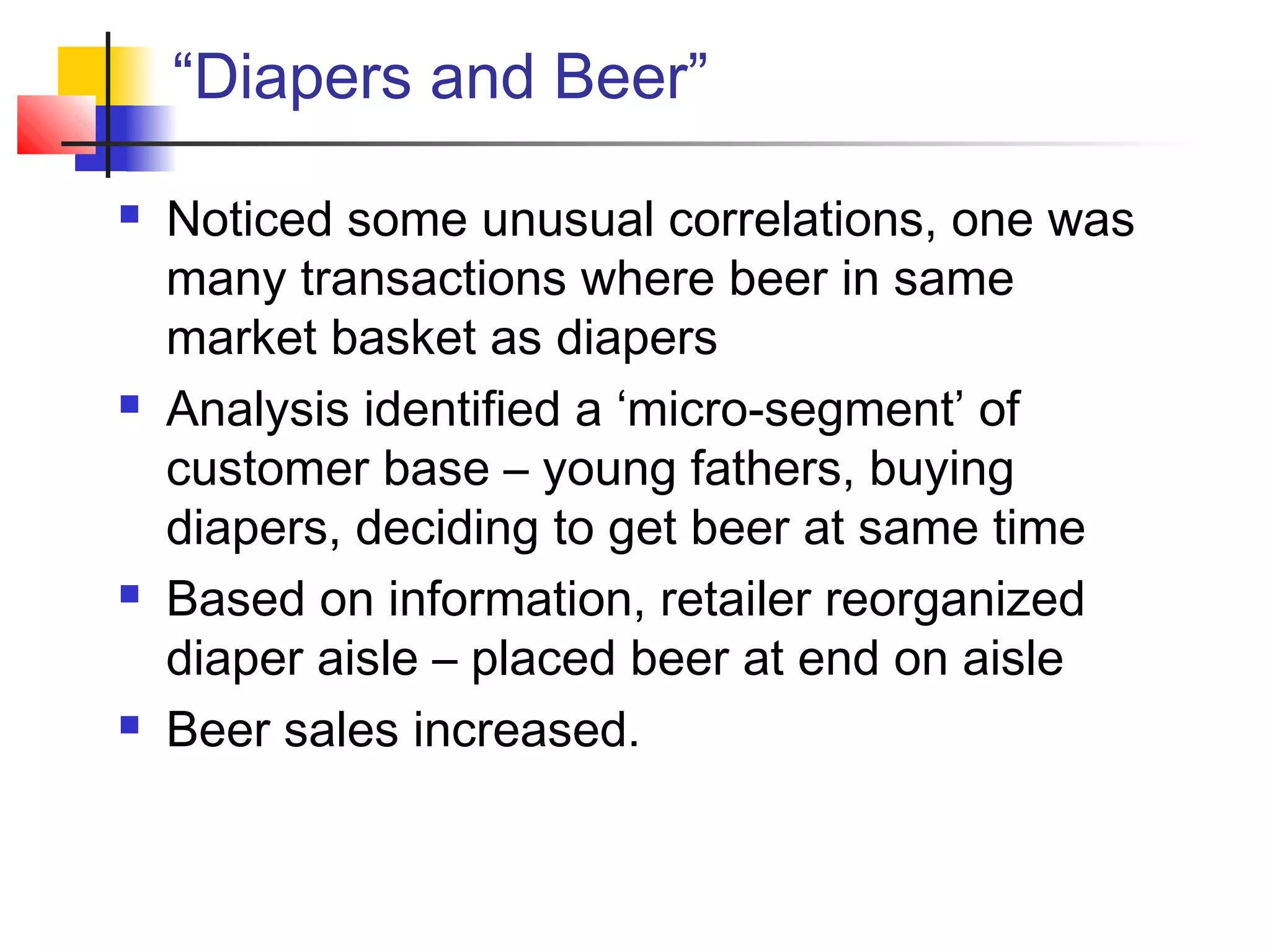
“Diapers and Beer”
 Several years ago, a large retailer
implemented a data warehouse to analyze
sales.
 Loaded huge volumes (Terabytes) of POS
data into the warehouse
 Built an application, based on specialized
‘data mining’ software to perform ‘market
basket analysis’
 What items are purchased with other items in the
same in the same transactions
“Diapers and Beer”
 Noticed some unusual correlations, one was
many transactions where beer in same
market basket as diapers
 Analysis identified a ‘micro-segment’ of
customer base – young fathers, buying
diapers, deciding to get beer at same time
 Based on information, retailer reorganized
diaper aisle – placed beer at end on aisle
 Beer sales increased.
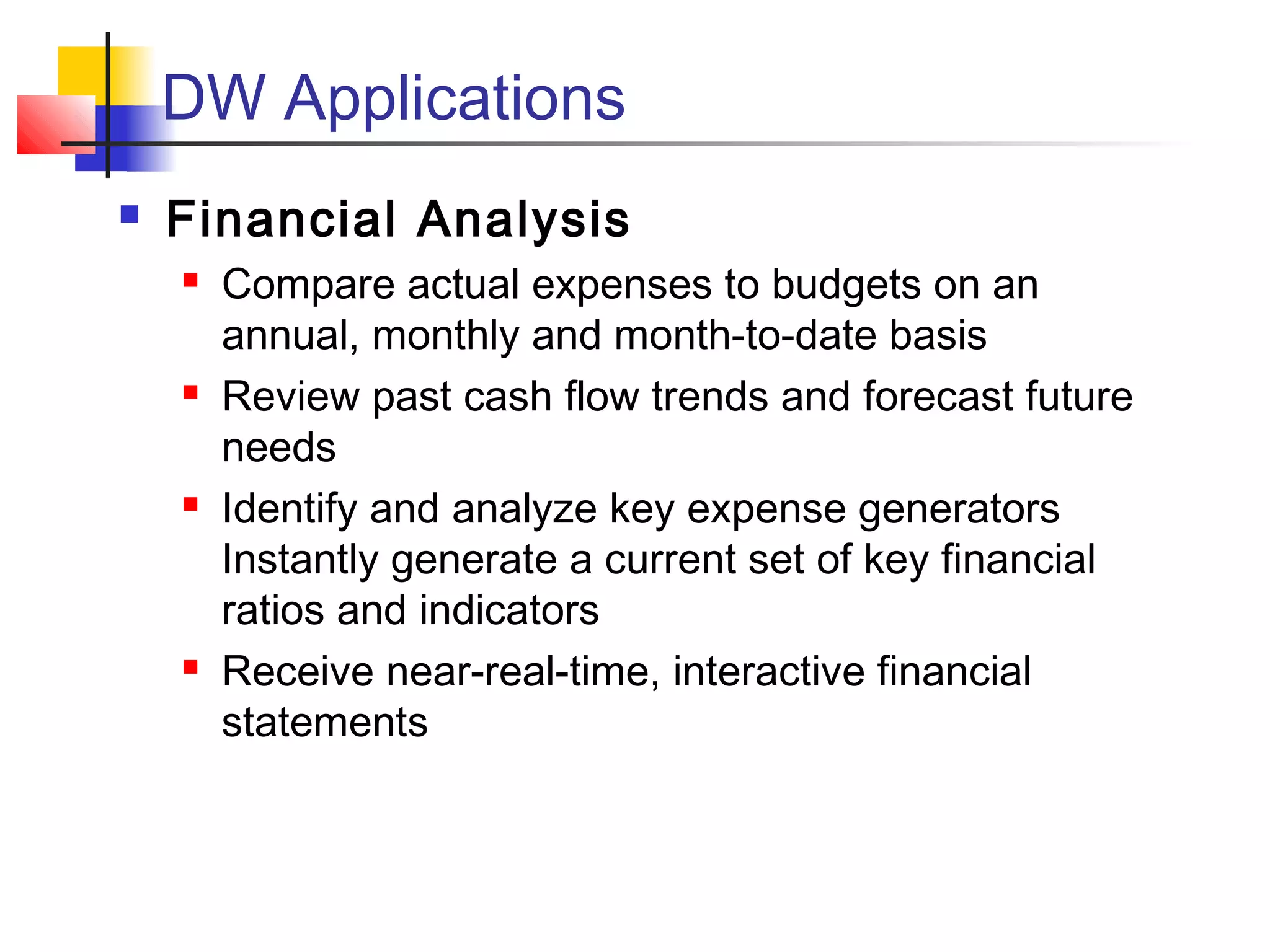
DW Applications
 Financial Analysis
 Compare actual expenses to budgets on an
annual, monthly and month-to-date basis
 Review past cash flow trends and forecast future
needs
 Identify and analyze key expense generators
Instantly generate a current set of key financial
ratios and indicators
 Receive near-real-time, interactive financial
statements
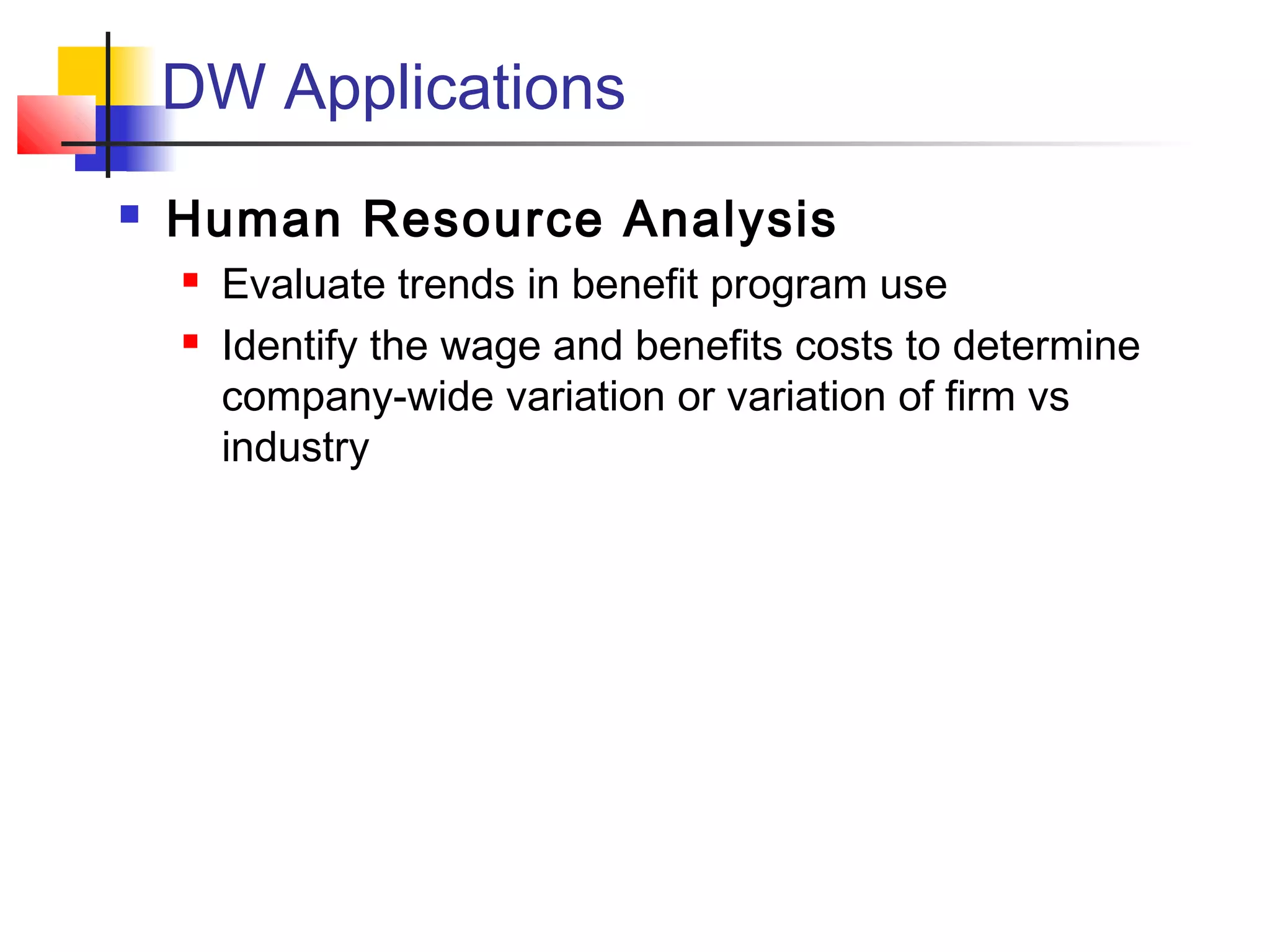
DW Applications
 Human Resource Analysis
 Evaluate trends in benefit program use
 Identify the wage and benefits costs to determine
company-wide variation or variation of firm vs
industry
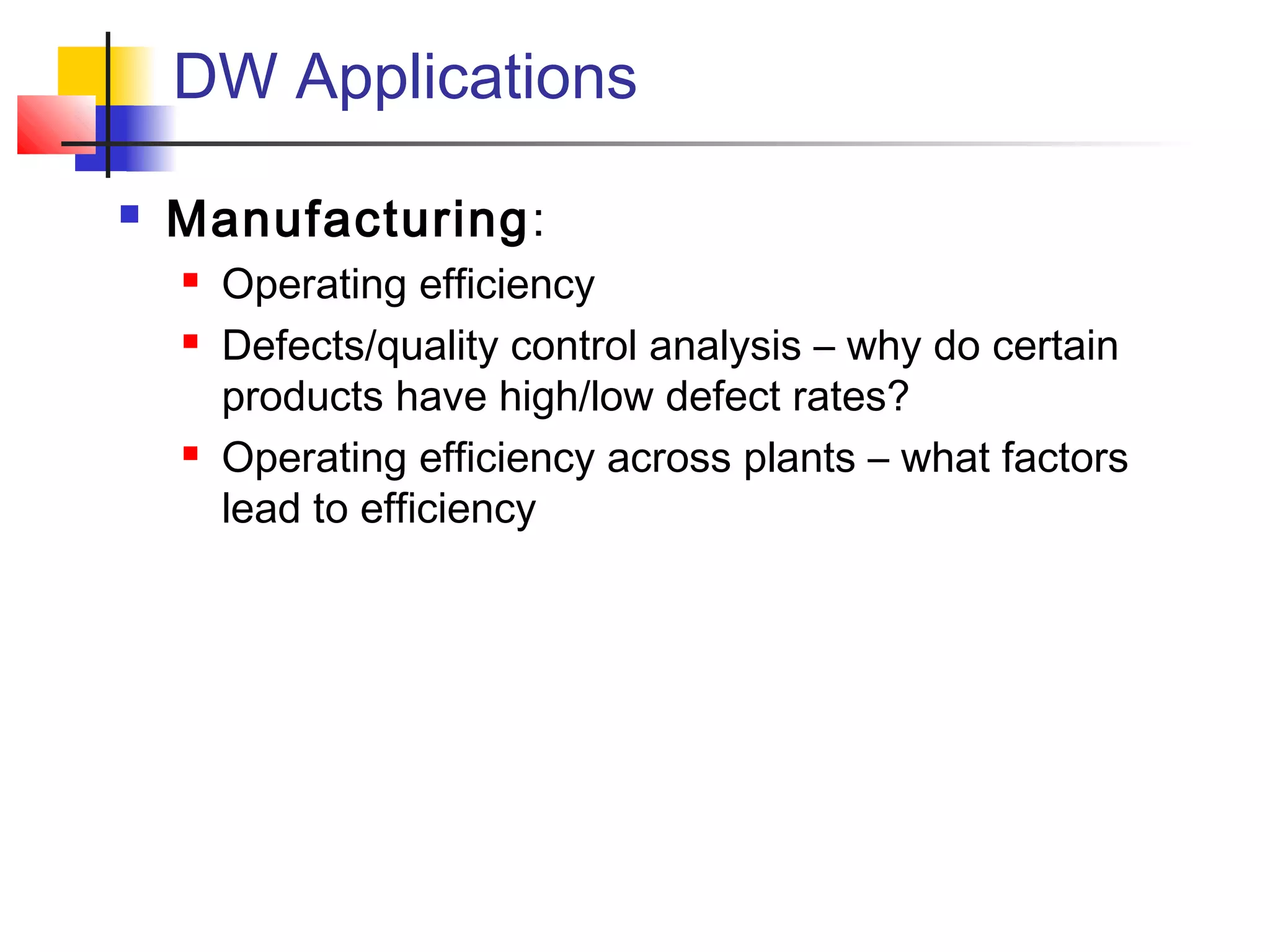
DW Applications
 Manufacturing:
 Operating efficiency
 Defects/quality control analysis – why do certain
products have high/low defect rates?
 Operating efficiency across plants – what factors
lead to efficiency
 Web Analysis
 Analyze traffic on your web site
 Understand what pages are effective, which are
not (e.g., are there certain pages that are viewed
before a sale? Are there pages where viewers get
‘stuck’ and leave the site?
 Understand patterns of behavior – what sequence
of events leads to an abandoned shopping cart?
Are there types of products people will buy on the
web vs those they will not?
DW Applications
Cyberian Outpost
 US-based computer and computer products
retailer.
 Built a website – Outpost.com
 Built a data warehouse to analyze traffic and
purchase behavior on the website
 Analysts using web site began to notice
pattern
 Certain types of products and products that cost
greater than X dollars were often ‘abandoned’.
 Based on this intelligence, Outpost ran a
series of focus groups to understand why
Cyberian Outpost
 Learned that:
 Certain types of customers were afraid to spend
large sums of money on the web.
 These customers would abandon their carts and
call Cyberian Outpost to order the product
 Based on this information, Outpost
redesigned their web site to make it much
easier to call and complete orders. Sales
increased dramatically
DW Applications
 Customer Analysis
 Analyze customer overall customer behavior –
purchases (from across applications), calls for
product service, response to marketing activity,
etc.
 Allows organization to understand who ‘best’
customers are so you can treat them in a special
way to retain them. Also, allows you to identify the
characteristics of your best customers so you can
recruit new customers
 Segment customers
 Predict Customer behavior
Large US Bank
 Had a problem with credit card customer
‘attrition’ – customers leaving the bank for
competitors
 Built a data warehouse and developed a
‘predictive model’ using special statistical
software.
 Looked at the descriptive characteristics and the
behavior of customers who had left the bank in the
past.
 The model was run against data from the
warehouse and was able to identify those
customers who looked like they might leave the
bank.
Large US Bank
 The model was extremely successful. It
would generate lists of ‘good’ customers who
looked like they might leave. The bank would
contact these customers and make special
offers (favorable interest rates, etc.) to keep
them
 Cost of the model: $50,000 - $75,000
 Benefits derived ~ $50,000,0000 per year
A Word on Cost Justification
 Data warehouses provide information that lets
organizations make good decisions that
ultimately provide an ROI.
 However, the data warehouse has virtually no
value unless the intelligence derived is
‘actionable’ – the business can use the
information to effect some change in the
organization
 Therefore:
 Data warehouses need to be integrated, at some
level with business processes within an
organization

Benefits of a data warehouse presentation by Being topper

  • 1.
    Benefits and Usesof a Data Warehouse: A Business Perspective
  • 2.
    Immediate Access toInformation  Data warehouses shrink the length of time it takes between when business events occurrence and executive alert. For example, in many corporations, sales reports are printed once a month - about a week after the end of each month. Thus, the June sales reports are delivered during the first week in July.  Using a warehouse, those same reports are available on a daily basis. Given this data delivery time compression, business decision makers can exploit opportunities that they would otherwise miss.
  • 3.
    Data integration fromacross, and even outside, the organization  To provide a complete picture, warehouses typically combine data from multiple sources such as a company's order entry and warranty systems. Thus, with a warehouse, it may be possible to track all interactions a company has with each customer - from that customer's first inquiry, through the terms of their purchase all the way through any warranty or service interactions.  This makes it possible for managers to have answers to questions like, "Is there a correlation between where a customer buys our product and the amount typically spent in supporting that customer?"
  • 4.
    Future vision fromhistorical trends  Effective business analysis frequently includes trend and seasonality analysis. To support this, warehouses typically contain multiple years of data  Also, warehouses are designed to do time- based (temporal, longitudinal) analysis
  • 5.
    Tools for lookingat data in new ways  Instead of paper reports, warehouses give users tools for looking at data differently. They also allow those users to manipulate their data.  There are times when a color coded map speaks volumes over a simple paper report.  An interactive table that allows the user to drill down into detail data with the click of a mouse can answer questions that might take months to answer in a traditional system.
  • 6.
    Freedom from ISdepartment resource limitations  One of the problems with computer systems is that they usually require computer experts to use them.  When a report is needed, the requesting manager calls the IS department. IS then assigns a programmer to write a program to produce the report. The report can be created in a few days or, in extreme cases, in over a year.  With a warehouse, users create most of their reports themselves. Thus, if a manager needs a report for a meeting in half an hour, they, or their assistant, can create that report in a matter of minutes.
  • 7.
    DW Applications  SalesAnalysis  Determine "moment in time" product sales to make vital pricing and distribution decisions  Analyze past product sales to determine success or failure attributes  Evaluate successful products and determine key success factors  Use corporate data to understand the margin as well as the revenue implications of a decision  Rapidly identify a preferred customer profile based on revenue and margin  Quickly isolate past preferred customers who no longer buy  Identify daily where product is in the manufacturing and distribution pipeline  Instantly determine which salespeople are performing, on both a revenue and margin basis, and which are behind
  • 8.
    “Diapers and Beer” Several years ago, a large retailer implemented a data warehouse to analyze sales.  Loaded huge volumes (Terabytes) of POS data into the warehouse  Built an application, based on specialized ‘data mining’ software to perform ‘market basket analysis’  What items are purchased with other items in the same in the same transactions
  • 9.
    “Diapers and Beer” Noticed some unusual correlations, one was many transactions where beer in same market basket as diapers  Analysis identified a ‘micro-segment’ of customer base – young fathers, buying diapers, deciding to get beer at same time  Based on information, retailer reorganized diaper aisle – placed beer at end on aisle  Beer sales increased.
  • 10.
    DW Applications  FinancialAnalysis  Compare actual expenses to budgets on an annual, monthly and month-to-date basis  Review past cash flow trends and forecast future needs  Identify and analyze key expense generators Instantly generate a current set of key financial ratios and indicators  Receive near-real-time, interactive financial statements
  • 11.
    DW Applications  HumanResource Analysis  Evaluate trends in benefit program use  Identify the wage and benefits costs to determine company-wide variation or variation of firm vs industry
  • 12.
    DW Applications  Manufacturing: Operating efficiency  Defects/quality control analysis – why do certain products have high/low defect rates?  Operating efficiency across plants – what factors lead to efficiency
  • 13.
     Web Analysis Analyze traffic on your web site  Understand what pages are effective, which are not (e.g., are there certain pages that are viewed before a sale? Are there pages where viewers get ‘stuck’ and leave the site?  Understand patterns of behavior – what sequence of events leads to an abandoned shopping cart? Are there types of products people will buy on the web vs those they will not? DW Applications
  • 14.
    Cyberian Outpost  US-basedcomputer and computer products retailer.  Built a website – Outpost.com  Built a data warehouse to analyze traffic and purchase behavior on the website  Analysts using web site began to notice pattern  Certain types of products and products that cost greater than X dollars were often ‘abandoned’.  Based on this intelligence, Outpost ran a series of focus groups to understand why
  • 15.
    Cyberian Outpost  Learnedthat:  Certain types of customers were afraid to spend large sums of money on the web.  These customers would abandon their carts and call Cyberian Outpost to order the product  Based on this information, Outpost redesigned their web site to make it much easier to call and complete orders. Sales increased dramatically
  • 16.
    DW Applications  CustomerAnalysis  Analyze customer overall customer behavior – purchases (from across applications), calls for product service, response to marketing activity, etc.  Allows organization to understand who ‘best’ customers are so you can treat them in a special way to retain them. Also, allows you to identify the characteristics of your best customers so you can recruit new customers  Segment customers  Predict Customer behavior
  • 17.
    Large US Bank Had a problem with credit card customer ‘attrition’ – customers leaving the bank for competitors  Built a data warehouse and developed a ‘predictive model’ using special statistical software.  Looked at the descriptive characteristics and the behavior of customers who had left the bank in the past.  The model was run against data from the warehouse and was able to identify those customers who looked like they might leave the bank.
  • 18.
    Large US Bank The model was extremely successful. It would generate lists of ‘good’ customers who looked like they might leave. The bank would contact these customers and make special offers (favorable interest rates, etc.) to keep them  Cost of the model: $50,000 - $75,000  Benefits derived ~ $50,000,0000 per year
  • 19.
    A Word onCost Justification  Data warehouses provide information that lets organizations make good decisions that ultimately provide an ROI.  However, the data warehouse has virtually no value unless the intelligence derived is ‘actionable’ – the business can use the information to effect some change in the organization  Therefore:  Data warehouses need to be integrated, at some level with business processes within an organization