DW 102 : The Business Dimensional Life Cycle ™
Objective To explain a methodology of designing, developing and deploying a data warehouse In a way that everyone involved in the data warehouse project have common understanding about the methodology So that the data warehouse project team can effectively use the methodology
Acknowledgement This presentation is summarized from the second chapter of ‘The data warehouse lifecycle toolkit : expert methods for designing, developing, and deploying data warehouses’ by Ralph Kimball and others.
The Business Dimensional Lifecycle “ Successful implementation of a data warehouse depends on the appropriate integration of numerous tasks and components.” “ The Business Dimensional Lifecycle is similar to the conductor’s score. It ensures that the project pieces are brought together in the right order and at the right time.”
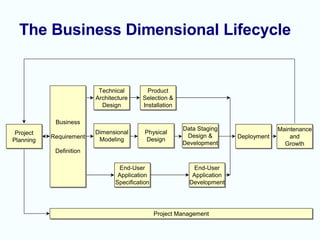
The Business Dimensional Lifecycle
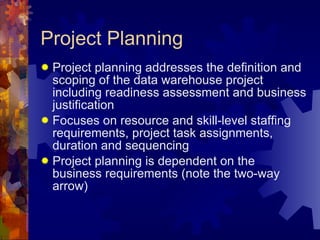
Project Planning Project planning addresses the definition and scoping of the data warehouse project including readiness assessment and business justification Focuses on resource and skill-level staffing requirements, project task assignments, duration and sequencing Project planning is dependent on the business requirements (note the two-way arrow)
Business Requirements Definition The better understanding of business user requirements, the greater chance of successful data warehouse The approach used to gather knowledge workers’ analytic requirements differs significantly from more traditional, data-driven requirements analysis. The business requirements establish the foundation for the tree parallel tracks focused on technology, data and end user applications
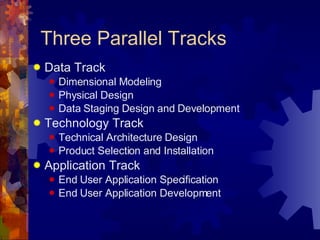
Three Parallel Tracks Data Track Dimensional Modeling Physical Design Data Staging Design and Development Technology Track Technical Architecture Design Product Selection and Installation Application Track End User Application Specification End User Application Development
Dimensional Modeling Designing data model to support business analyses requires a different approach than that used for operational systems design Begin by constructing a matrix that represents key business processes and their dimensionality From there, conduct a more detailed data analysis of relevant operational source systems Then develop a dimensional model, in which identifies the fact table grain, associated dimensions, attributes, and hierarchical drill paths
Physical Design Focuses on the physical structures necessary to support the logical design Include as well defining naming standards and setting up the database environment Preliminary indexing and partitioning strategies are also determined
Data Staging Design and Development Typically the most underestimated data warehouse project task Consist of three major steps: extraction, transformation, and load The extract process always exposes data quality issues in operational source systems These data quality issues have to be addressed during data staging Two staging processes are required, one for initial population and the other for the on-going
Technical Architecture Design Data warehouse requires the integration of numerous technologies Key consideration factors Business requirements Current technical environment Planned strategic technical directions
Product Selection and Installation Using the technical architecture as framework Standard technical evaluation processes along with specific evaluation factors for each architecture component have to be defined After selection and installation, a thoroughly tested is required to ensure appropriate end-to-end integration
End User Application Specification Defining a set of standard end user applications rather than single application Application specifications describe the report template, user driven parameters, and required calculations These specifications ensure that the development team and business users have a common understanding of the application to be delivered
End User Application Development The development involves configuring the tool meta data and constructing specified reports Applications could be built using an advanced data access tool that provide significant productivity gains Using advanced data access tool also offers a powerful mechanism for business users to easily modify existing report templates
Deployment Deployment represents the convergence of technology, data and end user applications Extensive planning is required Business user education is very important User support, communication process, and feedback strategies should be establish before user access to data warehouse Deployment should be deferred if all the pieces are not ready for release
Maintenance and Growth Focus attention on backroom to ensure the reliable ongoing operation of the warehouse Acceptance and performance metrics should be measured over time and logged to support marketing of data warehouse Changes should be viewed as a sign of success, not failure Prioritization processes should be establish to deal with additional demands After priorities are identified, go back to beginning of the lifecycle
Project Management Focus on monitoring project status, issue tracking, and change control Ongoing communication is absolutely critical

Data Warehouse 102

  • 1.
    DW 102 :The Business Dimensional Life Cycle ™
  • 2.
    Objective To explaina methodology of designing, developing and deploying a data warehouse In a way that everyone involved in the data warehouse project have common understanding about the methodology So that the data warehouse project team can effectively use the methodology
  • 3.
    Acknowledgement This presentationis summarized from the second chapter of ‘The data warehouse lifecycle toolkit : expert methods for designing, developing, and deploying data warehouses’ by Ralph Kimball and others.
  • 4.
    The Business DimensionalLifecycle “ Successful implementation of a data warehouse depends on the appropriate integration of numerous tasks and components.” “ The Business Dimensional Lifecycle is similar to the conductor’s score. It ensures that the project pieces are brought together in the right order and at the right time.”
  • 5.
  • 6.
    Project Planning Projectplanning addresses the definition and scoping of the data warehouse project including readiness assessment and business justification Focuses on resource and skill-level staffing requirements, project task assignments, duration and sequencing Project planning is dependent on the business requirements (note the two-way arrow)
  • 7.
    Business Requirements DefinitionThe better understanding of business user requirements, the greater chance of successful data warehouse The approach used to gather knowledge workers’ analytic requirements differs significantly from more traditional, data-driven requirements analysis. The business requirements establish the foundation for the tree parallel tracks focused on technology, data and end user applications
  • 8.
    Three Parallel TracksData Track Dimensional Modeling Physical Design Data Staging Design and Development Technology Track Technical Architecture Design Product Selection and Installation Application Track End User Application Specification End User Application Development
  • 9.
    Dimensional Modeling Designingdata model to support business analyses requires a different approach than that used for operational systems design Begin by constructing a matrix that represents key business processes and their dimensionality From there, conduct a more detailed data analysis of relevant operational source systems Then develop a dimensional model, in which identifies the fact table grain, associated dimensions, attributes, and hierarchical drill paths
  • 10.
    Physical Design Focuseson the physical structures necessary to support the logical design Include as well defining naming standards and setting up the database environment Preliminary indexing and partitioning strategies are also determined
  • 11.
    Data Staging Designand Development Typically the most underestimated data warehouse project task Consist of three major steps: extraction, transformation, and load The extract process always exposes data quality issues in operational source systems These data quality issues have to be addressed during data staging Two staging processes are required, one for initial population and the other for the on-going
  • 12.
    Technical Architecture DesignData warehouse requires the integration of numerous technologies Key consideration factors Business requirements Current technical environment Planned strategic technical directions
  • 13.
    Product Selection andInstallation Using the technical architecture as framework Standard technical evaluation processes along with specific evaluation factors for each architecture component have to be defined After selection and installation, a thoroughly tested is required to ensure appropriate end-to-end integration
  • 14.
    End User ApplicationSpecification Defining a set of standard end user applications rather than single application Application specifications describe the report template, user driven parameters, and required calculations These specifications ensure that the development team and business users have a common understanding of the application to be delivered
  • 15.
    End User ApplicationDevelopment The development involves configuring the tool meta data and constructing specified reports Applications could be built using an advanced data access tool that provide significant productivity gains Using advanced data access tool also offers a powerful mechanism for business users to easily modify existing report templates
  • 16.
    Deployment Deployment representsthe convergence of technology, data and end user applications Extensive planning is required Business user education is very important User support, communication process, and feedback strategies should be establish before user access to data warehouse Deployment should be deferred if all the pieces are not ready for release
  • 17.
    Maintenance and GrowthFocus attention on backroom to ensure the reliable ongoing operation of the warehouse Acceptance and performance metrics should be measured over time and logged to support marketing of data warehouse Changes should be viewed as a sign of success, not failure Prioritization processes should be establish to deal with additional demands After priorities are identified, go back to beginning of the lifecycle
  • 18.
    Project Management Focuson monitoring project status, issue tracking, and change control Ongoing communication is absolutely critical