
Humanizing
Big Data
Colin Strong
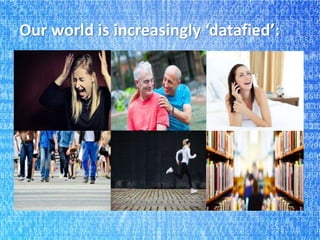
Our world is increasingly ‘datafied’:
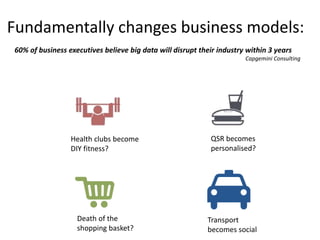
Fundamentally changes business models:
Health clubs become
DIY fitness?
Death of the
shopping basket?
QSR becomes
personalised?
Transport
becomes social
60% of business executives believe big data will disrupt their industry within 3 years
Capgemini Consulting
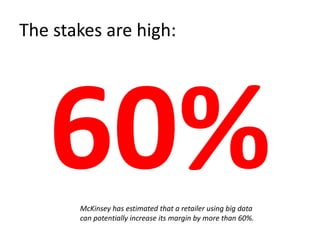
The stakes are high:
McKinsey has estimated that a retailer using big data
can potentially increase its margin by more than 60%.
Fuelling a technology arms race:
AT Kearney forecast
value of big data tech
market will be $114B
by 2018
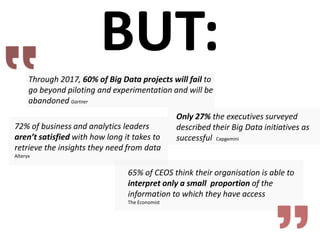
BUT:
Through 2017, 60% of Big Data projects will fail to
go beyond piloting and experimentation and will be
abandoned Gartner
72% of business and analytics leaders
aren’t satisfied with how long it takes to
retrieve the insights they need from data
Alteryx
65% of CEOS think their organisation is able to
interpret only a small proportion of the
information to which they have access
The Economist
Only 27% the executives surveyed
described their Big Data initiatives as
successful Capgemini
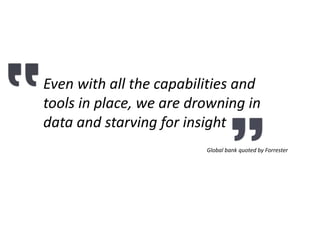
Even with all the capabilities and
tools in place, we are drowning in
data and starving for insight
Global bank quoted by Forrester
Some of the solution is organisational:
Scattered data lying in silos across the organisation
Absence of a clear business case for funding &
implementation
Ineffective co-ordination of big data and analytics
teams across the business
Dependence on legacy systems for data processing
and management
Sourced from Cracking the Data Conundrum : Capgemini Consulting
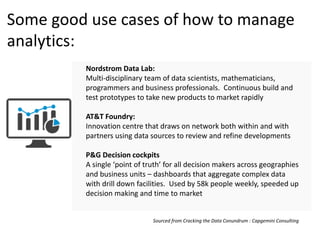
Some good use cases of how to manage
analytics:
Nordstrom Data Lab:
Multi-disciplinary team of data scientists, mathematicians,
programmers and business professionals. Continuous build and
test prototypes to take new products to market rapidly
AT&T Foundry:
Innovation centre that draws on network both within and with
partners using data sources to review and refine developments
P&G Decision cockpits
A single ‘point of truth’ for all decision makers across geographies
and business units – dashboards that aggregate complex data
with drill down facilities. Used by 58k people weekly, speeded up
decision making and time to market
Sourced from Cracking the Data Conundrum : Capgemini Consulting
The numbers have no way of speaking for
themselves. We speak for them. We imbue them
with meaning. Before we demand more of our
data, we need to demand more of ourselves.
Nate Silver
But is this enough?
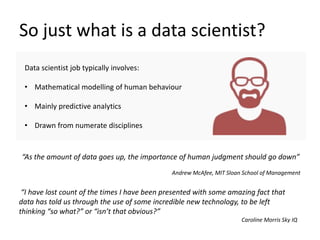
So just what is a data scientist?
Data scientist job typically involves:
• Mathematical modelling of human behaviour
• Mainly predictive analytics
• Drawn from numerate disciplines
“As the amount of data goes up, the importance of human judgment should go down”
Andrew McAfee, MIT Sloan School of Management
“I have lost count of the times I have been presented with some amazing fact that
data has told us through the use of some incredible new technology, to be left
thinking “so what?” or “isn’t that obvious?”
Caroline Morris Sky IQ
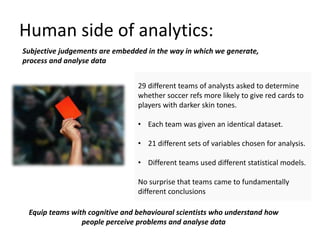
Human side of analytics:
29 different teams of analysts asked to determine
whether soccer refs more likely to give red cards to
players with darker skin tones.
• Each team was given an identical dataset.
• 21 different sets of variables chosen for analysis.
• Different teams used different statistical models.
No surprise that teams came to fundamentally
different conclusions
Subjective judgements are embedded in the way in which we generate,
process and analyse data
Equip teams with cognitive and behavioural scientists who understand how
people perceive problems and analyse data
Separating the signal from the noise:
Our predictions may be more prone to failure in the era of Big Data
• In a big data world statistical significance is no a longer
reliable means of discrimination
• Modellers and statisticians may well be ‘getting it wrong’
• Studies suggest that as much as 90% of published medical
information that doctors rely on is flawed
Marketing & consumer insights need to be embedded in the team to disentangle
signal from noise
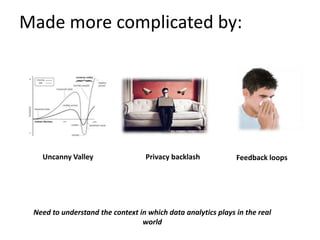
Made more complicated by:
Privacy backlashUncanny Valley
Need to understand the context in which data analytics plays in the real
world
Feedback loops
Measurement of outcomes:
Challenges in determining
attribution of advertising effect:
• Advertising blocking
• Advertising fraud
• Teasing apart background from
campaign effects
• Teasing apart retargeting
outcomes
The story the data
tells us is often the
one we’d like to
hear, and we
usually make sure
that it has a happy
ending
67% of business executives do not have well defined criteria to measure the success
for their big data initiatives
Capgemini Consulting
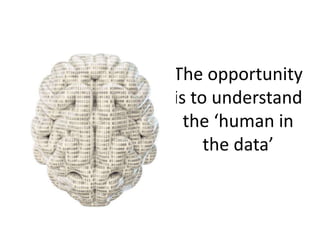
The opportunity
is to understand
the ‘human in
the data’
A more rounded view of the consumer:
SCVs are often limited to the brands’ data assets & data brokers
Help brands by:
• Identifying new sources
• Doing due diligence on the data assets
• Integrating (at a consumer level)
• Identifying value exchange for
consumers
Rapidly emerging personal data economy creates opportunities and
threats for brands
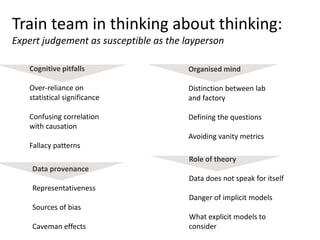
Train team in thinking about thinking:
Expert judgement as susceptible as the layperson
Cognitive pitfalls
Over-reliance on
statistical significance
Confusing correlation
with causation
Fallacy patterns
Role of theory
Data does not speak for itself
Danger of implicit models
What explicit models to
consider
Organised mind
Distinction between lab
and factory
Defining the questions
Avoiding vanity metrics
Data provenance
Representativeness
Sources of bias
Caveman effects
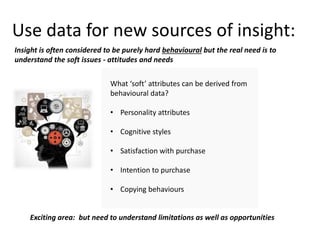
Use data for new sources of insight:
What ‘soft’ attributes can be derived from
behavioural data?
• Personality attributes
• Cognitive styles
• Satisfaction with purchase
• Intention to purchase
• Copying behaviours
Insight is often considered to be purely hard behavioural but the real need is to
understand the soft issues - attitudes and needs
Exciting area: but need to understand limitations as well as opportunities
Closing thoughts:
• Technology and organisation investment a necessary but
not sufficient condition for successful data analytics
• Explore how the right value exchange can enrich your
customer view
• Understand the consumer context of how you use customer
data
• Recognise and address human strengths and fallibilities in
big data analytics
• Involve marketers and insight professionals as part of core
team
Thank you:
Drop me a line:
@colinstrong
colinstrong@addverve.com

Does big data = big insights?

  • 1.
  • 2.
    Our world isincreasingly ‘datafied’:
  • 3.
    Fundamentally changes businessmodels: Health clubs become DIY fitness? Death of the shopping basket? QSR becomes personalised? Transport becomes social 60% of business executives believe big data will disrupt their industry within 3 years Capgemini Consulting
  • 4.
    The stakes arehigh: McKinsey has estimated that a retailer using big data can potentially increase its margin by more than 60%.
  • 5.
    Fuelling a technologyarms race: AT Kearney forecast value of big data tech market will be $114B by 2018
  • 6.
    BUT: Through 2017, 60%of Big Data projects will fail to go beyond piloting and experimentation and will be abandoned Gartner 72% of business and analytics leaders aren’t satisfied with how long it takes to retrieve the insights they need from data Alteryx 65% of CEOS think their organisation is able to interpret only a small proportion of the information to which they have access The Economist Only 27% the executives surveyed described their Big Data initiatives as successful Capgemini
  • 7.
    Even with allthe capabilities and tools in place, we are drowning in data and starving for insight Global bank quoted by Forrester
  • 8.
    Some of thesolution is organisational: Scattered data lying in silos across the organisation Absence of a clear business case for funding & implementation Ineffective co-ordination of big data and analytics teams across the business Dependence on legacy systems for data processing and management Sourced from Cracking the Data Conundrum : Capgemini Consulting
  • 9.
    Some good usecases of how to manage analytics: Nordstrom Data Lab: Multi-disciplinary team of data scientists, mathematicians, programmers and business professionals. Continuous build and test prototypes to take new products to market rapidly AT&T Foundry: Innovation centre that draws on network both within and with partners using data sources to review and refine developments P&G Decision cockpits A single ‘point of truth’ for all decision makers across geographies and business units – dashboards that aggregate complex data with drill down facilities. Used by 58k people weekly, speeded up decision making and time to market Sourced from Cracking the Data Conundrum : Capgemini Consulting
  • 10.
    The numbers haveno way of speaking for themselves. We speak for them. We imbue them with meaning. Before we demand more of our data, we need to demand more of ourselves. Nate Silver But is this enough?
  • 11.
    So just whatis a data scientist? Data scientist job typically involves: • Mathematical modelling of human behaviour • Mainly predictive analytics • Drawn from numerate disciplines “As the amount of data goes up, the importance of human judgment should go down” Andrew McAfee, MIT Sloan School of Management “I have lost count of the times I have been presented with some amazing fact that data has told us through the use of some incredible new technology, to be left thinking “so what?” or “isn’t that obvious?” Caroline Morris Sky IQ
  • 12.
    Human side ofanalytics: 29 different teams of analysts asked to determine whether soccer refs more likely to give red cards to players with darker skin tones. • Each team was given an identical dataset. • 21 different sets of variables chosen for analysis. • Different teams used different statistical models. No surprise that teams came to fundamentally different conclusions Subjective judgements are embedded in the way in which we generate, process and analyse data Equip teams with cognitive and behavioural scientists who understand how people perceive problems and analyse data
  • 13.
    Separating the signalfrom the noise: Our predictions may be more prone to failure in the era of Big Data • In a big data world statistical significance is no a longer reliable means of discrimination • Modellers and statisticians may well be ‘getting it wrong’ • Studies suggest that as much as 90% of published medical information that doctors rely on is flawed Marketing & consumer insights need to be embedded in the team to disentangle signal from noise
  • 14.
    Made more complicatedby: Privacy backlashUncanny Valley Need to understand the context in which data analytics plays in the real world Feedback loops
  • 15.
    Measurement of outcomes: Challengesin determining attribution of advertising effect: • Advertising blocking • Advertising fraud • Teasing apart background from campaign effects • Teasing apart retargeting outcomes The story the data tells us is often the one we’d like to hear, and we usually make sure that it has a happy ending 67% of business executives do not have well defined criteria to measure the success for their big data initiatives Capgemini Consulting
  • 16.
    The opportunity is tounderstand the ‘human in the data’
  • 17.
    A more roundedview of the consumer: SCVs are often limited to the brands’ data assets & data brokers Help brands by: • Identifying new sources • Doing due diligence on the data assets • Integrating (at a consumer level) • Identifying value exchange for consumers Rapidly emerging personal data economy creates opportunities and threats for brands
  • 18.
    Train team inthinking about thinking: Expert judgement as susceptible as the layperson Cognitive pitfalls Over-reliance on statistical significance Confusing correlation with causation Fallacy patterns Role of theory Data does not speak for itself Danger of implicit models What explicit models to consider Organised mind Distinction between lab and factory Defining the questions Avoiding vanity metrics Data provenance Representativeness Sources of bias Caveman effects
  • 19.
    Use data fornew sources of insight: What ‘soft’ attributes can be derived from behavioural data? • Personality attributes • Cognitive styles • Satisfaction with purchase • Intention to purchase • Copying behaviours Insight is often considered to be purely hard behavioural but the real need is to understand the soft issues - attitudes and needs Exciting area: but need to understand limitations as well as opportunities
  • 20.
    Closing thoughts: • Technologyand organisation investment a necessary but not sufficient condition for successful data analytics • Explore how the right value exchange can enrich your customer view • Understand the consumer context of how you use customer data • Recognise and address human strengths and fallibilities in big data analytics • Involve marketers and insight professionals as part of core team
  • 21.
    Thank you: Drop mea line: @colinstrong colinstrong@addverve.com