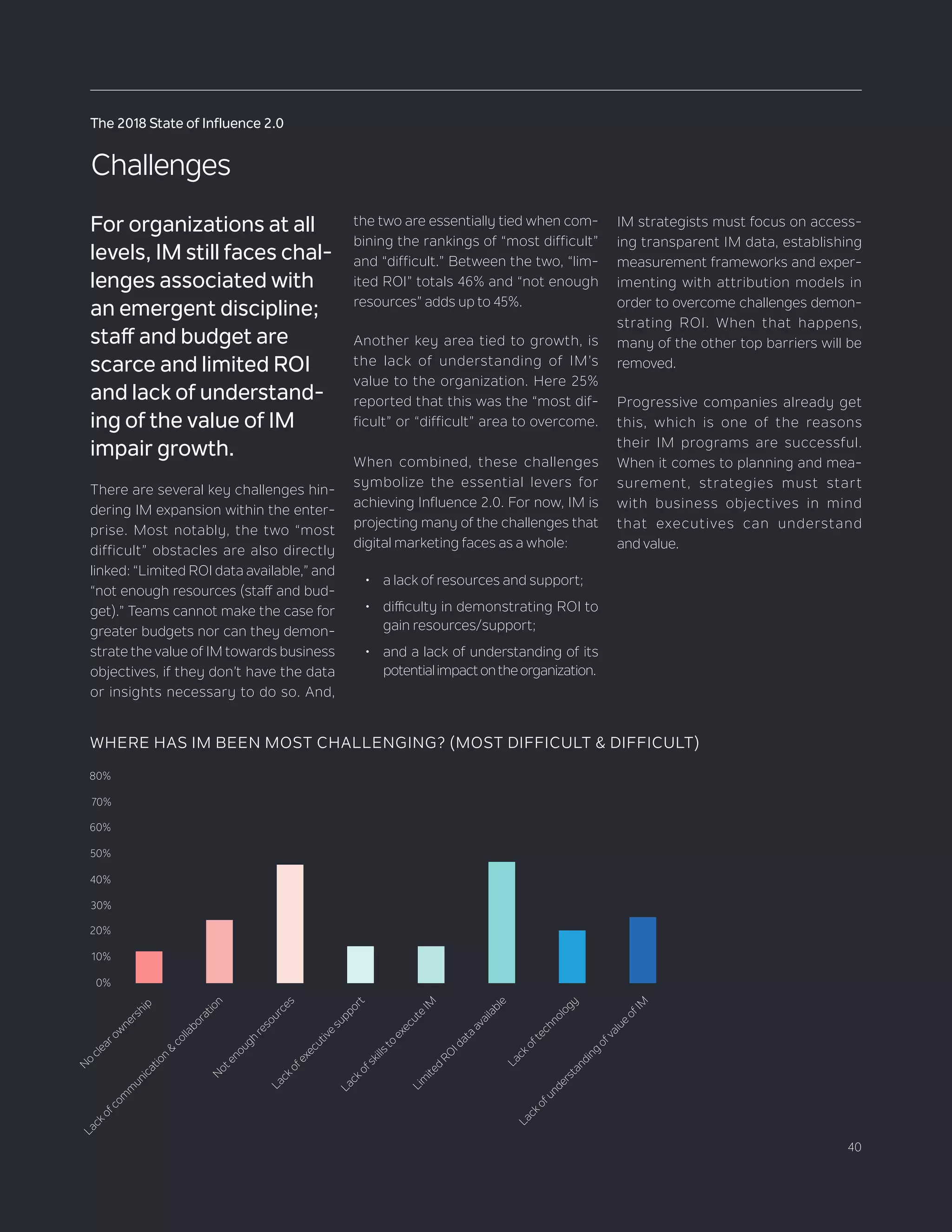
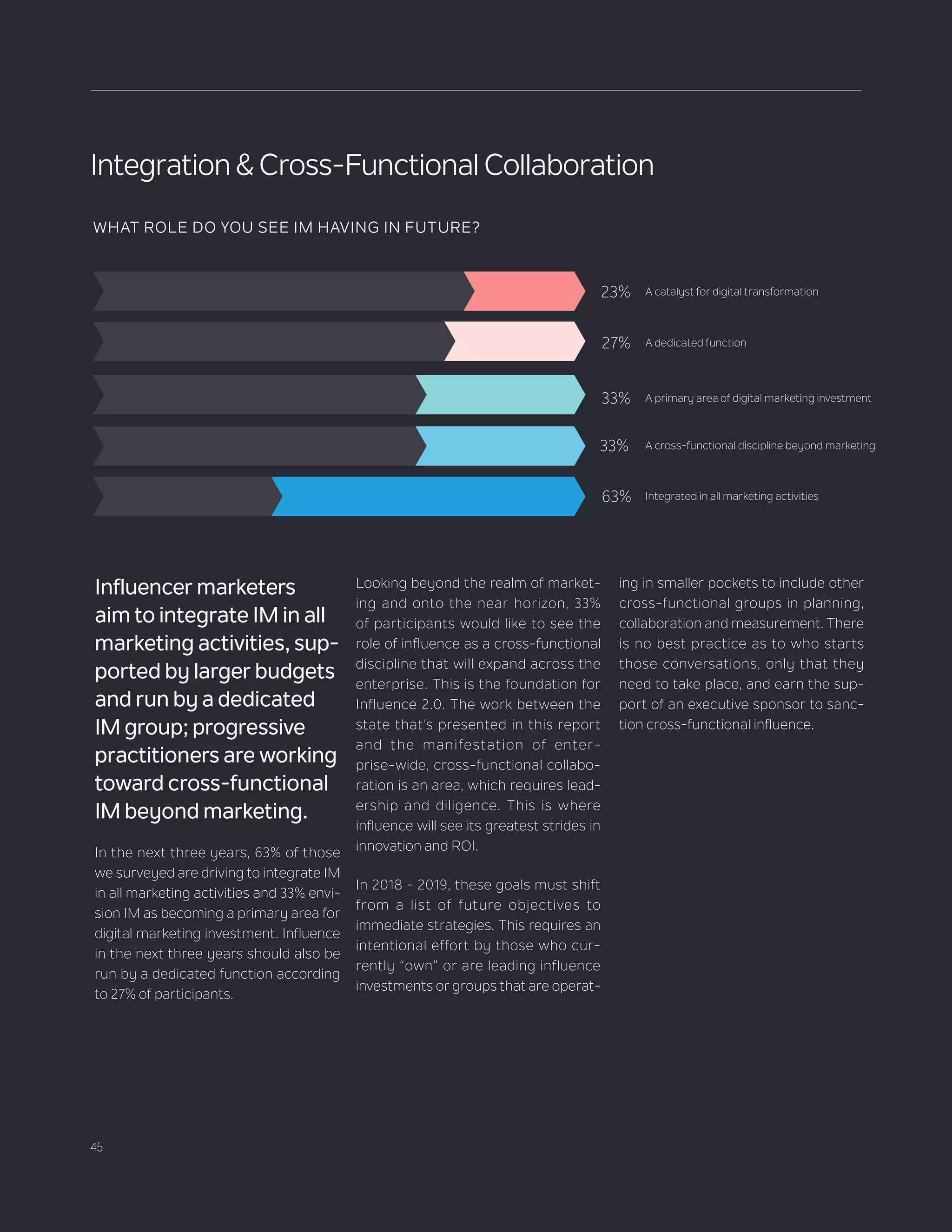
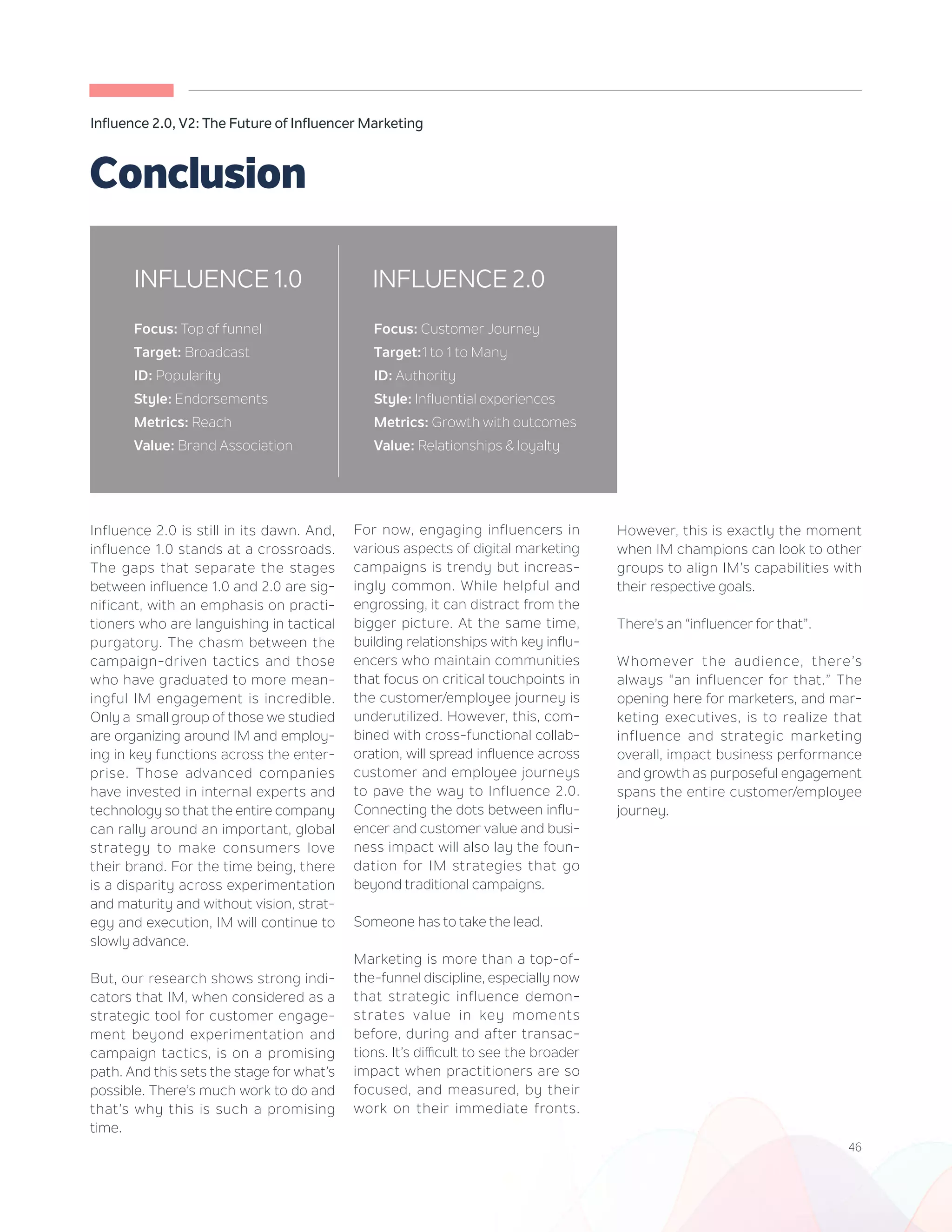
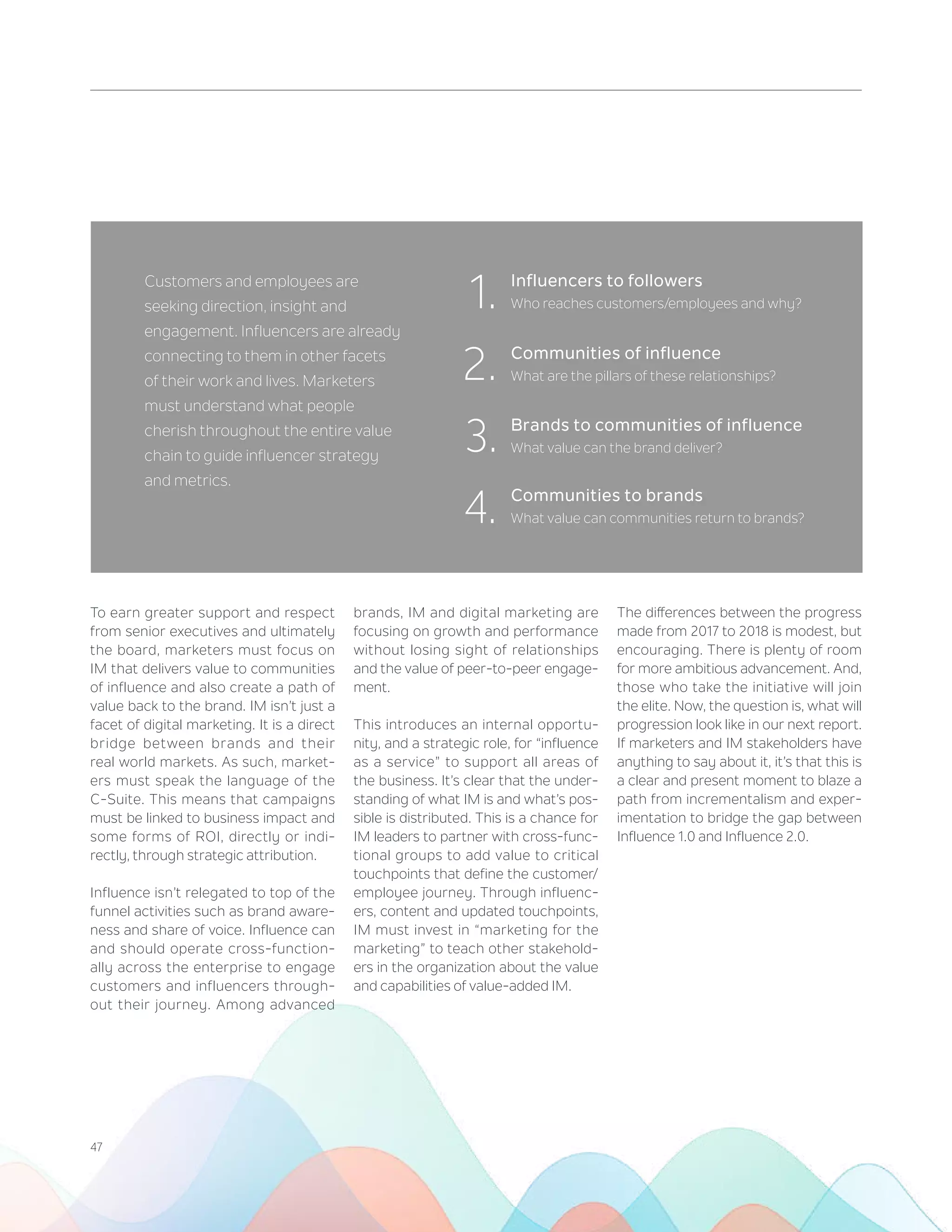
1
The 2018
State of Influence
Sometimes the best way to change the future is
to change your perception of what’s possible.
BY BRIAN SOLIS
Sponsored by Traackr
2
Altimeter, a Prophet company, is a research and strat-
egy consulting firm that helps companies understand
and take advantage of digital disruption. In 2015, Prophet
acquired Altimeter Group to bring forward-thinking digi-
tal research and strategy consulting together under one
umbrella, and to help clients unlock the power of digital
transformation. Altimeter, founded in 2008 by bestsell-
ing author Charlene Li, focuses on research in digital
transformation, social business and governance, cus-
tomer experience, big data, and content strategy.
Traackr builds Influencer Relationship Management
(IRM) technology that enables brands to effectively
manage, measure and scale influencer strategies, while
maintaining authenticity. This gives CMOs and their
teams the ability to align influencers along the customer
journey, impacting buying decisions at each moment-
of-truth with trustworthy touch points. Traackr’s SaaS
platform powers leading influencer programs for B2B
and B2C global enterprises such as L’Oréal, The Coca
Cola Company, Samsung, Microsoft, Intel, SAP, Orange,
USAA, Merck, Roche and Capital One.
Traackr
We would like to thank our
agency partners that have
helped us gather survey results:
3
4
THE STATE OF INFLUENCE 2.0 :
18 MONTHS LATER
31
6
CROSSING THE INFLUENCER
MARKETING CHASM
46
CONCLUSION &
METHODOLOGY
41
THE PATH TO
INFLUENCE 2.0
48
ABOUT
BRIAN SOLIS
TableofContents
4
The 2018 State of Influence 2.0
Welcome to a new era of marketing;
an era where brands are shaped by
the people who experience them. In a
world where most consumers are con-
nected, the experiences that they have
and share online collectively shape
their perceptions, impressions and
actions. To a certain extent, all con-
nected consumers are becoming influ-
ential in their own ways.
When customers or employees need
information, direction or meaningful
engagement, they go to the people
they trust. As most consumers live in
digital or mobile-first worlds, their net-
works of trusted authorities and peers
reflect personal and professional inter-
ests. Many go online first to make deci-
sions and seek the guidance of their
networks. And at the same time, many
spend hours a day online and, in those
moments, they are open to relevant
engagement by the people they follow
or those whom their friends follow.
Influence has never been more import-
ant. Every year, global communica-
tions marketing firm Edelman pub-
lishes its “Trust Barometer” report
that captures the sentiment of trust in
a variety of industries and scenarios.
In its 2017 edition1
, Edelman learned
that the credibility of CEOs was at its
lowest level ever. At the same time,
the report found that trust in peers,
or “a person like yourself,” is as cred-
ible a source of information about a
company as a technical or academic
expert. Without trust, brand market-
ing may fall upon skeptical, distrusting
or altogether inattentive audiences.
By partnering with the right influenc-
ers, or people who tell the right stories
in the right context by delivering value
at each step, brands can reach people
through those they trust while earning
trust in the process.
Introduction
5
In 2017, I partnered with influencer
relationship management (IRM) soft-
ware provider Traackr to study the
state of digital influence. We observed
that influencer marketing (IM), at large,
is one of the most promising and still
underutilized disciplines in the digital
marketing mix. To help, we introduced
“Influence 2.0,” a new paradigm for
digital influence that focuses on peer-
to-peer engagement, beyond word
of mouth, to add value to customer/
employee experiences throughout
their journey — beyond marketing.
Influence 2.0 represents a significant
shift from everyday IM and marketing
in general, to a more human-centered
genre of influencer and community
relations.
Strategic and thoughtful influence
offers the ability to directly reach
desired markets through the peers
they admire, respect and trust, using
their native connection and commu-
nication methods. IM as we know it
today however, extended traditional
marketing approaches to new chan-
nels through new voices. Public/media
relations, broadcast marketing, celeb-
rity endorsements, et al., plugged
influencers into campaigns and exper-
imental pilots to amplify content and
messages through their followers and
vibrant communities.
Influence 2.0 creates a pivotal moment
for marketing and for brands. It shifts
from one-to-many and many-to-
many models of the past to a one-to-
one-to-many approach focused not
only on delivering important informa-
tion, creating awareness about a topic
or driving desired outcomes, but also
on engaging people (brand, influenc-
ers and community) in ways that are
mutually beneficial and builds trust
between people and brands where tra-
ditional marketing erodes it.
We are not there yet, but digital influ-
ence is making progress. This year,
we set out to survey the landscape of
more than 100 digital marketers once
again to track the state and evolu-
tion of Influence 2.0. In this report, we
will also share trends, challenges and
opportunities to help marketers fur-
ther make the case for Influence 2.0
and shift to peer-to-peer influencer
relations.
The Rise Of Influence 2.0
66
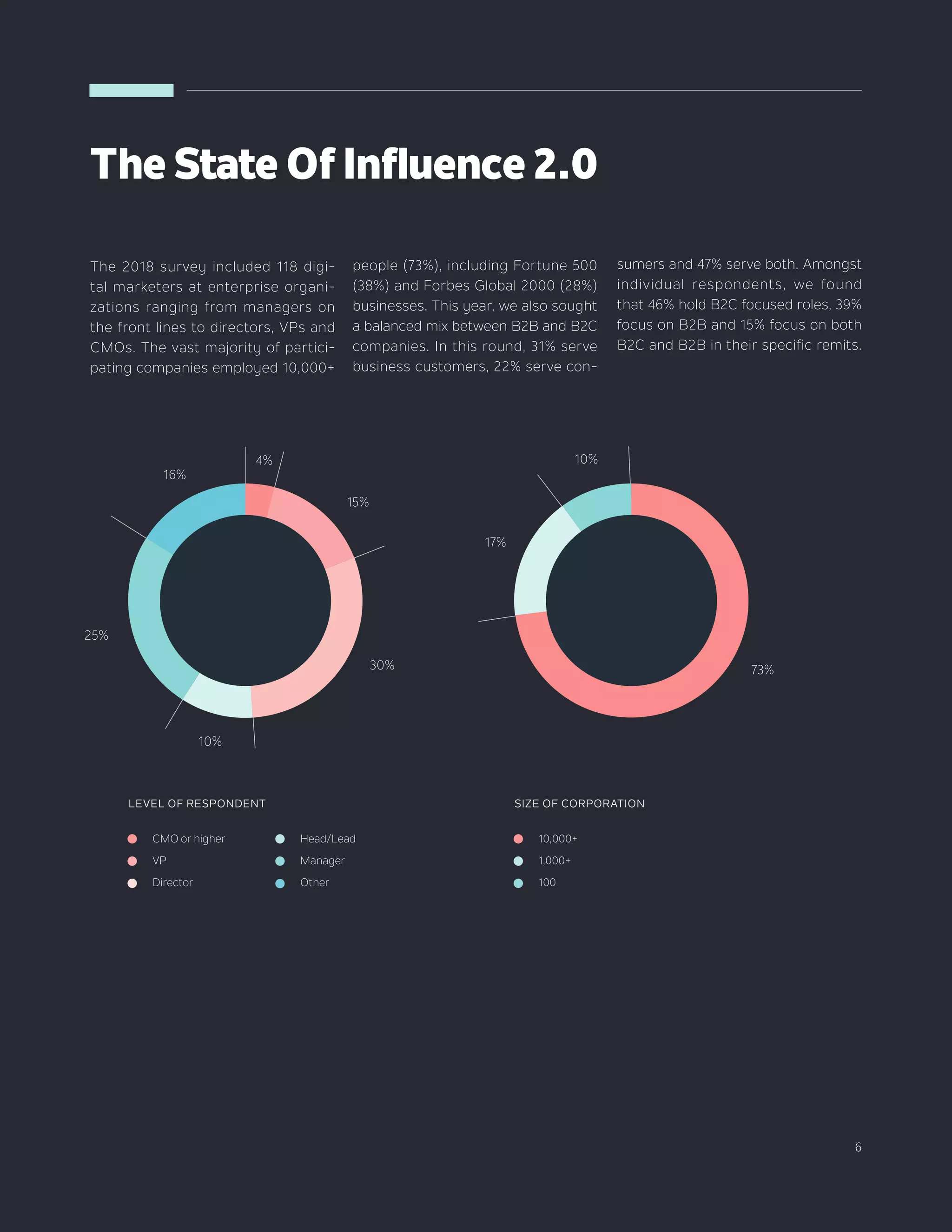
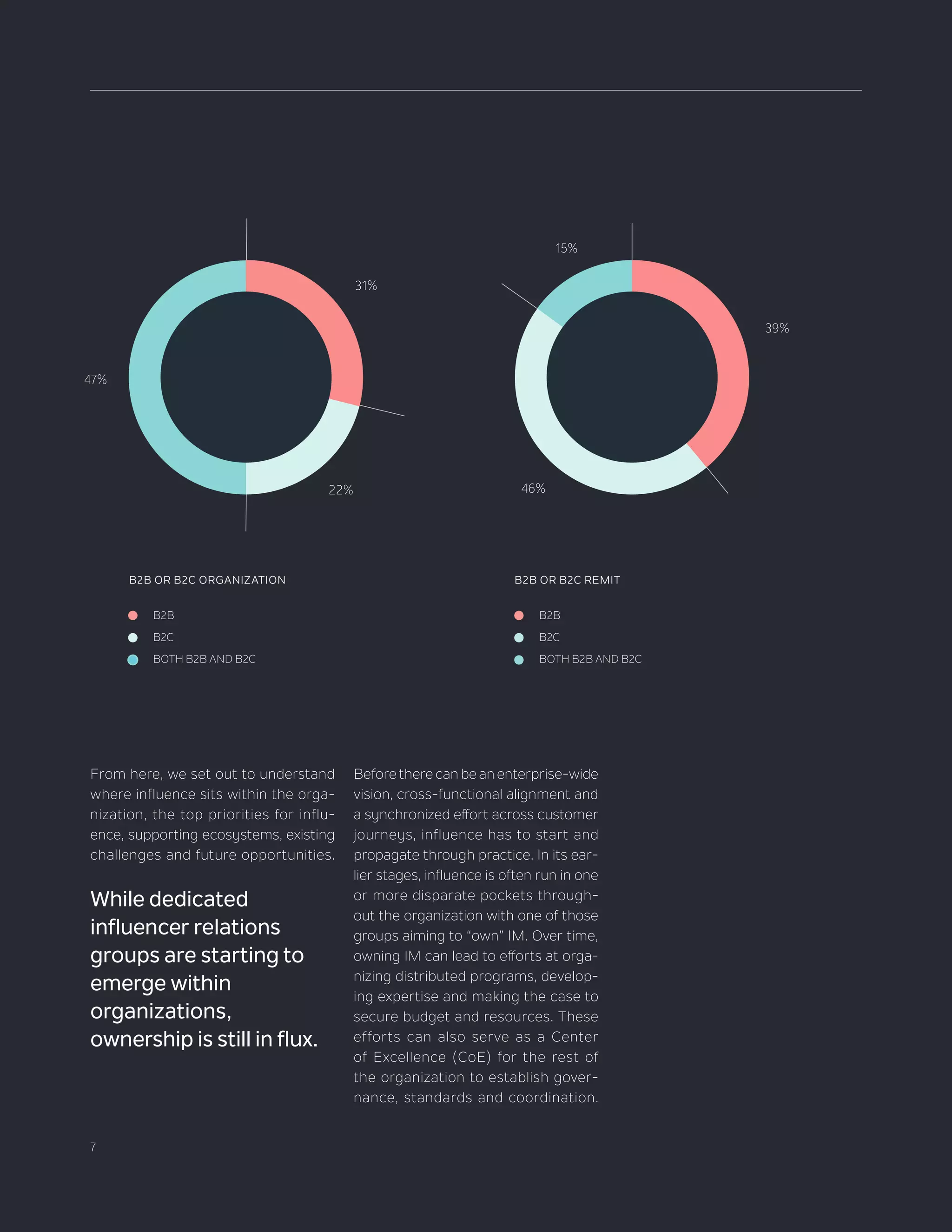
The 2018 survey included 118 digi-
tal marketers at enterprise organi-
zations ranging from managers on
the front lines to directors, VPs and
CMOs. The vast majority of partici-
pating companies employed 10,000+
people (73%), including Fortune 500
(38%) and Forbes Global 2000 (28%)
businesses. This year, we also sought
a balanced mix between B2B and B2C
companies. In this round, 31% serve
business customers, 22% serve con-
sumers and 47% serve both. Amongst
individual respondents, we found
that 46% hold B2C focused roles, 39%
focus on B2B and 15% focus on both
B2C and B2B in their specific remits.
TheStateOfInfluence2.0
CMO or higher
VP
Director
10,000+
1,000+
100
Head/Lead
Manager
Other
LEVEL OF RESPONDENT SIZE OF CORPORATION
73+17+10+L4+15+30+10+25+16+L
10%
73%
17%
4%
15%
30%
10%
25%
16%
77
B2B
B2C
BOTH B2B AND B2C
B2B OR B2C ORGANIZATION B2B OR B2C REMIT
From here, we set out to understand
where influence sits within the orga-
nization, the top priorities for influ-
ence, supporting ecosystems, existing
challenges and future opportunities.
While dedicated
influencer relations
groups are starting to
emerge within
organizations,
ownership is still in flux.
Before there can be an enterprise-wide
vision, cross-functional alignment and
a synchronized effort across customer
journeys, influence has to start and
propagate through practice. In its ear-
lier stages, influence is often run in one
or more disparate pockets through-
out the organization with one of those
groups aiming to “own” IM. Over time,
owning IM can lead to efforts at orga-
nizing distributed programs, develop-
ing expertise and making the case to
secure budget and resources. These
efforts can also serve as a Center
of Excellence (CoE) for the rest of
the organization to establish gover-
nance, standards and coordination.
B2B
B2C
BOTH B2B AND B2C
39+46+15+L29+21+50+L
15%
39%
46%
47%
31%
22%
8
The 2018 State of Influence 2.0
2%
2%
2%
43%
27%
14% 10%
2+10+2+43+27+2+14+L7%
31%
17%
28%
3%
18%
18%
42%
36%
4%4%
4%
24%
4%
60%
3+7+42+31+17+L 4+4+60+24+4+4+L 18+18+36+28+L
OWNERSHIP CROSSED WITH B2C OWNERSHIP CROSSED WITH B2B OWNERSHIP FOR BOTH B2B & B2C
Customer Care
Digital
Influencer Relations
Marketing
PR/Comms
Sales
Social Media
Who Owns Influencer Marketing?
Customer Care
Digital
Marketing
Digital
Influencer Relations
Marketing
PR/Comms
Social Media
PR/Comms
Sales
Social Media
Digital
Social Media
Marketing
PR/Comms
“Now Marketing has to meet
PR! With Influencer Marketing,
companies cannot separate
anymore marketing from PR.”
NICOLAS BORDAS,
VP International,
TBWAWorldwide
InfluencerMarketingSponsorship
9
“Organizations need
to implement the
appropriate standards,
workflows and
technologies to ensure
every member of their
team adopts a consistent
approach to influencer
outreach and relationship
management.
Establishing a global
center of excellence to
define a common set of
IM standards that your
local teams can tailor for
their country or region is
critical for success.”
JOEL BACKALER,
Author of Digital Influence &
MD at Frontier Strategy Group
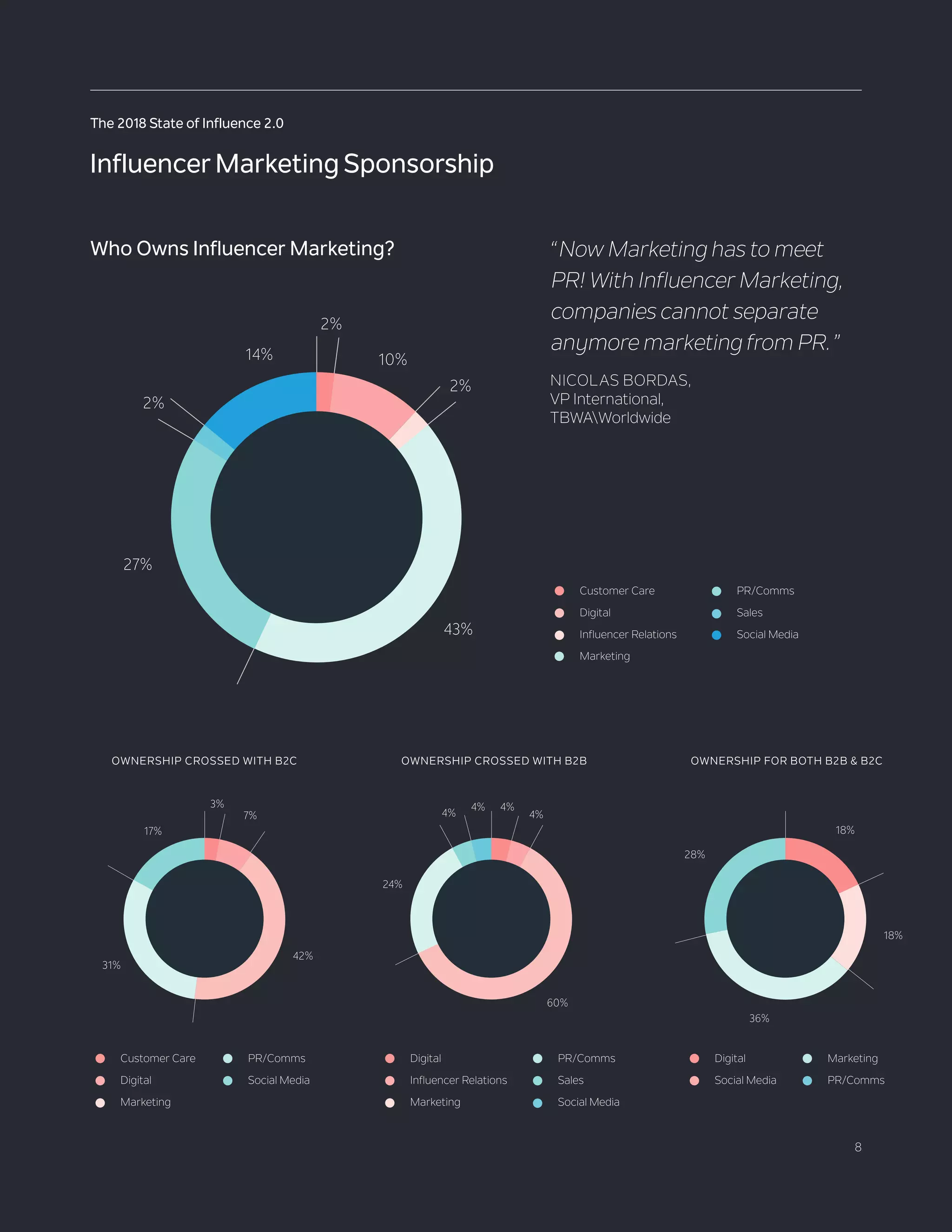
In this year’s research, we found that
marketing continues to maintain own-
ership of IM at 43%. However, this num-
ber has decreased from 70% in 2017. This
means that ownership is spread much
wider across the organization this year.
The broader distribution of ownership
could be a sign of heightened focus on
IM rather than an afterthought.
Public relations (PR) is now the sec-
ond most cited leadership group for
IM at 28%, jumping from 16% last year.
There’s also a noteworthy addition this
year — the rise of a dedicated depart-
ment for IM. While just a blip compared
to the other groups, it is a significant
entry in the fact that influencer rela-
tions indicate the potential formaliza-
tion of a CoE or internal strategic con-
sultancy or agency.
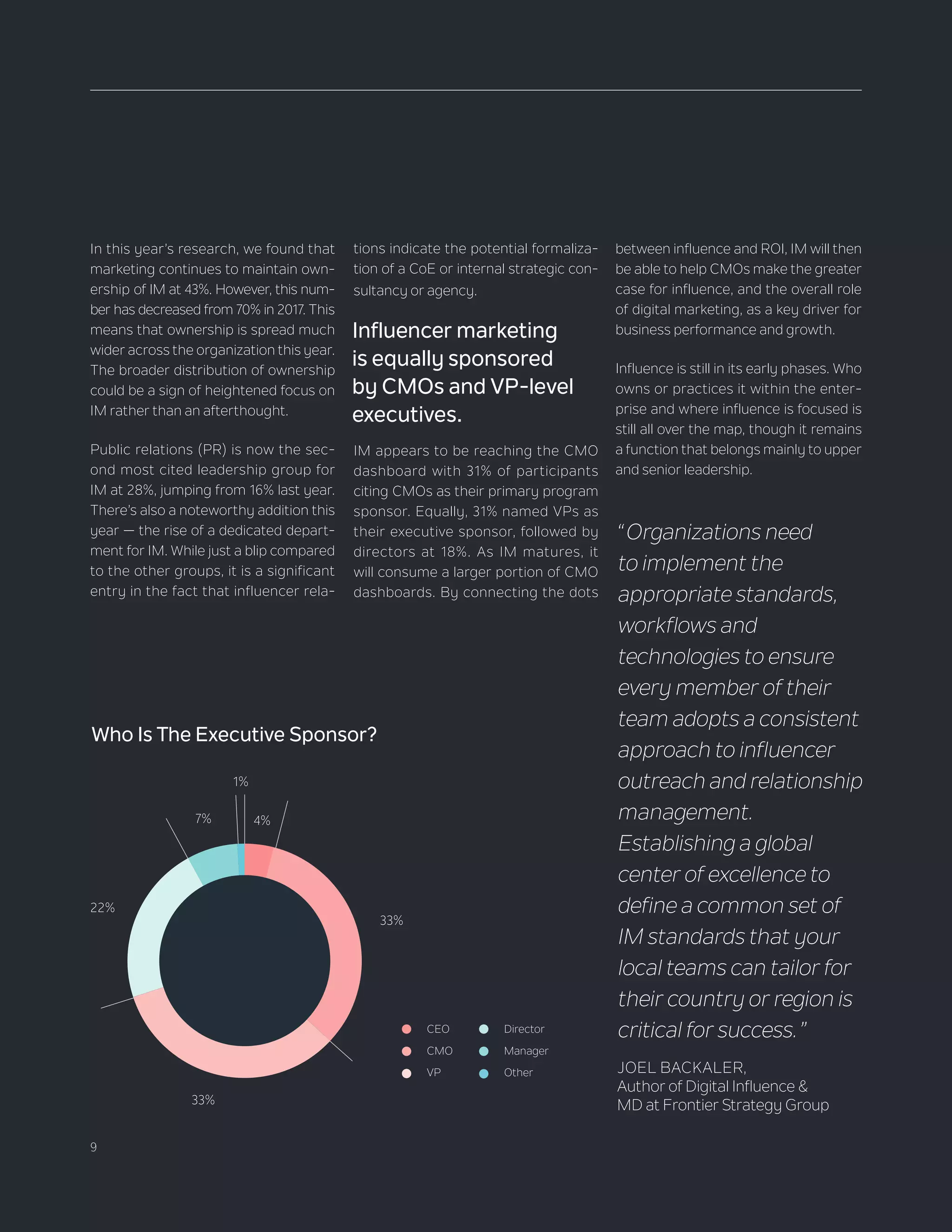
IM appears to be reaching the CMO
dashboard with 31% of participants
citing CMOs as their primary program
sponsor. Equally, 31% named VPs as
their executive sponsor, followed by
directors at 18%. As IM matures, it
will consume a larger portion of CMO
dashboards. By connecting the dots
between influence and ROI, IM will then
be able to help CMOs make the greater
case for influence, and the overall role
of digital marketing, as a key driver for
business performance and growth.
Influence is still in its early phases. Who
owns or practices it within the enter-
prise and where influence is focused is
still all over the map, though it remains
a function that belongs mainly to upper
and senior leadership.
Director
Manager
Other
Who Is The Executive Sponsor?
CEO
CMO
VP4+33+33+22+7+1+L
4%
1%
33%
33%
22%
7%
Influencer marketing
is equally sponsored
by CMOs and VP-level
executives.
10
The 2018 State of Influence 2.0
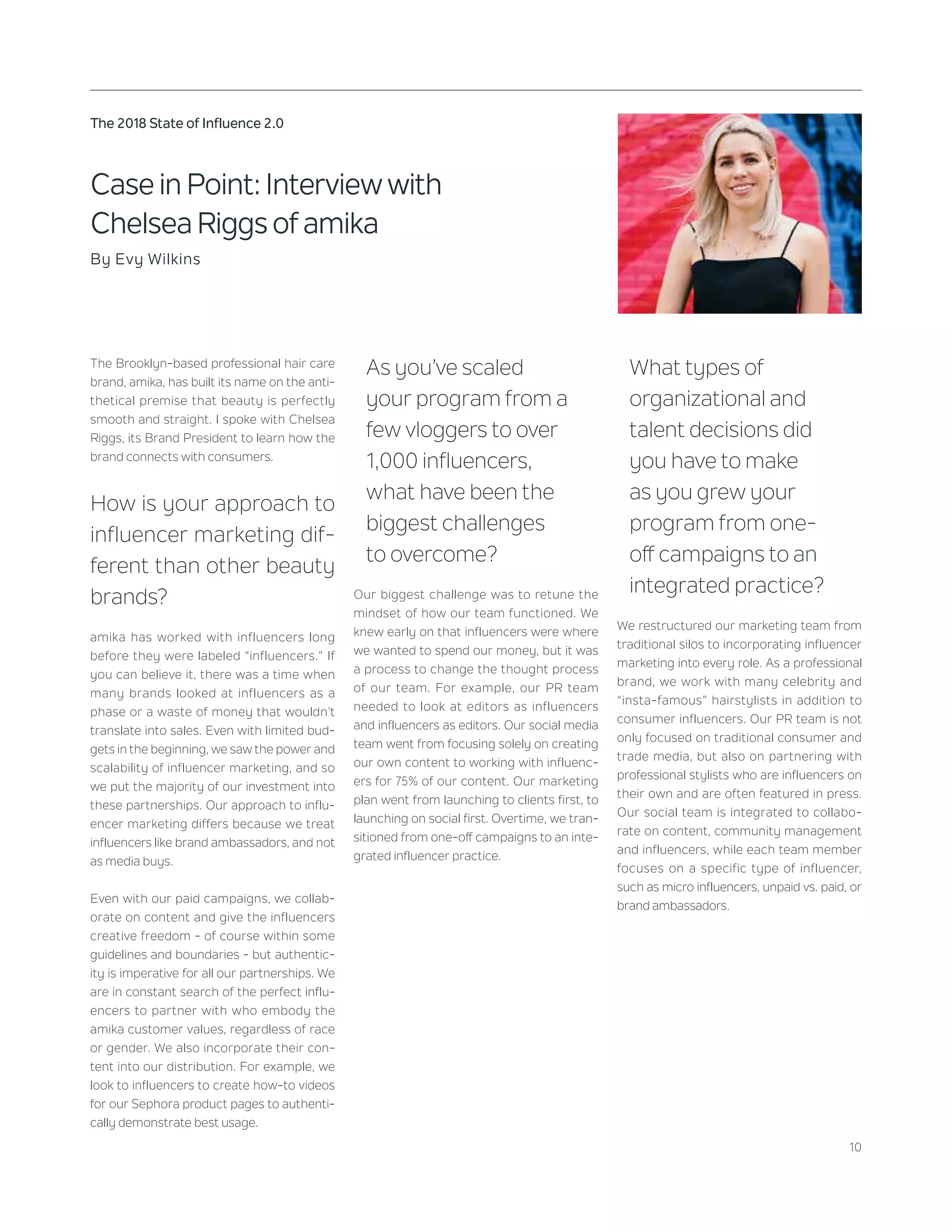
Case in Point: Interview with
Chelsea Riggs of amika
By Evy Wilkins
The Brooklyn-based professional hair care
brand, amika, has built its name on the anti-
thetical premise that beauty is perfectly
smooth and straight. I spoke with Chelsea
Riggs, its Brand President to learn how the
brand connects with consumers.
How is your approach to
influencer marketing dif-
ferent than other beauty
brands?
amika has worked with influencers long
before they were labeled “influencers.” If
you can believe it, there was a time when
many brands looked at influencers as a
phase or a waste of money that wouldn’t
translate into sales. Even with limited bud-
gets in the beginning, we saw the power and
scalability of influencer marketing, and so
we put the majority of our investment into
these partnerships. Our approach to influ-
encer marketing differs because we treat
influencers like brand ambassadors, and not
as media buys.
Even with our paid campaigns, we collab-
orate on content and give the influencers
creative freedom - of course within some
guidelines and boundaries - but authentic-
ity is imperative for all our partnerships. We
are in constant search of the perfect influ-
encers to partner with who embody the
amika customer values, regardless of race
or gender. We also incorporate their con-
tent into our distribution. For example, we
look to influencers to create how-to videos
for our Sephora product pages to authenti-
cally demonstrate best usage.
As you’ve scaled
your program from a
few vloggers to over
1,000 influencers,
what have been the
biggest challenges
to overcome?
Our biggest challenge was to retune the
mindset of how our team functioned. We
knew early on that influencers were where
we wanted to spend our money, but it was
a process to change the thought process
of our team. For example, our PR team
needed to look at editors as influencers
and influencers as editors. Our social media
team went from focusing solely on creating
our own content to working with influenc-
ers for 75% of our content. Our marketing
plan went from launching to clients first, to
launching on social first. Overtime, we tran-
sitioned from one-off campaigns to an inte-
grated influencer practice.
What types of
organizational and
talent decisions did
you have to make
as you grew your
program from one-
off campaigns to an
integrated practice?
We restructured our marketing team from
traditional silos to incorporating influencer
marketing into every role. As a professional
brand, we work with many celebrity and
“insta-famous” hairstylists in addition to
consumer influencers. Our PR team is not
only focused on traditional consumer and
trade media, but also on partnering with
professional stylists who are influencers on
their own and are often featured in press.
Our social team is integrated to collabo-
rate on content, community management
and influencers, while each team member
focuses on a specific type of influencer,
such as micro influencers, unpaid vs. paid, or
brand ambassadors.
22+23+23+26+27+27+30+30+40+49
11
Was that cross-
collaboration difficult
to establish?
What advice would
you share to integrate
influencer marketing
throughout brand
strategies?
In the beginning, it was somewhat difficult
to establish cross-collaboration within our
team, but the result was exceedingly worth-
while. My advice to anyone trying to inte-
grate influencer marketing throughout their
brand strategies is to first incorporate a level
of responsibility in each department head.
Our entire team participates in some form
at amika - we even involve our sales team in
the influencer identification decision-mak-
ing process. They also help us determine
which products to promote with influenc-
ers and what kind of influencer-generated
content will resonate best with our clients.
Today, everyone on the marketing team
plays some role in influencer marketing and
we have hired team members specifically
for integrated influencer marketing.
With influencer
marketing in-house,
how do you maintain
authenticrelationships
with so many people?
Maintaining personal relationships with
each of these influencers has definitely
been a challenge, however, we felt strongly
that keeping this in-house was the only
way to ensure this was possible. We did
attempt to work with agencies in the past
to help execute against a specific campaign,
however, the results and authenticity of the
campaigns suffered.
In the early days, we hired very junior
social talent, which led to some turnover,
and coupled with the fact that we tracked
everything in Excel, we ended up losing a
lot of data. I realized that if we truly wanted
influencer marketing to be the heart of our
marketing strategy, and not just a tactic, we
needed to restructure the team and bring
on software to make us more efficient.
I understand you
stopped tracking
EMV at amika. What
metrics do you track?
We do not use Earned Media Value (EMV)
as a metric, because for amika, it’s not
about the media equivalent cost, it’s about
achieving a specific marketing goal. On a
weekly basis, we are looking at activated
influencers per tier, the number of brand
mentions per influencer, our total share of
voice and influencer response rate. For spe-
cific campaigns, we will look at impressions,
total engagement, CPM and CPE.
Read the full interview
“Staging a Brand Rebellion:
How amika Scales Authentic
Influencer Marketing”
12
The 2018 State of Influence 2.0
For 2018, marketing
priorities are diverse
with performance
and growth efforts
gaining prominence.
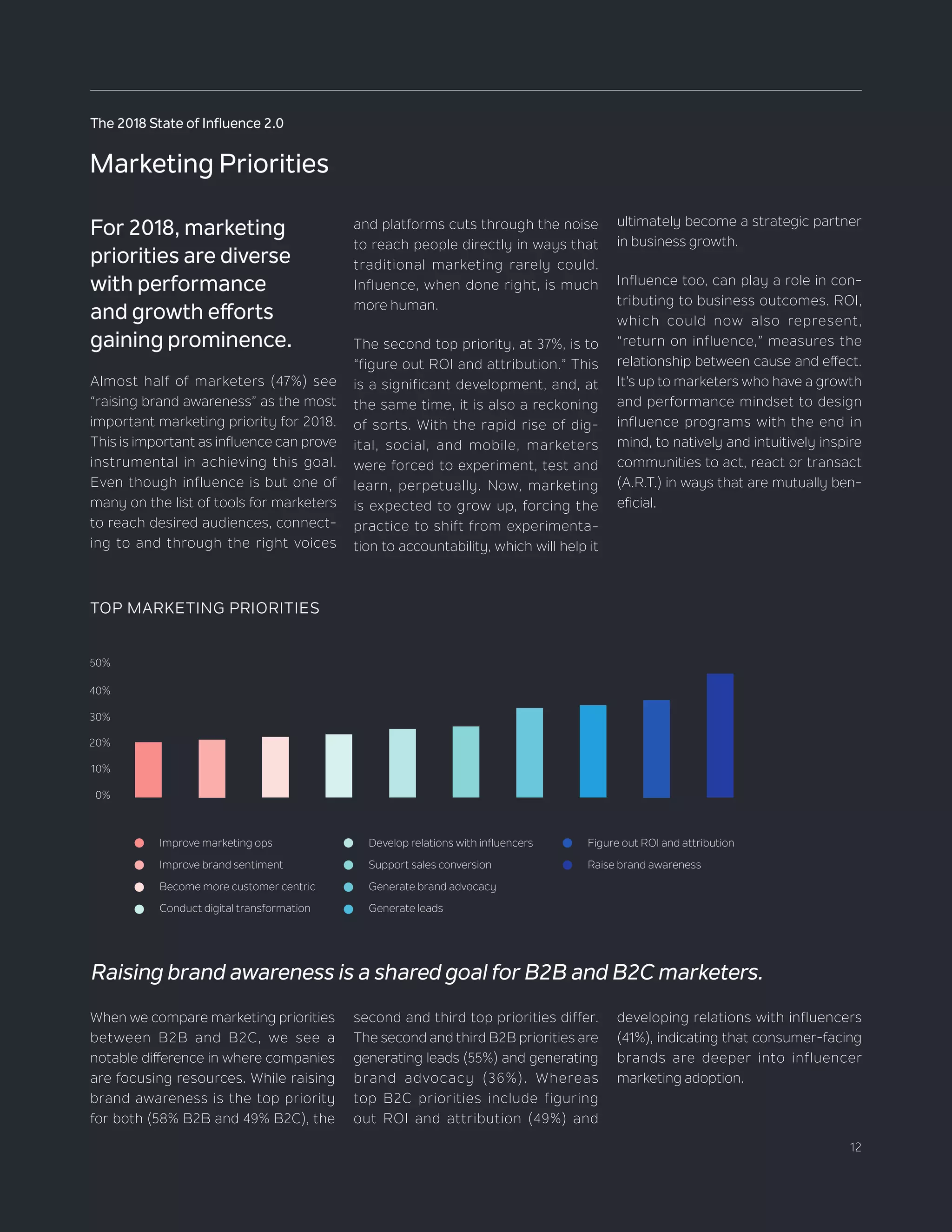
Almost half of marketers (47%) see
“raising brand awareness” as the most
important marketing priority for 2018.
This is important as influence can prove
instrumental in achieving this goal.
Even though influence is but one of
many on the list of tools for marketers
to reach desired audiences, connect-
ing to and through the right voices
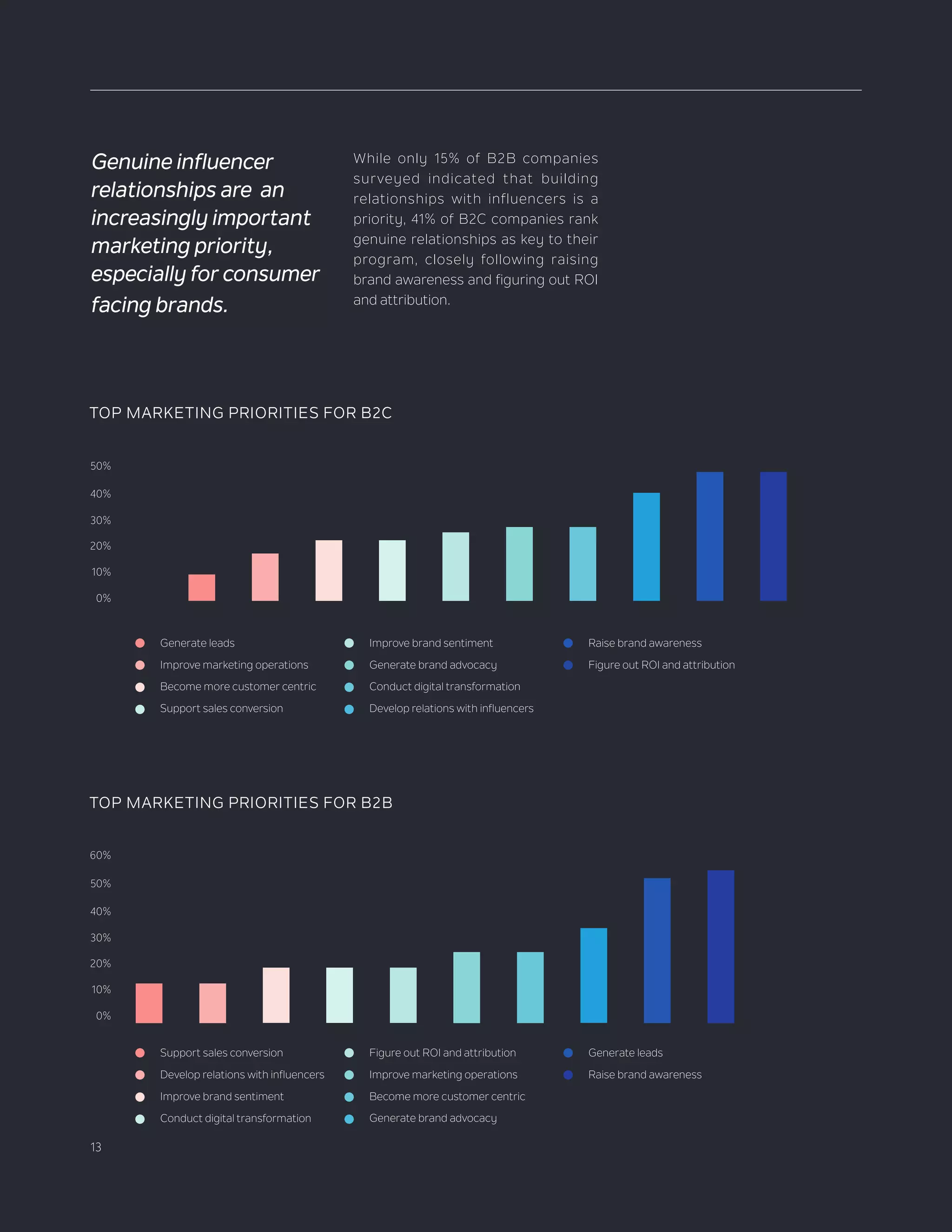
When we compare marketing priorities
between B2B and B2C, we see a
notable difference in where companies
are focusing resources. While raising
brand awareness is the top priority
for both (58% B2B and 49% B2C), the
second and third top priorities differ.
The second and third B2B priorities are
generating leads (55%) and generating
brand advocacy (36%). Whereas
top B2C priorities include figuring
out ROI and attribution (49%) and
developing relations with influencers
(41%), indicating that consumer-facing
brands are deeper into influencer
marketing adoption.
21+22+23+24+26+27+34+35+37+47
TOP MARKETING PRIORITIES
50%
40%
30%
20%
10%
0%
Improve marketing ops
Improve brand sentiment
Become more customer centric
Conduct digital transformation
Figure out ROI and attribution
Raise brand awareness
Develop relations with influencers
Support sales conversion
Generate brand advocacy
Generate leads
Raising brand awareness is a shared goal for B2B and B2C marketers.
Marketing Priorities
ultimately become a strategic partner
in business growth.
Influence too, can play a role in con-
tributing to business outcomes. ROI,
which could now also represent,
“return on influence,” measures the
relationship between cause and effect.
It’s up to marketers who have a growth
and performance mindset to design
influence programs with the end in
mind, to natively and intuitively inspire
communities to act, react or transact
(A.R.T.) in ways that are mutually ben-
eficial.
and platforms cuts through the noise
to reach people directly in ways that
traditional marketing rarely could.
Influence, when done right, is much
more human.
The second top priority, at 37%, is to
“figure out ROI and attribution.” This
is a significant development, and, at
the same time, it is also a reckoning
of sorts. With the rapid rise of dig-
ital, social, and mobile, marketers
were forced to experiment, test and
learn, perpetually. Now, marketing
is expected to grow up, forcing the
practice to shift from experimenta-
tion to accountability, which will help it
13
10+18+23+23+26+28+28+41+49+4950%
40%
30%
20%
10%
0%
Generate leads
Improve marketing operations
Become more customer centric
Support sales conversion
Raise brand awareness
Figure out ROI and attribution
Improve brand sentiment
Generate brand advocacy
Conduct digital transformation
Develop relations with influencers
TOP MARKETING PRIORITIES FOR B2C
15+15+21+21+21+27+27+36+55+5850%
60%
40%
30%
20%
10%
0%
Support sales conversion
Develop relations with influencers
Improve brand sentiment
Conduct digital transformation
Generate leads
Raise brand awareness
Figure out ROI and attribution
Improve marketing operations
Become more customer centric
Generate brand advocacy
TOP MARKETING PRIORITIES FOR B2B
Genuine influencer
relationships are an
increasingly important
marketing priority,
especially for consumer
facing brands.
While only 15% of B2B companies
surveyed indicated that building
relationships with influencers is a
priority, 41% of B2C companies rank
genuine relationships as key to their
program, closely following raising
brand awareness and figuring out ROI
and attribution.
14
The 2018 State of Influence 2.0
WHAT SOCIAL MEDIA TACTICS DO YOU USE TO ACHIEVE YOUR MARKETING PRIORITIES?
50%
50%
60%
60%
40%
40%
30%
30%
20%
20%
10%
10%
0%
0%
60+29+9+1Shape brand through social (Owned)
47+34+20+0Identify and partner with influencers (Earned)
34+55+10+1Invest in content marketing (Owned)
22+42+28+8Identify and partner with influencers (Paid)
34+36+23+7Engage consumers through UGC (Earned)
35+43+19+3Run social advertising (Paid)
Highly important Somewhat importantImportant Not Important
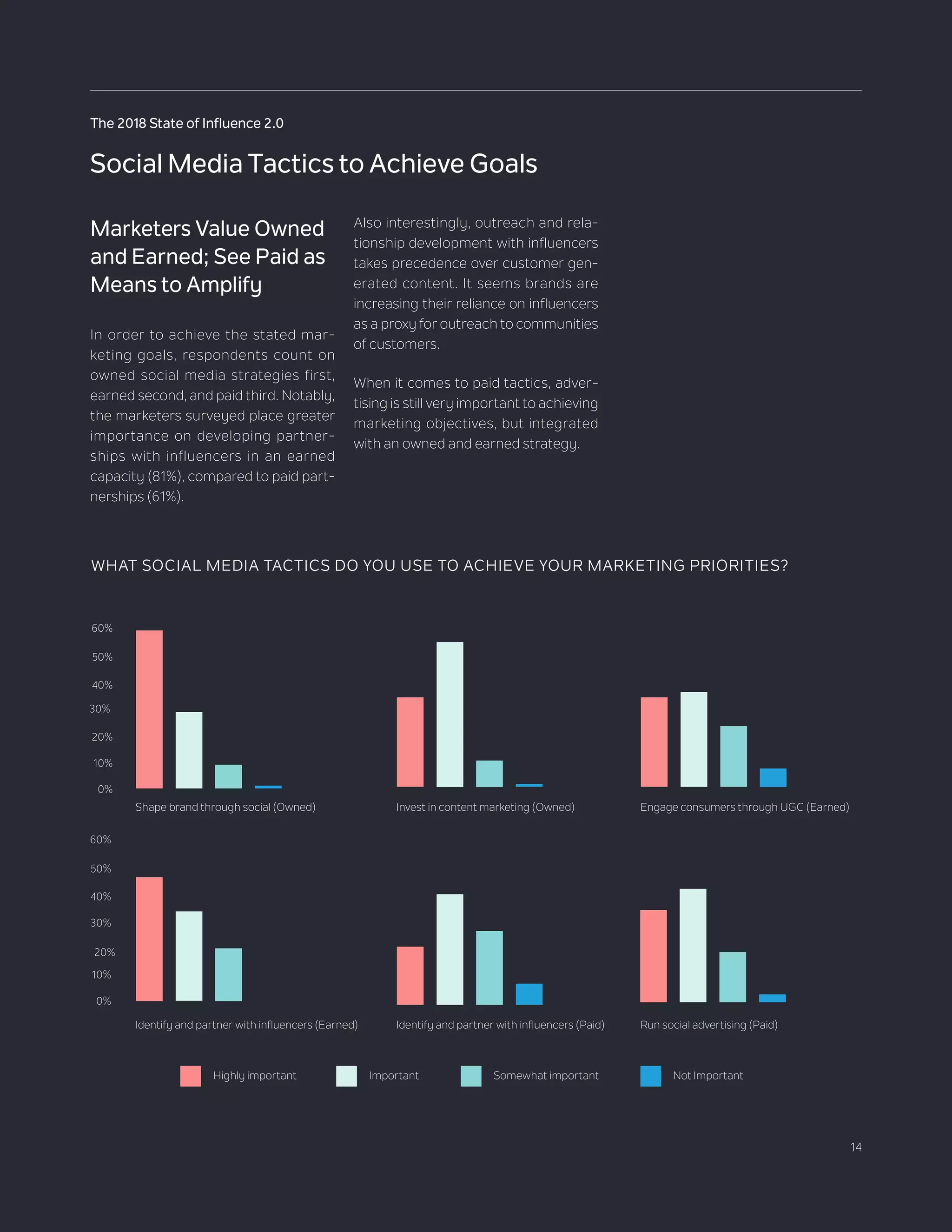
Marketers Value Owned
and Earned; See Paid as
Means to Amplify
In order to achieve the stated mar-
keting goals, respondents count on
owned social media strategies first,
earned second, and paid third. Notably,
the marketers surveyed place greater
importance on developing partner-
ships with influencers in an earned
capacity (81%), compared to paid part-
nerships (61%).
Social Media Tactics to Achieve Goals
Also interestingly, outreach and rela-
tionship development with influencers
takes precedence over customer gen-
erated content. It seems brands are
increasing their reliance on influencers
as a proxy for outreach to communities
of customers.
When it comes to paid tactics, adver-
tising is still very important to achieving
marketing objectives, but integrated
with an owned and earned strategy.
15
Shape our brand through
social media marketing (Owned)
Increase investments in
content marketing (Owned)
Engage consumers to shape social media
conversations through UGC (Earned)
Identify and partner with influencers
(Earned)
Identify and partner with influencers
(Paid)
Run social advertising campaigns
(Paid)
Highly important Somewhat importantImportant Not Important
50+0+230+730=
0+360+640=
50+320+230+410=
0+140+450+410=
0+270+450+270=
90+90+410+410=
SOCIAL MEDIA TACTICS TO BECOME MORE CUSTOMER CENTRIC
5%
5%
9%
36%
73%
23%
41%
45%
45%
41%
41%
41%
27%
64%
23%
32%
9%
14%
27%
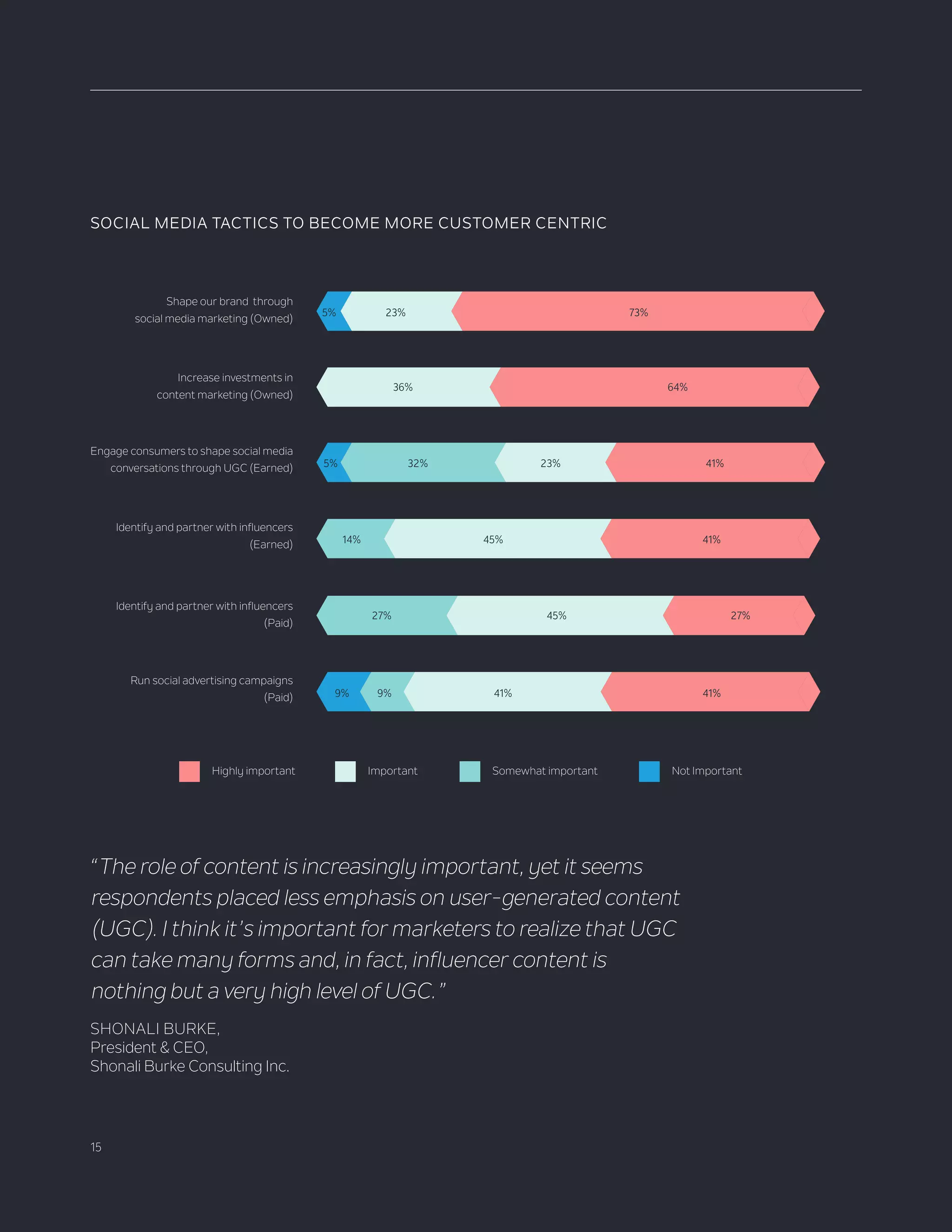
“The role of content is increasingly important, yet it seems
respondents placed less emphasis on user-generated content
(UGC). I think it’s important for marketers to realize that UGC
can take many forms and, in fact, influencer content is
nothing but a very high level of UGC.”
SHONALI BURKE,
President & CEO,
Shonali Burke Consulting Inc.
16
The 2018 State of Influence 2.0
OVERALL MARKETING BUDGET
<$100,000
$100,000 - $249,000
$250,000 - $499,000
$500,000 - $999,000
$1,000,000 - $4,999,000
$1,000,000 - $4,999,000
$10,000,000 - $24,999,000
$25,000,000 - $49,999,000
>$50,000,000
13+9+7+7+29+10+9+6+10+L
13%
9%
7%
7%
29%
10%
9%
6%
10%
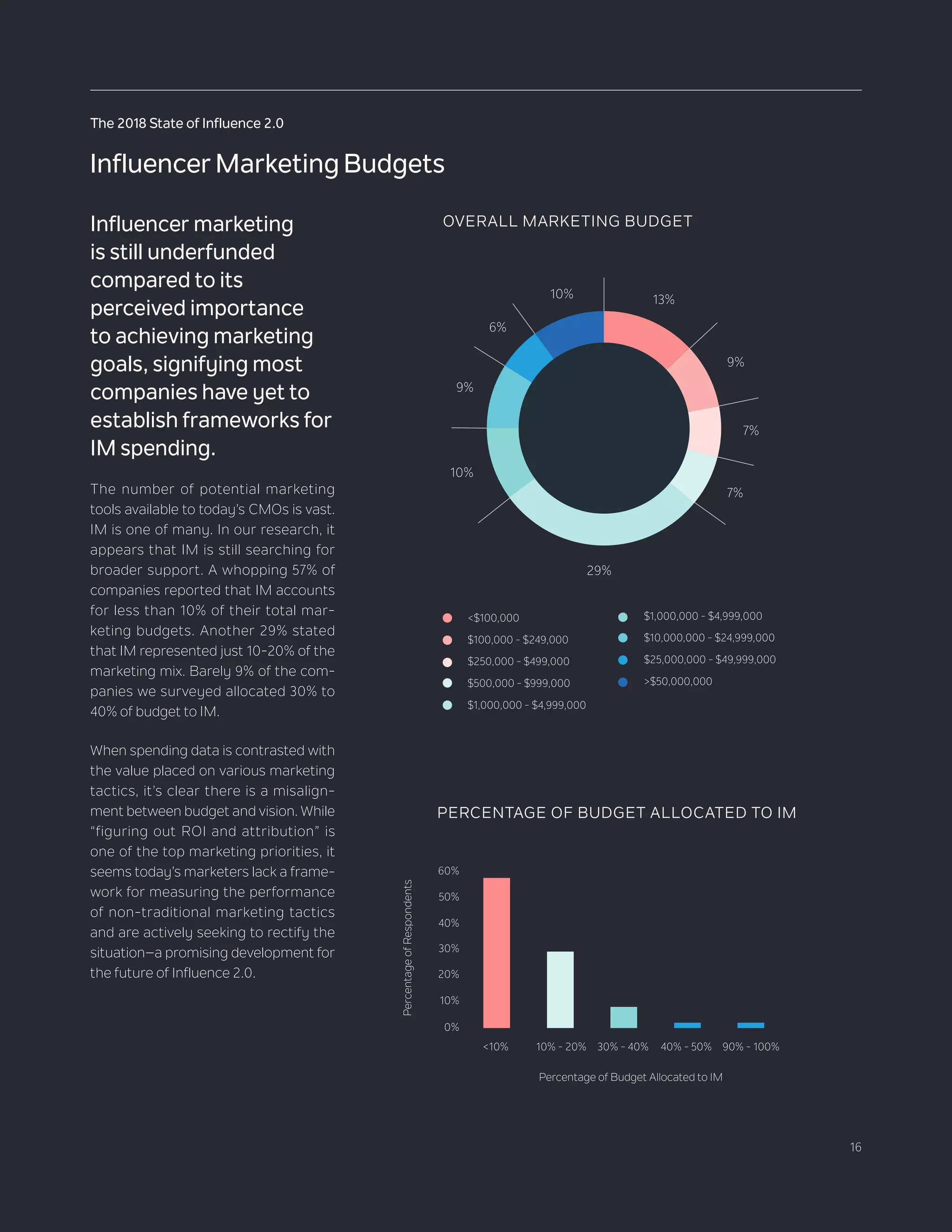
The number of potential marketing
tools available to today’s CMOs is vast.
IM is one of many. In our research, it
appears that IM is still searching for
broader support. A whopping 57% of
companies reported that IM accounts
for less than 10% of their total mar-
keting budgets. Another 29% stated
that IM represented just 10-20% of the
marketing mix. Barely 9% of the com-
panies we surveyed allocated 30% to
40% of budget to IM.
When spending data is contrasted with
the value placed on various marketing
tactics, it’s clear there is a misalign-
ment between budget and vision. While
“figuring out ROI and attribution” is
one of the top marketing priorities, it
seems today’s marketers lack a frame-
work for measuring the performance
of non-traditional marketing tactics
and are actively seeking to rectify the
situation–a promising development for
the future of Influence 2.0.
Influencer Marketing Budgets
Influencer marketing
is still underfunded
compared to its
perceived importance
to achieving marketing
goals, signifying most
companies have yet to
establish frameworks for
IM spending.
PERCENTAGE OF BUDGET ALLOCATED TO IM
50%
60%
40%
30%
20%
10%
0% 57+29+8+2+2<10% 10% - 20% 30% - 40% 40% - 50% 90% - 100%
Percentage of Budget Allocated to IM
PercentageofRespondents
17
IM BUDGET
FUTURE IM SPENDING PLANS
50%
60%
70%
40%
30%
20%
10%
0% 4+9+25+62Spend
less
I don’t
know
Spend
the same
Spend
more
50%
60%
40%
30%
20%
10%
0% 28+23+23+6+16+4
In last year’s report, half of those we
surveyed reported significantly smaller
2017 IM budgets when compared to
the rest of the marketing mix. Most
(50%) allocated less than $100,000
and another 25% invested between
$100,000 and $250,000 annually. And,
55% of those marketers indicated that
they planned to spend more in 2017.
For those companies that had already
spent more than $250,000 annually,
the percentage of companies that
planned to increase budget for the
next year jumped to 67%.
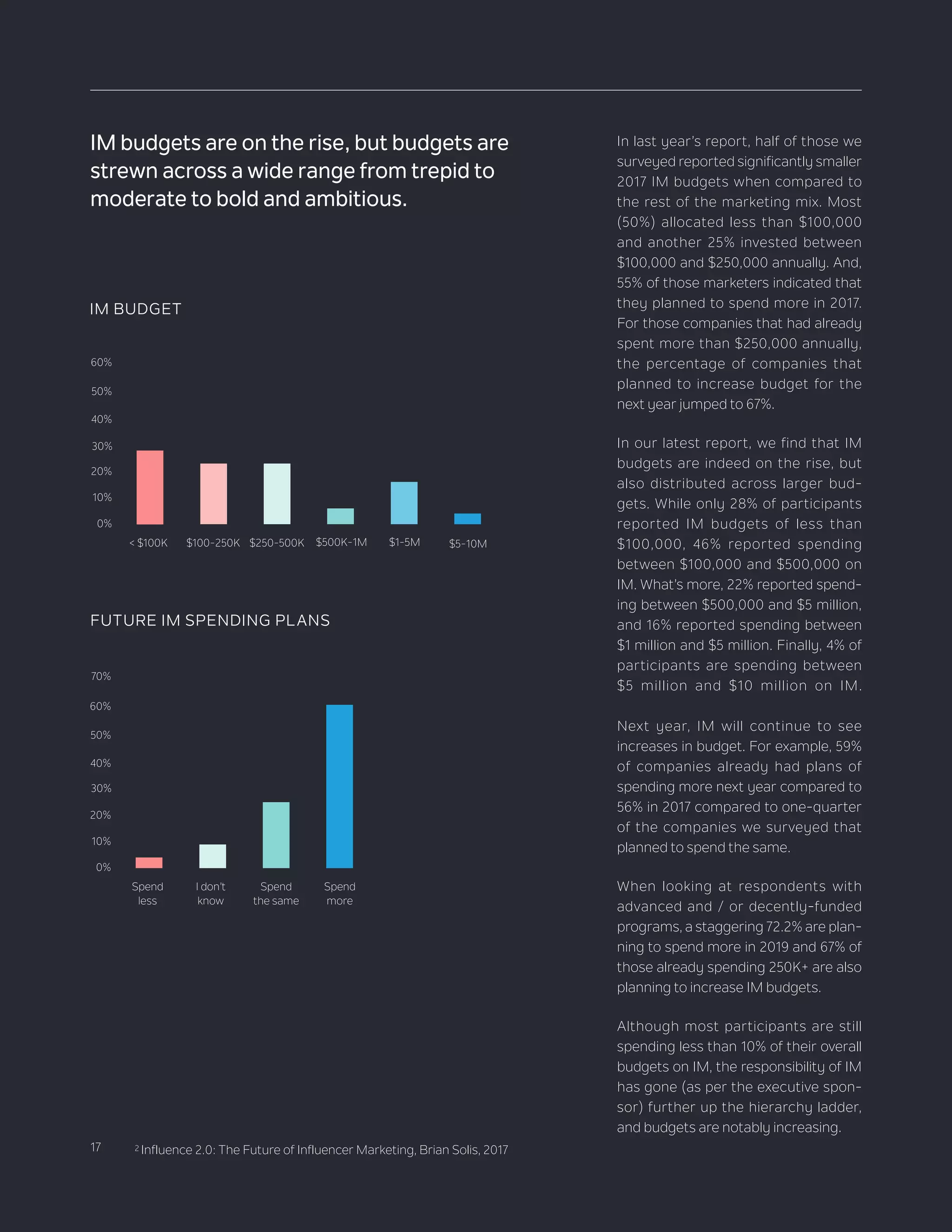
In our latest report, we find that IM
budgets are indeed on the rise, but
also distributed across larger bud-
gets. While only 28% of participants
reported IM budgets of less than
$100,000, 46% reported spending
between $100,000 and $500,000 on
IM. What’s more, 22% reported spend-
ing between $500,000 and $5 million,
and 16% reported spending between
$1 million and $5 million. Finally, 4% of
participants are spending between
$5 million and $10 million on IM.
Next year, IM will continue to see
increases in budget. For example, 59%
of companies already had plans of
spending more next year compared to
56% in 2017 compared to one-quarter
of the companies we surveyed that
planned to spend the same.
When looking at respondents with
advanced and / or decently-funded
programs, a staggering 72.2% are plan-
ning to spend more in 2019 and 67% of
those already spending 250K+ are also
planning to increase IM budgets.
Although most participants are still
spending less than 10% of their overall
budgets on IM, the responsibility of IM
has gone (as per the executive spon-
sor) further up the hierarchy ladder,
and budgets are notably increasing.
IM budgets are on the rise, but budgets are
strewn across a wide range from trepid to
moderate to bold and ambitious.
< $100K $100-250K $250-500K $500K-1M $1-5M $5-10M
2 Influence 2.0: The Future of Influencer Marketing, Brian Solis, 2017
18
The 2018 State of Influence 2.0
‘‘
Case in Point: Interview with
Amanda Duncan of Microsoft
By Mark W. Schaefer
For Amanda Duncan, lifestyle influ-
encer relations manager at Microsoft,
making a career transition to influencer
marketing simply made sense.
Microsoft’s influencer outreach pro-
grams are now spreading through-
out the world, but the function and
accountability remains local. “There
are so many different customs, laws,
and languages,” she said. “It makes
sense to connect to influencers at a
local level with local people.” Her coun-
terparts around the world frequently
share ideas and best practices to
grow as an organization. “It’s incredi-
bly important to spend time internally
making sure you’re on the same page.”
She said that influencer marketing
makes sense to Microsoft because its
products play such an intimate role in
a customer’s life. “We sell to people, so
as a company we need to learn to talk
like a person. It can’t be a campaign
with peaks and valleys. We can’t go
dark. We should be as interested in our
influencers as they are in us. And if you
approach it as human communication
instead of company communication,
those relationships will grow over time,
just as a friendship can grow over time.
For Microsoft, scaling influencer mar-
keting is a constant, methodical pro-
cess. The company is approaching this
growth in a few different ways. “There
are people that the team has worked
with previously and there is the oppor-
tunity to examine their networks to see
who else they might be connected to,”
she said. “Technology helps, but there
is definitely still a very large human
component involved in identifying rel-
evant influencers.”
The search for influencers is method-
ical and on-going, and nearly all of
Microsoft’s influencer connections are
unpaid. “The process is important,”
Amanda said. “It is relationship-based.
We strive for authentic advocacy. It
has to be mutually-beneficial and the
values have to be aligned. I think that
is an important way we have grown.
“To be effective at corporate communications today, you have to set
your mindset to the consumer,” she said. “How does a person prefer to
get their information these days? They ask their friends, they search
the web, they read reviews. That suggests a communication model
and a strategy that is vastly different from the traditional corporate
broadcast methods, doesn’t it? It means we need to actually be in
conversation with people. I find that to be an incredible challenge!”
The trick is scaling those conversa-
tions on a global scale. A Microsoft
scale! The Redmond, WA-based com-
pany is the largest software company
in the world with 120,000 employees
around the globe. Influencer marketing
has become a mainstream marketing
channel and its growth at Microsoft
has increased rapidly. From experi-
ments through outside agencies just a
few years ago to the creation of a ded-
icated team of in-house global experts
today, Microsoft is swiftly scaling its
efforts.
“Influencer relations
is the natural
evolution, this is the
place to be because
this is the future of
communications.”
19
Yes, reach, relevance and resonance
are important, but we want the values
to mesh as well.”
She stressed that the collaborative
decision process is just as important
for the influencers they work with.
“You can’t flip trust,” she said. “If you’re
advocating for a company one day and
then advocating for a competitor the
next day, you are sending the wrong
message to an audience. They will
begin to think you’re simply looking for
a payday and you’ll lose their trust. And
when that happens, you’re no longer
effective. If you chase dollars every-
body loses so both the company and
influencers have to be mindful of trust
at every step. You have to develop a
long-term vision of how the relation-
ship will evolve and how we will work
together.”
Influencer marketing is also extending
to other parts of the organization. “We
find that many different departments
can benefit from outside connections
and collaborations,” she said. “We may
not call it influencer marketing all the
time, but that’s what it is. One influ-
encer might have five or six different
touch-points in an organization, so
we’ll be flexible in terms of who leads
on the relationship. We try to meet the
influencer’s needs.”
Although Microsoft has come a long
way with its pioneering influencer mar-
keting efforts, Amanda knows that
they are just at the beginning of this
new world of customer conversations.
The company is scaling the level of its
conversations by constantly experi-
menting and piloting new ideas.
“We’ve come a long
way and there still is
not much of a road
map,” she said. “So
we experiment. Pilot
programs are big
here. And yes, we
fail, but the only real
failure is if you fail
to learn. You can’t
be so afraid to make
a mistake that you
don’t try anything
different. It gives you
an opportunity to try
more, to do more.”
Read the full interview
Conversations at Scale:
Interview with Amanda
Duncan of Microsoft
20
“More advanced companies use content marketing more; whereas more
tactics-driven companies rely more on social media. That tells me that
more advanced companies are thinking long-term with influencers about
co-creating or partnering across many platforms. As with any kind of
marketing… relationships are what always deliver.”
ANN HANDLEY,
Chief Content Officer,
MarketingProfs
The 2018 State of Influence 2.0
Influencer marketing budgets are largely focused
on content marketing, staff and influencer
compensation, which indicates the increasing
importance of influencer-generated content
for brands, as well as, the necessity of in-house
resources to build relationships with influencers.
SHARE OF IM BUDGET
30%
20%
10%
0% 22+12+19+20+27Agencies &
Consultants
Technology Influencer
Compensation
Staff Content
Creation
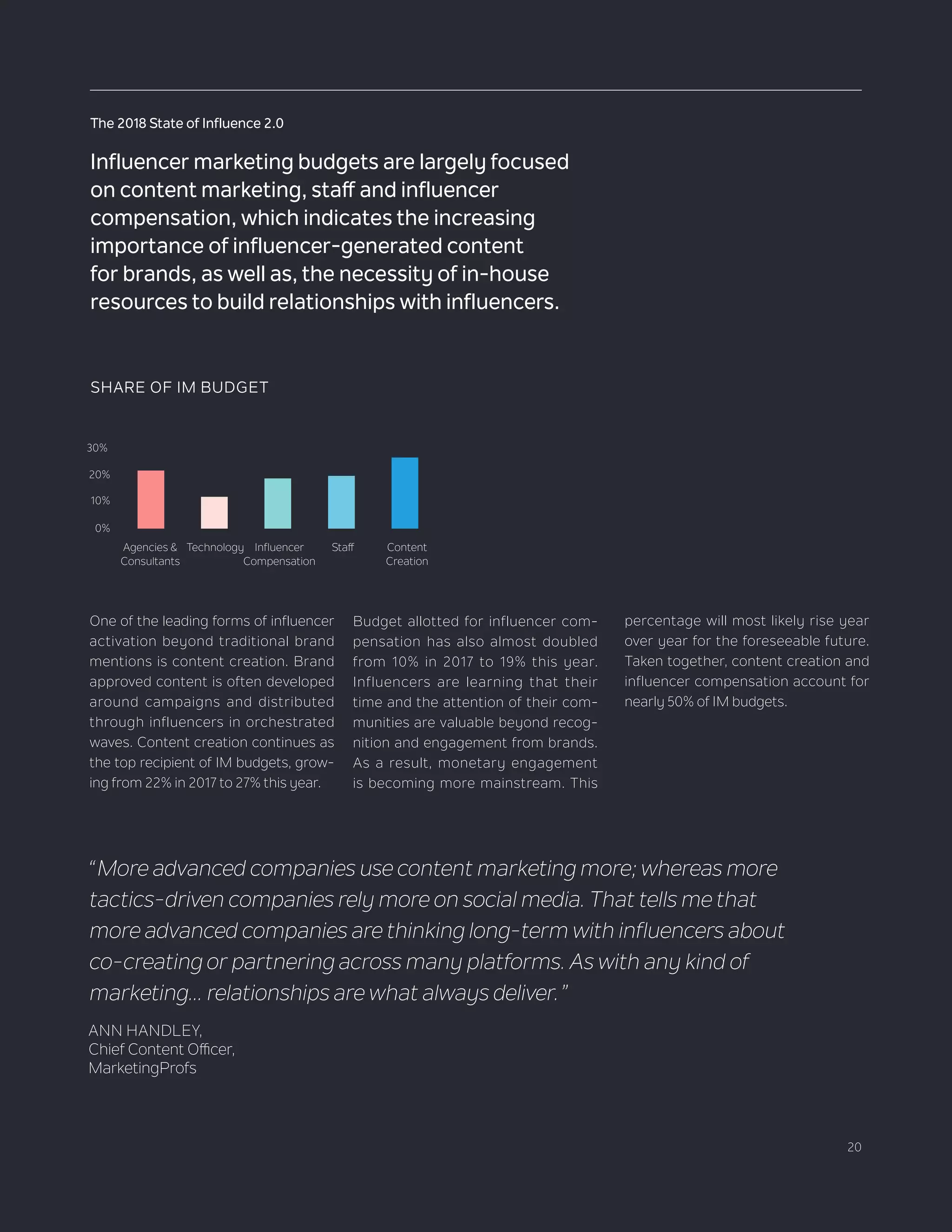
Budget allotted for influencer com-
pensation has also almost doubled
from 10% in 2017 to 19% this year.
Influencers are learning that their
time and the attention of their com-
munities are valuable beyond recog-
nition and engagement from brands.
As a result, monetary engagement
is becoming more mainstream. This
percentage will most likely rise year
over year for the foreseeable future.
Taken together, content creation and
influencer compensation account for
nearly 50% of IM budgets.
One of the leading forms of influencer
activation beyond traditional brand
mentions is content creation. Brand
approved content is often developed
around campaigns and distributed
through influencers in orchestrated
waves. Content creation continues as
the top recipient of IM budgets, grow-
ing from 22% in 2017 to 27% this year.
21
Technology usage
is on the rise;
influencer identification
and relationship
management tools
are main areas
of investment.
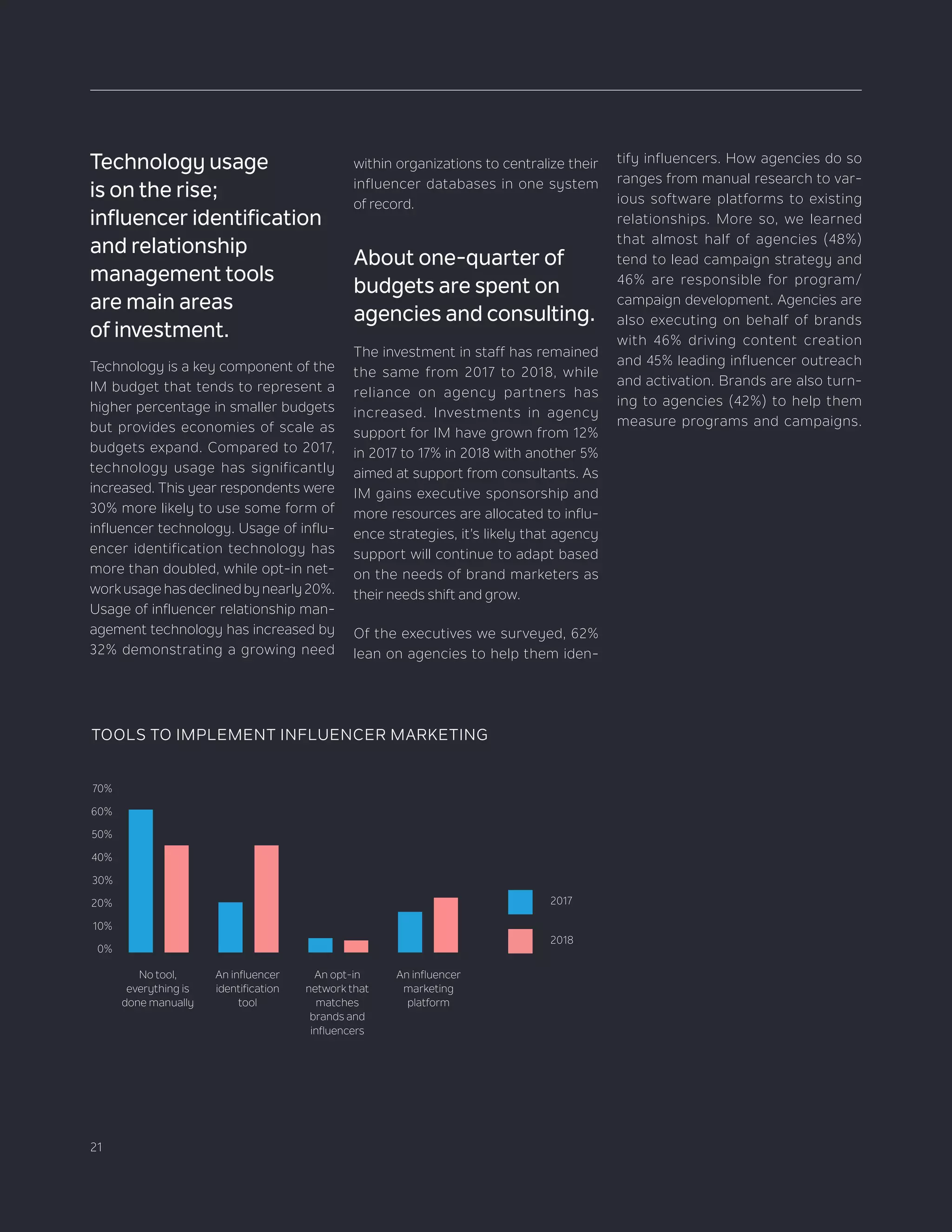
Technology is a key component of the
IM budget that tends to represent a
higher percentage in smaller budgets
but provides economies of scale as
budgets expand. Compared to 2017,
technology usage has significantly
increased. This year respondents were
30% more likely to use some form of
influencer technology. Usage of influ-
encer identification technology has
more than doubled, while opt-in net-
work usage has declined by nearly 20%.
Usage of influencer relationship man-
agement technology has increased by
32% demonstrating a growing need
within organizations to centralize their
influencer databases in one system
of record.
About one-quarter of
budgets are spent on
agencies and consulting.
The investment in staff has remained
the same from 2017 to 2018, while
reliance on agency partners has
increased. Investments in agency
support for IM have grown from 12%
in 2017 to 17% in 2018 with another 5%
aimed at support from consultants. As
IM gains executive sponsorship and
more resources are allocated to influ-
ence strategies, it’s likely that agency
support will continue to adapt based
on the needs of brand marketers as
their needs shift and grow.
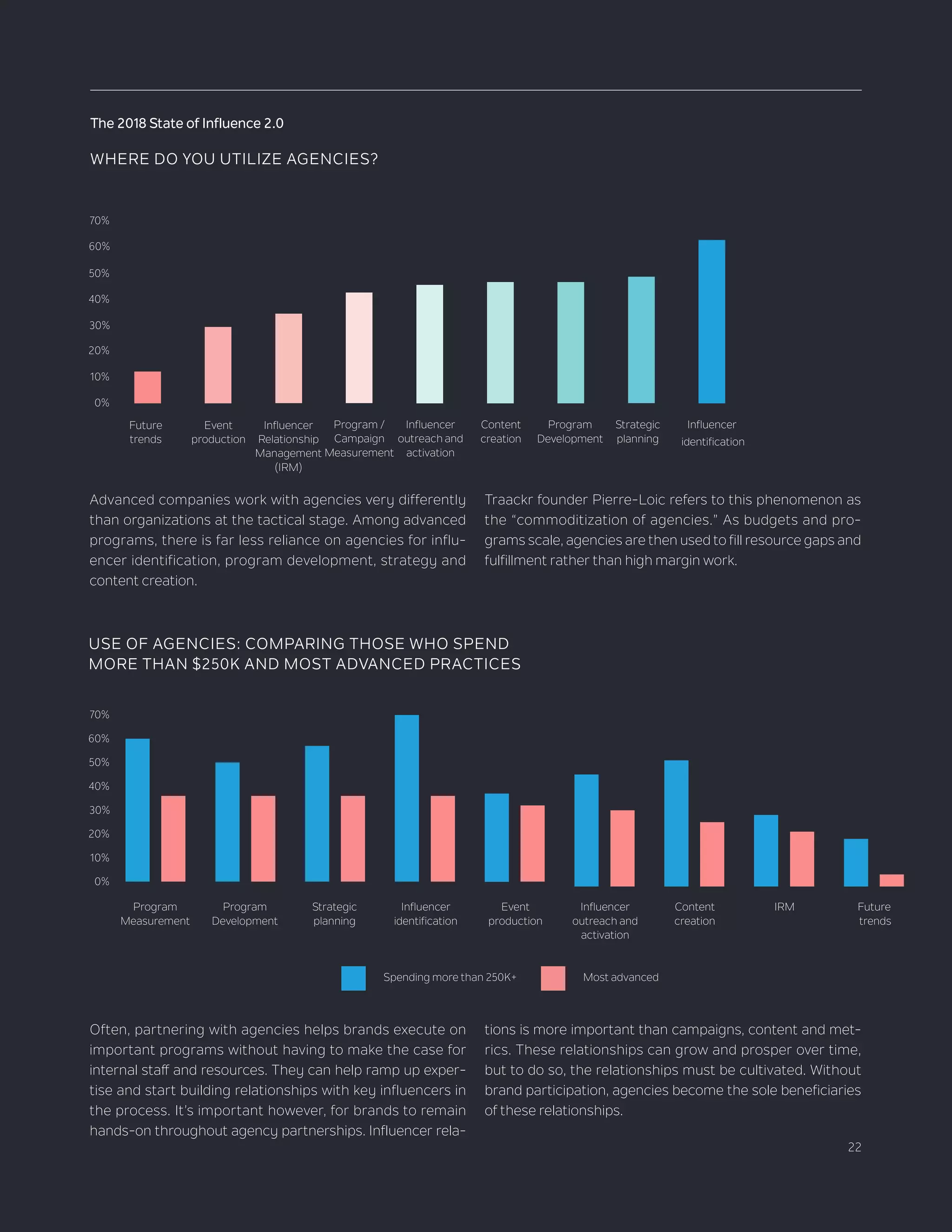
Of the executives we surveyed, 62%
lean on agencies to help them iden-
tify influencers. How agencies do so
ranges from manual research to var-
ious software platforms to existing
relationships. More so, we learned
that almost half of agencies (48%)
tend to lead campaign strategy and
46% are responsible for program/
campaign development. Agencies are
also executing on behalf of brands
with 46% driving content creation
and 45% leading influencer outreach
and activation. Brands are also turn-
ing to agencies (42%) to help them
measure programs and campaigns.
TOOLS TO IMPLEMENT INFLUENCER MARKETING
50%
60%
70%
40%
30%
20%
10%
0% 17+236+521+4560+45No tool,
everything is
done manually
An influencer
identification
tool
An opt-in
network that
matches
brands and
influencers
An influencer
marketing
platform
2017
2018
22
The 2018 State of Influence 2.0
USE OF AGENCIES: COMPARING THOSE WHO SPEND
MORE THAN $250K AND MOST ADVANCED PRACTICES
50%
60%
70%
40%
30%
20%
10%
0% 20+530+2353+2747+3237+3270+3657+3650+3660+36
12+29+34+42+45+46+46+48+62Advanced companies work with agencies very differently
than organizations at the tactical stage. Among advanced
programs, there is far less reliance on agencies for influ-
encer identification, program development, strategy and
content creation.
Traackr founder Pierre-Loic refers to this phenomenon as
the “commoditization of agencies.” As budgets and pro-
grams scale, agencies are then used to fill resource gaps and
fulfillment rather than high margin work.
Often, partnering with agencies helps brands execute on
important programs without having to make the case for
internal staff and resources. They can help ramp up exper-
tise and start building relationships with key influencers in
the process. It’s important however, for brands to remain
hands-on throughout agency partnerships. Influencer rela-
tions is more important than campaigns, content and met-
rics. These relationships can grow and prosper over time,
but to do so, the relationships must be cultivated. Without
brand participation, agencies become the sole beneficiaries
of these relationships.
Program
Measurement
Program
Development
Strategic
planning
Influencer
identification
Event
production
Influencer
outreach and
activation
Content
creation
IRM Future
trends
Spending more than 250K+ Most advanced
WHERE DO YOU UTILIZE AGENCIES?
50%
60%
70%
40%
30%
20%
10%
0%
Future
trends
Event
production
Influencer
Relationship
Management
(IRM)
Program /
Campaign
Measurement
Influencer
outreach and
activation
Content
creation
Program
Development
Strategic
planning
Influencer
identification
23
Influencer Marketing Experience
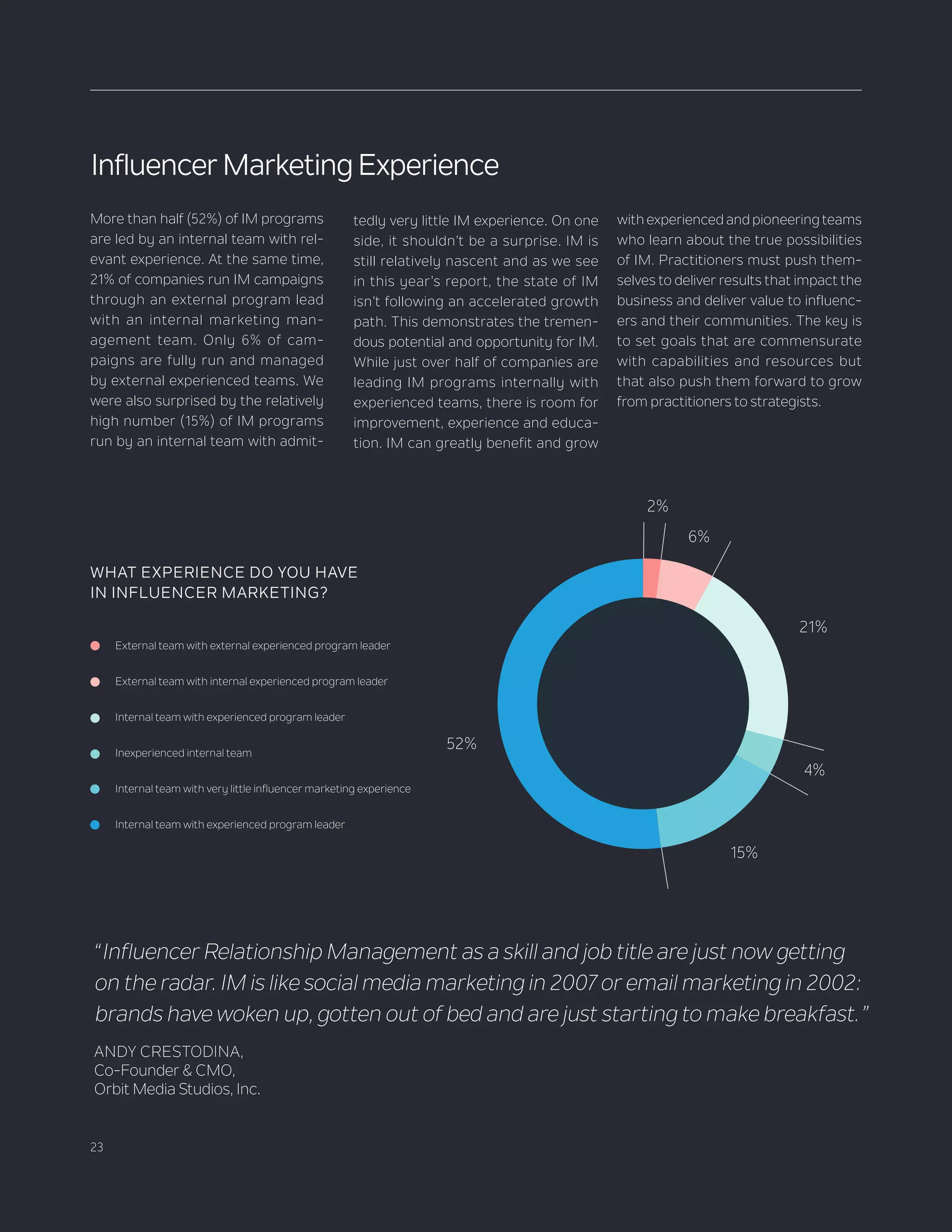
More than half (52%) of IM programs
are led by an internal team with rel-
evant experience. At the same time,
21% of companies run IM campaigns
through an external program lead
with an internal marketing man-
agement team. Only 6% of cam-
paigns are fully run and managed
by external experienced teams. We
were also surprised by the relatively
high number (15%) of IM programs
run by an internal team with admit-
External team with external experienced program leader
External team with internal experienced program leader
Internal team with experienced program leader
Inexperienced internal team
Internal team with very little influencer marketing experience
Internal team with experienced program leader
WHAT EXPERIENCE DO YOU HAVE
IN INFLUENCER MARKETING?
2+6+21+4+15+52+L
2%
6%
15%
52%
21%
4%
tedly very little IM experience. On one
side, it shouldn’t be a surprise. IM is
still relatively nascent and as we see
in this year’s report, the state of IM
isn’t following an accelerated growth
path. This demonstrates the tremen-
dous potential and opportunity for IM.
While just over half of companies are
leading IM programs internally with
experienced teams, there is room for
improvement, experience and educa-
tion. IM can greatly benefit and grow
with experienced and pioneering teams
who learn about the true possibilities
of IM. Practitioners must push them-
selves to deliver results that impact the
business and deliver value to influenc-
ers and their communities. The key is
to set goals that are commensurate
with capabilities and resources but
that also push them forward to grow
from practitioners to strategists.
“Influencer Relationship Management as a skill and job title are just now getting
on the radar. IM is like social media marketing in 2007 or email marketing in 2002:
brands have woken up, gotten out of bed and are just starting to make breakfast.”
ANDY CRESTODINA,
Co-Founder & CMO,
Orbit Media Studios, Inc.
24
The 2018 State of Influence 2.0
‘‘
Case in Point: Interview
with Santiago Garcia Solimei
of Meliá Hotels International
By Scott Guthrie
Meliá Hotels International is one of the
largest hotel companies in the world. I
spoke with Santiago Garcia Solimei, Global
Director of Social Media, to better under-
stand how the operator works with influ-
encers globally at an enterprise level.
What drives Meliá
Hotels International
to use influencer
marketing?
About 11% of traffic to our booking web-
site Melia.com comes from social. More
and more people are reaching out to social
media channels to discover new hotels and
to discover destinations. So not only do we
need to be present on social, but we need to
be present with really good content and the
way to ensure we have amazing and varied
content is through influencer marketing.
We used to operate a company-wide
PR and social media strategy that was
well established by brand and region but
lacked a system approach and specific
methodology to influencer marketing.
In January 2017, we made the switch to a
system-based approach. The move was a
response to the increasing number of influ-
encer requests being received at the hotel,
regional and global levels, plus the amount
of time needed to evaluate, consider and
respond to all those requests.
Can you give me
an idea of the scale
of influencers you
work with?
We categorize influencers at three stages:
identified, engaged and advocates. We only
keep relevant influencers in our Traackr
database. So far we have identified 896 rel-
evant influencers. This gives you an idea of
the size we’re talking about. Of those 896
influencers, 150 are engaged. That means
they’re doing something with us. A further
75 we classify as advocates. Overall about a
third of our influencers are associated with
the ME by Meliá brand. But, every year
each one of our seven brands runs a global
campaign which contains an influencer
marketing component.
How do you identify
the most appropriate
influencers to work
with for each brand?
The brand marketing department creates
a persona of an ideal influencer for each
brand. These profiles cover the ideal inter-
ests, age, and trends that these people fol-
low, along with brand configurations, and
reach. We have a very clearly spec’d out
map of what an influencer should be for
each of our brands. It is really important for
us that we do not share influencers across
different brands. Each brand has its own
specific targets and profiles.
We engage with influencers on an exclusive
basis. We look very carefully at the values of
that influencer and our brand, the message
the influencer is portraying to his or her
audience; what type of audience it is and
where they are located.
Which team ‘owns’
influencer marketing’?
The Global Social Media department is
responsible for the influencer marketing
vision, strategy and program, plus the way
it’s implemented by the regions and hotels.
We have created a methodology called the
MHI Influencer Best Practice Guide. PR and
social media agencies engage with influ-
encers based on our methodology. They
use Traackr as the influencer database and
reporting framework.
We devise the framework strategy cen-
trally. We then present this strategy to our
PR agencies, social media agencies and
hotels worldwide. Given our geographical
spread we rely on PR agencies and social
media agencies - our specialized resources
- to conduct local training with hotels. They
take the strategy down to a property level.
25
How does Meliá Hotels
International allocate
resources to its
influencer programs?
We have a central influencer budget allo-
cated to each brand that covers travel,
hosting and related expenses. As part of our
global campaigns, there is also a budget for
influencer marketing-related actions spe-
cific to each campaign. We want to engage
with influencers who fully connect with our
brands at an emotional level so we invite
them to an unforgettable hotel experience
where all expenses are covered. We only
pay for the influencer participation on spe-
cific ad-hoc activities (for example for DJing,
art interventions, or Ted Talks). We believe
this approach will result in more effective
and authentic content as well as a long-
term relationship of brand advocacy.
How do you measure
the success of your
influencer marketing?
Part of proving the ROI of social is via a
data-driven approach. Through Traackr,
we’re able to generate a report of every
relevant influencer campaign. Within the
report, we can see all of the coverage gen-
erated plus the mentions and interactions.
We can see which content has worked best
for us on each social network and by spe-
cific influencers.
We’re also putting together internal busi-
ness cases which show results on all the
different campaigns. Globally, about 11% of
traffic to our booking website Melia.com
comes from social. In some countries, social
media drives 15% of traffic to the booking
site. Through business cases and reports
we show our hotels’ general managers how
much coverage has been generated and
how much traction was achieved.
Read the full interview
How Meliá Hotels International
Scales Influencer Marketing
Across 7 Brands and 4 Continents
26
The 2018 State of Influence 2.0
This signifies that executive engage-
ment, at the highest level, can steer IM
strategy to align with business objec-
tives. As a result, IM can gain greater
prominence within the marketing mix
and the organization by playing a big-
ger role in driving business outcomes,
beyond playing a small role in tradi-
tional marketing mixes.
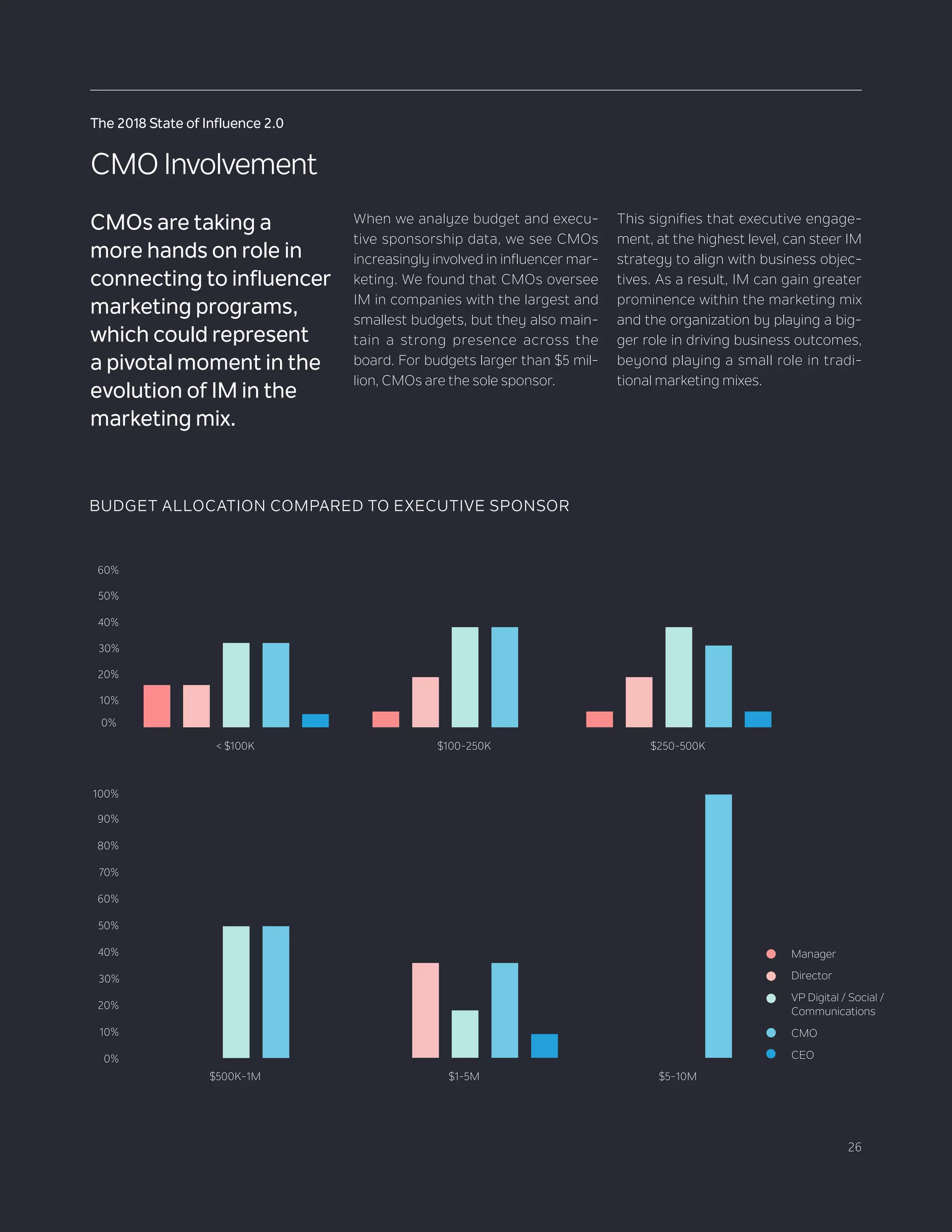
CMOs are taking a
more hands on role in
connecting to influencer
marketing programs,
which could represent
a pivotal moment in the
evolution of IM in the
marketing mix.
Manager
Director
VP Digital / Social /
Communications
CMO
CEO
BUDGET ALLOCATION COMPARED TO EXECUTIVE SPONSOR
50%
60%
40%
30%
20%
10%
0%
50%
80%
60%
90%
100%
40%
70%
30%
20%
10%
0%
16+16+32+32+5< $100K
0+0+50+50+0$500K-1M
6+19+38+38+0$100-250K
0+36+18+36+9$1-5M
6+19+38+31+6$250-500K
0+0+0+100+0$5-10M
When we analyze budget and execu-
tive sponsorship data, we see CMOs
increasingly involved in influencer mar-
keting. We found that CMOs oversee
IM in companies with the largest and
smallest budgets, but they also main-
tain a strong presence across the
board. For budgets larger than $5 mil-
lion, CMOs are the sole sponsor.
CMO Involvement
27
Departments Involved in IM
Influencers exist because they engage
their communities in unique and val-
ue-added ways. They don’t simply
exist to market to audiences. Looking
at how influencer engagement is man-
aged within the enterprise today, the
elements of influence 2.0 are present.
Given that each marketer, on average,
identified more than three depart-
ments that engage in IM, unity and
orchestration are essential.
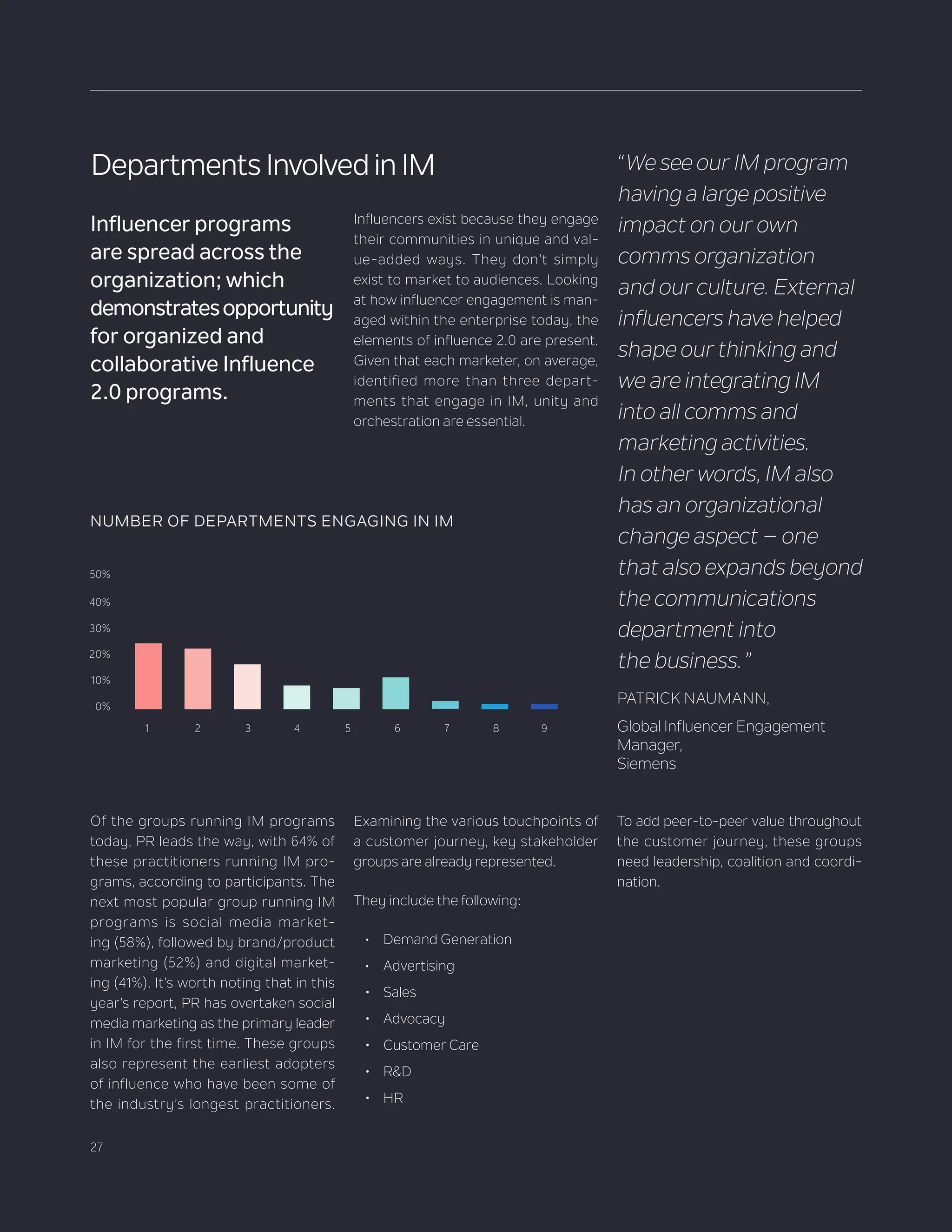
Of the groups running IM programs
today, PR leads the way, with 64% of
these practitioners running IM pro-
grams, according to participants. The
next most popular group running IM
programs is social media market-
ing (58%), followed by brand/product
marketing (52%) and digital market-
ing (41%). It’s worth noting that in this
year’s report, PR has overtaken social
media marketing as the primary leader
in IM for the first time. These groups
also represent the earliest adopters
of influence who have been some of
the industry’s longest practitioners.
Influencer programs
are spread across the
organization; which
demonstratesopportunity
for organized and
collaborative Influence
2.0 programs.
NUMBER OF DEPARTMENTS ENGAGING IN IM
50%
40%
30%
20%
10%
0% 25+23+17+9+8+12+3+2+21 2 3 4 5 6 7 8 9
Examining the various touchpoints of
a customer journey, key stakeholder
groups are already represented.
They include the following:
•	 Demand Generation
•	 Advertising
•	 Sales
•	 Advocacy
•	 Customer Care
•	 R&D
•	 HR
To add peer-to-peer value throughout
the customer journey, these groups
need leadership, coalition and coordi-
nation.
“We see our IM program
having a large positive
impact on our own
comms organization
and our culture. External
influencers have helped
shape our thinking and
we are integrating IM
into all comms and
marketing activities.
In other words, IM also
has an organizational
change aspect – one
that also expands beyond
the communications
department into
the business.”
PATRICK NAUMANN,
Global Influencer Engagement
Manager,
Siemens
28
The 2018 State of Influence 2.0
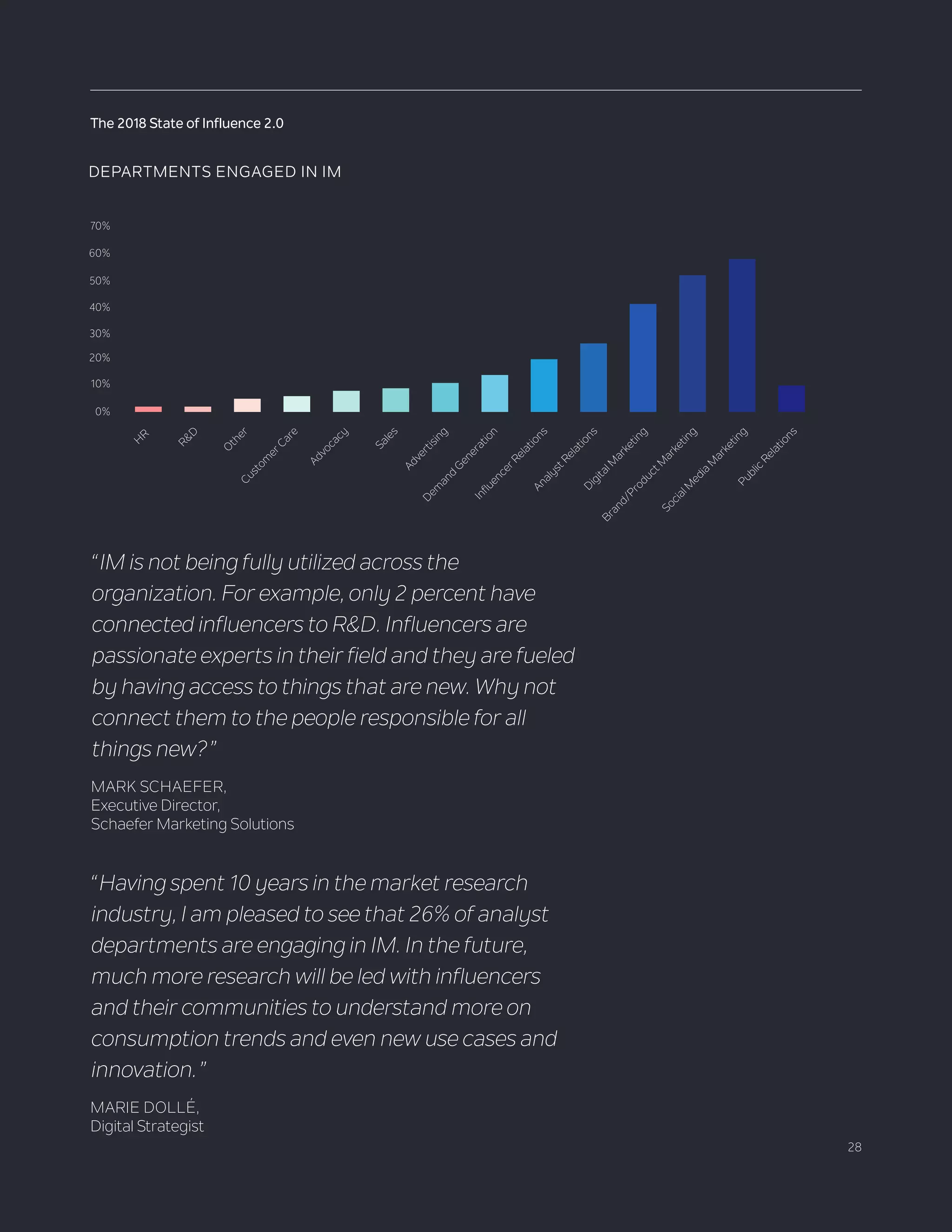
“IM is not being fully utilized across the
organization. For example, only 2 percent have
connected influencers to R&D. Influencers are
passionate experts in their field and they are fueled
by having access to things that are new. Why not
connect them to the people responsible for all
things new?”
MARK SCHAEFER,
Executive Director,
Schaefer Marketing Solutions
“Having spent 10 years in the market research
industry, I am pleased to see that 26% of analyst
departments are engaging in IM. In the future,
much more research will be led with influencers
and their communities to understand more on
consumption trends and even new use cases and
innovation.”
MARIE DOLLÉ,
Digital Strategist
2+2+5+6+8+9+11+14+20+26+41+52+58+10
DEPARTMENTS ENGAGED IN IM
40%
30%
20%
10%
0%
H
R
R&D
O
therCustom
erCare
Advocacy
Sales
Advertising
D
em
and
G
eneration
InfluencerRelations 
AnalystRelations
D
igitalM
arketing
Brand/ProductM
arketing
SocialM
edia
M
arketingPublic
Relations
70%
60%
50%
29
Influencer Marketing Priorities & Impact
Marketers are nearly unanimous
on improving brand advocacy as the
most important goal for IM at 95%, a
stable result compared to 94% in 2017.
The long-list of competing IM pro-
gram targets; however, is as diverse
as it is promising. The top six goals
are separated by the smallest of mar-
gins and are still in flux. But collec-
tively, they highlight the significance
of traditional marketing metrics, reach,
Marketing performance initiatives
typically represent a maturing focus
for influence. In 2018, we see that
growth/performance KPIs are nota-
ble. For instance, IM that focuses on
driving lead generation and improving
sales conversion rates are top priorities
among 69% and 60% of practitioners,
respectively. When compared to last
year however, the numbers dropped
from 74% and 67%. Sales are obviously
critical and this is in no way a state-
ment otherwise. Most likely, influence
is further permeating the enterprise
and efforts are increasingly distributed.
Improving brand
advocacy is the
leading goal for IM,
but objectives also
reflect the diverse
promise for influence
across the enterprise.
20+22+29+43+43+52+60+69+80+83+85+88+89+95
GOALS OF IM
Recruitm
ent / Talent acquisition
Accelerate
productinnovation
H
elp
solve
custom
ersproblem
s
Increase
custom
ersatisfaction/netprom
oterscore
Accelerate
digitaltransform
ation
Reputation
m
anagem
ent
Im
prove
salesconversion
rate
D
rive
lead
generation
Supportproductlaunches
Increase
share
ofvoice
Increase
brand
aw
areness
Im
prove
brand
sentim
ent
Reach
highly
targeted
audiences
Im
prove
brand
advocacy
sentiment, awareness, share of voice
andamplification.
•	 95% - Improve brand advocacy
•	 89% - Reach new/highly targeted audiences
•	 88% - Improve brand sentiment
•	 85% - Increase brand awareness
•	 83% - Increase share of voice
•	 80% - Support product launches
In fact, many other stakeholder groups
are also represented in the top list of
influence goals. These include custom-
er-focused programs, product innova-
tion and human resources.
40%
30%
20%
10%
0%
70%
60%
50%
30
The 2018 State of Influence 2.0
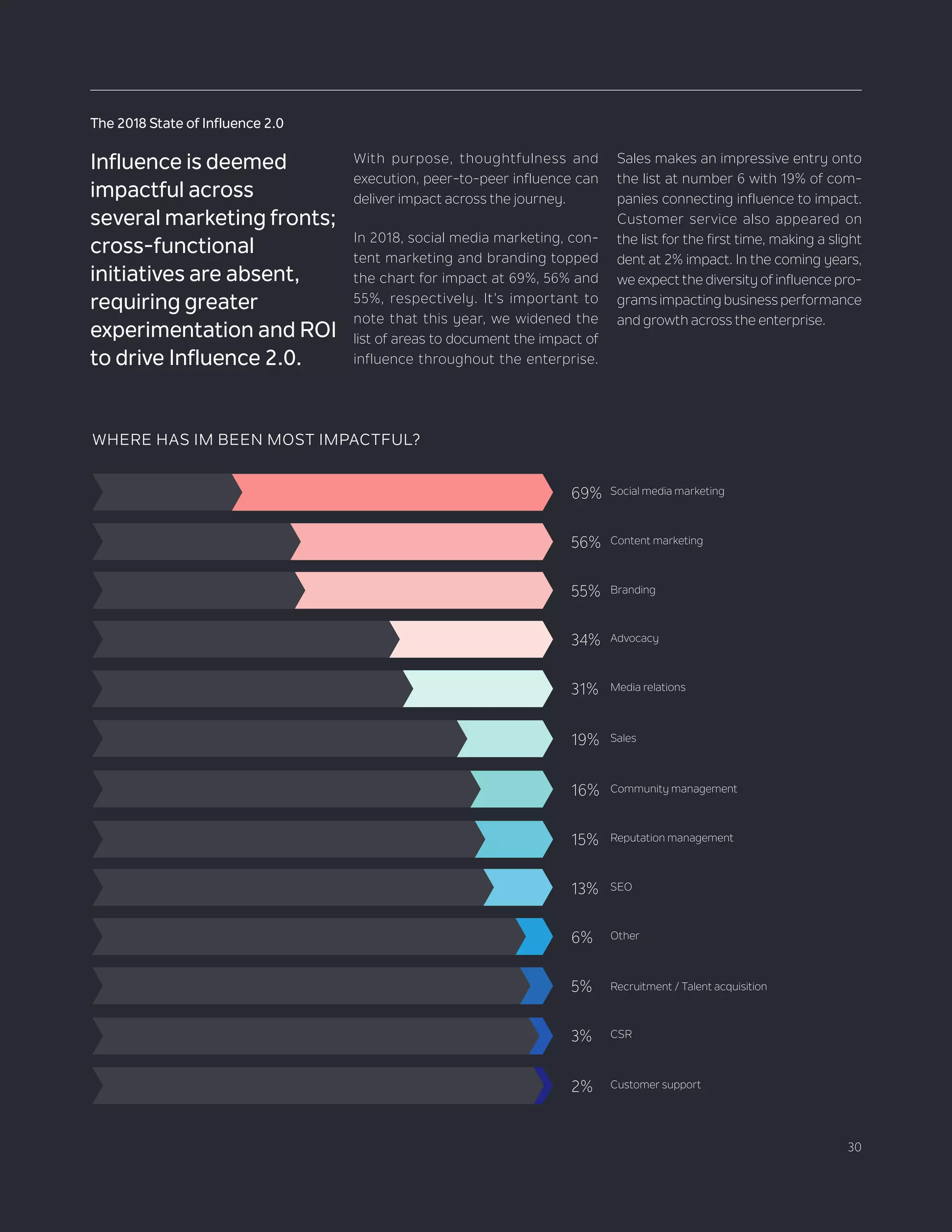
With purpose, thoughtfulness and
execution, peer-to-peer influence can
deliver impact across the journey.
In 2018, social media marketing, con-
tent marketing and branding topped
the chart for impact at 69%, 56% and
55%, respectively. It’s important to
note that this year, we widened the
list of areas to document the impact of
influence throughout the enterprise.
Influence is deemed
impactful across
several marketing fronts;
cross-functional
initiatives are absent,
requiring greater
experimentation and ROI
to drive Influence 2.0.
WHERE HAS IM BEEN MOST IMPACTFUL?
69%
19%
56%
16%
5%
55%
15%
3%
34%
13%
2%
31%
6%
Social media marketing
Sales
Content marketing
Community management
Recruitment / Talent acquisition
Branding
Reputation management
CSR
Advocacy
SEO
Customer support
Media relations
Other
1000
1000
1000
1000
1000
1000
1000
1000
1000
1000
1000
1000
1000
550
150
30
340
130
20
310
190
60
560
690
160
50
Sales makes an impressive entry onto
the list at number 6 with 19% of com-
panies connecting influence to impact.
Customer service also appeared on
the list for the first time, making a slight
dent at 2% impact. In the coming years,
we expect the diversity of influence pro-
grams impacting business performance
and growth across the enterprise.
31
Organizations that invest in IM are
still largely learning on the job. While
the promise of Influence 2.0 is helping
an elite group of progressive compa-
nies more effectively engage peers to
empower their peers across the cus-
tomer journey, the majority of com-
panies are taking a tactical and largely
campaign-centered approach to influ-
encer programs.
The good news is that more organiza-
tions have graduated beyond experi-
menting with IM. The bad news is that
many organizations remain stuck in
a tactical execution of IM strategy. In
the following section, we’ll explore the
differences between these two groups
and highlight the characteristics of
organizations who have truly estab-
lished IM in their core business.
When we compared last year’s matu-
rity data to 2018, we found that com-
panies are moving from experiment-
ing with IM to more tactical programs.
We refer to this as the “tactical trap”
as IM becomes more functional, i.e.
traditional 1.0 broadcast marketing
approaches rather than strategic influ-
encer relationship building or part-
nering with influencers to add value
beyond the top of the funnel through-
out the entire customer journey (aka
influence 2.0).
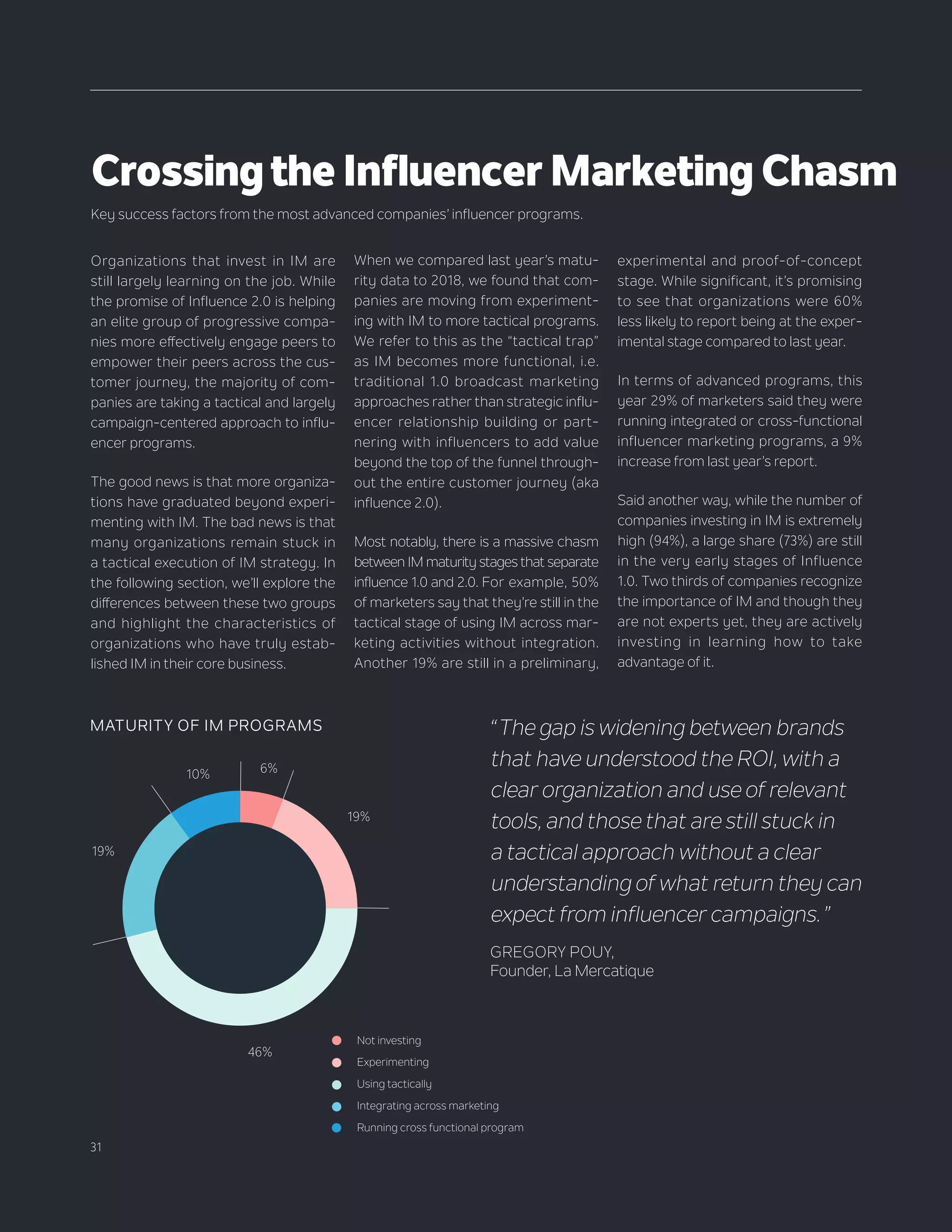
Most notably, there is a massive chasm
between IM maturity stages that separate
influence 1.0 and 2.0. For example, 50%
of marketers say that they’re still in the
tactical stage of using IM across mar-
keting activities without integration.
Another 19% are still in a preliminary,
experimental and proof-of-concept
stage. While significant, it’s promising
to see that organizations were 60%
less likely to report being at the exper-
imental stage compared to last year.
In terms of advanced programs, this
year 29% of marketers said they were
running integrated or cross-functional
influencer marketing programs, a 9%
increase from last year’s report.
Said another way, while the number of
companies investing in IM is extremely
high (94%), a large share (73%) are still
in the very early stages of Influence
1.0. Two thirds of companies recognize
the importance of IM and though they
are not experts yet, they are actively
investing in learning how to take
advantage of it.
CrossingtheInfluencerMarketingChasm
Key success factors from the most advanced companies’ influencer programs.
Not investing
Experimenting
Using tactically
Integrating across marketing
Running cross functional program
MATURITY OF IM PROGRAMS
6%
19%
46%
19%
10%
6+19+46+19+10+L
“The gap is widening between brands
that have understood the ROI, with a
clear organization and use of relevant
tools, and those that are still stuck in
a tactical approach without a clear
understanding of what return they can
expect from influencer campaigns.”
GREGORY POUY,
Founder, La Mercatique
32
The 2018 State of Influence 2.0
‘‘
Case in Point: Interview
with Marc Dusquenoy of L’Oréal
By Olivier Cimelière
Olivier explores how the world’s beauty
leader is scaling its strategic vision of
influencer marketing in 150 countries
with Marc Duquesnoy, Social Media
Performance Director for the L’Oréal
Group’s Global CDO Team.
How and why did
influencer marketing
become one of
L’Oréal’s top digital
strategy priorities?
Influencing our ecosystem has always
been an intrinsic part of L’Oréal’s activ-
ities. Well before digital reshuffled the
cards, hairdressers were the first influ-
encers recommending our products to
their clients. Then magazines, opinion
leaders and celebrities became influ-
ence drivers to nurture this word-of-
mouth, which remains essential for
brand adoption. The rapid ascent of
digital influencers has naturally led us
to broaden our communication and
marketing strategy. These influenc-
ers increase our legitimacy and act as
trustworthy relays to our consumers.
This is all the more important since
consumers are increasingly wary of
advertising and brand messages, but
also better informed, notably thanks
to influencers’ content. Influencers
play a bigger role though, as they cre-
ate trends and trigger new dynamics
around topics closely related to L’Oréal
brands.
For us, it is essential to be active within
these communities and to engage with
authoritative influencers. Based on
their own style of expression and tar-
get markets, each brand identifies and
categorizes influencers. This mapping
may naturally vary depending on mar-
ket segment or country. But generally
speaking, we distinguish two types of
influencers: Those with a huge follow-
ing that transcend national borders,
with whom we tend to focus on short
to long-term contractual relations and
at times exclusivities and co-creations.
Local micro-influencers who are just as
important as they speak to very spe-
cific communities. With them, we are
more in the realm of product sends, or
invitation to an event or an experience.
How is your influencer
marketing strategy
organized, considering
a portfolio of 34
brands and operations
in 150 countries?
Roles are precisely and pragmati-
cally divided up. The International
Marketing Direction is tasked with
developing and overseeing the image
platform for each brand, drawing on
rules and guidelines that local markets
need to follow. It is also in charge of
managing directly some global influ-
encers and internationally renowned
figureheads. However, developing and
consolidating engagement with influ-
encers and their communities is a local
affair split between our Marketing,
Communication and Digital teams,
depending on the brand’s objectives
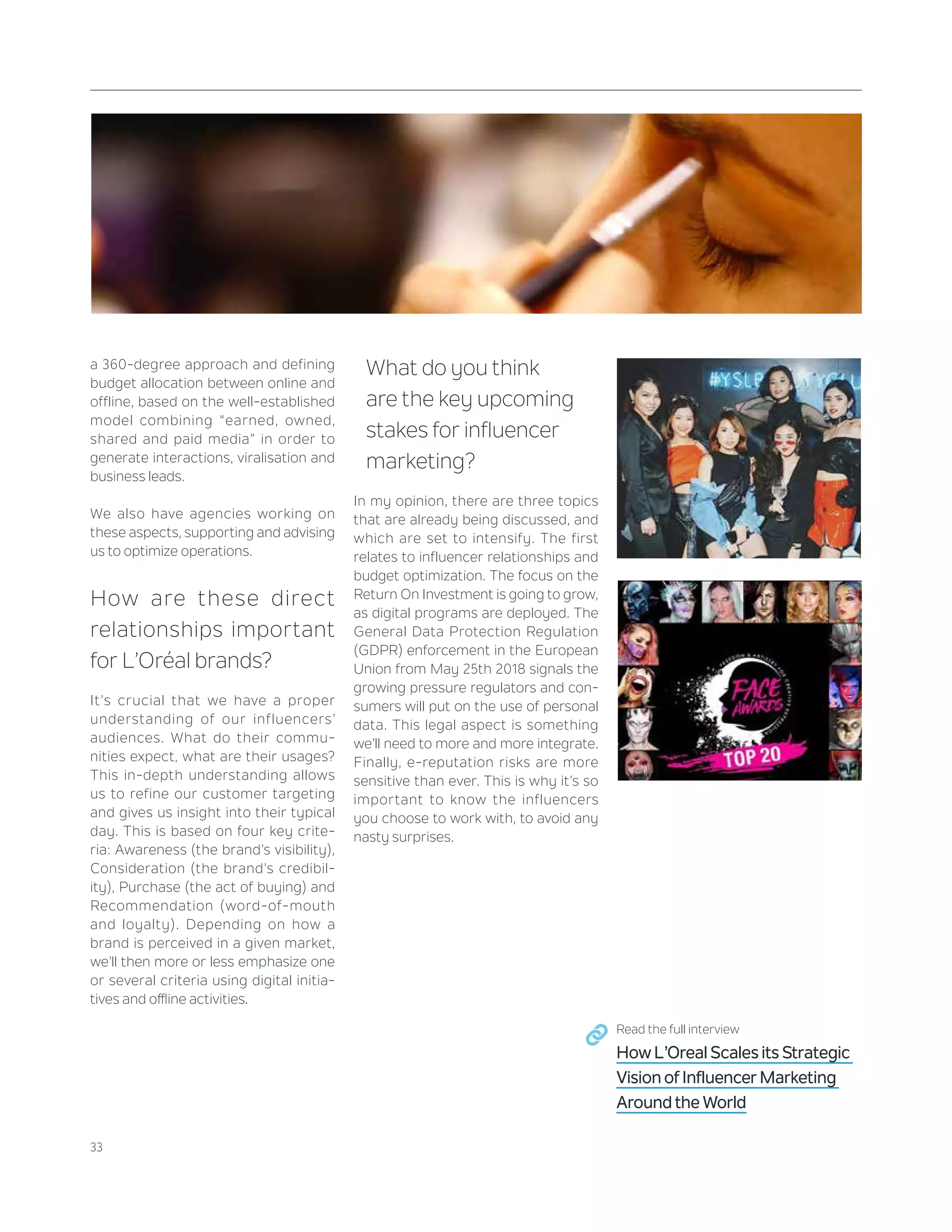
and criteria. An illustration of this is the
Face Awards by makeup brand NYX.
Over the past three years and in dif-
ferent countries, amateurs and pro-
fessionals have been invited to create
their own makeup looks based on given
themes, and upload their creations
to YouTube and Instagram. The best
looks are awarded by a jury made up of
L’Oréal representatives and local influ-
encers.
Which teams are
primarily involved in
influencer marketing
activities?
There’s no specific hierarchy, but
the Communication, Digital and
Marketing teams are always involved.
Because of its PR and press culture,
Communication is central to trans-
forming the relationships with the
influencers and their communities.
Digital is more involved in technologi-
cal aspects such as selecting the pro-
fessional softwares and platforms, like
Traackr, that we use. They also work
on operations and the exploitation of
statistical and analytical data. Finally,
Marketing is responsible for designing
33
a 360-degree approach and defining
budget allocation between online and
offline, based on the well-established
model combining “earned, owned,
shared and paid media” in order to
generate interactions, viralisation and
business leads.
We also have agencies working on
these aspects, supporting and advising
us to optimize operations.
How are these direct
relationships important
for L’Oréal brands?
It’s crucial that we have a proper
understanding of our influencers’
audiences. What do their commu-
nities expect, what are their usages?
This in-depth understanding allows
us to refine our customer targeting
and gives us insight into their typical
day. This is based on four key crite-
ria: Awareness (the brand’s visibility),
Consideration (the brand’s credibil-
ity), Purchase (the act of buying) and
Recommendation (word-of-mouth
and loyalty). Depending on how a
brand is perceived in a given market,
we’ll then more or less emphasize one
or several criteria using digital initia-
tives and offline activities.
What do you think
are the key upcoming
stakes for influencer
marketing?
In my opinion, there are three topics
that are already being discussed, and
which are set to intensify. The first
relates to influencer relationships and
budget optimization. The focus on the
Return On Investment is going to grow,
as digital programs are deployed. The
General Data Protection Regulation
(GDPR) enforcement in the European
Union from May 25th 2018 signals the
growing pressure regulators and con-
sumers will put on the use of personal
data. This legal aspect is something
we’ll need to more and more integrate.
Finally, e-reputation risks are more
sensitive than ever. This is why it’s so
important to know the influencers
you choose to work with, to avoid any
nasty surprises.
Read the full interview
How L’Oreal Scales its Strategic
Vision of Influencer Marketing
Around the World
34
The 2018 State of Influence 2.0
In this section, we explore the differ-
ences between organizations at the
advanced and tactical stages to iden-
tify lessons for those on the path to
Influence 2.0.
We also identified how tactical and
advanced teams work differently.
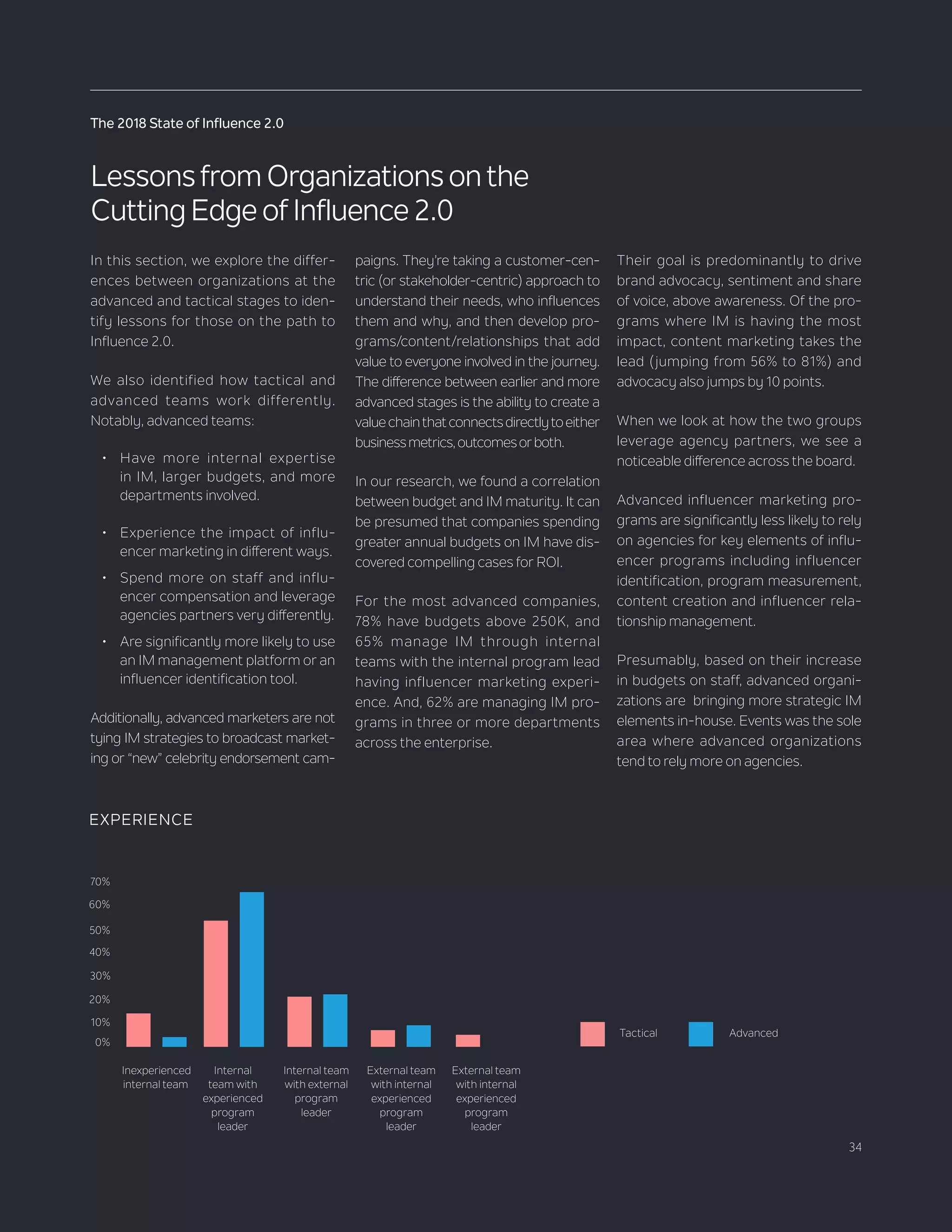
Notably, advanced teams:
•	 Have more internal expertise
in IM, larger budgets, and more
departments involved.
•	 Experience the impact of influ-
encer marketing in different ways.
•	 Spend more on staff and influ-
encer compensation and leverage
agencies partners very differently.
•	 Are significantly more likely to use
an IM management platform or an
influencer identification tool.
Additionally, advanced marketers are not
tying IM strategies to broadcast market-
ing or “new” celebrity endorsement cam-
Lessons from Organizations on the
Cutting Edge of Influence 2.0
paigns. They’re taking a customer-cen-
tric (or stakeholder-centric) approach to
understand their needs, who influences
them and why, and then develop pro-
grams/content/relationships that add
value to everyone involved in the journey.
The difference between earlier and more
advanced stages is the ability to create a
valuechainthatconnectsdirectlytoeither
businessmetrics,outcomesorboth.
In our research, we found a correlation
between budget and IM maturity. It can
be presumed that companies spending
greater annual budgets on IM have dis-
covered compelling cases for ROI.
For the most advanced companies,
78% have budgets above 250K, and
65% manage IM through internal
teams with the internal program lead
having influencer marketing experi-
ence. And, 62% are managing IM pro-
grams in three or more departments
across the enterprise.
Their goal is predominantly to drive
brand advocacy, sentiment and share
of voice, above awareness. Of the pro-
grams where IM is having the most
impact, content marketing takes the
lead (jumping from 56% to 81%) and
advocacy also jumps by 10 points.
When we look at how the two groups
leverage agency partners, we see a
noticeable difference across the board.
Advanced influencer marketing pro-
grams are significantly less likely to rely
on agencies for key elements of influ-
encer programs including influencer
identification, program measurement,
content creation and influencer rela-
tionship management.
Presumably, based on their increase
in budgets on staff, advanced organi-
zations are bringing more strategic IM
elements in-house. Events was the sole
area where advanced organizations
tend to rely more on agencies.
Tactical Advanced
EXPERIENCE
7+95+021+2253+6514+4Inexperienced
internal team
Internal
team with
experienced
program
leader
Internal team
with external
program
leader
External team
with internal
experienced
program
leader
External team
with internal
experienced
program
leader
50%
60%
70%
40%
30%
20%
10%
0%
35
USE OF AGENCIES
50%
60%
70%
80%
40%
30%
20%
10%
0% 15+542+2352+2748+3230+3273+3648+3652+3652+36Program
Measurement
Program
Development
Strategic
planning
Influencer
identification
Event
production
Influencer
outreach and
activation
Content
creation
IRM Future
trends
WHERE IM HAS BEEN IMPACTFUL
3+060%
80%
100%
40%
20%
0% 15+1318+1339+2558+44 6+633+44 3+682+63 27+1381+20 15+13Content
marketing
Community
management
Social media
marketing
SalesAdvocacy CSRBranding Talent
acquisition
Media
relations
Customer
support
Reputation
management
SEO
Tactical Advanced
Tactical Advanced
5+12+17+19+20+27SPENDING AREA
40%
30%
20%
10%
0%
Consulting Technology Agency Influencer
Compensation
Staff Content
creation
36
The 2018 State of Influence 2.0
1000
1000
1000
1000
1000
0%
17%
72%
78%
86%
Not investing
Experimenting
Using tactically
Integrating across marketing
Running cross-functional program
720
780
860
170
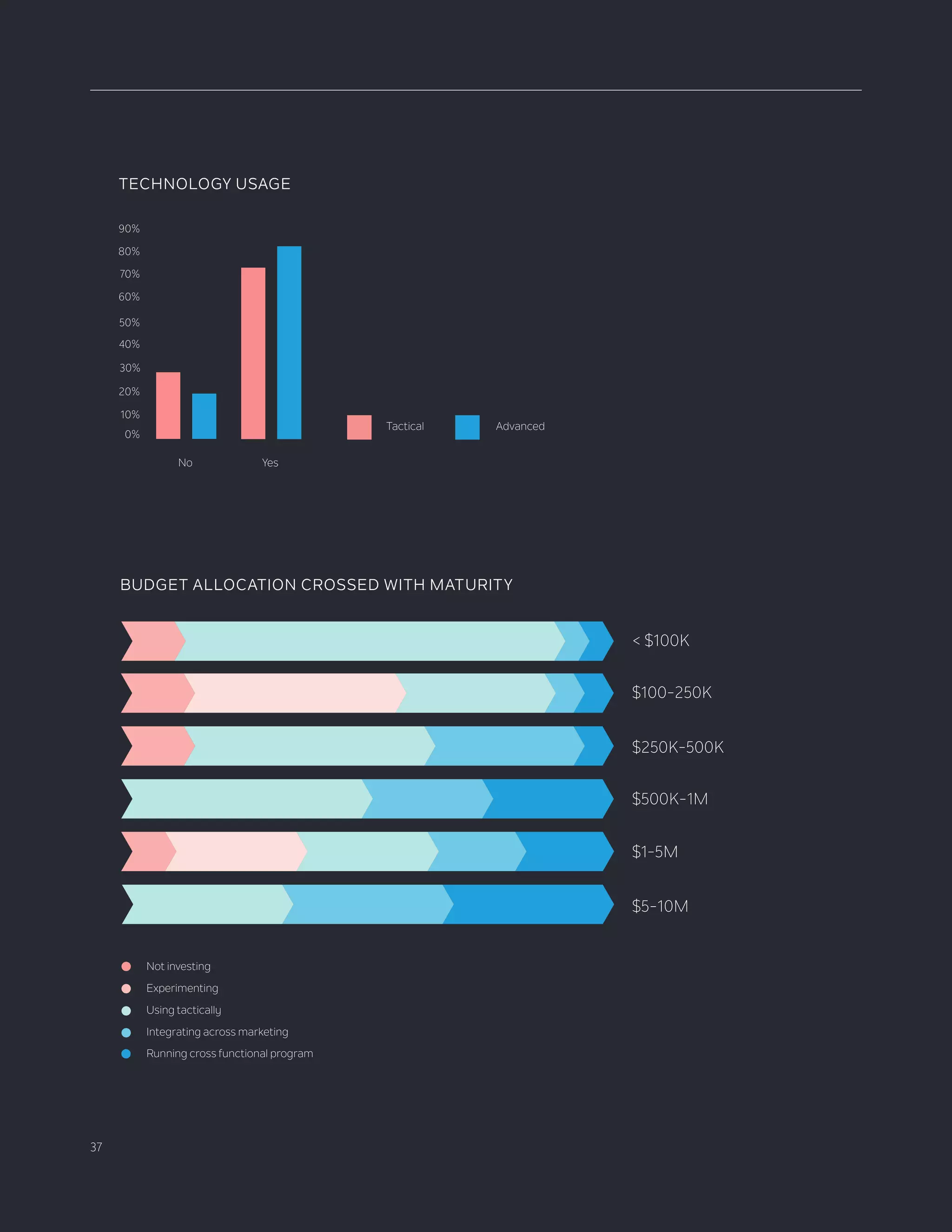
USE OF TECHNOLOGY COMPARED TO IM MATURITY
Many of those we surveyed (44%) are
not using any technology tools and
are instead still manually identifying,
managing, and measuring programs.
However, with maturity comes tech-
nology adoption.
Those companies that are mature
in their adoption and practice of
influence are also the ones leading
the way toward Influence 2.0. For
example, 78% and 86% of companies
running consistent IM campaigns
integrated across marketing activities
and also managing cross-functional IM
Technology adoption comes
with maturing influencer programs.
programs, are investing in technology
to scale influence.
In our previous report, we documented
an emergent state of IM that focused
on influencer relations across the total
customer or employee journey/lifecycle.
This was the basis for Influence 2.0,
one in which influencer relations were
coordinated, cross-functionally. For
most companies, IM is still focused on
marketing. But ultimately, we’re seeing
IM move across other key stakeholder
groups. In more mature companies,
“Competent use of technology with such a data intensive
practice is essential for all aspects of influencer relationships
from identification and qualification of the right influencers
to relationship management and especially measurement.”
LEE ODDEN,
CEO & Founder,
TopRank Marketing
we found that, among companies with
larger IM budgets, cross-functional
programs were more common across
the organization (beyond marketing).
When comparing budget and expe-
rience related to maturity, it is clear:
more experienced companies invest
more in IM and we can suppose that
gaining maturity can be a byproduct of
those investments.
37
BUDGET ALLOCATION CROSSED WITH MATURITY
50+50+790+110
60+60+310+440+130
60+310+500+0+130
250+250+500
180+180+270+270+90
330+330+330
< $100K
$100-250K
$250K-500K
$500K-1M
$1-5M
$5-10M
TECHNOLOGY USAGE
72+8128+19No Yes
50%
60%
70%
80%
90%
40%
30%
20%
10%
0%
Not investing
Experimenting
Using tactically
Integrating across marketing
Running cross functional program
Tactical Advanced
38
The 2018 State of Influence 2.0
‘‘
Case in Point: Interview
with Shelley Macintyre of Sipsmith
By Scott Guthrie
Since 2009, Sipsmith has played a signifi-
cant role in the resurgence of artisanal gin
distilling. I talked with Shelley Macintyre,
Global and UK Marketing Director about
building and scaling a brand through influ-
encer marketing.
How integral is
influencer marketing
to Sipsmith?
Influencer marketing and word-of-mouth
marketing are absolutely central to every-
thing that we do at Sipsmith. Bartenders
were our first key influencers. They love the
quality of the ingredients and the quality
of Sipsmith gin. We hold that if bartenders
believe in the product’s integrity they’ll want
to talk about the product to the person
they’re serving because they’re proud of
what they’re using.
As more people started to like our approach
we then looked at how we could get the
word out in a more scaled way, beyond
only bartenders - whilst always retaining
integrity. We use Traackr to find people who
are already talking about gin. People with
a genuine love for it who are talking about
authenticity and the importance of quality
in gin making. Particularly those interested
in craft, provenance and artistry. We look
at the type of content these influencers
are creating. The look, the feel, the ambi-
ance, the themes. We don’t go after people
just because they’ve got a lot of followers.
Instead it comes down to the relevance of a
person and how their content might reso-
nate with both our audience and theirs.
Once we’ve identified a potential influ-
encer based on relevance and resonance
we introduce them to Sipsmith. We’ll give
them a distillery tour, for instance. You quite
quickly get a sense of whether there is a
shared chemistry once you meet face-to-
face. As our approach towards influencers
has evolved, we’ve become more attune to
what people are searching for online.
Do you pay
influencers?
We have never wanted to pay people to
tell our story. We genuinely believe that if
we’ve got something interesting to share,
and we give people content which is useful
they’ll want to talk about it. For us when you
pay an influencer it’s not a story shared by
someone on behalf of the brand because
they love it, it’s shared because they’re ben-
efiting financially from it. And, I think the
consumer is more than savvy to that now.
When working with influencers we are very
willing to hand over control. We never say
‘would you mind just dropping in this sen-
tence to your piece’ or ‘could you make sure
you write about this aspect’. We believe a
story shared from the heart is a lot more
authentic than a story shared under duress.
Influencer marketing doesn’t have a stand-
alone budget at Sipsmith. It’s integrated
into everything we do. For instance, at
the beginning of the year we hosted Hot
Gin Roof at Ham Yard Hotel in London.
We ran the event in three phases: a
media and influencer night first fol-
lowed by night for the industry which
came ahead of a consumer run of events.
The approach was a success. We benefited
from 80 organic posts during the media
and influencer evening. And, by putting the
media and influencer evening first they were
able to share exclusive content with their
audiences. We didn’t have to put a budget
aside for the influencer event. We were
doing the event anyway for the consumer.
The event was designed to drive publicity
and give 1,500 people a memorable experi-
ence that they could then share with their
friends. That was all without paying people
to be there. Time and salaries are expensive
but that’s our only influencer investment.
39
Sipsmith is now owned
by Beam Suntory.
Has this affected your
approach towards
influencer marketing?
Beam Suntory are a wonderful partner.
They don’t want to change us other than
to help us grow internationally. In fact, they
want to use our word-of-mouth approach
with other brands in their portfolio. They
see it nourishing the credibility with the
broader PR plan. Traackr allows us to collate
all relevant influencer information to use in
a scalable way so that we can sense-check
what is working, learn from it and apply that
knowledge to international markets help-
ing guide those local teams. The distillery
sets and shares best practice and then, in
partnership with key markets, we guide the
strategy. The local markets write the strat-
egy with us and they then execute their
local plans.
How does Sipsmith
measure influencer
marketing success?
The questions we ask are: is the influencer
content and relationship authentic? Is it
relevant? Does the content resonate with
our audience? Is it a win-win relationship?
If we’re ticking those boxes, that’s how we’ll
continue to do it. But, it’s harder to scale
that relationship. It takes time.
Influencer marketing measurement is more
of an art than a science at Sipsmith. We
don’t measure conversions to purchase.
That’s not the point for us. It’s more about
other people sharing our stories. Hearing
about Sipsmith from someone else is more
powerful than hearing it from us as the
brand.
Read the full interview
Scaling an Artisanal Gin
Globally Through Influencer
Marketing
40
The 2018 State of Influence 2.0
For organizations at all
levels, IM still faces chal-
lenges associated with
an emergent discipline;
staff and budget are
scarce and limited ROI
and lack of understand-
ing of the value of IM
impair growth.
There are several key challenges hin-
dering IM expansion within the enter-
prise. Most notably, the two “most
difficult” obstacles are also directly
linked: “Limited ROI data available,” and
“not enough resources (staff and bud-
get).” Teams cannot make the case for
greater budgets nor can they demon-
strate the value of IM towards business
objectives, if they don’t have the data
or insights necessary to do so. And,
the two are essentially tied when com-
bining the rankings of “most difficult”
and “difficult.” Between the two, “lim-
ited ROI” totals 46% and “not enough
resources” adds up to 45%.
Another key area tied to growth, is
the lack of understanding of IM’s
value to the organization. Here 25%
reported that this was the “most dif-
ficult” or “difficult” area to overcome.
When combined, these challenges
symbolize the essential levers for
achieving Influence 2.0. For now, IM is
projecting many of the challenges that
digital marketing faces as a whole:
•	 a lack of resources and support;
•	 difficulty in demonstrating ROI to
gain resources/support;
•	 and a lack of understanding of its
potentialimpactontheorganization.
IM strategists must focus on access-
ing transparent IM data, establishing
measurement frameworks and exper-
imenting with attribution models in
order to overcome challenges demon-
strating ROI. When that happens,
many of the other top barriers will be
removed.
Progressive companies already get
this, which is one of the reasons
their IM programs are successful.
When it comes to planning and mea-
surement, strategies must start
with business objectives in mind
that executives can understand
and value.
Challenges
N
o
clear ow
nership
Lackofcom
m
unication
&
collaborationN
otenough
resources
Lackofexecutive
support
Lackofskillsto
execute
IM
Lim
ited
RO
Idata
available
Lackoftechnology
Lackofunderstanding
ofvalue
ofIM
12+24+45+14+14+46+20+25
WHERE HAS IM BEEN MOST CHALLENGING? (MOST DIFFICULT & DIFFICULT)
30%
20%
10%
0%
80%
70%
60%
50%
40%
41
The rising investment
in influencer programs
requires marketing
and communications
functions to rethink
the structure for how
influencer work is
accomplished across
their organizations.
“Leading with measurement” is akin
to performance marketing or driving
toward meaningful outcomes. The
difference between traditional 1.0 and
more advanced, emergent 2.0 pro-
grams is that metrics evolve as a result
of programs that start to focus on
business impact. As such, strategies,
teams and workflows adapt to perform
against these desired metrics.
Exploring the metrics data we have in
this regard, we can see that as influ-
ence marketing matures, challenges
“ROI remains a challenge, which is no surprise when
many clients still want AVEs for coverage and social!
Moving evaluation further down the path to purchase,
tracking what content and format nudges consumers
nearer to a sale, has to be a USP for influencer marketing.”
TANYA HUGHES,
President,
SERMO Communications, TALK.GLOBAL
ThePathtoInfluence2.0
to measure performance decline. For
example:
•	 Use of agencies (as highlighted
earlier) to support campaign mea-
surement drops from 52% among
more tactical approaches to 36%
for most advanced practitioners.
•	 The challenge to gather and mea-
sure ROI attributable data drops
from 59% in tactical campaigns to
45% for the most advanced pro-
grams.
As brands see the impact of influencer
marketing initiatives throughout the
customer journey, the pressure is on
to develop sophisticated, measurable
programs capable of supporting large-
scale strategies.
The challenge facing organizations
is to develop an influencer marketing
practice that aligns with overarch-
ing business strategy, while ensuring
leadership has the data and reporting
framework required to evaluate suc-
Lead with IM Performance Measurement
cess and prioritize spending.
Often when an organization seeks to
develop their influencer marketing
practice, there is pressure from exec-
utives to demonstrate positive results
before additional resources are allo-
cated. This can lead to a chicken and
egg scenario where marketers find
themselves at a standstill because they
can’t get the resources they require to
deliver the results they need to move
forward.
On the flip side, it’s equally as challeng-
ing to attempt to change your entire
process, workflow and team structure
at once.
The solution to both situations is to
start with influencer marketing mea-
surement. Empower your team
to benchmark the current of your
brand(s) performance among relevant
influencers and measure the perfor-
mance of your company’s influencer
marketing efforts.
42
The 2018 State of Influence 2.0
‘‘
Case in Point: Interview
with Kevin Maleterre of Michelin
By Olivier Cimelière
As the world’s leading tire manufacturer is
ploughing significant investment into online
influencers, Olivier Cimelière interviewed
Kevin Maleterre, B2C Marketing Vice
President for the Michelin group’s Northern
Europe region.
Influence is in
Michelin’s genes, as
per the launch of its
famous restaurant
guide in 1900.
Why and how is
influencer marketing
becoming one of
Michelin’s digital
strategy priorities?
The first and foremost reason we are
ramping up our efforts is our consumers.
In Northern Europe, whether motorcycles,
city cars, sedans or others, 70% of future
tire buyers start with online research. They
read manufacturers’ websites and specialist
media platforms, but they also view con-
tent generated by influencers on Instagram,
YouTube, Facebook, blogs etc. Our studies
show that 40% to 50% of them stick with
their first impressions when the time comes
for them to buy a set of tires. This empha-
sizes just how important it is for a brand like
Michelin to develop a closer relationship
with these communities. Influencers are
excellent bridges between them and us.
Then, we want to enhance our user expe-
rience. The idea is to engage consumers
more as users than just buyers. We want to
be present in their daily lives and offer them
brand experiences. To achieve this, we strive
to work all points of contact with our con-
sumers throughout the consumer journey.
In this sense, influencers are key partners
we’re inviting to events to learn more about
our products and services. They then go
on to describe and share their experience
with their communities. The tire is also a
slow-moving product: at best, in countries
such as Austria or Switzerland where the
change of summer / winter tires is required,
the consumer only returns to the store
twice a year. Using the influence of influenc-
ers throughout the year allows us to anchor
the brand in the daily lives of our customers.
What key questions
need to be asked
before developing
an influencer
marketing strategy?
The first prerequisite is to ensure that the
digital influencer marketing strategy is
aligned with the overall marketing strat-
egy. Next, depending on the size of the
target markets, we work to fine-tune our
segmentation, as we’ve done in Germany,
the UK, Switzerland and Austria. In parallel,
there is also another crucial segmentation
work to be done. The tire is intrinsic to the
criteria of consumer behavior. Sports car
enthusiasts want technologically advanced
tires. Off-roaders want durable tires. Those
who have family vehicles will prefer com-
fort for long journeys. City-dwellers who
multiply short journeys want adapted ones.
Transportation professionals need tires that
endure heavy loads. Hence the importance
of the granularity of our targeting in our
communication and marketing actions.
43
Who is responsible for
your influencer
marketing strategy and
who oversees activities
relating to operational
tools, processes and
shared best practices
development?
Like many major companies, we work within
a structured organizational matrix. To keep
things simple, I’ll describe it as three levels
of responsibility. In the marketing team, we
have “Segment managers” whose role is to
define the positioning and the intrinsic attri-
butes of each range of tires. Then, we have
within our team a “Customer Experience
management” who defines the strategy for
each segment and a Social Media manager
who sets to music and implements influ-
encer strategy for each country in ques-
tion. He is attached to the communication
department but works closely with mar-
keting and deals with all the segments. For
some special campaigns, we work with the
external communication, internal commu-
nication and press relations teams.
With so many market-
specific criteria and
constraints, does
it become tricky to
define the influencer
profiles that will
have the most
effective impact?
That’s precisely where the benefit of a tool
like Traackr is precious, making it easy for us
to identify the right influencers. That said,
we have two recurring categories of influ-
encer irrespective of country:
“Vertical” influencers, who talk about cars,
mechanics, transport, with a stronger focus
on industry and technology.
“Horizontal” influencers, who are generally
more interested in lifestyle. As we said ear-
lier, each tire is linked to specific technical
expectations from drivers, and different
well-defined lifestyles.
It’s up to us to source and mix relevant influ-
encers from both categories.
However, we don’t limit ourselves to influ-
encers who already have huge communi-
ties and followings and/or are media stars or
brands themselves. This type of influencer
can sometimes have excessive financial
demands. In these cases, we prefer to skip
them. Some have even come back to us
reviewing their demands after realizing they
had missed out on an amazing opportunity.
It’s crucial that the relationship between the
brand and the influencer remains authen-
tic. Without authenticity, the exercise is
pointless. That’s why we also follow other
influencers who may have a smaller reach
or ability to go viral but a tone of voice and
personality that make us want to involve
them to build lasting relationships and gen-
erate more engagement. That being said,
it’s not always easy. The influencer world is
a volatile one.
Read the full interview
Michelin Goes Full Speed
Ahead with Influencer Marketing
44
The 2018 State of Influence 2.0
Focus on the Customer Journey
27+42+50+52+65+68+77+80+83+87+88+88+92+93
HIGHLY IMPORTANT AND IMPORTANT FUTURE OBJECTIVES
40%
30%
20%
10%
0%
Talent acquisition
Accelerate
productinnovation
H
elp
solve
custom
ersproblem
s
Accelerate
digitaltransform
ation
Increase
custom
ersatisfaction
M
anage
reputation
D
rive
lead
generation
Im
prove
salesconversion
rate
Supportproductlaunches
Increase
share
ofvoice
Im
prove
brand
sentim
ent
Increase
brand
aw
areness
Im
prove
brand
advocacy
Reach
highly
targeted
audiences
100%
90%
80%
70%
60%
50%
In the next three years,
businesses aim to
shift from quantity to
quality as influence
expands its potential
beyond marketing.
The shift from broadcast market-
ing (influence 1.0) to peer-to-peer
engagement across the user journey is
slow, but it is unfolding. While IM today
is largely focused on marketing, influ-
encer marketers are thinking ahead
to a more holistic genre of influence
that reshapes customer (and all stake-
holder) journeys. Most notably, future
IM objectives are prioritizing highly tar-
geted peer groups and their commu-
nities vs. 1.0 broadcast or “spray and
pray” strategies.
In the next three years marketers see
IM as possessing Influence 2.0 traits,
shaped by diverse possibilities and
areas of impact. At the top of the list,
companies seek to reach highly-tar-
geted audiences (93%) through IM.
In 2017, we captured a closely related
goal, “reach new targeted audiences,”
which ranked third last year at 88%.
Quality engagement is where influ-
encer relations begins.
The remainder of top goals are still
reflective of the marketing and com-
munication departments’ reign over
IM. They include the following:
93% - Reach highly targeted audiences
92% - Improve brand advocacy
88% - Increase brand awareness
88% - Improve brand sentiment
87% - Increase share of voice
83% - Support product launches
As the list continues, the promise of
Influence 2.0 takes shape. Top goals
expand beyond marketing, highlight-
ing the realization that IM can impact
the sales funnel. For example, “improve
sales conversion” climbed from 74% in
2017 to 80%, “drive lead generation”
rose from 67% to 77% and “increase
customer satisfaction” remained sta-
ble with an increase from 63% to 65%.
Cross-functional goals also spanned
the entire customer journey and lifecy-
cle ranging from customer satisfaction
to customer service to product innova-
tion and employee recruitment.
45
1000
1000
1000
1000
1000
Influencer marketers
aim to integrate IM in all
marketing activities, sup-
ported by larger budgets
and run by a dedicated
IM group; progressive
practitioners are working
toward cross-functional
IM beyond marketing.
In the next three years, 63% of those
we surveyed are driving to integrate IM
in all marketing activities and 33% envi-
sion IM as becoming a primary area for
digital marketing investment. Influence
in the next three years should also be
run by a dedicated function according
to 27% of participants.
Looking beyond the realm of market-
ing and onto the near horizon, 33%
of participants would like to see the
role of influence as a cross-functional
discipline that will expand across the
enterprise. This is the foundation for
Influence 2.0. The work between the
state that’s presented in this report
and the manifestation of enter-
prise-wide, cross-functional collabo-
ration is an area, which requires lead-
ership and diligence. This is where
influence will see its greatest strides in
innovation and ROI.
In 2018 - 2019, these goals must shift
from a list of future objectives to
immediate strategies. This requires an
intentional effort by those who cur-
rently “own” or are leading influence
investments or groups that are operat-
ing in smaller pockets to include other
cross-functional groups in planning,
collaboration and measurement. There
is no best practice as to who starts
those conversations, only that they
need to take place, and earn the sup-
port of an executive sponsor to sanc-
tion cross-functional influence.
WHAT ROLE DO YOU SEE IM HAVING IN FUTURE?
23%
27%
33%
33%
63%
A catalyst for digital transformation
A dedicated function
A primary area of digital marketing investment
A cross-functional discipline beyond marketing
Integrated in all marketing activities
330
330
630
270
230
Integration & Cross-Functional Collaboration
46
Influence 2.0, V2: The Future of Influencer Marketing
Influence 2.0 is still in its dawn. And,
influence 1.0 stands at a crossroads.
The gaps that separate the stages
between influence 1.0 and 2.0 are sig-
nificant, with an emphasis on practi-
tioners who are languishing in tactical
purgatory. The chasm between the
campaign-driven tactics and those
who have graduated to more mean-
ingful IM engagement is incredible.
Only a small group of those we studied
are organizing around IM and employ-
ing in key functions across the enter-
prise. Those advanced companies
have invested in internal experts and
technology so that the entire company
can rally around an important, global
strategy to make consumers love
their brand. For the time being, there
is a disparity across experimentation
and maturity and without vision, strat-
egy and execution, IM will continue to
slowly advance.
But, our research shows strong indi-
cators that IM, when considered as a
strategic tool for customer engage-
ment beyond experimentation and
campaign tactics, is on a promising
path. And this sets the stage for what’s
possible. There’s much work to do and
that’s why this is such a promising
time.
For now, engaging influencers in
various aspects of digital marketing
campaigns is trendy but increas-
ingly common. While helpful and
engrossing, it can distract from the
bigger picture. At the same time,
building relationships with key influ-
encers who maintain communities
that focus on critical touchpoints in
the customer/employee journey is
underutilized. However, this, com-
bined with cross-functional collab-
oration, will spread influence across
customer and employee journeys
to pave the way to Influence 2.0.
Connecting the dots between influ-
encer and customer value and busi-
ness impact will also lay the foun-
dation for IM strategies that go
beyond traditional campaigns.
Someone has to take the lead.
Marketing is more than a top-of-
the-funnel discipline, especially now
that strategic influence demon-
strates value in key moments
before, during and after transac-
tions. It’s difficult to see the broader
impact when practitioners are so
focused, and measured, by their
work on their immediate fronts.
Conclusion
However, this is exactly the moment
when IM champions can look to other
groups to align IM’s capabilities with
their respective goals.
There’s an “influencer for that”.
Whomever the audience, there’s
always “an influencer for that.” The
opening here for marketers, and mar-
keting executives, is to realize that
influence and strategic marketing
overall, impact business performance
and growth as purposeful engagement
spans the entire customer/employee
journey.
Customers and employees are
seeking direction, insight and
engagement. Influencers are
INFLUENCE 2.0INFLUENCE 1.0
Focus: Top of funnel
Target: Broadcast
ID: Popularity
Style: Endorsements
Metrics: Reach
Value: Brand Association
Focus: Customer Journey
Target:1 to 1 to Many
ID: Authority
Style: Influential experiences
Metrics: Growth with outcomes
Value: Relationships & loyalty
47
Customers and employees are
seeking direction, insight and
engagement. Influencers are already
connecting to them in other facets
of their work and lives. Marketers
must understand what people
cherish throughout the entire value
chain to guide influencer strategy
and metrics.
1.
2.
3.
4.
To earn greater support and respect
from senior executives and ultimately
the board, marketers must focus on
IM that delivers value to communities
of influence and also create a path of
value back to the brand. IM isn’t just a
facet of digital marketing. It is a direct
bridge between brands and their
real world markets. As such, market-
ers must speak the language of the
C-Suite. This means that campaigns
must be linked to business impact and
some forms of ROI, directly or indi-
rectly, through strategic attribution.
Influence isn’t relegated to top of the
funnel activities such as brand aware-
ness and share of voice. Influence can
and should operate cross-function-
ally across the enterprise to engage
customers and influencers through-
out their journey. Among advanced
brands, IM and digital marketing are
focusing on growth and performance
without losing sight of relationships
and the value of peer-to-peer engage-
ment.
This introduces an internal opportu-
nity, and a strategic role, for “influence
as a service” to support all areas of
the business. It’s clear that the under-
standing of what IM is and what’s pos-
sible is distributed. This is a chance for
IM leaders to partner with cross-func-
tional groups to add value to critical
touchpoints that define the customer/
employee journey. Through influenc-
ers, content and updated touchpoints,
IM must invest in “marketing for the
marketing” to teach other stakehold-
ers in the organization about the value
and capabilities of value-added IM.
The differences between the progress
made from 2017 to 2018 is modest, but
encouraging. There is plenty of room
for more ambitious advancement. And,
those who take the initiative will join
the elite. Now, the question is, what will
progression look like in our next report.
If marketers and IM stakeholders have
anything to say about it, it’s that this is
a clear and present moment to blaze a
path from incrementalism and exper-
imentation to bridge the gap between
Influence 1.0 and Influence 2.0.
Influencers to followers
Who reaches customers/employees and why?
Communities of influence
What are the pillars of these relationships?
Brands to communities of influence
What value can the brand deliver?
Communities to brands
What value can communities return to brands?
48
The 2018 State of Influence 2.0
This research study was commis-
sioned by Traackr to understand the
current and future state of influencer
marketing in leading enterprises.
The research was conducted by
Traackr with the guidance of Brian
Solis from Altimeter using an anony-
mous online questionnaire between
October 2017 and January 2018. In
total, 118 brand strategists and mar-
keters from leading companies from
around the world responded. These
included Microsoft, Google, Samsung,
Nissan, L’Oréal, SAP, Pernod-Ricard
and many more.
This custom report is sponsored by
Traackr. While the research in this
report has been informed by the qual-
itative research study, all analysis and
insights are independent and repre-
sent Altimeter’s body of research.
118 brand strategists and marketers
from leading companies around the
world including Microsoft, Google,
Samsung, Nissan, L’Oréal, SAP,
Pernod-Ricard and many more.
73% of respondents come from com-
panies sized 10,000+, 17% of respon-
dents come from companies sized
1,000+, 66% come from either Fortune
500 or Forbes Global 2000
Of the respondents, 25% are CMOs or
higher, 40% are VPs or higher, 81% are
Directors or higher.
Methodology
Brian Solis is a digital analyst, anthro-
pologist, and also a futurist. Solis stud-
ies the effects of disruptive technol-
ogy on business and society. More
so, he humanizes these impacts to
help people see people differently and
understand what to do about it. He
is an award-winning author and avid
keynote speaker who is globally rec-
ognized as one of the most prominent
thought leaders in digital transforma-
tion, experience design and innovation.
Traackr partnered with Brian on the
“future of influence” because of his pio-
neering work in digital influence. With
roots in the 1990s, he helped shape
how digital influencers “become influ-
ential,” developed best practices in
influencer relations and measurement,
formed a practice in 1999 dedicated to
influencer engagement and also rose
to become an influencer in his own
right. Brian also authored a ground-
breaking research report on “The Rise
of Digital Influence” in 2012, which is
still regarded as one of the most com-
prehensive studies and forward-think-
ing pieces on the subject. Brian has
also authored several best-selling
books including What’s the Future of
Business (WTF), The End of Business
as Usual and Engage! His latest book
“X,” explores the intersection of where
business meets design to create
engaging and meaningful experiences.
About Brian Solis
49
50
Makeinfluencer
relationsapriority
now.
Learn how Traackr’s IRM capabilities can enable your brand to
effectively manage, measure and scale its influencer strategy.
TALK TO US

State of influence 2.0 by Brian Solis and Traackr

  • 1.
    1 The 2018 State ofInfluence Sometimes the best way to change the future is to change your perception of what’s possible. BY BRIAN SOLIS Sponsored by Traackr
  • 2.
    2 Altimeter, a Prophetcompany, is a research and strat- egy consulting firm that helps companies understand and take advantage of digital disruption. In 2015, Prophet acquired Altimeter Group to bring forward-thinking digi- tal research and strategy consulting together under one umbrella, and to help clients unlock the power of digital transformation. Altimeter, founded in 2008 by bestsell- ing author Charlene Li, focuses on research in digital transformation, social business and governance, cus- tomer experience, big data, and content strategy. Traackr builds Influencer Relationship Management (IRM) technology that enables brands to effectively manage, measure and scale influencer strategies, while maintaining authenticity. This gives CMOs and their teams the ability to align influencers along the customer journey, impacting buying decisions at each moment- of-truth with trustworthy touch points. Traackr’s SaaS platform powers leading influencer programs for B2B and B2C global enterprises such as L’Oréal, The Coca Cola Company, Samsung, Microsoft, Intel, SAP, Orange, USAA, Merck, Roche and Capital One. Traackr We would like to thank our agency partners that have helped us gather survey results:
  • 3.
    3 4 THE STATE OFINFLUENCE 2.0 : 18 MONTHS LATER 31 6 CROSSING THE INFLUENCER MARKETING CHASM 46 CONCLUSION & METHODOLOGY 41 THE PATH TO INFLUENCE 2.0 48 ABOUT BRIAN SOLIS TableofContents
  • 4.
    4 The 2018 Stateof Influence 2.0 Welcome to a new era of marketing; an era where brands are shaped by the people who experience them. In a world where most consumers are con- nected, the experiences that they have and share online collectively shape their perceptions, impressions and actions. To a certain extent, all con- nected consumers are becoming influ- ential in their own ways. When customers or employees need information, direction or meaningful engagement, they go to the people they trust. As most consumers live in digital or mobile-first worlds, their net- works of trusted authorities and peers reflect personal and professional inter- ests. Many go online first to make deci- sions and seek the guidance of their networks. And at the same time, many spend hours a day online and, in those moments, they are open to relevant engagement by the people they follow or those whom their friends follow. Influence has never been more import- ant. Every year, global communica- tions marketing firm Edelman pub- lishes its “Trust Barometer” report that captures the sentiment of trust in a variety of industries and scenarios. In its 2017 edition1 , Edelman learned that the credibility of CEOs was at its lowest level ever. At the same time, the report found that trust in peers, or “a person like yourself,” is as cred- ible a source of information about a company as a technical or academic expert. Without trust, brand market- ing may fall upon skeptical, distrusting or altogether inattentive audiences. By partnering with the right influenc- ers, or people who tell the right stories in the right context by delivering value at each step, brands can reach people through those they trust while earning trust in the process. Introduction
  • 5.
    5 In 2017, Ipartnered with influencer relationship management (IRM) soft- ware provider Traackr to study the state of digital influence. We observed that influencer marketing (IM), at large, is one of the most promising and still underutilized disciplines in the digital marketing mix. To help, we introduced “Influence 2.0,” a new paradigm for digital influence that focuses on peer- to-peer engagement, beyond word of mouth, to add value to customer/ employee experiences throughout their journey — beyond marketing. Influence 2.0 represents a significant shift from everyday IM and marketing in general, to a more human-centered genre of influencer and community relations. Strategic and thoughtful influence offers the ability to directly reach desired markets through the peers they admire, respect and trust, using their native connection and commu- nication methods. IM as we know it today however, extended traditional marketing approaches to new chan- nels through new voices. Public/media relations, broadcast marketing, celeb- rity endorsements, et al., plugged influencers into campaigns and exper- imental pilots to amplify content and messages through their followers and vibrant communities. Influence 2.0 creates a pivotal moment for marketing and for brands. It shifts from one-to-many and many-to- many models of the past to a one-to- one-to-many approach focused not only on delivering important informa- tion, creating awareness about a topic or driving desired outcomes, but also on engaging people (brand, influenc- ers and community) in ways that are mutually beneficial and builds trust between people and brands where tra- ditional marketing erodes it. We are not there yet, but digital influ- ence is making progress. This year, we set out to survey the landscape of more than 100 digital marketers once again to track the state and evolu- tion of Influence 2.0. In this report, we will also share trends, challenges and opportunities to help marketers fur- ther make the case for Influence 2.0 and shift to peer-to-peer influencer relations. The Rise Of Influence 2.0
  • 6.
    66 The 2018 surveyincluded 118 digi- tal marketers at enterprise organi- zations ranging from managers on the front lines to directors, VPs and CMOs. The vast majority of partici- pating companies employed 10,000+ people (73%), including Fortune 500 (38%) and Forbes Global 2000 (28%) businesses. This year, we also sought a balanced mix between B2B and B2C companies. In this round, 31% serve business customers, 22% serve con- sumers and 47% serve both. Amongst individual respondents, we found that 46% hold B2C focused roles, 39% focus on B2B and 15% focus on both B2C and B2B in their specific remits. TheStateOfInfluence2.0 CMO or higher VP Director 10,000+ 1,000+ 100 Head/Lead Manager Other LEVEL OF RESPONDENT SIZE OF CORPORATION 73+17+10+L4+15+30+10+25+16+L 10% 73% 17% 4% 15% 30% 10% 25% 16%
  • 7.
    77 B2B B2C BOTH B2B ANDB2C B2B OR B2C ORGANIZATION B2B OR B2C REMIT From here, we set out to understand where influence sits within the orga- nization, the top priorities for influ- ence, supporting ecosystems, existing challenges and future opportunities. While dedicated influencer relations groups are starting to emerge within organizations, ownership is still in flux. Before there can be an enterprise-wide vision, cross-functional alignment and a synchronized effort across customer journeys, influence has to start and propagate through practice. In its ear- lier stages, influence is often run in one or more disparate pockets through- out the organization with one of those groups aiming to “own” IM. Over time, owning IM can lead to efforts at orga- nizing distributed programs, develop- ing expertise and making the case to secure budget and resources. These efforts can also serve as a Center of Excellence (CoE) for the rest of the organization to establish gover- nance, standards and coordination. B2B B2C BOTH B2B AND B2C 39+46+15+L29+21+50+L 15% 39% 46% 47% 31% 22%
  • 8.
    8 The 2018 Stateof Influence 2.0 2% 2% 2% 43% 27% 14% 10% 2+10+2+43+27+2+14+L7% 31% 17% 28% 3% 18% 18% 42% 36% 4%4% 4% 24% 4% 60% 3+7+42+31+17+L 4+4+60+24+4+4+L 18+18+36+28+L OWNERSHIP CROSSED WITH B2C OWNERSHIP CROSSED WITH B2B OWNERSHIP FOR BOTH B2B & B2C Customer Care Digital Influencer Relations Marketing PR/Comms Sales Social Media Who Owns Influencer Marketing? Customer Care Digital Marketing Digital Influencer Relations Marketing PR/Comms Social Media PR/Comms Sales Social Media Digital Social Media Marketing PR/Comms “Now Marketing has to meet PR! With Influencer Marketing, companies cannot separate anymore marketing from PR.” NICOLAS BORDAS, VP International, TBWAWorldwide InfluencerMarketingSponsorship
  • 9.
    9 “Organizations need to implementthe appropriate standards, workflows and technologies to ensure every member of their team adopts a consistent approach to influencer outreach and relationship management. Establishing a global center of excellence to define a common set of IM standards that your local teams can tailor for their country or region is critical for success.” JOEL BACKALER, Author of Digital Influence & MD at Frontier Strategy Group In this year’s research, we found that marketing continues to maintain own- ership of IM at 43%. However, this num- ber has decreased from 70% in 2017. This means that ownership is spread much wider across the organization this year. The broader distribution of ownership could be a sign of heightened focus on IM rather than an afterthought. Public relations (PR) is now the sec- ond most cited leadership group for IM at 28%, jumping from 16% last year. There’s also a noteworthy addition this year — the rise of a dedicated depart- ment for IM. While just a blip compared to the other groups, it is a significant entry in the fact that influencer rela- tions indicate the potential formaliza- tion of a CoE or internal strategic con- sultancy or agency. IM appears to be reaching the CMO dashboard with 31% of participants citing CMOs as their primary program sponsor. Equally, 31% named VPs as their executive sponsor, followed by directors at 18%. As IM matures, it will consume a larger portion of CMO dashboards. By connecting the dots between influence and ROI, IM will then be able to help CMOs make the greater case for influence, and the overall role of digital marketing, as a key driver for business performance and growth. Influence is still in its early phases. Who owns or practices it within the enter- prise and where influence is focused is still all over the map, though it remains a function that belongs mainly to upper and senior leadership. Director Manager Other Who Is The Executive Sponsor? CEO CMO VP4+33+33+22+7+1+L 4% 1% 33% 33% 22% 7% Influencer marketing is equally sponsored by CMOs and VP-level executives.
  • 10.
    10 The 2018 Stateof Influence 2.0 Case in Point: Interview with Chelsea Riggs of amika By Evy Wilkins The Brooklyn-based professional hair care brand, amika, has built its name on the anti- thetical premise that beauty is perfectly smooth and straight. I spoke with Chelsea Riggs, its Brand President to learn how the brand connects with consumers. How is your approach to influencer marketing dif- ferent than other beauty brands? amika has worked with influencers long before they were labeled “influencers.” If you can believe it, there was a time when many brands looked at influencers as a phase or a waste of money that wouldn’t translate into sales. Even with limited bud- gets in the beginning, we saw the power and scalability of influencer marketing, and so we put the majority of our investment into these partnerships. Our approach to influ- encer marketing differs because we treat influencers like brand ambassadors, and not as media buys. Even with our paid campaigns, we collab- orate on content and give the influencers creative freedom - of course within some guidelines and boundaries - but authentic- ity is imperative for all our partnerships. We are in constant search of the perfect influ- encers to partner with who embody the amika customer values, regardless of race or gender. We also incorporate their con- tent into our distribution. For example, we look to influencers to create how-to videos for our Sephora product pages to authenti- cally demonstrate best usage. As you’ve scaled your program from a few vloggers to over 1,000 influencers, what have been the biggest challenges to overcome? Our biggest challenge was to retune the mindset of how our team functioned. We knew early on that influencers were where we wanted to spend our money, but it was a process to change the thought process of our team. For example, our PR team needed to look at editors as influencers and influencers as editors. Our social media team went from focusing solely on creating our own content to working with influenc- ers for 75% of our content. Our marketing plan went from launching to clients first, to launching on social first. Overtime, we tran- sitioned from one-off campaigns to an inte- grated influencer practice. What types of organizational and talent decisions did you have to make as you grew your program from one- off campaigns to an integrated practice? We restructured our marketing team from traditional silos to incorporating influencer marketing into every role. As a professional brand, we work with many celebrity and “insta-famous” hairstylists in addition to consumer influencers. Our PR team is not only focused on traditional consumer and trade media, but also on partnering with professional stylists who are influencers on their own and are often featured in press. Our social team is integrated to collabo- rate on content, community management and influencers, while each team member focuses on a specific type of influencer, such as micro influencers, unpaid vs. paid, or brand ambassadors.
  • 11.
    22+23+23+26+27+27+30+30+40+49 11 Was that cross- collaborationdifficult to establish? What advice would you share to integrate influencer marketing throughout brand strategies? In the beginning, it was somewhat difficult to establish cross-collaboration within our team, but the result was exceedingly worth- while. My advice to anyone trying to inte- grate influencer marketing throughout their brand strategies is to first incorporate a level of responsibility in each department head. Our entire team participates in some form at amika - we even involve our sales team in the influencer identification decision-mak- ing process. They also help us determine which products to promote with influenc- ers and what kind of influencer-generated content will resonate best with our clients. Today, everyone on the marketing team plays some role in influencer marketing and we have hired team members specifically for integrated influencer marketing. With influencer marketing in-house, how do you maintain authenticrelationships with so many people? Maintaining personal relationships with each of these influencers has definitely been a challenge, however, we felt strongly that keeping this in-house was the only way to ensure this was possible. We did attempt to work with agencies in the past to help execute against a specific campaign, however, the results and authenticity of the campaigns suffered. In the early days, we hired very junior social talent, which led to some turnover, and coupled with the fact that we tracked everything in Excel, we ended up losing a lot of data. I realized that if we truly wanted influencer marketing to be the heart of our marketing strategy, and not just a tactic, we needed to restructure the team and bring on software to make us more efficient. I understand you stopped tracking EMV at amika. What metrics do you track? We do not use Earned Media Value (EMV) as a metric, because for amika, it’s not about the media equivalent cost, it’s about achieving a specific marketing goal. On a weekly basis, we are looking at activated influencers per tier, the number of brand mentions per influencer, our total share of voice and influencer response rate. For spe- cific campaigns, we will look at impressions, total engagement, CPM and CPE. Read the full interview “Staging a Brand Rebellion: How amika Scales Authentic Influencer Marketing”
  • 12.
    12 The 2018 Stateof Influence 2.0 For 2018, marketing priorities are diverse with performance and growth efforts gaining prominence. Almost half of marketers (47%) see “raising brand awareness” as the most important marketing priority for 2018. This is important as influence can prove instrumental in achieving this goal. Even though influence is but one of many on the list of tools for marketers to reach desired audiences, connect- ing to and through the right voices When we compare marketing priorities between B2B and B2C, we see a notable difference in where companies are focusing resources. While raising brand awareness is the top priority for both (58% B2B and 49% B2C), the second and third top priorities differ. The second and third B2B priorities are generating leads (55%) and generating brand advocacy (36%). Whereas top B2C priorities include figuring out ROI and attribution (49%) and developing relations with influencers (41%), indicating that consumer-facing brands are deeper into influencer marketing adoption. 21+22+23+24+26+27+34+35+37+47 TOP MARKETING PRIORITIES 50% 40% 30% 20% 10% 0% Improve marketing ops Improve brand sentiment Become more customer centric Conduct digital transformation Figure out ROI and attribution Raise brand awareness Develop relations with influencers Support sales conversion Generate brand advocacy Generate leads Raising brand awareness is a shared goal for B2B and B2C marketers. Marketing Priorities ultimately become a strategic partner in business growth. Influence too, can play a role in con- tributing to business outcomes. ROI, which could now also represent, “return on influence,” measures the relationship between cause and effect. It’s up to marketers who have a growth and performance mindset to design influence programs with the end in mind, to natively and intuitively inspire communities to act, react or transact (A.R.T.) in ways that are mutually ben- eficial. and platforms cuts through the noise to reach people directly in ways that traditional marketing rarely could. Influence, when done right, is much more human. The second top priority, at 37%, is to “figure out ROI and attribution.” This is a significant development, and, at the same time, it is also a reckoning of sorts. With the rapid rise of dig- ital, social, and mobile, marketers were forced to experiment, test and learn, perpetually. Now, marketing is expected to grow up, forcing the practice to shift from experimenta- tion to accountability, which will help it
  • 13.
    13 10+18+23+23+26+28+28+41+49+4950% 40% 30% 20% 10% 0% Generate leads Improve marketingoperations Become more customer centric Support sales conversion Raise brand awareness Figure out ROI and attribution Improve brand sentiment Generate brand advocacy Conduct digital transformation Develop relations with influencers TOP MARKETING PRIORITIES FOR B2C 15+15+21+21+21+27+27+36+55+5850% 60% 40% 30% 20% 10% 0% Support sales conversion Develop relations with influencers Improve brand sentiment Conduct digital transformation Generate leads Raise brand awareness Figure out ROI and attribution Improve marketing operations Become more customer centric Generate brand advocacy TOP MARKETING PRIORITIES FOR B2B Genuine influencer relationships are an increasingly important marketing priority, especially for consumer facing brands. While only 15% of B2B companies surveyed indicated that building relationships with influencers is a priority, 41% of B2C companies rank genuine relationships as key to their program, closely following raising brand awareness and figuring out ROI and attribution.
  • 14.
    14 The 2018 Stateof Influence 2.0 WHAT SOCIAL MEDIA TACTICS DO YOU USE TO ACHIEVE YOUR MARKETING PRIORITIES? 50% 50% 60% 60% 40% 40% 30% 30% 20% 20% 10% 10% 0% 0% 60+29+9+1Shape brand through social (Owned) 47+34+20+0Identify and partner with influencers (Earned) 34+55+10+1Invest in content marketing (Owned) 22+42+28+8Identify and partner with influencers (Paid) 34+36+23+7Engage consumers through UGC (Earned) 35+43+19+3Run social advertising (Paid) Highly important Somewhat importantImportant Not Important Marketers Value Owned and Earned; See Paid as Means to Amplify In order to achieve the stated mar- keting goals, respondents count on owned social media strategies first, earned second, and paid third. Notably, the marketers surveyed place greater importance on developing partner- ships with influencers in an earned capacity (81%), compared to paid part- nerships (61%). Social Media Tactics to Achieve Goals Also interestingly, outreach and rela- tionship development with influencers takes precedence over customer gen- erated content. It seems brands are increasing their reliance on influencers as a proxy for outreach to communities of customers. When it comes to paid tactics, adver- tising is still very important to achieving marketing objectives, but integrated with an owned and earned strategy.
  • 15.
    15 Shape our brandthrough social media marketing (Owned) Increase investments in content marketing (Owned) Engage consumers to shape social media conversations through UGC (Earned) Identify and partner with influencers (Earned) Identify and partner with influencers (Paid) Run social advertising campaigns (Paid) Highly important Somewhat importantImportant Not Important 50+0+230+730= 0+360+640= 50+320+230+410= 0+140+450+410= 0+270+450+270= 90+90+410+410= SOCIAL MEDIA TACTICS TO BECOME MORE CUSTOMER CENTRIC 5% 5% 9% 36% 73% 23% 41% 45% 45% 41% 41% 41% 27% 64% 23% 32% 9% 14% 27% “The role of content is increasingly important, yet it seems respondents placed less emphasis on user-generated content (UGC). I think it’s important for marketers to realize that UGC can take many forms and, in fact, influencer content is nothing but a very high level of UGC.” SHONALI BURKE, President & CEO, Shonali Burke Consulting Inc.
  • 16.
    16 The 2018 Stateof Influence 2.0 OVERALL MARKETING BUDGET <$100,000 $100,000 - $249,000 $250,000 - $499,000 $500,000 - $999,000 $1,000,000 - $4,999,000 $1,000,000 - $4,999,000 $10,000,000 - $24,999,000 $25,000,000 - $49,999,000 >$50,000,000 13+9+7+7+29+10+9+6+10+L 13% 9% 7% 7% 29% 10% 9% 6% 10% The number of potential marketing tools available to today’s CMOs is vast. IM is one of many. In our research, it appears that IM is still searching for broader support. A whopping 57% of companies reported that IM accounts for less than 10% of their total mar- keting budgets. Another 29% stated that IM represented just 10-20% of the marketing mix. Barely 9% of the com- panies we surveyed allocated 30% to 40% of budget to IM. When spending data is contrasted with the value placed on various marketing tactics, it’s clear there is a misalign- ment between budget and vision. While “figuring out ROI and attribution” is one of the top marketing priorities, it seems today’s marketers lack a frame- work for measuring the performance of non-traditional marketing tactics and are actively seeking to rectify the situation–a promising development for the future of Influence 2.0. Influencer Marketing Budgets Influencer marketing is still underfunded compared to its perceived importance to achieving marketing goals, signifying most companies have yet to establish frameworks for IM spending. PERCENTAGE OF BUDGET ALLOCATED TO IM 50% 60% 40% 30% 20% 10% 0% 57+29+8+2+2<10% 10% - 20% 30% - 40% 40% - 50% 90% - 100% Percentage of Budget Allocated to IM PercentageofRespondents
  • 17.
    17 IM BUDGET FUTURE IMSPENDING PLANS 50% 60% 70% 40% 30% 20% 10% 0% 4+9+25+62Spend less I don’t know Spend the same Spend more 50% 60% 40% 30% 20% 10% 0% 28+23+23+6+16+4 In last year’s report, half of those we surveyed reported significantly smaller 2017 IM budgets when compared to the rest of the marketing mix. Most (50%) allocated less than $100,000 and another 25% invested between $100,000 and $250,000 annually. And, 55% of those marketers indicated that they planned to spend more in 2017. For those companies that had already spent more than $250,000 annually, the percentage of companies that planned to increase budget for the next year jumped to 67%. In our latest report, we find that IM budgets are indeed on the rise, but also distributed across larger bud- gets. While only 28% of participants reported IM budgets of less than $100,000, 46% reported spending between $100,000 and $500,000 on IM. What’s more, 22% reported spend- ing between $500,000 and $5 million, and 16% reported spending between $1 million and $5 million. Finally, 4% of participants are spending between $5 million and $10 million on IM. Next year, IM will continue to see increases in budget. For example, 59% of companies already had plans of spending more next year compared to 56% in 2017 compared to one-quarter of the companies we surveyed that planned to spend the same. When looking at respondents with advanced and / or decently-funded programs, a staggering 72.2% are plan- ning to spend more in 2019 and 67% of those already spending 250K+ are also planning to increase IM budgets. Although most participants are still spending less than 10% of their overall budgets on IM, the responsibility of IM has gone (as per the executive spon- sor) further up the hierarchy ladder, and budgets are notably increasing. IM budgets are on the rise, but budgets are strewn across a wide range from trepid to moderate to bold and ambitious. < $100K $100-250K $250-500K $500K-1M $1-5M $5-10M 2 Influence 2.0: The Future of Influencer Marketing, Brian Solis, 2017
  • 18.
    18 The 2018 Stateof Influence 2.0 ‘‘ Case in Point: Interview with Amanda Duncan of Microsoft By Mark W. Schaefer For Amanda Duncan, lifestyle influ- encer relations manager at Microsoft, making a career transition to influencer marketing simply made sense. Microsoft’s influencer outreach pro- grams are now spreading through- out the world, but the function and accountability remains local. “There are so many different customs, laws, and languages,” she said. “It makes sense to connect to influencers at a local level with local people.” Her coun- terparts around the world frequently share ideas and best practices to grow as an organization. “It’s incredi- bly important to spend time internally making sure you’re on the same page.” She said that influencer marketing makes sense to Microsoft because its products play such an intimate role in a customer’s life. “We sell to people, so as a company we need to learn to talk like a person. It can’t be a campaign with peaks and valleys. We can’t go dark. We should be as interested in our influencers as they are in us. And if you approach it as human communication instead of company communication, those relationships will grow over time, just as a friendship can grow over time. For Microsoft, scaling influencer mar- keting is a constant, methodical pro- cess. The company is approaching this growth in a few different ways. “There are people that the team has worked with previously and there is the oppor- tunity to examine their networks to see who else they might be connected to,” she said. “Technology helps, but there is definitely still a very large human component involved in identifying rel- evant influencers.” The search for influencers is method- ical and on-going, and nearly all of Microsoft’s influencer connections are unpaid. “The process is important,” Amanda said. “It is relationship-based. We strive for authentic advocacy. It has to be mutually-beneficial and the values have to be aligned. I think that is an important way we have grown. “To be effective at corporate communications today, you have to set your mindset to the consumer,” she said. “How does a person prefer to get their information these days? They ask their friends, they search the web, they read reviews. That suggests a communication model and a strategy that is vastly different from the traditional corporate broadcast methods, doesn’t it? It means we need to actually be in conversation with people. I find that to be an incredible challenge!” The trick is scaling those conversa- tions on a global scale. A Microsoft scale! The Redmond, WA-based com- pany is the largest software company in the world with 120,000 employees around the globe. Influencer marketing has become a mainstream marketing channel and its growth at Microsoft has increased rapidly. From experi- ments through outside agencies just a few years ago to the creation of a ded- icated team of in-house global experts today, Microsoft is swiftly scaling its efforts. “Influencer relations is the natural evolution, this is the place to be because this is the future of communications.”
  • 19.
    19 Yes, reach, relevanceand resonance are important, but we want the values to mesh as well.” She stressed that the collaborative decision process is just as important for the influencers they work with. “You can’t flip trust,” she said. “If you’re advocating for a company one day and then advocating for a competitor the next day, you are sending the wrong message to an audience. They will begin to think you’re simply looking for a payday and you’ll lose their trust. And when that happens, you’re no longer effective. If you chase dollars every- body loses so both the company and influencers have to be mindful of trust at every step. You have to develop a long-term vision of how the relation- ship will evolve and how we will work together.” Influencer marketing is also extending to other parts of the organization. “We find that many different departments can benefit from outside connections and collaborations,” she said. “We may not call it influencer marketing all the time, but that’s what it is. One influ- encer might have five or six different touch-points in an organization, so we’ll be flexible in terms of who leads on the relationship. We try to meet the influencer’s needs.” Although Microsoft has come a long way with its pioneering influencer mar- keting efforts, Amanda knows that they are just at the beginning of this new world of customer conversations. The company is scaling the level of its conversations by constantly experi- menting and piloting new ideas. “We’ve come a long way and there still is not much of a road map,” she said. “So we experiment. Pilot programs are big here. And yes, we fail, but the only real failure is if you fail to learn. You can’t be so afraid to make a mistake that you don’t try anything different. It gives you an opportunity to try more, to do more.” Read the full interview Conversations at Scale: Interview with Amanda Duncan of Microsoft
  • 20.
    20 “More advanced companiesuse content marketing more; whereas more tactics-driven companies rely more on social media. That tells me that more advanced companies are thinking long-term with influencers about co-creating or partnering across many platforms. As with any kind of marketing… relationships are what always deliver.” ANN HANDLEY, Chief Content Officer, MarketingProfs The 2018 State of Influence 2.0 Influencer marketing budgets are largely focused on content marketing, staff and influencer compensation, which indicates the increasing importance of influencer-generated content for brands, as well as, the necessity of in-house resources to build relationships with influencers. SHARE OF IM BUDGET 30% 20% 10% 0% 22+12+19+20+27Agencies & Consultants Technology Influencer Compensation Staff Content Creation Budget allotted for influencer com- pensation has also almost doubled from 10% in 2017 to 19% this year. Influencers are learning that their time and the attention of their com- munities are valuable beyond recog- nition and engagement from brands. As a result, monetary engagement is becoming more mainstream. This percentage will most likely rise year over year for the foreseeable future. Taken together, content creation and influencer compensation account for nearly 50% of IM budgets. One of the leading forms of influencer activation beyond traditional brand mentions is content creation. Brand approved content is often developed around campaigns and distributed through influencers in orchestrated waves. Content creation continues as the top recipient of IM budgets, grow- ing from 22% in 2017 to 27% this year.
  • 21.
    21 Technology usage is onthe rise; influencer identification and relationship management tools are main areas of investment. Technology is a key component of the IM budget that tends to represent a higher percentage in smaller budgets but provides economies of scale as budgets expand. Compared to 2017, technology usage has significantly increased. This year respondents were 30% more likely to use some form of influencer technology. Usage of influ- encer identification technology has more than doubled, while opt-in net- work usage has declined by nearly 20%. Usage of influencer relationship man- agement technology has increased by 32% demonstrating a growing need within organizations to centralize their influencer databases in one system of record. About one-quarter of budgets are spent on agencies and consulting. The investment in staff has remained the same from 2017 to 2018, while reliance on agency partners has increased. Investments in agency support for IM have grown from 12% in 2017 to 17% in 2018 with another 5% aimed at support from consultants. As IM gains executive sponsorship and more resources are allocated to influ- ence strategies, it’s likely that agency support will continue to adapt based on the needs of brand marketers as their needs shift and grow. Of the executives we surveyed, 62% lean on agencies to help them iden- tify influencers. How agencies do so ranges from manual research to var- ious software platforms to existing relationships. More so, we learned that almost half of agencies (48%) tend to lead campaign strategy and 46% are responsible for program/ campaign development. Agencies are also executing on behalf of brands with 46% driving content creation and 45% leading influencer outreach and activation. Brands are also turn- ing to agencies (42%) to help them measure programs and campaigns. TOOLS TO IMPLEMENT INFLUENCER MARKETING 50% 60% 70% 40% 30% 20% 10% 0% 17+236+521+4560+45No tool, everything is done manually An influencer identification tool An opt-in network that matches brands and influencers An influencer marketing platform 2017 2018
  • 22.
    22 The 2018 Stateof Influence 2.0 USE OF AGENCIES: COMPARING THOSE WHO SPEND MORE THAN $250K AND MOST ADVANCED PRACTICES 50% 60% 70% 40% 30% 20% 10% 0% 20+530+2353+2747+3237+3270+3657+3650+3660+36 12+29+34+42+45+46+46+48+62Advanced companies work with agencies very differently than organizations at the tactical stage. Among advanced programs, there is far less reliance on agencies for influ- encer identification, program development, strategy and content creation. Traackr founder Pierre-Loic refers to this phenomenon as the “commoditization of agencies.” As budgets and pro- grams scale, agencies are then used to fill resource gaps and fulfillment rather than high margin work. Often, partnering with agencies helps brands execute on important programs without having to make the case for internal staff and resources. They can help ramp up exper- tise and start building relationships with key influencers in the process. It’s important however, for brands to remain hands-on throughout agency partnerships. Influencer rela- tions is more important than campaigns, content and met- rics. These relationships can grow and prosper over time, but to do so, the relationships must be cultivated. Without brand participation, agencies become the sole beneficiaries of these relationships. Program Measurement Program Development Strategic planning Influencer identification Event production Influencer outreach and activation Content creation IRM Future trends Spending more than 250K+ Most advanced WHERE DO YOU UTILIZE AGENCIES? 50% 60% 70% 40% 30% 20% 10% 0% Future trends Event production Influencer Relationship Management (IRM) Program / Campaign Measurement Influencer outreach and activation Content creation Program Development Strategic planning Influencer identification
  • 23.
    23 Influencer Marketing Experience Morethan half (52%) of IM programs are led by an internal team with rel- evant experience. At the same time, 21% of companies run IM campaigns through an external program lead with an internal marketing man- agement team. Only 6% of cam- paigns are fully run and managed by external experienced teams. We were also surprised by the relatively high number (15%) of IM programs run by an internal team with admit- External team with external experienced program leader External team with internal experienced program leader Internal team with experienced program leader Inexperienced internal team Internal team with very little influencer marketing experience Internal team with experienced program leader WHAT EXPERIENCE DO YOU HAVE IN INFLUENCER MARKETING? 2+6+21+4+15+52+L 2% 6% 15% 52% 21% 4% tedly very little IM experience. On one side, it shouldn’t be a surprise. IM is still relatively nascent and as we see in this year’s report, the state of IM isn’t following an accelerated growth path. This demonstrates the tremen- dous potential and opportunity for IM. While just over half of companies are leading IM programs internally with experienced teams, there is room for improvement, experience and educa- tion. IM can greatly benefit and grow with experienced and pioneering teams who learn about the true possibilities of IM. Practitioners must push them- selves to deliver results that impact the business and deliver value to influenc- ers and their communities. The key is to set goals that are commensurate with capabilities and resources but that also push them forward to grow from practitioners to strategists. “Influencer Relationship Management as a skill and job title are just now getting on the radar. IM is like social media marketing in 2007 or email marketing in 2002: brands have woken up, gotten out of bed and are just starting to make breakfast.” ANDY CRESTODINA, Co-Founder & CMO, Orbit Media Studios, Inc.
  • 24.
    24 The 2018 Stateof Influence 2.0 ‘‘ Case in Point: Interview with Santiago Garcia Solimei of Meliá Hotels International By Scott Guthrie Meliá Hotels International is one of the largest hotel companies in the world. I spoke with Santiago Garcia Solimei, Global Director of Social Media, to better under- stand how the operator works with influ- encers globally at an enterprise level. What drives Meliá Hotels International to use influencer marketing? About 11% of traffic to our booking web- site Melia.com comes from social. More and more people are reaching out to social media channels to discover new hotels and to discover destinations. So not only do we need to be present on social, but we need to be present with really good content and the way to ensure we have amazing and varied content is through influencer marketing. We used to operate a company-wide PR and social media strategy that was well established by brand and region but lacked a system approach and specific methodology to influencer marketing. In January 2017, we made the switch to a system-based approach. The move was a response to the increasing number of influ- encer requests being received at the hotel, regional and global levels, plus the amount of time needed to evaluate, consider and respond to all those requests. Can you give me an idea of the scale of influencers you work with? We categorize influencers at three stages: identified, engaged and advocates. We only keep relevant influencers in our Traackr database. So far we have identified 896 rel- evant influencers. This gives you an idea of the size we’re talking about. Of those 896 influencers, 150 are engaged. That means they’re doing something with us. A further 75 we classify as advocates. Overall about a third of our influencers are associated with the ME by Meliá brand. But, every year each one of our seven brands runs a global campaign which contains an influencer marketing component. How do you identify the most appropriate influencers to work with for each brand? The brand marketing department creates a persona of an ideal influencer for each brand. These profiles cover the ideal inter- ests, age, and trends that these people fol- low, along with brand configurations, and reach. We have a very clearly spec’d out map of what an influencer should be for each of our brands. It is really important for us that we do not share influencers across different brands. Each brand has its own specific targets and profiles. We engage with influencers on an exclusive basis. We look very carefully at the values of that influencer and our brand, the message the influencer is portraying to his or her audience; what type of audience it is and where they are located. Which team ‘owns’ influencer marketing’? The Global Social Media department is responsible for the influencer marketing vision, strategy and program, plus the way it’s implemented by the regions and hotels. We have created a methodology called the MHI Influencer Best Practice Guide. PR and social media agencies engage with influ- encers based on our methodology. They use Traackr as the influencer database and reporting framework. We devise the framework strategy cen- trally. We then present this strategy to our PR agencies, social media agencies and hotels worldwide. Given our geographical spread we rely on PR agencies and social media agencies - our specialized resources - to conduct local training with hotels. They take the strategy down to a property level.
  • 25.
    25 How does MeliáHotels International allocate resources to its influencer programs? We have a central influencer budget allo- cated to each brand that covers travel, hosting and related expenses. As part of our global campaigns, there is also a budget for influencer marketing-related actions spe- cific to each campaign. We want to engage with influencers who fully connect with our brands at an emotional level so we invite them to an unforgettable hotel experience where all expenses are covered. We only pay for the influencer participation on spe- cific ad-hoc activities (for example for DJing, art interventions, or Ted Talks). We believe this approach will result in more effective and authentic content as well as a long- term relationship of brand advocacy. How do you measure the success of your influencer marketing? Part of proving the ROI of social is via a data-driven approach. Through Traackr, we’re able to generate a report of every relevant influencer campaign. Within the report, we can see all of the coverage gen- erated plus the mentions and interactions. We can see which content has worked best for us on each social network and by spe- cific influencers. We’re also putting together internal busi- ness cases which show results on all the different campaigns. Globally, about 11% of traffic to our booking website Melia.com comes from social. In some countries, social media drives 15% of traffic to the booking site. Through business cases and reports we show our hotels’ general managers how much coverage has been generated and how much traction was achieved. Read the full interview How Meliá Hotels International Scales Influencer Marketing Across 7 Brands and 4 Continents
  • 26.
    26 The 2018 Stateof Influence 2.0 This signifies that executive engage- ment, at the highest level, can steer IM strategy to align with business objec- tives. As a result, IM can gain greater prominence within the marketing mix and the organization by playing a big- ger role in driving business outcomes, beyond playing a small role in tradi- tional marketing mixes. CMOs are taking a more hands on role in connecting to influencer marketing programs, which could represent a pivotal moment in the evolution of IM in the marketing mix. Manager Director VP Digital / Social / Communications CMO CEO BUDGET ALLOCATION COMPARED TO EXECUTIVE SPONSOR 50% 60% 40% 30% 20% 10% 0% 50% 80% 60% 90% 100% 40% 70% 30% 20% 10% 0% 16+16+32+32+5< $100K 0+0+50+50+0$500K-1M 6+19+38+38+0$100-250K 0+36+18+36+9$1-5M 6+19+38+31+6$250-500K 0+0+0+100+0$5-10M When we analyze budget and execu- tive sponsorship data, we see CMOs increasingly involved in influencer mar- keting. We found that CMOs oversee IM in companies with the largest and smallest budgets, but they also main- tain a strong presence across the board. For budgets larger than $5 mil- lion, CMOs are the sole sponsor. CMO Involvement
  • 27.
    27 Departments Involved inIM Influencers exist because they engage their communities in unique and val- ue-added ways. They don’t simply exist to market to audiences. Looking at how influencer engagement is man- aged within the enterprise today, the elements of influence 2.0 are present. Given that each marketer, on average, identified more than three depart- ments that engage in IM, unity and orchestration are essential. Of the groups running IM programs today, PR leads the way, with 64% of these practitioners running IM pro- grams, according to participants. The next most popular group running IM programs is social media market- ing (58%), followed by brand/product marketing (52%) and digital market- ing (41%). It’s worth noting that in this year’s report, PR has overtaken social media marketing as the primary leader in IM for the first time. These groups also represent the earliest adopters of influence who have been some of the industry’s longest practitioners. Influencer programs are spread across the organization; which demonstratesopportunity for organized and collaborative Influence 2.0 programs. NUMBER OF DEPARTMENTS ENGAGING IN IM 50% 40% 30% 20% 10% 0% 25+23+17+9+8+12+3+2+21 2 3 4 5 6 7 8 9 Examining the various touchpoints of a customer journey, key stakeholder groups are already represented. They include the following: • Demand Generation • Advertising • Sales • Advocacy • Customer Care • R&D • HR To add peer-to-peer value throughout the customer journey, these groups need leadership, coalition and coordi- nation. “We see our IM program having a large positive impact on our own comms organization and our culture. External influencers have helped shape our thinking and we are integrating IM into all comms and marketing activities. In other words, IM also has an organizational change aspect – one that also expands beyond the communications department into the business.” PATRICK NAUMANN, Global Influencer Engagement Manager, Siemens
  • 28.
    28 The 2018 Stateof Influence 2.0 “IM is not being fully utilized across the organization. For example, only 2 percent have connected influencers to R&D. Influencers are passionate experts in their field and they are fueled by having access to things that are new. Why not connect them to the people responsible for all things new?” MARK SCHAEFER, Executive Director, Schaefer Marketing Solutions “Having spent 10 years in the market research industry, I am pleased to see that 26% of analyst departments are engaging in IM. In the future, much more research will be led with influencers and their communities to understand more on consumption trends and even new use cases and innovation.” MARIE DOLLÉ, Digital Strategist 2+2+5+6+8+9+11+14+20+26+41+52+58+10 DEPARTMENTS ENGAGED IN IM 40% 30% 20% 10% 0% H R R&D O therCustom erCare Advocacy Sales Advertising D em and G eneration InfluencerRelations  AnalystRelations D igitalM arketing Brand/ProductM arketing SocialM edia M arketingPublic Relations 70% 60% 50%
  • 29.
    29 Influencer Marketing Priorities& Impact Marketers are nearly unanimous on improving brand advocacy as the most important goal for IM at 95%, a stable result compared to 94% in 2017. The long-list of competing IM pro- gram targets; however, is as diverse as it is promising. The top six goals are separated by the smallest of mar- gins and are still in flux. But collec- tively, they highlight the significance of traditional marketing metrics, reach, Marketing performance initiatives typically represent a maturing focus for influence. In 2018, we see that growth/performance KPIs are nota- ble. For instance, IM that focuses on driving lead generation and improving sales conversion rates are top priorities among 69% and 60% of practitioners, respectively. When compared to last year however, the numbers dropped from 74% and 67%. Sales are obviously critical and this is in no way a state- ment otherwise. Most likely, influence is further permeating the enterprise and efforts are increasingly distributed. Improving brand advocacy is the leading goal for IM, but objectives also reflect the diverse promise for influence across the enterprise. 20+22+29+43+43+52+60+69+80+83+85+88+89+95 GOALS OF IM Recruitm ent / Talent acquisition Accelerate productinnovation H elp solve custom ersproblem s Increase custom ersatisfaction/netprom oterscore Accelerate digitaltransform ation Reputation m anagem ent Im prove salesconversion rate D rive lead generation Supportproductlaunches Increase share ofvoice Increase brand aw areness Im prove brand sentim ent Reach highly targeted audiences Im prove brand advocacy sentiment, awareness, share of voice andamplification. • 95% - Improve brand advocacy • 89% - Reach new/highly targeted audiences • 88% - Improve brand sentiment • 85% - Increase brand awareness • 83% - Increase share of voice • 80% - Support product launches In fact, many other stakeholder groups are also represented in the top list of influence goals. These include custom- er-focused programs, product innova- tion and human resources. 40% 30% 20% 10% 0% 70% 60% 50%
  • 30.
    30 The 2018 Stateof Influence 2.0 With purpose, thoughtfulness and execution, peer-to-peer influence can deliver impact across the journey. In 2018, social media marketing, con- tent marketing and branding topped the chart for impact at 69%, 56% and 55%, respectively. It’s important to note that this year, we widened the list of areas to document the impact of influence throughout the enterprise. Influence is deemed impactful across several marketing fronts; cross-functional initiatives are absent, requiring greater experimentation and ROI to drive Influence 2.0. WHERE HAS IM BEEN MOST IMPACTFUL? 69% 19% 56% 16% 5% 55% 15% 3% 34% 13% 2% 31% 6% Social media marketing Sales Content marketing Community management Recruitment / Talent acquisition Branding Reputation management CSR Advocacy SEO Customer support Media relations Other 1000 1000 1000 1000 1000 1000 1000 1000 1000 1000 1000 1000 1000 550 150 30 340 130 20 310 190 60 560 690 160 50 Sales makes an impressive entry onto the list at number 6 with 19% of com- panies connecting influence to impact. Customer service also appeared on the list for the first time, making a slight dent at 2% impact. In the coming years, we expect the diversity of influence pro- grams impacting business performance and growth across the enterprise.
  • 31.
    31 Organizations that investin IM are still largely learning on the job. While the promise of Influence 2.0 is helping an elite group of progressive compa- nies more effectively engage peers to empower their peers across the cus- tomer journey, the majority of com- panies are taking a tactical and largely campaign-centered approach to influ- encer programs. The good news is that more organiza- tions have graduated beyond experi- menting with IM. The bad news is that many organizations remain stuck in a tactical execution of IM strategy. In the following section, we’ll explore the differences between these two groups and highlight the characteristics of organizations who have truly estab- lished IM in their core business. When we compared last year’s matu- rity data to 2018, we found that com- panies are moving from experiment- ing with IM to more tactical programs. We refer to this as the “tactical trap” as IM becomes more functional, i.e. traditional 1.0 broadcast marketing approaches rather than strategic influ- encer relationship building or part- nering with influencers to add value beyond the top of the funnel through- out the entire customer journey (aka influence 2.0). Most notably, there is a massive chasm between IM maturity stages that separate influence 1.0 and 2.0. For example, 50% of marketers say that they’re still in the tactical stage of using IM across mar- keting activities without integration. Another 19% are still in a preliminary, experimental and proof-of-concept stage. While significant, it’s promising to see that organizations were 60% less likely to report being at the exper- imental stage compared to last year. In terms of advanced programs, this year 29% of marketers said they were running integrated or cross-functional influencer marketing programs, a 9% increase from last year’s report. Said another way, while the number of companies investing in IM is extremely high (94%), a large share (73%) are still in the very early stages of Influence 1.0. Two thirds of companies recognize the importance of IM and though they are not experts yet, they are actively investing in learning how to take advantage of it. CrossingtheInfluencerMarketingChasm Key success factors from the most advanced companies’ influencer programs. Not investing Experimenting Using tactically Integrating across marketing Running cross functional program MATURITY OF IM PROGRAMS 6% 19% 46% 19% 10% 6+19+46+19+10+L “The gap is widening between brands that have understood the ROI, with a clear organization and use of relevant tools, and those that are still stuck in a tactical approach without a clear understanding of what return they can expect from influencer campaigns.” GREGORY POUY, Founder, La Mercatique
  • 32.
    32 The 2018 Stateof Influence 2.0 ‘‘ Case in Point: Interview with Marc Dusquenoy of L’Oréal By Olivier Cimelière Olivier explores how the world’s beauty leader is scaling its strategic vision of influencer marketing in 150 countries with Marc Duquesnoy, Social Media Performance Director for the L’Oréal Group’s Global CDO Team. How and why did influencer marketing become one of L’Oréal’s top digital strategy priorities? Influencing our ecosystem has always been an intrinsic part of L’Oréal’s activ- ities. Well before digital reshuffled the cards, hairdressers were the first influ- encers recommending our products to their clients. Then magazines, opinion leaders and celebrities became influ- ence drivers to nurture this word-of- mouth, which remains essential for brand adoption. The rapid ascent of digital influencers has naturally led us to broaden our communication and marketing strategy. These influenc- ers increase our legitimacy and act as trustworthy relays to our consumers. This is all the more important since consumers are increasingly wary of advertising and brand messages, but also better informed, notably thanks to influencers’ content. Influencers play a bigger role though, as they cre- ate trends and trigger new dynamics around topics closely related to L’Oréal brands. For us, it is essential to be active within these communities and to engage with authoritative influencers. Based on their own style of expression and tar- get markets, each brand identifies and categorizes influencers. This mapping may naturally vary depending on mar- ket segment or country. But generally speaking, we distinguish two types of influencers: Those with a huge follow- ing that transcend national borders, with whom we tend to focus on short to long-term contractual relations and at times exclusivities and co-creations. Local micro-influencers who are just as important as they speak to very spe- cific communities. With them, we are more in the realm of product sends, or invitation to an event or an experience. How is your influencer marketing strategy organized, considering a portfolio of 34 brands and operations in 150 countries? Roles are precisely and pragmati- cally divided up. The International Marketing Direction is tasked with developing and overseeing the image platform for each brand, drawing on rules and guidelines that local markets need to follow. It is also in charge of managing directly some global influ- encers and internationally renowned figureheads. However, developing and consolidating engagement with influ- encers and their communities is a local affair split between our Marketing, Communication and Digital teams, depending on the brand’s objectives and criteria. An illustration of this is the Face Awards by makeup brand NYX. Over the past three years and in dif- ferent countries, amateurs and pro- fessionals have been invited to create their own makeup looks based on given themes, and upload their creations to YouTube and Instagram. The best looks are awarded by a jury made up of L’Oréal representatives and local influ- encers. Which teams are primarily involved in influencer marketing activities? There’s no specific hierarchy, but the Communication, Digital and Marketing teams are always involved. Because of its PR and press culture, Communication is central to trans- forming the relationships with the influencers and their communities. Digital is more involved in technologi- cal aspects such as selecting the pro- fessional softwares and platforms, like Traackr, that we use. They also work on operations and the exploitation of statistical and analytical data. Finally, Marketing is responsible for designing
  • 33.
    33 a 360-degree approachand defining budget allocation between online and offline, based on the well-established model combining “earned, owned, shared and paid media” in order to generate interactions, viralisation and business leads. We also have agencies working on these aspects, supporting and advising us to optimize operations. How are these direct relationships important for L’Oréal brands? It’s crucial that we have a proper understanding of our influencers’ audiences. What do their commu- nities expect, what are their usages? This in-depth understanding allows us to refine our customer targeting and gives us insight into their typical day. This is based on four key crite- ria: Awareness (the brand’s visibility), Consideration (the brand’s credibil- ity), Purchase (the act of buying) and Recommendation (word-of-mouth and loyalty). Depending on how a brand is perceived in a given market, we’ll then more or less emphasize one or several criteria using digital initia- tives and offline activities. What do you think are the key upcoming stakes for influencer marketing? In my opinion, there are three topics that are already being discussed, and which are set to intensify. The first relates to influencer relationships and budget optimization. The focus on the Return On Investment is going to grow, as digital programs are deployed. The General Data Protection Regulation (GDPR) enforcement in the European Union from May 25th 2018 signals the growing pressure regulators and con- sumers will put on the use of personal data. This legal aspect is something we’ll need to more and more integrate. Finally, e-reputation risks are more sensitive than ever. This is why it’s so important to know the influencers you choose to work with, to avoid any nasty surprises. Read the full interview How L’Oreal Scales its Strategic Vision of Influencer Marketing Around the World
  • 34.
    34 The 2018 Stateof Influence 2.0 In this section, we explore the differ- ences between organizations at the advanced and tactical stages to iden- tify lessons for those on the path to Influence 2.0. We also identified how tactical and advanced teams work differently. Notably, advanced teams: • Have more internal expertise in IM, larger budgets, and more departments involved. • Experience the impact of influ- encer marketing in different ways. • Spend more on staff and influ- encer compensation and leverage agencies partners very differently. • Are significantly more likely to use an IM management platform or an influencer identification tool. Additionally, advanced marketers are not tying IM strategies to broadcast market- ing or “new” celebrity endorsement cam- Lessons from Organizations on the Cutting Edge of Influence 2.0 paigns. They’re taking a customer-cen- tric (or stakeholder-centric) approach to understand their needs, who influences them and why, and then develop pro- grams/content/relationships that add value to everyone involved in the journey. The difference between earlier and more advanced stages is the ability to create a valuechainthatconnectsdirectlytoeither businessmetrics,outcomesorboth. In our research, we found a correlation between budget and IM maturity. It can be presumed that companies spending greater annual budgets on IM have dis- covered compelling cases for ROI. For the most advanced companies, 78% have budgets above 250K, and 65% manage IM through internal teams with the internal program lead having influencer marketing experi- ence. And, 62% are managing IM pro- grams in three or more departments across the enterprise. Their goal is predominantly to drive brand advocacy, sentiment and share of voice, above awareness. Of the pro- grams where IM is having the most impact, content marketing takes the lead (jumping from 56% to 81%) and advocacy also jumps by 10 points. When we look at how the two groups leverage agency partners, we see a noticeable difference across the board. Advanced influencer marketing pro- grams are significantly less likely to rely on agencies for key elements of influ- encer programs including influencer identification, program measurement, content creation and influencer rela- tionship management. Presumably, based on their increase in budgets on staff, advanced organi- zations are bringing more strategic IM elements in-house. Events was the sole area where advanced organizations tend to rely more on agencies. Tactical Advanced EXPERIENCE 7+95+021+2253+6514+4Inexperienced internal team Internal team with experienced program leader Internal team with external program leader External team with internal experienced program leader External team with internal experienced program leader 50% 60% 70% 40% 30% 20% 10% 0%
  • 35.
    35 USE OF AGENCIES 50% 60% 70% 80% 40% 30% 20% 10% 0%15+542+2352+2748+3230+3273+3648+3652+3652+36Program Measurement Program Development Strategic planning Influencer identification Event production Influencer outreach and activation Content creation IRM Future trends WHERE IM HAS BEEN IMPACTFUL 3+060% 80% 100% 40% 20% 0% 15+1318+1339+2558+44 6+633+44 3+682+63 27+1381+20 15+13Content marketing Community management Social media marketing SalesAdvocacy CSRBranding Talent acquisition Media relations Customer support Reputation management SEO Tactical Advanced Tactical Advanced 5+12+17+19+20+27SPENDING AREA 40% 30% 20% 10% 0% Consulting Technology Agency Influencer Compensation Staff Content creation
  • 36.
    36 The 2018 Stateof Influence 2.0 1000 1000 1000 1000 1000 0% 17% 72% 78% 86% Not investing Experimenting Using tactically Integrating across marketing Running cross-functional program 720 780 860 170 USE OF TECHNOLOGY COMPARED TO IM MATURITY Many of those we surveyed (44%) are not using any technology tools and are instead still manually identifying, managing, and measuring programs. However, with maturity comes tech- nology adoption. Those companies that are mature in their adoption and practice of influence are also the ones leading the way toward Influence 2.0. For example, 78% and 86% of companies running consistent IM campaigns integrated across marketing activities and also managing cross-functional IM Technology adoption comes with maturing influencer programs. programs, are investing in technology to scale influence. In our previous report, we documented an emergent state of IM that focused on influencer relations across the total customer or employee journey/lifecycle. This was the basis for Influence 2.0, one in which influencer relations were coordinated, cross-functionally. For most companies, IM is still focused on marketing. But ultimately, we’re seeing IM move across other key stakeholder groups. In more mature companies, “Competent use of technology with such a data intensive practice is essential for all aspects of influencer relationships from identification and qualification of the right influencers to relationship management and especially measurement.” LEE ODDEN, CEO & Founder, TopRank Marketing we found that, among companies with larger IM budgets, cross-functional programs were more common across the organization (beyond marketing). When comparing budget and expe- rience related to maturity, it is clear: more experienced companies invest more in IM and we can suppose that gaining maturity can be a byproduct of those investments.
  • 37.
    37 BUDGET ALLOCATION CROSSEDWITH MATURITY 50+50+790+110 60+60+310+440+130 60+310+500+0+130 250+250+500 180+180+270+270+90 330+330+330 < $100K $100-250K $250K-500K $500K-1M $1-5M $5-10M TECHNOLOGY USAGE 72+8128+19No Yes 50% 60% 70% 80% 90% 40% 30% 20% 10% 0% Not investing Experimenting Using tactically Integrating across marketing Running cross functional program Tactical Advanced
  • 38.
    38 The 2018 Stateof Influence 2.0 ‘‘ Case in Point: Interview with Shelley Macintyre of Sipsmith By Scott Guthrie Since 2009, Sipsmith has played a signifi- cant role in the resurgence of artisanal gin distilling. I talked with Shelley Macintyre, Global and UK Marketing Director about building and scaling a brand through influ- encer marketing. How integral is influencer marketing to Sipsmith? Influencer marketing and word-of-mouth marketing are absolutely central to every- thing that we do at Sipsmith. Bartenders were our first key influencers. They love the quality of the ingredients and the quality of Sipsmith gin. We hold that if bartenders believe in the product’s integrity they’ll want to talk about the product to the person they’re serving because they’re proud of what they’re using. As more people started to like our approach we then looked at how we could get the word out in a more scaled way, beyond only bartenders - whilst always retaining integrity. We use Traackr to find people who are already talking about gin. People with a genuine love for it who are talking about authenticity and the importance of quality in gin making. Particularly those interested in craft, provenance and artistry. We look at the type of content these influencers are creating. The look, the feel, the ambi- ance, the themes. We don’t go after people just because they’ve got a lot of followers. Instead it comes down to the relevance of a person and how their content might reso- nate with both our audience and theirs. Once we’ve identified a potential influ- encer based on relevance and resonance we introduce them to Sipsmith. We’ll give them a distillery tour, for instance. You quite quickly get a sense of whether there is a shared chemistry once you meet face-to- face. As our approach towards influencers has evolved, we’ve become more attune to what people are searching for online. Do you pay influencers? We have never wanted to pay people to tell our story. We genuinely believe that if we’ve got something interesting to share, and we give people content which is useful they’ll want to talk about it. For us when you pay an influencer it’s not a story shared by someone on behalf of the brand because they love it, it’s shared because they’re ben- efiting financially from it. And, I think the consumer is more than savvy to that now. When working with influencers we are very willing to hand over control. We never say ‘would you mind just dropping in this sen- tence to your piece’ or ‘could you make sure you write about this aspect’. We believe a story shared from the heart is a lot more authentic than a story shared under duress. Influencer marketing doesn’t have a stand- alone budget at Sipsmith. It’s integrated into everything we do. For instance, at the beginning of the year we hosted Hot Gin Roof at Ham Yard Hotel in London. We ran the event in three phases: a media and influencer night first fol- lowed by night for the industry which came ahead of a consumer run of events. The approach was a success. We benefited from 80 organic posts during the media and influencer evening. And, by putting the media and influencer evening first they were able to share exclusive content with their audiences. We didn’t have to put a budget aside for the influencer event. We were doing the event anyway for the consumer. The event was designed to drive publicity and give 1,500 people a memorable experi- ence that they could then share with their friends. That was all without paying people to be there. Time and salaries are expensive but that’s our only influencer investment.
  • 39.
    39 Sipsmith is nowowned by Beam Suntory. Has this affected your approach towards influencer marketing? Beam Suntory are a wonderful partner. They don’t want to change us other than to help us grow internationally. In fact, they want to use our word-of-mouth approach with other brands in their portfolio. They see it nourishing the credibility with the broader PR plan. Traackr allows us to collate all relevant influencer information to use in a scalable way so that we can sense-check what is working, learn from it and apply that knowledge to international markets help- ing guide those local teams. The distillery sets and shares best practice and then, in partnership with key markets, we guide the strategy. The local markets write the strat- egy with us and they then execute their local plans. How does Sipsmith measure influencer marketing success? The questions we ask are: is the influencer content and relationship authentic? Is it relevant? Does the content resonate with our audience? Is it a win-win relationship? If we’re ticking those boxes, that’s how we’ll continue to do it. But, it’s harder to scale that relationship. It takes time. Influencer marketing measurement is more of an art than a science at Sipsmith. We don’t measure conversions to purchase. That’s not the point for us. It’s more about other people sharing our stories. Hearing about Sipsmith from someone else is more powerful than hearing it from us as the brand. Read the full interview Scaling an Artisanal Gin Globally Through Influencer Marketing
  • 40.
    40 The 2018 Stateof Influence 2.0 For organizations at all levels, IM still faces chal- lenges associated with an emergent discipline; staff and budget are scarce and limited ROI and lack of understand- ing of the value of IM impair growth. There are several key challenges hin- dering IM expansion within the enter- prise. Most notably, the two “most difficult” obstacles are also directly linked: “Limited ROI data available,” and “not enough resources (staff and bud- get).” Teams cannot make the case for greater budgets nor can they demon- strate the value of IM towards business objectives, if they don’t have the data or insights necessary to do so. And, the two are essentially tied when com- bining the rankings of “most difficult” and “difficult.” Between the two, “lim- ited ROI” totals 46% and “not enough resources” adds up to 45%. Another key area tied to growth, is the lack of understanding of IM’s value to the organization. Here 25% reported that this was the “most dif- ficult” or “difficult” area to overcome. When combined, these challenges symbolize the essential levers for achieving Influence 2.0. For now, IM is projecting many of the challenges that digital marketing faces as a whole: • a lack of resources and support; • difficulty in demonstrating ROI to gain resources/support; • and a lack of understanding of its potentialimpactontheorganization. IM strategists must focus on access- ing transparent IM data, establishing measurement frameworks and exper- imenting with attribution models in order to overcome challenges demon- strating ROI. When that happens, many of the other top barriers will be removed. Progressive companies already get this, which is one of the reasons their IM programs are successful. When it comes to planning and mea- surement, strategies must start with business objectives in mind that executives can understand and value. Challenges N o clear ow nership Lackofcom m unication & collaborationN otenough resources Lackofexecutive support Lackofskillsto execute IM Lim ited RO Idata available Lackoftechnology Lackofunderstanding ofvalue ofIM 12+24+45+14+14+46+20+25 WHERE HAS IM BEEN MOST CHALLENGING? (MOST DIFFICULT & DIFFICULT) 30% 20% 10% 0% 80% 70% 60% 50% 40%
  • 41.
    41 The rising investment ininfluencer programs requires marketing and communications functions to rethink the structure for how influencer work is accomplished across their organizations. “Leading with measurement” is akin to performance marketing or driving toward meaningful outcomes. The difference between traditional 1.0 and more advanced, emergent 2.0 pro- grams is that metrics evolve as a result of programs that start to focus on business impact. As such, strategies, teams and workflows adapt to perform against these desired metrics. Exploring the metrics data we have in this regard, we can see that as influ- ence marketing matures, challenges “ROI remains a challenge, which is no surprise when many clients still want AVEs for coverage and social! Moving evaluation further down the path to purchase, tracking what content and format nudges consumers nearer to a sale, has to be a USP for influencer marketing.” TANYA HUGHES, President, SERMO Communications, TALK.GLOBAL ThePathtoInfluence2.0 to measure performance decline. For example: • Use of agencies (as highlighted earlier) to support campaign mea- surement drops from 52% among more tactical approaches to 36% for most advanced practitioners. • The challenge to gather and mea- sure ROI attributable data drops from 59% in tactical campaigns to 45% for the most advanced pro- grams. As brands see the impact of influencer marketing initiatives throughout the customer journey, the pressure is on to develop sophisticated, measurable programs capable of supporting large- scale strategies. The challenge facing organizations is to develop an influencer marketing practice that aligns with overarch- ing business strategy, while ensuring leadership has the data and reporting framework required to evaluate suc- Lead with IM Performance Measurement cess and prioritize spending. Often when an organization seeks to develop their influencer marketing practice, there is pressure from exec- utives to demonstrate positive results before additional resources are allo- cated. This can lead to a chicken and egg scenario where marketers find themselves at a standstill because they can’t get the resources they require to deliver the results they need to move forward. On the flip side, it’s equally as challeng- ing to attempt to change your entire process, workflow and team structure at once. The solution to both situations is to start with influencer marketing mea- surement. Empower your team to benchmark the current of your brand(s) performance among relevant influencers and measure the perfor- mance of your company’s influencer marketing efforts.
  • 42.
    42 The 2018 Stateof Influence 2.0 ‘‘ Case in Point: Interview with Kevin Maleterre of Michelin By Olivier Cimelière As the world’s leading tire manufacturer is ploughing significant investment into online influencers, Olivier Cimelière interviewed Kevin Maleterre, B2C Marketing Vice President for the Michelin group’s Northern Europe region. Influence is in Michelin’s genes, as per the launch of its famous restaurant guide in 1900. Why and how is influencer marketing becoming one of Michelin’s digital strategy priorities? The first and foremost reason we are ramping up our efforts is our consumers. In Northern Europe, whether motorcycles, city cars, sedans or others, 70% of future tire buyers start with online research. They read manufacturers’ websites and specialist media platforms, but they also view con- tent generated by influencers on Instagram, YouTube, Facebook, blogs etc. Our studies show that 40% to 50% of them stick with their first impressions when the time comes for them to buy a set of tires. This empha- sizes just how important it is for a brand like Michelin to develop a closer relationship with these communities. Influencers are excellent bridges between them and us. Then, we want to enhance our user expe- rience. The idea is to engage consumers more as users than just buyers. We want to be present in their daily lives and offer them brand experiences. To achieve this, we strive to work all points of contact with our con- sumers throughout the consumer journey. In this sense, influencers are key partners we’re inviting to events to learn more about our products and services. They then go on to describe and share their experience with their communities. The tire is also a slow-moving product: at best, in countries such as Austria or Switzerland where the change of summer / winter tires is required, the consumer only returns to the store twice a year. Using the influence of influenc- ers throughout the year allows us to anchor the brand in the daily lives of our customers. What key questions need to be asked before developing an influencer marketing strategy? The first prerequisite is to ensure that the digital influencer marketing strategy is aligned with the overall marketing strat- egy. Next, depending on the size of the target markets, we work to fine-tune our segmentation, as we’ve done in Germany, the UK, Switzerland and Austria. In parallel, there is also another crucial segmentation work to be done. The tire is intrinsic to the criteria of consumer behavior. Sports car enthusiasts want technologically advanced tires. Off-roaders want durable tires. Those who have family vehicles will prefer com- fort for long journeys. City-dwellers who multiply short journeys want adapted ones. Transportation professionals need tires that endure heavy loads. Hence the importance of the granularity of our targeting in our communication and marketing actions.
  • 43.
    43 Who is responsiblefor your influencer marketing strategy and who oversees activities relating to operational tools, processes and shared best practices development? Like many major companies, we work within a structured organizational matrix. To keep things simple, I’ll describe it as three levels of responsibility. In the marketing team, we have “Segment managers” whose role is to define the positioning and the intrinsic attri- butes of each range of tires. Then, we have within our team a “Customer Experience management” who defines the strategy for each segment and a Social Media manager who sets to music and implements influ- encer strategy for each country in ques- tion. He is attached to the communication department but works closely with mar- keting and deals with all the segments. For some special campaigns, we work with the external communication, internal commu- nication and press relations teams. With so many market- specific criteria and constraints, does it become tricky to define the influencer profiles that will have the most effective impact? That’s precisely where the benefit of a tool like Traackr is precious, making it easy for us to identify the right influencers. That said, we have two recurring categories of influ- encer irrespective of country: “Vertical” influencers, who talk about cars, mechanics, transport, with a stronger focus on industry and technology. “Horizontal” influencers, who are generally more interested in lifestyle. As we said ear- lier, each tire is linked to specific technical expectations from drivers, and different well-defined lifestyles. It’s up to us to source and mix relevant influ- encers from both categories. However, we don’t limit ourselves to influ- encers who already have huge communi- ties and followings and/or are media stars or brands themselves. This type of influencer can sometimes have excessive financial demands. In these cases, we prefer to skip them. Some have even come back to us reviewing their demands after realizing they had missed out on an amazing opportunity. It’s crucial that the relationship between the brand and the influencer remains authen- tic. Without authenticity, the exercise is pointless. That’s why we also follow other influencers who may have a smaller reach or ability to go viral but a tone of voice and personality that make us want to involve them to build lasting relationships and gen- erate more engagement. That being said, it’s not always easy. The influencer world is a volatile one. Read the full interview Michelin Goes Full Speed Ahead with Influencer Marketing
  • 44.
    44 The 2018 Stateof Influence 2.0 Focus on the Customer Journey 27+42+50+52+65+68+77+80+83+87+88+88+92+93 HIGHLY IMPORTANT AND IMPORTANT FUTURE OBJECTIVES 40% 30% 20% 10% 0% Talent acquisition Accelerate productinnovation H elp solve custom ersproblem s Accelerate digitaltransform ation Increase custom ersatisfaction M anage reputation D rive lead generation Im prove salesconversion rate Supportproductlaunches Increase share ofvoice Im prove brand sentim ent Increase brand aw areness Im prove brand advocacy Reach highly targeted audiences 100% 90% 80% 70% 60% 50% In the next three years, businesses aim to shift from quantity to quality as influence expands its potential beyond marketing. The shift from broadcast market- ing (influence 1.0) to peer-to-peer engagement across the user journey is slow, but it is unfolding. While IM today is largely focused on marketing, influ- encer marketers are thinking ahead to a more holistic genre of influence that reshapes customer (and all stake- holder) journeys. Most notably, future IM objectives are prioritizing highly tar- geted peer groups and their commu- nities vs. 1.0 broadcast or “spray and pray” strategies. In the next three years marketers see IM as possessing Influence 2.0 traits, shaped by diverse possibilities and areas of impact. At the top of the list, companies seek to reach highly-tar- geted audiences (93%) through IM. In 2017, we captured a closely related goal, “reach new targeted audiences,” which ranked third last year at 88%. Quality engagement is where influ- encer relations begins. The remainder of top goals are still reflective of the marketing and com- munication departments’ reign over IM. They include the following: 93% - Reach highly targeted audiences 92% - Improve brand advocacy 88% - Increase brand awareness 88% - Improve brand sentiment 87% - Increase share of voice 83% - Support product launches As the list continues, the promise of Influence 2.0 takes shape. Top goals expand beyond marketing, highlight- ing the realization that IM can impact the sales funnel. For example, “improve sales conversion” climbed from 74% in 2017 to 80%, “drive lead generation” rose from 67% to 77% and “increase customer satisfaction” remained sta- ble with an increase from 63% to 65%. Cross-functional goals also spanned the entire customer journey and lifecy- cle ranging from customer satisfaction to customer service to product innova- tion and employee recruitment.
  • 45.
    45 1000 1000 1000 1000 1000 Influencer marketers aim tointegrate IM in all marketing activities, sup- ported by larger budgets and run by a dedicated IM group; progressive practitioners are working toward cross-functional IM beyond marketing. In the next three years, 63% of those we surveyed are driving to integrate IM in all marketing activities and 33% envi- sion IM as becoming a primary area for digital marketing investment. Influence in the next three years should also be run by a dedicated function according to 27% of participants. Looking beyond the realm of market- ing and onto the near horizon, 33% of participants would like to see the role of influence as a cross-functional discipline that will expand across the enterprise. This is the foundation for Influence 2.0. The work between the state that’s presented in this report and the manifestation of enter- prise-wide, cross-functional collabo- ration is an area, which requires lead- ership and diligence. This is where influence will see its greatest strides in innovation and ROI. In 2018 - 2019, these goals must shift from a list of future objectives to immediate strategies. This requires an intentional effort by those who cur- rently “own” or are leading influence investments or groups that are operat- ing in smaller pockets to include other cross-functional groups in planning, collaboration and measurement. There is no best practice as to who starts those conversations, only that they need to take place, and earn the sup- port of an executive sponsor to sanc- tion cross-functional influence. WHAT ROLE DO YOU SEE IM HAVING IN FUTURE? 23% 27% 33% 33% 63% A catalyst for digital transformation A dedicated function A primary area of digital marketing investment A cross-functional discipline beyond marketing Integrated in all marketing activities 330 330 630 270 230 Integration & Cross-Functional Collaboration
  • 46.
    46 Influence 2.0, V2:The Future of Influencer Marketing Influence 2.0 is still in its dawn. And, influence 1.0 stands at a crossroads. The gaps that separate the stages between influence 1.0 and 2.0 are sig- nificant, with an emphasis on practi- tioners who are languishing in tactical purgatory. The chasm between the campaign-driven tactics and those who have graduated to more mean- ingful IM engagement is incredible. Only a small group of those we studied are organizing around IM and employ- ing in key functions across the enter- prise. Those advanced companies have invested in internal experts and technology so that the entire company can rally around an important, global strategy to make consumers love their brand. For the time being, there is a disparity across experimentation and maturity and without vision, strat- egy and execution, IM will continue to slowly advance. But, our research shows strong indi- cators that IM, when considered as a strategic tool for customer engage- ment beyond experimentation and campaign tactics, is on a promising path. And this sets the stage for what’s possible. There’s much work to do and that’s why this is such a promising time. For now, engaging influencers in various aspects of digital marketing campaigns is trendy but increas- ingly common. While helpful and engrossing, it can distract from the bigger picture. At the same time, building relationships with key influ- encers who maintain communities that focus on critical touchpoints in the customer/employee journey is underutilized. However, this, com- bined with cross-functional collab- oration, will spread influence across customer and employee journeys to pave the way to Influence 2.0. Connecting the dots between influ- encer and customer value and busi- ness impact will also lay the foun- dation for IM strategies that go beyond traditional campaigns. Someone has to take the lead. Marketing is more than a top-of- the-funnel discipline, especially now that strategic influence demon- strates value in key moments before, during and after transac- tions. It’s difficult to see the broader impact when practitioners are so focused, and measured, by their work on their immediate fronts. Conclusion However, this is exactly the moment when IM champions can look to other groups to align IM’s capabilities with their respective goals. There’s an “influencer for that”. Whomever the audience, there’s always “an influencer for that.” The opening here for marketers, and mar- keting executives, is to realize that influence and strategic marketing overall, impact business performance and growth as purposeful engagement spans the entire customer/employee journey. Customers and employees are seeking direction, insight and engagement. Influencers are INFLUENCE 2.0INFLUENCE 1.0 Focus: Top of funnel Target: Broadcast ID: Popularity Style: Endorsements Metrics: Reach Value: Brand Association Focus: Customer Journey Target:1 to 1 to Many ID: Authority Style: Influential experiences Metrics: Growth with outcomes Value: Relationships & loyalty
  • 47.
    47 Customers and employeesare seeking direction, insight and engagement. Influencers are already connecting to them in other facets of their work and lives. Marketers must understand what people cherish throughout the entire value chain to guide influencer strategy and metrics. 1. 2. 3. 4. To earn greater support and respect from senior executives and ultimately the board, marketers must focus on IM that delivers value to communities of influence and also create a path of value back to the brand. IM isn’t just a facet of digital marketing. It is a direct bridge between brands and their real world markets. As such, market- ers must speak the language of the C-Suite. This means that campaigns must be linked to business impact and some forms of ROI, directly or indi- rectly, through strategic attribution. Influence isn’t relegated to top of the funnel activities such as brand aware- ness and share of voice. Influence can and should operate cross-function- ally across the enterprise to engage customers and influencers through- out their journey. Among advanced brands, IM and digital marketing are focusing on growth and performance without losing sight of relationships and the value of peer-to-peer engage- ment. This introduces an internal opportu- nity, and a strategic role, for “influence as a service” to support all areas of the business. It’s clear that the under- standing of what IM is and what’s pos- sible is distributed. This is a chance for IM leaders to partner with cross-func- tional groups to add value to critical touchpoints that define the customer/ employee journey. Through influenc- ers, content and updated touchpoints, IM must invest in “marketing for the marketing” to teach other stakehold- ers in the organization about the value and capabilities of value-added IM. The differences between the progress made from 2017 to 2018 is modest, but encouraging. There is plenty of room for more ambitious advancement. And, those who take the initiative will join the elite. Now, the question is, what will progression look like in our next report. If marketers and IM stakeholders have anything to say about it, it’s that this is a clear and present moment to blaze a path from incrementalism and exper- imentation to bridge the gap between Influence 1.0 and Influence 2.0. Influencers to followers Who reaches customers/employees and why? Communities of influence What are the pillars of these relationships? Brands to communities of influence What value can the brand deliver? Communities to brands What value can communities return to brands?
  • 48.
    48 The 2018 Stateof Influence 2.0 This research study was commis- sioned by Traackr to understand the current and future state of influencer marketing in leading enterprises. The research was conducted by Traackr with the guidance of Brian Solis from Altimeter using an anony- mous online questionnaire between October 2017 and January 2018. In total, 118 brand strategists and mar- keters from leading companies from around the world responded. These included Microsoft, Google, Samsung, Nissan, L’Oréal, SAP, Pernod-Ricard and many more. This custom report is sponsored by Traackr. While the research in this report has been informed by the qual- itative research study, all analysis and insights are independent and repre- sent Altimeter’s body of research. 118 brand strategists and marketers from leading companies around the world including Microsoft, Google, Samsung, Nissan, L’Oréal, SAP, Pernod-Ricard and many more. 73% of respondents come from com- panies sized 10,000+, 17% of respon- dents come from companies sized 1,000+, 66% come from either Fortune 500 or Forbes Global 2000 Of the respondents, 25% are CMOs or higher, 40% are VPs or higher, 81% are Directors or higher. Methodology
  • 49.
    Brian Solis isa digital analyst, anthro- pologist, and also a futurist. Solis stud- ies the effects of disruptive technol- ogy on business and society. More so, he humanizes these impacts to help people see people differently and understand what to do about it. He is an award-winning author and avid keynote speaker who is globally rec- ognized as one of the most prominent thought leaders in digital transforma- tion, experience design and innovation. Traackr partnered with Brian on the “future of influence” because of his pio- neering work in digital influence. With roots in the 1990s, he helped shape how digital influencers “become influ- ential,” developed best practices in influencer relations and measurement, formed a practice in 1999 dedicated to influencer engagement and also rose to become an influencer in his own right. Brian also authored a ground- breaking research report on “The Rise of Digital Influence” in 2012, which is still regarded as one of the most com- prehensive studies and forward-think- ing pieces on the subject. Brian has also authored several best-selling books including What’s the Future of Business (WTF), The End of Business as Usual and Engage! His latest book “X,” explores the intersection of where business meets design to create engaging and meaningful experiences. About Brian Solis 49
  • 50.
    50 Makeinfluencer relationsapriority now. Learn how Traackr’sIRM capabilities can enable your brand to effectively manage, measure and scale its influencer strategy. TALK TO US