Data Structures
Abstract Data Type
A collection of related data is known as
 an abstract data type (ADT)

Data Structure = ADT + Collection of
 functions that operate on the ADT
Data Structure
• Consist of the data structure definition
  and a collection of functions that operate
  on the struct
  – We will never access the struct directly!
• Separate what you can do with data from
  how it is represented
• Other parts of the program interacts with
  data through provided operations
  according to their specifications
• Implementation chooses how to represent
  data and implement its operations
Multiple Implementations
• An ADT can have several implementations
• Interface functions are the same
• Application programs will not see any
  difference
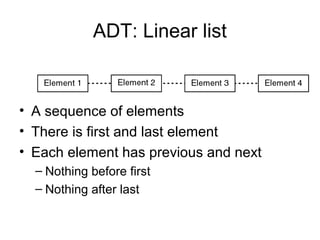
ADT: Linear list


• A sequence of elements
• There is first and last element
• Each element has previous and next
  – Nothing before first
  – Nothing after last
Why linked lists ?
• A linked list is a dynamic data structure.
   – It can grow or shrink in size during the execution
     of a program.
   – It can be made just as long as required.
   – It does not waste memory space.
• Linked lists provide flexibility in allowing the
  items to be rearranged efficiently.
   – Insert an element.
   – Delete an element.
• What we can do with a linear list?
  – Delete element
  – Insert element
  – Find element
  – Traverse list
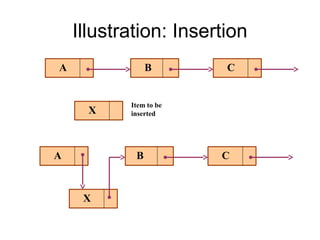
Illustration: Insertion
A               B       C


           Item to be
      X    inserted


A           B           C


     X
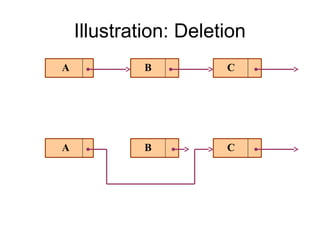
Illustration: Deletion
A            B         C


A            B         C
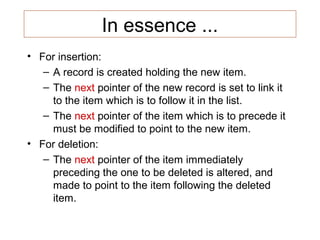
In essence ...
• For insertion:
   – A record is created holding the new item.
   – The next pointer of the new record is set to link it
     to the item which is to follow it in the list.
   – The next pointer of the item which is to precede it
     must be modified to point to the new item.
• For deletion:
   – The next pointer of the item immediately
     preceding the one to be deleted is altered, and
     made to point to the item following the deleted
     item.
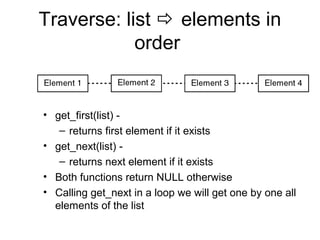
Traverse: list  elements in
            order


• get_first(list) -
   – returns first element if it exists
• get_next(list) -
   – returns next element if it exists
• Both functions return NULL otherwise
• Calling get_next in a loop we will get one by one all
  elements of the list
How we can implement a list?
• Array?
• Search is easy (sequential or binary)
• Traversal is easy:
  for(i = first; i <= last; ++i)
     process(a[i]);
• Insert and delete is not easy
  – a good part of the array has to be moved!
• Hard to guess the size of an array
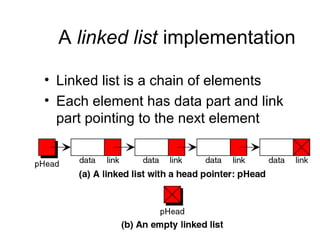
A linked list implementation

• Linked list is a chain of elements
• Each element has data part and link
  part pointing to the next element
Main operations
• Create list
• Add node
  – beginning,middle or end
• Delete node
  – beginning,middle or end
• Find node
• Traverse list
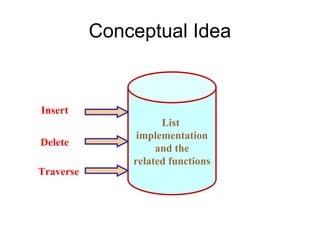
Conceptual Idea


Insert
                     List
                implementation
Delete
                    and the
               related functions
Traverse
Example: Working with linked list
•   Consider the structure of a node as follows:

     struct stud {
                          int roll;
                          char name[25];
                          int age;
                          struct stud *next;
                     };

              /* A user-defined data type called “node” */
     typedef struct stud node;
     node *head;
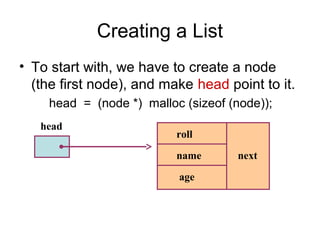
Creating a List
• To start with, we have to create a node
  (the first node), and make head point to it.
    head = (node *) malloc (sizeof (node));
   head
                          roll

                          name      next

                          age
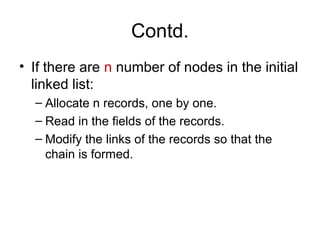
Contd.
• If there are n number of nodes in the initial
  linked list:
  – Allocate n records, one by one.
  – Read in the fields of the records.
  – Modify the links of the records so that the
    chain is formed.
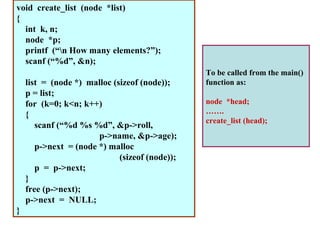
void create_list (node *list)
{
  int k, n;
  node *p;
  printf (“n How many elements?”);
  scanf (“%d”, &n);
                                                To be called from the main()
    list = (node *) malloc (sizeof (node));     function as:
    p = list;
    for (k=0; k<n; k++)                         node *head;
    {                                           …….
                                                create_list (head);
       scanf (“%d %s %d”, &p->roll,
                       p->name, &p->age);
       p->next = (node *) malloc
                             (sizeof (node));
       p = p->next;
    }
    free (p->next);
    p->next = NULL;
}
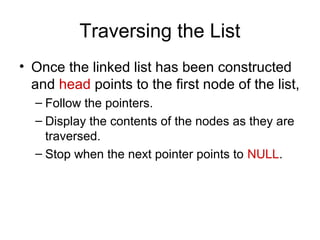
Traversing the List
• Once the linked list has been constructed
  and head points to the first node of the list,
  – Follow the pointers.
  – Display the contents of the nodes as they are
    traversed.
  – Stop when the next pointer points to NULL.
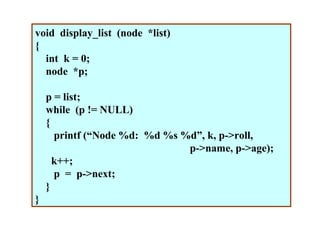
void display_list (node *list)
{
  int k = 0;
  node *p;

    p = list;
    while (p != NULL)
    {
      printf (“Node %d: %d %s %d”, k, p->roll,
                               p->name, p->age);
      k++;
      p = p->next;
    }
}
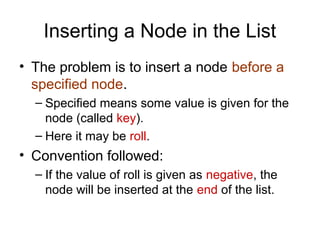
Inserting a Node in the List
• The problem is to insert a node before a
  specified node.
  – Specified means some value is given for the
    node (called key).
  – Here it may be roll.
• Convention followed:
  – If the value of roll is given as negative, the
    node will be inserted at the end of the list.
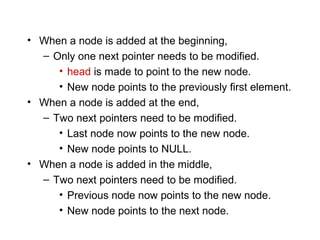
• When a node is added at the beginning,
  – Only one next pointer needs to be modified.
     • head is made to point to the new node.
     • New node points to the previously first element.
• When a node is added at the end,
  – Two next pointers need to be modified.
     • Last node now points to the new node.
     • New node points to NULL.
• When a node is added in the middle,
  – Two next pointers need to be modified.
     • Previous node now points to the new node.
     • New node points to the next node.
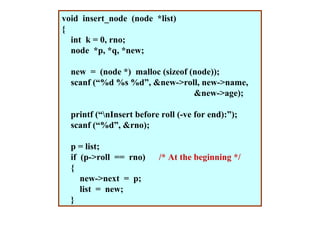
void insert_node (node *list)
{
  int k = 0, rno;
  node *p, *q, *new;

  new = (node *) malloc (sizeof (node));
  scanf (“%d %s %d”, &new->roll, new->name,
                                 &new->age);

  printf (“nInsert before roll (-ve for end):”);
  scanf (“%d”, &rno);

  p = list;
  if (p->roll == rno)     /* At the beginning */
  {
     new->next = p;
     list = new;
  }
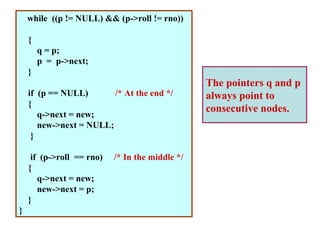
while ((p != NULL) && (p->roll != rno))

    {
        q = p;
        p = p->next;
    }
                                                 The pointers q and p
    if (p == NULL)       /* At the end */        always point to
    {
                                                 consecutive nodes.
       q->next = new;
       new->next = NULL;
     }

     if (p->roll == rno)   /* In the middle */
    {
       q->next = new;
       new->next = p;
    }
}
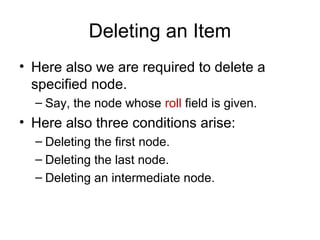
Deleting an Item
• Here also we are required to delete a
  specified node.
  – Say, the node whose roll field is given.
• Here also three conditions arise:
  – Deleting the first node.
  – Deleting the last node.
  – Deleting an intermediate node.
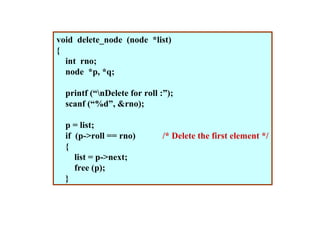
void delete_node (node *list)
{
  int rno;
  node *p, *q;

  printf (“nDelete for roll :”);
  scanf (“%d”, &rno);

  p = list;
  if (p->roll == rno)        /* Delete the first element */
  {
     list = p->next;
     free (p);
  }
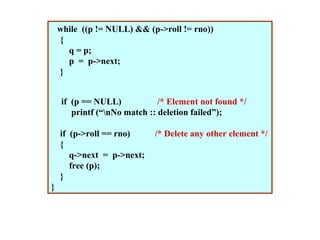
while ((p != NULL) && (p->roll != rno))
    {
      q = p;
      p = p->next;
    }


     if (p == NULL)            /* Element not found */
        printf (“nNo match :: deletion failed”);

    if (p->roll == rno)      /* Delete any other element */
    {
       q->next = p->next;
       free (p);
    }
}
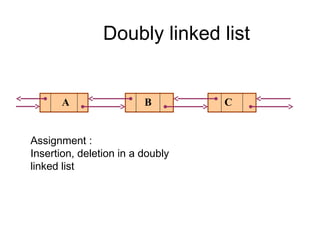
Doubly linked list


       A                 B        C


Assignment :
Insertion, deletion in a doubly
linked list
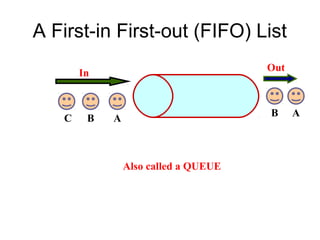
A First-in First-out (FIFO) List
                                      Out
       In


                                      B     A
   C    B   A


                Also called a QUEUE
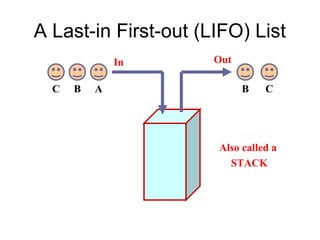
A Last-in First-out (LIFO) List
              In      Out

  C   B   A                 B   C


                      Also called a
                        STACK
Stack
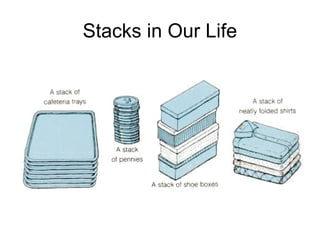
Stacks in Our Life
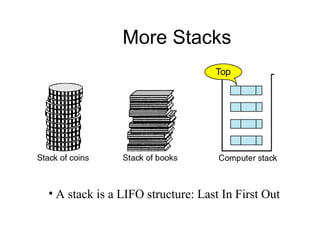
More Stacks


• A stack is a LIFO structure: Last In First Out
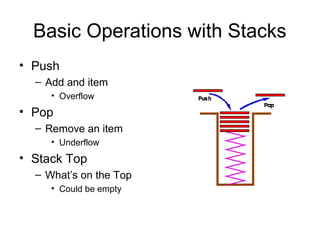
Basic Operations with Stacks
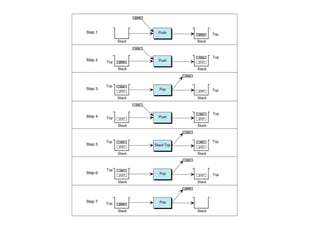
• Push
  – Add and item
     • Overflow
• Pop
  – Remove an item
     • Underflow
• Stack Top
  – What’s on the Top
     • Could be empty
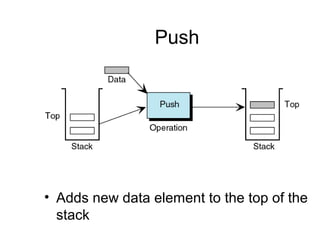
Push


• Adds new data element to the top of the
  stack
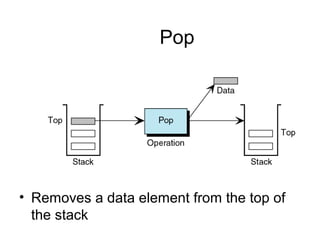
Pop


• Removes a data element from the top of
  the stack
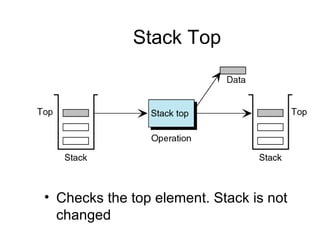
Stack Top


• Checks the top element. Stack is not
  changed
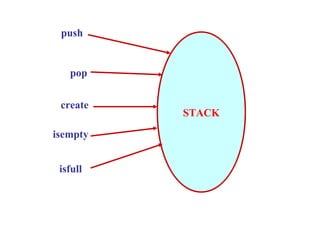
push


   pop


 create
          STACK

isempty


 isfull
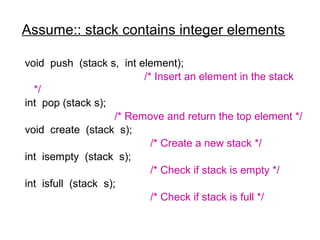
Assume:: stack contains integer elements

void push (stack s, int element);
                           /* Insert an element in the stack
  */
int pop (stack s);
                     /* Remove and return the top element */
void create (stack s);
                             /* Create a new stack */
int isempty (stack s);
                             /* Check if stack is empty */
int isfull (stack s);
                             /* Check if stack is full */
• We shall look into two different
  implementations of stack:
  – Using arrays
  – Using linked list
Stack Implementation
Stack Implementation Using
             Arrays
• Basic idea.
  – Declare an array of fixed size (which
    determines the maximum size of the stack).
  – Keep a variable which always points to the
    “top” of the stack.
Declaration
#define MAXSIZE 100

struct lifo {
                int st[MAXSIZE];
                int top;
             };
typedef struct lifo stack;
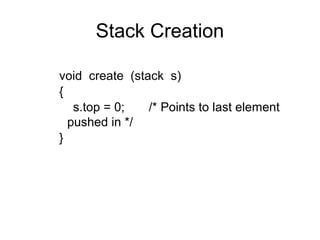
Stack Creation

void create (stack s)
{
   s.top = 0;   /* Points to last element
  pushed in */
}
Pushing an element into the stack
   void push (stack s, int element)
   {
     if (s.top == (MAXSIZE-1))
        {
            printf (“n Stack overflow”);
            break;
         }
     else
         {
             s.top ++;
             s.st [s.top] = element;
          }
Removing/Popping an element from the stack

  int pop (stack s)
  {
     if (s.top == 0)
        {
           printf (“n Stack underflow”);
           break;
        }
     else
        {
           return (s.st [s.top --]);
        }
  }
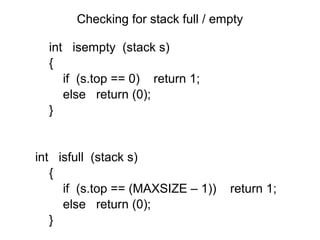
Checking for stack full / empty

  int isempty (stack s)
  {
     if (s.top == 0) return 1;
     else return (0);
  }


int isfull (stack s)
   {
     if (s.top == (MAXSIZE – 1))   return 1;
     else return (0);
   }
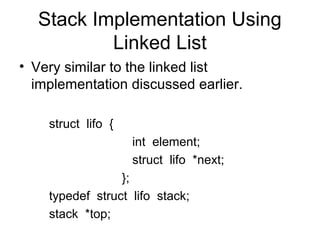
Stack Implementation Using
          Linked List
• Very similar to the linked list
  implementation discussed earlier.

    struct lifo {
                    int element;
                    struct lifo *next;
                 };
    typedef struct lifo stack;
    stack *top;
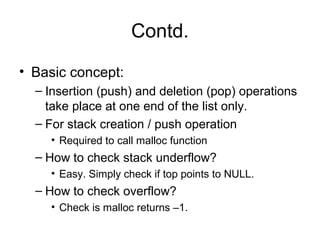
Contd.
• Basic concept:
  – Insertion (push) and deletion (pop) operations
    take place at one end of the list only.
  – For stack creation / push operation
    • Required to call malloc function
  – How to check stack underflow?
    • Easy. Simply check if top points to NULL.
  – How to check overflow?
    • Check is malloc returns –1.
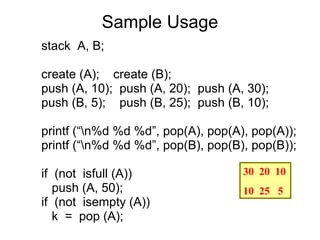
Sample Usage
stack A, B;

create (A); create (B);
push (A, 10); push (A, 20); push (A, 30);
push (B, 5); push (B, 25); push (B, 10);

printf (“n%d %d %d”, pop(A), pop(A), pop(A));
printf (“n%d %d %d”, pop(B), pop(B), pop(B));

if (not isfull (A))                 30 20 10
   push (A, 50);                    10 25 5
if (not isempty (A))
   k = pop (A);
Queues
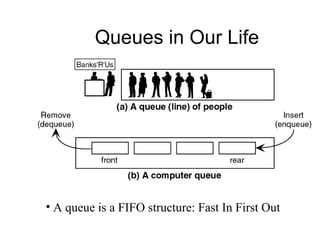
Queues in Our Life


• A queue is a FIFO structure: Fast In First Out
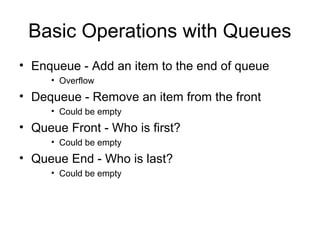
Basic Operations with Queues
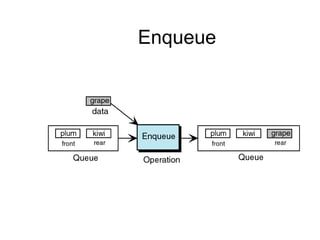
• Enqueue - Add an item to the end of queue
     • Overflow
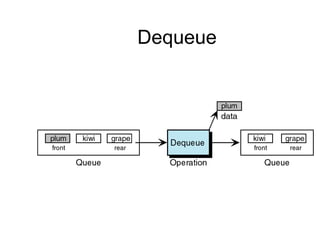
• Dequeue - Remove an item from the front
     • Could be empty
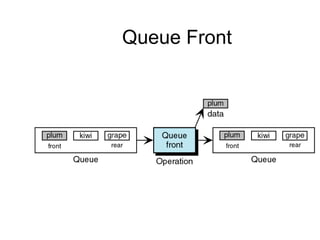
• Queue Front - Who is first?
     • Could be empty
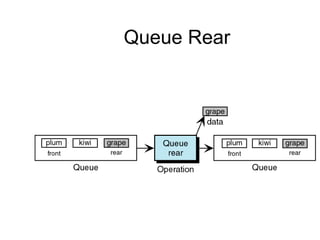
• Queue End - Who is last?
     • Could be empty
Enqueue
Dequeue
Queue Front
Queue Rear
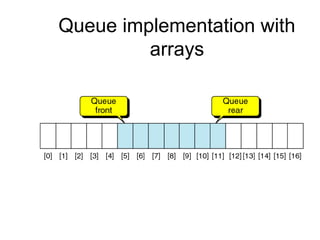
Queue implementation with
         arrays
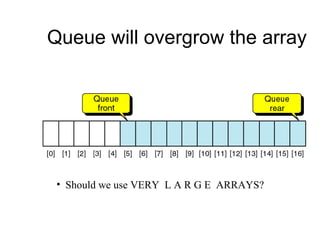
Queue will overgrow the array


 • Should we use VERY L A R G E ARRAYS?
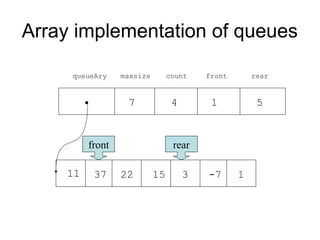
Array implementation of queues

     queueAry    maxsize        count    front       rear


                  7              4        1           5


         front                   rear

    11    37     22        15        3   -7      1
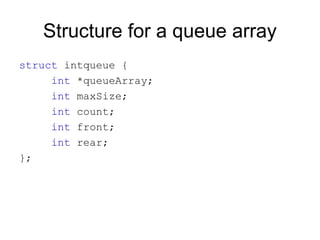
Structure for a queue array
struct intqueue {
     int *queueArray;
     int maxSize;
     int count;
     int front;
     int rear;
};
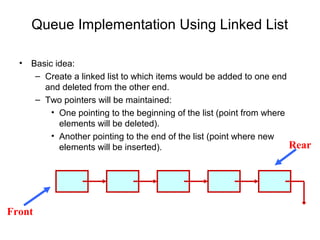
Queue Implementation Using Linked List

  •   Basic idea:
       – Create a linked list to which items would be added to one end
         and deleted from the other end.
       – Two pointers will be maintained:
           • One pointing to the beginning of the list (point from where
             elements will be deleted).
           • Another pointing to the end of the list (point where new
             elements will be inserted).                                 Rear


Front
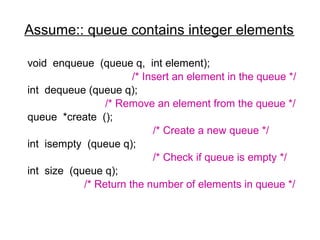
Assume:: queue contains integer elements

void enqueue (queue q, int element);
                       /* Insert an element in the queue */
int dequeue (queue q);
                 /* Remove an element from the queue */
queue *create ();
                            /* Create a new queue */
int isempty (queue q);
                            /* Check if queue is empty */
int size (queue q);
            /* Return the number of elements in queue */
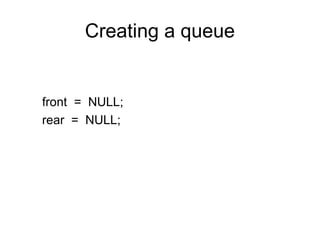
Creating a queue


front = NULL;
rear = NULL;
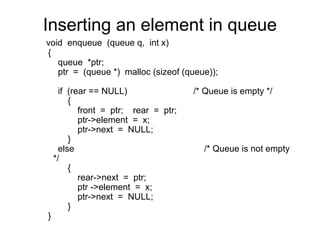
Inserting an element in queue
void enqueue (queue q, int x)
{
   queue *ptr;
   ptr = (queue *) malloc (sizeof (queue));

      if (rear == NULL)                /* Queue is empty */
         {
            front = ptr; rear = ptr;
            ptr->element = x;
            ptr->next = NULL;
         }
      else                               /* Queue is not empty
    */
         {
            rear->next = ptr;
            ptr ->element = x;
            ptr->next = NULL;
         }
}
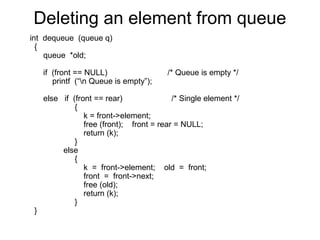
Deleting an element from queue
int dequeue (queue q)
  {
    queue *old;

     if (front == NULL)                  /* Queue is empty */
        printf (“n Queue is empty”);

     else if (front == rear)               /* Single element */
              {
                 k = front->element;
                 free (front); front = rear = NULL;
                 return (k);
              }
          else
              {
                 k = front->element; old = front;
                 front = front->next;
                 free (old);
                 return (k);
              }
 }
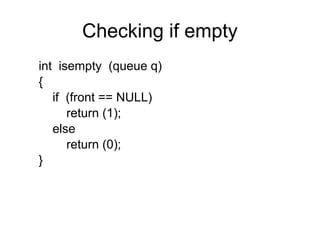
Checking if empty
int isempty (queue q)
{
   if (front == NULL)
      return (1);
   else
      return (0);
}

Data structures

  • 1.
  • 2.
    Abstract Data Type Acollection of related data is known as an abstract data type (ADT) Data Structure = ADT + Collection of functions that operate on the ADT
  • 3.
    Data Structure • Consistof the data structure definition and a collection of functions that operate on the struct – We will never access the struct directly!
  • 4.
    • Separate whatyou can do with data from how it is represented • Other parts of the program interacts with data through provided operations according to their specifications • Implementation chooses how to represent data and implement its operations
  • 5.
    Multiple Implementations • AnADT can have several implementations • Interface functions are the same • Application programs will not see any difference
  • 6.
    ADT: Linear list •A sequence of elements • There is first and last element • Each element has previous and next – Nothing before first – Nothing after last
  • 7.
    Why linked lists? • A linked list is a dynamic data structure. – It can grow or shrink in size during the execution of a program. – It can be made just as long as required. – It does not waste memory space. • Linked lists provide flexibility in allowing the items to be rearranged efficiently. – Insert an element. – Delete an element.
  • 8.
    • What wecan do with a linear list? – Delete element – Insert element – Find element – Traverse list
  • 9.
    Illustration: Insertion A B C Item to be X inserted A B C X
  • 10.
  • 11.
    In essence ... •For insertion: – A record is created holding the new item. – The next pointer of the new record is set to link it to the item which is to follow it in the list. – The next pointer of the item which is to precede it must be modified to point to the new item. • For deletion: – The next pointer of the item immediately preceding the one to be deleted is altered, and made to point to the item following the deleted item.
  • 12.
    Traverse: list elements in order • get_first(list) - – returns first element if it exists • get_next(list) - – returns next element if it exists • Both functions return NULL otherwise • Calling get_next in a loop we will get one by one all elements of the list
  • 13.
    How we canimplement a list? • Array? • Search is easy (sequential or binary) • Traversal is easy: for(i = first; i <= last; ++i) process(a[i]); • Insert and delete is not easy – a good part of the array has to be moved! • Hard to guess the size of an array
  • 14.
    A linked listimplementation • Linked list is a chain of elements • Each element has data part and link part pointing to the next element
  • 15.
    Main operations • Createlist • Add node – beginning,middle or end • Delete node – beginning,middle or end • Find node • Traverse list
  • 16.
    Conceptual Idea Insert List implementation Delete and the related functions Traverse
  • 17.
    Example: Working withlinked list • Consider the structure of a node as follows: struct stud { int roll; char name[25]; int age; struct stud *next; }; /* A user-defined data type called “node” */ typedef struct stud node; node *head;
  • 18.
    Creating a List •To start with, we have to create a node (the first node), and make head point to it. head = (node *) malloc (sizeof (node)); head roll name next age
  • 19.
    Contd. • If thereare n number of nodes in the initial linked list: – Allocate n records, one by one. – Read in the fields of the records. – Modify the links of the records so that the chain is formed.
  • 20.
    void create_list (node*list) { int k, n; node *p; printf (“n How many elements?”); scanf (“%d”, &n); To be called from the main() list = (node *) malloc (sizeof (node)); function as: p = list; for (k=0; k<n; k++) node *head; { ……. create_list (head); scanf (“%d %s %d”, &p->roll, p->name, &p->age); p->next = (node *) malloc (sizeof (node)); p = p->next; } free (p->next); p->next = NULL; }
  • 21.
    Traversing the List •Once the linked list has been constructed and head points to the first node of the list, – Follow the pointers. – Display the contents of the nodes as they are traversed. – Stop when the next pointer points to NULL.
  • 22.
    void display_list (node*list) { int k = 0; node *p; p = list; while (p != NULL) { printf (“Node %d: %d %s %d”, k, p->roll, p->name, p->age); k++; p = p->next; } }
  • 23.
    Inserting a Nodein the List • The problem is to insert a node before a specified node. – Specified means some value is given for the node (called key). – Here it may be roll. • Convention followed: – If the value of roll is given as negative, the node will be inserted at the end of the list.
  • 24.
    • When anode is added at the beginning, – Only one next pointer needs to be modified. • head is made to point to the new node. • New node points to the previously first element. • When a node is added at the end, – Two next pointers need to be modified. • Last node now points to the new node. • New node points to NULL. • When a node is added in the middle, – Two next pointers need to be modified. • Previous node now points to the new node. • New node points to the next node.
  • 25.
    void insert_node (node*list) { int k = 0, rno; node *p, *q, *new; new = (node *) malloc (sizeof (node)); scanf (“%d %s %d”, &new->roll, new->name, &new->age); printf (“nInsert before roll (-ve for end):”); scanf (“%d”, &rno); p = list; if (p->roll == rno) /* At the beginning */ { new->next = p; list = new; }
  • 26.
    while ((p !=NULL) && (p->roll != rno)) { q = p; p = p->next; } The pointers q and p if (p == NULL) /* At the end */ always point to { consecutive nodes. q->next = new; new->next = NULL; } if (p->roll == rno) /* In the middle */ { q->next = new; new->next = p; } }
  • 27.
    Deleting an Item •Here also we are required to delete a specified node. – Say, the node whose roll field is given. • Here also three conditions arise: – Deleting the first node. – Deleting the last node. – Deleting an intermediate node.
  • 28.
    void delete_node (node*list) { int rno; node *p, *q; printf (“nDelete for roll :”); scanf (“%d”, &rno); p = list; if (p->roll == rno) /* Delete the first element */ { list = p->next; free (p); }
  • 29.
    while ((p !=NULL) && (p->roll != rno)) { q = p; p = p->next; } if (p == NULL) /* Element not found */ printf (“nNo match :: deletion failed”); if (p->roll == rno) /* Delete any other element */ { q->next = p->next; free (p); } }
  • 30.
    Doubly linked list A B C Assignment : Insertion, deletion in a doubly linked list
  • 31.
    A First-in First-out(FIFO) List Out In B A C B A Also called a QUEUE
  • 32.
    A Last-in First-out(LIFO) List In Out C B A B C Also called a STACK
  • 33.
  • 34.
  • 35.
    More Stacks • Astack is a LIFO structure: Last In First Out
  • 36.
    Basic Operations withStacks • Push – Add and item • Overflow • Pop – Remove an item • Underflow • Stack Top – What’s on the Top • Could be empty
  • 37.
    Push • Adds newdata element to the top of the stack
  • 38.
    Pop • Removes adata element from the top of the stack
  • 39.
    Stack Top • Checksthe top element. Stack is not changed
  • 41.
    push pop create STACK isempty isfull
  • 42.
    Assume:: stack containsinteger elements void push (stack s, int element); /* Insert an element in the stack */ int pop (stack s); /* Remove and return the top element */ void create (stack s); /* Create a new stack */ int isempty (stack s); /* Check if stack is empty */ int isfull (stack s); /* Check if stack is full */
  • 43.
    • We shalllook into two different implementations of stack: – Using arrays – Using linked list
  • 44.
  • 45.
    Stack Implementation Using Arrays • Basic idea. – Declare an array of fixed size (which determines the maximum size of the stack). – Keep a variable which always points to the “top” of the stack.
  • 46.
    Declaration #define MAXSIZE 100 structlifo { int st[MAXSIZE]; int top; }; typedef struct lifo stack;
  • 47.
    Stack Creation void create(stack s) { s.top = 0; /* Points to last element pushed in */ }
  • 48.
    Pushing an elementinto the stack void push (stack s, int element) { if (s.top == (MAXSIZE-1)) { printf (“n Stack overflow”); break; } else { s.top ++; s.st [s.top] = element; }
  • 49.
    Removing/Popping an elementfrom the stack int pop (stack s) { if (s.top == 0) { printf (“n Stack underflow”); break; } else { return (s.st [s.top --]); } }
  • 50.
    Checking for stackfull / empty int isempty (stack s) { if (s.top == 0) return 1; else return (0); } int isfull (stack s) { if (s.top == (MAXSIZE – 1)) return 1; else return (0); }
  • 51.
    Stack Implementation Using Linked List • Very similar to the linked list implementation discussed earlier. struct lifo { int element; struct lifo *next; }; typedef struct lifo stack; stack *top;
  • 52.
    Contd. • Basic concept: – Insertion (push) and deletion (pop) operations take place at one end of the list only. – For stack creation / push operation • Required to call malloc function – How to check stack underflow? • Easy. Simply check if top points to NULL. – How to check overflow? • Check is malloc returns –1.
  • 53.
    Sample Usage stack A,B; create (A); create (B); push (A, 10); push (A, 20); push (A, 30); push (B, 5); push (B, 25); push (B, 10); printf (“n%d %d %d”, pop(A), pop(A), pop(A)); printf (“n%d %d %d”, pop(B), pop(B), pop(B)); if (not isfull (A)) 30 20 10 push (A, 50); 10 25 5 if (not isempty (A)) k = pop (A);
  • 54.
  • 55.
    Queues in OurLife • A queue is a FIFO structure: Fast In First Out
  • 56.
    Basic Operations withQueues • Enqueue - Add an item to the end of queue • Overflow • Dequeue - Remove an item from the front • Could be empty • Queue Front - Who is first? • Could be empty • Queue End - Who is last? • Could be empty
  • 57.
  • 58.
  • 59.
  • 60.
  • 62.
  • 63.
    Queue will overgrowthe array • Should we use VERY L A R G E ARRAYS?
  • 65.
    Array implementation ofqueues queueAry maxsize count front rear 7 4 1 5 front rear 11 37 22 15 3 -7 1
  • 66.
    Structure for aqueue array struct intqueue { int *queueArray; int maxSize; int count; int front; int rear; };
  • 67.
    Queue Implementation UsingLinked List • Basic idea: – Create a linked list to which items would be added to one end and deleted from the other end. – Two pointers will be maintained: • One pointing to the beginning of the list (point from where elements will be deleted). • Another pointing to the end of the list (point where new elements will be inserted). Rear Front
  • 68.
    Assume:: queue containsinteger elements void enqueue (queue q, int element); /* Insert an element in the queue */ int dequeue (queue q); /* Remove an element from the queue */ queue *create (); /* Create a new queue */ int isempty (queue q); /* Check if queue is empty */ int size (queue q); /* Return the number of elements in queue */
  • 69.
    Creating a queue front= NULL; rear = NULL;
  • 70.
    Inserting an elementin queue void enqueue (queue q, int x) { queue *ptr; ptr = (queue *) malloc (sizeof (queue)); if (rear == NULL) /* Queue is empty */ { front = ptr; rear = ptr; ptr->element = x; ptr->next = NULL; } else /* Queue is not empty */ { rear->next = ptr; ptr ->element = x; ptr->next = NULL; } }
  • 71.
    Deleting an elementfrom queue int dequeue (queue q) { queue *old; if (front == NULL) /* Queue is empty */ printf (“n Queue is empty”); else if (front == rear) /* Single element */ { k = front->element; free (front); front = rear = NULL; return (k); } else { k = front->element; old = front; front = front->next; free (old); return (k); } }
  • 72.
    Checking if empty intisempty (queue q) { if (front == NULL) return (1); else return (0); }