Linked List
Mrs. K.KASTHURI, M.Sc., M.Phil., M.Tech.,
Assistant Professor,
Department of Information Technology,
V.V.Vanniaperumal College for Women
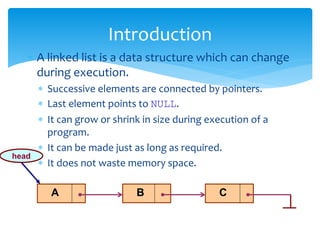
 A linked list is a data structure which can change
during execution.
 Successive elements are connected by pointers.
 Last element points to NULL.
 It can grow or shrink in size during execution of a
program.
 It can be made just as long as required.
 It does not waste memory space.
Introduction
A B C
head
 Keeping track of a linked list:
 Must know the pointer to the first element of the list
(called start, head, etc.).
 Linked lists provide flexibility in allowing the items to
be rearranged efficiently.
 Insert an element.
 Delete an element.
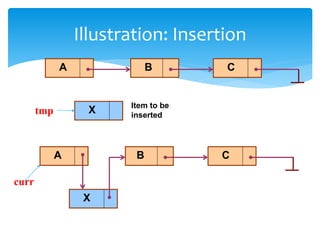
Illustration: Insertion
A
A
Item to be
inserted
X
X
A B C
B C
curr
tmp
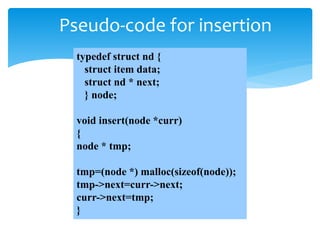
Pseudo-code for insertion
typedef struct nd {
struct item data;
struct nd * next;
} node;
void insert(node *curr)
{
node * tmp;
tmp=(node *) malloc(sizeof(node));
tmp->next=curr->next;
curr->next=tmp;
}
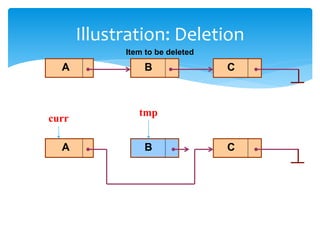
Illustration: Deletion
A B
A B C
C
Item to be deleted
curr
tmp
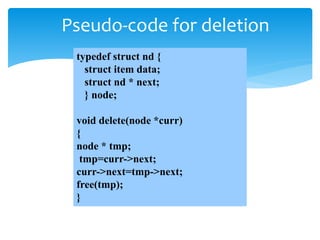
Pseudo-code for deletion
typedef struct nd {
struct item data;
struct nd * next;
} node;
void delete(node *curr)
{
node * tmp;
tmp=curr->next;
curr->next=tmp->next;
free(tmp);
}
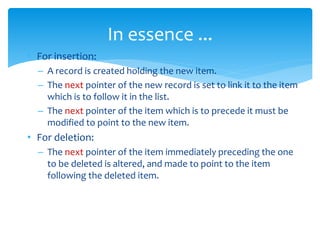
• For insertion:
– A record is created holding the new item.
– The next pointer of the new record is set to link it to the item
which is to follow it in the list.
– The next pointer of the item which is to precede it must be
modified to point to the new item.
• For deletion:
– The next pointer of the item immediately preceding the one
to be deleted is altered, and made to point to the item
following the deleted item.
In essence ...
• Arrays are suitable for:
– Inserting/deleting an element at the end.
– Randomly accessing any element.
– Searching the list for a particular value.
• Linked lists are suitable for:
– Inserting an element.
– Deleting an element.
– Applications where sequential access is required.
– In situations where the number of elements cannot be
predicted beforehand.
Array versus Linked Lists
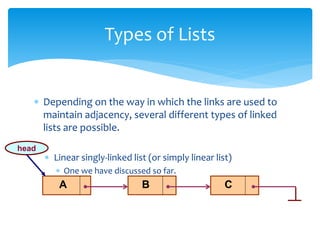
 Depending on the way in which the links are used to
maintain adjacency, several different types of linked
lists are possible.
 Linear singly-linked list (or simply linear list)
 One we have discussed so far.
Types of Lists
A B C
head
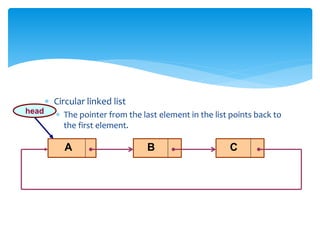
 Circular linked list
 The pointer from the last element in the list points back to
the first element.
A B C
head
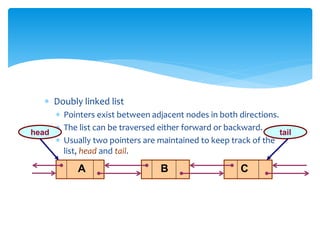
 Doubly linked list
 Pointers exist between adjacent nodes in both directions.
 The list can be traversed either forward or backward.
 Usually two pointers are maintained to keep track of the
list, head and tail.
A B C
head tail
 Creating a list
 Traversing the list
 Inserting an item in the list
 Deleting an item from the list
 Concatenating two lists into one
Basic Operations on a List
• What is an abstract data type?
– It is a data type defined by the user.
– Typically more complex than simple data types like int, float,
etc.
• Why abstract?
– Because details of the implementation are hidden.
– When you do some operation on the list, say insert an
element, you just call a function.
– Details of how the list is implemented or how the insert
function is written is no longer required.
List is an Abstract Data Type
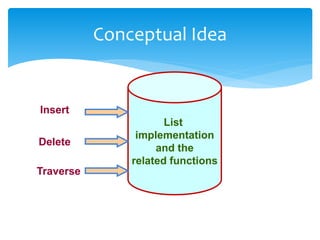
Conceptual Idea
List
implementation
and the
related functions
Insert
Delete
Traverse
 Consider the structure of a node as follows:
struct stud {
int roll;
char name[25];
int age;
struct stud *next;
};
/* A user-defined data type called “node” */
typedef struct stud node;
node *head;
Example: Working with linked list
Creating a List
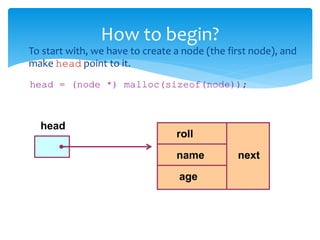
 To start with, we have to create a node (the first node), and
make head point to it.
head = (node *) malloc(sizeof(node));
How to begin?
head
age
name
roll
next
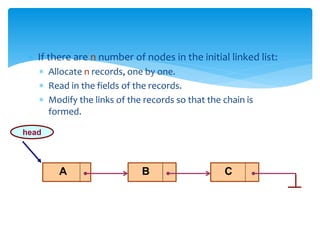
 If there are n number of nodes in the initial linked list:
 Allocate n records, one by one.
 Read in the fields of the records.
 Modify the links of the records so that the chain is
formed.
A B C
head
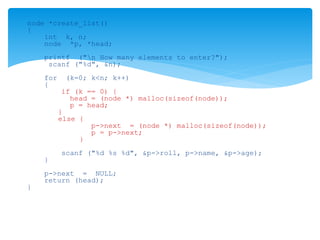
node *create_list()
{
int k, n;
node *p, *head;
printf ("n How many elements to enter?");
scanf ("%d", &n);
for (k=0; k<n; k++)
{
if (k == 0) {
head = (node *) malloc(sizeof(node));
p = head;
}
else {
p->next = (node *) malloc(sizeof(node));
p = p->next;
}
scanf ("%d %s %d", &p->roll, p->name, &p->age);
}
p->next = NULL;
return (head);
}
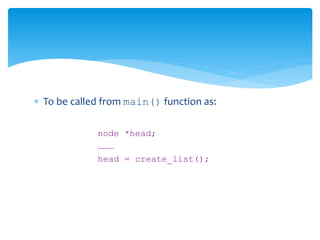
 To be called from main() function as:
node *head;
………
head = create_list();
Traversing the List
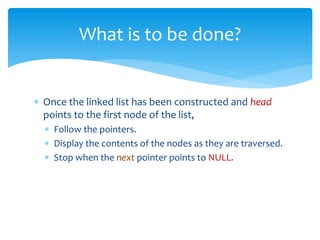
 Once the linked list has been constructed and head
points to the first node of the list,
 Follow the pointers.
 Display the contents of the nodes as they are traversed.
 Stop when the next pointer points to NULL.
What is to be done?
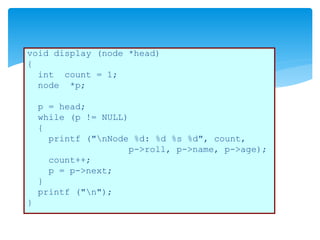
void display (node *head)
{
int count = 1;
node *p;
p = head;
while (p != NULL)
{
printf ("nNode %d: %d %s %d", count,
p->roll, p->name, p->age);
count++;
p = p->next;
}
printf ("n");
}
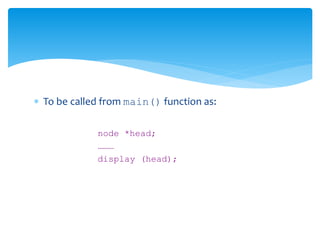
 To be called from main() function as:
node *head;
………
display (head);
Inserting a Node in a List
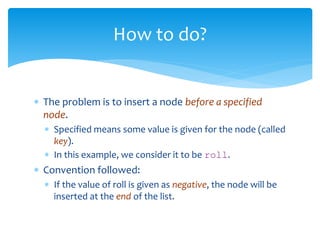
 The problem is to insert a node before a specified
node.
 Specified means some value is given for the node (called
key).
 In this example, we consider it to be roll.
 Convention followed:
 If the value of roll is given as negative, the node will be
inserted at the end of the list.
How to do?
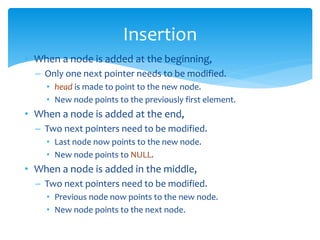
• When a node is added at the beginning,
– Only one next pointer needs to be modified.
• head is made to point to the new node.
• New node points to the previously first element.
• When a node is added at the end,
– Two next pointers need to be modified.
• Last node now points to the new node.
• New node points to NULL.
• When a node is added in the middle,
– Two next pointers need to be modified.
• Previous node now points to the new node.
• New node points to the next node.
Insertion
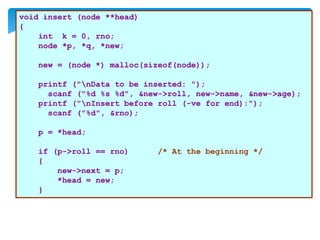
void insert (node **head)
{
int k = 0, rno;
node *p, *q, *new;
new = (node *) malloc(sizeof(node));
printf ("nData to be inserted: ");
scanf ("%d %s %d", &new->roll, new->name, &new->age);
printf ("nInsert before roll (-ve for end):");
scanf ("%d", &rno);
p = *head;
if (p->roll == rno) /* At the beginning */
{
new->next = p;
*head = new;
}
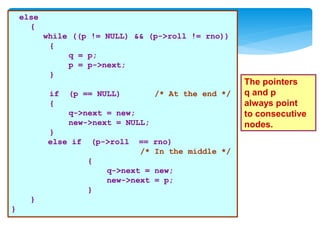
else
{
while ((p != NULL) && (p->roll != rno))
{
q = p;
p = p->next;
}
if (p == NULL) /* At the end */
{
q->next = new;
new->next = NULL;
}
else if (p->roll == rno)
/* In the middle */
{
q->next = new;
new->next = p;
}
}
}
The pointers
q and p
always point
to consecutive
nodes.
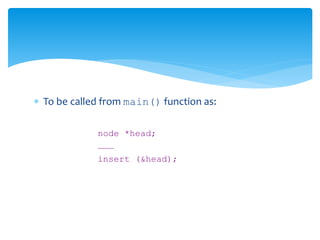
 To be called from main() function as:
node *head;
………
insert (&head);
Deleting a node from the list
 Here also we are required to delete a specified node.
 Say, the node whose roll field is given.
 Here also three conditions arise:
 Deleting the first node.
 Deleting the last node.
 Deleting an intermediate node.
What is to be done?
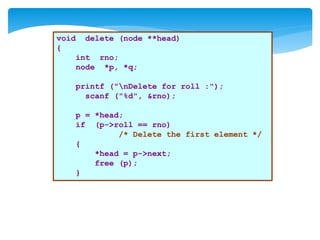
void delete (node **head)
{
int rno;
node *p, *q;
printf ("nDelete for roll :");
scanf ("%d", &rno);
p = *head;
if (p->roll == rno)
/* Delete the first element */
{
*head = p->next;
free (p);
}
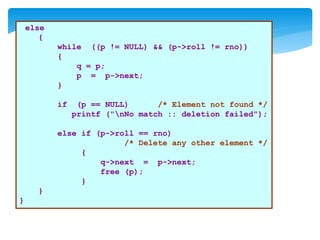
else
{
while ((p != NULL) && (p->roll != rno))
{
q = p;
p = p->next;
}
if (p == NULL) /* Element not found */
printf ("nNo match :: deletion failed");
else if (p->roll == rno)
/* Delete any other element */
{
q->next = p->next;
free (p);
}
}
}
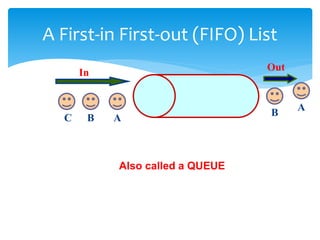
A First-in First-out (FIFO) List
Also called a QUEUE
In Out
A
C B
A
B
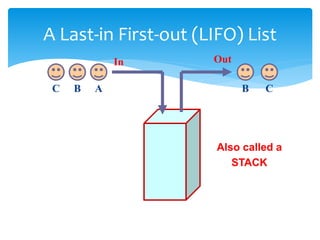
A Last-in First-out (LIFO) List
In Out
A
B
C C
B
Also called a
STACK
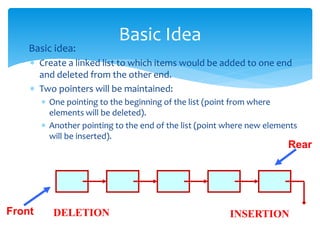
 Basic idea:
 Create a linked list to which items would be added to one end
and deleted from the other end.
 Two pointers will be maintained:
 One pointing to the beginning of the list (point from where
elements will be deleted).
 Another pointing to the end of the list (point where new elements
will be inserted).
Basic Idea
Front
Rear
DELETION INSERTION
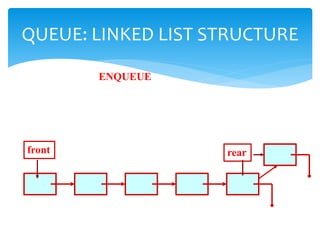
QUEUE: LINKED LIST STRUCTURE
front rear
ENQUEUE
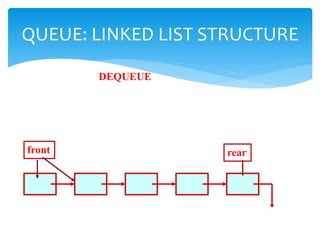
QUEUE: LINKED LIST STRUCTURE
front rear
DEQUEUE

Linked list1.ppt

  • 1.
    Linked List Mrs. K.KASTHURI,M.Sc., M.Phil., M.Tech., Assistant Professor, Department of Information Technology, V.V.Vanniaperumal College for Women
  • 2.
     A linkedlist is a data structure which can change during execution.  Successive elements are connected by pointers.  Last element points to NULL.  It can grow or shrink in size during execution of a program.  It can be made just as long as required.  It does not waste memory space. Introduction A B C head
  • 3.
     Keeping trackof a linked list:  Must know the pointer to the first element of the list (called start, head, etc.).  Linked lists provide flexibility in allowing the items to be rearranged efficiently.  Insert an element.  Delete an element.
  • 4.
    Illustration: Insertion A A Item tobe inserted X X A B C B C curr tmp
  • 5.
    Pseudo-code for insertion typedefstruct nd { struct item data; struct nd * next; } node; void insert(node *curr) { node * tmp; tmp=(node *) malloc(sizeof(node)); tmp->next=curr->next; curr->next=tmp; }
  • 6.
    Illustration: Deletion A B AB C C Item to be deleted curr tmp
  • 7.
    Pseudo-code for deletion typedefstruct nd { struct item data; struct nd * next; } node; void delete(node *curr) { node * tmp; tmp=curr->next; curr->next=tmp->next; free(tmp); }
  • 8.
    • For insertion: –A record is created holding the new item. – The next pointer of the new record is set to link it to the item which is to follow it in the list. – The next pointer of the item which is to precede it must be modified to point to the new item. • For deletion: – The next pointer of the item immediately preceding the one to be deleted is altered, and made to point to the item following the deleted item. In essence ...
  • 9.
    • Arrays aresuitable for: – Inserting/deleting an element at the end. – Randomly accessing any element. – Searching the list for a particular value. • Linked lists are suitable for: – Inserting an element. – Deleting an element. – Applications where sequential access is required. – In situations where the number of elements cannot be predicted beforehand. Array versus Linked Lists
  • 10.
     Depending onthe way in which the links are used to maintain adjacency, several different types of linked lists are possible.  Linear singly-linked list (or simply linear list)  One we have discussed so far. Types of Lists A B C head
  • 11.
     Circular linkedlist  The pointer from the last element in the list points back to the first element. A B C head
  • 12.
     Doubly linkedlist  Pointers exist between adjacent nodes in both directions.  The list can be traversed either forward or backward.  Usually two pointers are maintained to keep track of the list, head and tail. A B C head tail
  • 13.
     Creating alist  Traversing the list  Inserting an item in the list  Deleting an item from the list  Concatenating two lists into one Basic Operations on a List
  • 14.
    • What isan abstract data type? – It is a data type defined by the user. – Typically more complex than simple data types like int, float, etc. • Why abstract? – Because details of the implementation are hidden. – When you do some operation on the list, say insert an element, you just call a function. – Details of how the list is implemented or how the insert function is written is no longer required. List is an Abstract Data Type
  • 15.
  • 16.
     Consider thestructure of a node as follows: struct stud { int roll; char name[25]; int age; struct stud *next; }; /* A user-defined data type called “node” */ typedef struct stud node; node *head; Example: Working with linked list
  • 17.
  • 18.
     To startwith, we have to create a node (the first node), and make head point to it. head = (node *) malloc(sizeof(node)); How to begin? head age name roll next
  • 19.
     If thereare n number of nodes in the initial linked list:  Allocate n records, one by one.  Read in the fields of the records.  Modify the links of the records so that the chain is formed. A B C head
  • 20.
    node *create_list() { int k,n; node *p, *head; printf ("n How many elements to enter?"); scanf ("%d", &n); for (k=0; k<n; k++) { if (k == 0) { head = (node *) malloc(sizeof(node)); p = head; } else { p->next = (node *) malloc(sizeof(node)); p = p->next; } scanf ("%d %s %d", &p->roll, p->name, &p->age); } p->next = NULL; return (head); }
  • 21.
     To becalled from main() function as: node *head; ……… head = create_list();
  • 22.
  • 23.
     Once thelinked list has been constructed and head points to the first node of the list,  Follow the pointers.  Display the contents of the nodes as they are traversed.  Stop when the next pointer points to NULL. What is to be done?
  • 24.
    void display (node*head) { int count = 1; node *p; p = head; while (p != NULL) { printf ("nNode %d: %d %s %d", count, p->roll, p->name, p->age); count++; p = p->next; } printf ("n"); }
  • 25.
     To becalled from main() function as: node *head; ……… display (head);
  • 26.
  • 27.
     The problemis to insert a node before a specified node.  Specified means some value is given for the node (called key).  In this example, we consider it to be roll.  Convention followed:  If the value of roll is given as negative, the node will be inserted at the end of the list. How to do?
  • 28.
    • When anode is added at the beginning, – Only one next pointer needs to be modified. • head is made to point to the new node. • New node points to the previously first element. • When a node is added at the end, – Two next pointers need to be modified. • Last node now points to the new node. • New node points to NULL. • When a node is added in the middle, – Two next pointers need to be modified. • Previous node now points to the new node. • New node points to the next node. Insertion
  • 29.
    void insert (node**head) { int k = 0, rno; node *p, *q, *new; new = (node *) malloc(sizeof(node)); printf ("nData to be inserted: "); scanf ("%d %s %d", &new->roll, new->name, &new->age); printf ("nInsert before roll (-ve for end):"); scanf ("%d", &rno); p = *head; if (p->roll == rno) /* At the beginning */ { new->next = p; *head = new; }
  • 30.
    else { while ((p !=NULL) && (p->roll != rno)) { q = p; p = p->next; } if (p == NULL) /* At the end */ { q->next = new; new->next = NULL; } else if (p->roll == rno) /* In the middle */ { q->next = new; new->next = p; } } } The pointers q and p always point to consecutive nodes.
  • 31.
     To becalled from main() function as: node *head; ……… insert (&head);
  • 32.
    Deleting a nodefrom the list
  • 33.
     Here alsowe are required to delete a specified node.  Say, the node whose roll field is given.  Here also three conditions arise:  Deleting the first node.  Deleting the last node.  Deleting an intermediate node. What is to be done?
  • 34.
    void delete (node**head) { int rno; node *p, *q; printf ("nDelete for roll :"); scanf ("%d", &rno); p = *head; if (p->roll == rno) /* Delete the first element */ { *head = p->next; free (p); }
  • 35.
    else { while ((p !=NULL) && (p->roll != rno)) { q = p; p = p->next; } if (p == NULL) /* Element not found */ printf ("nNo match :: deletion failed"); else if (p->roll == rno) /* Delete any other element */ { q->next = p->next; free (p); } } }
  • 36.
    A First-in First-out(FIFO) List Also called a QUEUE In Out A C B A B
  • 37.
    A Last-in First-out(LIFO) List In Out A B C C B Also called a STACK
  • 38.
     Basic idea: Create a linked list to which items would be added to one end and deleted from the other end.  Two pointers will be maintained:  One pointing to the beginning of the list (point from where elements will be deleted).  Another pointing to the end of the list (point where new elements will be inserted). Basic Idea Front Rear DELETION INSERTION
  • 39.
    QUEUE: LINKED LISTSTRUCTURE front rear ENQUEUE
  • 40.
    QUEUE: LINKED LISTSTRUCTURE front rear DEQUEUE