Presented by:
Doaa Mohey Eldin
PhD researcher in information Systems
Faculty of Computers and Artificial intelligence – Cairo University
IEEE Society Member
Agenda
• What is Data Classification?
• What is Data Classification Terminologies ?
• Why use Data Classification?
• How use Data Classification in real life?
• Data Classification Techniques
• Data Classification Validation
• How choose the suitable data classification technique?
• Data Classification Challenges
• Data Classification Trends 2
Data_Science_lecture4_by_Doaa_Mohey
1. What is Data Classification?
• Data Classification is
– “the process of analyzing structured and
unstructured data for organizing data into classes
based on file type, content, and metadata”.
– Classification is a supervised learning.
– Uses training sets which has correct answers
(class label attributes).
– A model is created by running the algorithm on
the training data.
3
Data_Science_lecture4_by_Doaa_Mohey
2. What is Data Classification Terminologies ?
 A Classifier: An algorithm that maps the input data to a specific category.
 A classification model draws some conclusion from the input values given
for training. It will predict the class labels/categories for the new data.
 Data Classification Terminologies:
 A feature refers to an individual measurable property of a phenomenon
being observed.
 Binary Classification: refers to a task with two possible outcomes.
e.g: Gender classification (Male / Female)
 Multi-class classification: refers to a classification that interprets with
more than two classes. Each sample is assigned to one and only one
target label.
e.g: An animal can be cat or dog but not both at the same time
 Multi-label classification: refers to a classification task where each
sample is mapped to a set of target labels (more than one class).
e.g: A news article can be about sports, a person, and location at the
same time.
Data_Science_lecture4_by_Doaa_Mohey 4
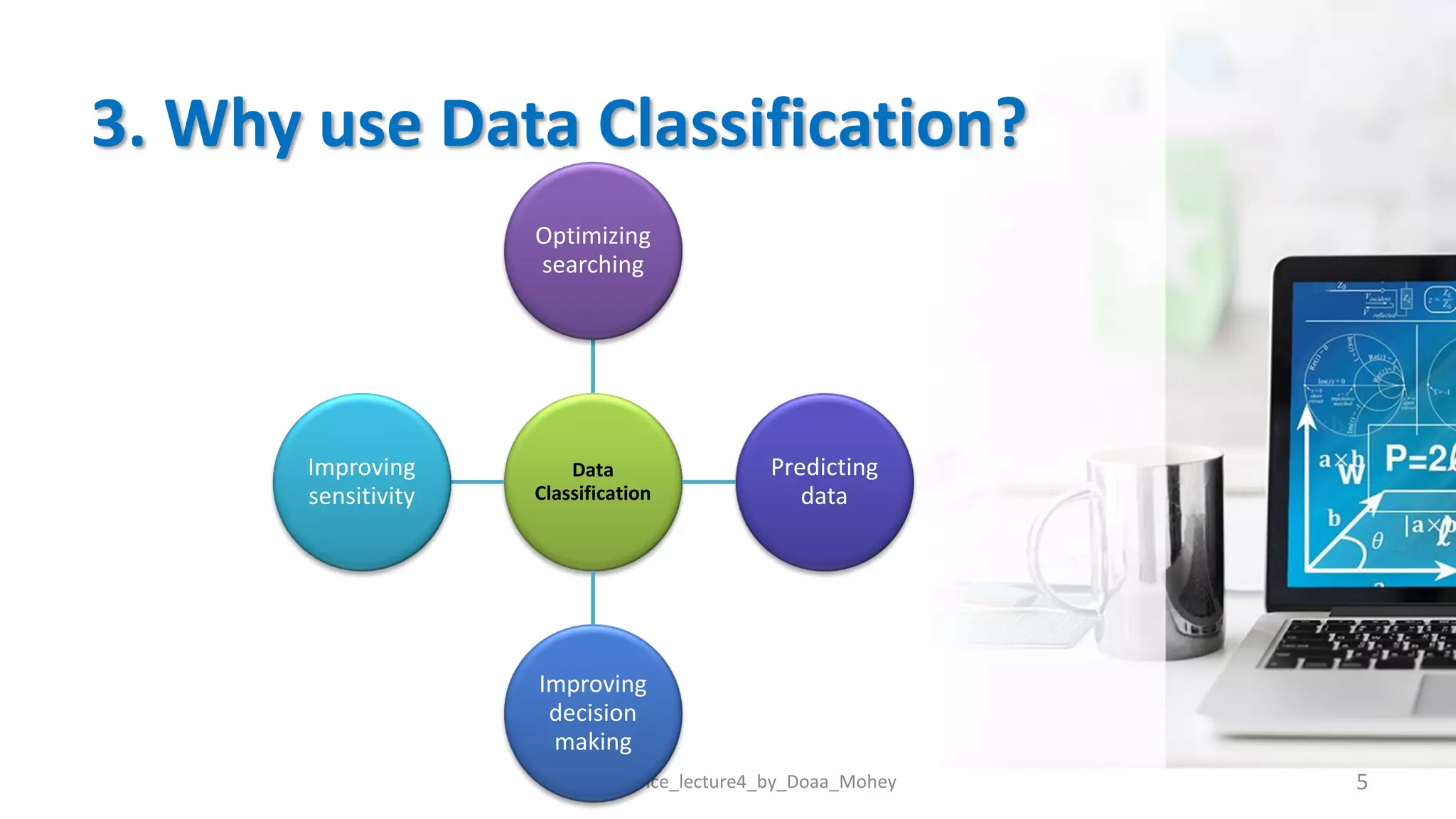
3. Why use Data Classification?
Data_Science_lecture4_by_Doaa_Mohey 5
Data
Classification
Optimizing
searching
Predicting
data
Improving
decision
making
Improving
sensitivity
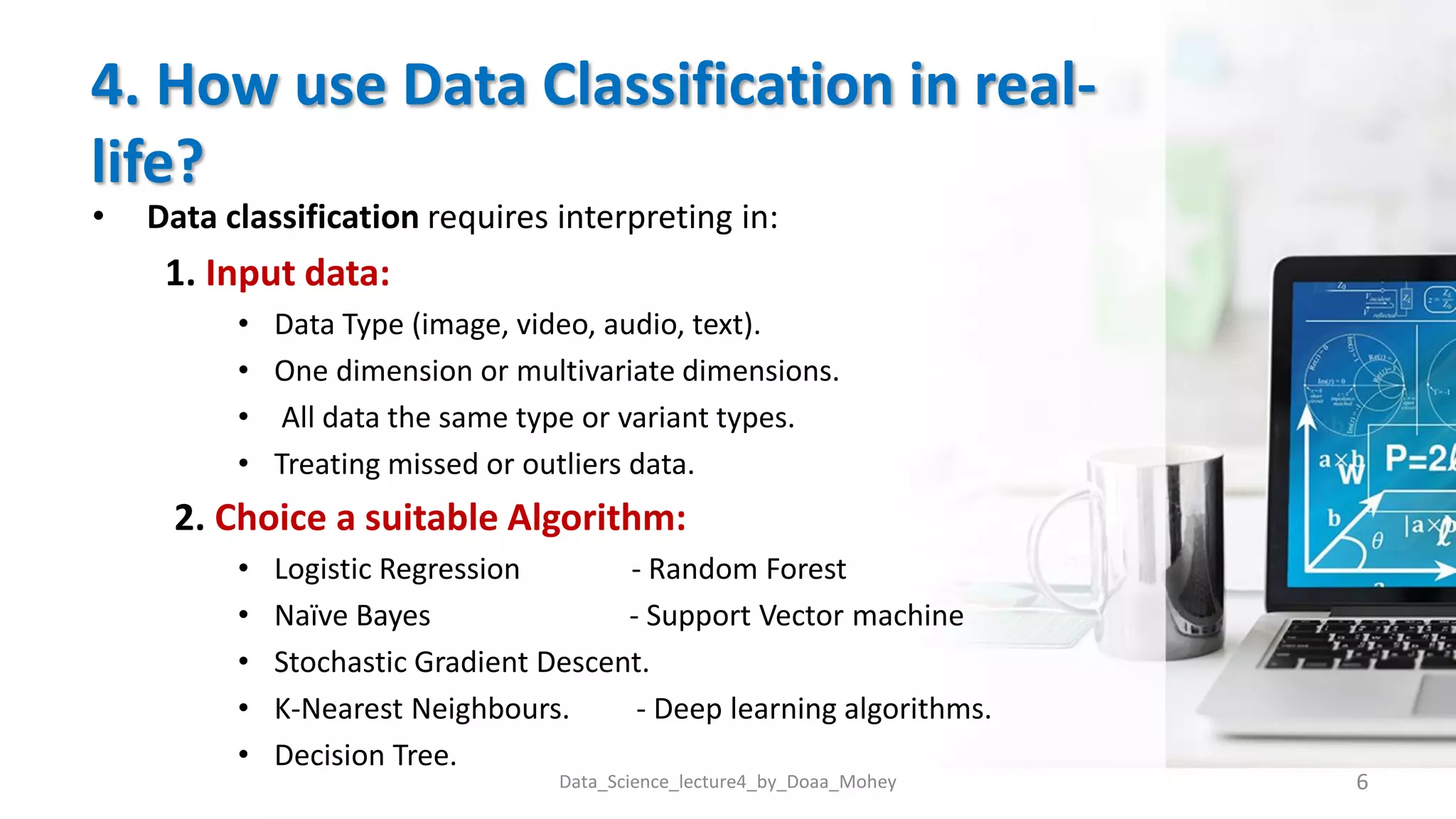
4. How use Data Classification in real-
life?
• Data classification requires interpreting in:
1. Input data:
• Data Type (image, video, audio, text).
• One dimension or multivariate dimensions.
• All data the same type or variant types.
• Treating missed or outliers data.
2. Choice a suitable Algorithm:
• Logistic Regression - Random Forest
• Naïve Bayes - Support Vector machine
• Stochastic Gradient Descent.
• K-Nearest Neighbours. - Deep learning algorithms.
• Decision Tree.
6
Data_Science_lecture4_by_Doaa_Mohey
4. How use Data Classification in real-
life? (continue)
3. Choice validation algorithm:
• Precision, recall, or F-measure (Accuracy)
• Loss function (Error function)
• Other validations, performance & optimization.
• Data Classification applications in real life such as the following:
Diseases , Market, or Marks.
4. Choice validation algorithm:
• Precision, recall, or F-measure (Accuracy)
• Loss function (Error function)
• Other validations, performance & optimization.
7
Data_Science_lecture4_by_Doaa_Mohey
4. How use Data Classification in real-
life? (continue)
• Data Classification applications in real life such as the
following:
– Classify Diseases ,
– Classify profit of Market, or
– Marks.
• COVID-19 classification is a hot trend of classification
based on image classes and analysis classes.
8
Data_Science_lecture4_by_Doaa_Mohey
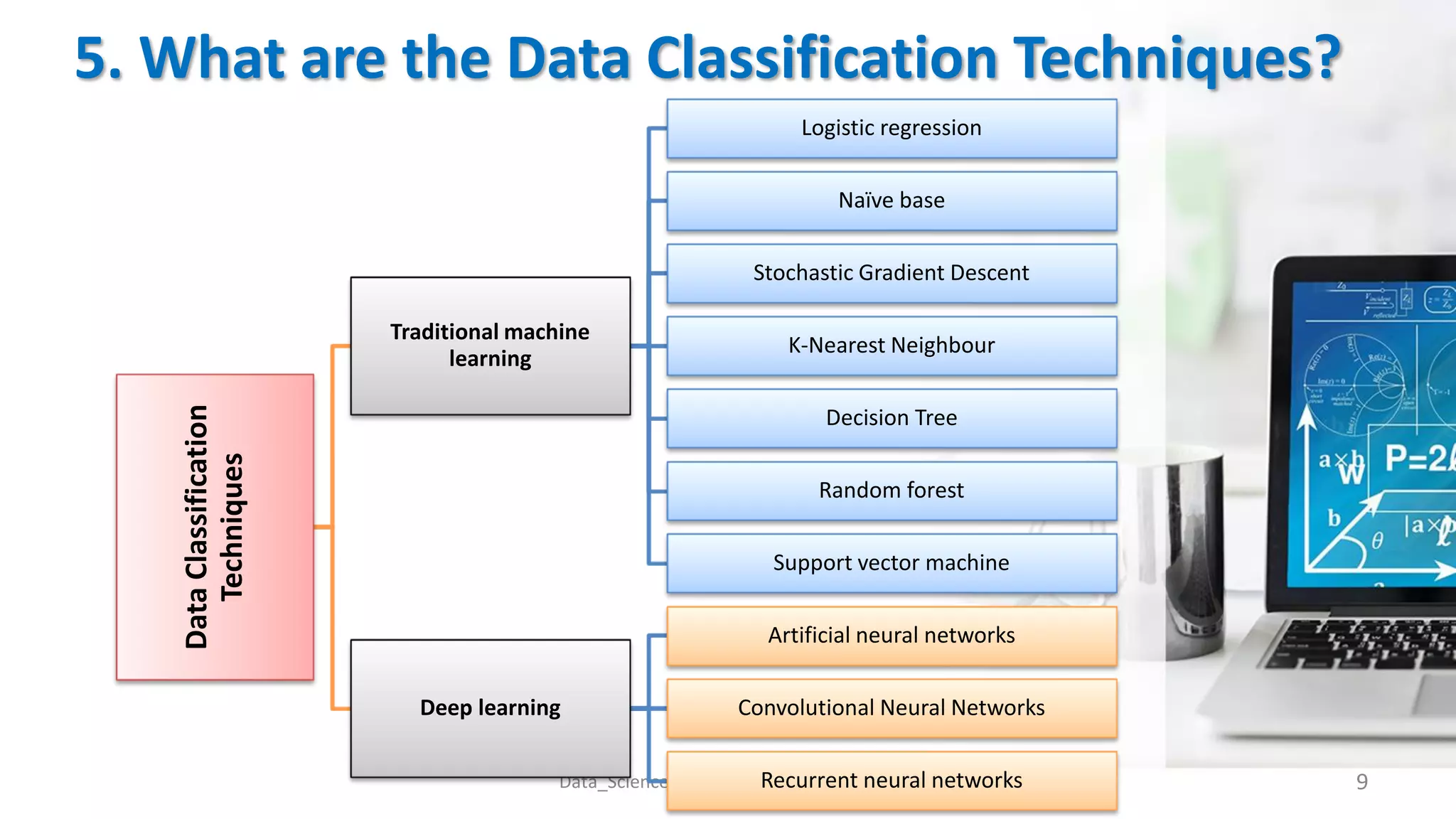
5. What are the Data Classification Techniques?
Data_Science_lecture4_by_Doaa_Mohey 9
Data
Classification
Techniques
Traditional machine
learning
Logistic regression
Naïve base
Stochastic Gradient Descent
K-Nearest Neighbour
Decision Tree
Random forest
Support vector machine
Deep learning
Artificial neural networks
Convolutional Neural Networks
Recurrent neural networks
5. What are the Data Classification Techniques?
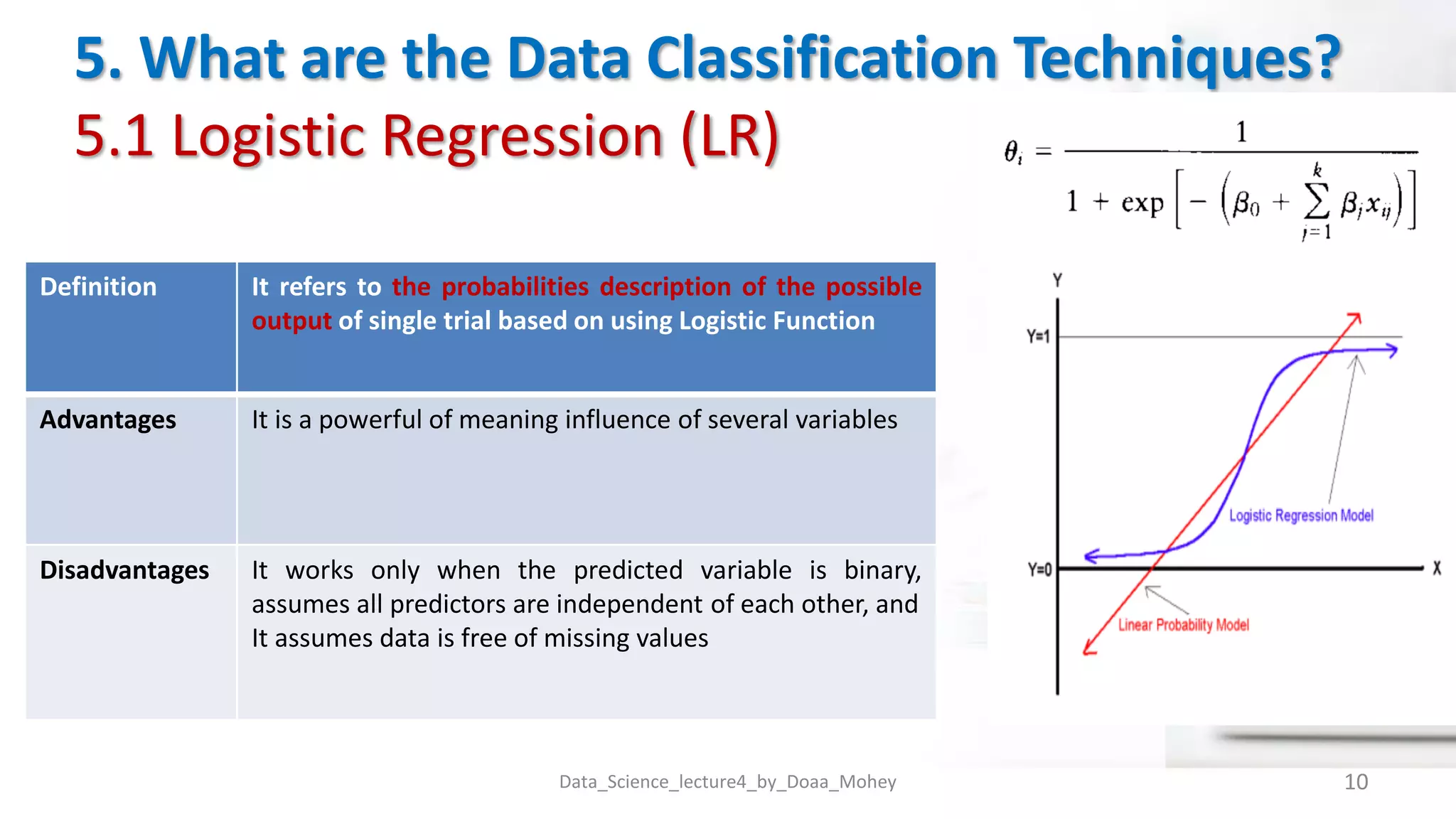
5.1 Logistic Regression (LR)
Data_Science_lecture4_by_Doaa_Mohey 10
Definition It refers to the probabilities description of the possible
output of single trial based on using Logistic Function
Advantages It is a powerful of meaning influence of several variables
Disadvantages It works only when the predicted variable is binary,
assumes all predictors are independent of each other, and
It assumes data is free of missing values
5. What are the Data Classification Techniques?
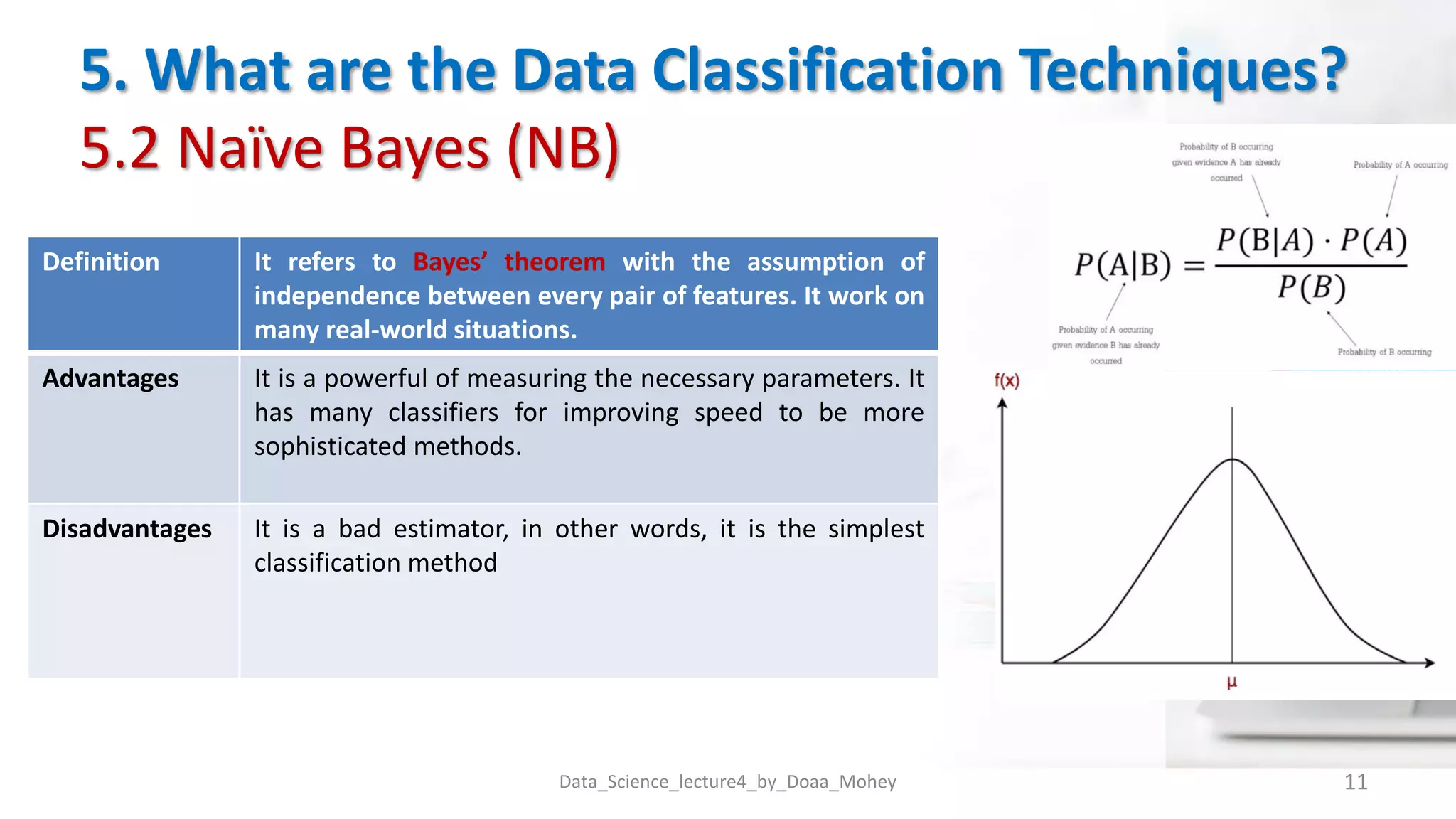
5.2 Naïve Bayes (NB)
Data_Science_lecture4_by_Doaa_Mohey 11
Definition It refers to Bayes’ theorem with the assumption of
independence between every pair of features. It work on
many real-world situations.
Advantages It is a powerful of measuring the necessary parameters. It
has many classifiers for improving speed to be more
sophisticated methods.
Disadvantages It is a bad estimator, in other words, it is the simplest
classification method
5. What are the Data Classification Techniques?
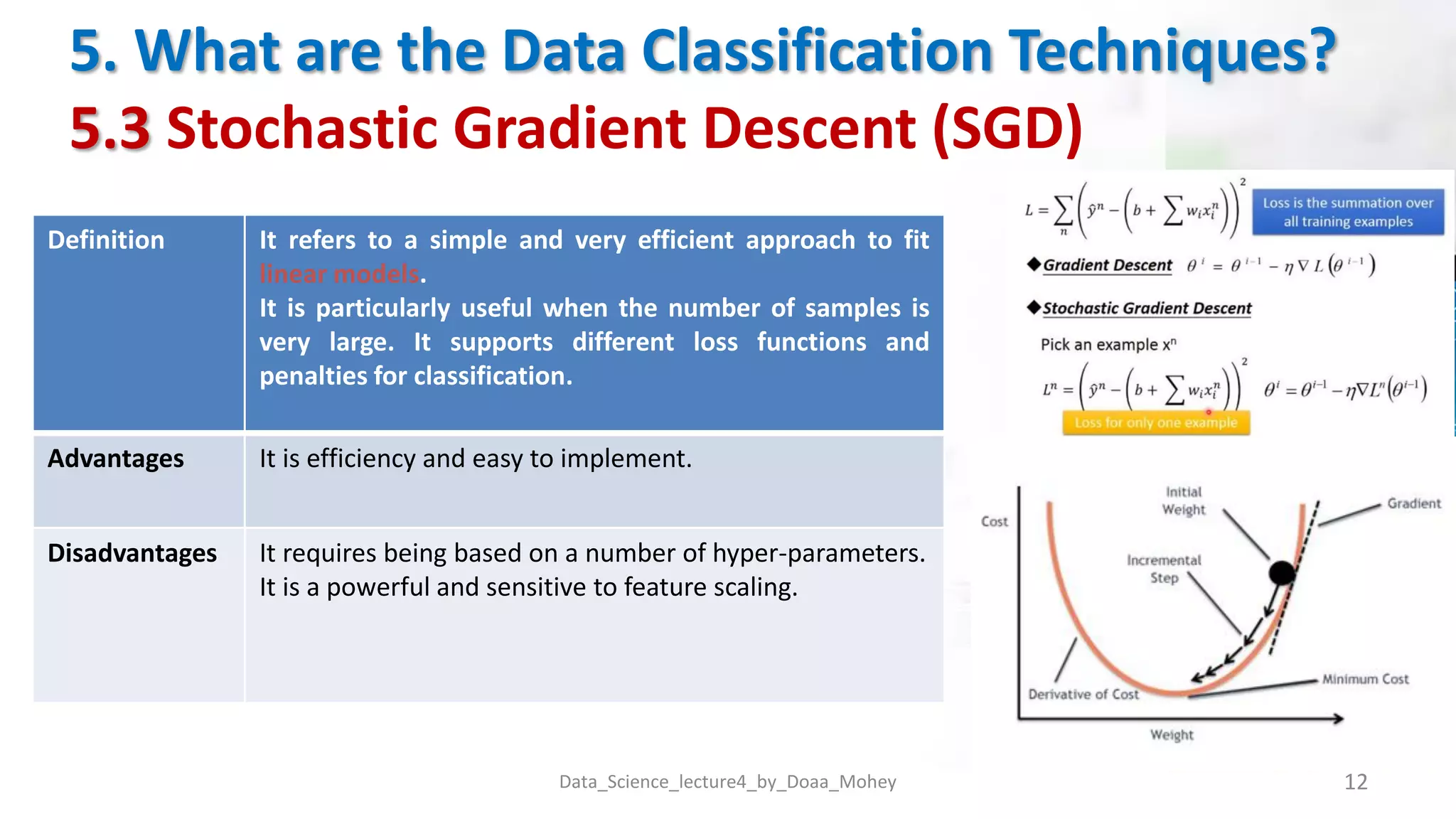
5.3 Stochastic Gradient Descent (SGD)
Data_Science_lecture4_by_Doaa_Mohey 12
Definition It refers to a simple and very efficient approach to fit
linear models.
It is particularly useful when the number of samples is
very large. It supports different loss functions and
penalties for classification.
Advantages It is efficiency and easy to implement.
Disadvantages It requires being based on a number of hyper-parameters.
It is a powerful and sensitive to feature scaling.
5. What are the Data Classification Techniques?
5.4 K-Nearest Neighbours (KNN)
Data_Science_lecture4_by_Doaa_Mohey 13
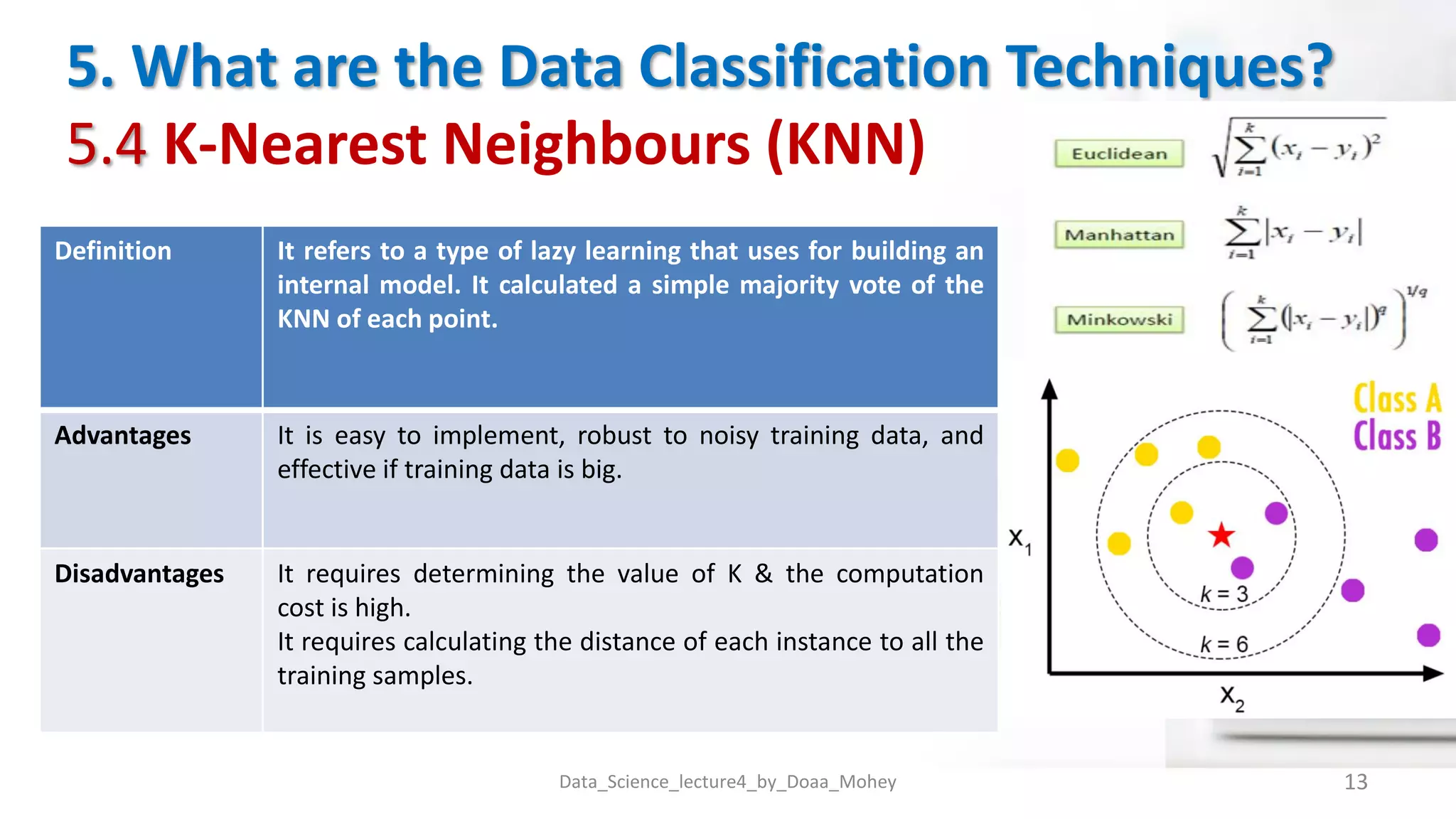
Definition It refers to a type of lazy learning that uses for building an
internal model. It calculated a simple majority vote of the
KNN of each point.
Advantages It is easy to implement, robust to noisy training data, and
effective if training data is big.
Disadvantages It requires determining the value of K & the computation
cost is high.
It requires calculating the distance of each instance to all the
training samples.
5. What are the Data Classification Techniques?
5.5 Decision Tree (DT)
Data_Science_lecture4_by_Doaa_Mohey 14
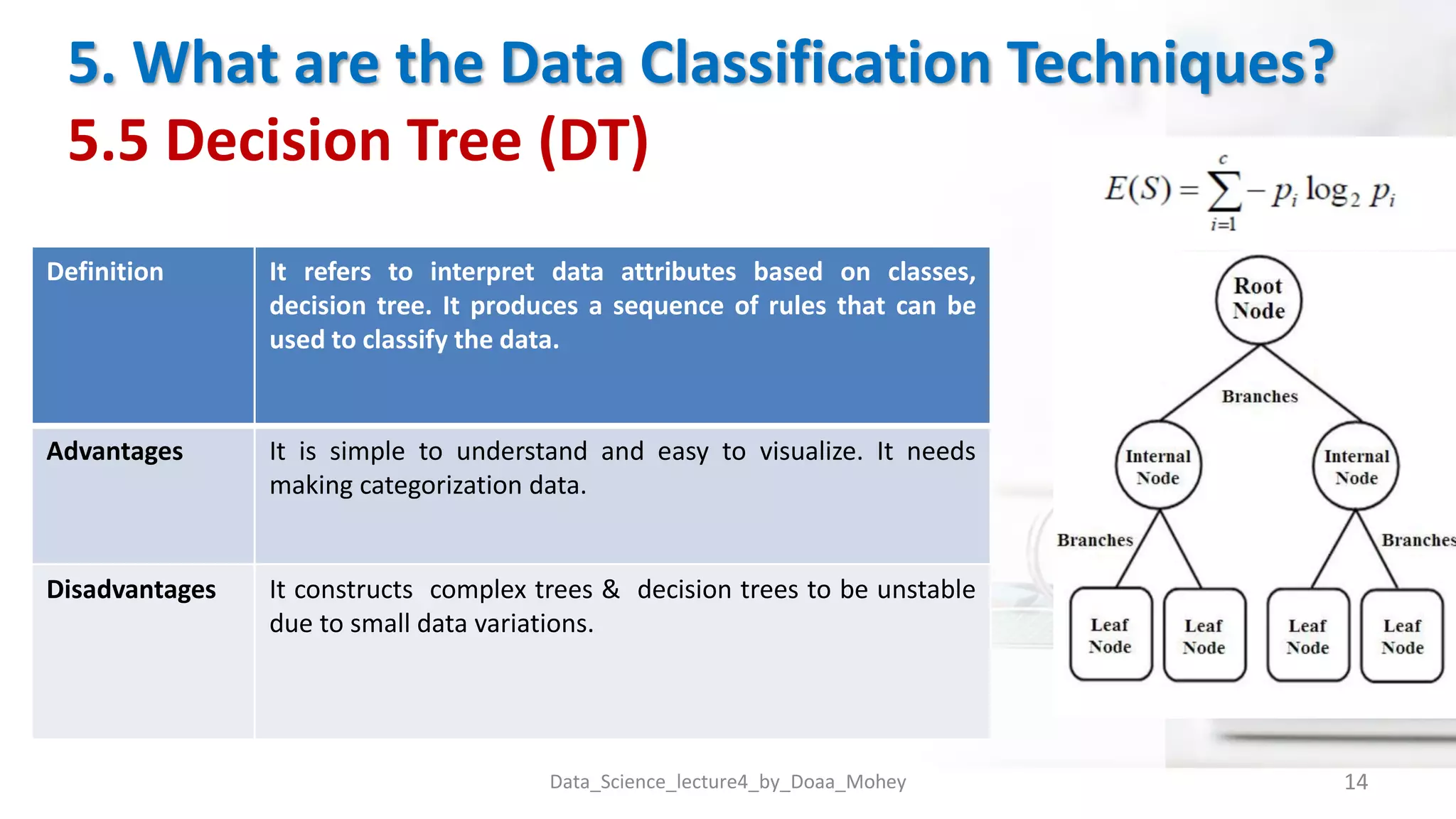
Definition It refers to interpret data attributes based on classes,
decision tree. It produces a sequence of rules that can be
used to classify the data.
Advantages It is simple to understand and easy to visualize. It needs
making categorization data.
Disadvantages It constructs complex trees & decision trees to be unstable
due to small data variations.
5. What are the Data Classification Techniques?
5.6 Random Forest (RF)
Data_Science_lecture4_by_Doaa_Mohey 15
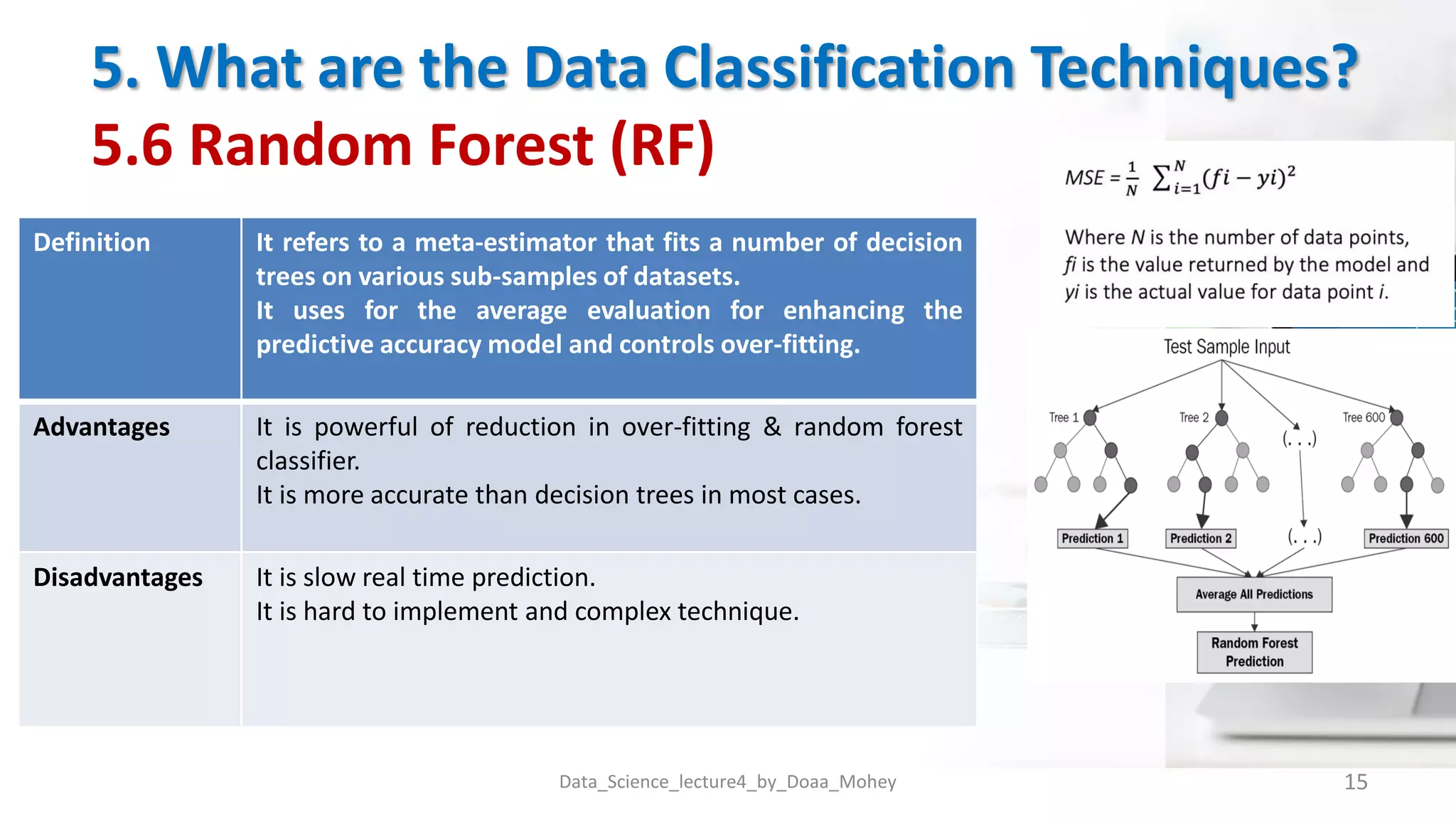
Definition It refers to a meta-estimator that fits a number of decision
trees on various sub-samples of datasets.
It uses for the average evaluation for enhancing the
predictive accuracy model and controls over-fitting.
Advantages It is powerful of reduction in over-fitting & random forest
classifier.
It is more accurate than decision trees in most cases.
Disadvantages It is slow real time prediction.
It is hard to implement and complex technique.
5. What are the Data Classification Techniques?
5.7 Support Vector Machine (SVM)
Data_Science_lecture4_by_Doaa_Mohey 16
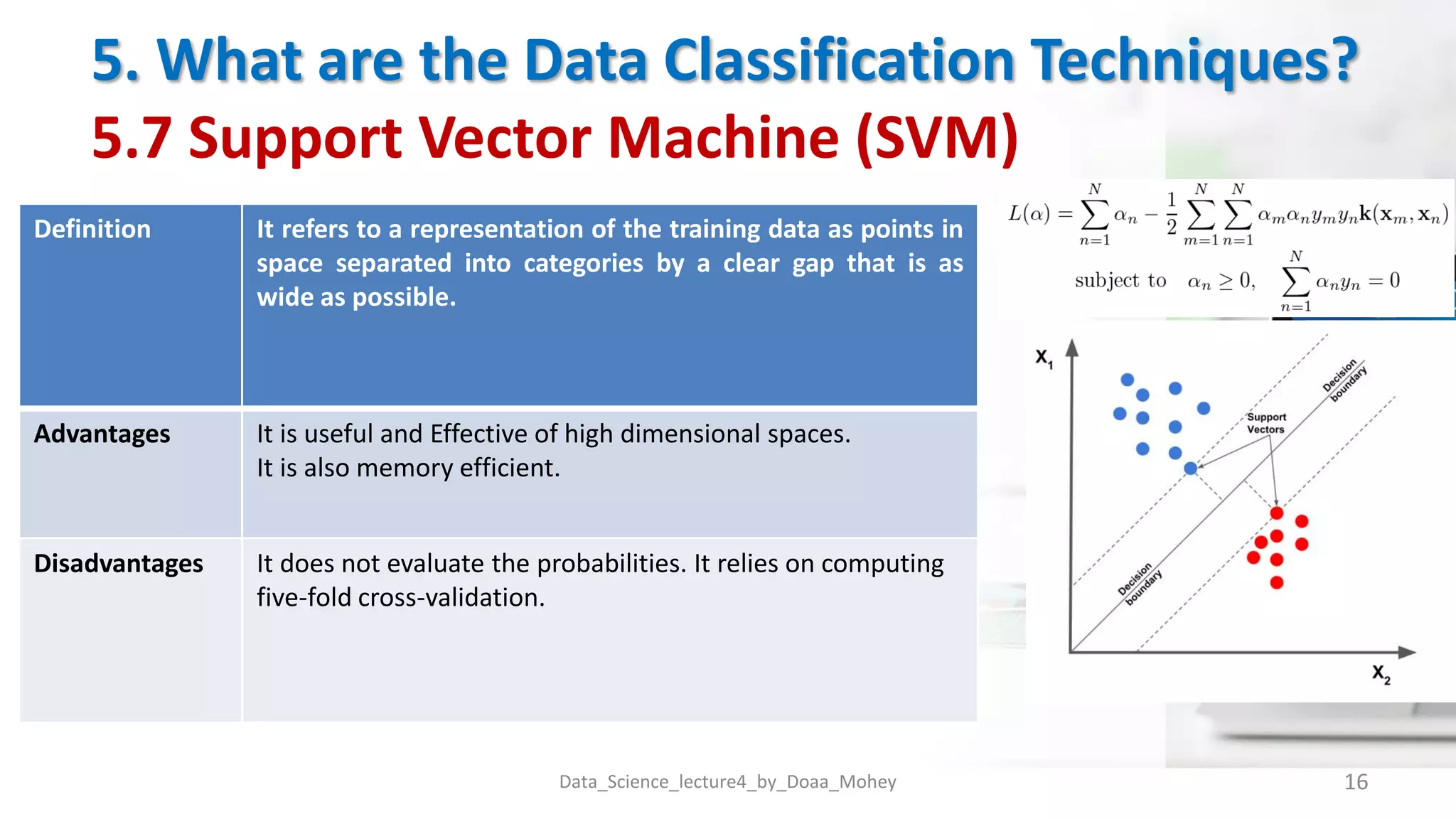
Definition It refers to a representation of the training data as points in
space separated into categories by a clear gap that is as
wide as possible.
Advantages It is useful and Effective of high dimensional spaces.
It is also memory efficient.
Disadvantages It does not evaluate the probabilities. It relies on computing
five-fold cross-validation.
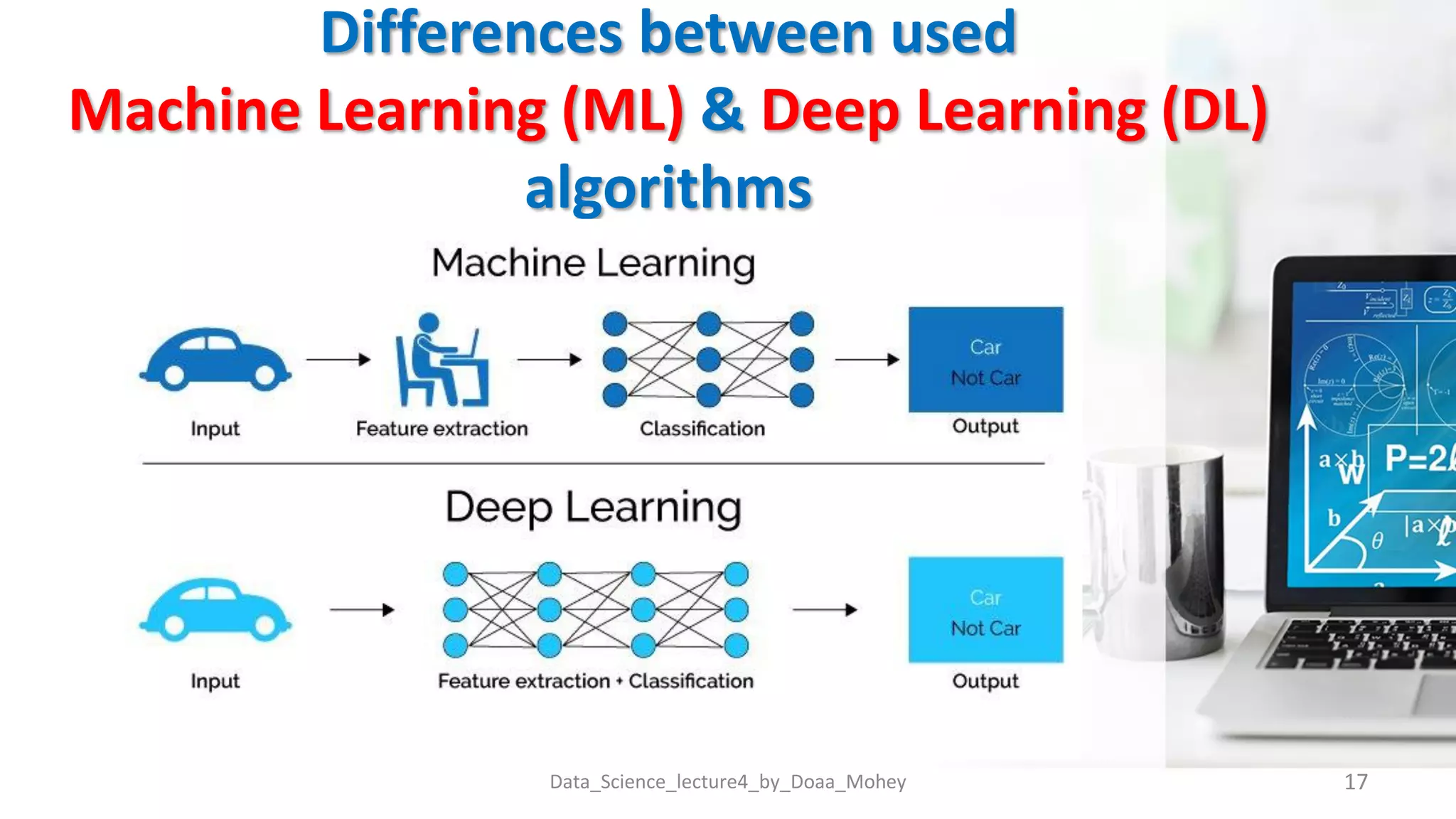
Differences between used
Machine Learning (ML) & Deep Learning (DL)
algorithms
Data_Science_lecture4_by_Doaa_Mohey 17
5. What are the Data Classification Techniques?
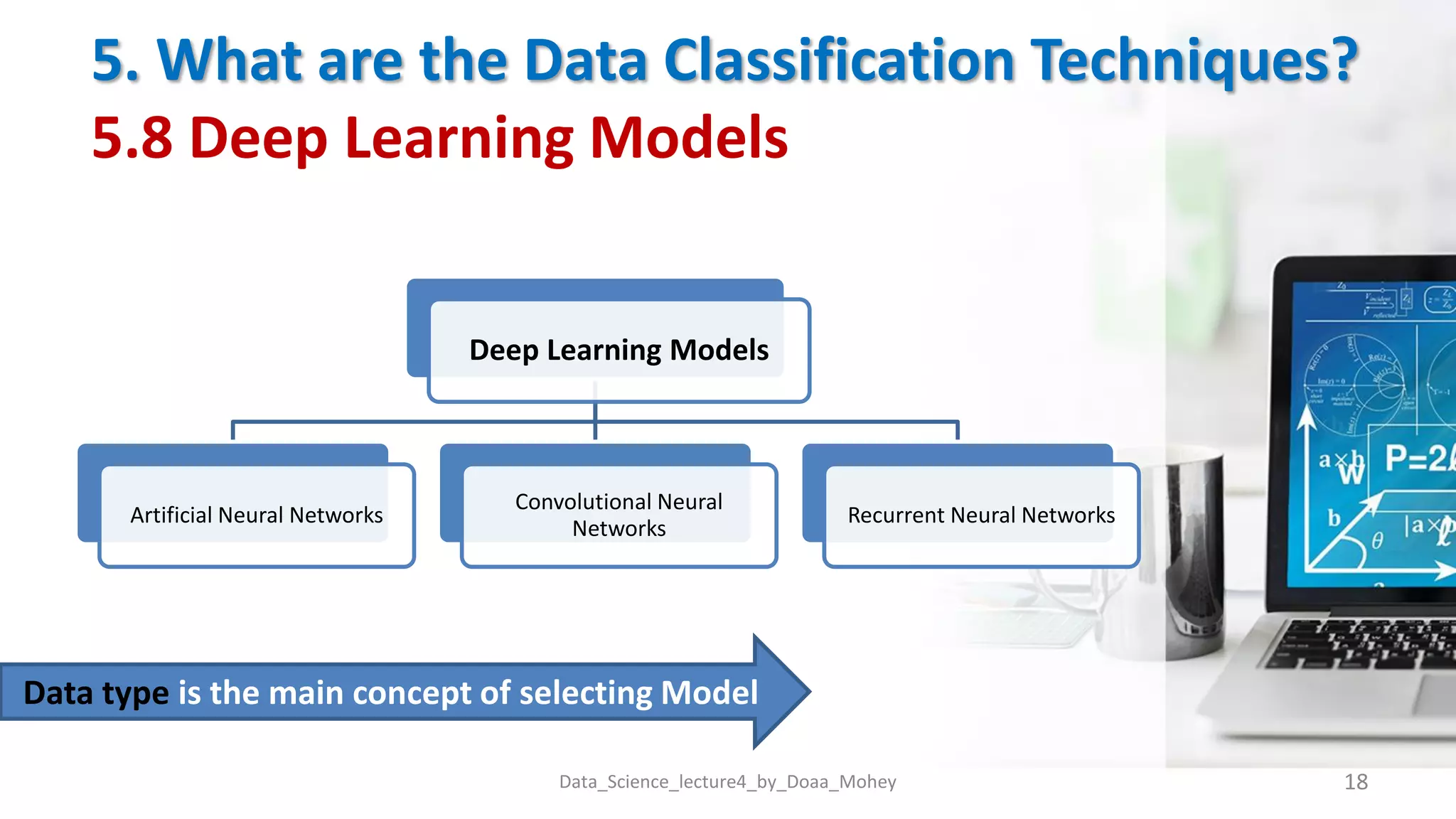
5.8 Deep Learning Models
Data_Science_lecture4_by_Doaa_Mohey 18
Deep Learning Models
Artificial Neural Networks
Convolutional Neural
Networks
Recurrent Neural Networks
Data type is the main concept of selecting Model
5. What are the Data Classification Techniques?
5.8 Deep Learning:
A) Artificial neural network (ANN)
Data_Science_lecture4_by_Doaa_Mohey 19
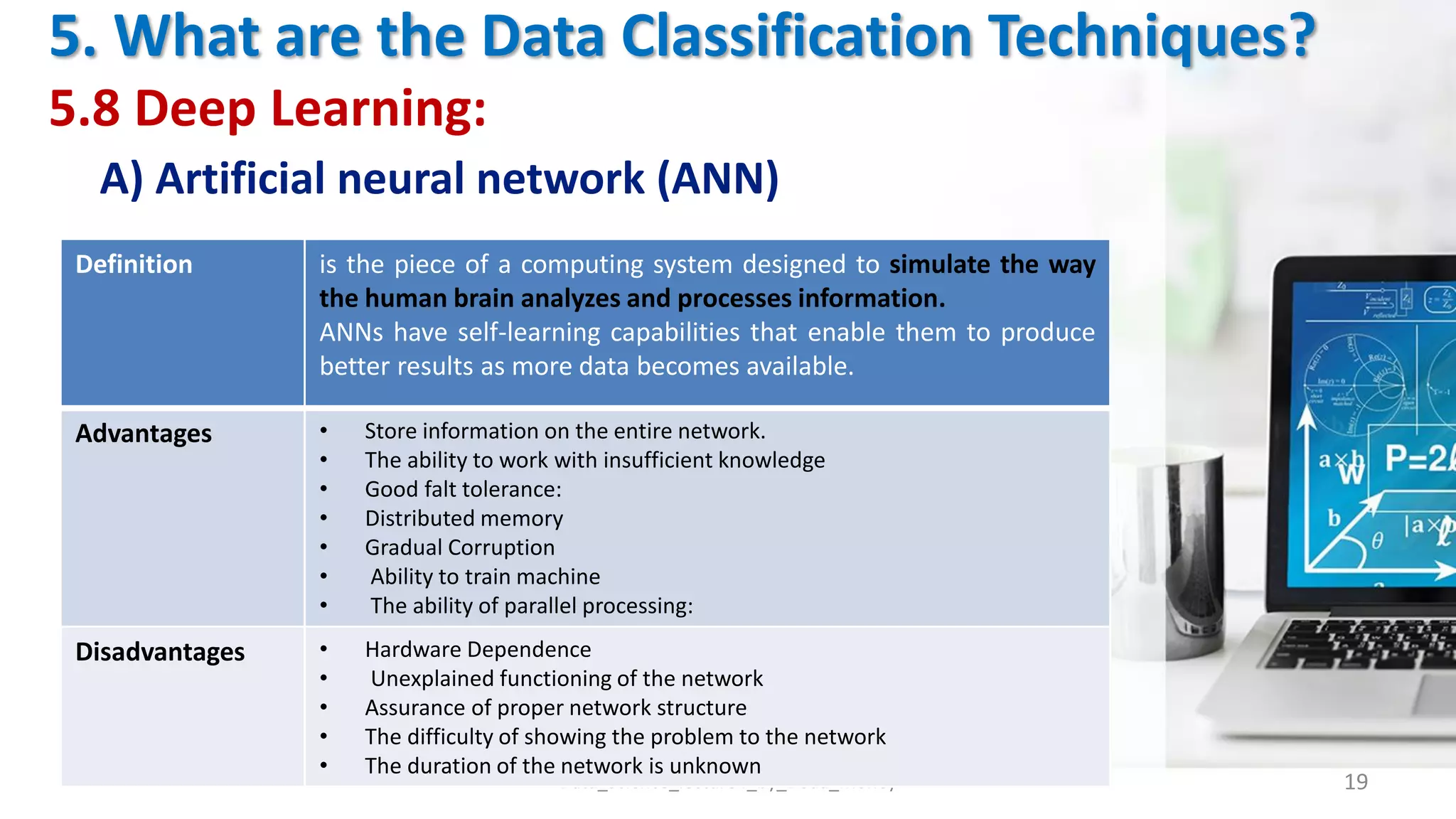
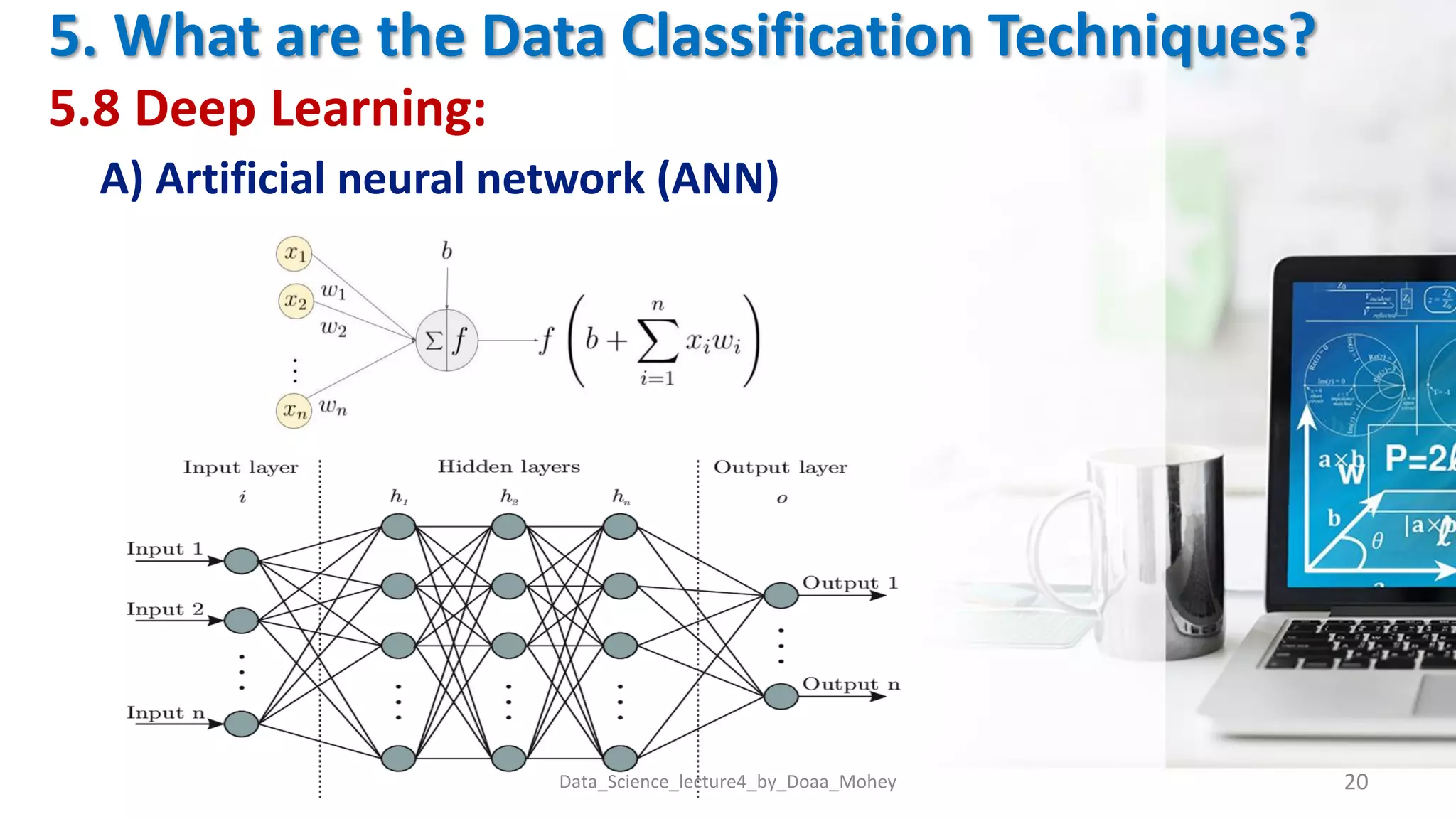
Definition is the piece of a computing system designed to simulate the way
the human brain analyzes and processes information.
ANNs have self-learning capabilities that enable them to produce
better results as more data becomes available.
Advantages • Store information on the entire network.
• The ability to work with insufficient knowledge
• Good falt tolerance:
• Distributed memory
• Gradual Corruption
• Ability to train machine
• The ability of parallel processing:
Disadvantages • Hardware Dependence
• Unexplained functioning of the network
• Assurance of proper network structure
• The difficulty of showing the problem to the network
• The duration of the network is unknown
5. What are the Data Classification Techniques?
5.8 Deep Learning:
A) Artificial neural network (ANN)
Data_Science_lecture4_by_Doaa_Mohey 20
5. What are the Data Classification Techniques?
5.8 Deep Learning:
B) Convolutional Neural Network (CNN)
Data_Science_lecture4_by_Doaa_Mohey 21
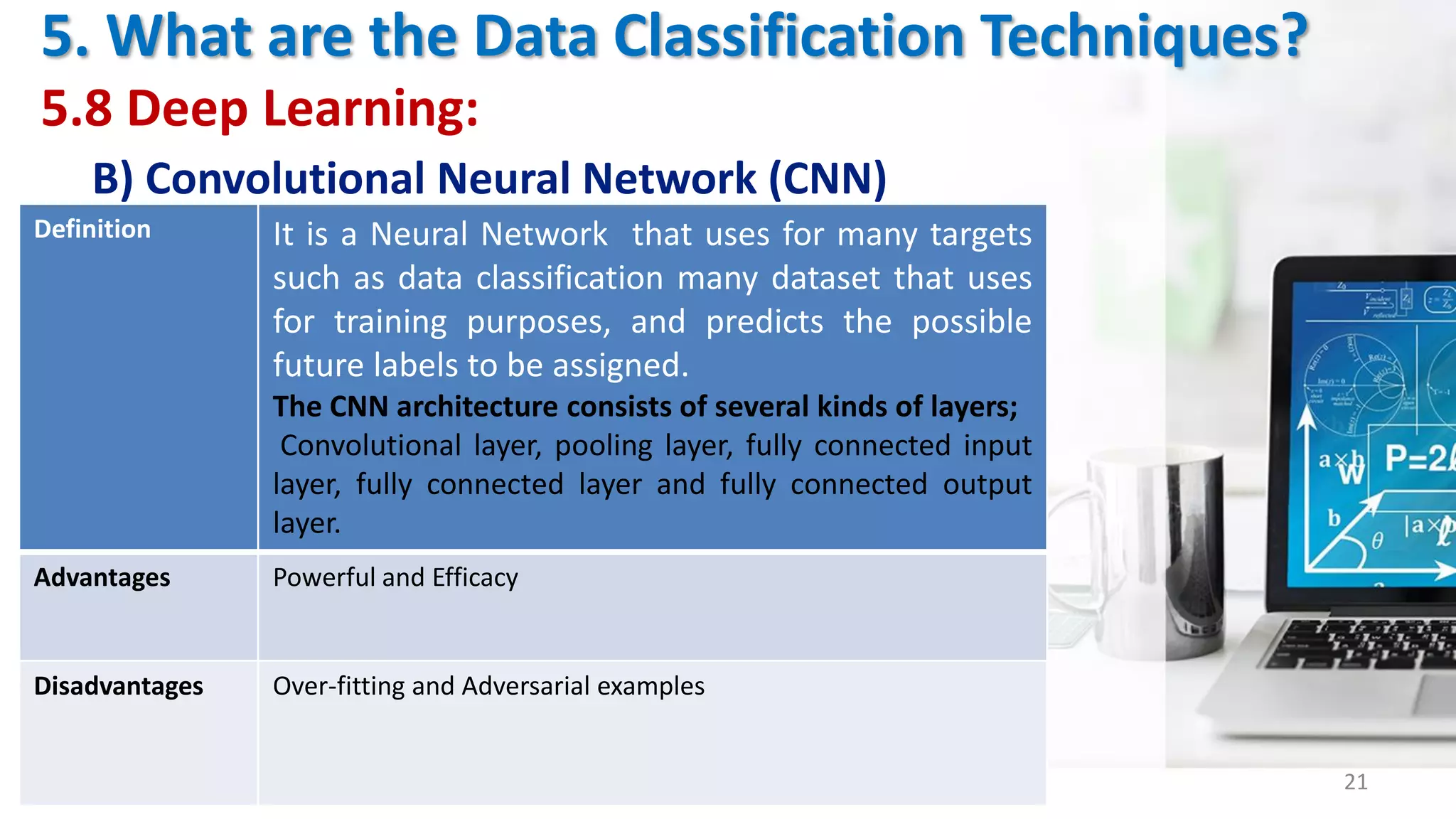
Definition It is a Neural Network that uses for many targets
such as data classification many dataset that uses
for training purposes, and predicts the possible
future labels to be assigned.
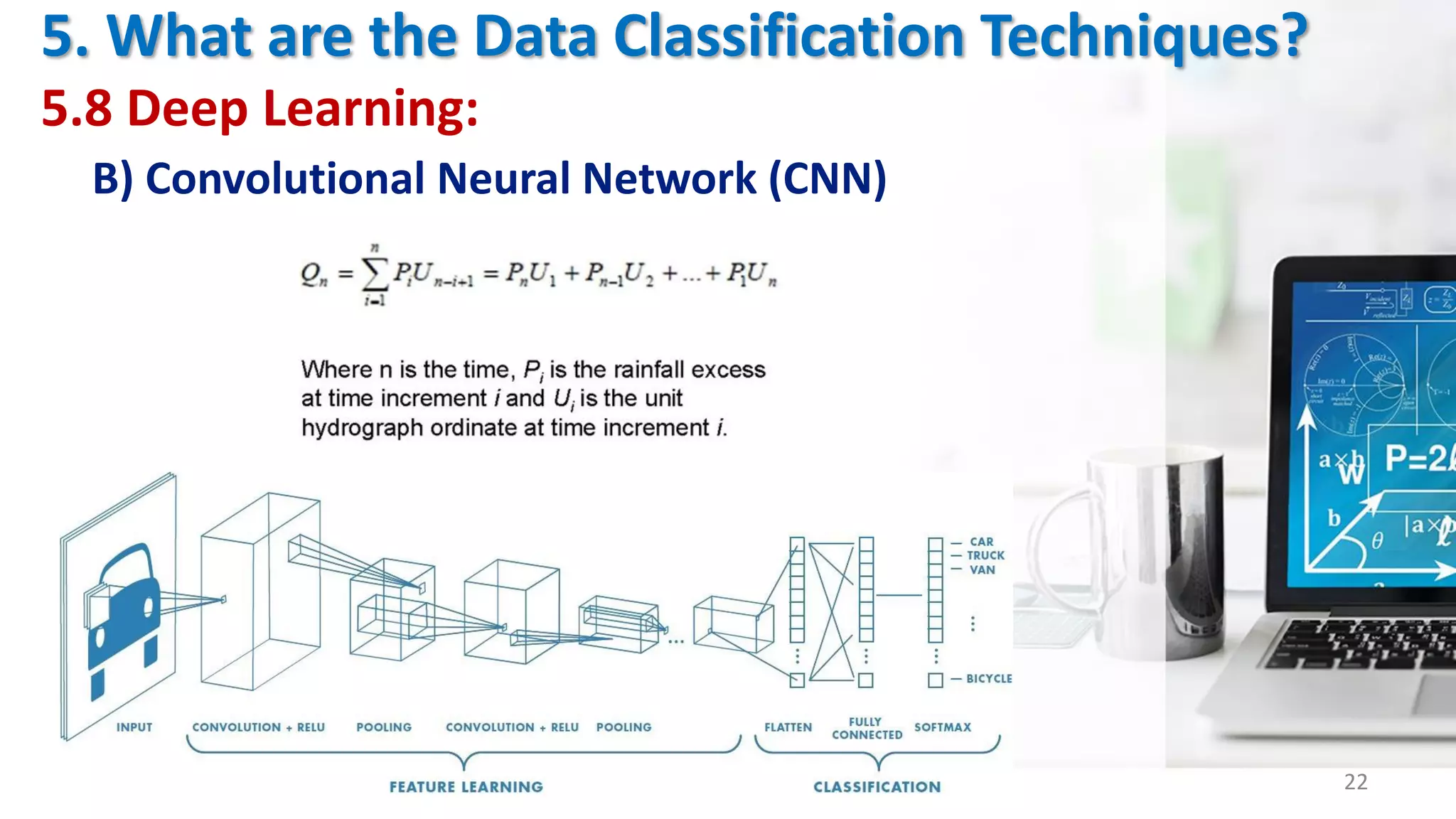
The CNN architecture consists of several kinds of layers;
Convolutional layer, pooling layer, fully connected input
layer, fully connected layer and fully connected output
layer.
Advantages Powerful and Efficacy
Disadvantages Over-fitting and Adversarial examples
5. What are the Data Classification Techniques?
5.8 Deep Learning:
B) Convolutional Neural Network (CNN)
Data_Science_lecture4_by_Doaa_Mohey 22
5. What are the Data Classification Techniques?
5.8 Deep Learning:
C) Recurrent Neural Network (RNN)
Data_Science_lecture4_by_Doaa_Mohey 23
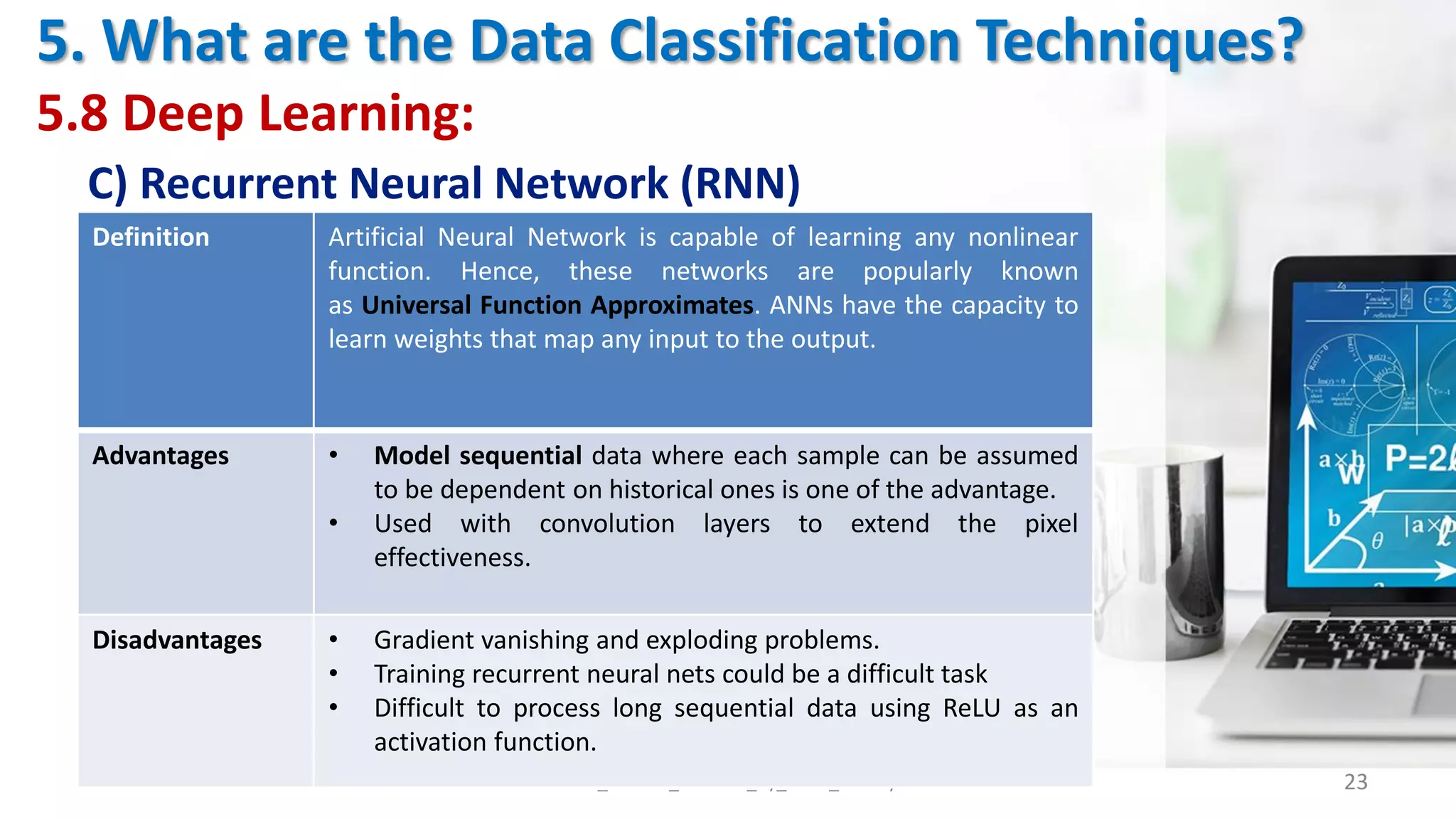
Definition Artificial Neural Network is capable of learning any nonlinear
function. Hence, these networks are popularly known
as Universal Function Approximates. ANNs have the capacity to
learn weights that map any input to the output.
Advantages • Model sequential data where each sample can be assumed
to be dependent on historical ones is one of the advantage.
• Used with convolution layers to extend the pixel
effectiveness.
Disadvantages • Gradient vanishing and exploding problems.
• Training recurrent neural nets could be a difficult task
• Difficult to process long sequential data using ReLU as an
activation function.
5. What are the Data Classification Techniques?
5.8 Deep Learning:
C) Recurrent Neural Network (RNN)
Data_Science_lecture4_by_Doaa_Mohey 24
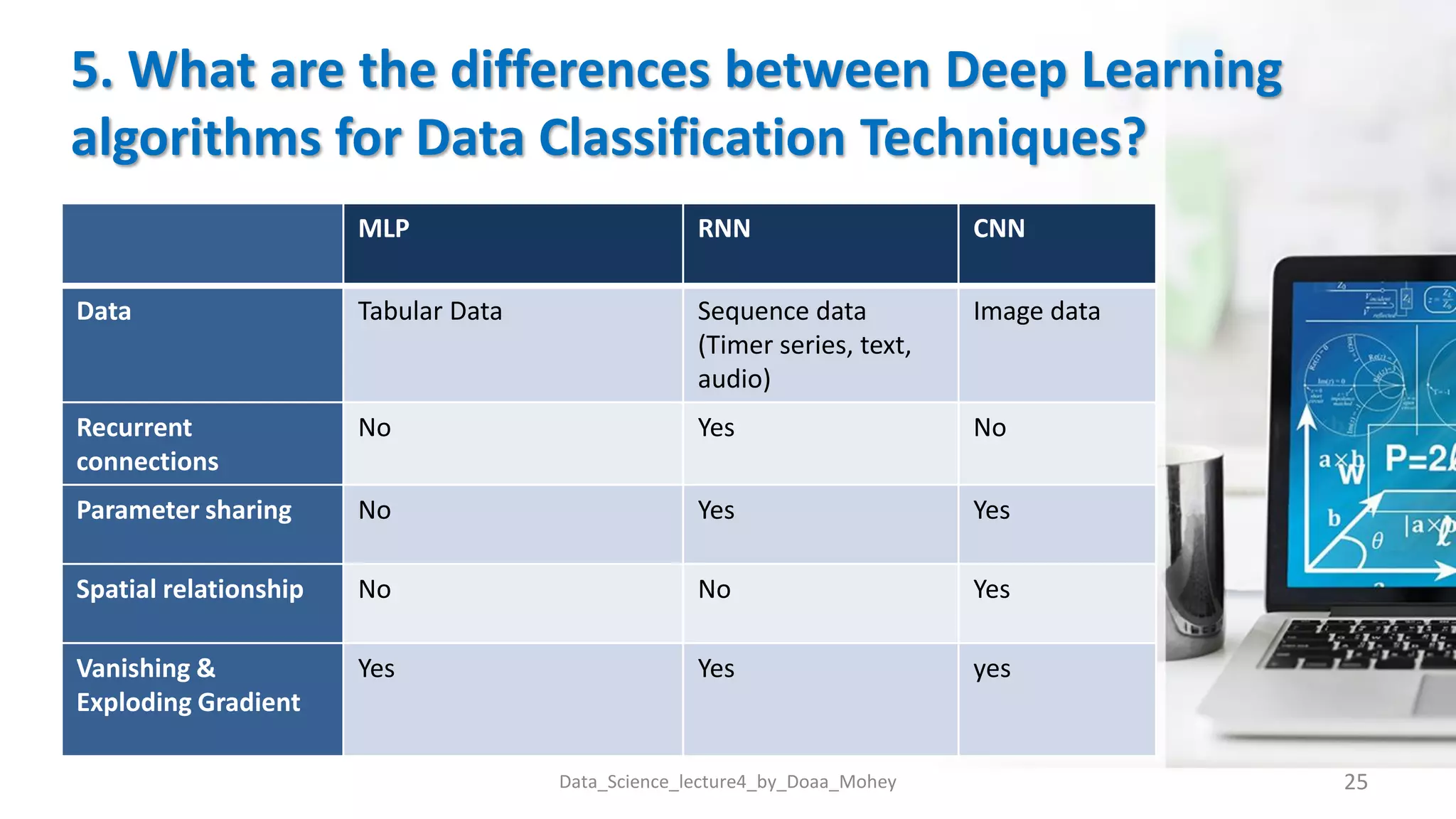
5. What are the differences between Deep Learning
algorithms for Data Classification Techniques?
Data_Science_lecture4_by_Doaa_Mohey 25
MLP RNN CNN
Data Tabular Data Sequence data
(Timer series, text,
audio)
Image data
Recurrent
connections
No Yes No
Parameter sharing No Yes Yes
Spatial relationship No No Yes
Vanishing &
Exploding Gradient
Yes Yes yes
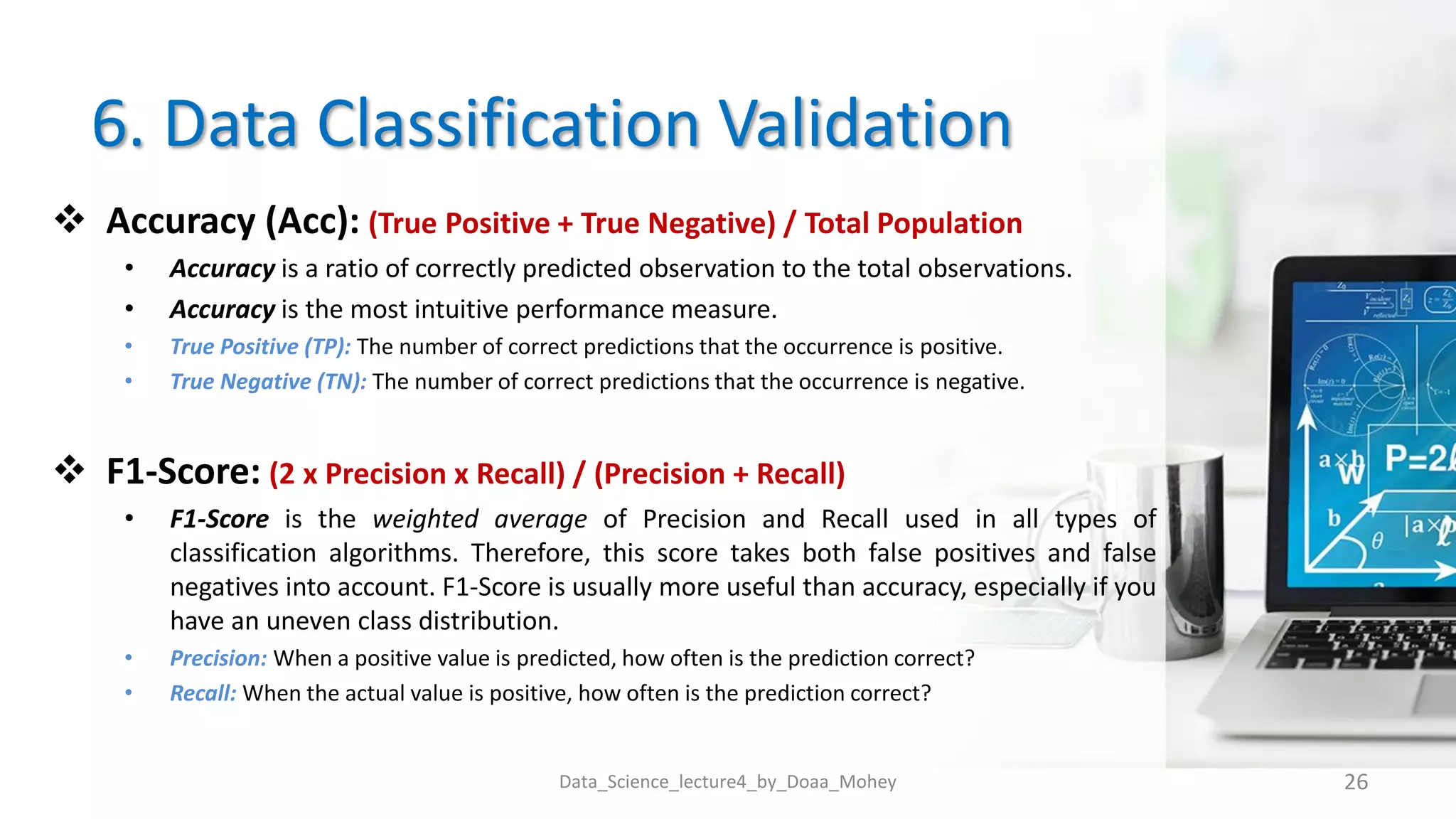
6. Data Classification Validation
 Accuracy (Acc): (True Positive + True Negative) / Total Population
• Accuracy is a ratio of correctly predicted observation to the total observations.
• Accuracy is the most intuitive performance measure.
• True Positive (TP): The number of correct predictions that the occurrence is positive.
• True Negative (TN): The number of correct predictions that the occurrence is negative.
 F1-Score: (2 x Precision x Recall) / (Precision + Recall)
• F1-Score is the weighted average of Precision and Recall used in all types of
classification algorithms. Therefore, this score takes both false positives and false
negatives into account. F1-Score is usually more useful than accuracy, especially if you
have an uneven class distribution.
• Precision: When a positive value is predicted, how often is the prediction correct?
• Recall: When the actual value is positive, how often is the prediction correct?
Data_Science_lecture4_by_Doaa_Mohey 26
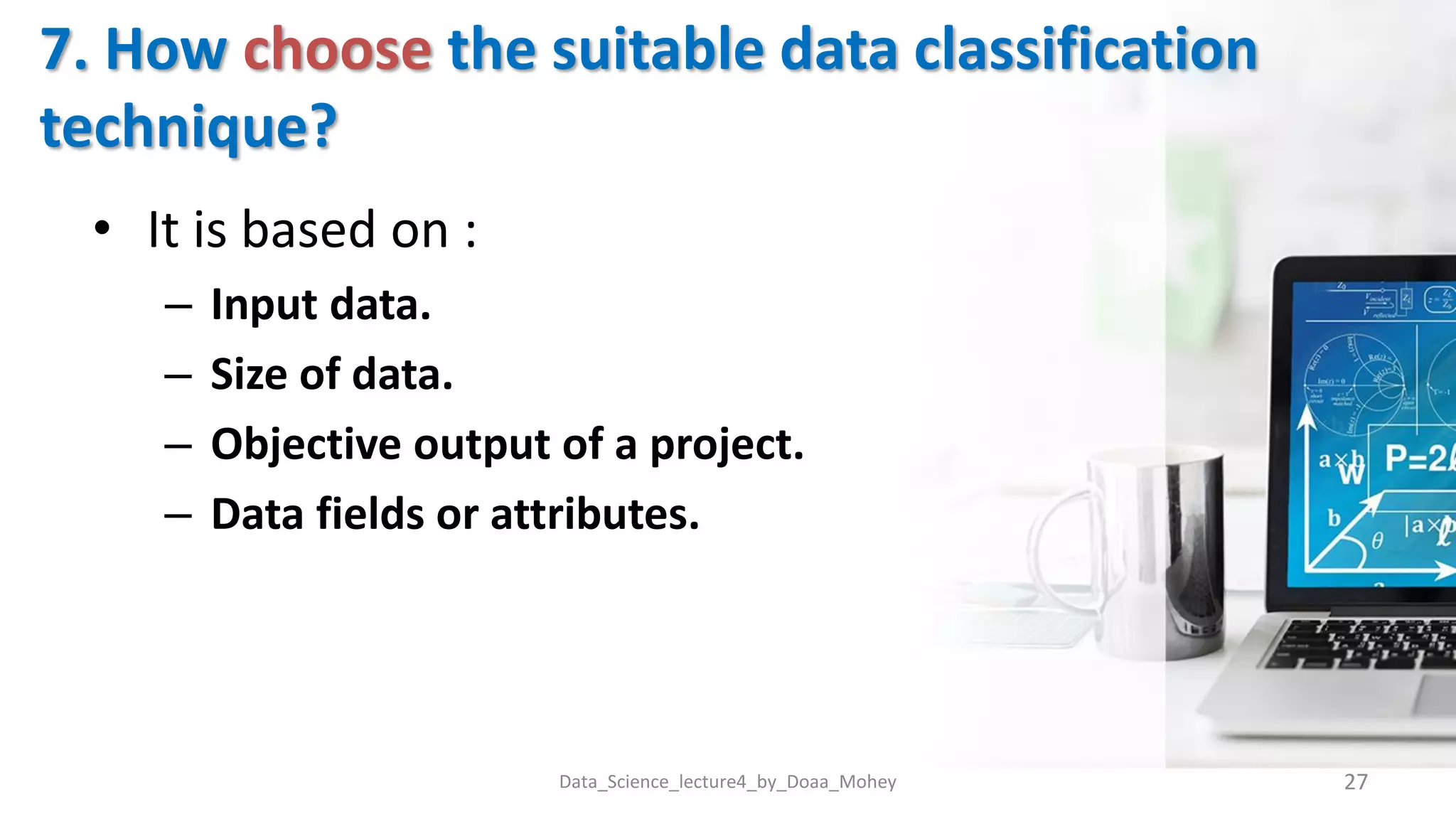
7. How choose the suitable data classification
technique?
Data_Science_lecture4_by_Doaa_Mohey 27
• It is based on :
– Input data.
– Size of data.
– Objective output of a project.
– Data fields or attributes.
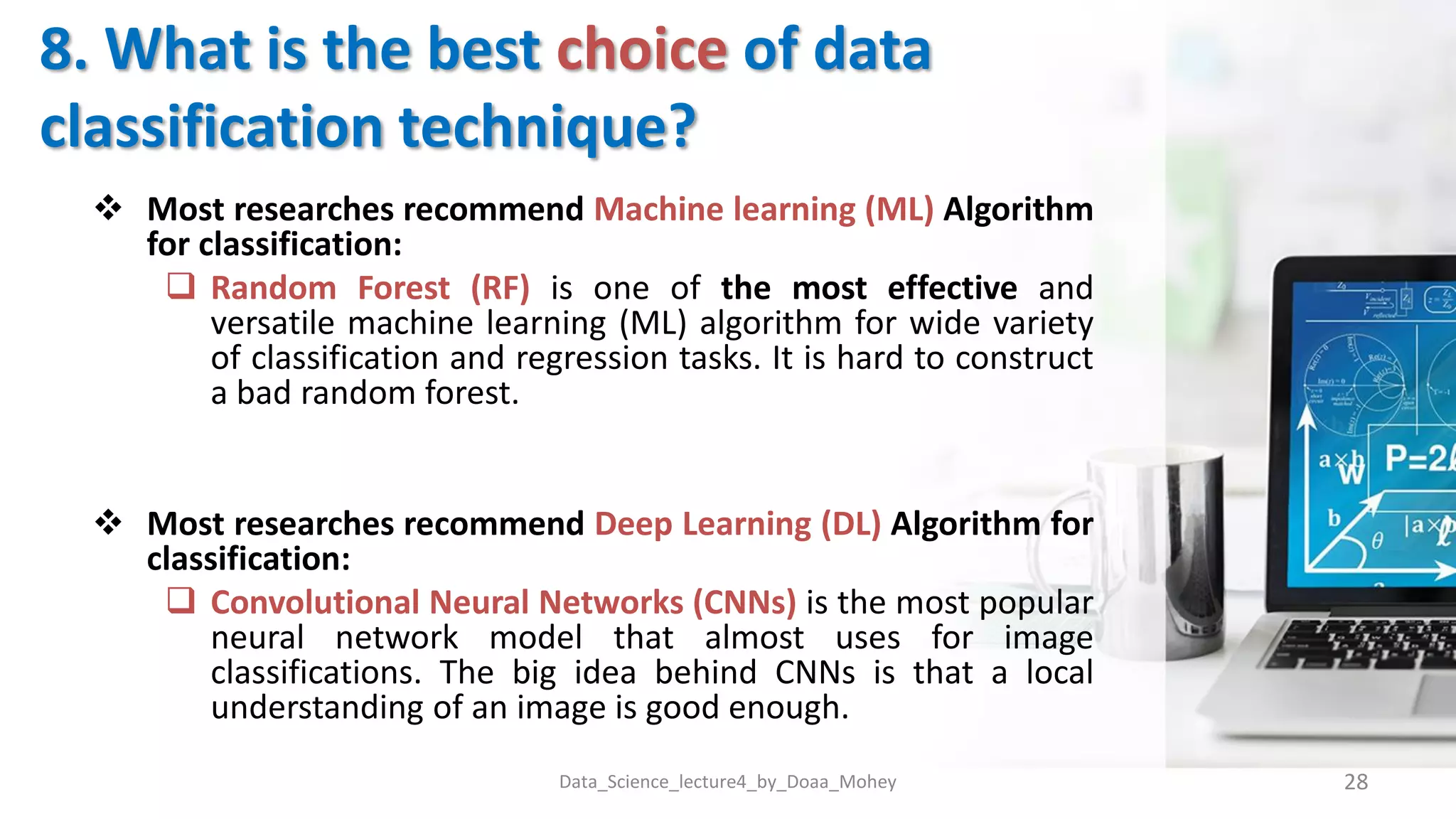
8. What is the best choice of data
classification technique?
Data_Science_lecture4_by_Doaa_Mohey 28
 Most researches recommend Machine learning (ML) Algorithm
for classification:
 Random Forest (RF) is one of the most effective and
versatile machine learning (ML) algorithm for wide variety
of classification and regression tasks. It is hard to construct
a bad random forest.
 Most researches recommend Deep Learning (DL) Algorithm for
classification:
 Convolutional Neural Networks (CNNs) is the most popular
neural network model that almost uses for image
classifications. The big idea behind CNNs is that a local
understanding of an image is good enough.
9. Data Classification Challenges
There are many challenges for classifying data:
1. Missing data or outliers in data Resources.
2. Hardness of learning from data.
3. No standardization of classification for various
domains.
4. Privilege Management
5. Maintain Compliance
Data_Science_lecture4_by_Doaa_Mohey 29
10. Data Classification Trends
 Recently, Big data classification with various data
type in various domains is a research trend.
 It requires making motivations for improving
classification with high accuracy and best
performance time.
 The optimization dimension becomes important in
recent researches.
 “COVID-19 classification domain” is a hottest domain for
making a research and achieving the best results for
classifications.
Data_Science_lecture4_by_Doaa_Mohey 30
31
Data_Science_lecture4_by_Doaa_Mohey

Data science lecture4_doaa_mohey

  • 1.
    Presented by: Doaa MoheyEldin PhD researcher in information Systems Faculty of Computers and Artificial intelligence – Cairo University IEEE Society Member
  • 2.
    Agenda • What isData Classification? • What is Data Classification Terminologies ? • Why use Data Classification? • How use Data Classification in real life? • Data Classification Techniques • Data Classification Validation • How choose the suitable data classification technique? • Data Classification Challenges • Data Classification Trends 2 Data_Science_lecture4_by_Doaa_Mohey
  • 3.
    1. What isData Classification? • Data Classification is – “the process of analyzing structured and unstructured data for organizing data into classes based on file type, content, and metadata”. – Classification is a supervised learning. – Uses training sets which has correct answers (class label attributes). – A model is created by running the algorithm on the training data. 3 Data_Science_lecture4_by_Doaa_Mohey
  • 4.
    2. What isData Classification Terminologies ?  A Classifier: An algorithm that maps the input data to a specific category.  A classification model draws some conclusion from the input values given for training. It will predict the class labels/categories for the new data.  Data Classification Terminologies:  A feature refers to an individual measurable property of a phenomenon being observed.  Binary Classification: refers to a task with two possible outcomes. e.g: Gender classification (Male / Female)  Multi-class classification: refers to a classification that interprets with more than two classes. Each sample is assigned to one and only one target label. e.g: An animal can be cat or dog but not both at the same time  Multi-label classification: refers to a classification task where each sample is mapped to a set of target labels (more than one class). e.g: A news article can be about sports, a person, and location at the same time. Data_Science_lecture4_by_Doaa_Mohey 4
  • 5.
    3. Why useData Classification? Data_Science_lecture4_by_Doaa_Mohey 5 Data Classification Optimizing searching Predicting data Improving decision making Improving sensitivity
  • 6.
    4. How useData Classification in real- life? • Data classification requires interpreting in: 1. Input data: • Data Type (image, video, audio, text). • One dimension or multivariate dimensions. • All data the same type or variant types. • Treating missed or outliers data. 2. Choice a suitable Algorithm: • Logistic Regression - Random Forest • Naïve Bayes - Support Vector machine • Stochastic Gradient Descent. • K-Nearest Neighbours. - Deep learning algorithms. • Decision Tree. 6 Data_Science_lecture4_by_Doaa_Mohey
  • 7.
    4. How useData Classification in real- life? (continue) 3. Choice validation algorithm: • Precision, recall, or F-measure (Accuracy) • Loss function (Error function) • Other validations, performance & optimization. • Data Classification applications in real life such as the following: Diseases , Market, or Marks. 4. Choice validation algorithm: • Precision, recall, or F-measure (Accuracy) • Loss function (Error function) • Other validations, performance & optimization. 7 Data_Science_lecture4_by_Doaa_Mohey
  • 8.
    4. How useData Classification in real- life? (continue) • Data Classification applications in real life such as the following: – Classify Diseases , – Classify profit of Market, or – Marks. • COVID-19 classification is a hot trend of classification based on image classes and analysis classes. 8 Data_Science_lecture4_by_Doaa_Mohey
  • 9.
    5. What arethe Data Classification Techniques? Data_Science_lecture4_by_Doaa_Mohey 9 Data Classification Techniques Traditional machine learning Logistic regression Naïve base Stochastic Gradient Descent K-Nearest Neighbour Decision Tree Random forest Support vector machine Deep learning Artificial neural networks Convolutional Neural Networks Recurrent neural networks
  • 10.
    5. What arethe Data Classification Techniques? 5.1 Logistic Regression (LR) Data_Science_lecture4_by_Doaa_Mohey 10 Definition It refers to the probabilities description of the possible output of single trial based on using Logistic Function Advantages It is a powerful of meaning influence of several variables Disadvantages It works only when the predicted variable is binary, assumes all predictors are independent of each other, and It assumes data is free of missing values
  • 11.
    5. What arethe Data Classification Techniques? 5.2 Naïve Bayes (NB) Data_Science_lecture4_by_Doaa_Mohey 11 Definition It refers to Bayes’ theorem with the assumption of independence between every pair of features. It work on many real-world situations. Advantages It is a powerful of measuring the necessary parameters. It has many classifiers for improving speed to be more sophisticated methods. Disadvantages It is a bad estimator, in other words, it is the simplest classification method
  • 12.
    5. What arethe Data Classification Techniques? 5.3 Stochastic Gradient Descent (SGD) Data_Science_lecture4_by_Doaa_Mohey 12 Definition It refers to a simple and very efficient approach to fit linear models. It is particularly useful when the number of samples is very large. It supports different loss functions and penalties for classification. Advantages It is efficiency and easy to implement. Disadvantages It requires being based on a number of hyper-parameters. It is a powerful and sensitive to feature scaling.
  • 13.
    5. What arethe Data Classification Techniques? 5.4 K-Nearest Neighbours (KNN) Data_Science_lecture4_by_Doaa_Mohey 13 Definition It refers to a type of lazy learning that uses for building an internal model. It calculated a simple majority vote of the KNN of each point. Advantages It is easy to implement, robust to noisy training data, and effective if training data is big. Disadvantages It requires determining the value of K & the computation cost is high. It requires calculating the distance of each instance to all the training samples.
  • 14.
    5. What arethe Data Classification Techniques? 5.5 Decision Tree (DT) Data_Science_lecture4_by_Doaa_Mohey 14 Definition It refers to interpret data attributes based on classes, decision tree. It produces a sequence of rules that can be used to classify the data. Advantages It is simple to understand and easy to visualize. It needs making categorization data. Disadvantages It constructs complex trees & decision trees to be unstable due to small data variations.
  • 15.
    5. What arethe Data Classification Techniques? 5.6 Random Forest (RF) Data_Science_lecture4_by_Doaa_Mohey 15 Definition It refers to a meta-estimator that fits a number of decision trees on various sub-samples of datasets. It uses for the average evaluation for enhancing the predictive accuracy model and controls over-fitting. Advantages It is powerful of reduction in over-fitting & random forest classifier. It is more accurate than decision trees in most cases. Disadvantages It is slow real time prediction. It is hard to implement and complex technique.
  • 16.
    5. What arethe Data Classification Techniques? 5.7 Support Vector Machine (SVM) Data_Science_lecture4_by_Doaa_Mohey 16 Definition It refers to a representation of the training data as points in space separated into categories by a clear gap that is as wide as possible. Advantages It is useful and Effective of high dimensional spaces. It is also memory efficient. Disadvantages It does not evaluate the probabilities. It relies on computing five-fold cross-validation.
  • 17.
    Differences between used MachineLearning (ML) & Deep Learning (DL) algorithms Data_Science_lecture4_by_Doaa_Mohey 17
  • 18.
    5. What arethe Data Classification Techniques? 5.8 Deep Learning Models Data_Science_lecture4_by_Doaa_Mohey 18 Deep Learning Models Artificial Neural Networks Convolutional Neural Networks Recurrent Neural Networks Data type is the main concept of selecting Model
  • 19.
    5. What arethe Data Classification Techniques? 5.8 Deep Learning: A) Artificial neural network (ANN) Data_Science_lecture4_by_Doaa_Mohey 19 Definition is the piece of a computing system designed to simulate the way the human brain analyzes and processes information. ANNs have self-learning capabilities that enable them to produce better results as more data becomes available. Advantages • Store information on the entire network. • The ability to work with insufficient knowledge • Good falt tolerance: • Distributed memory • Gradual Corruption • Ability to train machine • The ability of parallel processing: Disadvantages • Hardware Dependence • Unexplained functioning of the network • Assurance of proper network structure • The difficulty of showing the problem to the network • The duration of the network is unknown
  • 20.
    5. What arethe Data Classification Techniques? 5.8 Deep Learning: A) Artificial neural network (ANN) Data_Science_lecture4_by_Doaa_Mohey 20
  • 21.
    5. What arethe Data Classification Techniques? 5.8 Deep Learning: B) Convolutional Neural Network (CNN) Data_Science_lecture4_by_Doaa_Mohey 21 Definition It is a Neural Network that uses for many targets such as data classification many dataset that uses for training purposes, and predicts the possible future labels to be assigned. The CNN architecture consists of several kinds of layers; Convolutional layer, pooling layer, fully connected input layer, fully connected layer and fully connected output layer. Advantages Powerful and Efficacy Disadvantages Over-fitting and Adversarial examples
  • 22.
    5. What arethe Data Classification Techniques? 5.8 Deep Learning: B) Convolutional Neural Network (CNN) Data_Science_lecture4_by_Doaa_Mohey 22
  • 23.
    5. What arethe Data Classification Techniques? 5.8 Deep Learning: C) Recurrent Neural Network (RNN) Data_Science_lecture4_by_Doaa_Mohey 23 Definition Artificial Neural Network is capable of learning any nonlinear function. Hence, these networks are popularly known as Universal Function Approximates. ANNs have the capacity to learn weights that map any input to the output. Advantages • Model sequential data where each sample can be assumed to be dependent on historical ones is one of the advantage. • Used with convolution layers to extend the pixel effectiveness. Disadvantages • Gradient vanishing and exploding problems. • Training recurrent neural nets could be a difficult task • Difficult to process long sequential data using ReLU as an activation function.
  • 24.
    5. What arethe Data Classification Techniques? 5.8 Deep Learning: C) Recurrent Neural Network (RNN) Data_Science_lecture4_by_Doaa_Mohey 24
  • 25.
    5. What arethe differences between Deep Learning algorithms for Data Classification Techniques? Data_Science_lecture4_by_Doaa_Mohey 25 MLP RNN CNN Data Tabular Data Sequence data (Timer series, text, audio) Image data Recurrent connections No Yes No Parameter sharing No Yes Yes Spatial relationship No No Yes Vanishing & Exploding Gradient Yes Yes yes
  • 26.
    6. Data ClassificationValidation  Accuracy (Acc): (True Positive + True Negative) / Total Population • Accuracy is a ratio of correctly predicted observation to the total observations. • Accuracy is the most intuitive performance measure. • True Positive (TP): The number of correct predictions that the occurrence is positive. • True Negative (TN): The number of correct predictions that the occurrence is negative.  F1-Score: (2 x Precision x Recall) / (Precision + Recall) • F1-Score is the weighted average of Precision and Recall used in all types of classification algorithms. Therefore, this score takes both false positives and false negatives into account. F1-Score is usually more useful than accuracy, especially if you have an uneven class distribution. • Precision: When a positive value is predicted, how often is the prediction correct? • Recall: When the actual value is positive, how often is the prediction correct? Data_Science_lecture4_by_Doaa_Mohey 26
  • 27.
    7. How choosethe suitable data classification technique? Data_Science_lecture4_by_Doaa_Mohey 27 • It is based on : – Input data. – Size of data. – Objective output of a project. – Data fields or attributes.
  • 28.
    8. What isthe best choice of data classification technique? Data_Science_lecture4_by_Doaa_Mohey 28  Most researches recommend Machine learning (ML) Algorithm for classification:  Random Forest (RF) is one of the most effective and versatile machine learning (ML) algorithm for wide variety of classification and regression tasks. It is hard to construct a bad random forest.  Most researches recommend Deep Learning (DL) Algorithm for classification:  Convolutional Neural Networks (CNNs) is the most popular neural network model that almost uses for image classifications. The big idea behind CNNs is that a local understanding of an image is good enough.
  • 29.
    9. Data ClassificationChallenges There are many challenges for classifying data: 1. Missing data or outliers in data Resources. 2. Hardness of learning from data. 3. No standardization of classification for various domains. 4. Privilege Management 5. Maintain Compliance Data_Science_lecture4_by_Doaa_Mohey 29
  • 30.
    10. Data ClassificationTrends  Recently, Big data classification with various data type in various domains is a research trend.  It requires making motivations for improving classification with high accuracy and best performance time.  The optimization dimension becomes important in recent researches.  “COVID-19 classification domain” is a hottest domain for making a research and achieving the best results for classifications. Data_Science_lecture4_by_Doaa_Mohey 30
  • 31.