1
An In-Depth Look at Big Data
Trends and Challenges
Results from a Global Survey by Dimensional Research
August 2018
1
Global Survey of Business,
IT and Big Data Professionals
O V E R V I E W
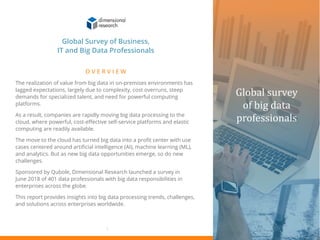
The realization of value from big data in on-premises environments has
lagged expectations, largely due to complexity, cost overruns, steep
demands for specialized talent, and need for powerful computing
platforms.
As a result, companies are rapidly moving big data processing to the
cloud, where powerful, cost-effective self-service platforms and elastic
computing are readily available.
The move to the cloud has turned big data into a profit center with use
cases centered around artificial intelligence (AI), machine learning (ML),
and analytics. But as new big data opportunities emerge, so do new
challenges.
Sponsored by Qubole, Dimensional Research launched a survey in
June 2018 of 401 data professionals with big data responsibilities in
enterprises across the globe.
This report provides insights into big data processing trends, challenges,
and solutions across enterprises worldwide.
Global survey
of big data
professionals
1
2
Big Data is Skyrocketing in Size
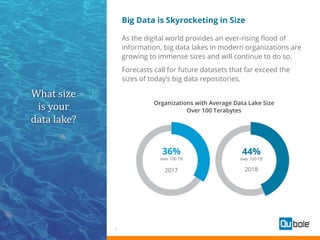
As the digital world provides an ever-rising flood of
information, big data lakes in modern organizations are
growing to immense sizes and will continue to do so.
Forecasts call for future datasets that far exceed the
sizes of today’s big data repositories.
Organizations with Average Data Lake Size
Over 100 Terabytes
What size
is your
data lake?
3
Types of Big Data Processing
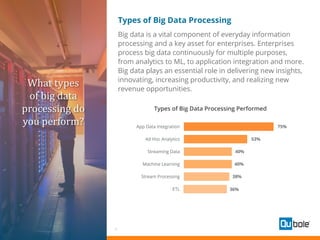
Big data is a vital component of everyday information
processing and a key asset for enterprises. Enterprises
process big data continuously for multiple purposes,
from analytics to ML, to application integration and more.
Big data plays an essential role in delivering new insights,
innovating, increasing productivity, and realizing new
revenue opportunities.
Types of Big Data Processing Performed
What types
of big data
processing do
you perform?
4
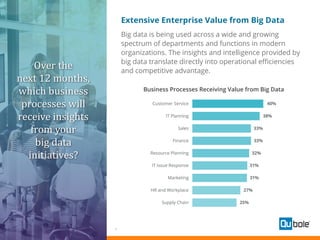
Extensive Enterprise Value from Big Data
Big data is being used across a wide and growing
spectrum of departments and functions in modern
organizations. The insights and intelligence provided by
big data translate directly into operational efficiencies
and competitive advantage.
Business Processes Receiving Value from Big Data
Over the
next 12 months,
which business
processes will
receive insights
from your
big data
initiatives?
5
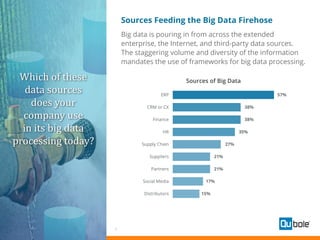
Sources Feeding the Big Data Firehose
Big data is pouring in from across the extended
enterprise, the Internet, and third-party data sources.
The staggering volume and diversity of the information
mandates the use of frameworks for big data processing.
Sources of Big Data
Which of these
data sources
does your
company use
in its big data
processing today?
6
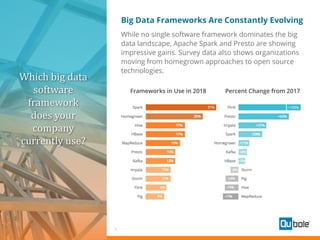
Big Data Frameworks Are Constantly Evolving
While no single software framework dominates the big
data landscape, Apache Spark and Presto are showing
impressive gains. Survey data also shows organizations
moving from homegrown approaches to open source
technologies.
Frameworks in Use in 2018
Which big data
software
framework
does your
company
currently use?
Percent Change from 2017
7
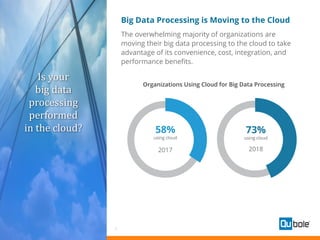
Big Data Processing is Moving to the Cloud
The overwhelming majority of organizations are
moving their big data processing to the cloud to take
advantage of its convenience, cost, integration, and
performance benefits.
Organizations Using Cloud for Big Data Processing
Is your
big data
processing
performed
in the cloud?
8
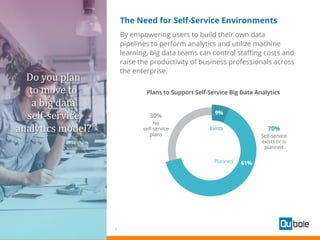
The Need for Self-Service Environments
By empowering users to build their own data
pipelines to perform analytics and utilize machine
learning, big data teams can control staffing costs and
raise the productivity of business professionals across
the enterprise.
Plans to Support Self-Service Big Data Analytics
Do you plan
to move to
a big data
self-service
analytics model?
9
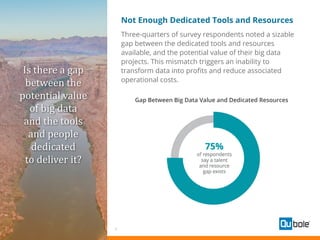
Not Enough Dedicated Tools and Resources
Three-quarters of survey respondents noted a sizable
gap between the dedicated tools and resources
available, and the potential value of their big data
projects. This mismatch triggers an inability to
transform data into profits and reduce associated
operational costs.
Gap Between Big Data Value and Dedicated Resources
Is there a gap
between the
potential value
of big data
and the tools
and people
dedicated
to deliver it?
10
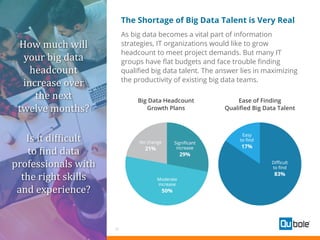
The Shortage of Big Data Talent is Very Real
As big data becomes a vital part of information
strategies, IT organizations would like to grow
headcount to meet project demands. But many IT
groups have flat budgets and face trouble finding
qualified big data talent. The answer lies in maximizing
the productivity of existing big data teams.
Big Data Headcount
Growth Plans
How much will
your big data
headcount
increase over
the next
twelve months?
Is it difficult
to find data
professionals with
the right skills
and experience?
Ease of Finding
Qualified Big Data Talent
11
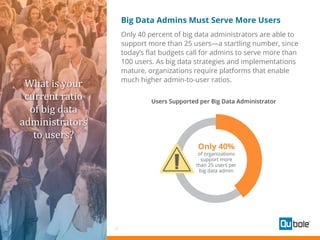
Big Data Admins Must Serve More Users
Only 40 percent of big data administrators are able to
support more than 25 users—a startling number, since
today’s flat budgets call for admins to serve more than
100 users. As big data strategies and implementations
mature, organizations require platforms that enable
much higher admin-to-user ratios.
What is your
current ratio
of big data
administrators
to users?
Users Supported per Big Data Administrator
12
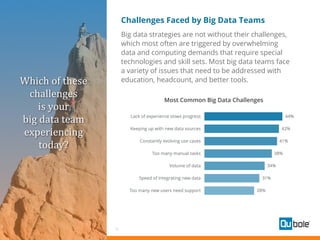
Challenges Faced by Big Data Teams
Big data strategies are not without their challenges,
which most often are triggered by overwhelming
data and computing demands that require special
technologies and skill sets. Most big data teams face
a variety of issues that need to be addressed with
education, headcount, and better tools.
Which of these
challenges
is your
big data team
experiencing
today?
Most Common Big Data Challenges
13
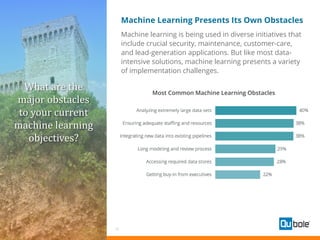
Machine Learning Presents Its Own Obstacles
Machine learning is being used in diverse initiatives that
include crucial security, maintenance, customer-care,
and lead-generation applications. But like most data-
intensive solutions, machine learning presents a variety
of implementation challenges.
Most Common Machine Learning Obstacles
What are the
major obstacles
to your current
machine learning
objectives?
14
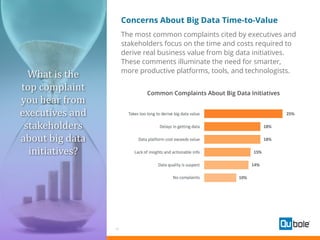
Concerns About Big Data Time-to-Value
The most common complaints cited by executives and
stakeholders focus on the time and costs required to
derive real business value from big data initiatives.
These comments illuminate the need for smarter,
more productive platforms, tools, and technologists.
What is the
top complaint
you hear from
executives and
stakeholders
about big data
initiatives?
Common Complaints About Big Data Initiatives
15
The Cloud-Native, Data Platform for
Artificial Intelligence, Machine Learning
and Analytics
More than 200 organizations worldwide use Qubole to process over
an exabyte of data per month for AI, machine learning, and analytics.
Qubole’s cloud-native platform delivers:
•	Fastest time to value from AI, ML, and analytics
•	End-to-end data processing on a single, shared platform
•	Self-service capabilities to support 10 times more users and data
per administrator
•	50 percent lower cloud data processing costs than alternatives
Since the company’s inception, Qubole has continued to push the
limits of possibility in big data and cloud computing.
Do you need
a faster, easier
way to reap
the rewards
of big data
in your
organization?
Copyright © 2018 Qubole, Inc. All rights reserved.
To learn more, visit qubole.com

Big Data Trends and Challenges Report - Whitepaper

  • 1.
    1 An In-Depth Lookat Big Data Trends and Challenges Results from a Global Survey by Dimensional Research August 2018
  • 2.
    1 Global Survey ofBusiness, IT and Big Data Professionals O V E R V I E W The realization of value from big data in on-premises environments has lagged expectations, largely due to complexity, cost overruns, steep demands for specialized talent, and need for powerful computing platforms. As a result, companies are rapidly moving big data processing to the cloud, where powerful, cost-effective self-service platforms and elastic computing are readily available. The move to the cloud has turned big data into a profit center with use cases centered around artificial intelligence (AI), machine learning (ML), and analytics. But as new big data opportunities emerge, so do new challenges. Sponsored by Qubole, Dimensional Research launched a survey in June 2018 of 401 data professionals with big data responsibilities in enterprises across the globe. This report provides insights into big data processing trends, challenges, and solutions across enterprises worldwide. Global survey of big data professionals 1
  • 3.
    2 Big Data isSkyrocketing in Size As the digital world provides an ever-rising flood of information, big data lakes in modern organizations are growing to immense sizes and will continue to do so. Forecasts call for future datasets that far exceed the sizes of today’s big data repositories. Organizations with Average Data Lake Size Over 100 Terabytes What size is your data lake?
  • 4.
    3 Types of BigData Processing Big data is a vital component of everyday information processing and a key asset for enterprises. Enterprises process big data continuously for multiple purposes, from analytics to ML, to application integration and more. Big data plays an essential role in delivering new insights, innovating, increasing productivity, and realizing new revenue opportunities. Types of Big Data Processing Performed What types of big data processing do you perform?
  • 5.
    4 Extensive Enterprise Valuefrom Big Data Big data is being used across a wide and growing spectrum of departments and functions in modern organizations. The insights and intelligence provided by big data translate directly into operational efficiencies and competitive advantage. Business Processes Receiving Value from Big Data Over the next 12 months, which business processes will receive insights from your big data initiatives?
  • 6.
    5 Sources Feeding theBig Data Firehose Big data is pouring in from across the extended enterprise, the Internet, and third-party data sources. The staggering volume and diversity of the information mandates the use of frameworks for big data processing. Sources of Big Data Which of these data sources does your company use in its big data processing today?
  • 7.
    6 Big Data FrameworksAre Constantly Evolving While no single software framework dominates the big data landscape, Apache Spark and Presto are showing impressive gains. Survey data also shows organizations moving from homegrown approaches to open source technologies. Frameworks in Use in 2018 Which big data software framework does your company currently use? Percent Change from 2017
  • 8.
    7 Big Data Processingis Moving to the Cloud The overwhelming majority of organizations are moving their big data processing to the cloud to take advantage of its convenience, cost, integration, and performance benefits. Organizations Using Cloud for Big Data Processing Is your big data processing performed in the cloud?
  • 9.
    8 The Need forSelf-Service Environments By empowering users to build their own data pipelines to perform analytics and utilize machine learning, big data teams can control staffing costs and raise the productivity of business professionals across the enterprise. Plans to Support Self-Service Big Data Analytics Do you plan to move to a big data self-service analytics model?
  • 10.
    9 Not Enough DedicatedTools and Resources Three-quarters of survey respondents noted a sizable gap between the dedicated tools and resources available, and the potential value of their big data projects. This mismatch triggers an inability to transform data into profits and reduce associated operational costs. Gap Between Big Data Value and Dedicated Resources Is there a gap between the potential value of big data and the tools and people dedicated to deliver it?
  • 11.
    10 The Shortage ofBig Data Talent is Very Real As big data becomes a vital part of information strategies, IT organizations would like to grow headcount to meet project demands. But many IT groups have flat budgets and face trouble finding qualified big data talent. The answer lies in maximizing the productivity of existing big data teams. Big Data Headcount Growth Plans How much will your big data headcount increase over the next twelve months? Is it difficult to find data professionals with the right skills and experience? Ease of Finding Qualified Big Data Talent
  • 12.
    11 Big Data AdminsMust Serve More Users Only 40 percent of big data administrators are able to support more than 25 users—a startling number, since today’s flat budgets call for admins to serve more than 100 users. As big data strategies and implementations mature, organizations require platforms that enable much higher admin-to-user ratios. What is your current ratio of big data administrators to users? Users Supported per Big Data Administrator
  • 13.
    12 Challenges Faced byBig Data Teams Big data strategies are not without their challenges, which most often are triggered by overwhelming data and computing demands that require special technologies and skill sets. Most big data teams face a variety of issues that need to be addressed with education, headcount, and better tools. Which of these challenges is your big data team experiencing today? Most Common Big Data Challenges
  • 14.
    13 Machine Learning PresentsIts Own Obstacles Machine learning is being used in diverse initiatives that include crucial security, maintenance, customer-care, and lead-generation applications. But like most data- intensive solutions, machine learning presents a variety of implementation challenges. Most Common Machine Learning Obstacles What are the major obstacles to your current machine learning objectives?
  • 15.
    14 Concerns About BigData Time-to-Value The most common complaints cited by executives and stakeholders focus on the time and costs required to derive real business value from big data initiatives. These comments illuminate the need for smarter, more productive platforms, tools, and technologists. What is the top complaint you hear from executives and stakeholders about big data initiatives? Common Complaints About Big Data Initiatives
  • 16.
    15 The Cloud-Native, DataPlatform for Artificial Intelligence, Machine Learning and Analytics More than 200 organizations worldwide use Qubole to process over an exabyte of data per month for AI, machine learning, and analytics. Qubole’s cloud-native platform delivers: • Fastest time to value from AI, ML, and analytics • End-to-end data processing on a single, shared platform • Self-service capabilities to support 10 times more users and data per administrator • 50 percent lower cloud data processing costs than alternatives Since the company’s inception, Qubole has continued to push the limits of possibility in big data and cloud computing. Do you need a faster, easier way to reap the rewards of big data in your organization? Copyright © 2018 Qubole, Inc. All rights reserved. To learn more, visit qubole.com