DATA PROTECTION ACT
2018 (GDPR)
OWASP EVENT
APRIL 2019
V1.0
WHAT IS THE DPA 2018 ALL ABOUT?
• Changes to consent requirements
• Changes to security requirements
• Introduces the Privacy by Design concept – the protection of C,
I & A
• Changes to geographical reach and responsibilities
• Introduces the need for Data Protection Officers
• Gives control to the data subject (the 7 + 1 rights)
• Changes the definition of personal data
• Huge fines and possible criminal offences
CONTROLLERS VS PROCESSORS
The Controller is the Organisation or Person who:
• Defines the legal basis for collecting data
• Decides which items of personal data to collect, i.e. the content of
the data
• Decides the purpose or purposes the data are to be used for
• Decides which individuals to collect data about
• Decides whether to disclose the data, and if so, who to
• Decides whether subject access and other individuals’ rights apply
CONTROLLERS VS PROCESSORS
The Processor is the person or Organisation who:
• does not have overall control of the data
• are told what they can do with the Personal Data via contracts and
agreements with the Controller
• Processors often decide the security arrangements for the data
• Stepping outside of the terms of a contract could amount to an
infringement of Data Subjects rights and subsequently, the law
IMPORTANT!
If you use data for any other purpose than that stated in the
privacy notice – you may be stepping into controller realms and
this could be in contravention of DPA requirements
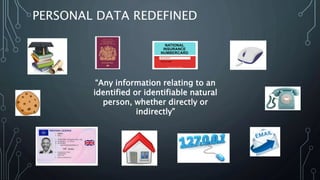
PERSONAL DATA REDEFINED
“Any information relating to an
identified or identifiable natural
person, whether directly or
indirectly”
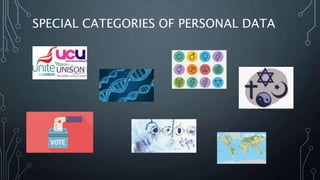
SPECIAL CATEGORIES OF PERSONAL DATA
RIGHTS OF THE DATA SUBJECT
The DPA 2018 has been designed to enhance protection of Personal
Data and to enhance data subjects’ ‘rights and freedoms’. These rights
are:
• The right to be informed
• The right of access (the only GUARANTEED right)
• The right to erasure (the right to be forgotten)
• The right to portability
• The right to rectification
• The right to restriction
• The right to object
• Rights in relation to automated decision making and profiling
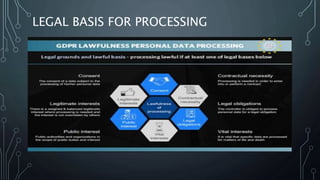
LEGAL BASIS FOR PROCESSING
GEO – LOCATION
• The GDPR requires that the Personal Data of EU citizens is
protected and not transferred outside of the EEA unless
“adequacy” can be demonstrated
• Permission from the governing Data Protection Authority may
be required before transfer of the data to a country outside of
the EEA – this means you must consider the physical location of
cloud servers to ensure we remain compliant
• Consider the use of cloud applications
PRIVACY – BY – DESIGN
The Privacy by Design concept has been introduced by the GDPR, it should
include the following:
• Security to be included in project risk assessments from project concept:
• Security objectives should be set
• Consideration common and not so common threats to Personal Data should
be given – is your product unique
• Assign mitigations to reduce the risk
• Review security risks and objectives at project milestones – document the
outcomes!
All security themed project documentation should be retained in the same way
you retain your project notes, plans and meeting minutes.
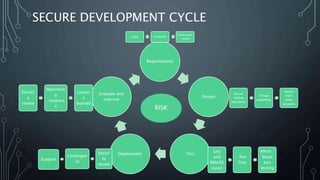
SECURE DEVELOPMENT CYCLE
Requirements
Design
TestDeployment
Evaluate and
improve
Legal Customer
Governance
/ policy
Secure
coding
standards
Threat
modelling
Inputs
from
other
projects
Use
and
MISUSE
cases
Pen
Test
White /
black
box
testing
Support
Contingen
cy
Securi
ty
review
Securit
y
review
Monitorin
g
/respons
e
Lesson
s
learned
RISK
DATA PRIVACY IMPACT ASSESSMENTS
• Data privacy impact assessments (DPIAs) must be conducted where there is
a risk to the rights and freedoms of data subjects
• DPIAs must be documented
• A DPIA is a risk based approach to identifying and mitigating data security
risk
• It is sensible to create a written risk assessment procedure to ensure the
process is repeatable
• DPIAs should be reviewed at regular intervals and updated where there are
significant process changes or new technologies
COMMON SECURITY RISK - DEVELOPMENT
Common risks which should be considered as part of your Risk Assessment:
• Use of cloud – consider data types and location
• Lack of portability – can we move a data subjects’ personal data from one
place to another?
• Sharing of data with Third Party’s – who are we giving it to? Are they secure?
• Protection of source code
• Control of mobile devices
• Lack of infrastructure control (e.g. use of Azure as controlled by Microsoft,
or use of AWS as controlled by Amazon)
• Use of insecure protocols (e.g. Telnet, SNMPv1/2)
• Poor encryption key management (Crypto - cycle)
• Human Error – THIS IS YOUR BIGGEST RISK
MISCHIEF MANAGED – RISK MITIGATION
Once we have identified our risks, we must reduce the undesired effects. A
number of mitigations can be considered:
• Security training for those on the project
• Contracts and agreements which include security stipulations
• Security testing of products and solutions
• Use of security controls such as encryption, anonymisation and
psuedonymisation (KEY CONTROLS)
• Consider penetration tests and vulnerability scans – patch the holes!
• Contact, collaboration and monitoring of suppliers
• Access control (granted on the minimum level in order to complete a task or
role, consider both physical and logical, reviewed upon changes to project
or team)
• Policies, procedures and disaster recovery plans
• Plus much more!
MOBILE DEVICE
SECURITY
If you, the employees, trustees or volunteers use their
personal devices to connect to company data – such
as emails, you must ensure the control of mobile
devices.
• Have a Bring Your Own Device Policy
• Insist that users use a lock to keep access to their
devices secure
• Insist that mobile devices have anti – virus
applications installed where possible
• Insist that all work related information is purged
from mobile devices regularly
• Ensure your workforce are aware of incident
reporting requirements
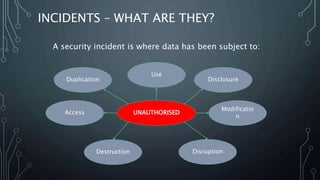
INCIDENTS – WHAT ARE THEY?
A security incident is where data has been subject to:
Duplication
Access
Use
DisruptionDestruction
Modificatio
n
Disclosure
UNAUTHORISED
INCIDENT EXAMPLES
• Lost or stolen laptop
• Unauthorised access to a cloud platform
• Unauthorised access to project work space
• Confidential paperwork disposed of with no shredding
• Malicious code infection that has not been picked up and cleaned by Anti-Virus software
• Network disruptions
• A lost USB or external storage device
• Email sent to incorrect recipient
• Man in the Cloud vulnerability exploited
• Accidental disclosure or modification
• Disgruntled employee making unauthorised changes
• Plus more – if in doubt, report it!
INCIDENTS • Reports to the ICO must be made
within 72 hours of the incident being
noticed
• If personal data was encrypted when it
was lost – it does not need to be
reported
• You should gather as much
information about the incident as
possible and preserve it
• The ICO website has a dedicated page
for reporting incidents (data breaches)
https://ico.org.uk/for-
organisations/report-a-breach/
• Not all personal data breaches are
reportable – the ICO guidance should
be used to decide whether to make a
report
Encryption, anonymisation and pseudonymisation
are key security controls for Personal Data, consider
these controls in your risk assessment!
SUBJECT ACCESS REQUESTS (SARS)
Could come in any form – but written is encouraged
Must be referred to the data protection officer (or similar) without delay
30 days to meet or reject the request
SARs are a way of giving control to the data subject and help to uphold the 7 + 1 rights
Access is the only absolute right
CONSEQUENCES For the organisation
• Higher fines (up to 4% of annual, global
turnover)
• Lower fines (up to 2% of annual, global
turnover)
• Improvement notices
• Costs of repairing damage
• Possible criminal charges
• Possible civil action
For directors
• Possible criminal charges
• Bad press
FINES AND PROSECUTION
Facebook’s recent data incident attracted the
maximum fine under the old DPA. Under the new DPA
that fine would have been £1.626 BILLION
The ICO found that Facebook had not made any effort
to control the use of personal data its third parties
had access to.
FINES AND
PROSECUTION
Cambridge
Analytica used
personal data it
had access to
through
Facebook, to
perform illegal
activities.
The ICO have
confirmed
they will be
bringing
criminal
charges
IN THE NEWS…
THIRD PARTY CONTROL
• Contracts which detail data protection requirements should be
in place with third parties who have access to personal data you
control
• Assess those third parties to ensure they are managing
personal data in a compliant way
• Use specific security agreements where necessary
SUMMARY
• Be mindful of your day to day use of data, keeping data secure
is as important as health and safety
• Look after the data you and your employees have access to,
make sure access is kept to a minimum
• Report all incidents and SARs to the designated person
• Implement security policies as part of your project
• Use ICO guidance to keep you on the right track
MORE INFORMATION
• Information Commissioners Office (ICO) https://ico.org.uk/
• National Cyber Security Centre https://www.ncsc.gov.uk/

Data protection within development

  • 1.
    DATA PROTECTION ACT 2018(GDPR) OWASP EVENT APRIL 2019 V1.0
  • 2.
    WHAT IS THEDPA 2018 ALL ABOUT? • Changes to consent requirements • Changes to security requirements • Introduces the Privacy by Design concept – the protection of C, I & A • Changes to geographical reach and responsibilities • Introduces the need for Data Protection Officers • Gives control to the data subject (the 7 + 1 rights) • Changes the definition of personal data • Huge fines and possible criminal offences
  • 3.
    CONTROLLERS VS PROCESSORS TheController is the Organisation or Person who: • Defines the legal basis for collecting data • Decides which items of personal data to collect, i.e. the content of the data • Decides the purpose or purposes the data are to be used for • Decides which individuals to collect data about • Decides whether to disclose the data, and if so, who to • Decides whether subject access and other individuals’ rights apply
  • 4.
    CONTROLLERS VS PROCESSORS TheProcessor is the person or Organisation who: • does not have overall control of the data • are told what they can do with the Personal Data via contracts and agreements with the Controller • Processors often decide the security arrangements for the data • Stepping outside of the terms of a contract could amount to an infringement of Data Subjects rights and subsequently, the law
  • 5.
    IMPORTANT! If you usedata for any other purpose than that stated in the privacy notice – you may be stepping into controller realms and this could be in contravention of DPA requirements
  • 6.
    PERSONAL DATA REDEFINED “Anyinformation relating to an identified or identifiable natural person, whether directly or indirectly”
  • 7.
    SPECIAL CATEGORIES OFPERSONAL DATA
  • 8.
    RIGHTS OF THEDATA SUBJECT The DPA 2018 has been designed to enhance protection of Personal Data and to enhance data subjects’ ‘rights and freedoms’. These rights are: • The right to be informed • The right of access (the only GUARANTEED right) • The right to erasure (the right to be forgotten) • The right to portability • The right to rectification • The right to restriction • The right to object • Rights in relation to automated decision making and profiling
  • 9.
    LEGAL BASIS FORPROCESSING
  • 10.
    GEO – LOCATION •The GDPR requires that the Personal Data of EU citizens is protected and not transferred outside of the EEA unless “adequacy” can be demonstrated • Permission from the governing Data Protection Authority may be required before transfer of the data to a country outside of the EEA – this means you must consider the physical location of cloud servers to ensure we remain compliant • Consider the use of cloud applications
  • 11.
    PRIVACY – BY– DESIGN The Privacy by Design concept has been introduced by the GDPR, it should include the following: • Security to be included in project risk assessments from project concept: • Security objectives should be set • Consideration common and not so common threats to Personal Data should be given – is your product unique • Assign mitigations to reduce the risk • Review security risks and objectives at project milestones – document the outcomes! All security themed project documentation should be retained in the same way you retain your project notes, plans and meeting minutes.
  • 12.
    SECURE DEVELOPMENT CYCLE Requirements Design TestDeployment Evaluateand improve Legal Customer Governance / policy Secure coding standards Threat modelling Inputs from other projects Use and MISUSE cases Pen Test White / black box testing Support Contingen cy Securi ty review Securit y review Monitorin g /respons e Lesson s learned RISK
  • 13.
    DATA PRIVACY IMPACTASSESSMENTS • Data privacy impact assessments (DPIAs) must be conducted where there is a risk to the rights and freedoms of data subjects • DPIAs must be documented • A DPIA is a risk based approach to identifying and mitigating data security risk • It is sensible to create a written risk assessment procedure to ensure the process is repeatable • DPIAs should be reviewed at regular intervals and updated where there are significant process changes or new technologies
  • 14.
    COMMON SECURITY RISK- DEVELOPMENT Common risks which should be considered as part of your Risk Assessment: • Use of cloud – consider data types and location • Lack of portability – can we move a data subjects’ personal data from one place to another? • Sharing of data with Third Party’s – who are we giving it to? Are they secure? • Protection of source code • Control of mobile devices • Lack of infrastructure control (e.g. use of Azure as controlled by Microsoft, or use of AWS as controlled by Amazon) • Use of insecure protocols (e.g. Telnet, SNMPv1/2) • Poor encryption key management (Crypto - cycle) • Human Error – THIS IS YOUR BIGGEST RISK
  • 15.
    MISCHIEF MANAGED –RISK MITIGATION Once we have identified our risks, we must reduce the undesired effects. A number of mitigations can be considered: • Security training for those on the project • Contracts and agreements which include security stipulations • Security testing of products and solutions • Use of security controls such as encryption, anonymisation and psuedonymisation (KEY CONTROLS) • Consider penetration tests and vulnerability scans – patch the holes! • Contact, collaboration and monitoring of suppliers • Access control (granted on the minimum level in order to complete a task or role, consider both physical and logical, reviewed upon changes to project or team) • Policies, procedures and disaster recovery plans • Plus much more!
  • 16.
    MOBILE DEVICE SECURITY If you,the employees, trustees or volunteers use their personal devices to connect to company data – such as emails, you must ensure the control of mobile devices. • Have a Bring Your Own Device Policy • Insist that users use a lock to keep access to their devices secure • Insist that mobile devices have anti – virus applications installed where possible • Insist that all work related information is purged from mobile devices regularly • Ensure your workforce are aware of incident reporting requirements
  • 17.
    INCIDENTS – WHATARE THEY? A security incident is where data has been subject to: Duplication Access Use DisruptionDestruction Modificatio n Disclosure UNAUTHORISED
  • 18.
    INCIDENT EXAMPLES • Lostor stolen laptop • Unauthorised access to a cloud platform • Unauthorised access to project work space • Confidential paperwork disposed of with no shredding • Malicious code infection that has not been picked up and cleaned by Anti-Virus software • Network disruptions • A lost USB or external storage device • Email sent to incorrect recipient • Man in the Cloud vulnerability exploited • Accidental disclosure or modification • Disgruntled employee making unauthorised changes • Plus more – if in doubt, report it!
  • 19.
    INCIDENTS • Reportsto the ICO must be made within 72 hours of the incident being noticed • If personal data was encrypted when it was lost – it does not need to be reported • You should gather as much information about the incident as possible and preserve it • The ICO website has a dedicated page for reporting incidents (data breaches) https://ico.org.uk/for- organisations/report-a-breach/ • Not all personal data breaches are reportable – the ICO guidance should be used to decide whether to make a report Encryption, anonymisation and pseudonymisation are key security controls for Personal Data, consider these controls in your risk assessment!
  • 20.
    SUBJECT ACCESS REQUESTS(SARS) Could come in any form – but written is encouraged Must be referred to the data protection officer (or similar) without delay 30 days to meet or reject the request SARs are a way of giving control to the data subject and help to uphold the 7 + 1 rights Access is the only absolute right
  • 21.
    CONSEQUENCES For theorganisation • Higher fines (up to 4% of annual, global turnover) • Lower fines (up to 2% of annual, global turnover) • Improvement notices • Costs of repairing damage • Possible criminal charges • Possible civil action For directors • Possible criminal charges • Bad press
  • 22.
    FINES AND PROSECUTION Facebook’srecent data incident attracted the maximum fine under the old DPA. Under the new DPA that fine would have been £1.626 BILLION The ICO found that Facebook had not made any effort to control the use of personal data its third parties had access to.
  • 23.
    FINES AND PROSECUTION Cambridge Analytica used personaldata it had access to through Facebook, to perform illegal activities. The ICO have confirmed they will be bringing criminal charges
  • 24.
  • 25.
    THIRD PARTY CONTROL •Contracts which detail data protection requirements should be in place with third parties who have access to personal data you control • Assess those third parties to ensure they are managing personal data in a compliant way • Use specific security agreements where necessary
  • 26.
    SUMMARY • Be mindfulof your day to day use of data, keeping data secure is as important as health and safety • Look after the data you and your employees have access to, make sure access is kept to a minimum • Report all incidents and SARs to the designated person • Implement security policies as part of your project • Use ICO guidance to keep you on the right track
  • 27.
    MORE INFORMATION • InformationCommissioners Office (ICO) https://ico.org.uk/ • National Cyber Security Centre https://www.ncsc.gov.uk/