XXX-X-XXXX-XXXX-X/XX/$XX.00 ©20XX IEEE
Data Mining on FinTech related datasets
Amarnath Venkataramanan
MSc FinTech
National College of Ireland
Dublin, Ireland
x18105149@student.ncirl.ie
Abstract—In this project, the various data mining methods
will be applied to three of fintech related datasets in order to
discover the insights from the datasets. The methods will be
applied to the datasets in R studio and corresponding outputs
will be shown in this paper. Then the applied methods will be
compared with each other to identify how well the method is
performing on each of the datasets and then finally the better
method will be chosen for each of the datasets. The methods
were explained in detail along with their advantages with the
help of the information from the relevant papers. Every
method which has been applied to the datasets has been
confirmed whether it follows the data mining methodologies.
Data mining methodologies like CRISP-DM, KDD and
SEMMA will also be explained in detail via this paper. The
process flow of the data mining methodologies will be
explained and also will be made sure that whether the process
flow has been followed while applying each method on the
datasets. The Data mining in now considered as a major factor
of the risk management process of the financial institutions.
Even though various data mining tools are existing in the
market, this paper allows readers to understand how the
algorithm works on the dataset and how to justify that whether
algorithm’s prediction.
Keywords—Data mining, FinTech, CRISP-DM, KDD
I. INTRODUCTION
[1] states that FinTech is responsible for the all kind of
data-oriented activities on financial services. Whereas
FinTech adopts data relevant activities such as data analytics,
data mining and data de-duplication in order to obtain a
knowledge from the data that leads to enhancing financial
services or introducing the entirely new services in financial
sector. In general, data mining is the process of determining
any valuable insights or patterns from the huge pool of
datasets [2]. There are two variants of data mining
techniques and they are, 1. Descriptive technique and 2.
Predictive technique. Descriptive technique helps the analyst
to fetch the characteristics of the data given as input.
Predictive technique allows the analyst to predict the hidden
information from the data given as input [3]. In FinTech,
data mining plays a major role to improve the various
existing services of the financial firms by discovering the
insights from the financial data [4]. There are three process
models exist for data mining and they are namely, 1.
Knowledge Discover Databases (KDD), 2. Cross-Industry
Standard Process for Data Mining (CRISP-DM) and 3.
Sample, Explore, Modify, Model, Assess. The detailed
description of these process model will be found below in
this paper [5].
A. Objective and motivation of this project
In recent times one of the major problems faced by banking
institution are follows,
a. Credit card fraud
b. Credit card default
c. Loan default
The ultimate aim of this project is to predict all of the
above-mentioned fraudulent activities from the
correspondingly related real time datasets by performing
data mining process with the help of the certain algorithms
under KDD data mining methodology to each of the dataset.
And also, we will compare those algorithms applied to each
of the dataset and we will be identifying the better
algorithms with the highest accuracy of prediction for each
of the dataset. All these data mining application are comes
under the risk management process of the financial
institutions.
Credit card fraudulent transactions. In order to detect those
fraudulent transactions of credit card currently various
predictive algorithms are currently used to perform the data
mining to predict which of the transactions are legitimate
and fraudulent. In this project we will be discussing by
applying various data mining algorithms on the real time
credit card data as per the KDD data mining methodology
[12].
After the financial crisis in 2008, bank and other financial
institutions are investing a huge amount in the risk
management. Data analytics / mining shares a major portion
of the potential risk management and investment on it. Even
though with high level prediction algorithm and data mining
tools available bank default is being frequent [13]. But,
don’t forget that “Something is better than nothing” even
with high level data mining algorithm 100% detection of
bank loan default is not possible atleast for some extent it
would reduce bank loan default. Let us apply some of the
high-level data mining algorithms to the real time bank loan
default data and justify their predictions.
Another problem faced by bank is credit card default which
is the situation where the user of the credit card failed to pay
the debt amount within the due date. Once it happens the
issuer (Bank) of the credit card will apply the penalty in
addition to the due amount. There are two categories of the
credit card default, they are follows,
a. Willingly credit card default
b. Unwillingly credit card default
Willingly credit card default is the situation where the users
of the credit card intentionally will not pay the debt caused
by credit card
Unwillingly credit card default is the situation where the
users not able to pay their debts caused by credit card due to
their financial or personal problems.
II. RELEVANT WORK
A. Datasets
Datasets used in this data mining process are follows,
1. Credit card fraud: Obtaining the dataset which
consists of customer’s transaction details are not
easy due to the security policies and their
organization’s regulations. Presently, analysts are
using the data from the data generators in order to
test their newly created data mining tools [14]. The
contributor of [15] have released the dataset for the
public availability so that many analysts can use this
data set for their analysis research purposes. This
dataset consists of 31 variables. The feature “Time”
refers to the seconds took for each transaction after
first transaction in the dataset. The “Amount” term
refers to the transaction amount. The “Class”
feature is the response variable which is categorical
with the values 0’s and 1’s whereas 0’s represents
normal transaction and 1’s represents fraudulent
transactions. The structure of the dataset denotes
that this dataset is highly imbalanced whereas only
492 fraudulent transactions among 284807
transactions which makes the dataset highly skewed
as well. Due to the data confidentiality reason some
of the variables are not in detail and features have
been transformed to principal components (V1,
V2…, V28) via Principal Component Analysis. The
identification of cardholders also made unavailable
that makes each transaction are anonymous [15].
2. Credit card default prediction (Taiwanese
Dataset): "Credit card default prediction as a
classification problem" (Soui et al., 2018) is the
data from Taiwan. With the help of predictive
algorithm “Novel sorted smoothing” method, the
probability of response variable "default payment
next month" has been predicted. The response
variable of this dataset is a binary categorical data
which states customer credible or non-credible
clients. As per [27] the prediction of the credit card
default end up in the binary result as either good or
bad. The prediction will help to reduce such
delinquency of credit card default.
3. P2P lending bank loan default: (Đurović, 2017)
states that the prediction of the bank loan default
status is the highly dependent on the characteristics
of the loan whereas the loan with short repayment
duration is lesser risky than the loan with long
repayment duration. [28] believes that the
prediction of loan default in P2P lending usually
takes duration of loan and type of loan as major
prediction-affecting factors. The operational risk is
considered as the crucial risk in the peer to peer
lending system because of the failure to perform
risk assessment on the right time. Such operational
risks can be reduced to significant low level via
certain standardized approaches. [30] believes that
bidding credit is attached to lender credit in terms
of P2P lending in China. Risk management is
considering as a key factor in P2P lending system
in order to avoid certain unfortunate circumstances
like loan default. [23]
B. Methods
This section provides the brief details of various methods
used in this data mining process and also discusses it
advantages and disadvantages.
1. Logistic regression: As most of our datasets
contain target variable as categorical so it is best to
apply logistic regression rather than linear
regression. [24] states that linear regression will not
always return the prediction of the target variable
between 0 and1, it might end up in beyond the
range. It also expresses how the response variable
depends on the predictive variables. The application
of logistic regression is vast among various
industries which can be used for the prediction of
the certain activities they need based on the past
data. [12] used logistic regression to predict the
occurrences of the fraudulent credit card
transactions and [16] used this model for the
prediction of the credit card default. There are many
more researchers and analysts have been logistic
regression for the predicting purpose.
2. K-Nearest Neighbors algorithm model: Based on
the process of clustering and similarity KNN
predicts the behavior of the customer. [25] states
that KNN model follows an assumption model by
assuming if one entity belongs to a certain category
then the entire entities of the same sample also falls
under the same category. KNN model performs
well with minimal error when the target dataset
used is too large. The dependency of the model on
the near neighbors varies with different problems.
As it is mostly used in the big data the resources
required by it will be way more. [25] The higher
accuracy can be achieved with higher K value than
1NN. In recent times KNN being used by analyst
for the various purposes of the data mining like [17]
used KNN model to the automate the recording of
the web usage details, [25] used KNN model in
combination with Simulated Annealing model in
order to predict the credit ratings and [18] used
KNN model in an efficient way in order to predict
the consumer credit risk.
3. Random Forest model: Random forest
model can be used in the identification of useful
features which will be ranked by the model based
on the importance. It can be used for the
classification and regression by generating the
multitude of the decision trees. Significance of the
variables are taken as deciding factor to identify the
important variables. [29]. Layer construction and
identify split variables among nodes are considered
as the main challenges while using this model.
Boosting and bagging methods are used to improve
the performance of the random forest model. [31].
The P2P lending can be evaluated with the help of
Random forest model and with the help of gentic
algorithm optimal solution is obtained which have
been detailly explained in [19].
4. Support Vector Machine: Support Vector
Machine model is one of the supervised machine
learning algorith mostly used to perform the
regrssion and classification. SVM model is the
effective model if in case the target dataset is highly
skewed due to the unbalanced nature. SVM is
highly used by most of the financial institutions in
order to differentiate the fraudulent financial
activities among normal financial activities [20]. In
the risk managent stages of the financial institution
SVM model plays a major role in emprirical risk
mitigation. (ping feng pai, 2011). [20] also discusses
about how SVM model can be embedded into
communal and spike detection as Hybrid SVM
(HSCVM) in order to predict the fraudulent
activities using credit card. SVM can also be
efficiently used in [21] to evaluate credit report via
data mining approach.
III. DATA MINING
Data mining is the process that includes both the machine
learning and statistics in order to extract a pattern from the
target dataset. The extracted pattern can be later used for the
decision making in the financial institutions. The primary
techniques of data mining can be categorized into two
categories and they are,
1. Descriptive: It is a technique that exposes the
quality of day by analyzing its properties.
2. Predictive: It is a technique that speculates the
target data to predict the hidden pattern in the data.
There are three process models for the data mining and they
are follows,
The Knowledge Discovery Database (KDD) is the step by
step collaborative model [5], which consists of six steps to
discover the knowledge from the input dataset [6]. [7]
defines data mining as one of the steps in the KDD process.
Cross-Industry Standard Process for Data Mining
(CRISP-DM) is an iterative model with total of six steps
and was first introduced in 1996 [8].
Sample, Explore, Modify, Model, Assess (SEMMA) is the
five steps process model for data mining developed by SAS
institute [9].
A. Knowledge Discovery Database
KDD is the process of fetching the pattern or knowledge
which is hidden in the input dataset. The relevant application
of domain knowledge must be required by KDD. KDD is the
step by step process with six stages that follows,
1. Select an appropriate dataset or a combination of
certain sources of data.
2. Preprocessing involves the exploration of dataset to
make it fit for further mining process.
3. Transformation of dataset will be carried out in order
to convert the dataset into an appropriate format.
4. Build model (Data mining) includes the various
statistical learning and machine learning algorithm in
order to extract a hidden patter or knowledge from
the target dataset.
5. Evaluation of model describes how good the model
fits the dataset.
6. Extract the knowledge from the applied model.
The extraction of insights from the dataset via data mining
enables decision making process [10].
Figure 01: Various process stages of KDD.
B. CRoss-Industry Standard Process for Data Mining
Cross-Industry Standard Process for Data Mining [11] is
the six-phase processing model for data mining that provides
a regular framework and guidelines for data miners. The six
stage of CRISP-DM have been explained below,
1. Business Understanding: Identifying the motivation
and objectives of data mining.
2. Data Understanding: Collecting the data, exploring
the data and identifying the quality of data.
3. Data Preparation: Transforming and cleaning the
data.
4. Modelling: Application of the appropriate model for
the target dataset.
5. Evaluation: Identifying the accuracy of the pattern or
knowledge obtained by applying a suitable model to
the target dataset.
6. Deployment: Deployment, update and improvement
of models.
CRISP-DM and KDD are almost same in the functionality.
Figure 02: Process stages of CRISP-DM
C. SEMMA Process model
The SEMMA is the five-stage process model of data
mining developed by SAS institute in order to provide better
understanding, maintenance, development and organization
for the data mining projects. SEMMA is in built with the
SAS enterprise miner tool. The five stages of SEMMA
process model follows,
1. Sample: It is the first stage of SEMMA process
model in which a subset of large dataset that is more
than enough to obtain the pattern and smaller enough
to process faster.
2. Explore: Exploration of data, already discussed in
the above-mentioned process model.
3. Modify: Transformation of data.
4. Model: Application of appropriate model.
5. Access: Evaluating the accuracy of the pattern or
knowledge obtained from the target dataset.
Before you begin to format your paper, first write and
save the content as a separate text file. Complete all
content and organizational editing before formatting.
Please note sections A-D below for more information on
proofreading, spelling and grammar.
Keep your text and graphic files separate until after the
text has been formatted and styled. Do not use hard tabs, and
limit use of hard returns to only one return at the end of a
paragraph. Do not add any kind of pagination anywhere in
the paper. Do not number text heads-the template will do that
for you.
D. Model Building on the datasets
Among different data mining methodologies let’s adopt the
Knowledge Discovery Database (KDD) and apply data
mining algorithms on the dataset as per the KDD
methodology.
Step01 - Selection of datasets:
There are three datasets which all are relevant to the
FinTech domain. By applying four of the data mining
algorithms namely, 1. Logistic regression, 2. SVM, 3.
Random Forest and 4. KNN, we are intent to extract the
pattern which will help the financial firm to get rid of the
fraudulent financial activities. As per KDD let’s start with
the reading target datasets,
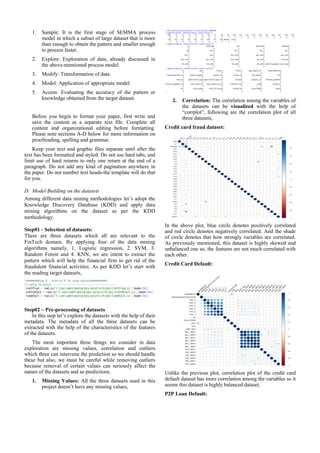
Step02 – Pre-processing of datasets
In this step let’s explore the datasets with the help of their
metadata. The metadata of all the three datasets can be
extracted with the help of the characteristics of the features
of the datasets.
The most important three things we consider in data
exploration are missing values, correlation and outliers
which three can intervene the prediction so we should handle
these but also, we must be careful while removing outliers
because removal of certain values can seriously affect the
nature of the datasets and so predictions.
1. Missing Values: All the three datasets used in this
project doesn’t have any missing values,
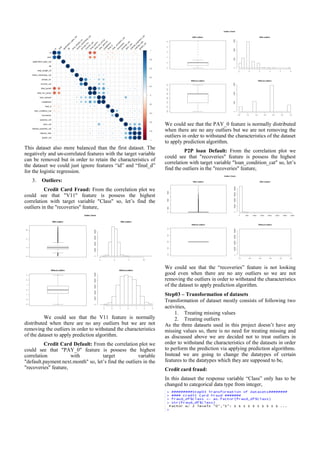
2. Correlation: The correlation among the variables of
the datasets can be visualized with the help of
“corrplot”, following are the correlation plot of all
three datasets,
Credit card fraud dataset:
In the above plot, blue circle denotes positively correlated
and red circle denotes negatively correlated. And the shade
of circle denotes that how strongly variables are correlated.
As previously mentioned, this dataset is highly skewed and
unbalanced one so, the features are not much correlated with
each other.
Credit Card Default:
Unlike the previous plot, correlation plot of the credit card
default dataset has more correlation among the variables so it
seems this dataset is highly balanced dataset.
P2P Loan Default:
This dataset also more balanced than the first dataset. The
negatively and un-correlated features with the target variable
can be removed but in order to retain the characteristics of
the dataset we could just ignore features “id” and “final_d”
for the logistic regression.
3. Outliers:
Credit Card Fraud: From the correlation plot we
could see that "V11" feature is possess the highest
correlation with target variable "Class" so, let’s find the
outliers in the "recoveries" feature,
We could see that the V11 feature is normally
distributed when there are no any outliers but we are not
removing the outliers in order to withstand the characteristics
of the dataset to apply prediction algorithm.
Credit Card Default: From the correlation plot we
could see that "PAY_0" feature is possess the highest
correlation with target variable
"default.payment.next.month" so, let’s find the outliers in the
"recoveries" feature,
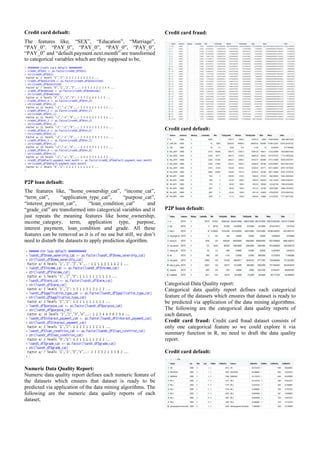
We could see that the PAY_0 feature is normally distributed
when there are no any outliers but we are not removing the
outliers in order to withstand the characteristics of the dataset
to apply prediction algorithm.
P2P loan Default: From the correlation plot we
could see that "recoveries" feature is possess the highest
correlation with target variable "loan_condition_cat" so, let’s
find the outliers in the "recoveries" feature,
We could see that the “recoveries” feature is not looking
good even when there are no any outliers so we are not
removing the outliers in order to withstand the characteristics
of the dataset to apply prediction algorithm.
Step03 – Transformation of datasets
Transformation of dataset mostly consists of following two
activities,
1. Treating missing values
2. Treating outliers
As the three datasets used in this project doesn’t have any
missing values so, there is no need for treating missing and
as discussed above we are decided not to treat outliers in
order to withstand the characteristics of the datasets in order
to perform the prediction via applying prediction algorithms.
Instead we are going to change the datatypes of certain
features to the datatypes which they are supposed to be,
Credit card fraud:
In this dataset the response variable “Class” only has to be
changed to categorical data type from integer,
Credit card default:
The features like, “SEX”, “Education”, “Marriage”,
“PAY_0”. “PAY_0”, “PAY_0”, “PAY_0”, “PAY_0”,
“PAY_0” and “default.payment.next.month” are transformed
to categorical variables which are they supposed to be,
P2P loan default:
The features like, “home_ownership_cat”, “income_cat”,
“term_cat”, “application_type_cat”, “purpose_cat”,
“interest_payment_cat”, “loan_condition_cat” and
“grade_cat” are transformed into categorical variables and it
just repeats the meaning features like home_ownership,
income_category, term, application type, purpose,
interest payment, loan_condition and grade. All these
features can be removed as it is of no use but still, we don’t
need to disturb the datasets to apply prediction algorithm.
Numeric Data Quality Report:
Numeric data quality report defines each numeric feature of
the datasets which ensures that dataset is ready to be
predicted via application of the data mining algorithms. The
following are the numeric data quality reports of each
dataset,
Credit card fraud:
Credit card default:
P2P loan default:
Categorical Data Quality report:
Categorical data quality report defines each categorical
feature of the datasets which ensures that dataset is ready to
be predicted via application of the data mining algorithms.
The following are the categorical data quality reports of
each dataset,
Credit card fraud: Credit card fraud dataset consists of
only one categorical feature so we could explore it via
summary function in R, no need to draft the data quality
report.
Credit card default:
P2P loan default:
Step04 – Application of data mining algorithm on
datasets:
Sampling of datasets: Each dataset set has to be split into
test and training datasets, where as in training dataset data
mining methods will be applied and predicted against the
corresponding dataset.
In three datasets we have, from first dataset and third dataset
(credit fraud and P2P loan default) we have taken only
20000 rows for the prediction purpose, as these are being
big data it takes too long to process so we have taken limited
number of rows to apply data mining techniques. From these
20000 rows, 70% of data are assigned to the training dataset
to apply predictive methods and 30% to the testing dataset.
Whereas we take entire second dataset (Credit default) into
an account and the 70:30 partition has been made to this
dataset also. Take a look at the snippet of code,
IV. EVALUATION
Applying methods to datasets: In this project, four data
mining algorithms were chosen for the prediction purpose
and they are follows,
1. Logistic Regression’
2. K – Nearest Neighbor algorithm
3. Random Forest algorithm
4. Support Vector Machine algorithm
Let’s discuss about the advantages and disadvantages of the
above-mentioned methods,
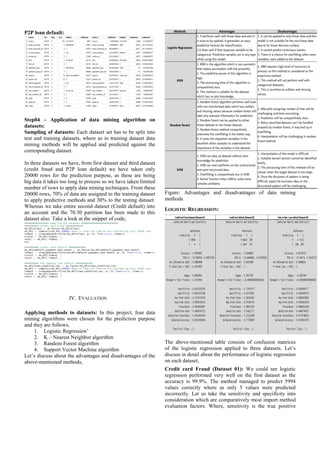
Figure: Advantages and disadvantages of data mining
methods
LOGISTIC REGRESSION:
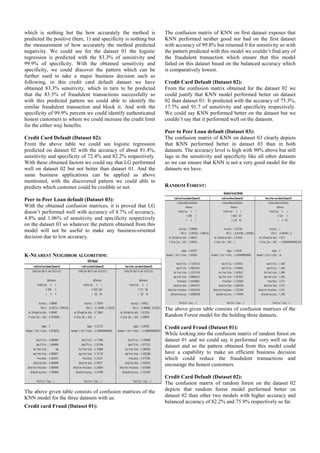
The above-mentioned table consists of confusion matrices
of the logistic regression applied to three datasets. Let’s
discuss in detail about the performance of logistic regression
on each dataset,
Credit card Fraud (Dataset 01): We could see logistic
regression performed very well on the first dataset as the
accuracy is 99.9%. The method managed to predict 5994
values correctly where as only 5 values were predicted
incorrectly. Let us take the sensitivity and specificity into
consideration which are comparatively most import method
evaluation factors. Where, sensitivity is the true positive
which is nothing but the how accurately the method is
predicted the positive (here, 1) and specificity is nothing but
the measurement of how accurately the method predicted
negativity. We could see for the dataset 01 the logistic
regression is predicted with the 83.3% of sensitivity and
99.9% of specificity. With the obtained sensitivity and
specificity, we could discover the pattern which can be
further used to take a major business decision such as
following, in this credit card default dataset we have
obtained 83.3% sensitivity, which in turn to be predicted
that the 83.3% of fraudulent transactions successfully so
with this predicted pattern we could able to identify the
similar fraudulent transaction and block it. And with the
specificity of 99.9% percent we could identify authenticated
honest customers to whom we could increase the credit limit
for the either way benefits.
Credit Card Default (Dataset 02):
From the above table we could see logistic regression
predicted on dataset 02 with the accuracy of about 81.4%,
sensitivity and specificity of 72.4% and 82.2% respectively.
With these obtained factors we could say that LG performed
well on dataset 02 but not better than dataset 01. And the
same business applications can be applied as above
mentioned, with the discovered pattern we could able to
predicts which customer could be credible or not.
Peer to Peer Loan default (Dataset 03):
With the obtained confusion matrices, it is proved that LG
doesn’t performed well with accuracy of 4.7% of accuracy,
4.8% and 1.06% of sensitivity and specificity respectively
on the dataset 03 so whatever the pattern obtained from this
model will not be useful to make any business-oriented
decision due to low accuracy.
K-NEAREST NEIGHBOR ALGORITHM:
The above given table consists of confusion matrices of the
KNN model for the three datasets with us.
Credit card Fraud (Dataset 01):
The confusion matrix of KNN on first dataset exposes that
KNN performed neither good nor bad on the first dataset
with accuracy of 99.8% but returned 0 for sensitivity so with
the pattern predicted with this model we couldn’t find any of
the fraudulent transaction which ensure that this model
failed on this dataset based on the balanced accuracy which
is comparatively lowest.
Credit Card Default (Dataset 02):
From the confusion matrix obtained for the dataset 02 we
could justify that KNN model performed better on dataset
02 than dataset 01. It predicted with the accuracy of 75.3%,
17.7% and 91.7 of sensitivity and specificity respectively.
We could say KNN performed better on the dataset but we
couldn’t say that it performed well on the datasets.
Peer to Peer Loan default (Dataset 03):
The confusion matrix of KNN on dataset 03 clearly depicts
that KNN performed better in dataset 03 than in both
datasets. The accuracy level is high with 90% above but still
lags in the sensitivity and specificity like all other datasets
so we can ensure that KNN is not a very good model for the
datasets we have.
RANDOM FOREST:
The above given table consists of confusion matrices of the
Random Forest model for the holding three datasets.
Credit card Fraud (Dataset 01):
While looking into the confusion matrix of random forest on
dataset 01 and we could say it performed very well on the
dataset and so the pattern obtained from this model could
have a capability to make an efficient business decision
which could reduce the fraudulent transactions and
encourage the honest customers.
Credit Card Default (Dataset 02):
The confusion matrix of random forest on the dataset 02
depicts that random forest model performed better on
dataset 02 than other two models with higher accuracy and
balanced accuracy of 82.2% and 75.9% respectively so far.
Peer to Peer Loan default (Dataset 03):
The performance of the random forest model is the best on
the dataset 03 with 100% accuracy, sensitivity, specificity
and balanced accuracy. This is achieved because of the
random forest characteristics which is not sensitive to the
outliers and missing values and it process only with the
relevant data.
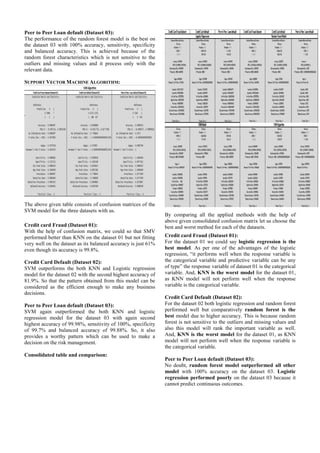
SUPPORT VECTOR MACHINE ALGORITHM:
The above given table consists of confusion matrices of the
SVM model for the three datasets with us.
Credit card Fraud (Dataset 01):
With the help of confusion matrix, we could so that SMV
performed better than KNN on the dataset 01 but not fitting
very well on the dataset as its balanced accuracy is just 61%
even though its accuracy is 99.8%.
Credit Card Default (Dataset 02):
SVM outperforms the both KNN and Logistic regression
model for the dataset 02 with the second highest accuracy of
81.9%. So that the pattern obtained from this model can be
considered as the efficient enough to make any business
decisions.
Peer to Peer Loan default (Dataset 03):
SVM again outperformed the both KNN and logistic
regression model for the dataset 03 with again second
highest accuracy of 99.98%, sensitivity of 100%, specificity
of 99.7% and balanced accuracy of 99.88%. So, it also
provides a worthy pattern which can be used to make a
decision on the risk management.
Consolidated table and comparison:
By comparing all the applied methods with the help of
above given consolidated confusion matrix let us choose the
best and worst method for each of the datasets.
Credit card Fraud (Dataset 01):
For the dataset 01 we could say logistic regression is the
best model. As per one of the advantages of the logistic
regression, “it performs well when the response variable is
the categorical variable and predictive variable can be any
of type” the response variable of dataset 01 is the categorical
variable. And, KNN is the worst model for the dataset 01,
as KNN model will not perform well when the response
variable is the categorical variable.
Credit Card Default (Dataset 02):
For the dataset 02 both logistic regression and random forest
performed well but comparatively random forest is the
best model due to higher accuracy. This is because random
forest is not sensitive to the outliers and missing values and
also this model will rank the important variable as well.
And, KNN is the worst model for the dataset 01, as KNN
model will not perform well when the response variable is
the categorical variable.
Peer to Peer Loan default (Dataset 03):
No doubt, random forest model outperformed all other
model with 100% accuracy on the dataset 03. Logistic
regression performed poorly on the dataset 03 because it
cannot predict continuous outcomes.
V. CONCLUSION
To conclude, though there are multiple and high-risk
challenges of fraud and delinquencies in today’s era
compared to the earlier era for banking and financial
institutions, timely decisions to prevent the customer likely
to default augments profitability and loyal customers for the
ban, which will ultimately increase the share-holders value.
In this report, it has been proposed to identify and work on
three datasets from reliable repositories and have applied
four machine language algorithms using R function along
with understanding of the datasets, pre-processing of
datasets, infer the correlation and conducting the data
quality report for numeric and categorical variable and
assigning the binary operators to target variables for
prediction purposes on all three3 datasets.
Further, this report also discussed about the comparison of
the empirical result reflects in confusion matrix using the
notions of performance namely the accuracy, sensitivity and
specificity of four methods and 3 data sets. It has been
identified that the “Random Forest” algorithm predicts
better accuracy in all 3 methods. Also noted that in dataset 1
& 2 the Logistic regression is failed due to less accuracy
predication and for dataset 3 the oversampling method is
failed.
The purpose of this report is to provide the sense of
behavioral scoring of delinquent borrowers to the banks and
FI and they can use as reference for real world applications.
However, there are limitations to this study where, this
report included the raw data but not considered if customer
have multiple debts, if any debt etc.
Additionally, as an extension to this study, it has also been
thought that during the course of this study, the experiences
learnt can be explored and applied to replicate the same in
other industries like Healthcare, Stock markets, Insurances
and other financial and non-financial domains.
VI. REFERENCES
[1] aK. Gai, M. Qiu, and X. Sun, “A survey on FinTech,” Journal of
Network and Computer Applications, vol. 103, pp. 262–273, Feb.
2018.
[2] D. J. Hand, “Principles of Data Mining:,” Drug Safety, vol. 30, no. 7,
pp. 621–622, 2007.
[3] S. Agarwal, “Data Mining: Data Mining Concepts and Techniques,” in
2013 International Conference on Machine Intelligence and Research
Advancement, 2013, pp. 203–207
[4] M. Kantardzic, Data Mining: Concepts, Models, Methods, and
Algorithms. John Wiley & Sons, 2011.
[5] Brachman, R. J. & Anand, T., “The process of knowledge discovery in
databases.”, AAAI Press / The MIT Press. 1996.
[6] U. Shafique and H. Qaiser, “A comparative study of data mining
process models (KDD, CRISP-DM and SEMMA),” International
Journal of Innovation and Scientific Research, vol. 12, no. 1, pp. 217–
222, 2014.
[7] U. Fayyad, G. Piatetsky-Shapiro, and P. Smyth, “From Data Mining to
Knowledge Discovery in Databases,” 1, vol. 17, no. 3, pp. 37–37,
Mar. 1996.
[8] Brachman, R. J. & Anand, T., “The process of knowledge discovery in
databases.”, AAAI Press / The MIT Press. 1996.
[9] SAS Enterprise Miner – SEMMA. SAS Institute, 2014 [online]
available:
http://www.sas.com/technologies/analytics/datamining/miner/semma.html
(September 2014.)
[10] J. D. Kelleher, B. M. Namee, and A. D’Arcy, “FUNDAMENTALS
OF MACHINE LEARNING FOR PREDICTIVE DATA
ANALYTICS,” p. 31.
[11] P. Chapman, “CRISP-DM 1.0: Step-by-Step Data Mining Guide,”
2000.
[12] S. Bhattacharyya, S. Jha, K. Tharakunnel, and J. C. Westland, “Data
mining for credit card fraud: A comparative study,” Decision Support
Systems, vol. 50, no. 3, pp. 602–613, Feb. 2011.
[13] L. Ying, “Research on bank credit default prediction based on data
mining algorithm,” 1, vol. 5, no. 6, pp. 4820–4823, Jun. 2018.
[14] Yufeng Kou, Chang-Tien Lu, Sirirat Sirwongwattana, Survey of Fraud
Detection Techniques, Proc. IEEE : International Conference on
Networking , Sensing & Control, pp. 749-754, 2004.
[15] A. D. Pozzolo, “Adaptive Machine Learning for Credit Card Fraud
Detection,” p. 199.
[16] I.-C. Yeh and C. Lien, “The comparisons of data mining techniques
for the predictive accuracy of probability of default of credit card
clients,” Expert Systems with Applications, vol. 36, no. 2, pp. 2473–
2480, Mar. 2009.
[17] D. A. Adeniyi, Z. Wei, and Y. Yongquan, “Automated web usage data
mining and recommendation system using K-Nearest Neighbor (KNN)
classification method,” Applied Computing and Informatics, vol. 12, no. 1,
pp. 90–108, Jan. 2016.
[18] J. Kruppa, A. Schwarz, G. Arminger, and A. Ziegler, “Consumer
credit risk: Individual probability estimates using machine learning,”
Expert Systems with Applications, vol. 40, no. 13, pp. 5125–5131, 2013.
[19] X. Ye, L. Dong, and D. Ma, “Loan evaluation in P2P lending based on
Random Forest optimized by genetic algorithm with profit score,”
Electronic Commerce Research and Applications, vol. 32, pp. 23–36, Nov.
2018.
[20] V. Mareeswari and G. Gunasekaran, “Prevention of credit card fraud
detection based on HSVM,” in 2016 International Conference on
Information Communication and Embedded Systems (ICICES), 2016, pp.
1–4.
[21 ]C.-L. Huang, M.-C. Chen, and C.-J. Wang, “Credit scoring with a data
mining approach based on support vector machines,” Expert Systems with
Applications, vol. 33, no. 4, pp. 847–856, Nov. 2007.
[22] Tao Guo and Gui-Yang Li, “Neural data mining for credit card fraud
detection,” in 2008 International Conference on Machine Learning and
Cybernetics, Kunming, China, 2008, pp. 3630–3634.
[23] Pingfan Song, , Yunzhi Chen, , Zhixiang Zhou, & Huaqing Wu.
(2018). Performance Analysis of Peer-to-Peer Online Lending Platforms in
China. Sustainability -MDPI.
[24] S. K. S. P K Viswanathan, "Journal of Emerging Market Finance,"
Modelling Credit Default in Microfinance -An Indian case study , p. 3,
2017.
[25]Van Shi,Xin Fan and Wenjie Li, & lianfeng Liu and Hongbo Ma.
(2016). Study on Key Technology of Power Users Credit Rating Evaluation
Based on Big Data. IEEE.
[26]S. H. U. ,. S. P. H. D H Pandya, "Expert Systems with Applications,"
Fault Diagnosis of rolling element bearing with intrinsic mode function of
acoustic emission data using APF - KNN, 2013.
[27]Yun-Huan Lee a , & Ya-Li Huang b. (2011). The expansion of the
credit card market in Taiwan. Applied Economics Letters, 3.
[28]Yun-Huan Lee a , & Ya-Li Huang b. (2011). The expansion of the
credit card market in Taiwan. Applied Economics Letters, 3.
[29]Yu Jina, & Yudan Zhua. (2015). A data-driven approach to predict
default risk of loan for online Peer-to-Peer(P2P) lending. IEEE, 3.
[30]Zhang, Y. (2017). Influencing Factors of Online P2P Lending Sucess
Rate in China. ScienceDirect -Procedia Computer Science 122 (2017) 896–
901
[31]Milad Malekipirbazari, & Vural Aksakalli. (2015). Risk assessment in
social lending via random forests. Expert Systems with Applications.

Data mining on Financial Data

  • 1.
    XXX-X-XXXX-XXXX-X/XX/$XX.00 ©20XX IEEE DataMining on FinTech related datasets Amarnath Venkataramanan MSc FinTech National College of Ireland Dublin, Ireland x18105149@student.ncirl.ie Abstract—In this project, the various data mining methods will be applied to three of fintech related datasets in order to discover the insights from the datasets. The methods will be applied to the datasets in R studio and corresponding outputs will be shown in this paper. Then the applied methods will be compared with each other to identify how well the method is performing on each of the datasets and then finally the better method will be chosen for each of the datasets. The methods were explained in detail along with their advantages with the help of the information from the relevant papers. Every method which has been applied to the datasets has been confirmed whether it follows the data mining methodologies. Data mining methodologies like CRISP-DM, KDD and SEMMA will also be explained in detail via this paper. The process flow of the data mining methodologies will be explained and also will be made sure that whether the process flow has been followed while applying each method on the datasets. The Data mining in now considered as a major factor of the risk management process of the financial institutions. Even though various data mining tools are existing in the market, this paper allows readers to understand how the algorithm works on the dataset and how to justify that whether algorithm’s prediction. Keywords—Data mining, FinTech, CRISP-DM, KDD I. INTRODUCTION [1] states that FinTech is responsible for the all kind of data-oriented activities on financial services. Whereas FinTech adopts data relevant activities such as data analytics, data mining and data de-duplication in order to obtain a knowledge from the data that leads to enhancing financial services or introducing the entirely new services in financial sector. In general, data mining is the process of determining any valuable insights or patterns from the huge pool of datasets [2]. There are two variants of data mining techniques and they are, 1. Descriptive technique and 2. Predictive technique. Descriptive technique helps the analyst to fetch the characteristics of the data given as input. Predictive technique allows the analyst to predict the hidden information from the data given as input [3]. In FinTech, data mining plays a major role to improve the various existing services of the financial firms by discovering the insights from the financial data [4]. There are three process models exist for data mining and they are namely, 1. Knowledge Discover Databases (KDD), 2. Cross-Industry Standard Process for Data Mining (CRISP-DM) and 3. Sample, Explore, Modify, Model, Assess. The detailed description of these process model will be found below in this paper [5]. A. Objective and motivation of this project In recent times one of the major problems faced by banking institution are follows, a. Credit card fraud b. Credit card default c. Loan default The ultimate aim of this project is to predict all of the above-mentioned fraudulent activities from the correspondingly related real time datasets by performing data mining process with the help of the certain algorithms under KDD data mining methodology to each of the dataset. And also, we will compare those algorithms applied to each of the dataset and we will be identifying the better algorithms with the highest accuracy of prediction for each of the dataset. All these data mining application are comes under the risk management process of the financial institutions. Credit card fraudulent transactions. In order to detect those fraudulent transactions of credit card currently various predictive algorithms are currently used to perform the data mining to predict which of the transactions are legitimate and fraudulent. In this project we will be discussing by applying various data mining algorithms on the real time credit card data as per the KDD data mining methodology [12]. After the financial crisis in 2008, bank and other financial institutions are investing a huge amount in the risk management. Data analytics / mining shares a major portion of the potential risk management and investment on it. Even though with high level prediction algorithm and data mining tools available bank default is being frequent [13]. But, don’t forget that “Something is better than nothing” even with high level data mining algorithm 100% detection of bank loan default is not possible atleast for some extent it would reduce bank loan default. Let us apply some of the high-level data mining algorithms to the real time bank loan default data and justify their predictions. Another problem faced by bank is credit card default which is the situation where the user of the credit card failed to pay the debt amount within the due date. Once it happens the issuer (Bank) of the credit card will apply the penalty in addition to the due amount. There are two categories of the credit card default, they are follows, a. Willingly credit card default b. Unwillingly credit card default Willingly credit card default is the situation where the users of the credit card intentionally will not pay the debt caused by credit card Unwillingly credit card default is the situation where the users not able to pay their debts caused by credit card due to their financial or personal problems.
  • 2.
    II. RELEVANT WORK A.Datasets Datasets used in this data mining process are follows, 1. Credit card fraud: Obtaining the dataset which consists of customer’s transaction details are not easy due to the security policies and their organization’s regulations. Presently, analysts are using the data from the data generators in order to test their newly created data mining tools [14]. The contributor of [15] have released the dataset for the public availability so that many analysts can use this data set for their analysis research purposes. This dataset consists of 31 variables. The feature “Time” refers to the seconds took for each transaction after first transaction in the dataset. The “Amount” term refers to the transaction amount. The “Class” feature is the response variable which is categorical with the values 0’s and 1’s whereas 0’s represents normal transaction and 1’s represents fraudulent transactions. The structure of the dataset denotes that this dataset is highly imbalanced whereas only 492 fraudulent transactions among 284807 transactions which makes the dataset highly skewed as well. Due to the data confidentiality reason some of the variables are not in detail and features have been transformed to principal components (V1, V2…, V28) via Principal Component Analysis. The identification of cardholders also made unavailable that makes each transaction are anonymous [15]. 2. Credit card default prediction (Taiwanese Dataset): "Credit card default prediction as a classification problem" (Soui et al., 2018) is the data from Taiwan. With the help of predictive algorithm “Novel sorted smoothing” method, the probability of response variable "default payment next month" has been predicted. The response variable of this dataset is a binary categorical data which states customer credible or non-credible clients. As per [27] the prediction of the credit card default end up in the binary result as either good or bad. The prediction will help to reduce such delinquency of credit card default. 3. P2P lending bank loan default: (Đurović, 2017) states that the prediction of the bank loan default status is the highly dependent on the characteristics of the loan whereas the loan with short repayment duration is lesser risky than the loan with long repayment duration. [28] believes that the prediction of loan default in P2P lending usually takes duration of loan and type of loan as major prediction-affecting factors. The operational risk is considered as the crucial risk in the peer to peer lending system because of the failure to perform risk assessment on the right time. Such operational risks can be reduced to significant low level via certain standardized approaches. [30] believes that bidding credit is attached to lender credit in terms of P2P lending in China. Risk management is considering as a key factor in P2P lending system in order to avoid certain unfortunate circumstances like loan default. [23] B. Methods This section provides the brief details of various methods used in this data mining process and also discusses it advantages and disadvantages. 1. Logistic regression: As most of our datasets contain target variable as categorical so it is best to apply logistic regression rather than linear regression. [24] states that linear regression will not always return the prediction of the target variable between 0 and1, it might end up in beyond the range. It also expresses how the response variable depends on the predictive variables. The application of logistic regression is vast among various industries which can be used for the prediction of the certain activities they need based on the past data. [12] used logistic regression to predict the occurrences of the fraudulent credit card transactions and [16] used this model for the prediction of the credit card default. There are many more researchers and analysts have been logistic regression for the predicting purpose. 2. K-Nearest Neighbors algorithm model: Based on the process of clustering and similarity KNN predicts the behavior of the customer. [25] states that KNN model follows an assumption model by assuming if one entity belongs to a certain category then the entire entities of the same sample also falls under the same category. KNN model performs well with minimal error when the target dataset used is too large. The dependency of the model on the near neighbors varies with different problems. As it is mostly used in the big data the resources required by it will be way more. [25] The higher accuracy can be achieved with higher K value than 1NN. In recent times KNN being used by analyst for the various purposes of the data mining like [17] used KNN model to the automate the recording of the web usage details, [25] used KNN model in combination with Simulated Annealing model in order to predict the credit ratings and [18] used KNN model in an efficient way in order to predict the consumer credit risk. 3. Random Forest model: Random forest model can be used in the identification of useful features which will be ranked by the model based on the importance. It can be used for the classification and regression by generating the multitude of the decision trees. Significance of the variables are taken as deciding factor to identify the important variables. [29]. Layer construction and identify split variables among nodes are considered as the main challenges while using this model. Boosting and bagging methods are used to improve the performance of the random forest model. [31]. The P2P lending can be evaluated with the help of Random forest model and with the help of gentic algorithm optimal solution is obtained which have been detailly explained in [19]. 4. Support Vector Machine: Support Vector Machine model is one of the supervised machine
  • 3.
    learning algorith mostlyused to perform the regrssion and classification. SVM model is the effective model if in case the target dataset is highly skewed due to the unbalanced nature. SVM is highly used by most of the financial institutions in order to differentiate the fraudulent financial activities among normal financial activities [20]. In the risk managent stages of the financial institution SVM model plays a major role in emprirical risk mitigation. (ping feng pai, 2011). [20] also discusses about how SVM model can be embedded into communal and spike detection as Hybrid SVM (HSCVM) in order to predict the fraudulent activities using credit card. SVM can also be efficiently used in [21] to evaluate credit report via data mining approach. III. DATA MINING Data mining is the process that includes both the machine learning and statistics in order to extract a pattern from the target dataset. The extracted pattern can be later used for the decision making in the financial institutions. The primary techniques of data mining can be categorized into two categories and they are, 1. Descriptive: It is a technique that exposes the quality of day by analyzing its properties. 2. Predictive: It is a technique that speculates the target data to predict the hidden pattern in the data. There are three process models for the data mining and they are follows, The Knowledge Discovery Database (KDD) is the step by step collaborative model [5], which consists of six steps to discover the knowledge from the input dataset [6]. [7] defines data mining as one of the steps in the KDD process. Cross-Industry Standard Process for Data Mining (CRISP-DM) is an iterative model with total of six steps and was first introduced in 1996 [8]. Sample, Explore, Modify, Model, Assess (SEMMA) is the five steps process model for data mining developed by SAS institute [9]. A. Knowledge Discovery Database KDD is the process of fetching the pattern or knowledge which is hidden in the input dataset. The relevant application of domain knowledge must be required by KDD. KDD is the step by step process with six stages that follows, 1. Select an appropriate dataset or a combination of certain sources of data. 2. Preprocessing involves the exploration of dataset to make it fit for further mining process. 3. Transformation of dataset will be carried out in order to convert the dataset into an appropriate format. 4. Build model (Data mining) includes the various statistical learning and machine learning algorithm in order to extract a hidden patter or knowledge from the target dataset. 5. Evaluation of model describes how good the model fits the dataset. 6. Extract the knowledge from the applied model. The extraction of insights from the dataset via data mining enables decision making process [10]. Figure 01: Various process stages of KDD. B. CRoss-Industry Standard Process for Data Mining Cross-Industry Standard Process for Data Mining [11] is the six-phase processing model for data mining that provides a regular framework and guidelines for data miners. The six stage of CRISP-DM have been explained below, 1. Business Understanding: Identifying the motivation and objectives of data mining. 2. Data Understanding: Collecting the data, exploring the data and identifying the quality of data. 3. Data Preparation: Transforming and cleaning the data. 4. Modelling: Application of the appropriate model for the target dataset. 5. Evaluation: Identifying the accuracy of the pattern or knowledge obtained by applying a suitable model to the target dataset. 6. Deployment: Deployment, update and improvement of models. CRISP-DM and KDD are almost same in the functionality. Figure 02: Process stages of CRISP-DM C. SEMMA Process model The SEMMA is the five-stage process model of data mining developed by SAS institute in order to provide better understanding, maintenance, development and organization for the data mining projects. SEMMA is in built with the SAS enterprise miner tool. The five stages of SEMMA process model follows,
  • 4.
    1. Sample: Itis the first stage of SEMMA process model in which a subset of large dataset that is more than enough to obtain the pattern and smaller enough to process faster. 2. Explore: Exploration of data, already discussed in the above-mentioned process model. 3. Modify: Transformation of data. 4. Model: Application of appropriate model. 5. Access: Evaluating the accuracy of the pattern or knowledge obtained from the target dataset. Before you begin to format your paper, first write and save the content as a separate text file. Complete all content and organizational editing before formatting. Please note sections A-D below for more information on proofreading, spelling and grammar. Keep your text and graphic files separate until after the text has been formatted and styled. Do not use hard tabs, and limit use of hard returns to only one return at the end of a paragraph. Do not add any kind of pagination anywhere in the paper. Do not number text heads-the template will do that for you. D. Model Building on the datasets Among different data mining methodologies let’s adopt the Knowledge Discovery Database (KDD) and apply data mining algorithms on the dataset as per the KDD methodology. Step01 - Selection of datasets: There are three datasets which all are relevant to the FinTech domain. By applying four of the data mining algorithms namely, 1. Logistic regression, 2. SVM, 3. Random Forest and 4. KNN, we are intent to extract the pattern which will help the financial firm to get rid of the fraudulent financial activities. As per KDD let’s start with the reading target datasets, Step02 – Pre-processing of datasets In this step let’s explore the datasets with the help of their metadata. The metadata of all the three datasets can be extracted with the help of the characteristics of the features of the datasets. The most important three things we consider in data exploration are missing values, correlation and outliers which three can intervene the prediction so we should handle these but also, we must be careful while removing outliers because removal of certain values can seriously affect the nature of the datasets and so predictions. 1. Missing Values: All the three datasets used in this project doesn’t have any missing values, 2. Correlation: The correlation among the variables of the datasets can be visualized with the help of “corrplot”, following are the correlation plot of all three datasets, Credit card fraud dataset: In the above plot, blue circle denotes positively correlated and red circle denotes negatively correlated. And the shade of circle denotes that how strongly variables are correlated. As previously mentioned, this dataset is highly skewed and unbalanced one so, the features are not much correlated with each other. Credit Card Default: Unlike the previous plot, correlation plot of the credit card default dataset has more correlation among the variables so it seems this dataset is highly balanced dataset. P2P Loan Default:
  • 5.
    This dataset alsomore balanced than the first dataset. The negatively and un-correlated features with the target variable can be removed but in order to retain the characteristics of the dataset we could just ignore features “id” and “final_d” for the logistic regression. 3. Outliers: Credit Card Fraud: From the correlation plot we could see that "V11" feature is possess the highest correlation with target variable "Class" so, let’s find the outliers in the "recoveries" feature, We could see that the V11 feature is normally distributed when there are no any outliers but we are not removing the outliers in order to withstand the characteristics of the dataset to apply prediction algorithm. Credit Card Default: From the correlation plot we could see that "PAY_0" feature is possess the highest correlation with target variable "default.payment.next.month" so, let’s find the outliers in the "recoveries" feature, We could see that the PAY_0 feature is normally distributed when there are no any outliers but we are not removing the outliers in order to withstand the characteristics of the dataset to apply prediction algorithm. P2P loan Default: From the correlation plot we could see that "recoveries" feature is possess the highest correlation with target variable "loan_condition_cat" so, let’s find the outliers in the "recoveries" feature, We could see that the “recoveries” feature is not looking good even when there are no any outliers so we are not removing the outliers in order to withstand the characteristics of the dataset to apply prediction algorithm. Step03 – Transformation of datasets Transformation of dataset mostly consists of following two activities, 1. Treating missing values 2. Treating outliers As the three datasets used in this project doesn’t have any missing values so, there is no need for treating missing and as discussed above we are decided not to treat outliers in order to withstand the characteristics of the datasets in order to perform the prediction via applying prediction algorithms. Instead we are going to change the datatypes of certain features to the datatypes which they are supposed to be, Credit card fraud: In this dataset the response variable “Class” only has to be changed to categorical data type from integer,
  • 6.
    Credit card default: Thefeatures like, “SEX”, “Education”, “Marriage”, “PAY_0”. “PAY_0”, “PAY_0”, “PAY_0”, “PAY_0”, “PAY_0” and “default.payment.next.month” are transformed to categorical variables which are they supposed to be, P2P loan default: The features like, “home_ownership_cat”, “income_cat”, “term_cat”, “application_type_cat”, “purpose_cat”, “interest_payment_cat”, “loan_condition_cat” and “grade_cat” are transformed into categorical variables and it just repeats the meaning features like home_ownership, income_category, term, application type, purpose, interest payment, loan_condition and grade. All these features can be removed as it is of no use but still, we don’t need to disturb the datasets to apply prediction algorithm. Numeric Data Quality Report: Numeric data quality report defines each numeric feature of the datasets which ensures that dataset is ready to be predicted via application of the data mining algorithms. The following are the numeric data quality reports of each dataset, Credit card fraud: Credit card default: P2P loan default: Categorical Data Quality report: Categorical data quality report defines each categorical feature of the datasets which ensures that dataset is ready to be predicted via application of the data mining algorithms. The following are the categorical data quality reports of each dataset, Credit card fraud: Credit card fraud dataset consists of only one categorical feature so we could explore it via summary function in R, no need to draft the data quality report. Credit card default:
  • 7.
    P2P loan default: Step04– Application of data mining algorithm on datasets: Sampling of datasets: Each dataset set has to be split into test and training datasets, where as in training dataset data mining methods will be applied and predicted against the corresponding dataset. In three datasets we have, from first dataset and third dataset (credit fraud and P2P loan default) we have taken only 20000 rows for the prediction purpose, as these are being big data it takes too long to process so we have taken limited number of rows to apply data mining techniques. From these 20000 rows, 70% of data are assigned to the training dataset to apply predictive methods and 30% to the testing dataset. Whereas we take entire second dataset (Credit default) into an account and the 70:30 partition has been made to this dataset also. Take a look at the snippet of code, IV. EVALUATION Applying methods to datasets: In this project, four data mining algorithms were chosen for the prediction purpose and they are follows, 1. Logistic Regression’ 2. K – Nearest Neighbor algorithm 3. Random Forest algorithm 4. Support Vector Machine algorithm Let’s discuss about the advantages and disadvantages of the above-mentioned methods, Figure: Advantages and disadvantages of data mining methods LOGISTIC REGRESSION: The above-mentioned table consists of confusion matrices of the logistic regression applied to three datasets. Let’s discuss in detail about the performance of logistic regression on each dataset, Credit card Fraud (Dataset 01): We could see logistic regression performed very well on the first dataset as the accuracy is 99.9%. The method managed to predict 5994 values correctly where as only 5 values were predicted incorrectly. Let us take the sensitivity and specificity into consideration which are comparatively most import method evaluation factors. Where, sensitivity is the true positive
  • 8.
    which is nothingbut the how accurately the method is predicted the positive (here, 1) and specificity is nothing but the measurement of how accurately the method predicted negativity. We could see for the dataset 01 the logistic regression is predicted with the 83.3% of sensitivity and 99.9% of specificity. With the obtained sensitivity and specificity, we could discover the pattern which can be further used to take a major business decision such as following, in this credit card default dataset we have obtained 83.3% sensitivity, which in turn to be predicted that the 83.3% of fraudulent transactions successfully so with this predicted pattern we could able to identify the similar fraudulent transaction and block it. And with the specificity of 99.9% percent we could identify authenticated honest customers to whom we could increase the credit limit for the either way benefits. Credit Card Default (Dataset 02): From the above table we could see logistic regression predicted on dataset 02 with the accuracy of about 81.4%, sensitivity and specificity of 72.4% and 82.2% respectively. With these obtained factors we could say that LG performed well on dataset 02 but not better than dataset 01. And the same business applications can be applied as above mentioned, with the discovered pattern we could able to predicts which customer could be credible or not. Peer to Peer Loan default (Dataset 03): With the obtained confusion matrices, it is proved that LG doesn’t performed well with accuracy of 4.7% of accuracy, 4.8% and 1.06% of sensitivity and specificity respectively on the dataset 03 so whatever the pattern obtained from this model will not be useful to make any business-oriented decision due to low accuracy. K-NEAREST NEIGHBOR ALGORITHM: The above given table consists of confusion matrices of the KNN model for the three datasets with us. Credit card Fraud (Dataset 01): The confusion matrix of KNN on first dataset exposes that KNN performed neither good nor bad on the first dataset with accuracy of 99.8% but returned 0 for sensitivity so with the pattern predicted with this model we couldn’t find any of the fraudulent transaction which ensure that this model failed on this dataset based on the balanced accuracy which is comparatively lowest. Credit Card Default (Dataset 02): From the confusion matrix obtained for the dataset 02 we could justify that KNN model performed better on dataset 02 than dataset 01. It predicted with the accuracy of 75.3%, 17.7% and 91.7 of sensitivity and specificity respectively. We could say KNN performed better on the dataset but we couldn’t say that it performed well on the datasets. Peer to Peer Loan default (Dataset 03): The confusion matrix of KNN on dataset 03 clearly depicts that KNN performed better in dataset 03 than in both datasets. The accuracy level is high with 90% above but still lags in the sensitivity and specificity like all other datasets so we can ensure that KNN is not a very good model for the datasets we have. RANDOM FOREST: The above given table consists of confusion matrices of the Random Forest model for the holding three datasets. Credit card Fraud (Dataset 01): While looking into the confusion matrix of random forest on dataset 01 and we could say it performed very well on the dataset and so the pattern obtained from this model could have a capability to make an efficient business decision which could reduce the fraudulent transactions and encourage the honest customers. Credit Card Default (Dataset 02): The confusion matrix of random forest on the dataset 02 depicts that random forest model performed better on dataset 02 than other two models with higher accuracy and balanced accuracy of 82.2% and 75.9% respectively so far.
  • 9.
    Peer to PeerLoan default (Dataset 03): The performance of the random forest model is the best on the dataset 03 with 100% accuracy, sensitivity, specificity and balanced accuracy. This is achieved because of the random forest characteristics which is not sensitive to the outliers and missing values and it process only with the relevant data. SUPPORT VECTOR MACHINE ALGORITHM: The above given table consists of confusion matrices of the SVM model for the three datasets with us. Credit card Fraud (Dataset 01): With the help of confusion matrix, we could so that SMV performed better than KNN on the dataset 01 but not fitting very well on the dataset as its balanced accuracy is just 61% even though its accuracy is 99.8%. Credit Card Default (Dataset 02): SVM outperforms the both KNN and Logistic regression model for the dataset 02 with the second highest accuracy of 81.9%. So that the pattern obtained from this model can be considered as the efficient enough to make any business decisions. Peer to Peer Loan default (Dataset 03): SVM again outperformed the both KNN and logistic regression model for the dataset 03 with again second highest accuracy of 99.98%, sensitivity of 100%, specificity of 99.7% and balanced accuracy of 99.88%. So, it also provides a worthy pattern which can be used to make a decision on the risk management. Consolidated table and comparison: By comparing all the applied methods with the help of above given consolidated confusion matrix let us choose the best and worst method for each of the datasets. Credit card Fraud (Dataset 01): For the dataset 01 we could say logistic regression is the best model. As per one of the advantages of the logistic regression, “it performs well when the response variable is the categorical variable and predictive variable can be any of type” the response variable of dataset 01 is the categorical variable. And, KNN is the worst model for the dataset 01, as KNN model will not perform well when the response variable is the categorical variable. Credit Card Default (Dataset 02): For the dataset 02 both logistic regression and random forest performed well but comparatively random forest is the best model due to higher accuracy. This is because random forest is not sensitive to the outliers and missing values and also this model will rank the important variable as well. And, KNN is the worst model for the dataset 01, as KNN model will not perform well when the response variable is the categorical variable. Peer to Peer Loan default (Dataset 03): No doubt, random forest model outperformed all other model with 100% accuracy on the dataset 03. Logistic regression performed poorly on the dataset 03 because it cannot predict continuous outcomes.
  • 10.
    V. CONCLUSION To conclude,though there are multiple and high-risk challenges of fraud and delinquencies in today’s era compared to the earlier era for banking and financial institutions, timely decisions to prevent the customer likely to default augments profitability and loyal customers for the ban, which will ultimately increase the share-holders value. In this report, it has been proposed to identify and work on three datasets from reliable repositories and have applied four machine language algorithms using R function along with understanding of the datasets, pre-processing of datasets, infer the correlation and conducting the data quality report for numeric and categorical variable and assigning the binary operators to target variables for prediction purposes on all three3 datasets. Further, this report also discussed about the comparison of the empirical result reflects in confusion matrix using the notions of performance namely the accuracy, sensitivity and specificity of four methods and 3 data sets. It has been identified that the “Random Forest” algorithm predicts better accuracy in all 3 methods. Also noted that in dataset 1 & 2 the Logistic regression is failed due to less accuracy predication and for dataset 3 the oversampling method is failed. The purpose of this report is to provide the sense of behavioral scoring of delinquent borrowers to the banks and FI and they can use as reference for real world applications. However, there are limitations to this study where, this report included the raw data but not considered if customer have multiple debts, if any debt etc. Additionally, as an extension to this study, it has also been thought that during the course of this study, the experiences learnt can be explored and applied to replicate the same in other industries like Healthcare, Stock markets, Insurances and other financial and non-financial domains. VI. REFERENCES [1] aK. Gai, M. Qiu, and X. Sun, “A survey on FinTech,” Journal of Network and Computer Applications, vol. 103, pp. 262–273, Feb. 2018. [2] D. J. Hand, “Principles of Data Mining:,” Drug Safety, vol. 30, no. 7, pp. 621–622, 2007. [3] S. Agarwal, “Data Mining: Data Mining Concepts and Techniques,” in 2013 International Conference on Machine Intelligence and Research Advancement, 2013, pp. 203–207 [4] M. Kantardzic, Data Mining: Concepts, Models, Methods, and Algorithms. John Wiley & Sons, 2011. [5] Brachman, R. J. & Anand, T., “The process of knowledge discovery in databases.”, AAAI Press / The MIT Press. 1996. [6] U. Shafique and H. Qaiser, “A comparative study of data mining process models (KDD, CRISP-DM and SEMMA),” International Journal of Innovation and Scientific Research, vol. 12, no. 1, pp. 217– 222, 2014. [7] U. Fayyad, G. Piatetsky-Shapiro, and P. Smyth, “From Data Mining to Knowledge Discovery in Databases,” 1, vol. 17, no. 3, pp. 37–37, Mar. 1996. [8] Brachman, R. J. & Anand, T., “The process of knowledge discovery in databases.”, AAAI Press / The MIT Press. 1996. [9] SAS Enterprise Miner – SEMMA. SAS Institute, 2014 [online] available: http://www.sas.com/technologies/analytics/datamining/miner/semma.html (September 2014.) [10] J. D. Kelleher, B. M. Namee, and A. D’Arcy, “FUNDAMENTALS OF MACHINE LEARNING FOR PREDICTIVE DATA ANALYTICS,” p. 31. [11] P. Chapman, “CRISP-DM 1.0: Step-by-Step Data Mining Guide,” 2000. [12] S. Bhattacharyya, S. Jha, K. Tharakunnel, and J. C. Westland, “Data mining for credit card fraud: A comparative study,” Decision Support Systems, vol. 50, no. 3, pp. 602–613, Feb. 2011. [13] L. Ying, “Research on bank credit default prediction based on data mining algorithm,” 1, vol. 5, no. 6, pp. 4820–4823, Jun. 2018. [14] Yufeng Kou, Chang-Tien Lu, Sirirat Sirwongwattana, Survey of Fraud Detection Techniques, Proc. IEEE : International Conference on Networking , Sensing & Control, pp. 749-754, 2004. [15] A. D. Pozzolo, “Adaptive Machine Learning for Credit Card Fraud Detection,” p. 199. [16] I.-C. Yeh and C. Lien, “The comparisons of data mining techniques for the predictive accuracy of probability of default of credit card clients,” Expert Systems with Applications, vol. 36, no. 2, pp. 2473– 2480, Mar. 2009. [17] D. A. Adeniyi, Z. Wei, and Y. Yongquan, “Automated web usage data mining and recommendation system using K-Nearest Neighbor (KNN) classification method,” Applied Computing and Informatics, vol. 12, no. 1, pp. 90–108, Jan. 2016. [18] J. Kruppa, A. Schwarz, G. Arminger, and A. Ziegler, “Consumer credit risk: Individual probability estimates using machine learning,” Expert Systems with Applications, vol. 40, no. 13, pp. 5125–5131, 2013. [19] X. Ye, L. Dong, and D. Ma, “Loan evaluation in P2P lending based on Random Forest optimized by genetic algorithm with profit score,” Electronic Commerce Research and Applications, vol. 32, pp. 23–36, Nov. 2018. [20] V. Mareeswari and G. Gunasekaran, “Prevention of credit card fraud detection based on HSVM,” in 2016 International Conference on Information Communication and Embedded Systems (ICICES), 2016, pp. 1–4. [21 ]C.-L. Huang, M.-C. Chen, and C.-J. Wang, “Credit scoring with a data mining approach based on support vector machines,” Expert Systems with Applications, vol. 33, no. 4, pp. 847–856, Nov. 2007. [22] Tao Guo and Gui-Yang Li, “Neural data mining for credit card fraud detection,” in 2008 International Conference on Machine Learning and Cybernetics, Kunming, China, 2008, pp. 3630–3634. [23] Pingfan Song, , Yunzhi Chen, , Zhixiang Zhou, & Huaqing Wu. (2018). Performance Analysis of Peer-to-Peer Online Lending Platforms in China. Sustainability -MDPI. [24] S. K. S. P K Viswanathan, "Journal of Emerging Market Finance," Modelling Credit Default in Microfinance -An Indian case study , p. 3, 2017. [25]Van Shi,Xin Fan and Wenjie Li, & lianfeng Liu and Hongbo Ma. (2016). Study on Key Technology of Power Users Credit Rating Evaluation Based on Big Data. IEEE. [26]S. H. U. ,. S. P. H. D H Pandya, "Expert Systems with Applications," Fault Diagnosis of rolling element bearing with intrinsic mode function of acoustic emission data using APF - KNN, 2013. [27]Yun-Huan Lee a , & Ya-Li Huang b. (2011). The expansion of the credit card market in Taiwan. Applied Economics Letters, 3. [28]Yun-Huan Lee a , & Ya-Li Huang b. (2011). The expansion of the credit card market in Taiwan. Applied Economics Letters, 3. [29]Yu Jina, & Yudan Zhua. (2015). A data-driven approach to predict default risk of loan for online Peer-to-Peer(P2P) lending. IEEE, 3. [30]Zhang, Y. (2017). Influencing Factors of Online P2P Lending Sucess Rate in China. ScienceDirect -Procedia Computer Science 122 (2017) 896– 901 [31]Milad Malekipirbazari, & Vural Aksakalli. (2015). Risk assessment in social lending via random forests. Expert Systems with Applications.