Data Mining: Concepts and Techniques 1
Applications and Social Impact of Data
Mining
 Data mining applications
 Social impacts of data mining
 Summary
Data Mining: Concepts and Techniques 2
Data Mining Applications
 Data mining is an interdisciplinary field with wide
and diverse applications
 There exist nontrivial gaps between data
mining principles and domain-specific
applications
 Some application domains
 Financial data analysis
 Retail industry
 Telecommunication industry
 Biological data analysis
Data Mining: Concepts and Techniques 3
Data Mining for Financial Data Analysis
 Financial data collected in banks and financial institutions
are often relatively complete, reliable, and of high quality
 Design and construction of data warehouses for
multidimensional data analysis and data mining
 View the debt and revenue changes by month, by
region, by sector, and by other factors
 Access statistical information such as max, min, total,
average, trend, etc.
 Loan payment prediction/consumer credit policy analysis
 feature selection and attribute relevance ranking
 Loan payment performance
 Consumer credit rating
Data Mining: Concepts and Techniques 4
Financial Data Mining
 Classification and clustering of customers for targeted
marketing
 multidimensional segmentation by nearest-neighbor,
classification, decision trees, etc. to identify customer
groups or associate a new customer to an appropriate
customer group
 Detection of money laundering and other financial crimes
 integration of from multiple DBs (e.g., bank
transactions, federal/state crime history DBs)
 Tools: data visualization, linkage analysis,
classification, clustering tools, outlier analysis, and
sequential pattern analysis tools (find unusual access
sequences)
June 26, 2013 Data Mining: Concepts and Techniques 5
Data Mining for Retail Industry
 Retail industry: huge amounts of data on sales, customer
shopping history, etc.
 Applications of retail data mining
 Identify customer buying behaviors
 Discover customer shopping patterns and trends
 Improve the quality of customer service
 Achieve better customer retention and satisfaction
 Enhance goods consumption ratios
 Design more effective goods transportation and
distribution policies
Data Mining: Concepts and Techniques 6
Data Mining in Retail Industry (2)
 Ex. 1. Design and construction of data warehouses based
on the benefits of data mining
 Multidimensional analysis of sales, customers, products,
time, and region
 Ex. 2. Analysis of the effectiveness of sales campaigns
 Ex. 3. Customer retention: Analysis of customer loyalty
 Use customer loyalty card information to register
sequences of purchases of particular customers
 Use sequential pattern mining to investigate changes in
customer consumption or loyalty
 Suggest adjustments on the pricing and variety of
goods
 Ex. 4. Purchase recommendation and cross-reference of
items
Data Mining: Concepts and Techniques 7
Data Mining for Telecomm. Industry (1)
 A rapidly expanding and highly competitive industry
and a great demand for data mining
 Understand the business involved
 Identify telecommunication patterns
 Catch fraudulent activities
 Make better use of resources
 Improve the quality of service
 Multidimensional analysis of telecommunication data
 Intrinsically multidimensional: calling-time, duration,
location of caller, location of callee, type of call, etc.
Data Mining: Concepts and Techniques 8
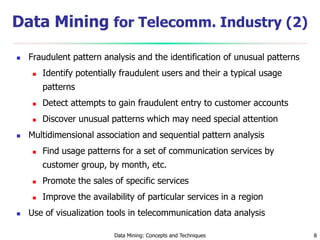
Data Mining for Telecomm. Industry (2)
 Fraudulent pattern analysis and the identification of unusual patterns
 Identify potentially fraudulent users and their a typical usage
patterns
 Detect attempts to gain fraudulent entry to customer accounts
 Discover unusual patterns which may need special attention
 Multidimensional association and sequential pattern analysis
 Find usage patterns for a set of communication services by
customer group, by month, etc.
 Promote the sales of specific services
 Improve the availability of particular services in a region
 Use of visualization tools in telecommunication data analysis
Data Mining: Concepts and Techniques 9
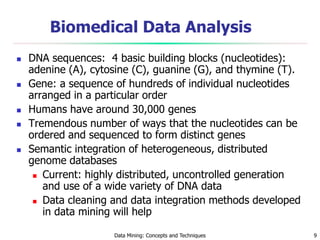
Biomedical Data Analysis
 DNA sequences: 4 basic building blocks (nucleotides):
adenine (A), cytosine (C), guanine (G), and thymine (T).
 Gene: a sequence of hundreds of individual nucleotides
arranged in a particular order
 Humans have around 30,000 genes
 Tremendous number of ways that the nucleotides can be
ordered and sequenced to form distinct genes
 Semantic integration of heterogeneous, distributed
genome databases
 Current: highly distributed, uncontrolled generation
and use of a wide variety of DNA data
 Data cleaning and data integration methods developed
in data mining will help
Data Mining: Concepts and Techniques 10
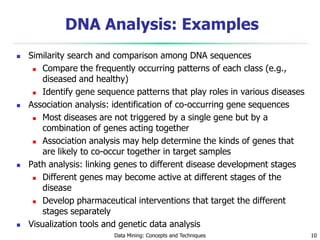
DNA Analysis: Examples
 Similarity search and comparison among DNA sequences
 Compare the frequently occurring patterns of each class (e.g.,
diseased and healthy)
 Identify gene sequence patterns that play roles in various diseases
 Association analysis: identification of co-occurring gene sequences
 Most diseases are not triggered by a single gene but by a
combination of genes acting together
 Association analysis may help determine the kinds of genes that
are likely to co-occur together in target samples
 Path analysis: linking genes to different disease development stages
 Different genes may become active at different stages of the
disease
 Develop pharmaceutical interventions that target the different
stages separately
 Visualization tools and genetic data analysis
Social impacts of data mining
Data Mining: Concepts and Techniques 11
Data Mining: Concepts and Techniques 12
Is Data Mining a Hype or Will It Be Persistent?
 Data mining is a technology
 Technological life cycle
 Innovators
 Early adopters
 Chasm
 Early majority
 Late majority
 Laggards
Data Mining: Concepts and Techniques 13
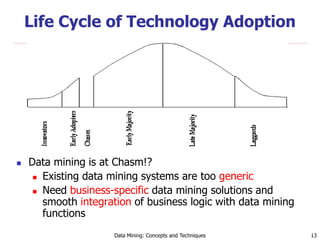
Life Cycle of Technology Adoption
 Data mining is at Chasm!?
 Existing data mining systems are too generic
 Need business-specific data mining solutions and
smooth integration of business logic with data mining
functions
Data Mining: Concepts and Techniques 14
Data Mining: Managers' Business or Everyone's?
 Data mining will surely be an important tool for managers’
decision making
 Bill Gates: “Business @ the speed of thought”
 The amount of the available data is increasing, and data
mining systems will be more affordable
 Multiple personal uses
 Mine your family's medical history to identify
genetically-related medical conditions
 Mine the records of the companies you deal with
 Mine data on stocks and company performance, etc.
 Invisible data mining
 Build data mining functions into many intelligent tools
Data Mining: Concepts and Techniques 15
Social Impacts: Threat to Privacy and Data
Security?
 Is data mining a threat to privacy and data security?
 “Big Brother”, “Big Banker”, and “Big Business” are
carefully watching you
 Profiling information is collected every time
 credit card, debit card, supermarket loyalty card, or
frequent flyer card, or apply for any of the above
 You surf the Web, rent a video, fill out a contest entry
form,
 You pay for prescription drugs, or present you medical
care number when visiting the doctor
 Collection of personal data may be beneficial for
companies and consumers, there is also potential for
misuse
 Medical Records, Employee Evaluations, etc.
Data Mining: Concepts and Techniques 16
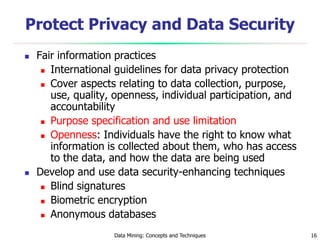
Protect Privacy and Data Security
 Fair information practices
 International guidelines for data privacy protection
 Cover aspects relating to data collection, purpose,
use, quality, openness, individual participation, and
accountability
 Purpose specification and use limitation
 Openness: Individuals have the right to know what
information is collected about them, who has access
to the data, and how the data are being used
 Develop and use data security-enhancing techniques
 Blind signatures
 Biometric encryption
 Anonymous databases
Data Mining: Concepts and Techniques 17
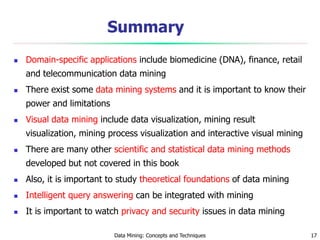
Summary
 Domain-specific applications include biomedicine (DNA), finance, retail
and telecommunication data mining
 There exist some data mining systems and it is important to know their
power and limitations
 Visual data mining include data visualization, mining result
visualization, mining process visualization and interactive visual mining
 There are many other scientific and statistical data mining methods
developed but not covered in this book
 Also, it is important to study theoretical foundations of data mining
 Intelligent query answering can be integrated with mining
 It is important to watch privacy and security issues in data mining

Data Mining Appliction chapter 5.pdf

  • 1.
    Data Mining: Conceptsand Techniques 1 Applications and Social Impact of Data Mining  Data mining applications  Social impacts of data mining  Summary
  • 2.
    Data Mining: Conceptsand Techniques 2 Data Mining Applications  Data mining is an interdisciplinary field with wide and diverse applications  There exist nontrivial gaps between data mining principles and domain-specific applications  Some application domains  Financial data analysis  Retail industry  Telecommunication industry  Biological data analysis
  • 3.
    Data Mining: Conceptsand Techniques 3 Data Mining for Financial Data Analysis  Financial data collected in banks and financial institutions are often relatively complete, reliable, and of high quality  Design and construction of data warehouses for multidimensional data analysis and data mining  View the debt and revenue changes by month, by region, by sector, and by other factors  Access statistical information such as max, min, total, average, trend, etc.  Loan payment prediction/consumer credit policy analysis  feature selection and attribute relevance ranking  Loan payment performance  Consumer credit rating
  • 4.
    Data Mining: Conceptsand Techniques 4 Financial Data Mining  Classification and clustering of customers for targeted marketing  multidimensional segmentation by nearest-neighbor, classification, decision trees, etc. to identify customer groups or associate a new customer to an appropriate customer group  Detection of money laundering and other financial crimes  integration of from multiple DBs (e.g., bank transactions, federal/state crime history DBs)  Tools: data visualization, linkage analysis, classification, clustering tools, outlier analysis, and sequential pattern analysis tools (find unusual access sequences)
  • 5.
    June 26, 2013Data Mining: Concepts and Techniques 5 Data Mining for Retail Industry  Retail industry: huge amounts of data on sales, customer shopping history, etc.  Applications of retail data mining  Identify customer buying behaviors  Discover customer shopping patterns and trends  Improve the quality of customer service  Achieve better customer retention and satisfaction  Enhance goods consumption ratios  Design more effective goods transportation and distribution policies
  • 6.
    Data Mining: Conceptsand Techniques 6 Data Mining in Retail Industry (2)  Ex. 1. Design and construction of data warehouses based on the benefits of data mining  Multidimensional analysis of sales, customers, products, time, and region  Ex. 2. Analysis of the effectiveness of sales campaigns  Ex. 3. Customer retention: Analysis of customer loyalty  Use customer loyalty card information to register sequences of purchases of particular customers  Use sequential pattern mining to investigate changes in customer consumption or loyalty  Suggest adjustments on the pricing and variety of goods  Ex. 4. Purchase recommendation and cross-reference of items
  • 7.
    Data Mining: Conceptsand Techniques 7 Data Mining for Telecomm. Industry (1)  A rapidly expanding and highly competitive industry and a great demand for data mining  Understand the business involved  Identify telecommunication patterns  Catch fraudulent activities  Make better use of resources  Improve the quality of service  Multidimensional analysis of telecommunication data  Intrinsically multidimensional: calling-time, duration, location of caller, location of callee, type of call, etc.
  • 8.
    Data Mining: Conceptsand Techniques 8 Data Mining for Telecomm. Industry (2)  Fraudulent pattern analysis and the identification of unusual patterns  Identify potentially fraudulent users and their a typical usage patterns  Detect attempts to gain fraudulent entry to customer accounts  Discover unusual patterns which may need special attention  Multidimensional association and sequential pattern analysis  Find usage patterns for a set of communication services by customer group, by month, etc.  Promote the sales of specific services  Improve the availability of particular services in a region  Use of visualization tools in telecommunication data analysis
  • 9.
    Data Mining: Conceptsand Techniques 9 Biomedical Data Analysis  DNA sequences: 4 basic building blocks (nucleotides): adenine (A), cytosine (C), guanine (G), and thymine (T).  Gene: a sequence of hundreds of individual nucleotides arranged in a particular order  Humans have around 30,000 genes  Tremendous number of ways that the nucleotides can be ordered and sequenced to form distinct genes  Semantic integration of heterogeneous, distributed genome databases  Current: highly distributed, uncontrolled generation and use of a wide variety of DNA data  Data cleaning and data integration methods developed in data mining will help
  • 10.
    Data Mining: Conceptsand Techniques 10 DNA Analysis: Examples  Similarity search and comparison among DNA sequences  Compare the frequently occurring patterns of each class (e.g., diseased and healthy)  Identify gene sequence patterns that play roles in various diseases  Association analysis: identification of co-occurring gene sequences  Most diseases are not triggered by a single gene but by a combination of genes acting together  Association analysis may help determine the kinds of genes that are likely to co-occur together in target samples  Path analysis: linking genes to different disease development stages  Different genes may become active at different stages of the disease  Develop pharmaceutical interventions that target the different stages separately  Visualization tools and genetic data analysis
  • 11.
    Social impacts ofdata mining Data Mining: Concepts and Techniques 11
  • 12.
    Data Mining: Conceptsand Techniques 12 Is Data Mining a Hype or Will It Be Persistent?  Data mining is a technology  Technological life cycle  Innovators  Early adopters  Chasm  Early majority  Late majority  Laggards
  • 13.
    Data Mining: Conceptsand Techniques 13 Life Cycle of Technology Adoption  Data mining is at Chasm!?  Existing data mining systems are too generic  Need business-specific data mining solutions and smooth integration of business logic with data mining functions
  • 14.
    Data Mining: Conceptsand Techniques 14 Data Mining: Managers' Business or Everyone's?  Data mining will surely be an important tool for managers’ decision making  Bill Gates: “Business @ the speed of thought”  The amount of the available data is increasing, and data mining systems will be more affordable  Multiple personal uses  Mine your family's medical history to identify genetically-related medical conditions  Mine the records of the companies you deal with  Mine data on stocks and company performance, etc.  Invisible data mining  Build data mining functions into many intelligent tools
  • 15.
    Data Mining: Conceptsand Techniques 15 Social Impacts: Threat to Privacy and Data Security?  Is data mining a threat to privacy and data security?  “Big Brother”, “Big Banker”, and “Big Business” are carefully watching you  Profiling information is collected every time  credit card, debit card, supermarket loyalty card, or frequent flyer card, or apply for any of the above  You surf the Web, rent a video, fill out a contest entry form,  You pay for prescription drugs, or present you medical care number when visiting the doctor  Collection of personal data may be beneficial for companies and consumers, there is also potential for misuse  Medical Records, Employee Evaluations, etc.
  • 16.
    Data Mining: Conceptsand Techniques 16 Protect Privacy and Data Security  Fair information practices  International guidelines for data privacy protection  Cover aspects relating to data collection, purpose, use, quality, openness, individual participation, and accountability  Purpose specification and use limitation  Openness: Individuals have the right to know what information is collected about them, who has access to the data, and how the data are being used  Develop and use data security-enhancing techniques  Blind signatures  Biometric encryption  Anonymous databases
  • 17.
    Data Mining: Conceptsand Techniques 17 Summary  Domain-specific applications include biomedicine (DNA), finance, retail and telecommunication data mining  There exist some data mining systems and it is important to know their power and limitations  Visual data mining include data visualization, mining result visualization, mining process visualization and interactive visual mining  There are many other scientific and statistical data mining methods developed but not covered in this book  Also, it is important to study theoretical foundations of data mining  Intelligent query answering can be integrated with mining  It is important to watch privacy and security issues in data mining