





D ATA
M A N A G E M E N T
I N Q U A L I TAT I V E
L E G A L
R E S E A R C H
P R E E T I K A N A S I K D E R
A S S I S TA N T P R O F E S S O R
D E PA R T M E N T O F L AW & J U S T I C E
J A H A N G I R N A G A R U N I V E R S I T Y
WHERE,
WHEN, WHO
AND WHAT?
SAMPLING
SAMPLING IN QUALITATIVE
RESEARCH
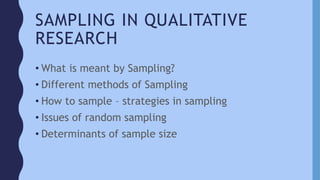
• What is meant by Sampling?
• Different methods of Sampling
• How to sample – strategies in sampling
• Issues of random sampling
• Determinants of sample size
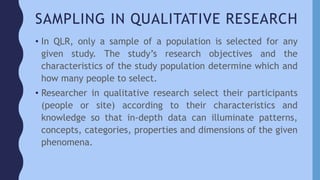
SAMPLING IN QUALITATIVE RESEARCH
• In QLR, only a sample of a population is selected for any
given study. The study’s research objectives and the
characteristics of the study population determine which and
how many people to select.
• Researcher in qualitative research select their participants
(people or site) according to their characteristics and
knowledge so that in-depth data can illuminate patterns,
concepts, categories, properties and dimensions of the given
phenomena.
U LT I M AT E G O A L
O F S A M P L I N G I N
Q U A L I TAT I V E
R E S E A R C H
To h a v e a v e r y r i c h
i n f o r m a t i o n t h r o u g h
‘ s u b j e c t i v e , i n t e r p r e t a t i v e
a n d c o n t e x t u a l ’ a n a l y s i s o f
t h e s a m p l e a n d d i s c o v e r ( n o t
m e a s u r e ) a l l f a c e t s o f a n
i s s u e
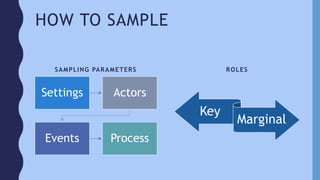
HOW TO SAMPLE
SAMPLING PARAMETERS
Settings Actors
Events Process
ROLES
Key
Marginal
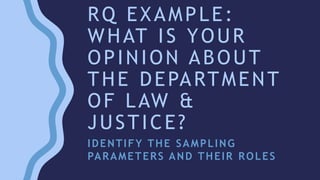
RQ EXAMPLE:
WHAT IS YOUR
OPINION ABOUT
THE DEPARTMENT
OF LAW &
JUSTICE?
IDENTIFY THE SAMPLING
PARAMETERS AND THEIR ROLES
HOW TO SAMPLE: AN EXAMPLE
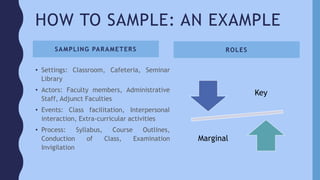
SAMPLING PARAMETERS
• Settings: Classroom, Cafeteria, Seminar
Library
• Actors: Faculty members, Administrative
Staff, Adjunct Faculties
• Events: Class facilitation, Interpersonal
interaction, Extra-curricular activities
• Process: Syllabus, Course Outlines,
Conduction of Class, Examination
Invigilation
ROLES
Key
Marginal
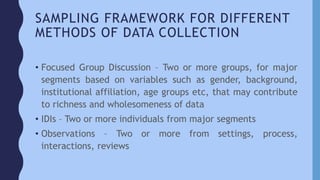
SAMPLING FRAMEWORK FOR DIFFERENT
METHODS OF DATA COLLECTION
• Focused Group Discussion – Two or more groups, for major
segments based on variables such as gender, background,
institutional affiliation, age groups etc, that may contribute
to richness and wholesomeness of data
• IDIs – Two or more individuals from major segments
• Observations – Two or more from settings, process,
interactions, reviews
SELECTION
OF SAMPLES
WHY AN UNIQUE APPROACH IS
NEEDED IN QUALITATIVE SAMPLING
• The purpose is to understand complex issues and not to
generalise; increase in number may not increase the
richness of data
• Issues to be addressed in qualitative research such as
perception, belief, values and attitude is not normally
distributed.
• Not every one is equal in information; some ones are richer
than others – a random sample may not generate enough
rich information
THE PURPOSEFUL SAMPLING: AN
UNIQUE FEATURE OF QLR
• According to Maxwell, purposeful sampling is a strategy in which particular
settings, persons, or events are deliberately selected for the important
information they can provide that cannot be gotten as well from other
choices.
• It is when the researcher chooses persons or sites which provide specific
knowledge about the topic of the study.
• It focuses on selecting information-rich cases whose study will illuminate the
questions under study
• Studying information-rich cases yields insights and in-depth understanding
rather than empirical generalisations.
IMPORTANT USES FOR PURPOSEFUL
SAMPLING: JOSEPH ALEX MAXWELL
1. It can be used to achieve representativeness or typicality of the settings, individuals,
or activities selected. A small sample that has been systematically selected for
typicality and relative homogeneity provides far more confidence that the conclusions
adequately represent the average members of the population than does a sample of
the same size that incorporates substantial random or accidental variation.
2. It can be used to capture adequately the heterogeneity in the population.
The goal here is to ensure that the conclusions adequately represent the entire range
of variation rather than only the typical members or some subset of this range.
3. A sample can be purposefully selected to allow for the examination of cases
that are critical for the theories that the study began with or that have subsequently
been developed.
4. Purposeful sampling can be used to establish particular comparisons to illuminate the
reasons for differences between settings or individuals, a common strategy in multi-
case qualitative studies.
THE VARIATIONS!
• Snowball Strategy
• Convenience Sampling
• Quota Strategy
• Judgmental or Purposive strategy
• Extreme or deviant case sampling
• Intensity Sampling
• Maximum Variation Sampling
• Homogenous Sampling
• Typical Case Sampling
• Critical Case Sampling
• Criterion Sampling
• Theory based Sampling
• Opportunistic Sampling
• Confirming and Disconfirming
Cases
• Combination or mixed
purposeful sampling
LET’S FIND OUT
WHICH OF THESE
WOULD BE
SUITABLE FOR
LEGAL RESEARCH
MAXIMAL VARIATION SAMPLING
• Researcher chooses cases or individuals that differ on some
characteristics or trait
• At first researcher identifies the characteristic and then find
individuals or sites which display different dimensions of
that characteristic
• Example: The highest achiever and the lowest achiever
students in a classroom
EXTREME CASE SAMPLING
• To study an outlier case with extreme characteristics
• To learn about a case that is particularly troublesome or enlightening,
or noticeable for its success or failure
• Researchers identify these cases by locating persons or organisations
that others have cited for achievements or distinguishing
characteristics
• Example: The poorest and the richest people in a community
CRITICAL SAMPLING
• To study an exceptional case that represents the central
phenomenon in dramatic terms
• The idea involved here is that, if the theory works at a
critical case/situation, it will work anywhere
• Example: Suppose the education ministry wants to test a
new evaluation system in schools. The concern here is about
the toughness of the evaluation system. Here the critical
sampling would be a lowest achieving school. If students of
that school find it alright, then they can proceed with it in
other schools too.
TYPICAL SAMPLING
• To study a person or a site that is ‘typical’ to those
unfamiliar with the situation.
• The researcher can select a typical sample by collecting
demographic data or survey data about all cases.
• Example: The middle class people in a community; an
average achieving student in a classroom
Note: A typical sampling needs to possess all the
characteristics that the researcher is investigating about.
THEORY OR CONCEPT SAMPLING
• To select individuals or sites because they can help researcher to
generate or discover a theory or specific concepts within the
theory
• In this strategy the researcher needs a clear understanding of the
concept or the larger theory expected to discover during the
study.
• Example: If a researcher wants to develop a theory about the
relationship between students’ academic achievement and their
economical background, then he might choose students with
different level of achievements (high, low and medium) and
investigate about their background and vice-versa
HOMOGENOUS SAMPLING
• To select certain sites or people because they
possess similar trait or characteristics
• In this strategy you need to identify the
characteristics and find individuals or sites that
possess it.
• Example: Only the high achieving or only the low
achieving students in the classroom
OPPORTUNISTIC SAMPLING
• It is undertaken after the data collection begins.
• When researcher finds that he needs to collect new information to
best answer the research questions.
• In this process, the sample emerges during the inquiry.
• Example: If the sample is university professors of Bangladesh. The
researcher suddenly and by opportunity comes across a foreign
university professor and he decides that the foreign professor’s
provided information can add new dimension to his study. The foreign
professor hereby would become an opportunistic sampling in the
study.
SNOWBALL SAMPLING
• When researcher does not know the best people to study because of
the unfamiliarity of the topic or the complexity of events
• It proceeds after a study begins
• Researcher asks participants to suggest other individuals to be
sampled during interview or through informal conversation.
• Example: Drug addicted youths or illegal immigrants generally would
not come out, but one of their own who is known to the researcher
can assure others and bring them to the researcher. The new comers
may bring others. The process can go on like a snowball.
CONFIRMING AND
DISCONFIRMING SAMPLING
• It is used after a study begins
• To sample individuals or sites to confirm or disconfirm preliminary
findings
• Researcher uses this strategy to follow up on specific cases to test or
explore further specific findings
• Example: Suppose a researcher has sampled and collected data from
the poorest of a community about their lifestyle. Now he wants to
collect data from some other people who are the poorest and the
richest in the community, who may confirm or disconfirm his
preliminary findings.
THE CASE OF
DETERMINING
SAMPLE SIZE
o W H AT Y O U WA N T TO F I N D O U T ?
o W H Y Y O U WA N T TO F I N D I T O U T ?
o H O W T H E F I N D I N G S W I L L B E U S E D ?
o W H AT R E S O U R C E S Y O U H AV E F O R
T H E S T U D Y ?
SAMPLE SIZE IN QUALITATIVE
RESEARCH
• It is necessary to reduce the chances of discovery failure
rather than to limit error in estimation.
• Researcher tends to increase sample size until:
– No new data regarding a concept or category emerges
– The concept or category is well developed in terms of dimensions
and variations that it its valid and meaningful with enough insights
SAMPLE SIZE IN QUALITATIVE
RESEARCH
• ‘Nature or Sensitivity’
– More sensitive more sample or more interviews with the same
subject
– More controversial more interviews with each or more subjects
• Quality of data
– Deeper insight or understandings more samples
– More quality data from one participant less would be sample size
SAMPLE SIZE IN QUALITATIVE
RESEARCH
• Observational and analytical ability, experience or knowledge of
researcher plays its role
– More the ability, experience or knowledge less the sample size
– Researcher shall be beware of distraction by preconceived ides or conception
from the important insights of participants
• Diversity of population or phenomenon
– More diversity more sample and more interviews
– All segments should be targeted to have contact with
– Two or more groups may be required per segment
SAMPLE SIZE IN QUALITATIVE
RESEARCH
• Simple research questions or very detailed studies – single
figure
• Complex research questions require large samples and
complex sampling techniques using ‘a framework of the
variables; that might influence an individual’s contribution’
and depends on
– Researcher’s knowledge of the research area
– Available literature
– Evidence from the study
SOURCES USED FOR THIS
LECTURE
• Md. Munir-ul Islam, Sampling in Qualitative Research: a ‘Cyclical’
and iterative process, 24th Basic Course on Qualitative Research
Methodology, icddr,b, January 2019
• Md. Alamgir Hossain, Sampling in Qualitative Research, Training
on Advanced Research Methodology, 2015, Institute of Education
& Research, University of Dhaka
• Joseph Alex Maxwell, Qualitative Research Design: An Interactive
Approach, 2012

Data Management in Legal Research: Qualitative Sampling

  • 1.
    D ATA M AN A G E M E N T I N Q U A L I TAT I V E L E G A L R E S E A R C H P R E E T I K A N A S I K D E R A S S I S TA N T P R O F E S S O R D E PA R T M E N T O F L AW & J U S T I C E J A H A N G I R N A G A R U N I V E R S I T Y
  • 2.
  • 3.
    SAMPLING IN QUALITATIVE RESEARCH •What is meant by Sampling? • Different methods of Sampling • How to sample – strategies in sampling • Issues of random sampling • Determinants of sample size
  • 4.
    SAMPLING IN QUALITATIVERESEARCH • In QLR, only a sample of a population is selected for any given study. The study’s research objectives and the characteristics of the study population determine which and how many people to select. • Researcher in qualitative research select their participants (people or site) according to their characteristics and knowledge so that in-depth data can illuminate patterns, concepts, categories, properties and dimensions of the given phenomena.
  • 5.
    U LT IM AT E G O A L O F S A M P L I N G I N Q U A L I TAT I V E R E S E A R C H To h a v e a v e r y r i c h i n f o r m a t i o n t h r o u g h ‘ s u b j e c t i v e , i n t e r p r e t a t i v e a n d c o n t e x t u a l ’ a n a l y s i s o f t h e s a m p l e a n d d i s c o v e r ( n o t m e a s u r e ) a l l f a c e t s o f a n i s s u e
  • 6.
    HOW TO SAMPLE SAMPLINGPARAMETERS Settings Actors Events Process ROLES Key Marginal
  • 7.
    RQ EXAMPLE: WHAT ISYOUR OPINION ABOUT THE DEPARTMENT OF LAW & JUSTICE? IDENTIFY THE SAMPLING PARAMETERS AND THEIR ROLES
  • 8.
    HOW TO SAMPLE:AN EXAMPLE SAMPLING PARAMETERS • Settings: Classroom, Cafeteria, Seminar Library • Actors: Faculty members, Administrative Staff, Adjunct Faculties • Events: Class facilitation, Interpersonal interaction, Extra-curricular activities • Process: Syllabus, Course Outlines, Conduction of Class, Examination Invigilation ROLES Key Marginal
  • 9.
    SAMPLING FRAMEWORK FORDIFFERENT METHODS OF DATA COLLECTION • Focused Group Discussion – Two or more groups, for major segments based on variables such as gender, background, institutional affiliation, age groups etc, that may contribute to richness and wholesomeness of data • IDIs – Two or more individuals from major segments • Observations – Two or more from settings, process, interactions, reviews
  • 10.
  • 11.
    WHY AN UNIQUEAPPROACH IS NEEDED IN QUALITATIVE SAMPLING • The purpose is to understand complex issues and not to generalise; increase in number may not increase the richness of data • Issues to be addressed in qualitative research such as perception, belief, values and attitude is not normally distributed. • Not every one is equal in information; some ones are richer than others – a random sample may not generate enough rich information
  • 12.
    THE PURPOSEFUL SAMPLING:AN UNIQUE FEATURE OF QLR • According to Maxwell, purposeful sampling is a strategy in which particular settings, persons, or events are deliberately selected for the important information they can provide that cannot be gotten as well from other choices. • It is when the researcher chooses persons or sites which provide specific knowledge about the topic of the study. • It focuses on selecting information-rich cases whose study will illuminate the questions under study • Studying information-rich cases yields insights and in-depth understanding rather than empirical generalisations.
  • 13.
    IMPORTANT USES FORPURPOSEFUL SAMPLING: JOSEPH ALEX MAXWELL 1. It can be used to achieve representativeness or typicality of the settings, individuals, or activities selected. A small sample that has been systematically selected for typicality and relative homogeneity provides far more confidence that the conclusions adequately represent the average members of the population than does a sample of the same size that incorporates substantial random or accidental variation. 2. It can be used to capture adequately the heterogeneity in the population. The goal here is to ensure that the conclusions adequately represent the entire range of variation rather than only the typical members or some subset of this range. 3. A sample can be purposefully selected to allow for the examination of cases that are critical for the theories that the study began with or that have subsequently been developed. 4. Purposeful sampling can be used to establish particular comparisons to illuminate the reasons for differences between settings or individuals, a common strategy in multi- case qualitative studies.
  • 14.
    THE VARIATIONS! • SnowballStrategy • Convenience Sampling • Quota Strategy • Judgmental or Purposive strategy • Extreme or deviant case sampling • Intensity Sampling • Maximum Variation Sampling • Homogenous Sampling • Typical Case Sampling • Critical Case Sampling • Criterion Sampling • Theory based Sampling • Opportunistic Sampling • Confirming and Disconfirming Cases • Combination or mixed purposeful sampling
  • 15.
    LET’S FIND OUT WHICHOF THESE WOULD BE SUITABLE FOR LEGAL RESEARCH
  • 16.
    MAXIMAL VARIATION SAMPLING •Researcher chooses cases or individuals that differ on some characteristics or trait • At first researcher identifies the characteristic and then find individuals or sites which display different dimensions of that characteristic • Example: The highest achiever and the lowest achiever students in a classroom
  • 17.
    EXTREME CASE SAMPLING •To study an outlier case with extreme characteristics • To learn about a case that is particularly troublesome or enlightening, or noticeable for its success or failure • Researchers identify these cases by locating persons or organisations that others have cited for achievements or distinguishing characteristics • Example: The poorest and the richest people in a community
  • 18.
    CRITICAL SAMPLING • Tostudy an exceptional case that represents the central phenomenon in dramatic terms • The idea involved here is that, if the theory works at a critical case/situation, it will work anywhere • Example: Suppose the education ministry wants to test a new evaluation system in schools. The concern here is about the toughness of the evaluation system. Here the critical sampling would be a lowest achieving school. If students of that school find it alright, then they can proceed with it in other schools too.
  • 19.
    TYPICAL SAMPLING • Tostudy a person or a site that is ‘typical’ to those unfamiliar with the situation. • The researcher can select a typical sample by collecting demographic data or survey data about all cases. • Example: The middle class people in a community; an average achieving student in a classroom Note: A typical sampling needs to possess all the characteristics that the researcher is investigating about.
  • 20.
    THEORY OR CONCEPTSAMPLING • To select individuals or sites because they can help researcher to generate or discover a theory or specific concepts within the theory • In this strategy the researcher needs a clear understanding of the concept or the larger theory expected to discover during the study. • Example: If a researcher wants to develop a theory about the relationship between students’ academic achievement and their economical background, then he might choose students with different level of achievements (high, low and medium) and investigate about their background and vice-versa
  • 21.
    HOMOGENOUS SAMPLING • Toselect certain sites or people because they possess similar trait or characteristics • In this strategy you need to identify the characteristics and find individuals or sites that possess it. • Example: Only the high achieving or only the low achieving students in the classroom
  • 22.
    OPPORTUNISTIC SAMPLING • Itis undertaken after the data collection begins. • When researcher finds that he needs to collect new information to best answer the research questions. • In this process, the sample emerges during the inquiry. • Example: If the sample is university professors of Bangladesh. The researcher suddenly and by opportunity comes across a foreign university professor and he decides that the foreign professor’s provided information can add new dimension to his study. The foreign professor hereby would become an opportunistic sampling in the study.
  • 23.
    SNOWBALL SAMPLING • Whenresearcher does not know the best people to study because of the unfamiliarity of the topic or the complexity of events • It proceeds after a study begins • Researcher asks participants to suggest other individuals to be sampled during interview or through informal conversation. • Example: Drug addicted youths or illegal immigrants generally would not come out, but one of their own who is known to the researcher can assure others and bring them to the researcher. The new comers may bring others. The process can go on like a snowball.
  • 24.
    CONFIRMING AND DISCONFIRMING SAMPLING •It is used after a study begins • To sample individuals or sites to confirm or disconfirm preliminary findings • Researcher uses this strategy to follow up on specific cases to test or explore further specific findings • Example: Suppose a researcher has sampled and collected data from the poorest of a community about their lifestyle. Now he wants to collect data from some other people who are the poorest and the richest in the community, who may confirm or disconfirm his preliminary findings.
  • 25.
    THE CASE OF DETERMINING SAMPLESIZE o W H AT Y O U WA N T TO F I N D O U T ? o W H Y Y O U WA N T TO F I N D I T O U T ? o H O W T H E F I N D I N G S W I L L B E U S E D ? o W H AT R E S O U R C E S Y O U H AV E F O R T H E S T U D Y ?
  • 26.
    SAMPLE SIZE INQUALITATIVE RESEARCH • It is necessary to reduce the chances of discovery failure rather than to limit error in estimation. • Researcher tends to increase sample size until: – No new data regarding a concept or category emerges – The concept or category is well developed in terms of dimensions and variations that it its valid and meaningful with enough insights
  • 27.
    SAMPLE SIZE INQUALITATIVE RESEARCH • ‘Nature or Sensitivity’ – More sensitive more sample or more interviews with the same subject – More controversial more interviews with each or more subjects • Quality of data – Deeper insight or understandings more samples – More quality data from one participant less would be sample size
  • 28.
    SAMPLE SIZE INQUALITATIVE RESEARCH • Observational and analytical ability, experience or knowledge of researcher plays its role – More the ability, experience or knowledge less the sample size – Researcher shall be beware of distraction by preconceived ides or conception from the important insights of participants • Diversity of population or phenomenon – More diversity more sample and more interviews – All segments should be targeted to have contact with – Two or more groups may be required per segment
  • 29.
    SAMPLE SIZE INQUALITATIVE RESEARCH • Simple research questions or very detailed studies – single figure • Complex research questions require large samples and complex sampling techniques using ‘a framework of the variables; that might influence an individual’s contribution’ and depends on – Researcher’s knowledge of the research area – Available literature – Evidence from the study
  • 30.
    SOURCES USED FORTHIS LECTURE • Md. Munir-ul Islam, Sampling in Qualitative Research: a ‘Cyclical’ and iterative process, 24th Basic Course on Qualitative Research Methodology, icddr,b, January 2019 • Md. Alamgir Hossain, Sampling in Qualitative Research, Training on Advanced Research Methodology, 2015, Institute of Education & Research, University of Dhaka • Joseph Alex Maxwell, Qualitative Research Design: An Interactive Approach, 2012